Current Situation and Issue of Industrial Accident Compensation
Insurance
Industrial Accident Compensation Insurance (IACI) has a history of about 50 yr, and is the oldest social insurance system in Korea. After more than 20 times of revision improvements in benefits, its contents and claim systems have been upgraded. It became the protector of injured workers and their families, and at the same time became the system which could cope with both financial burden of employers and their responsibilities. However, there are some issues to be reformed to upgrade the IACI: 1) the problems in the approval system of occupational diseases, 2) quality improvement of workers‘ compensation medical care, 3) vocational rehabilitation and return to work, 4) workers‘ compensation premiums and out-of-pocket money of injured workers, 5) issues in application of IACI. Growth of IACI cannot be achieved by an effort of an individual. Efforts by workers, owners, and government, in addition to physicians and welfare professionals toward the same goal are required for the next level improvement of IACI.
Key Words: Workers’ Compensation; Occupational Disease; Occupational Injury; Medical Care; Return to Work
Inah Kim1, Jeongbae Rhie2, Jo-Duk Yoon3,
Jinsoo Kim4, and Jonguk Won2
1Graduate School of Public Health, Yonsei University,
Seoul; 2College of Medicine and Institute for
Occupational Health, Yonsei University, Seoul;
3Korean Social Policy Institute, Seoul; 4School of
Social Welfare, Yonsei University, Seoul, Korea Received: 25 May 2011
Accepted: 7 November 2011 Address for Correspondence: Jonguk Won, MD
Department of Preventive Medicine & Public Health, College of Medicine Yonsei University, 50 Yonsei-ro, Seodaemoon-gu, Seoul 120-752, Korea
Tel: +82.2-2228-1872, Fax: +82.2-392-8622 E-mail: [email protected]
http://dx.doi.org/10.3346/jkms.2012.27.S.S47 • J Korean Med Sci 2012; 27: S47-54
INTRODUCTION
The historical origins of workers’ compensation insurance could be found first in Germany. Germany enacted the employers’ li-ability act in 1838. Employers should be responsible for their employee’s injuries or death regardless of their faults under the employers’ liability act. In 1884, Germany enacted a compulso-ry system of accident insurance, which is the first workers’ com-pensation act in the world (1). Workers’ comcom-pensation insur-ance was adapted in many countries for protection of workers from occupational injuries and it became the first social securi-ty system in most of the countries (2, 3).
The development of IACI
In case of Korea, in 1953 the Labor Standard Act (LSA) stated the employer’s duty to compensate for the employee’s injury and illness as an obligation. In 1963, by using the framework of social insurance on industrial injuries, Industrial Accident Compen-sation Insurance (IACI) Act was established (4).
IACI has a history of about 50 yr, and is the oldest social in-surance system among four other social inin-surance systems in Korea. However, compared to other European countries where industrialization happened earlier, Korean IACI has a rather short history. Though IACI Act had a lot of difficulties during the pro-cess of early establishment and its actual application, after more than 20 times of revision improvements in benefits, contents
and claim systems have been made. Therefore, it became the protector of injured workers and their families, and at the same time became the system which could cope with both financial burden of employers and their responsibilities.
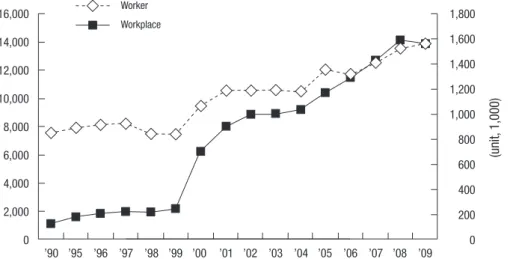
In 1964, when IACI was first established, it was only applied for workers working in the mining and manufacturing indus-tries of more than 500 fulltime workers. The compensations for the rest of the companies were carried out according to Labor Standard Act. From then, coverage of IACI continuously expand-ed and on July 1, 2000 it was appliexpand-ed to all companies where one or more workers are employed. As a result, 13,880,000 workers from 1,560,000 companies are now receiving benefits of IACI (Fig. 1) (5).
Coverage according to business types expanded from busi-nesses where LSA is applied, to all busibusi-nesses or companies in 1989, and from 2001, to public business conducted by central or local government. Moreover, in 2008, rules for independent contractors were established (6).
Expansion to cover all types of business scales and employ-ment status indicates qualitative improveemploy-ments. Realization of benefit level was achieved and aspects of social security were emphasized by pension type payment of disability benefits and funeral expenses. Currently, political efforts are being made to expand coverage of medical care benefits, to reduce the portion of uninsured benefits, and to accomplish workers return to work. However, due to insufficient administrative force there are still
many blind spots. There are also criticisms about IACI that it is executed according to the rule of causation, thus betraying the fundamental rule of social security (7). At the same time, nurs-ing benefit prices and medical care duration for industrial acci-dent victims were pointed out as other problems, since they are much higher and longer than that of other patient groups (8).
Contents of 2008 revised version of workers’ compensation insurance and its meanings
Workers’ compensation achieved significant improvements in contents, but still there are needs for quality improvements. Quality improvement is especially required to accomplish fair-ness in work related disease approval process, prolonged of du-ration of medical care, and absence of proper rehabilitation pro-grams. The blind spots of IACI such as independent contractors were pointed out as one of problems. In order to solve these var-ious problems, Committee of Workers’ Compensation Insurance Development was organized in Tripartite Commission in 2006. In July 1st 2008, a revised version of IACI Act by this committee was enacted (9). The 2008 revised version of IACI Act contains following subjects (10).
First, to clarify work related disease approval standards, spe-cifics were indicated in the enforcement ordinance of IACI act. At the same time Occupational Disease Award Commission consisted of various specialists from Regional Headquarters of Korean Workers’ Compensation and Welfare Service (COMWEL) was established to enhance fairness and professionalism, and was ordered to evaluate work related disease.
Second, rehabilitation benefit was defined as one of the med-ical care benefits, and specialized nursing service was provided through reasonable nursing standards. In addition, to prevent delays in claims, claims were made to be requested not only by workers but also by medical facilities. To prevent increased bur-den of workers medical fees before the approval, the National Health Insurance was made to be applied in advance.
Third, all tertiary hospitals were legally designated as an
insti-tute to apply IACI for the quality improvement in medical care. Individual treatment plan was made to be submitted for exten-sion of treatment periods.
Fourth, in case of insurance benefits, fluctuation of wages in-cluding the discrepancies between the scales of business and employment status was considered. For patients older than 60, variability of consumer price was considered. The maximum and minimum compensation amounts were set to 1.8 times and 1/2 of the average wage of the whole workers, respectively. Fifth, to motivate workers’ early return to work, partial tem-porary disability benefits were introduced. If returning to work is proven not to aggravate the disease condition, and if the re-turned workers’ working hours and tasks are limited to certain degree, these benefits could be rewarded fully.
Other than these, the level of temporary disability benefits and injury-disease compensation annuity for low-income workers, and workers aged ≥ 65 yr old were raised, and disability approv-al and classification system were approv-also rationapprov-alized. The whole prices of compensation were made to be given to foreign work-ers at once, in case they’re leaving Korea. IACI Eligibility Award Commission was established to enhance the specialty and fair-ness in processing the work related disease claims, and mem-bers recommended by workers’ union or employers’ organiza-tion among committee were increased to up to 2/5 of the num-ber limit.
IACI was applied to jobs formerly considered blind spots of the system, like insurance salesmen, drivers of a ready mixed concrete truck, study paper instructors, golf caddies, and to ac-cidents happening from self-supporting public work programs, which are conducted by recipients according to Nation Mini-mum Livelihood Security Law. In the concept of sharing of risks as part of a social security system, the maximum level of the pre-mium rate and annual variability of IACI was adjusted to the optimal level and the collection process of the insurance fees was rationalized.
Above amendments could be valued highly since they con- ’90con- ’95con- ’96con- ’97con- ’98con- ’99con- ’00con- ’01con- ’02con- ’03con- ’04con- ’05con- ’06con- ’07con- ’08con- ’09 16,000 14,000 12,000 10,000 8,000 6,000 4,000 2,000 0 1,800 1,600 1,400 1,200 1,000 800 600 400 200 0 Worker Workplace
Fig. 1. Number of insured workplaces and work-ers by year. (u ni t, 1, 00 0)
tain significant improvements in IACI system achieved by mu-tual agreements between labor, management and government. By these improvements, IACI now has a new foundation of a social agreement. Another characteristic of current improve-ment is that it concerns about disadvantaged class of workers and equity of paying benefits as a concept of the social security program (11).
This also can be valued highly, since IACI cannot be consid-ered separately from population structure, social economy, and labor market change. Despite changes of economic structure and improvements of technology, work-related accident rates in Korea are not decreasing as expected, but on the contrary new risk factors of accidents are emerging (12). In this aspect, labor union asserts that fundamental goal of improvement of 2008 revisions is to prevent further increase of benefits due to prolon-gation of individual treatment durations which will lead to finan-cial crisis in the insurance fund, thus decreasing function of the social security system (13). Criticism is especially concentrated about the Occupational Disease Award Commission because of improper involvements of non-specialists in the committee, insufficient judging time, and absence of processes of hearing from the victims directly (14).
As shown above, various opinions are being submitted ac-cording to one’s standpoints. To this day there had been a lot of positive changes in the Korean workers’ compensation system, and a lot of positive outcomes followed. However, there are still numerous long term and short term issues to be solved in order for workers’ compensation system can properly act as a social safety net in Korea. From now on, let’s go in to details about the current problems that Korean workers’ compensation system is facing.
CURRENT ISSUES
Issues in approval of occupational diseases
There are 38 occupational diseases in the Presidential Decree of Labor Standard Act and 23 of them have detailed diagnostic cri-teria in the Presidential Decree of IACI Act (15, 16). Diseases con-sidered with importance in Korea are pneumoconiosis, noise induced hearing loss, infectious disease and so on, which con-sists more than 90% of all occupatonal disease. As a result of work environment improvement and serial occupational ease prevention projects, occurrence rates of occupational dis-ease has been decrdis-eased for the past 5 yr (Table 1) (17), but since standards of work related disease approval process in cases of cerebro-cardiovascular and musculoskeletal disease has been changed in the 2008 revised version of IACI Act, we should view this phenomenon from a rather different view.
Before 2008, cerebro-cardiovascular disease (CVD) was con-sidered work related if fulfilled following conditions: 1) sudden change in work environment or obvious stress factor, 2) increased workload, 3) brain hemorrhage happened during work which has no obvious evidence that it is not work related (18). In the past, stress factors or relation to work were not considered with importance, and approval was given if the accident happened during work. This led to abnormally high approval rates of work related cerebro-cardiovascular disease. As a result, there is a significant discrepancy in approval rates between work related brain infarct, acute myocardial infarction (25%), and work related cerebro-cardiovascular disease (WR-CVD) (70%) (Table 2) (19). This significant discrepancy in approval rates between dis-eases connotes waste of workers’ compensation fund and prin-ciple of equity between workers since high disapproval rates were observed in workers with even worse conditions. In order Table 1. Occupational and work-related diseases by year Unit: number
Year Total Occupational Disease Work-related Disease
Subtotal Pneu NIHL Metal Sol Chem Other Subtotal CVD Back MSD Other
2005 7,495 2,524 1,994 302 10 19 44 155 4,971 1,834 975 1,926 236
2006 10,235 2,174 1,620 272 8 16 64 194 8,061 1,607 4,618 1,615 221
2007 11,472 2,098 1,422 237 6 25 153 255 9,374 1,493 6,333 1,390 158
2008 9,734 1,653 1,145 220 11 11 68 198 8,081 1,207 5,232 1,471 171
2009 8,721 1,746 1,003 205 3 7 61 467 6,975 639 4,879 1,343 114
Pneu, pneumoconiosis; NIHL, noise induced hearing loss; Sol, solvents; Chem, chemicals; CVD, cerebro-cardiovascular diseases; Back, low back pain; MSD, musculoskeletal diseases.
Table 2. Approval rate of WR-CVDs by year CVDs
2005 2006 2007
Claims Approved Approval rate (%) Claims Approved Approval rate (%) Claims Approved Approval rate (%)
MI 485 201 41.4 508 159 31.3 429 120 28.0
SH 340 241 70.9 458 311 67.9 428 288 67.3
CH 1,331 985 74.0 1,071 752 70.2 981 679 69.2
CI 1,047 302 28.8 1,003 161 16.1 921 176 19.1
Table 3. Approval rate of cerebro-cardiovascular disease and musculoskeletal disease by year (2007-2010) Disease
2007 2008 2009 2010
Claims Approved Approval rate (%) Claims Approved Approval rate (%) Claims Approved Approval rate (%) Claims Approved Approval rate (%)
CVD 3,236 1,302 40.2 3,103 998 32.2 2,909 454 15.6 2,780 401 14.4
MSD 3,485 1,928 55.3 3,885 2,235 57.5 5,853 3,143 53.7 6,163 2,942 47.7
Total 6,721 3,230 48.1 6,988 3,233 46.3 8,762 3,597 41.1 8,943 3,343 37.4
to solve this problem, in the 2008 revision of IACI, a clause stat-ing that all CVD was work-related if it happened durstat-ing work was removed. Also to clarify the stress factors and overwork, follow-ing changes have been added to the standard: 1) sudden stress factors or work environment change happened within 24 hr-periods before the accident, 2) > 30% increase of workload be-fore 1 week period of accident, 3) > 3 months prolonged period of overwork. Since there is no specification concerning about chronic overwork there was tendency to evaluate overwork too conservatively. This tendency became an issue because it led to continued decrease of approval rates of WR-CVD since 2000 which can be a sign of non-objectivity. As a result, after the 2008 revision, WR-CVD approval rate dropped to an unexpected lev-el, thus raising questions on the role of workers’ compensation as a social security system from the labor associations and sev-eral academic societies (Table 3) (20).
At the same time, in case of WR-MSD, previously approved degenerative disease was not included in the work related dis-ease list (18), but since most of the WR-MSD is due to chronic overwork which inevitably accompanies degenerative changes, many workers with WR-MSD took disadvantages. On the revised version of approval standards, this clause was deleted, thus even if there are degenerated lesions, WR-MSD could be actually ap-proved according to the actual workload, but just like the approv-al rate of the CVD, WR-MSD approvapprov-al rate approv-also showed contin-uous decrease even after the revision (Table 3) (20).
Major reasons of decrease of approval rates in WR-CVD or MSD are because the judgment process is based on the com-prehensive concept rather than specific standards, and system-atic problems including Occupational Disease Award Commis-sion (20). Currently, diverse efforts are being made to solve these systematic problems.
Quality of workers’ compensation medical care
General medical care and workers’ compensation medical care shares the aspect of medical care but, in the aspect of quality as-suring process there are various differences. The biggest differ-ence between these two is that the goal of workers’ compensa-tion medical care is injured workers’ return to work. Other than this, workers’ compensation medical care specifically concerns about the long term job retention, productivity, employer satis-faction, disability cost, and economic impact on the patients and the patients’ family (21). So far, studies concerning quality
of workers’ compensation medical care in Korea are quite rare but, recently many discussions concerning about length of med-ical care of occupationally injured patients and their return to work are being made.
Korea’s occupationally injured patients treatment periods are known to be longer than that of the other group of patients but this is debatable. First, the treatment periods of occupationally injured patients can be measured exactly by checking the WCI request data, but in case of health insurance patients, outpatient care duration cannot be measured precisely thus making the comparison between these two groups quite inadequate. Sec-ond, there is a difference in severity of injury between occutionally injured patients and other groups. Health insurance pa-tients tend to sustain simple injuries, in contrast occupationally injured patients tend to sustain multiple injuries, thus again making simple comparison between these two meaningless. However, occupationally injured patients’ treatment duration is longer due to their longer admission days.
Won et al. (8) reported that according to the number of hos-pitals patients visited during care, admission duration and out-patient care duration of simple lumbar sprain cases showed 3.7 times and 2.4 times difference, respectively (Table 4). These pa-tients also showed difference in admission and outpatient care period according to the types and characteristics of the medical facility. This is to say, patients who visited university hospital showed relatively short admission duration and longer outpa-tient care period, but primary clinic visitors showed longer ad-mission duration and shorter outpatient period (Table 4) (8). This phenomenon states that medical care period for occupa-tionally injured patients is not calculated properly.
Physical therapy is especially important and also frequently prescribed in occupationally injured patients, since WR-MSD is common among workers. In case of physical therapy for rotator cuff tears, thermotherapy and exercise therapy were prescribed in most of the patients but for lower grade facility patients, ten-Table 4. Length of care for lumbar sprain patients by types of hospital
Types of hospital Admission (days) Ambulation (days)
N mean ± S.D N mean ± S.D
University hospital 39 18.0 ± 15.9 93 76.3 ± 91.1 General hospital 855 28.0 ± 50.4 1,161 58.6 ± 61.4 Hospital 1,843 25.1 ± 25.9 2,678 62.3 ± 48.8 Clinic 2,729 34.0 ± 75.6 4,067 59.1 ± 47.3
dency of lower prescription rate of exercise therapy and higher prescription rate of electric therapy were shown (Table 5) (8). This is thought to be related to difference between medical facil-ities’ treatment options and various quality of occupational med-icine. Therefore, COMWEL should pay great attention on the quality control of occupational medicine centers.
Issue of return to work
Final goal of workers’ compensation is workers’ return to work (RTW). Korean workers with short employment duration, long admission period, female gender, old age, and who work in small size companies had more difficulties in coming back to work (22, 23). In RTW, social factors played a great role, but at the same time medical factors should not be overlooked.
In addition to medical reasons, injured workers who had lon-ger period of sick leave tend to show low rate of RTW due to ad-aptation to work. This is to say that, shortened sick leave might help with workers RTW. Thus, we should know that relatively long period of sick leave of Korean workers’ might have a bad influence on the injured workers’ actual return to work. Another important factor that affects workers’ RTW is the pres-ence of job rehabilitation service. Job rehabilitation service could be defined as a job-seeking service or a vocational training in a narrow perspective, but the true identity of job rehabilitation can be defined as a comprehensive course of treatment, rehabilita-tion, vocational therapy, job seeking and reemployment. Rate of RTW among Korean workers have increased from 40% in 2000 to 57.2% in 2009, and compared to the other developed countries, this is not a bad figure (Table 6). However, rate of RTW for disabled workers is still low, and rate of return to original work-place is also low. In addition to this, long term job retention rate is low compared to that of the other developed countries. The concepts of promotion of rehabilitation and return to so-ciety of workers were specified in the provision of the workers’
compensation insurance by the amendment in 2000. The 5-yr project (from 2001 to 2005) on rehabilitation was planned and implemented with the purpose of consolidation of the system regarding not only medical rehabilitation but also vocational and social rehabilitation, and return to work.
Though rehabilitation benefit is added to 2008 revision of WCI, medical rehabilitation and vocational rehabilitation are still be-ing considered separately. This is to say that vocational and med-ical rehabilitation is not ideally connected to each other since the vocational rehabilitation benefits can only be requested after the termination of medical care benefits. Therefore, attention of doctors should be paid not only on the medical care but also on the return to work of occupationally injured patients.
Case management is a collaborative process of whole RTW period to promote quality cost-effective outcomes in workers’ compensation medical care. It has been introduced to Korea several years ago as a name of ‘Visiting Service’ or ‘Individual-ized Service’. However, it was insufficient to achieve the goal be-cause of lack of qualified case managers and appropriate man-ual. In this context, COMWEL has trained case managers since 2010. These trained case managers will be able to do important role in workers’ compensation medical care or RTW.
Financial aspects of workers’ compensation
Workers’ compensation premium is calculated by multiplica-tion of the total sum of wages of a business and an insurance premium rate applied to other similar kinds of business. This is to say that the total sum of premium that owners should pay is decided by the total sum of wages in the company and the insur-ance premium rate according to the business types. Workers’ compensation premium rate is applied according to the 61 job classifications established in 2009 and 2010. The average premi-um rate applied for computing business in 2011 was 1.8%. Coal mining business showed the highest rate of 35.4%, and finance
Table 6. Annual return-to-work (RTW) rates of injured workers in Korea Unit: number (%) Year No. of injured workers Types of return-to-work Not returned Unable to survey
Total Previous worksite Another worksite Own business
2009 35,569 20,334 (57.2) 12,511 (35.2) 6,684 (18.8) 1,139 (3.2) 12,330 (34.7) 2,905 (8.2) 2008 37,178 19,950 (53.7) 12,962 (34.9) 6,031 (16.2) 957 (2.6) 13,905 (37.4) 3,323 (8.9) 2007 36,553 18,220 (49.8) 12,216 (33.4) 5,223 (14.3) 781 (2.1) 13,459 (36.8) 4,874 (13.3) 2006 38,872 17,681 (45.5) 11,794 (30.3) 5,472 (14.1) 415 (1.1) 15,095 (38.8) 6,096 (15.7) 2005 37,119 15,680 (42.2) 10,144 (27.3) 4,958 (13.4) 578 (1.6) 13,225 (35.6) 8,214 (22.1) Table 5. Claims of physical therapy by types of hospital Unit: number (%)
Type of care Types of hospital Total physical
therapy Thermotherapy TENS ICT Exercise therapy
Admission General hospital Hospital Clinic 8 9 14 6 (75.0) 6 (66.7) 13 (92.9) 2 (25.0) 3 (33.3) 7 (50.0) 2 (25.0) 3 (33.3) 8 (57.1) 7 (87.5) 6 (66.7) 9 (64.3) Ambulation General hospital
Hospital Clinic 14 23 35 13 (92.9) 22 (95.7) 35 (100.0) 8 (57.1) 11 (47.8) 23 (65.7) 4 (28.6) 13 (56.5) 20 (57.1) 13 (92.9) 17 (73.9) 26 (74.3)
insurance and public health & welfare business showed the low-est rate of 0.7%. The actual workers’ compensation premium is calculated based on the above premium rates except for the in-dividual risk rating for businesses of > 20 employees (24). It is not optimal to compare Korean system with the Ameri-can one since the US insurance premium rate varies according to the judging agencies; this is to say that the average premium rate in 2008 was 1.4% according to National Academy of Social Insurance (NASI) and 2.1% according to Bureau of Labor Statis-tics (BLS) (25). Due to the discrepancies between the two coun-tries simple comparison is quite difficult but average benefit rate of Korea in 2008 was 1.95%.
Total budget in 2008 was 7,894,200,000,000 won, consisted of 4,846,000,000,000 won of IACI and 3,421,800,000,000 won of insurance benefits. The benefits of IACI are consisted of 23.7% (812,200,000,000 won) of medical care benefits, and 23.2% (792,400,000,000 won) of temporary disability benefits to re-place salary. Permanent disability benefit consists 36.1% (1,706,000,000,000 won) of total benefits (9). Medical care ben-efits consisted more than half (50.4%) of total benefit, and wage replacement benefit only consisted of 17% of total benefit in America, though it is hard to compare America to Korea due to America’s expensive medical cost. Proportion of temporary dis-ability benefits was 31.5% in Korea, consisting of the large amount of cash benefit and this high proportion is probably due to long sick leave. Owners should pay medical bills for occupationally injured patients according to Labor Standard Act, but medical care benefits in IACI are rewarded according to National Health Insurance Act. National Health Insurance Act states that work-ers should pay for the proportions that are not covered by health insurances and this proportion is not covered by IACI either. According to Cho et al., this proportion consists > 26% of total medical expenditure (26). In a view of LSA and IACI, this pro-portion should be paid by the employers, but only 23.3% of the total cases were paid by the employers fully. Some parts of co-payment were generated due to unnecessary causes like higher grade room charges, but at the same time some parts were gen-erated due to high price examinations that were not originally covered by health insurance. Thus, by careful evaluation of cus-tomary co-payment, we should pay extra efforts to lessen work-ers’ actual financial burdens.
Problems in application of industrial accident compensation insurance
Korea’s IACI has the limitations in coverage. The first major branch of limitation is the range of eligible workers. This group of workers is those who are excluded from an eligibility list due to involvement in economic activity. Second major branch of limitations is the narrow range of benefits due to insufficient approval range.
Due to narrow spectrum of eligible population, most of the
self-employed workers and almost entire farmers are not includ-ed in IACI. Of the 3 million agricultural population only 42,445 people are covered by IACI in 2009, and among them 620 peo-ple (1.46%) sustained occupational injury. This proportion is higher than that of a manufacture industry or than that of total average (27). Accident rate between agricultural industry farm-ers does not always coincide with each other, but by crude as-sumption, there were approximately 45,000 injured people, which consists of 46.5% (total: 97,000) of total occupational in-juries. However, among them only 620 people got covered by IACI.
Workers’ compensation system for farmers is similar in many ways with other compensation systems, but at the same time different in several ways. Compensation for farmers is not based on the principle of liability of reparation, it is usually based on a family business, and there might be discrepancies in the disas-ter scale and the actual financial loss. Approval rate is related to the range of the disaster. Thus, contents and actual application of compensation for farmers should be studied from multi-an-gle view (28).
Since the 2008 revision independent contractors such as in-surance salesmen, drivers of a ready mixed concrete truck, study paper instructors, and golf caddies, who used to be excluded from IACI due to the policy for employment flexibility were in-cluded in the IACI, but only under 10% of workers were actually enrolled to this insurance (29).
In 1990, qualification to IACI for employers was expanded to companies of less than 50 workers, thus for the first time permit-ting enrollment of them to IACI. Unfortunately, this clause is not yet become an obligation, and its application range is not expanding either. The least advanced area of IACI is the area of the benefits, and the limitations can be found from the spectrum of approval and kind, form, and level of the benefits.
In other developed countries, when injured worker gets dis-approval from the worker’s compensation, national health in-surance covers the treatment fee, disability benefit, bereavement benefit, and actual loss of income from the public fund. How-ever, in case of Korea, workers paid the whole price before 1977 since the national health insurance system was adopted then, and before the adoption of the national pension system in 1988, workers did not get any disability benefits or bereavement ben-efits. Currently even under the presence of health insurance, the personal financial burden takes up 1/3 of the total expense related to the accident, and disability or bereavement benefits are far less than the minimum cost of living.
Approval of commuting accidents constantly raises questions to this day. IACI still doesn’t approve commuting accidents as occupational accidents. Only in the cases of commuting acci-dents happened in the vehicles that are provided by the owner and under their supervision are considered work related. But, in the jobs that different compensation system is applied such
as civil servants, public school teachers and soldiers, commut-ing accidents are considered work related (30, 31).
In Germany, accidents on the road are classified to simple commuting injury and occupational accident, and the latter is defined as a broad spectrum of accident during work related commute. Since 1946 in France, accidents happened during commute between workplace, residence, or dining places are considered as work-related commute injuries, and thus covered by workers’ compensation system. On the other hand, in UK, only the accidents that happened while using a transportation system directly run by the employers are considered work-re-lated commute injuries. In Japan, accidents happened between residence and workplace while using rational routes and meth-ods are considered work related, but due to the restriction in the definition of the “rational”, some accidents are not considered work related (32).
There are generally two perspectives of looking at the com-mute accidents. First one is that in the principle of law, comcom-mute accidents are not be considered work related since commuting process is not under the direct supervision nor control of the em-ployers and at the same time workers have the full control of the route or the method of the commute. The second perspective is that commuting itself is an essential part of job that acts of com-mute should also be considered as an extension of work (4). We need positive attitudes toward the approval of commut-ing accidents regardless of all these debates not only because it is a worldwide trend to consider commute accidents are work related, but also because commuting accidents are already be-ing considered work related in Korea in some of the jobs, and accidents happened in the vehicles that are provided by the owners are also considered work related.
CONCLUSION
Industrial Accident Compensation Insurance is the first social security system in Korea, and for about 50 yearsit made contin-uous improvements. It is the only social security system in Korea that the level of benefit exceeds the ILO standards, but there are still a lot of problems such as worker’s actual financial burdens or cessation of payment of survivor’s benefits (benefits for the family) in case of dead worker.
Most of all, though the patients’ medical care period applied to IACI is longer than that of the national healthcare insurance, their satisfaction or quality of treatment is not excellent. Although the final goal to treat injured workers is their return to work, in Korea, there are no programs designed specifically for this. For-tunately, Korea Workers’ Compensation and Welfare Service started a case manager training program. The goal of case man-agement should be set to increase of workers’ satisfaction, their return to work, and improvement of quality assurance of occu-pational medicine.
For the last, revitalization of prevention projects which are fundamentals of IACI is an urgent matter. Through series of pre-vention programs, not only the decreased incident of industrial accidents can be achieved but also the decreased workers’ ben-efit can be achieved, which will eventually lead to financial stabi-lization of the insurance fund and to improve the quality of care. Growth of IACI cannot be achieved by an effort of an individ-ual. Efforts by workers, employers, and government, in addition to physicians and welfare professionals toward the same goal are required for the next level improvement of IACI.
REFERENCES
1. Hood JB, Hardy BA, Lewis HS. Workers’ compensation and employee protection laws. 3rd ed. St. Paul, Minn: West Group, 1999, p 6-8. 2. Rimlinger GV. Welfare policy and industrialization in Europe, America
and Russia, translated by Academy of Critical Social Welfare. 2nd ed. Seoul: Hanul Academy, 2005, p 123-85.
3. Woo M. The importance of the introduction of the industrial accident insurance program in the development of the Korean welfare policies. Korean J Sociol 2007; 41: 154-85.
4. Oh SG. A study upon reconstructing the roles & functions of the IACI act as is effective in South Korea. J Labour Law 2006; 22: 305-61.
5. Industrial accident compensation insurance & employment insurance collection data & analysis. Seoul: Korea Workers’ Compensation & Wel-fare Service Labor Insurance Research Institute, 2009.
6. The Korean Society for Preventive Medicine. Industrial accident. In: Pre-ventive medicine and public health. Seoul: GyeChukMunWhaSa Pub-lishing Co., 2010, p 519-24.
7. Seok J. The causal principle of workers’ compensation insurance; prob-lem and prospect. Situation Welf 2003; 14: 147-75.
8. Won JU, Kim JS, Kim HR, Lim SH, Kim TR. Study on the healthcare sys-tem for injured workers by analyzing workers’ compensation claim data. Gwacheon: Ministry of Employment and Labor, 2010.
9. Ministry of Labor. Workers’ compensation insurance yearly business re-port. Gwacheon: Ministry of Labor, 2008.
10. Kim HB. The amendment ‘Act of Industrial Accident Compensation In-surance’: the contents and significance of the amendment of Industrial Accident Compensation Insurance. Labor Insur Forum 2008; 1: 2-15. 11. Oh SG. The amendment ‘Act of Industrial Accident Compensation
Insur-ance’: the appraisal and further development of the amendment ‘Act of Industrial Accident Compensation Insurance’: around Dec. 14. 2007 (Act No. 8694). Labor Insur Forum 2008; 1: 16-23.
12. Lee K. The legal issues on standards for recognition of industrial acci-dents: the scope of occupation and the standards for recognition of the mental overloads in Industrial Accident Compensation Insurance Act. J Labour Law 2010; 33: 227-58.
13. Kwon DH. The evaluation of amendment the Act of Industrial Accident Compensation Insurance. In: A debate about problem evaluation and improvement of industrial accident compensation insurance. Seoul: Korean Confederation of Trade Unions, 2009, p 5-26.
14. Kim Y. The problem of the board for illness judgment on a professional’s perspective. In: A debate about problem evaluation and improvement of industrial accident compensation insurance. Seoul: Korean
Confedera-tion of Trade Unions, 2009, p 36-44.
15. Enforcement Decree of the Labor Standard Act: Presidential Decree No. 22804 (2010.11.18). Available at: http://www.law.go.kr/lsSc.do?me nuId=0&p1=&subMenu=1&nwYn=1&query=22804&x=0&y=0 [accessed 23 Oct, 2011].
16. Enforcement Decree of the Industrial Accident Compensation Insur-ance Act: Presidential Decree No. 22637 (2010.11.24). Available at: http: //www.law.go.kr/lsSc.do?menuId=0&p1=&subMenu=1&nwYn=1&quer y=22804&x=0&y=0#AJAX [accessed 23 Oct 2011].
17. Kang SK, Kim EA. Occupational diseases in Korea. J Korean Med Sci 2010; 25: S4-12.
18. Enforcement Rule of the Industrial Accident Compensation Insurance Act: Ministry of Labor Rule No. 281 (2007.7.24). Available at: http:// www.law.go.kr/lsBylInfoR.do?bylSeq=899604&lsiSeq=87719#AJAX [ac-cessed 23 Oct, 2011].
19. Won JU, Kim SK, Lim HJ, Kim HR. Study on the criteria of overwork of work-related cerebro-cardiovascular diseases. Gwacheon: Ministry of Labor, 2008.
20. Won JU. Discussion about current problems and future direction of work-related disease adjudication system. In: Proceeding of open forum for the reforming workers’ compensation insurance. Seoul: Federation of Korean Trade Union and Korean Confederation of Trade Union, 2011. 21. Himmelstein JS, Pransky G. Measuring and improving the quality of
workers’ compensation medical care. John Burton’s Workers’ Compen-sation Monitor, 1995, p 4-9.
22. Jeong WM, Park CY, Koo JW, Roh YM. Predictors of return to work in occupational injured workers. Korean J Occup Environ Med 2003; 15: 119-31.
23. Kang HT, Im HJ, Kim YK, Ju YS, Lee HP, Kim JM, Kwon YJ. Predictors of return to work and job retention after work-related injury or illness.
Korean J Occup Environ Med 2006; 18: 221-31.
24. Korea Workers’ Compensation & Welfare Service Labor Insurance Re-search Institute. Industrial accident compensation insurance & employ-ment insurance collection data & analysis. Seoul: Korea Workers’ Com-pensation & Welfare Service, 2010.
25. Sengupta I, Reno V, Burton JF. Workers’ compensation: benefits, cover-age, and costs 2008. Washington DC: National Academy of Social Insur-ance, 2010.
26. Cho YS, Won JU, Yoon JD. Analysis on the out-of-pocket money of a uni-versity inpatients compensated by workers’ compensation insurance. Korean Soc Secur Stud 2009; 25: 93-120.
27. Ministry of Employment and Labor. Statics of Occupational Injuries and Diseases 2009. Gwacheon: Ministry of Labor and Employment, 2010, p 26-31.
28. Kim JS, Jeon HJ, Byun YW. A scheme of compensation system for farm-ers’ accidents in Korea. Korean Soc Secur Stud 2010; 26: 209-31. 29. Cho SH. The yearly decrease to enroll for IACI among independent
con-tractor such as insurance salesman. Financial News; 15 October 2010. Available at http://www.fnnews.com/view?ra=Sent1201m_View&corp= fnnews&arcid=00000922108012&cDateYear=2010&cDateMonth=10&c DateDay=05 [accessed 20 May 2011].
30. Public officials pension act: Presidential Decree No. 10435 (2011. 3. 8). Available at: http://www.law.go.kr/lsSc.do?menuId=0&p1=&subMenu= 1&nwYn=1&query=10435&x=0&y=0 [accessed 23 Oct 2011].
31. Private school teachers and staff pension act: Presidential Decree No. 10636 (2011. 5. 19). Available at: http://www.law.go.kr/lsSc.do?menuId =0&p1=&subMenu=1&nwYn=1&query=10435&x=0&y=0 [accessed 23 Oct 2011].
32. Park CY, Lee IJ, Choi KC, Jeong YT. Study on the compensation of com-muting injuries in several countries. Seoul: Korea Labor Institute, 2004.