Corresponding author: Sanghee Kim
College of Nursing, Yonsei University, 50-1 Yonsei-ro, Seodaemun-gu, Seoul 03722, Korea. Tel: +82-2-2228-3388, Fax: +82-2-2227-8303, E-mail: [email protected]
Received: Mar 17, 2021 / Revised: Apr 9, 2021 / Accepted: Apr 12, 2021
This is an open access article distributed under the terms of the Creative Commons Attribution Non-Commercial License (http://creativecommons.org/licenses/ by-nc/3.0), which permits unrestricted non-commercial use, distribution, and reproduction in any medium, provided the original work is properly cited.
청소년의 성 건강정보 추구행동: 질적연구를 중심으로 한
통합적 문헌고찰
김 수 경
1· 김 상 희
2연세대학교 간호대학 박사후 연구원1, 연세대학교 간호대학 ․ 김모임간호학연구소 부교수2
Integrative Review of Sexual Health Information Seeking Behaviors
among Adolescents: Based on Qualitative Research
Sookyung Kim
1· Sanghee Kim
21Postdoctoral Researcher, College of Nursing, Yonsei University
2Associate Professor, College of Nursing ․ Mo-Im Kim Nursing Research Institute, Yonsei University
ABSTRACT
Purpose: With the development of media, the ways adolescents can obtain information related to sexual health
have diversified. Prior quantitative research on adolescents’ sexual health information seeking behaviors (HISB)
has limitations in grasping the details, and sexual issues of adolescents have tended to be underreported in
quantitative studies. It is necessary to explore sexual HISB through an integrative review of qualitative research.
The aim of the study was to analyze the literature on sexual HISB among adolescents, focusing on qualitative
research. Methods: An integrative review was undertaken to explore the studies conducted between 2009 and
2018 that addressed sexual HISB such as source preferences, perceived trustworthiness, and tendency
according to age and gender among adolescents. Results: Seven studies met the selection criteria and were
analyzed according different sexual HISB. It was identified that adolescents preferred trustworthy sources and
had a pattern of reviewing and comparing the content among diverse sources to confirm the quality of the
information. Female adolescents valued privacy and confidentiality, while male adolescents would like to earn
information along with their peers and perceived it as an opportunity to exchange their experiences and thoughts.
Late adolescents preferred to seek sexual health information from peers and on the internet such as websites
and social platforms compared to early adolescents. Conclusion: This study is significant in that it provides
evidence that can be applied when developing programs for promoting sexual health in adolescents. It is
suggested that programs should focus on building trustworthiness and consider differences in age and gender
to improve the use of sexual health information among adolescents.
서
론
1. 연구의 필요성
청소년기는 흡연, 음주, 성 관계와 같은 위험 행동이 시작될 수 있는 건강에 취약성이 높은 시기이다[1]. 청소년의 건강행 동과 관련된 발달적 특성에는 자율성, 인지적 과정, 사회적 영 향력이 포함되며[2], 청소년의 건강행동에 대한 의사결정은 사회적, 정서적, 자기통제 요인에 의해 영향을 받는 것으로 보 고된다[3]. 성인과 달리 청소년은 건강을 위한 의사결정에 필 요한 정보를 수집하는 과정 중이며, 과거의 제한된 경험으로 인하여 인터넷, 소셜 미디어, 친구 및 가족과 같은 외부 정보에 더 많이 의존하는 경향이 있으므로 청소년의 건강정보 추구행 동이 중요하다[4]. 건강정보 추구행동은“건강에 대한 정보를 찾을 목적으로 개인이 수행하는 적극적이고 의도적인 행동”으로 정의된다 [5]. Lambert와 Loiselle [6]는 건강정보 추구행동을 건강을 위협하는 상황에서의 대처(coping with a health-threatening situation), 건강관리 의사결정의 참여(participation and in-volvement in medical decision making), 행동변화와 예방 행위(behavior change and preventive behavior)의 맥락에 서 수행된다고 하였다. 개념적 측면에서, 건강정보 추구행동 은 (1) 정보 영역(information dimension)과 (2) 방법 영역 (method dimension)으로 구분되고, 정보 영역은 정보추구의 유형과 양으로 구성되며, 방법 영역은 정보를 얻기 위해 수행 하는 특정 행동 및 개인이 사용하는 출처로 구성된다[6]. 대부 분의 사람들은 자신, 친구, 가족과 같은 개인(personal) 및 책, 인터넷과 같은 비인격(impersonal) 출처에서 건강정보를 찾 는 것으로 나타나는데[6], 심리사회적 정보를 찾을 때 친구 또 는 같은 문제를 겪고 있는 사람을 선호하고[7], 민감한 정보를 찾을 때는 인터넷과 같은 출처를 선호하는 경향이 있다고 보고 된다[8]. 또한, 선호하는 정보 출처의 선호도에 출처의 신뢰성 이 주요인으로 강조되었다[8]. 연구 측면에서 건강정보 추구 행동 개념은 청소년의 교정치료에 대한 건강정보 획득[9], 도 시에 거주하는 다문화 청소년의 건강정보에 대한 요구도 및 정 보를 얻는 방법을 탐색하는 연구[4]에 적용된 바 있다. 한편, 국외 청소년을 대상으로 수행된 연구에서 흡연, 음주, 고위험 성 행동, 약물남용, 신체활동과 같은 건강 행동에 관한 정보를 얻는 출처로 인터넷이 1위, 소셜 미디어가 2위로 밟혀 졌고, 학교 및 교사에 의해 정보를 얻는 것은 12위 중 9위에 머 물렀다고 보고되었으며[10], 국내 청소년도 건강 정보를 얻는 출처 1위는 인터넷, 2위는 소셜 미디어로 나타났다[11]. Gray 와 동료들의 연구에서[8] 청소년은 인터넷에서 성 건강 주제에 대하여 정보를 찾는 것에 흥미가 높다고 언급되었으며, 한국 청소년을 대상으로 수행된 연구에서 하루에 인터넷을 3시간 이상 사용한 청소년은 3시간 미만 사용한 청소년에 비해 높은 수준으로 성에 대하여 개방적이고 허용적인 태도를 갖는 것으 로 밝혀졌다[12]. 더불어, 2019년 한국의 청소년건강행태조사 에 의하면[13], 성관계를 경험하는 청소년 비율은 지속적으로 증가하여 2019년도 5.9%를 나타냈고, 중학생의 경우 2.9%가 성관계 경험이 있었으며, 고등학생의 경우 청소년건강행태조 사 이래 가장 높은 8.6%를 차지하였다[13]. 선행연구에서 청소 년기 이른 성 경험을 한 청소년은 성인기에 성 매개 감염의 발 생률이 높다고 밝혀졌다[14]. 위와 같이 온라인에서 정보를 얻 는 청소년의 행동이 많아진 시대적 흐름과 성 경험이 조사 이 래 가장 높은 수준으로 나타난 점은 청소년의 성 건강정보 추 구행동에 대한 탐색을 통해 청소년의 성 건강증진을 위한 학교 보건학적 연구가 필요함을 의미한다. 청소년의 성 건강정보 추구행동을 조사한 선행 양적연구에 서는[10,15] 세부적인 내용을 파악하는데 한계가 있고, 청소년 의 성 건강 관련 이슈는 양적연구에서 과소 보고되는 점을[16] 고려하여, 청소년이 성 건강정보를 추구하는 행동의 경험과 맥락을 통한 내용의 종합을 위해서 질적연구를 중심으로 통합 적 문헌고찰을 수행하는 것이 필요하다. 따라서, 본 연구는 청 소년의 성 건강정보 추구행동에 대한 주제를 질적연구방법으 로 연구한 문헌들의 통합적 문헌고찰을 통해 청소년의 성 관련 건강정보 추구양상을 이해하고 이에 따른 건강 서비스 제공을 위한 연구의 기초자료를 마련하고자 한다.2. 연구목적
본 연구는 국내외 청소년을 대상으로 성 건강과 관련된 건강 정보 추구행동을 탐색한 질적연구를 분석 및 평가함으로써 추후 청소년의 성 건강 증진을 위한 중재 개발을 모색하기 위함이다. 구체적인 연구목적은 다음과 같다. 청소년의 성 건강정보 추구행동과 관련된 질적연구의 특 성 파악한다. 청소년의 성 건강 관련 정보 출처의 선호도를 파악한다. 청소년의 성 건강 관련 정보 추구행동의 신뢰도 및 소셜 미디어 양상을 파악한다. 청소년의 성 건강정보 추구행동의 나이 및 성별 간의 차이 를 파악한다.Figure 1. Flow chart of study selection.
연 구 방 법
1. 연구설계
본 연구는 청소년의 성 건강정보 추구행동을 탐색하기 위해 질적연구로 수행된 문헌을 통합적 문헌고찰 방법으로 분석한 문헌분석 연구이다.2. 연구절차
본 연구는 Whittemore and Knafl [17]가 제시한 통합적 문
헌고찰 과정에 따라, 문제규정(Problem Identification), 문헌 검색(Literature Search), 자료평가(Data Evaluation), 자료 분석(Data Analysis), 자료제시(Data Presentation)의 5단계 로 수행하였다. 1) 문제규정(Problem Identification) 청소년의 성 건강정보 추구행동과 관련된 주제를 통한 통합 적 문헌고찰을 위해 본 연구에서 제기하는 4가지 문제는 다음 과 같다. 청소년의 성 건강정보 추구행동과 관련된 연구의 특성(자 료수집방법, 다중자료원의 유무, 분석방법, 저자의 연구 분야, 프로그램 보조 활용 유무)은 어떠한가? 청소년의 성 건강정보 추구행동의 선호도는 어떠한가? 청소년의 성 건강정보 추구행동의 신뢰도 및 소셜 미디어 양상은 어떠한가? 청소년의 성 건강정보 추구행동의 나이 및 성별 간의 차이 는 어떠한가? 2) 문헌검색 및 선정(Literature Search) 청소년의 성 건강정보 추구행동과 관련된 논문은 국외 검색 엔진 PubMed, 국내 검색 엔진 한국학술정보(KISS), 대한의학 학술지편집인협의회정보(KoreaMed), 한국교육학술정보원 (RISS)에서 시행하였으며, 검색어는 (1) ‘청소년(adolescent)’, (2) ‘성 건강(sexual health)’, (3) ‘건강정보 추구행동(health information seeking behavior)’, ‘정보 추구(information seeking)’, ‘정보 획득 행동(information seeking behavior)’ 을 조합하여 검색하였다. 본 연구의 문헌검색범위는 2009년 3 월에서 2018년도 3월에 출판된 것으로 설정하였다. 분석할 문 헌의 선정기준은 (1) 청소년의 성 건강정보 추구행동과 관련된 논문 (2) 성 건강 정보의 내용보다 정보 추구 행동에 중점을 둔 내용이 포함된 논문 (3)질적연구방법의 논문 (4) peer review 된 논문 (5) 한국어와 영어로 게재된 논문이다. 배제 기준은 (1) 청소년의 성 건강정보 추구행동이 아닌 성 건강 정보의 내용에 초점을 둔 논문 (2) 실험연구, 유사실험연구, 조사연구, 사례연 구, 종설, 학위논문, 심포지엄, 학술대회자료집에 개재된 논문 (3) 원문이 확인되지 않는 논문으로 선정하였다. 이를 통해 초 기 검색결과에서는 PubMed 2,533편, RISS 544편, KISS 145 편, KoreaMed 28편으로 총 3,250편이 검색되었다. 그 후, 논 문 제목과 초록에서 정보 추구(information seeking) 단어가 포함된 문헌을 선택하였고, 59편의 문헌 중 중복된 4편을 제외 한 후 55편의 각 문헌의 제목과 초록을 읽으며 본 연구의 선정 기준에 부합하지 않는 문헌 35편을 제거하였다. 20편의 각 원문 을 상세히 읽으며 본 연구의 주제에 부합하는지 확인하여 최종 7편의 논문을 선정하였고, 문헌검색 및 선정과정은 체계적 문 헌고찰과 메타분석의 보고 형식(Preferred Reporting Items for Systematic Reviews and Meta-Analyses; PRISMA)으로 Figure 1에 제시하였다.
3) 자료평가(Data Evaluation)
본 연구에서 선정된 문헌의 질 평가는 Critical Appraisal Skills Programme (CASP) Qualitative Studies Checklist (https://casp-uk.net/wp-content/uploads/2018/01/CA SP-Qualitative-Checklist-2018.pdf)를 사용하여 두 연구자
Table 1. Characteristics of Studies
Characteristics Categories n (%)
Data collection In-depth interviews Focus groups
Posts on the Facebook Community mapping Photovoice 4 (57.1) 4 (57.1) 1 (14.3) 1 (14.3) 1 (14.3) Multiple data Yes
No
2 (28.6) 5 (71.4) Data analysis Thematic analysis
Content analysis Others
2 (28.6) 1 (14.3) 4 (57.1) Author's field Medicine or public health
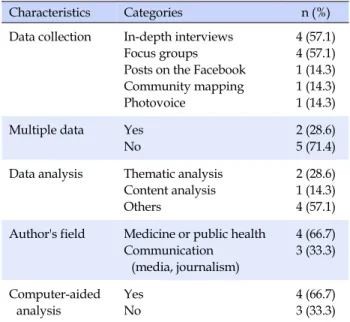
Communication (media, journalism) 4 (66.7) 3 (33.3) Computer-aided analysis Yes No 4 (66.7) 3 (33.3) 가 독립적으로 질 평가를 수행하였다. 평가는 총 10 항목으로 구성되며, 연구의 목적, 연구방법, 연구목적에 따른 연구설계, 참여자 모집 전략, 자료수집방법, 연구자와 참여자 관계의 적 절성, 윤리적 고려, 분석의 엄격성, 결과 진술의 명확성에 대한 9개 항목을 예(Yes), 언급할 수 없음(Can’t tell), 아니오(No)로 평가하였고, 마지막 항목은 연구의 가치에 대한 주관식 평가 를 각 문헌별로 수행하였다. 두 연구자가 평가한 결과를 대조 하였을 때, 7편의 문헌 모두 각 항목에 대해 아니오(No)로 평 가된 것이 없어 제외된 문헌은 없었다. 4) 자료분석(Data Analysis) 최종 선정된 논문의 원문을 반복적으로 읽으며 ‘성 건강 관 련 정보 추구 행동의 선호 출처, 신뢰도, 소셜 미디어에서의 양 상, 나이 또는 성별 간의 차이’가 도출된 원문의 결과에 표시하 였고, 자료를 축소하기 위해 표시한 결과 중 의미 있는 부분을 추출하여 표로 정리하며 분석하였다. 5) 자료제시(Data Presentation)
Whittemore와 Knafl [17]는 연구 문제에 대하여 문헌(data) 이 통합된 결론으로 요약하여 제시되는 것이 중요하다고 강조 하였다. 따라서 연구의 특성은 Table 1로 제시하였고, 청소년 의 성 건강 관련 정보 추구 행동의 선호도, 신뢰도 및 소셜 미디 어 양상, 나이 및 성별 간의 차이를 Table 2, 3, 4로 결과를 제시 하였다.
연 구 결 과
1. 청소년의 성 건강정보 추구행동에 대한 논문의 특성
본 연구에서 최종 선정된 7편은 모두 국외 논문이었으며, 논 문의 특성은 Table 1과 같다. 자료수집방법은 심층 면담 4편[18- 20,22], 포커스 그룹 4편[19-21,23], 커뮤니티 매핑 1편[20], 포토 보이스 1편[20], 소셜 미디어 게시물 1편[24]이었고, 다중 자료 원을 활용한 연구가 2편[19,20], 한가지 자료원을 사용한 연구 가 5편[18,21-24]이었다. 분석방법은 주제분석 2편[19,22], 내용 분석 1편[24], 기타 4편[18,20,21,23]이었으며 기타에는 지속적 비교 분석[20], 상황 담론 분석[23]이 포함되었고, 2편의 논문에 서는 분석과정을 기술하였다. 저자의 연구분야는 의학 및 보건 4편[19-22], 커뮤니케이션, 미디어 및 저널리즘 분야 3편[18, 23,24]이었다. 분석에 컴퓨터 프로그램의 도움을 받은 논문 4편 [18,20,22,24], 받지 않은 논문 3편[19,21,23]으로 확인되었다.2. 청소년의 성 건강 관련 정보 출처의
선호도(Prefer-ences of sources)
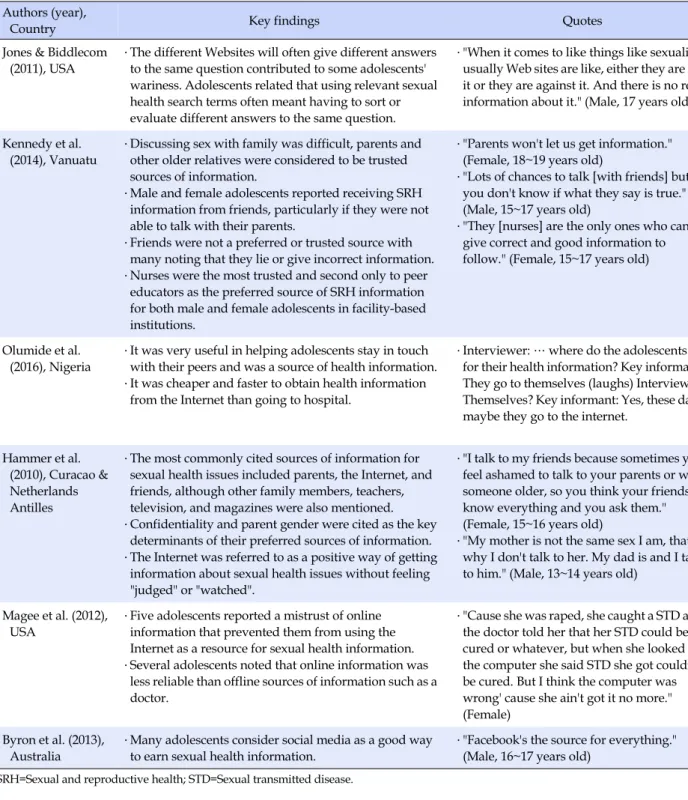
본 연구에서 도출된 청소년이 선호하는 성 건강 관련 정보 출처에 대한 문헌은 총 6편이었고 주요 결과는 Table 2와 같 다. 성 건강 정보 출처는 부모, 가족, 친척, 친구, 인터넷, 간호 사, 의사, 교사, TV, 잡지, 영화 등 다양하게 나타났다. 청소년 들은 가족 및 친척 특히, 부모를 신뢰하는 출처로 인식하였으 나[18,19], 부모들은 성과 관련된 정보를 자녀들이 받아들이기 에 너무 어리다고 생각하거나 성관계를 하도록 부추긴다고 인 식하는 경향이 있었다. 청소년들이 성과 관련된 이유로 병원 에 간 것에 대해 부모가 알게 될 것을 두려워하여 병원에 정보 를 얻으러 가기를 꺼려함이 확인되었다[19]. 청소년들은 부모 와 이야기를 나눌 수 없을 때, 친구들에게서 얻는 성 건강 정보 가 거짓이거나 또는 잘못된 점이 있을 수 있다고 인식을 하면 서도 친구들로부터 정보를 얻게 되는 양상을 확인할 수 있었다 [19]. 또한, 또래 친구들로부터 성 건강 정보를 얻는 것은 친구 들과의 관계 유지에 도움이 된다고 여기는 것이 확인되었다 [20]. 청소년들은 병원에 가는 것보다 인터넷으로 정보를 얻는 것이 빠르고 비용이 들지 않으며[20], 성 건강 정보를 찾는 것 에 대하여 누군가로부터 좋지 않은 평가를 받지 않을 수 있다 는 것을 장점이라고 인식하였다[21]. 그러한 장점에도 불구하 고, 많은 청소년들은 온라인 상의 정보는 믿을 수 없는 정보가 많다고 인식하였고[18,22], Jones와 Biddlecom [18]의 연구 에 참여한 청소년은 인터넷 상의 정보는 누구나 만들 수 있으Table 2. Summary of Studies about the Preferences of Sources Authors (year),
Country Key findings Quotes
Jones & Biddlecom (2011), USA
․The different Websites will often give different answers to the same question contributed to some adolescents' wariness. Adolescents related that using relevant sexual health search terms often meant having to sort or evaluate different answers to the same question.
․"When it comes to like things like sexuality, usually Web sites are like, either they are for it or they are against it. And there is no real information about it." (Male, 17 years old) Kennedy et al.
(2014), Vanuatu
․Discussing sex with family was difficult, parents and other older relatives were considered to be trusted sources of information.
․Male and female adolescents reported receiving SRH information from friends, particularly if they were not able to talk with their parents.
․Friends were not a preferred or trusted source with many noting that they lie or give incorrect information. ․Nurses were the most trusted and second only to peer
educators as the preferred source of SRH information for both male and female adolescents in facility-based institutions.
․"Parents won't let us get information." (Female, 18~19 years old)
․"Lots of chances to talk [with friends] but you don't know if what they say is true." (Male, 15~17 years old)
․"They [nurses] are the only ones who can give correct and good information to follow." (Female, 15~17 years old)
Olumide et al. (2016), Nigeria
․It was very useful in helping adolescents stay in touch with their peers and was a source of health information. ․It was cheaper and faster to obtain health information
from the Internet than going to hospital.
․Interviewer: … where do the adolescents go for their health information? Key informant: They go to themselves (laughs) Interviewer: Themselves? Key informant: Yes, these days maybe they go to the internet.
Hammer et al. (2010), Curacao & Netherlands Antilles
․The most commonly cited sources of information for sexual health issues included parents, the Internet, and friends, although other family members, teachers, television, and magazines were also mentioned. ․Confidentiality and parent gender were cited as the key
determinants of their preferred sources of information. ․The Internet was referred to as a positive way of getting
information about sexual health issues without feeling "judged" or "watched".
․"I talk to my friends because sometimes you feel ashamed to talk to your parents or with someone older, so you think your friends know everything and you ask them." (Female, 15~16 years old)
․"My mother is not the same sex I am, that is why I don't talk to her. My dad is and I talk to him." (Male, 13~14 years old)
Magee et al. (2012), USA
․Five adolescents reported a mistrust of online information that prevented them from using the Internet as a resource for sexual health information. ․Several adolescents noted that online information was
less reliable than offline sources of information such as a doctor.
․"Cause she was raped, she caught a STD and the doctor told her that her STD could be cured or whatever, but when she looked on the computer she said STD she got couldn't be cured. But I think the computer was wrong' cause she ain't got it no more." (Female)
Byron et al. (2013), Australia
․Many adolescents consider social media as a good way to earn sexual health information.
․"Facebook's the source for everything." (Male, 16~17 years old)
SRH=Sexual and reproductive health; STD=Sexual transmitted disease. 므로 성 건강정보 추구행동을 할 때 의심하지 않을 수 없다고 언급하며, 찾은 정보 중에서 관련 없는 것을 골라 내야 하고, 같 은 질문에 다른 대답을 한 정보를 평가해야 하고, 성을 팔기 위 한 목적인 시장에서 만들어진 건강 정보에 청소년들은 회의적 으로 인식하고 있음이 확인되었다. 일부 청소년이 휴대폰을 이 용하여 성 건강 정보 추구를 선호한 점은 휴대폰으로 간호사 및 친구를 통해 정보를 얻고자 하는 수단적 도구로서의 역할이라 고 언급하였다[19]. 대표적인 소셜 미디어인 페이스북이 건강 정보원으로 사용되며 청소년의 건강 추구 행동에 미치는 영향 에 대한 논문이 2편으로 확인되었다[23,24]. Hammer 등[21]의 연구에서 청소년들이 일반적으로 성 건 강 정보를 얻는 출처는 ‘부모, 인터넷, 친구’였고, Kennedy 등
Table 3. Summary of Studies about the Trustworthy Sources & Tendency in Social Media Authors (year),
Country Key findings Quotes
Jones & Biddlecom (2011), USA
․Adolescents were more likely to trust (in order) family members (parents), school, medical professionals, and friends for sexual health information.
․Trust depended on whether the website was a reputable or known source. News websites and those associated with general health or medical sources were considered trustworthy.
․Eight adolescents talked about purposefully using the Internet to cross-check or validate information from other sources, including friends, school, magazines, and other websites.
․"It depends on the Web site. Wikipedia would be like 60%. But like on [Web]MD, I would be like 90% because those are like information from doctors and stuff, yeah." (Male, 17 years old)
․I can't say that I've got too much information from them [his friends], but depending on what it was, I might like look it up on the Internet and see if I can trust them about it or not. (Male, 17 years old) Byron et al. (2013),
Australia
․Most adolescents used Facebook daily as a media hub that allowed them to engage with friends, social events, news, entertainment and more.
․"Yeah. With health information, I think it's better if it's anonymous because I don't think everyone's really comfortable about talking about that kind of stuff with random [people]... It's something they want to keep to themselves." (Female) Yeo & Chu (2017),
China
․According to advice seeking purposes, about 60% of the posts involved some form of support seeking. The most common advice-seeking mode was request for opinion or information (51.12%), The other support-seeking posts comprised request for advice (23.02%), problem disclosure (16.78%), and situation comparison (9.08%).
․According to advice types, 70% of the comments to advice seeking posts were classified as supportive; direct advice (30.1%) and indirect advice (2.8%) appeared more frequently than hedged advice (4.0%).
․(Example of the request for opinion) "My boyfriend refuses to have sex with me, what should I do?" (Anonymous) ․(Example of the directive advice) "See a
doctor! If it's just scratches, you won't bleed for three days!" (Anonymous)
Magee et al. (2012), USA
․Subset of young people appeared motivated by an urgent sense that they needed to know the information because of feared relevance in online.
․"The first time I had sex after that time period, when I was in my auntie's house, it was unprotected again. I was just making mistakes, so I was just like, whoa, I need to, like I never felt any symptoms of an STD, I never saw anything, but then I know there are some that you don't see symptoms of. And so then I looked online to see what those symptoms were." (Male)
STD=Sexual transmitted disease.
[19]의 연구에서는 성 건강 관련 정보를 의료시설 기반에서는 간호사로부터 받을 때 가장 신뢰할 수 있어 높은 선호도를 보였 으며, 두 번째로 선호하는 출처는 또래 교육자(peer educator) 로 나타났으며, 학교 기반에서는 학교 간호사가 청소년에게 필 요한 성 건강 정보를 줄 수 있는 중요한 자원인데 보건부가 아 닌 교육부 소속이라 관련 연수에 제약이 있어 충실한 출처로서 의 역할에 어려움이 있음이 확인되었다[19]. 위의 내용을 종합 하였을 때, 연구마다 선호하는 출처에 대하여 차이가 있었지 만, 공통적으로‘믿을만한 정보원’을 청소년들은 선호하는 것 으로 분석되었다[18,19,21,22].
3. 청소년의 성 건강 관련 정보 추구 행동의 신뢰도, 소셜
미디어 양상(Trustworthy sources & Tendency in
social media)
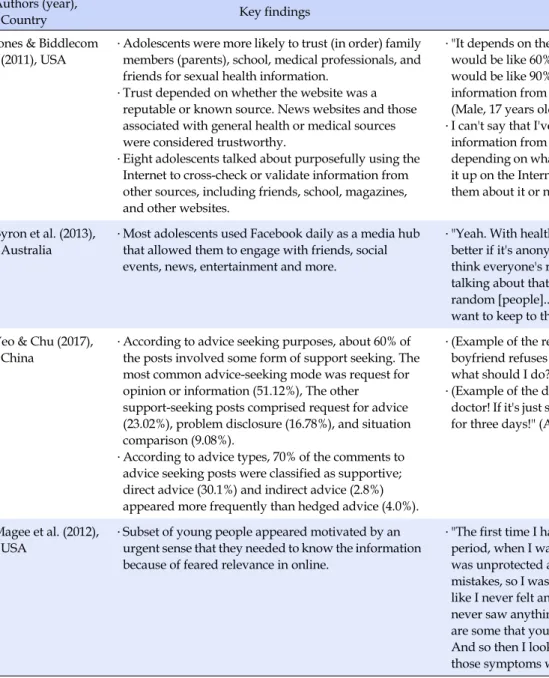
청소년이 신뢰하는 성 건강 정보의 출처 및 사용하는 소셜 미 디어 양상에 대한 문헌은 총 4편이었고, 주요 결과는 Table 3과 같다. Jones와 Biddlecom [18]의 연구에 따르면 청소년은 온 라인에서 정보를 능동적으로 추구하든지, 강제적으로 노출되 든지 여부에 관계없이 온라인에서 얻는 정보의 신뢰성에 대해 우려하는 것으로 확인되었다. 청소년들은 웹사이트의 명성과Table 4. Summary of Studies about the Differences in Age and Gender Authors (year),
Country Key findings Quotes
Kennedy et al. (2014), Vanuatu
․Female adolescents more so than male adolescents preferred one-on-one peer education to be private and confidential.
․Male adolescents preferred peer-led group workshops to hear the same information and provided opportunities to exchange ideas and experience.
․"Because one-on-one you feel free to ask questions."
․ (Female, 18~19 years old)
․"Group workshops are good because many people are ashamed to go to the clinic. It's easy to share ideas and information." (Male, 15~17 years old)
Hammer et al. (2010), Curacao & Netherlands Antilles
․While younger adolescents (13~14 years old) preferred their parents as their source of information, older adolescents (15~18 years old) stated that they felt more comfortable asking friends or looking for information on the Internet.
․Female adolescents stated that they felt more comfortable talking to their mothers, whereas male adolescents preferred talking to their fathers.
․"I talk to my friends because sometimes you feel ashamed to talk to your parents or with someone older, so you think your friends know everything and you ask them." (Female, 15~16 years old)
Byron et al. (2013), Australia
․Younger adolescents indicated that content linked to sexual practice and sexual health was unlikely to be shared among their peers on Facebook, due to the stigma attached to sexual practice.
․There was less concern about search histories among older adolescents, who were more likely to have their own personal computers.
․"I think it's something I'd rather either, yeah, talk about in person or with a friend". (Male, 18~22 years old) 알고 있었던 출처를 통해 믿을 만한 온라인 웹사이트로 인지하 였고, 새로운 웹사이트일 경우 건강 또는 의학에서 온 출처(예. WebMD)를 믿을 만한 것으로 여기는 것으로 확인되었다. 몇 몇 청소년들은 인터넷에서 얻은 정보를 여러 번 검토하거나, 정보를 평가하기 위해 친구, 학교, 잡지 및 다른 사이트와 비교 하는 양상을 보였다. 소셜 미디어는 단순히 정보를 얻기 위한 수단이나 도구가 아니라, 사람 간의 관계 형성과 배움의 기반이 다져지고 조 정되는 토대로서[23], 연구자가 만든 페이스북 “성 비밀(sex secrets)”에 청소년들이 ‘포스팅한 게시물의 목적 및 원하는 조언의 유형’과 ‘게시물의 코멘트 및 조언 유형’을 분석한 연구 의 양상은 다음과 같다[24]. 게시물의 60.0%가 도움을 요청하 는 정보 추구(support seeking) 양상이 가장 많았고, 23.2%는 개인이 처한 상황을 공유하는 스토리텔링이었다. 정보 추구 양상은 절반 이상의 청소년이 ‘의견 또는 정보를 요청(request for opinion or information)’하는 경우가 가장 많았고, 그 다 음으로는 ‘조언 요청(request advice)’, ‘문제 공개(problem disclosure)’, ‘상황 비교(situation comparison)’ 순으로 나타 났다. 조언을 요청하는(advice seeking) 게시물 코멘트의 특 성은 약 70.0%가 지지적이었고, 직접적인 조언을 해주는 경우 가 30.1%, 간접적인 조언 22.8%, 애매한 조언 4.0% 순으로 나 타났다. 명확하게 조언을 요청하는 게시물일 경우에 의견이나 정보를 직접적으로 코멘트하는 경향을 보였으며, 그렇지 않을 때에는 간접적인 조언을 하거나 추가적인 질문을 하는 경향이 확인되었다[24]. 성소수자 청소년이 온라인에서 성 건강 관련 정보를 찾는 행동의 동기는 그들이 미래에 필요한 정보로써 알 아야 한다고 압박을 느꼈거나, 불편감 증상이나 징후가 실제 로 나타났을 때라는 것으로 확인되었다[22].
4. 청소년의 성 건강정보 추구행동의 나이 및 성별 간의 차이
(Differences in age and gender)
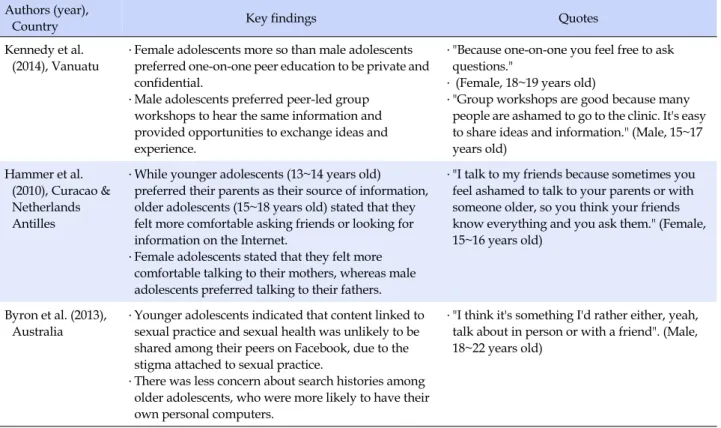
나이와 성별에 따라 청소년의 성 건강정보 추구행동의 차이 를 다룬 문헌은 총 3편이었고, 주요 결과는 Table 4와 같다. 청 소년들이 또래 친구로부터 받는 정보를 선호하는 면에서 성별 에 따라 차이를 보였는데[19], 여학생들은 정보보호(privacy) 와 비밀유지(confidentiality)를 위해 또래 친구로부터 일대일 교육을 받는 것을 선호하였고, 남학생들은 같은 정보를 함께 듣기를 원했으며 본인의 경험과 생각들을 주고받을 수 있는 기 회로 인식하는 점이 다른 것으로 확인되었다. 여학생들은 같 은 성별인 어머니와 성에 대해 이야기하는 것을 편하게 여겼 고, 남학생들은 아버지와 성에 대해 이야기 나누는 것을 선호
하였다. 청소년들이 성과 관련된 정보를 얻는 출처 선호의 핵 심 요인은 비밀유지(confidentiality)와 부모의 성별이라고 언 급하였다. 초기 청소년(13~14세)과 후기 청소년(15~18세)은 건강정 보 추구행동에 차이를 보였는데, 초기 청소년은 그들의 부모 로부터 성과 관련된 정보를 얻기를 원한 반면, 후기 청소년들 은 친구에게 묻거나 인터넷에서 찾는 것에 편안함을 느끼는 것 으로 확인되었다[21]. 나이가 더 많은 청소년들은 ‘경험이 더 많은 친구’ 또는 ‘같은 상황에 있거나 그 정보에 대해 알 것 같 은 친구’와 성에 대해 의논하기를 선호하는 것으로 확인되었 다. 소셜 미디어 중 하나인 페이스북에서 정보를 주고받는 경 향도 연령에 따라 차이가 있었는데, 초기 청소년들은 성 행위 (sexual practice) 및 성 건강과 관련된 내용을 페이스북에 친 구들과 공유하는 것이 성 행위에 대한 낙인을 조장할 수 있으 므로 원하지 않는 것으로 확인되었다. 특히, 초기 청소년은 페 이스북 뉴스피드에 성 건강과 관련된 정보를 공개적으로 올리 는 것에 부정적인 반면, 상대적으로 나이가 많은 후기 청소년 은 대부분 개인 컴퓨터를 소유하고 있어서 검색 기록이 남는 것에 덜 걱정하는 등의 이유로 성 건강 정보를 주고받는 정보 원으로 페이스북 활용하는 것에 보다 긍정적인 것으로 나타났 다[23]. 정보가 보호되는 환경에서 초기 청소년들끼리 성 건강 과 관련된 정보를 찾고 공유할 수 있는 온라인 정보원의 필요 성이 언급되었다[23].
논
의
본 연구에서는 청소년의 성 건강정보 추구행동에 대해 질적 연구를 수행한 문헌들을 Whittemore와 Knafl [17]의 통합적 문헌고찰 방법을 적용하여, 논문의 특성, 청소년의 성 건강 관 련 정보 추구 행동의 선호도, 신뢰도 및 소셜 미디어 양상, 나이 및 성별 간의 차이를 총 7편의 문헌으로 분석하였다. 논의를 통 해 향후 청소년의 성 건강을 위한 교육 및 중재 개발에 근거가 될 방향을 모색하고자 한다. 본 연구에서 분석된 4편의 문헌은 의학 및 보건 분야에서 출 판되었고, 3편은 커뮤니케이션 및 미디어 분야였다. 의학 및 보건분야는 청소년 성 건강의 정보 추구에 내용적인 면에 중점 을 두어 연구하고 분석하는 경향이었다면, 커뮤니케이션 및 미디어 분야는 정보를 추구하는 이유, 동기 등을 나타내는 양 상에 중점을 둔 것으로 확인할 수 있었다. 선정된 7편의 논문의 출판 년도는 2010년부터 2017년까지 고루 분포하고 있으며, 자료수집은 출판 년도보다 1~3년 정도 앞선 것을 고려할 때, 최근 몇 년간의 사회적 정보화의 급속 팽창을 반영하지 못했을 수 있다는 제한점을 염두하고 논의할 필요가 있다. 최종 분석된 논문을 건강정보 추구행동의 4가지 속성의 관 점에서 살펴볼 때, 건강정보 추구행동의 네 가지 속성인 접근 (access), 이해(understand), 해석(interpret), 활용(use or deci-sion-making) 중[25], 분석된 문헌에서 주로 다루어진 속성은 접근(access)에 해당하는 출처(sources) 및 신뢰도(trustwor-thiness) 등에 중점을 두고 있는 반면, 적절한 정보인지 이해하 고 해석하는 연구 및 얻게 된 성 건강 정보를 적절하게 활용하 거나 의사결정에 활용하는지에 대하여 연구한 문헌은 불충분 한 것으로 확인되었다. Donaldson 등[26]의 선행연구에 의하면 청소년은 성 건강 정보를 부모로부터 받는 경향 높다고 밝혀졌는데, 본 연구결 과에서 가장 신뢰받는 정보원으로 부모를 포함한 또래집단 및 인터넷으로 도출되었다. 본 연구에서 청소년은 건강정보 추구 행동에서 믿을 만한 정보원으로 부모, 교사라고 인식하고 있 었으나, 부모에게 이야기할 때 부모가 청소년은 아직 몰라도 되는 것이라는 인식하거나 성 관련 문제 행동을 일으킬 것이라 고 추측하는 부모들의 부정적인 태도가 다른 정보원을 찾게 만 든다고 확인된 것은 성소수자 청소년들이 성 건강 정보를 부모 로부터 가장 적게 얻고, 인터넷이 주 정보원이라고 여긴다는 체계적 문헌고찰의 연구결과[27]와 유사하다. 친구들로부터 얻는 정보에 거짓이나 틀린 내용의 가능성을 인식하고 있는 것 으로 도출된 결과는 친구와 성에 대한 의사소통을 많이 하는 청소년이 온라인 상에서 성 건강정보 추구행동이 높은 것으로 밝혀진 Nikkelen 등[28]의 연구와 비슷한 맥락으로 청소년들 이 받아들이는 정보의 분별을 할 수 있도록 교육 또는 중재가 제공되어야 함을 시사한다. 청소년은 부모, 친구, 인터넷 중 성 건강과 관련된 정보 출처 의 선호도가 일원화된 것이 아니라, 궁극적으로 높은 수준의 신뢰도가 있는 정보원을 추구하는 것으로 나타났으므로 청소 년을 위한 성 건강 정보를 제공하는 중재 프로그램을 개발할 때, 믿을 만한 정보원이라고 청소년이 인식하도록 내용을 구성 하고 전략을 세우는 것이 중요하다. 남태평양에 위치한 바누 아트에서 수행된 Kennedy 등[19]의 연구에서 청소년들이 성 건강 관련 정보를 학교 기반에서 학교 간호사가 그 역할을 수 행 하는데 제약이 있다고 도출된 결과는 한국에서는 성 관련 정보를 얻는 대상으로 보건교사가 가장 높게 나온 Ahn 등[29] 의 연구결과와 다른 것으로 확인된 점은 문화에 따라 차이가 있음을 시사한다. 소셜 미디어의 메시지 또는 영상과 같이 성 정보에 노출이많이 된 청소년일수록 콘돔 사용과 같은 성 관련 건강행동을 많이 한다고 보고되는 선행 결과는[30] 청소년의 성 행동이 높 아지는 상황에서 현실적으로 건강행동을 실천하도록 도와주 는 방법을 개발하고 제공하는 것이 중요하다는 사실을 시사한 다. 앞으로 온라인 정보의 영향력이 더욱 커지는 환경에서 본 인이 찾은 정보가 원하는 정보이고, 신뢰할 만한 정보인지 해 석하고 취할 수 있는 능력을 청소년들에게 교육을 통해 길러주 는 것이 요구되는 바이다. 국내에서 청소년의 디지털 및 미디 어 리터러시 교육의 중요성에 대한 인식이 증진되고 있다. 1인 미디어가 확산되고, 휴대폰 사용 연령이 낮아지며, 일상생활 을 미디어와 함께하는 청소년들이 미디어가 생산하는 정보를 종합적으로 이해하고 자신의 생각을 미디어를 통해 바람직하 게 소통할 수 있도록 교육부가 미디어 리터러시 교육을 강조하 고 있으며[31], 2022 교육과정에 미디어 리터러시 역량이 포함 되어야 한다고 제언하고 있으므로[32], 청소년이 성 건강에 대 한 정보 중, 신뢰하는 출처에서 정보를 얻기를 원하는 것으로 도출된 본 연구결과는 성 건강에 대한 출처와 정보를 분별하는 청소년의 능력이 학교 보건교육을 통해 제공되어야 함을 지지 하는 근거로서 시사점이 있다. 본 연구에서 남녀 청소년이 원하는 방식은 달랐지만 친구로 부터 성 건강 정보를 얻는 편이었으며, 위와 같은 성별의 부모 에게 성과 관련된 의논을 하기를 선호하는 것으로 도출되었는 데, 2018년 청소년 통계에 의하면[33], 같은 맥락에서 남녀 청 소년 모두 약 49.1%가 친구에게 고민을 상담하는 비율이 높았 고, 남자 청소년은 여자 청소년에 비해 아버지 및 스스로 해결 하는 비율이 높은 것으로 보고되었다. 또한 연령이 높을수록 고민에 대한 의논을 부모님과 하거나 친구 또는 스스로 해결하 는 비율이 높은 것은[33] 친구 또는 스스로 해결하기 위해 얻는 성 건강 정보를 올바르게 판단하고 활용하는 것이 중요하다는 앞서 언급한 미디어 리터러시 교육의 요구도가 높음을 의미한 다. 대학생 대상의 건강 관련 정보 추구행동에 대한 선행연구 에서 성에 대한 정보를 공유하기 위하여 다수의 학생들은 디지 털 기술을 활용하는 것을 확인할 수 있었고, 성 건강 정보에 대 하여 여학생들은 의사 및 성인 여성과 의논하기 어려워하여 온 라인에서 정보를 추구하는 경향이 많은 것으로 밝혀진 결과는 [34] 본 연구에서 후기 여자 청소년들의 건강정보 추구행동의 양상과 유사한 것으로 확인되었다. 국내 학령기 아동에게 제 공된 성교육에 대한 통합적 문헌고찰의 결과에 의하면, 성과 관련된 지식 및 태도를 다룬 성교육 연구는 많은 것으로 나타 났으나, 성에 대한 인식 및 가치에 대한 내용은 불충분한 것으 로 밝혀졌는데[35], 학교에서는 청소년들이 올바른 성에 대한 인식과 가치를 바탕으로 바람직한 정보를 습득하고 건강하게 활용할 수 있도록 교육이 필요함을 설명한다. 본 연구에는 몇 가지 제한점이 있다. 첫째, 선정된 논문들이 최근에 출판된 논문들로만 이루어진 것은 아니므로 디지털 시 대의 사회적 변화를 충분히 반영하기에 제한점이 있다. 둘째, 선정된 논문들의 나라가 다양하고 문화와 기술발달 정도가 다 르므로 일반화할 수 없다는 점이 한계이다. 셋째, 세계적으로 기술발달과 휴대폰 보급률이 높은 국내 상황을 본 연구결과로 만 받아들이기에 제한점이 있다. 청소년의 성 건강에 대한 새로운 정보를 제공할 온라인 미 디어나 정보를 개발하고자 한다면, 실제 경험의 이야기를 기 반으로 하고, 간단함이 중요하며, 청소년들이 친구들에게 정 보를 공유하기 위해서는 유머 요소를 포함할 것이 권장된다 [21]. 연구 측면으로는 간호 및 보건 분야와 커뮤니케이션 및 미디어 분야 둘 사이의 갭을 줄여, 청소년이 얻는 건강 관련 정 보 중 적절하고 유익한 것을 취할 수 있도록 ‘건강 내용과 접근 방법’의 각 분야 전문가들이 융합하여 청소년의 성 건강 행동 증진을 목적으로 하는 연구를 통해 기여할 수 있기를 기대한 다. 선택된 논문 모두 해외에서 연구된 것으로 우리나라에 그 대로 함의를 적용하기에 제한점이 있으므로 국내 청소년 대상 의 성 건강정보 추구행동 양상에 대한 연구를 통해 가장 신뢰 하는 정보의 출처는 무엇이고, 어떤 출처에서 가장 정보를 많 이 얻으며 얻은 정보에 대한 해석과 평가는 어떻게 하고 있는 지, 평가한 정보를 건강 관련 의사결정에 어떻게 활용하는지 후속 연구가 수행되기를 제언한다.
결
론
본 연구는 통합적 문헌고찰을 통해 청소년의 성 건강 관련 정보추구 행동의 선호도, 신뢰도 및 소셜 미디어 이용 양상, 나 이 및 성별 간의 차이를 확인한 연구이다. 청소년들은 믿을 만 한 정보원을 선호하였고, 친구 또는 인터넷에서 얻은 정보가 신뢰할 만한 것인지 다양한 출처와 비교하는 양상을 확인할 수 있었다. 성별 및 연령에 따른 차이 측면에서, 여학생들은 정보 보호와 비밀유지를 중시하여 친구로부터의 일대일 정보교환 또는 교육을 선호하였고, 남학생들은 본인들의 경험과 생각을 교환할 수 있는 기회로 인식하며 정보를 친구들과 함께 듣기를 원하는 것으로 나타났다. 또한, 상대적으로 초기 청소년에 비 해 후기 청소년은 온라인 공간에서의 정보를 더욱 선호하는 것 으로 확인되었다. 본 연구결과를 바탕으로 남녀 및 연령 차이 를 충분한 고려하고, 신뢰할 만한 정보원으로 청소년들이 인식하도록 전략을 세워 청소년들의 성 건강을 위한 소프트웨어 또는 중재를 개발할 것을 제언한다. 더불어, 학교에서는 청소 년들이 올바른 성에 대한 인식과 가치를 바탕으로 습득한 정보 를 분별하여 건강하게 활용할 수 있도록 정책 마련 및 교육 제 공을 제언한다. 본 연구는 청소년 성 건강을 위한 효과적인 정 보 전달 방법에 집중하여 도출한 결과로서 추후 학교를 비롯한 다양한 환경에서 건강정보 추구행동을 중심으로 청소년의 성 건강 중재 개발에 근거로써 활용되기를 기대한다. CONFLICTS OF INTEREST
The authors declared no conflict of interest.
REFERENCES
1. Santelli JS, Sivaramakrishnan K, Edelstein ZR, Fried LP. Adolescent risk-taking, cancer risk, and life course approaches to prevention.Journal of Adolescent Health. 2013;52(5, Supple-ment):S41-S44.
https://doi.org/10.1016/j.jadohealth.2013.02.017
2. Chassin L, Presson CC, Sherman SJ, McConnell AR. Adolescent health issues: handbook of pediatric psychology. 2nd ed. NY, US: The Guilford Press; 1995. p. 723-740.
3. Albert D, Steinberg L. Peer influences on adolescent risk beha-vior. In: Bardo M, Fishbein D, Milich R, editors. Inhibitory con-trol and drug abuse prevention. New York, NY: Springer; 2011.
p. 211-226.
4. koniewski AE, Lee YJ, Rodriguez M, Schnall R, Low AF. Health information seeking behaviors of ethnically diverse adolescents. Journal of Immigrant and Minority Health. 2014;16(4):652-660. https://doi.org/10.1007/s10903-013-9803-y
5. Zimmerman MS, Shaw GJr. Health information seeking beha-viour: a concept analysis. Health Information LibrariesJournal. 2020;37(3):173-191. https://doi.org/10.1111/hir.12287 6. Lambert SD, Loiselle CG. Health information-seeking behavior.
Qualitative Health Research. 2007;17(8):1006-1019. https://doi.org/10.1177/1049732307305199
7. Beresford BA, Sloper P. Chronically ill adolescents' experiences of communicating with doctors: a qualitative study.Journal of Adolescence Health. 2003;33(3):172-179.
https://doi.org/10.1016/s1054-139x(03)00047-8
8. Gray NJ, KleinJD, Noyce PR, Sesselberg TS, CantrillJA. Health information-seeking behaviour in adolescence: the place of the internet. Social Science & Medicine. 2005;60(7):1467-1478. https://doi.org/10.1016/j.socscimed.2004.08.010
9. Stephens R, Ryan FS, Cunningham SJ. Information-seeking behavior of adolescent orthodontic patients. AmericanJournal of Orthodontics and Dentofacial Orthopedics. 2013;143(3):303-
309. https://doi.org/10.1016/j.ajodo.2012.10.018
10. Esmaeilzadeh S, Ashrafi-rizi H, Shahrzadi L, Mostafavi F. A survey on adolescent health information seeking behavior related to high-risk behaviors in a selected educational district in Isfahan. PloS one. 2018;13(11):e0206647.
https://doi.org/10.1371/journal.pone.0206647
11. Jang BS. Development of Korean adolescent health literacy scale (KHLS-Teen) [dissertation]. Busan: Pusan National Univer-sity; 2017. p. 1-163.
12. Jung S, Kim HJ. Differences in sexual attitudes, sexual permis-siveness and sexual behaviors among female high school stu-dents according to mass media consumption.Journal of the Korean Society of School Health. 2020;33(1):1-9.
https://doi.org/10.15434/kssh.2020.33.1.1
13. Korean Ministry of Education, Ministry of Health and Welfare, Korea Disease Control and Prevention Agency. The fifteenth Korea youth risk behavior web-based survey statistics. Osong: Korea Disease Control and Prevention Agency; 2019.
14. Kugler KC, Vasilenko SA, Butera NM, Coffman DL. Long-term consequences of early sexual initiation on young adult health: a causal inference approach. TheJournal of early adolescence. 2017;37(5):662-676.
https://doi.org/10.1177/0272431615620666
15. Otwombe K, DietrichJ, Laher F, Hornschuh S, Nkala B, Chi-moyi, et al. Health-seeking behaviours by gender among ado-lescents in Soweto, South Africa. Global Health Action. 2015; 8(1):25670. https://doi.org/10.3402/gha.v8.25670
16. King BM, Marino LE, Barry KR. Does the Centers for Disease Control and Prevention's youth risk behavior survey under-report risky sexual behavior? Sexually Transmitted Diseases. 2018;45(3):e10-e11.
https://doi.org/10.1097/OLQ.0000000000000704
17. Whittemore R, Knafl K. The integrative review: updated method-ology.Journal of Advanced Nursing. 2005;52(5):546-553. https://doi.org/10.1111/j.1365-2648.2005.03621.x
18. Jones RK, Biddlecom AE. Is the internet filling the sexual health information gap for teens? an exploratory study. Journal of Health Communication. 2011;16(2):112-123.
https://doi.org/10.1080/10810730.2010.535112
19. Kennedy EC, Bulu S, HarrisJ, Humphreys D, MalverusJ, Gray NJ. "These issues aren't talked about at home": a qualitative study of the sexual and reproductive health information pre-ferences of adolescents in Vanuatu. BMC Public Health. 2014; 14(1):770. https://doi.org/10.1186/1471-2458-14-770
20. Olumide AO, Ojengbede OA. The media as a critical determi-nant of the sexual and reproductive health of adolescents in Ibadan, Nigeria. Sexual & Reproductive Healthcare. 2016;8: 63-74. https://doi.org/10.1016/j.srhc.2016.02.006
21. Hammer J, Rao SP, Banegas MP. How much do they know about sexual health?: knowledge and information-seeking
be-haviors of spanish-speaking immigrant adolescents in Cura-cao, Netherlands Antilles. Family & Community Health. 2010; 33(4):285-300.
https://doi.org/10.1097/FCH.0b013e3181f3b23c
22. MageeJC, Bigelow L, Dehaan S, Mustanski BS. Sexual health information seeking online: a mixed-methods study among lesbian, gay, bisexual, and transgender young people. Health Education & Behavior. 2012;39(3):276-289.
https://doi.org/10.1177/1090198111401384
23. Byron P, Albury K, Evers C. "It would be weird to have that on Facebook": young people's use of social media and the risk of sharing sexual health information. Reproductive Health Mat-ters. 2013;21(41):35-44.
https://doi.org/10.1016/S0968-8080(13)41686-5
24. Yeo TED, Chu TH. Sharing "Sex Secrets" on Facebook: a content analysis of youth peer communication and advice exchange on social media about sexual health and intimate relations. Jour-nal of Health Communication. 2017;22(9):753-762.
https://doi.org/10.1080/10810730.2017.1347217
25. Sørensen K, Van den Broucke S, FullamJ, Doyle G, PelikanJ, Slonska Z, et al. Health literacy and public health: a systematic review and integration of definitions and models. BMC Public Health. 2012;25(12)80.
https://doi.org/10.1186/1471-2458-12-80
26. Donaldson AA, Lindberg LD, EllenJM, Marcell AV. Receipt of sexual health information from parents, teachers, and health-care providers by sexually experienced US adolescents. Jour-nal of Adolescent Health. 2013;53(2):235-240.
https://doi.org/10.1016/j.jadohealth.2013.03.017
27. Rose ID, Friedman DB. We need health information too: a systematic review of studies examining the health information seeking and communication practices of sexual minority youth. Health EducationJournal. 2013;72(4):417-430.
https://doi.org/10.1177/0017896912446739
28. Nikkelen SWC, van OostenJMF, van den Borne MMJJ. Sexual-ity education in the digital era: intrinsic and extrinsic predic-tors of online sexual information seeking among youth. The Journal of Sex Research. 2020;57(2):189-199.
https://doi.org/10.1080/00224499.2019.1612830
29. Ahn YH, Lim YM, Kim K, Kim KK, Song HY. Impacts of sexual knowledge and sexual self-efficacy on sexual autonomy among middle school students in a rural area. Journal of Korean Public Health Nursing. 2015;29(1):90-101.
https://doi.org/10.5932/JKPHN.2015.29.1.90
30. Stevens R, Gilliard-Matthews S, DunaevJ, Todhunter-Reid A, Brawner B, StewartJ. Social media use and sexual risk reduc-tion behavior among minority youth: seeking safe sex informa-tion. Nursing Research. 2017;66(5):368-377.
https://doi.org/10.1097/NNR.0000000000000237
31. Namgong Y. Meet with elementary Korean textbooks and media literacy to support distance classes [Internet]. Sejong: Ministry of Education; 2020 [cited 2020 December 30]. Available from: https://www.moe.go.kr/boardCnts/view.do?boardID=294& lev=0&statusYN=W&s=moe&m=0204&opType=N&boardSeq =80397
32. Kang JS. A study on improving citizenship competence by following media literacy curriculum: 2019 policy research of ministry of education report [Internet]. Sejong: Ministy of Edu-cation; 2019 December. [cited 2020 December 30]. Available from:
http://www.prism.go.kr/homepage/lately/retrieveLatelyDe tail.do;jsessionid=198031DFC3D61E92DD6DAB489FDD2CCB .node02?research_id=1342000-201900092
33. Statistics Korea, Ministry of Gender Equality and Family. Ado-lecsent statistics 2019 [Internet]. Seoul: Author; 2019 [cited 2021 March 10]. Available from:
https://www.google.com/url?sa=t&rct=j&q=&esrc=s&source =web&cd=&ved=2ahUKEwiK44DdqKrvAhVPQd4KHSHbC MYQFjABegQIAxAD&url=http%3A%2F%2Fm.kostat.go.kr% 2Fboard%2Ffile_dn.jsp%3FaSeq%3D381815%26ord%3D2&usg =AOvVaw2qodbKr-Z3cNdTlqwOyB-3
34. Waldman L, Ahmed T, Scott N, Akter S, Standing H, Rasheed S. 'We have the internet in our hands': Bangladeshi college stu-dents' use of ICTs for health information. Global Health. 2018; 14(1):31. https://doi.org/10.1186/s12992-018-0349-6
35. LeeJ,Je M. Integrative review of sex education for school age children.Journal of the Korean Society of School Health. 2017; 30(3):251-265. https://doi.org/10.15434/kssh.2017.30.3.251