7
-Introduction
1)
*Corresponding author. E-mail:[email protected] Phone:82-55-751-3272, Fax:82-55-751-3279
Received 17 January 2018; Revised 21 February 2018; Accepted 21 February 2018.
Copyright ⓒ The Korean Society of Food Preservation. All rights reserved.
Comparison of γ-aminobutyric acid and isoflavone aglycone contents,
to radical scavenging activities of high-protein soybean sprouting by
lactic acid fermentation with
Lactobacillus brevis
Chung Eun Hwang
1, Md. Azizul Haque
2, Jin Hwan Lee
3, Ok Soo Joo
1,
Su Cheol Kim
1, Hee Yul Lee
1, Bong Sik Um
1, Kyung Sook Park
1, Kye Man Cho
1*
1
Department of Food Science, Gyeongnam National University of Science and Technology, Jinju 52725, Korea
2Department of Biochemistry and Molecular Biology, Hajee Mohammad Danesh Science and Technology University,
Dinajpur 5200, Bangladesh
3
Division of Research Development and Education, National Institute of Chemical Safety (NICS),
Ministry of Environment, Daejeon 34111, Korea
발아 고단백 콩의
Lactobacillus brevis
젖산발효에 의한 가바와 이소플라본
함량 및 라디칼 소거활성의 비교
황정은
1․모하메드 아지줄 하크만
2․이진환
3․주옥수
1․김수철
1․이희율
1․
엄봉식
1․박경숙
1․조계만
1*
1경남과학기술대학교 식품과학과, 2함재모함마드단에시과학기술대학교 생화학․분자생물학학과, 3환경부 화학물질안전원 AbstractIn this study, soy-powder yogurt (SPY) with enhanced levels of γ-aminobutyric acid (GABA) and isoflavone aglycone was produced from sprouting high-protein soybeans (HPSs). The fermented steam-HPS sprouts (0 to 4 cm) were fermented (72 h) with Lactobacillus brevis, and the total free amino acids (FAAs) of the formed mixtures were determined to be 79.53, 489.93, 877.55, 780.53, and 979.97 mg/100 mL in the fermented HPS (FHPS), and the fermented steam-HPS with 0 cm (FSHPS-0), 1 cm (FSHPS-1), 2 cm (FSHPS-2), and 4 cm sprouting lengths (FSHPS-4), respectively. The levels of glutamic acid (GA) and GABA were observed to be the highest, 100.31 and 101.60 mg/100 mL, respectively, in the unfermented HPS (UFSHPS-1, 1 cm) and FSHPS-1 sprouts, respectively. Moreover, the total contents of the isoflavone glycoside form decreased proportionally to the increasing total levels of isoflavone aglycones after fermentation in FSHPS-0, FSHPS-1, FSHPS-2, and FSHPS-4. The levels of isoflavone aglycones were detected as 350.34, 289.15, 361.61, 445.05, and 491.25 µg/g in FHPS, FSHPS-0, FSHPS-1, FSHPS-2, and FSHPS-4, respectively. While FSHPS-1 exhibited the highest DPPH (63.28%) and ABTS (73.28%) radical scavenging activities, FSHPS-4 contained the highest isoflavone aglycone ratio (81.63%). All in all, the FSHPS-1 mixture prepared in this study exhibited high GABA content and functional prosperity, thereby making it suitable for potential applications in the soy-dairy industry.
Key words:γ-aminobutyric acid, high-protein soybean, isoflavones, lactic acid fermentation, radical scavenging activity, sprouting
Soybean (Glycine maxL.) is widely cultivated in the world. Soybeans are used in a variety of foods, such as soybean pastes, soybean sauces, soybean curds, soybean sprouts, and soy yogurts. Soybean sprouts have been traditionally consumed in oriental cultures as a vegetable (1-3). The germination of soybean can be an alternative means to enhance the nutritional qualities of targeted phytochemical components (2). The sprouting of soybeans is expected to be an economical and effective technology that hydrolyzes macromolecules, improving digestibility and increasing its nutritive value (4). In particular, the soybean sprouts can increase the γ-aminobutyric acid (5-7) and isoflavone contents (8) and antioxidant effects (9).
Gamma-aminobutyric acid (GABA) is widely found in eukaryotic and prokaryotic organisms. GABA is a non-protein amino acid that is produced mainly by the decarboxylation of glutamic acid catalyzed by the enzyme glutamate decarboxylase (GAD) (10) and under the presence of coenzyme pyridoxal 5´-phosphate (PLP) and converted to succinate semialdehyde by GABA transaminase. GABA is an important inhibitory neurotransmitter in the central nervous system of mammals, triggering a series of metabolic functions including tranquilizing and allaying excitement, decreasing blood pressure (11,12) and cholesterol, and improving human health (6). However, its content in animals is very low. GABA production can be increased in the soybean by stimulating the activity of GAD through various environmental stresses (7,13). Soaking, sprouting and lactic acid fermentation have been reported to be effective for the production of GABA in cereals such as germinated soybean (14) andLactobacillus paracasei with fermented foods (15).
Glutamic acid (GA) is used to produce the GABA that is found in most soybeans. GABA synthesis by plants through supplementation with glutamic acid or glutamate has been reported (16,17). However, the yield of GABA accumulated by fruits and vegetables is low. GABA production through fermentation, believed to be convenient and efficient, has been applied in the food industry. Several microorganisms generally recognized as safe including lactic acid bacteria (LAB) such as Lactobacillus brevis(18-20), andLactobacillus paracasei (15) have been widely studied and applied in GABA production over the last few years. In general, soybean cultivars are 35-40% proteins, including 20% GA. However, the high-protein soybean cultivar (HPS, Glycinemax L., cv.
Saedanbaek) contains approximately 45% to 48% protein, including 30% GA (3). Because the Saedanbaek soybean cultivar contains a higher ratio of GA, the production of
GABA from the Saedanbaeksoybean would be higher. Researchers have developed various GABA-rich fermented foods by using Lactobacillus sp. (21-23). Recently, GABA-enriched soybean paste without aflatoxin produced byApergillus oryzaeandLactobacillus breviswas reported (24). Wang et al. (6) reported that the levels of GABA, isoflavone and antioxidant activities were enhanced by the germination of Chinese soybean cultivars. There have also been several reports on GABA in soybean sprouts. Although some studies have been carried out to improve the GABA content in soybeans under germination conditions, few reports have studied the enhanced levels of GABA and isoflavone aglycones in fermented soybean sprouts using L. brevis.
The objective of this study was to investigate the effect of sprouting on the levels of selected health-promotion functional factors (GABA and isoflavone aglycones) in the high-protein soybean (HPS). This paper reports the methods and results for the production of the HPS sprouts with high levels of GABA, free amino acids and isoflavone aglycones.
Materials and Methods
Soybean, microorganism medium and chemicals
The high-protein soybean (HPS),Saedanbaekcultivar, was collected from the National Institute of Crop Science (Miryang, Korea) in 2013.Lactobacillus brevisKCTC 3320 was collected from the Korean Collection for Type Cultures (Daejeon, Korea). Three isoflavone glycosides and aglycones, namely, daidzin, glycitin and genistein, daidzein, glycitein, and genistein were purchased from Sigma-Aldrich Chemical Co. (St. Louis, MO, USA). Three malonyl and acetyl isoflavone glycosides (malonyldaidzin, malonylglycitin, malonylgenistin, acetyldaidzin, acetylglycitin and acetylgenistin) were obtained from LC laboratories (Woburn, USA). Monosodium glutamate (MSG), glutamic acid (GA), γ -aminobutyric acid, glacial acetic acid, Folin-Cicalteu phenol reagent, 2,2-diphenyl-1-picryl-hydrazyl (DPPH), 2,2-azinobis (3-ethyl-benzothiazoline-6-sulfonic acid) diammonium salt (ABTS), and potassium persulfate were purchased from Sigma-Aldrich Chemical Co. (USA). HPLC-grade H2O,
methanol, and acetonitrile were purchased from Fisher Scientific (Fairlawn, NJ, USA). All other reagents were of analytical grade.
Sprouting of HPS
methods of Huang et al. (4). Briefly, whole HPSs were washed and soaked in water at room temperature for 12 h. After soaking, the soybeans were put into a semi-automatic sprouting machine (model HANCELL, Gwangmyeong control electronic, Gwangmyeong, Korea). The HPSs were automatically watered every hour for 8 h, and were sprouted for 0 h (0 cm), 48 h (1 cm), 72 h (2 cm), and 96 h (4 cm) hr in an incubator at 20℃ (Fig. 1). The sprouted HPS samples were steamed for 30 min at 121℃. The steamed HPSs were harvested and stored in a deep freezer at -70℃ until further analysis.
Fig. 1. Photograph of high-protein soybean (HPS) sprouts with varied length.
Soy-powder yoghurt (SPY) preparation and fermentation
The different processing conditions of HPSs, namely, raw soybean, steamed soybean (0 cm) and sprouting of steamed HPSs (1, 2, and 4 cm), were ground for 3 min. 10 g of soy-powder was mixed with 100 mL of a 2% sucrose solution in different containers. This mixture, namely, unfermented HPS (UFHPS) and unfermented steam-HPSs (UFSHPS), were then sterilized in an autoclave at 121℃ for 15 min. After the seed culture contained approximately 108 CFU/mL with L. brevis, UFHPS and UFSHPSs were fermented at 30±1℃ for 72 h [fermented HPS (FHPS) and fermented stem-HPSs (FSHPSs)], and sampling were carried out at 0 and 72 h. The samples were stored at -70℃ until analysis.
Determination of free amino acid contents
Free amino acids (FAAs) were analyzed according to the method of described by Kim and Ji (24). 1 mL of sample was added to 4 mL of distilled water, and then a heating block (HB-48P, DAIHAN Scientific, Wonju, Korea) was used
to drive hydrolysis at 60℃ for 1 h. After 1 mL of 5-sulfosalicylic acid (10%) was added, the mixture was vortexed for 1 min and maintained at 4℃ for 2 h. After centrifuging at 3,000 rpm for 3 min, the supernatant was collected and syringe filtered using a rotary vacuum evaporator at 60℃. The lithium buffer (pH 2.2) was dissolved by applying membrane filtration. The free amino acids content was determined using an amino acid analyzer (Hitachi L-8900, Hitachi, Tokyo, Japan).
Total phenolics and isoflavones extraction
The UFHPS, UFSHPSs, FHPS, and FSHPSs samples were dried in freezing dryer (Rikaikai Co., Ltd., Tokyo, Japan) and were ground for 3 min. Each of the ground powders (1 g) was extracted with 10 mL of 50% MeOH by shaking at room temperature for 12 h; the extracts were subjected to membrane filtration (3).
Determination of total phenolic contents
The 0.5 mL of 50% methanol (MeOH) extract was mixed with 0.5 mL of a 25% sodium carbonate (Na2CO3) solution
and 0.25 mL of Folin-Cicalteu reagent in a test tube and was kept at 30℃ for 1 h. The absorbance of the mixtures was determined at 750 nm. A gallic acid equivalent (GAE) standard curve was prepared according to the method of Lee et al. (3).
Determination of isoflavone contents
The quantification of isoflavone in 50% MeOH extracts was carried out by a high-performance liquid chromatograph (HPLC, 1200 series, Agilent Co., Forest Hill, Australia) equipped with a diode array detector (DAD). The extracts were separated on a 100 RP C18 column (4.6×250 mm, 5.0
μm, Merck, Darmstadt, Germany) at 30℃. The injection volume was 20 μL for all extracts, and the flow rate was 1.0 mL/min. The following binary mobile phase consisting of (A) 0.2% acetic acid in water and (B) 0.2% acetic acid in acetonitrile was used for the separation of isoflavone: 0 min, 100% A; 15 min, 90% A; 25 min, 80% A; 35 min, 75% A; 45 min, 65% A; 50 min, 65%. All isoflavone peaks were detected and monitored at 254 nm (3).
DPPH assay
The DPPH radical scavenging activity of fermented 50% MeOH extracts was performed according to the method described by Hwang et al. (25). Specifically, DPPH solution (1.5×10⁻⁴ mM, 0.8 mL) was mixed with the soy-powder milk
(SPM) and SPY extracts. After standing at room temperature for 30 min, the absorbance of the mixture was determined at 525 nm using a spectrophotometer (Spectronic 2D, Thermo Co., Petaluma, CA, USA).
ABTS assay
The ABTS radical scavenging activity was following the modified methods of Hwang et al. (25). The ABTS stock solution diluted 50 times with sample extract (0.1 mL) was added to 0.9 mL of ABTS•+ solution. After being kept in
the dark at room temperature for 3 min, the absorbance was determined at 730 nm using spectrophotometer(Spectronic 2D, Thermo Co.).
Results and Discussion
Comparison of free amino acids (FAAs), glutamic acid (GA) and γ-aminobutyric acid (GABA) contents
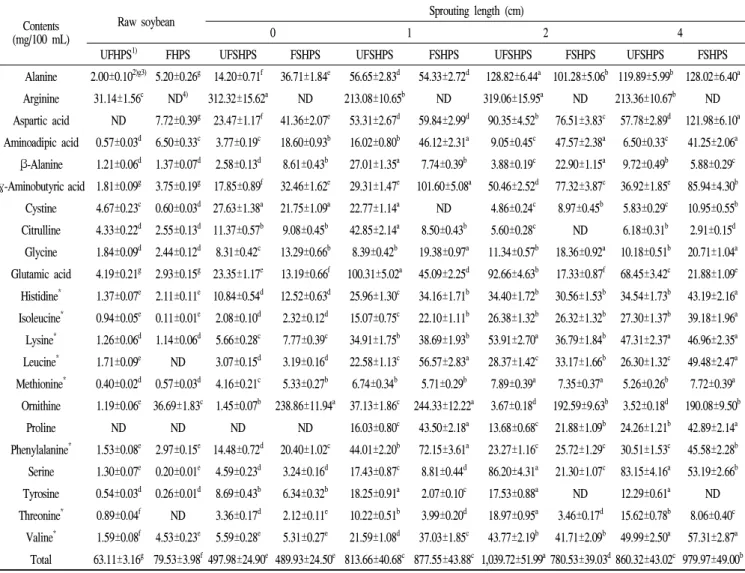
In addition to nutrients, certain foods contain a number of substances that do not have a defined nutritional function but may have a significant impact on health. Recent studies have reported the bioactive functions of the non-proteogenic or FAAs, GABA and ornithine. As a highly nutritious plant food material, the soybean (Glycine max L.) has been germinated for human consumption because germination can decrease the level of antinutritional factors (26), while increasing the amounts of some nutrients and phytochemicals, such as amino acids, vitamins, isoflavones, and tocopherols (27). In this study, the individual and total FAAs in the unfermented and fermented HPSs are presented in Table 1. The results differed to some extent for the different lengths of sprouting. The total FAAs were 63.11, 497.98, 813.66, 1,039.72, and 860.32 mg/100 mL in the unfermented HPS (UFHPS) and unfermented HPS with 0 cm (UFSHPS-0), 1 cm (UFSHPS-1), 2 cm (UFSHPS-2), and 4 cm sprouting length (UFSHPS-4) and 79.53, 489.93, 877.55, 780.53, and 979.97 mg/100 mL in the fermented HPS (FHPS) and fermented HPS with 0 cm (FSHPS-0), 1 cm (FSHPS-1), 2 cm (FSHPS-2), and 4 cm sprouting length (FSHPS-4), respectively. The GA concentrations increased from the unfermented raw HPS (UFHPS) to the soybean sprouts of 0 to 1 cm length (UFSHPS-1), and after that, it gradually decreased up to UFSHPS-4. The alanine, aspartic acid, aminoadipic acid, GABA, glycine, isoleucine, lysine, leucine, methionine, serine, threonine, and ornithine concentrations similarly increased from the unfermented raw to fermented
sprouting HPS sprouts of 0 to 2 cm length and decreased for the fermented HPS sprouts of 4 cm length. However, the β-alanine, cysteine, citrulline, and valine concentrations gradually increased from the raw to fermented sprouting HPS sprouts of 4 cm in length. Importantly, the arginine concentrations non-linearly increased in the unfermented HPS with varied sprouting lengths, but it was not detected in the fermented HPSs. Conversely, ornithine concentrations were low in the unfermented HPSs but greatly enhanced in the fermented HPSs.
Previously, the study reported the sedative and hypnotic effect of the oral administration of L-ornithine in neonatal chicks exposed to stress (28). Ornithine has also been used to treat cirrhosis because it facilitates the removal of toxic ammonia from the liver (29). Here, the concentration of ornithine is 24.4 mg/kg, which is higher than that found by Pinho et al. (30) (from traces to 4 mg/kg). Ornithine is formed by the decarboxylation activity of LAB metabolism through the precursor’s arginine and citrulline during the early stages of the ripening of cheese (18). Thus, the higher concentration of ornithine in the SPY from HPSs with varied sprouting lengths is due to the decarboxylation of arginine and citrulline. In addition, from SPYs (FSHPS-2 to FSHPS-4), this amino acid’s concentration decreased, possibly because of degradation by arginase activity and proportionally lower concentrations of arginine in UFSHPS-2 to UFSHPS-4, in partial agreement with Diana et al. (18).
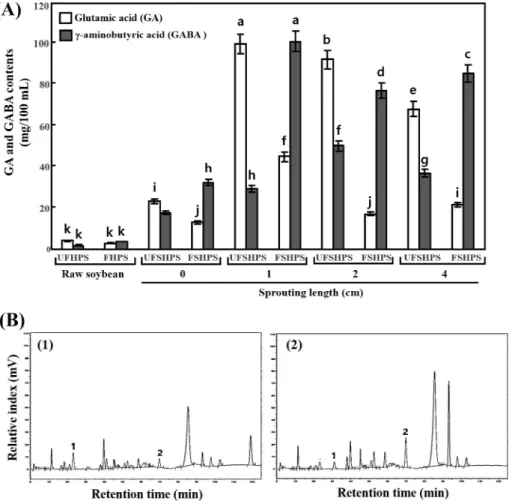
Importantly, the concentrations of GA were decreased in the fermented raw and fermented sprouting HPS sprouts compared to the unfermented HPSs, while the GABA concentrations were enhanced in the fermented raw and sprouting HPS sprouts (Fig. 2). As seen in Fig. 2, the UFHPS exhibits 4.19 and 1.81 mg/100 mL of GA and GABA, respectively, while the fermented HPS (FHPS) exhibits 2.93 and 3.75 mg/100 mL of GA and GABA, respectively. Interestingly, the sprouting of HPSs at 0 to 4 cm length showed increased levels of GA and GABA compared to the raw HPSs. In particular, at the 0 cm of the HPS sprouts, the UFSHPS-0 exhibits 23.35 and 17.85 mg/100 mL of GA and GABA, respectively. However, after fermentation (FSHPS-0), the free GA was reduced to 13.19 mg/100 mL, and consequently the GABA markedly increased to 32.46 mg/100 mL. Importantly, the GA and GABA were exhibited to maximums of 100.31 and 29.31 mg/100 mL at UFSHPS-1, while the GA markedly decreased to 45.09 mg/100 mL and the GABA increased to a maximum of 101.6 mg/mL in FSHPS-1. Similarly, the GA and GABA exhibited 92.66 and
50.46 mg/100 mL in UFSHPS-2, 17.33 and 77.32 mg/100 mL in FSHPS-2, 68.45 and 36.92 mg/100 mL in UFSHPS-4, and 21.88 and 85.94 mg/100 mL in FSHPS-4. The highest GA appeared in UFSHPS-1, while the highest GABA was found in FSHPS-1 among all the HPS sprouts tested in this study. However, there are significant differences in the GA content in SPY from varied sprouting lengths.
GABA-enriched black soybean milk produced byL. brevis
FPA 3709 was reported (31). Some studies (32) reported that the glutamate decarboxylase reaction may be stimulated with an increase of GA, indicating that the increase in the GA level may be one of the reasons for the increase of GABA, which is in agreement with the present results. The GABA
Table 1. Comparison of free amino acid contents in the unfermented and fermented raw and HPSs sprouting Contents
(mg/100 mL) Raw soybean
Sprouting length (cm)
0 1 2 4
UFHPS1) FHPS UFSHPS FSHPS UFSHPS FSHPS UFSHPS FSHPS UFSHPS FSHPS
Alanine 2.00±0.102)g3) 5.20±0.26g 14.20±0.71f 36.71±1.84e 56.65±2.83d 54.33±2.72d 128.82±6.44a 101.28±5.06b 119.89±5.99b 128.02±6.40a Arginine 31.14±1.56c ND4) 312.32±15.62a ND 213.08±10.65b ND 319.06±15.95a ND 213.36±10.67b ND Aspartic acid ND 7.72±0.39g 23.47±1.17f 41.36±2.07e 53.31±2.67d 59.84±2.99d 90.35±4.52b 76.51±3.83c 57.78±2.89d 121.98±6.10a Aminoadipic acid 0.57±0.03d 6.50±0.33c 3.77±0.19c 18.60±0.93b 16.02±0.80b 46.12±2.31a 9.05±0.45c 47.57±2.38a 6.50±0.33c 41.25±2.06a β-Alanine 1.21±0.06d 1.37±0.07d 2.58±0.13d 8.61±0.43b 27.01±1.35a 7.74±0.39b 3.88±0.19c 22.90±1.15a 9.72±0.49b 5.88±0.29c γ-Aminobutyric acid 1.81±0.09g 3.75±0.19g 17.85±0.89f 32.46±1.62e 29.31±1.47e 101.60±5.08a 50.46±2.52d 77.32±3.87c 36.92±1.85e 85.94±4.30b Cystine 4.67±0.23c 0.60±0.03d 27.63±1.38a 21.75±1.09a 22.77±1.14a ND 4.86±0.24c 8.97±0.45b 5.83±0.29c 10.95±0.55b Citrulline 4.33±0.22d 2.55±0.13d 11.37±0.57b 9.08±0.45b 42.85±2.14a 8.50±0.43b 5.60±0.28c ND 6.18±0.31b 2.91±0.15d Glycine 1.84±0.09d 2.44±0.12d 8.31±0.42c 13.29±0.66b 8.39±0.42b 19.38±0.97a 11.34±0.57b 18.36±0.92a 10.18±0.51b 20.71±1.04a Glutamic acid 4.19±0.21g 2.93±0.15g 23.35±1.17e 13.19±0.66f 100.31±5.02a 45.09±2.25d 92.66±4.63b 17.33±0.87f 68.45±3.42c 21.88±1.09e Histidine* 1.37±0.07e 2.11±0.11e 10.84±0.54d 12.52±0.63d 25.96±1.30c 34.16±1.71b 34.40±1.72b 30.56±1.53b 34.54±1.73b 43.19±2.16a Isoleucine* 0.94±0.05e 0.11±0.01e 2.08±0.10d 2.32±0.12d 15.07±0.75c 22.10±1.11b 26.38±1.32b 26.32±1.32b 27.30±1.37b 39.18±1.96a Lysine* 1.26±0.06d 1.14±0.06d 5.66±0.28c 7.77±0.39c 34.91±1.75b 38.69±1.93b 53.91±2.70a 36.79±1.84b 47.31±2.37a 46.96±2.35a Leucine* 1.71±0.09e ND 3.07±0.15d 3.19±0.16d 22.58±1.13c 56.57±2.83a 28.37±1.42c 33.17±1.66b 26.30±1.32c 49.48±2.47a Methionine* 0.40±0.02d 0.57±0.03d 4.16±0.21c 5.33±0.27b 6.74±0.34b 5.71±0.29b 7.89±0.39a 7.35±0.37a 5.26±0.26b 7.72±0.39a Ornithine 1.19±0.06e 36.69±1.83c 1.45±0.07b 238.86±11.94a 37.13±1.86c 244.33±12.22a 3.67±0.18d 192.59±9.63b 3.52±0.18d 190.08±9.50b Proline ND ND ND ND 16.03±0.80c 43.50±2.18a 13.68±0.68c 21.88±1.09b 24.26±1.21b 42.89±2.14a Phenylalanine* 1.53±0.08e 2.97±0.15e 14.48±0.72d 20.40±1.02c 44.01±2.20b 72.15±3.61a 23.27±1.16c 25.72±1.29c 30.51±1.53c 45.58±2.28b Serine 1.30±0.07e 0.20±0.01e 4.59±0.23d 3.24±0.16d 17.43±0.87c 8.81±0.44d 86.20±4.31a 21.30±1.07c 83.15±4.16a 53.19±2.66b Tyrosine 0.54±0.03d 0.26±0.01d 8.69±0.43b 6.34±0.32b 18.25±0.91a 2.07±0.10c 17.53±0.88a ND 12.29±0.61a ND Threonine* 0.89±0.04f ND 3.36±0.17d 2.12±0.11e 10.22±0.51b 3.99±0.20d 18.97±0.95a 3.46±0.17d 15.62±0.78b 8.06±0.40c Valine* 1.59±0.08f 4.53±0.23e 5.59±0.28e 5.31±0.27e 21.59±1.08d 37.03±1.85c 43.77±2.19b 41.71±2.09b 49.99±2.50a 57.31±2.87a Total 63.11±3.16g 79.53±3.98f497.98±24.90e 489.93±24.50e 813.66±40.68c 877.55±43.88c 1,039.72±51.99a780.53±39.03d860.32±43.02c 979.97±49.00b *Essential amino acids.
1)Abbreviation: UFHSP, unfermented high-protein soybean; FHSP, fermented high-protein soybean; UFSHPS, unfermented steam high-protein soybean; FSHPS, fermented steam high-protein
soybean.
2)All values are presented as the mean±SD of triplicate determination.
3)All values within a column with different superscript letters are significantly different from each other at p<0.05 by Duncan’s multiple range test. 4)ND, not detected.
is mainly from the conversion of GA, while the GA is mainly derived from the breakdown of proteins during germination (33,34). The levels of GABA and GA are continually changing during germination, based on complex metabolic pathways. One explanation for this result is that GA is being produced while being converted and that the conversion of GA to GABA may have some influence on its production during germination, namely, the higher the conversion, the more production. Therefore, the highest concentration of GA in UFSHPS-1 was responsible for the highest concentration of GABA in FSHPS-1. Bai et al. (35) reported that there was a gradual increase in the GABA yield with the increasing substrate concentration, but a decrease occurred when the
GA concentration exceeded 1.5 mg/mL in foxtail millet (Seratia italica L.) during germination process. Komatsuzaki et al. (15) suggested that the glutamate decarboxylase and GABA contents are regulated by GA addition. Makno et al. (36) reported that the relationship between GABA and GA was unclear in a study on vine-ripe tomato fruits under modified atmospheres. Thus, the complexity of the relationship between GABA and GA supports our result to some degree.
Comparison of total phenolic contents
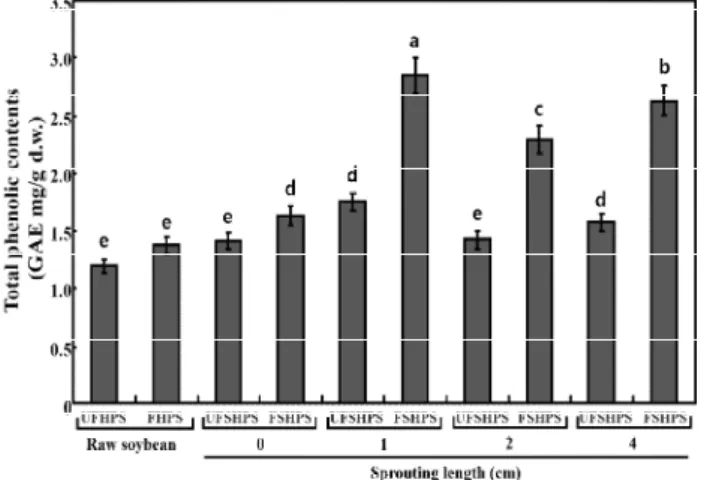
The total phenolic contents (TPCs) in the UFHPS, UFSHPSs, FHPS, and FSHPSs samples of raw and HPS sprouts are displayed in Fig. 3. The contents of TPCs increased after fermentation for raw and sprouting HPSs and were
Fig. 2. Comparison of glutamic acid (GA) and γ-amino butyric acid (GABA) contents in the unfermented and fermented raw and HPS sprouts.
Abbreviation: UFHSP, unfermented high-protein soybean; FHSP, fermented high-protein soybean; UFSHPS, unfermented steam high-protein soybean; FSHPS, fermented steam high-protein soybean.
A, Graph of GA and GABA profiles; B, Typical chromatogram of GA and GABA. B1, UFSHPS-1, UFSHPS with 1 cm sprouting length; B2, FSHPS-1, FSHPS with 1 cm sprouting length. 1, GA; 2, GABA.
Data represented mean±SD of three replicates. All values within a column with different superscript letters are significantly different from each other at p<0.05 by Duncan’s multiple range test.
markedly higher in the sprouting of HPS yogurts compared to the raw HPS yogurt. The value linearly increased over the sprouting length of the HPS and reached a peak value at a 1 cm HPS sprouting length before decreasing with the extension of the sprouting length. In particular, the TPC levels were 1.2, 1.42, 1.76, 1.44, and 1.58 mg/g in UFHPS, UFSHPS-0, UFSHPS-1, UFSHPS-2, and UFSHPS-4, respectively, while they were 1.43, 1.63, 2.92, 2.30, and 2.54 mg/g in FHPS, FSHPS-0, FSHPS-1, FSHPS-2, and FSHPS-4, respectively. The soybean sprouts can non-linearly increase the TPCs value in the HPS.
The maximum increase appeared in the 4-day-germinated soybean (14 cm sprouting length), an approximately 330% increase compared to the non-germinated soybean (4). In a related study, Lin and Lai (37) reported similar results that
germination enhanced the phenolic content in most soybean cultivars, with the highest content exhibited in the 4-day-germinated bean. In this study, the TPCs were found to be maximum in UFSHPS-1 and FSHPS-1 and thereafter decreasing according to the increased sprouting length, which is in partially agreement with Huang et al. (4). In addition, our previous study reported that the TPCs were increased in SPM by fermentation withL. plantarumP1201 (25). The above results suggest that the L. brevis probiotic played a vital role in the biotrans formation of the SPY biopolymers into beneficial phenolics.
Fig. 3. Comparison of total phenolic contents in the unfermented and fermented raw and HPS sprouts.
Abbreviation: UFHSP, unfermented high-protein soybean; FHSP, fermented high-protein soybean; UFSHPS, unfermented steam high-protein soybean; FSHPS, fermented steam high-protein soybean.
Data represented mean±SD of three replicates. All values within a column with different superscript letters are significantly different from each other at p<0.05 by Duncan’s multiple range test.
Comparison of isoflavone contents
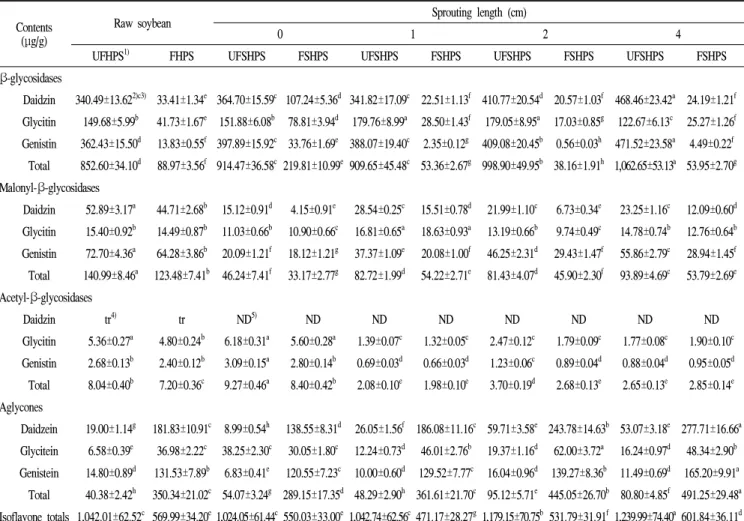
Germination can increase the isoflavone content and change the isoflavone composition of the HPS. Paucar-Menacho et al. (8) reported that the reduction of the 7-O-β -glycoside isoflavone after germination might be contributed to the β-glycosidases activated in germination, which could catalyze the aglycones released from the glycosides. In this study, the isoflavone glycosides were decreased slowly, accompanied by the accumulation of aglycones during the fermentation of SPY by L. brevis (Table 2 & Fig. 4). In fact, the total isoflavone glycosides are markedly increased according to the increased length (cm) of the sprouting of unfermented HPSs. Importantly, the total levels of isoflavone glycosides are proportionally decreased in the sprouting of fermented HPSs. In particular, UFHPS, UFSHPS-0, UFSHPS-1, UFSHPS-2, and UFSHPS-4 showed 852.6,
914.47, 909.65, 998.9, 1,062.65 μg/g of total isoflavone glycosides, which decrease to 88.97, 219.81, 53.36, 38.16, and 53.95 μg/g in FHPS, FSHPS-0, FSHPS-1, FSHPS-2, and FSHPS-4, respectively. Though the concentrations of daidzin, glycitin and genistin fluctuated in the fermented HPS sprouts, the overall tendencies were downward. The result indicates that UFSHPS-4 showed the highest levels of isoflavone glycosides compared to the other UFSHPS at various sprouting lengths (cm). Similarly, the malonyl-β-glycoside levels reached its highest level of 140.99 μg/g in the raw UFHPS compared to the other UFSHPSs. Slight changes in the acetyl-β-glycosides are observed after the fermentation of UFSHPS at various sprouting lengths. Interestingly, the total levels of isoflavone aglycones are increased after fermentation in FSHPS-0, FSHPS-1, FSHPS-2, and FSHPS-4. The levels of isoflavone aglycones are detected as 350.34, 289.15, 361.61, 445.05, and 491.25 μg/g in FHPS, FSHPS-0, FSHPS-1, FSHPS-2, and FSHPS-4, respectively. The total isoflavones reached maximums of 1,239.99 and 601.84 μg/g in UFSHPS-4 and FSHPS-4, respectively (Table 2). The ratio of isoflavone contents is shown in Fig. 4A. The glycosides are the highest in UFSHPS-0 (89.29%), followed by UFSHPS-1 (87.24%), UFSHPS-4 (85.7%), UFSHPS-2 (84.71%) and UFHPS (81.83%). As seen in Fig. 4A, the isoflavone aglycone concentrations are markedly increased after the fermentation of the raw and HPS sprouts of various lengths compared to the unfermented HPSs. In particular, after 72 h of fermentation, the isoflavone aglycone concentrations (%) were increased to 15.88-, 9.94-, 16.57-, 10.37-, and 12.52-fold for FHPS, FSHPS-0, FSHPS-1, FSHPS-2, and FSHPS-4, respectively, from their initial values. It is clearly shown in the typical HPLC chromatograms that the isoflavone glycoside levels decreased, while the isoflavone aglycones increased, during the fermentation of HPSs with various sprouting lengths (Fig. 4B). This result suggests that FSHPS-1 exhibited more isoflavone aglycones than the other fermented HPSs tested.
It was reported that germination could affect the contents and compositions of isoflavones in the soybean (4). In this study, the content and percentage of aglycones were increased in the SPYs made from various lengths of sprouting. The enhancement of the total isoflavone content was proposed to be the biosynthesized through phenylpropanoid pathways (38) and malonate pathways (39). Therefore, in the SPY, the total aglycone enhancement is proportional to the total isoflavones that were synthesized during the sprouting of the soybean. It was reported that the ratio of aglycones to total
isoflavones was improved by germination in black soybeans (37). Devi et al. (40) reported that the germinated soybean had the highest isoflavone content among the soybean products, including soy milk, soy sauce, soy meals and soy flour and soy seeds. In a related study, we found that the roasted soybean showed a maximum level of 598.6 μg/g of total isoflavones (3), while in this study, the SPY of the HPS showed a maximum level of 1,239.99 μg/g of total isoflavones, which is in agreement with Devi et al. (40).
Comparison of radical scavenging activities
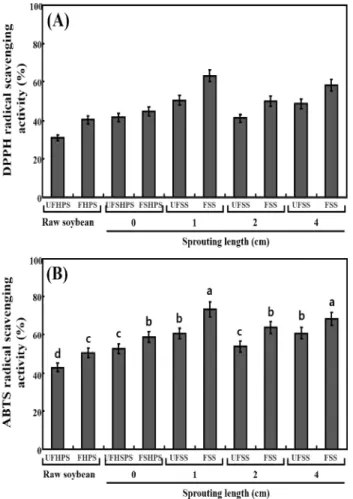
The antioxidant activities of the unfermented and fermented HPS sprouts were analyzed according to the DPPH and ABTS radical‑scavenging activity (Fig. 5). The DPPH radical-scavenging activity in the UFHPS, 30.81%, markedly
Table 2. Comparison of isoflavone contents in the unfermented and fermented raw and HPSs sprouting Contents
(μg/g) Raw soybean
Sprouting length (cm)
0 1 2 4
UFHPS1) FHPS UFSHPS FSHPS UFSHPS FSHPS UFSHPS FSHPS UFSHPS FSHPS
β-glycosidases Daidzin 340.49±13.622)c3) 33.41±1.34e 364.70±15.59c 107.24±5.36d 341.82±17.09c 22.51±1.13f 410.77±20.54d 20.57±1.03f 468.46±23.42a 24.19±1.21f Glycitin 149.68±5.99b 41.73±1.67e 151.88±6.08b 78.81±3.94d 179.76±8.99a 28.50±1.43f 179.05±8.95a 17.03±0.85g 122.67±6.13c 25.27±1.26f Genistin 362.43±15.50d 13.83±0.55f 397.89±15.92c 33.76±1.69e 388.07±19.40c 2.35±0.12g 409.08±20.45b 0.56±0.03h 471.52±23.58a 4.49±0.22f Total 852.60±34.10d 88.97±3.56f 914.47±36.58c 219.81±10.99e 909.65±45.48c 53.36±2.67g 998.90±49.95b 38.16±1.91h 1,062.65±53.13a 53.95±2.70g Malonyl-β-glycosidases Daidzin 52.89±3.17a 44.71±2.68b 15.12±0.91d 4.15±0.91e 28.54±0.25c 15.51±0.78d 21.99±1.10c 6.73±0.34e 23.25±1.16c 12.09±0.60d Glycitin 15.40±0.92b 14.49±0.87b 11.03±0.66b 10.90±0.66c 16.81±0.65a 18.63±0.93a 13.19±0.66b 9.74±0.49c 14.78±0.74b 12.76±0.64b Genistin 72.70±4.36a 64.28±3.86b 20.09±1.21f 18.12±1.21g 37.37±1.09e 20.08±1.00f 46.25±2.31d 29.43±1.47f 55.86±2.79c 28.94±1.45f Total 140.99±8.46a 123.48±7.41b 46.24±7.41f 33.17±2.77g 82.72±1.99d 54.22±2.71e 81.43±4.07d 45.90±2.30f 93.89±4.69c 53.79±2.69e Acetyl-β-glycosidases Daidzin tr4) tr ND5) ND ND ND ND ND ND ND Glycitin 5.36±0.27a 4.80±0.24b 6.18±0.31a 5.60±0.28a 1.39±0.07c 1.32±0.05c 2.47±0.12c 1.79±0.09c 1.77±0.08c 1.90±0.10c Genistin 2.68±0.13b 2.40±0.12b 3.09±0.15a 2.80±0.14b 0.69±0.03d 0.66±0.03d 1.23±0.06c 0.89±0.04d 0.88±0.04d 0.95±0.05d Total 8.04±0.40b 7.20±0.36c 9.27±0.46a 8.40±0.42b 2.08±0.10e 1.98±0.10e 3.70±0.19d 2.68±0.13e 2.65±0.13e 2.85±0.14e Aglycones Daidzein 19.00±1.14g 181.83±10.91c 8.99±0.54h 138.55±8.31d 26.05±1.56f 186.08±11.16c 59.71±3.58e 243.78±14.63b 53.07±3.18e 277.71±16.66a Glycitein 6.58±0.39e 36.98±2.22c 38.25±2.30c 30.05±1.80c 12.24±0.73d 46.01±2.76b 19.37±1.16d 62.00±3.72a 16.24±0.97d 48.34±2.90b Genistein 14.80±0.89d 131.53±7.89b 6.83±0.41e 120.55±7.23c 10.00±0.60d 129.52±7.77c 16.04±0.96d 139.27±8.36b 11.49±0.69d 165.20±9.91a Total 40.38±2.42h 350.34±21.02c 54.07±3.24g 289.15±17.35d 48.29±2.90h 361.61±21.70c 95.12±5.71e 445.05±26.70b 80.80±4.85f 491.25±29.48a Isoflavone totals 1,042.01±62.52c 569.99±34.20e1,024.05±61.44c550.03±33.00e 1,042.74±62.56c471.17±28.27g 1,179.15±70.75b 531.79±31.91f1,239.99±74.40a 601.84±36.11d 1)Abbreviation: UFHSP, unfermented high-protein soybean; FHSP, fermented high-protein soybean; UFSHPS, unfermented steam high-protein soybean; and FSHPS, fermented steam
high-protein soybean.
2)All values are presented as the mean±SD of triplicate determination.
3)All values within a column with different superscript letters are significantly different from each other at p<0.05 by Duncan’s multiple range test. 4)tr: trace (< 0.002 μg/g).
5)ND, not detected.
increased to 40.45% in the FHPS. It was observed to be 41.68% in UFSHPS-0, which slightly increased to 44.66%. The DPPH radical-scavenging activity in the UFSHPS-1 was 50.56%, which sharply increased to 63.28% in FSHPS-1. The levels sharply decreased to 41.24% and 49.98% in UFSHPS-2 and FSHPS-2, respectively. No significant changes were observed (48.81%) in the UFSHPS-4, but there was a great increase to 58.26% in FSHPS-4 (Fig. 5A). This result suggests that UFSHPS-1 and FSHPS-1 show the highest levels of DPPH radical‑scavenging activity compared to the other fermented and unfermented HPS sprouts. The ABTS radical‑scavenging activities were also observed to be the highest in UFSHPS-1 (60.56%) and FSHPS-1 (73.28%) compared to the other fermented and unfermented HPS sprouts, as seen in Fig. 5B.
The antioxidant capacity is one of the biological activities of phenolic compounds that provide beneficial effects to humans (41). For the germinated soybean, the TPCs were enhanced during germination and reached its highest value after 4 days germination, but while the antioxidant capacities was also the highest then, the change in the TPCs were not proportional to the change in the antioxidant capacity (4). Because the highest TPCs and antioxidant activity were found in FSHPS-1 in this study, the change in TPCs are proportional to the changes in antioxidant activities. Previously, much of the research on isoflavones has reported that they had a low scavenging potential for DPPH radicals, with scavenging effects only half those of α-tocopherol and epicatechin (42). However, several studies revealed that phenolic compounds were responsible for the antioxidant activities of soybean seed, soy paste and soy curd (43,44). Juan and Chou (45) reported that the combined isoflavone and phenolic content accounted
Fig. 4. Comparison of isoflavone contents ratio of β-glycosides, malonyl-β-glycosids, acetyl-β-glycosides, and aglycones in the unfermented and fermented raw and HPS sprouts.
Abbreviation: UFHSP, unfermented high-protein soybean; FHPS, fermented high-protein soybean; UFSHPS, unfermented steam high-protein soybean; FSHPS, fermented steam high-protein soybean.
A, Graph of isoflavone ratio; B, Typical chromatogram of isoflavone. B1, UFSHPS-1, UFSHPS with 1 cm sprouting length; B2, FSHPS-1, FSHPS with 1 cm sprouting length. 1, daidzin; 2, glycitin; 3, genistin; 4, malonyldaidzin; 5, malonylglycitin; 6, acetylglycitin; 7, malonylgenistin; 8, diadzein; 9, glycitein; 10, acetyl genistein; 11, genistein.
for nearly all of the in vitro antioxidant activity of black soybean extract. Recently, the TPC was higher in soybean sprouts than in soybean seeds, corresponding to antioxidant activity higher appeared (2). Therefore, it is expected that the high antioxidant activity of the fermented FSHPS-1 might be related to the markedly higher total phenolic and isoflavone aglycone contents achieved during fermentation.
In conclusion, the contents of total phenolics, isoflavone aglycones, GABA, and ornithine and antioxidant activities were significantly enhanced in the SPYs made of HPS sprouting of various lengths. Importantly, FSHPS-1 exhibits higher levels of these functional products than the others, such as FSHPS-2 and FSHPS-4, made of soybeans with various sprouting lengths. FSHPS-1 also showed the highest DPPH and ABTS radical scavenger activities. This result suggested that FSHPS-1 exhibits high nutritive value and functional properties, which make it a prospect for application in the soy-dairy industry.
Fig. 5. Comparison of antioxidant activiteis of the unfermented and fermented raw and HPS sprouts. (A) DPPH radical scavenging activity; and (B) ABTS radical scavenging activity.
Abbreviation: UFHPS, unfermented high-protein soybean; FHPS, fermented high-protein soybean; UFSHPS, unfermented steam high-protein soybean; FSHPS, fermented steam high-protein soybean.
Data represented mean±SD of three replicates. All values within a column with different superscript letters are significantly different from each other at p<0.05 by Duncan’s multiple range test.
요
약
본 연구는 발아된 고단백 콩(high protein soybeans, HPSs) 으로부터 가바(GABA)와 비배당체 이소플라본(isoflavone aglycones)이 증가된 콩-분말 요구르트(SPY)를 제조하였 다. 이를 위해 L. brevis로 발효 증자 고단백콩 발아체 (FSHPS, 0-4 cm)를 72시간 발효하였다. 발효 고단백콩 (FHPS), 0 cm 발효 증자 고단백콩 발아체(FSHPS-0), 1cm 발효 증자 고단백콩 발아체(FSHPS-1), 2cm 발효 증자 고단 백콩 발아체(FSHPS-2) 및 4 cm 발효 증자 고단백콩 발아체 (FSHPS-4)의 총 유리아미노산 함량은 각 79.53, 489.93, 877.55, 780.53 및 979.97 mg 이었다. 발효되지 않은 고단백 콩 발아체(UFSHPS-1, 1 cm) 및 FSHPS-1의 글루탐산(GA) 및 GABA 함량이 각각 최고 100.31 mg/100 mL 및 101.60 mg/100 mL로 관찰되었다. 또한 FSHPS-1에서 가장 높은 DPPH(63.28%) 및 ABTS(73.28%) 라디칼 소거능을 보였다. 그러나 FSHPS-4에서 isoflavone aglycone 비율이 81.63%로 가장 높았다. 특히, FSHPS-1은 높은 가바 함량과 기능적 특성을 나타내어 두유 산업에 응용할 수 있을 것이다.
Acknowledgment
This work was supported by Gyeongnam National University of Science and Technology Grant (2016 year), Republic of Korea.
References
1. Cho DY, Lee MK, Kim EA, Lee SY (2015) Analysis of the isoflavone content, antioxidant activity, and SDS-PAGE of cheese analogs produced with different proteolysis and soymilk residue contents. J Korean Soc Appl Biol Chem, 58, 501-509
2. Koo SC, Kim SG, Bae DW, Kim HY, Kim HT, Lee YH, Kang BK, Baek SB, Baek IY, Yun HT, Choi MS (2015) Biochemical and proteomic analysis of soybean sprouts at different germination temperatures. J Korean Soc Appl Biol Chem, 58, 397-407
3. Lee JH, Lee BW, Kim B, Kim HT, Ko JM, Baek IY, Seo WT, Kang YM, Cho KM (2013) Changes in phenolic compounds (isoflavones and phenolic acids) and antioxidant properties in high-protein soybean (Glycine maxL., cv.Saedanbaek) for different roasting conditions. J Korean Soc Appl Biol Chem, 56, 605-612
4. Huang X, Cai W, Xu B (2014) Kinetic changes of nutrients and antioxidant capacities of germinated soybean (Glycine max. L) and mung bean (Vigna radiata
L.) with germination time. Food Chem, 143, 268-276 5. Matsuyama A, Yoshimura K, Shimizu C, Murano Y, Takeuchi H, Ishimoto M (2009) Characterization of glutamate decarboxylase mediating γ-amino butyric acid increase in the early germination stage of soybean (Glycine maxL. Merr). J Biosci Bioeng, 107, 538-543 6. Wang F, Wang H, Wang D, Fang F, Lai J, Wu T, Tsao R (2015) Isoflavone, γ-aminobutyric acid contents and antioxidant activities are significantly increased during germination of three Chinese soybean cultivars. J Funct Foods, 14, 596-604
content and related enzyme activities in Jindou 25 soybean (Glycine max L.) seeds during germination. LWT-Food Sci Technol, 55, 341-346
8. Paucar-Menacho LM, Berhow MA, Mandarino JMG, Chang YK, de Mejia EG (2010) Effect of time and temperature on bioactive compounds in germinated Brazilian soybean cultivars BRS 258. Food Res Int, 43, 1856-1865
9. Cevallos-Casals BA, Cisneros-Zevallos L (2010) Impact of germination on phenolic content and antioxidant activity of 13 edible seed species. Food Chem, 119, 1485-1490
10. Park KB, Oh SH (2007) Production of yogurt with enhanced levels of gamma-aminobutyric acid and valuable nutrients using lactic acid bacteria and germinated soybean extract. Bioresour Technol, 98, 1675-1679
11. Chen C, Chen F (2009) Study on the conditions to brew rice vinegar with high content of γ-amino butyric acid by response surface methology. Food Bioprod Process, 87, 334-340
12. Thuwapanichayanan R, Yoosabai U, Jaisut D, Soponronnarit S, Prachayawarakorn S (2015) Enhancement of γ-aminobutyric acid in germinated paddy by soaking in combination with anaerobic and fluidized bed heat treatment. Food Bioprod Process, 95, 55-62
13. Narayan VS, Nair PM (1990) Metabolism, enzymology and possible role of 4-aminobutyrate in higher plants. Phytochemistry, 29, 367-375
14. Guo Y, Chen H, Song Y, Gu Z (2011) Effects of soaking and aeration treatment on γ-aminobutyric acid accumulation in germinated soybean (Glycine maxL.). Eur Food Res Technol, 232, 787-795
15. Komatsuzaki N, Shima J, Kawamoto S, Momose H, Kimura T (2005) Production of γ-aminobutyric acid (GABA) by Lactobacillus paracasei isolated from traditional fermented foods. Food Microbiol, 22, 497-504 16. Komatsuzaki N, Tsukahara K, Toyoshima H, Suzuki T, Shimizu N, Kimura T (2007) Effect of soaking and gaseous treatment on GABA content in germinated brown rice. J Food Eng, 78, 556-560
17. Wang HF, Tsai YS, Lin ML, Ou AS (2006) Comparison of bioactive components in GABA tea and green tea produced in Taiwan. Food Chem, 96, 648-653 18. Diana M, Rafecas M, Arco C, Quilez J (2014) Free amino
acid profile of Spanish artisanal cheeses: Importance of
gamma-aminobutyric acid (GABA) and ornithine content. J Food Compos Anal, 35, 94-100
19. Park KB, Oh SH (2007) Cloning, sequencing and expression of a novel glutamate decarboxylase gene from a newly isolated lactic acid bacterium Lactobacillus brevis OPK-3. Bioresour Technol, 98, 312-319 20. Yokoyama S, Hiramatsu JI, Hayakawa K (2002)
Production of γ-aminobutyric acid from alcohol distillery lees byLactobacillus brevisIFO-12005. J Biosci Bioeng, 93, 95-97
21. Jeng KC, Chen CS, Fang YP, Hou RCW, Chen YS (2007) Effect of microbial fermentation on content of strain, GABA, and polyphenolics in Pu-Erh tea. J Agric Food Chem, 55, 8787-8792
22. Lin SD, Mau JL, Hsu CA (2012) Bioactive components and antioxidant properties of γ-aminobutyric acid (GABA) tea leaves. LWT- Food Sci Technol, 46, 64-70 23. Komatsuzaki N, Tsukahara K, Toyoshima H, Shimizu N, Kimura T (2007) Effect of soaking and gaseous treatment on GABA content in germinated brown rice. J Food Eng, 78, 556-560
24. Kim NY, Ji GE (2014) Characterization of soybean fermented by aflatoxin non-producingAspergillus oryzae
and γ-aminobutyric acid producingLactobacillus brevis. J Korean Soc Appl Biol Chem, 57, 703-708
25. Hwang CE, An MJ, Lee HY, Lee BW, Kim HT, Ko JM, Baek IY, Seo WT, Cho KM (2014) Potential probiotic Lactobacillus plantarum P1201 to produce soy-yogurt with enhanced antioxidant activity. Korean J Food Sci Technol, 46, 556-565
26. Kumar V, Rani A, Pandey V, Chauhan GS (2006) Changes in lipoxygenase isozymes and trypsin inhibitor activity in soybean during germination at different temperatures. Food Chem, 99, 563-568
27. Shi H, Nam PK, Ma Y (2010) Comprehensive profiling of isoflavones, phytosterols, tocopherols, minerals, crude protein, lipid, and sugar during soybean (Glycine max) germination. J Agric Food Chem, 58, 4970-4976 28. Kurata K, Nagasawa M, Tomonaga S, Aoki M, Morishita
K, Denbow DM, Furuse M (2011) Orally administered L-ornithine elevates brain L-ornithine levels and has an anxiolytic-like effect in mice. Nutr Neurosci, 14, 243-248 29. Sugino T, Shirai T, Kajimoto Y, Kajimoto O (2008) L-ornithine supplementation attenuates physical fatigue in healthy volunteers by modulating lipid and amino acid metabolism. Nutr Res, 28, 738-743
(2001) Effect of temperature on evolution of free amino acid and biogenic amine contents during storage of azeitao cheese. Food Chem, 75, 287-291
31. Ko CY, Lin HTV, Tsai GJ (2013) Gamma-aminobutyric acid production in black soybean milk by Lactobacillus brevis FPA 3709 and the antidepressant effect of the fermented product on a forced swimming rat model. Process Biochem, 48, 559-568
32. Chung HJ, Jang SH, Cho HY, Lim ST (2009) Effects of steeping and anaerobic treatment on GABA (γ-amino butyric acid) content in germinated waxy hull-less barley. LWT-Food Sci Technol, 42, 1712-1716
33. Bouche N, Fromm H (2004) GABA in plants: just a metabolite?. Trends Plant Sci, 9, 111-115
34. Streeter JG, Thompson JF (1972) Anaerobic accumulation of γ-aminobutyric acid and alanine in radish leaves (Raphanus sativus L.). Plant Physiol, 49, 572-578 35. Bai Q, Chai M, Gu Z, Cao X, Li Y, Liu K (2009) Effects of components in culture medium on glutamate decarboxylase activity and γ-aminobutyric acid accumulation in foxtail millet (Seratia italica L.) during germination. Food Chem, 116, 152-157
36. Makno Y, Soga N, Oshita S, Kawagoe Y, Tanaka A (2008) Stimulation of γ-amino butyric acid production in vine-ripe tomato (Lycopersicon esculentumMill.) fruits under modified atmospheres. J Agric Food Chem, 56, 7189-7193
37. Lin PY, Lai HM (2006) Bioactive compounds in legumes and their germinated products. J Agric Food Chem, 54, 3807-3814
38. Yu O, Jung W, Shi J, Croes RA, Fader GM, McGonigle B, Odell JT (2000) Production of the isoflavones genistein and daidzein in non-legume dicot and monocot tissues. J Plant Physiol, 124, 781-793
39. Hahlbrock K, Scheel D (1989) Physiology and molecular biology of phenylpropanoid metabolism. Annu Rev Plant Physicol, 40, 347-369
40. Devi MKA, Gondi M, Sakthivelu G, Giridhar P, Rajasekaran T, Ravishankar GA (2009) Functional attributes of soybean seeds and products, with reference to isoflavone content and antioxidant activity. Food Chem, 114, 771-776
41. Rice-Evans C, Miller N, Pagana G (1997) Antioxidant properties of phenolic compounds. Trends Plant Sci, 2, 152-159
42. Chien HL, Huang HY, Chou CC (2006) Transformation of isoflavone phytoestrogens during the fermentation of soymilk with lactic acid bacteria andbifidobacteria. Food Microbiol, 23, 772-778
43. Chung IM, Seo SH, Ahn JK, Kim SH (2011) Effect of processing, fermentation, and aging treatment to content and profile of phenolic compounds in soybean seed, soy curd and soy paste. Food Chem, 127, 960-967 44. Youn KS, Chung HS (2012) Optimization of the roasting
temperature and time for preparation of coffee-like maize beverage using the response surface methodology. LWT-Food Sci Technol, 46, 305-310
45. Juan MY, Chou CC (2010) Enhancement of antioxidant activity, total phenolic and flavonoid content of black soybeans by solid state fermentation withBacillus subtilis