Article Info
Received February 23, 2021 Revised April 1, 2021 Accepted April 1, 2021
Corresponding Author Woochol Joseph Choi E-mail: [email protected] https://orcid.org/0000-0002-6623-3806 Key Words Balance Center of mass Center of pressure Quiet standing
Background: Theoretically, balance is affected by the height of center of mass (COM) during quiet standing. However, no one examined this in humans with variables derived from the center of pressure (COP).
Objects: We have conducted balance experiment to measure COP data during quiet stand-ing, in order to examine how the COP measures were affected by the height of COM, vision, floor conditions, and gender.
Methods: Twenty individuals stood still with feet together and arms at sides for 30 seconds on a force plate. Trials were acquired with three COM heights: 1% increased or decreased, and not changed, with two vision conditions: eyes closed (EC) and eyes open (EO), and with two floor conditions: unstable (foam pad) and stable (force plate) floor. Outcome variables included the mean distance, root mean square distance, total excursion, mean velocity, and 95% confidence circle area.
Results: All outcome variables were associated with the COM height (p < 0.0005), vision (p < 0.0005), and floor condition (p < 0.003). The mean velocity and 95% confidence circle area were 5.7% and 21.8% greater, respectively, in raised COM than in lowered COM (24.6
versus 23.2 mm/s; 1,013.4 versus 832.3 mm2). However, there were no interactions between
the COM height and vision condition (p > 0.096), and between the COM height and floor condition (p > 0.183) for all outcome variables. Furthermore, there was no gender difference in all outcome variables (p > 0.186).
Conclusion: Balance was affected by the change of COM height induced by a weight belt in human. However, the effect was not affected by vision or floor condition. Our results should inform the design of balance exercise program to improve the outcome of the balance training.
Copyright ⓒ Korean Research Society of Physical Therapy
This is an Open Access article distributed under the terms of the Creative Commons Attribution Non-Commercial License (http://creativecommons.org/licenses/by-nc/4.0) which permits unrestricted non-commercial use, distribution, and reproduction in any medium, provided the original work is properly cited.
INTRODUCTION
Consequences of falls in older adults are often debilitating, and prevention is important. One method to prevent a fall is an exercise to improve balance, which may help to decrease a risk of fall. Some clinical studies suggest that exercises (i.e., group-based resistance and balance training, aquatic exercise, Tai Chi) help to decrease the fall risk (thereby reduce the fall incidence) [1-4], but others provide evidence that exercises (i.e., treadmill training with projected visual context, RESTORE intervention, water based exercise) do not help to improve one’s balance [5-7]. While difficult to discuss what causes the discrepancy, the effectiveness of exercise may be improved by modifying environmental conditions surrounding individuals
during tasks (i.e., eyes open or closed, stable or unstable floor, lowered or raised center of mass [COM]).
Balance is an ability to place the center of pressure (COP) within a base of support during movements, and the balance performance can be improved by exercise or balance training under various environmental conditions. Research has shown that the training effect becomes superior when exercised on the unstable floor (i.e., foam pad, BOSU) [8-10], and gait and balance performance improved 15% and 11%, respectively, in older adults with exercises administered on the BOSU and Swiss ball [9]. Kang and Kim (2019) [11] has shown that task oriented balance training with unstable surface has greater ef-fects in improving Berg Balance Scale and 10 meter walking test when compared to training with stable surface in patients
Physical Therapy Korea
PTK
https://doi.org/10.12674/ptk.2021.28.2.154 pISSN: 1225-8962 eISSN: 2287-982X Phys Ther Korea. 2021;28(2):154-160Original
Article
Effect on the Center of Pressure of Vision, Floor Condition, and the Height of
Center of Mass During Quiet Standing
Seung-su Kim, PT, BPT, Kitaek Lim, PT, BPT, Woochol Joseph Choi, PT, PhD
with stroke. Furthermore, the effect of balance training can be improved with visual deprivation during tasks, and the time to complete the Star Excursion Balance Test, a clinical measure-ment tool for balance performance, was reduced 16% with the eyes-closed exercise training, but only 4% with the eyes-open training [12].
Mechanically, balance is affected by changes of the height of COM (i.e., the higher COM, the more unstable), and this no-tion is supported, in part, by some clinical measures. Almeida et al. (2011) [13] have measured the height of COM between fallers and non-fallers in older adults to conduct regression analyses. They have found that fall risk increases 37% for every 1% increase in the height of COM. Furthermore, Dounskaia et al. (2018) [14] and Richardson et al. (2000) [15] have shown that the elevated height of COM due to a halo vest or weight adjustable jacket decreases single limb stance time and perfor-mance of quiet standing and functional reaching task. In these three studies, however, the changed height of COM was not measured in every individual, leaving the exact biomechanical effect of the change of COM height on balance unclear. One study tried to answer this question and placed a weight belt 10 cm below the individual’s original COM to lower the COM height systematically across all participants. However, they did not measure the lowered COM height in every individual either, and their results should be interpreted in light of this limitation [16].
COP measures are widely used for the evaluation of standing balance and greater displacement and velocity of COP has of-ten been interpreted as poor balance. Among variables
extract-ed from the COP measure, mean distance (MDIST), root mean square distance (RDIST), total excursion (TOTEX), mean veloc-ity (MVELO), and 95% confidence circle area (95% Conf Circle Area) are known to be sensitive in assessing standing balance under various environmental conditions [17-19]. Formulas to derive these variables are provided in data analysis section be-low. Clinically, the TOTEX and 95% Conf Circle Area concern the amount of body sway during standing, and the MDIST and RDIST refer to “average” of the body sway. Furthermore, the MVELO represents how fast the body sways given time.
Against the background, we have conducted balance experi-ment to measure COP data during quiet standing, in order to examine how the COP measures (i.e., velocity, distance, area) were affected by the height of COM, vision, floor conditions, and gender.
MATERIALS AND METHODS
1. Subjects
Twenty young healthy adults (10 men and 10 women) aged between 19 and 29 participated in the balance experiment. On average, participants’ age, weight, height, body mass index, and height of COM were 23.85 (SD = 1.9), 69.7 (SD = 10.1), 168.4 (SD = 7.1), 24.5 (SD = 3.1), and 93.8 (SD = 4.7), respective-ly. Exclusion criteria included recent musculoskeletal injuries, including but not limited to, fractures, sprain and strain. The study protocol was approved by the Institutional Review Board at Yonsei University Mirae campus, and all subjects agreed to participate by providing a written informed consent form.
X = height of COM (m) X = raised height of COM (m) X = lowered height of COM (m) R = scale reading without human (N)1
R = scale reading with human (N)2
R = scale reading with human and belt (N)3
H = height of human body (m) m = mass of human (kg)h
M = total mass (m + mass of weight belt)h
g = gravitational acceleration (9.81m/s2) R =3 R =3 + R+ R11 (X +0.01H)Mg (X +0.01H)Mg D D X = X =D(RD(R22 R )R )11 m gh m gh A B C COM Force plate X
1% increased COM Weight belt
1% decreased COM X
X
D
Figure 1.
Figure 1. Participants lay on a reaction board to determine (A) the height of COM, and positions of a weight belt (5% of body weight) so the height of COM (B) increased or (C) decreased 1% with respect to the original height of COM.
2. Experimental Protocol
In the first session, participants lay on a reaction board to determine the location of COM and the position of a weight belt (5% of body weight; Weight Adjustable Aquatic Exercise
Belt; ALLPRO®
, Tampa, FL, USA), which changes the height of COM 1% higher or lower with respect to the original height of COM (i.e., raised or lowered 1.6 cm for an individual who is 160 cm tall) (Figure 1). We decided to apply the 1% change of COM height as it was the maximal capacity that the current experimental design provides. Associated steps and equations to compute the height of COM are provided in the inset of Fig-ure 1.
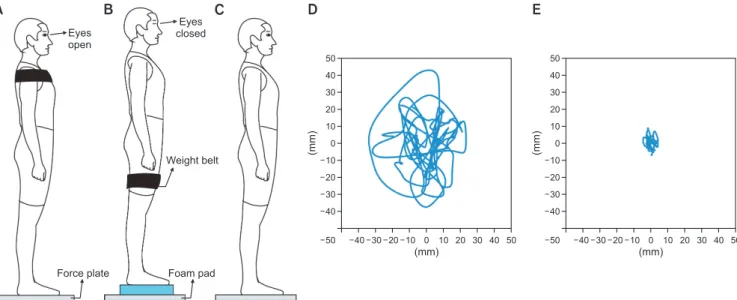
In the second session, participants stood still with feet to-gether and arms at sides for 30 seconds on a force plate (OR6-7-2000; AMTI, Waltham, MA, USA) to measure the trajectory of COP (Figure 2). Trials were acquired with three COM heights: increased, decreased, and not changed, with two vision tions: eyes closed and eyes open, and with two floor condi-tions: unstable (foam pad) and stable (force plate) floor. Two trials were acquired for each combination of the conditions and averaged for data analyses. Participants took an one-min-ute rest between trials. To minimize learning effects, the order of testing conditions was randomized.
3. Data Analysis
COP data were sampled at a rate of 1,000 Hz and was filtered through a fourth-order zero phase Butterworth low-pass digital
filter with a 5-Hz cut-off frequency [19]. The last 20 seconds COP data were used for data analyses. Outcome variables in-cluded the MDIST, RDIST, TOTEX, MVELO, and % Conf. Circle Area [19,20], and each variable was defined as follows:
MDIST = � �1 �����(�)�� ����(�)�� ����� � = ��� ������ �� ���� ����� RDIST = �� �1 (����(�)�� ����(�)�) TOTE� = � �(����(� � 1) � ����(�))�� (����(� � 1) � ����(�))� MVELO = ������ � ����� � = �� ������� 95% Conf. Circle Area = π ∗ ������ � 1.645 ∗ ��� ������(�)�� ����(�)���� � ����� 1.645 = ��� � ���������� �� ��� 95% ���������� ����� ��� = �������� ��������� All outcome variables were computed using a customized Matlab routine (Matlab R2019a; MathWorks, Natick, MA, USA).
For statistical analyses, a three-way repeated measures ANO-VA with gender as a grouping factor was used to test if these variables were associated with the COM height (3 levels), vision (2 levels), and floor condition (2 levels). When a main effect was significant, pairwise comparisons were conducted using Bonferroni correction with an alpha level at 0.05.
RESULTS
All outcome variables were associated with the COM height
A B C D E Eyes open Eyes closed Weight belt
Force plate Foam pad
50 40 30 20 10 0 10 20 30 40 (mm) 40 30 20 10 0 10 20 30 40 50 50 (mm) 50 40 30 20 10 0 10 20 30 40 (mm) 40 30 20 10 0 10 20 30 40 50 50 (mm) Figure 2.
Figure 2. Sample schematics of quiet standing tasks with (A) eyes open, COM raised, and stable floor condition, (B) eyes closed, COM lowered, and un-stable floor condition, and (C) eyes open, COM not changed, and un-stable floor condition, along with a sample COP trace under (D) eyes closed, COM raised, and unstable floor, and (E) eyes open, COM lowered, and stable floor condition.
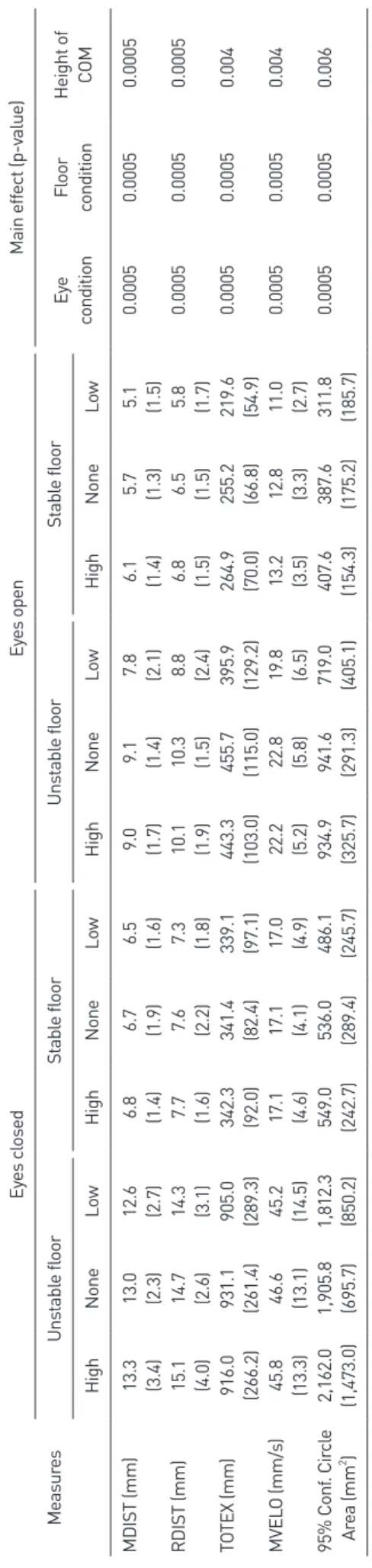
(p < 0.0005), vision (p < 0.0005), and floor condition (p < 0.003). The MVELO and 95% Conf Circle Area were 5.7% and 21.8% greater, respectively, in raised COM than in lowered COM
(24.6 versus 23.2 mm/s; 1,013.4 versus 832.3 mm2
), 85.5% and 101.2% greater, respectively, in eyes closed than in eyes open
(31.5 versus 17.0 mm/s; 1,241.9 versus 617.1 mm2), and 129.6%
and 216.5% greater, respectively, in unstable than in stable floor condition (33.7 versus 14.7 mm/s; 1,412.6 versus 446.3
mm2
) (Figure 3, Table 1). However, there were no interactions between the COM height and vision condition (p > 0.096), and between the COM height and floor condition (p > 0.183) for all outcome variables. Furthermore, there was no difference be-tween male and female participants for all outcome variables (p > 0.186).
DISCUSSION
The goal of this study was to examine how balance was af-fected by the weight belt induced change in the height of COM during quiet standing. We found that individuals swayed more over greater area with greater velocity when the height of COM increased. This agrees well with a model prediction. In theory of one link inverted pendulum model (often used to describe standing balance in humans), the greater the COM height, the smaller leaning angle is needed to initiate instability (easier to loose balance) and the greater recovery ankle torque is re-quired when lost balance, resulting in more sway and muscle
Mean
velocity
(mm/s)
Mean velocity
95% confidence circle area
95% confidence circle area (mm ) 2
High None Low
30 25 20 15 10 5 Height of COM 0 * 1,400 1,200 1,000 800 600 400 200 0 ** ** ** Figure 3.
Figure 3. Effects of the height of COM on COP measures during quiet standing. Individuals swayed more over greater area with greater
veloc-ity. *p = 0.053; **p < 0.05. Tabl e 1. Tabl e 1. A ver age v alues of out come v ariabl es in each t es ting c ondition (s tandar d de viation sho wn in par entheses) Measur es Ey es cl osed Ey es open Main eff ect (p-v alue) Uns tabl e fl oor St abl e fl oor Uns tabl e fl oor St abl e fl oor Ey e condition Fl oor condition Height of COM High None Low High None Low High None Low High None Low MDIST (mm) 13.3 (3.4) 13.0 (2.3) 12.6 (2.7) 6.8 (1.4) 6.7 (1.9) 6.5 (1.6) 9.0 (1.7) 9.1 (1.4) 7.8 (2.1) 6.1 (1.4) 5.7 (1.3) 5.1 (1.5) 0.0005 0.0005 0.0005 RDIST (mm) 15.1 (4.0) 14.7 (2.6) 14.3 (3.1) 7.7 (1.6) 7.6 (2.2) 7.3 (1.8) 10.1 (1.9) 10.3 (1.5) 8.8 (2.4) 6.8 (1.5) 6.5 (1.5) 5.8 (1.7) 0.0005 0.0005 0.0005 TO TEX (mm) 916.0 (266.2) 931.1 (261.4) 905.0 (289.3) 342.3 (92.0) 341.4 (82.4) 339.1 (97.1) 443.3 (103.0) 455.7 (115.0) 395.9 (129.2) 264.9 (70.0) 255.2 (66.8) 219.6 (54.9) 0.0005 0.0005 0.004 MVEL O (mm/s) 45.8 (13.3) 46.6 (13.1) 45.2 (14.5) 17.1 (4.6) 17.1 (4.1) 17.0 (4.9) 22.2 (5.2) 22.8 (5.8) 19.8 (6.5) 13.2 (3.5) 12.8 (3.3) 11.0 (2.7) 0.0005 0.0005 0.004 95% Conf . Cir cl e Ar ea (mm 2) 2,162.0 (1,473.0) 1,905.8 (695.7) 1,812.3 (850.2) 549.0 (242.7) 536.0 (289.4) 486.1 (245.7) 934.9 (325.7) 941.6 (291.3) 719.0 (405.1) 407.6 (154.3) 387.6 (175.2) 311.8 (185.7) 0.0005 0.0005 0.006
MDIST, mean dis
tanc
e; RDIST, r
oot mean squar
e dis tanc e; T OTEX, t ot al e xcur sion; MVEL O, mean v el ocity; 95% Conf . Cir cl e Ar ea, 95% c onfidenc e cir cl e ar ea; COM, c ent er of mas s.
contraction (energy consumption) during quiet standing [21,22]. Collectively, the change of COM height with a weight belt successfully created a challenging environment, under which the outcome of balance training can be better.
We also found that balance performance was largely affected by vision and floor condition, and individuals swayed more with eyes closed, and on the unstable floor. These findings also agree well with previous findings, where impaired visual input decreases postural stability and unstable floor affects somato-sensory inputs, resulting in poor balance [10,12,23-29].
Another goal of this study was to examine how the effect of COM change was affected by vision and floor condition during quiet standing. We found that the balance performance was largely affected by the COM height, vision, and floor condition (main effect). Interestingly, however, our data suggest that the three environmental conditions affect balance independently and not influence each other, indicating no combined ef-fects among conditions. In balance training, one may want to change the level of difficulty depending on individuals’ status (i.e., patients in early rehab stage or elite athletes) by combin-ing several environmental conditions, and balance traincombin-ing with visual deprivation and/or on unstable floor condition have often been used [8-12]. However, our results suggest that such strategy provides no additional benefits in the outcome of training (i.e., balancing on the unstable floor while wearing a weight belt above waist, or training with eyes closed while wearing a weight belt above waist).
Recently, Phan et al. (2020) [16] have conducted the limit of stability (LOS) test (i.e., moving COP onto targets placed near the boundary of the base of support) while changing individu-als’ COM height using a weight belt, and found that the bal-ance was not affected by the COM change. However, they did not control hip joint movements during the LOS task (therefore, participants were free to use hip strategy to reach targets). Fur-thermore, they mathematically calculated the changes of COM height, which never been confirmed experimentally. Whereas, our task limited hip strategy during experiments, and we di-rectly determined positions of a weight belt when participants lay on a reaction board to confirm the 1% increase or decrease of COM height across participants. Therefore, our results should be interpreted in light of these differences.
CONCLUSIONS
Balance was affected by the change of COM height induced by a weight belt in human. However, the effect was not affect-ed by vision or floor condition. Our results should inform the design of balance exercise program to improve the outcome of the balance training.
ACKNOWLEDGEMENTS
This work was supported by the “Brain Korea 21 FOUR Project”, the Korean Research Foundation for Department of Physical Therapy in the Graduate School of Yonsei University.
CONFLICTS OF INTEREST
No potential conflict of interest relevant to this article was reported.
AUTHOR CONTRIBUTIONS
Conceptualization: WJC. Formal analysis: SK, KL. Investiga-tion: SK, KL. Supervision: WJC. VisualizaInvestiga-tion: SK, WJC. Writing - original draft: SK. Writing - review & editing: WJC.
ORCID
Seung-su Kim, https://orcid.org/0000-0002-8735-3794 Kitaek Lim, https://orcid.org/0000-0001-5475-3196
REFERENCES
1. Alfieri FM, Riberto M, Gatz LS, Ribeiro CP, Lopes JA, Battistella
LR. Comparison of multisensory and strength training for
postural control in the elderly. Clin Interv Aging 2012;7:119-25.
2. Cyarto EV, Brown WJ, Marshall AL, Trost SG. Comparative
effects of home- and group-based exercise on balance confi-dence and balance ability in older adults: cluster randomized trial. Gerontology 2008;54(5):272-80.
3. Irandoust K, Taheri M, Mirmoezzi M, H’mida C, Chtourou H, Trabelsi K, et al. The effect of aquatic exercise on postural
mobility of healthy older adults with endomorphic somato-type. Int J Environ Res Public Health 2019;16(22):4387.
4. Li F, Harmer P, Fisher KJ, McAuley E. Tai Chi: improving func- tional balance and predicting subsequent falls in older per-sons. Med Sci Sports Exerc 2004;36(12):2046-52.
5. Hale LA, Waters D, Herbison P. A randomized controlled trial
to investigate the effects of water-based exercise to improve falls risk and physical function in older adults with lower-ex- tremity osteoarthritis. Arch Phys Med Rehabil 2012;93(1):27-34.
6. Sherrington C, Fairhall N, Kirkham C, Clemson L, Tiedemann A, Vogler C, et al. Exercise to reduce mobility disability and
prevent falls after fall-related leg or pelvic fracture: RE-STORE randomized controlled trial. J Gen Intern Med 2020; 35(10):2907-16.
7. van Ooijen MW, Roerdink M, Trekop M, Janssen TW, Beek PJ.
The efficacy of treadmill training with and without projected visual context for improving walking ability and reducing fall incidence and fear of falling in older adults with fall-related hip fracture: a randomized controlled trial. BMC Geriatr 2016;16(1):215.
8. Cheatham SW, Chaparro G, Kolber MJ. Balance training: does
anticipated balance confidence correlate with actual balance confidence for different unstable objects? Int J Sports Phys Ther 2020;15(6):977-84.
9. Martínez-Amat A, Hita-Contreras F, Lomas-Vega R, Caballero-Martínez I, Alvarez PJ, Caballero-Martínez-López
E. Effects of 12-week proprioception training program on postural stability, gait, and balance in older adults: a controlled clinical trial. J Strength Cond Res 2013;27(8):2180-8.
10. Nepocatych S, Ketcham CJ, Vallabhajosula S, Balilionis G. The
effects of unstable surface balance training on postural sway, stability, functional ability and flexibility in women. J Sports Med Phys Fitness 2018;58(1-2):27-34.
11. Kang TW, Kim
BR. Comparison of task-oriented balance train-ing on stable and unstable surfaces for fall risk, balance, and gait abilities of patients with stroke. J Korean Soc Phys Med 2019;14(2):89-95.
12. Hutt K, Redding E. The effect of an eyes-closed dance-specific
training program on dynamic balance in elite pre-profession-al ballet dancers: a randomized controlled pilot study. J Dance Med Sci 2014;18(1):3-11.
13. Almeida CW, Castro CH, Pedreira PG, Heymann RE, Szejnfeld VL. Percentage height of center of mass is associated with the
risk of falls among elderly women: a case-control study. Gait Posture 2011;34(2):208-12.
14. Dounskaia N, Peterson D, Bruhns RP. Destabilization of the
upright posture through elevation of the center of mass. Ann Biomed Eng 2018;46(2):318-23.
15. Richardson JK, Ross AD, Riley B, Rhodes RL. Halo vest effect
on balance. Arch Phys Med Rehabil 2000;81(3):255-7. 16. Phan J, Wakumoto K, Chen J, Choi WJ. Effect on the limit of
stability of the lowered center of mass with a weight belt. Phys Ther Korea 2020;27(2):155-61.
17. Baloh RW, Jacobson KM, Beykirch K, Honrubia V. Static and
dynamic posturography in patients with vestibular and cer-ebellar lesions. Arch Neurol 1998;55(5):649-54.
18. Baloh RW, Jacobson KM, Enrietto JA, Corona S, Honrubia V.
Balance disorders in older persons: quantification with pos-turography. Otolaryngol Head Neck Surg 1998;119(1):89-92. 19. Prieto TE, Myklebust JB, Hoffmann RG, Lovett EG, Myklebust
BM. Measures of postural steadiness: differences between
healthy young and elderly adults. IEEE Trans Biomed Eng 1996;43(9):956-66.
20. Palmieri RM, Ingersoll CD, Stone MB, Krause
BA. Center-of- pressure parameters used in the assessment of postural con-trol. J Sport Rehabil 2002;11(1):51-66.
21. Winter DA, Patla AE, Ishac M, Gage WH. Motor mechanisms
of balance during quiet standing. J Electromyogr Kinesiol 2003;13(1):49-56.
22. Wan FKW, Yick KL, Yu
WWM. Effects of heel height and high-heel experience on foot stability during quiet standing. Gait Posture 2019;68:252-7.
23. Bryanton MA, Bilodeau M. The effect of vision and surface
compliance on balance in untrained and strength athletes. J Mot Behav 2019;51(1):75-82.
24. Eysel-Gosepath K, McCrum C, Epro G, Brüggemann GP, Kara-manidis
K. Visual and proprioceptive contributions to pos-tural control of upright stance in unilateral vestibulopathy. Somatosens Mot Res 2016;33(2):72-8.
25. Hammami R, Behm DG, Chtara M, Ben Othman A, Chaouachi
A. Comparison of static balance and the role of vision in elite
athletes. J Hum Kinet 2014;41:33-41.
26. Killebrew SS, Petrella JK, Jung AP, Hensarling RW. The effect
of loss of visual input on muscle power in resistance trained and untrained young men and women. J Strength Cond Res 2013;27(2):495-500.
27. Tomomitsu MS, Alonso AC, Morimoto E, Bobbio TG, Greve JM.
Static and dynamic postural control in low-vision and normal-vision adults. Clinics (Sao Paulo) 2013;68(4):517-21.
28. Yang F, Liu X. Relative importance of vision and propriocep-tion in maintaining standing balance in people with multiple sclerosis. Mult Scler Relat Disord 2019;39:101901.
29. Aartolahti E, Häkkinen A, Lönnroos E, Kautiainen H, Sulkava
R, Hartikainen S. Relationship between functional vision and
balance and mobility performance in community-dwelling older adults. Aging Clin Exp Res 2013;25(5):545-52.