저작자표시-비영리-변경금지 2.0 대한민국 이용자는 아래의 조건을 따르는 경우에 한하여 자유롭게 l 이 저작물을 복제, 배포, 전송, 전시, 공연 및 방송할 수 있습니다. 다음과 같은 조건을 따라야 합니다: l 귀하는, 이 저작물의 재이용이나 배포의 경우, 이 저작물에 적용된 이용허락조건 을 명확하게 나타내어야 합니다. l 저작권자로부터 별도의 허가를 받으면 이러한 조건들은 적용되지 않습니다. 저작권법에 따른 이용자의 권리는 위의 내용에 의하여 영향을 받지 않습니다. 이것은 이용허락규약(Legal Code)을 이해하기 쉽게 요약한 것입니다. Disclaimer 저작자표시. 귀하는 원저작자를 표시하여야 합니다. 비영리. 귀하는 이 저작물을 영리 목적으로 이용할 수 없습니다. 변경금지. 귀하는 이 저작물을 개작, 변형 또는 가공할 수 없습니다.
경제학석사학위논문
Impact of High Speed Railroad on
Regional Income Inequalities in China
and Korea
한중 고속철도가 지역격차에 미치는 영향
2016년 8월
서울대학교 대학원
농경제사회학부 지역정보전공
JIANG MIN
Impact of High Speed Railroad on
Regional Income Inequalities in China
and Korea
지도교수 김의준
이 논문을 경제학석사학위논문으로 제출함
2016 년 6 월
서울대학교 대학원
농경제사회학부 지역정보전공
지앙민
지앙민의 석사학위논문을 인준함
위원장 (인)
위원장 (인)
위원장 (인)
i
Abstract
Impact of High Speed Railroad on
Regional Income Inequalities in China
and Korea
Jiang Min
Program in Regional information
Department of Agricultural Economics and Rural Development
The Graduate School
Seoul National University
The purpose of this study is to analyze the impact of opening high speed railroad (HSR) on the regional income inequalities in China and Korea. The convergence models are applied to test the effect of the HSR on regional growth in terms of GRDP per capita across 455 cities and counties along the Beijing-Shanghai HSR corridor and 112 cities and counties along the Seoul-Busan HSR corridor respectively. The results indicate that at national level, a trend of convergence emerges during the three-year period of analysis in both China and Korea. The results indicate that at national level, a trend of convergence emerges during the
ii
three-year period of analysis in both China and Korea. At the HSR passing area level, HSR contributes to accelerate regional economic convergence and reduce the regional income disparities in China and Korea. However, HSR has different impacts on reducing the regional income inequalities in China and Korea considering the HSR station cities; in Korea, the regional inequality is rather wider among the cities where HSR station located.
Key Words : High Speed Railroad, Regional Growth, Income Disparity, Convergence Model, International Comparison of China and Korea
iii
CONTENTS
Contents... i
List of Tables ... ii
List of Figures... iii
Abstract ... iv
1. Introduction... 1
2. Literature Review ... 4
2.1 The HSR and Regional Economies ... 4
2.2 Straw Effects and Regional Economies ... 13
2.3 Regional Convergence and Economic inequalities ... 16
3. Analysis... 24
4. Conclusions ... 42
Reference ... 44
iv
List of Tables
Table 1 Impacts of Transportation Infrastructure on Regional Economies ... 6
Table 2 Impacts of HSR on Regional Economies ... 8
Table 3 Regional Convergence in China and Korea ... 20
Table 4 Two HSR Lines ... 26
Table 5 Description of Variables ... 29
Table 6 Annual Growth Rate of GDP per capita in China ... 35
Table 7 Annual Growth Rate of GDP per capita in Korea ... 35
Table 8 Estimation Results of Convergence Models in China and Korea (1) ... 37
Table 9 Estimation Results of Convergence Models in China and Korea (2) ... 38
v
List of Figures
Figure1 Seoul – Busan HSR in Korea ... 27
Figure 2 Beijing – Shanghai HSR in China ... 28
Figure 3 Annual Growth Rate of GDP per capita in China and Korea ... 32
Figure 4 GDP per capita in China ... 33
Figure 5 Annual Growth Rate of GDP per capita in China ... 33
Figure 6 GDP per capita in Korea ... 34
1
1. Introduction
The first high speed railroad (HSR) line in the world, Shinkansen, was introduced just in time for the Tokyo Olympics in 1964. Followed Japan, developed countries in Europe started to operate the HSR network in 1990s. Korea inaugurated Korea Train Express services of Seoul-Busan HSR lines on April 1, 2004, becoming the fifth country to run HSR followed Japan, France, Germany and Spain. In general, the construction of Korean HSR decreases firms' production cost and improves the utility of life for the passengers by reducing inter-regional transport costs and time, and expands production and market as well as create new employment (Kim, et al., 2013). In addition, Korean HSR was found to generate positive effects on the national and regional economy by increasing the efficiency of land use, promoting the technological innovation, and lowering the barrier of inter-regional trade (Kim, et al., 2011). Despite the various economic advantages from the development of the HSR, there have been several controversies on the so-called ‘straw effect’ regarding to whether the local human resources are adversely concentrated to Seoul and other metropolitan areas after opening of the HSR (Jeon et al., 2004; Kim, et al., 2009; Heo, 2010; Chen et al., 2013).
China’s high speed rail construction started 30 years behind Japan and European developed counties, but the speed of its expansion was remarkable in the last decade since the first HSR connection inaugurated in 2008 between Beijing and
2
Tianjin. After the opening of the Beijing-Tianjin line, the construction of China’s HSR network entered into a new era of rapid development. In July 2011, the opening of Beijing-Shanghai HSR line created a business corridor connecting China’s two most dynamic cities which shortened the travel time from 9 hours 54 minutes to 4 hours 48 minutes. By the end of 2015, China accomplished the line running 18,000 km making it the most extensive HSR network in the world. China is expected to complete the entire system reaching 20,000 km by 2020. Although China gained great progress in its HSR building boom, the development of the HSR projects has suffered from a few controversies about whether China can bear the heavy burden of the HSR investment under the current economic situation and whether the HSR can bring a positive impact on narrowing the regional income inequality.
The development of the HSR has been constantly encouraged and supported due to its potential contributions to regional growth and development. Concerning the link between the HSR and regional development, most of the existing studies have focused on the influence of the HSR construction on the regional economic growth. Relatively few researchers have focused on quantitatively exploring the relationship between the HSR and regional inequalities. By conducting a comparative analysis between China and Korea, this study focuses on effect of the HSR on the regional disparity by examining the question whether the speed of convergence in the HSR passing areas is faster than the national level in the two
3
neighboring counties with different economic structure and political system. In order to solve this question, two sets of convergence models, the national model and the HSR regional model, are applied to test the effect of the HSR on regional growth in terms of GRDP per capita during three-year period after the construction of the HSR across 455 regions along the Beijing-Shanghai HSR corridor and 112 regions along the Seoul-Busan HSR corridor respectively in China and Korea. The remainder of this paper is organized as follows: Section 2 introduces the literature review of this paper. Section 3 describes the model specification. Section 4 presents the estimation results of convergence model and discusses the convergence pattern associated with the development of HSR in China and Korea. The final section summarizes the result and conclusion.
4
2. Literature Review
2.1 The HSR and Regional Economies
Most of the early studies found that new transport infrastructure provision had a positive effect on regional economic growth (Carlino and Voith, 1992; Garcia-Mila and McGuire, 1992; Keeler and Ying, 1988). Other studies found that the introduction of new transport infrastructure may have differential impacts on the local economy (Krugman, 1993; Ono and Asano, 2005; Lee and Kim, 2014). Many studies highlighted a possible negative effect on local economic growth, referring to the so-called ‘straw effects’ of the HSR.
Over the last three decades many studies have been conducted on the impact of transportation infrastructure development on economic growth. Most previous studies concluded that public investment in transport infrastructure had a strong and positive impact on the economic growth through reduction of travel time and cost, increase of traffic volume, and induced spatial distribution of economic activities (Banister et al., 2000). The range of the methods measuring the effects of infrastructure investment on economic growth varies widely among studies (see Table 1). The most common approach is to develop a production function type model in which transportation infrastructure is treated as an important input to production (Aschauer, 1989; Evans, 1994; Gillen, 1996; Berechman et al., 2006;
5
Ozbay et al., 2007; Liu, 2010; Tong, 2013). Since Aschauer (1989) found the evidence that the transportation stock reduced the costs of transportation and contributed to economic growth as well as that of private labor and capital inputs. Most of the previous studies estimated the production function model with a similar structure treating the transportation capital investment as controlling variables to determine the output. Besides, cost production function approach is also widely applied to assess the economic impact of infrastructure investment (Keeler, 1988; Lynde, 1992; Kim, 1998; Kim and Shin 2002). Though estimating the cost elasticity of the transportation input in the cost production function, transportation stock can be proved to reduce the costs of transportation and contribute to economic growth. In addition, cost production function can be applied to assess optimal size and scale economies of infrastructure facilities. On the other hand, infrastructure investment does not always have such a positive effect on the spatial economy. For example, if institutional restrictions were placed on capital mobility, public infrastructure investment would crowd out private investment, causing inflation in price levels and capital cost (Kim, 1998). Furthermore, the spatial economic effects from the expansion of transportation facilities might not be positive if equilibrium of supply and demand is maintained in the transportation services (Rietveld, 1989). Besides, some studies also analyzed the effect of transport infrastructure on property value through the multiple regression analysis or multiple hedonic price models (Sung, 2011; Yoo, 2012; Lim, 2013). In the recent
6
researches, there has been a growing concern on spatial econometric approach illustrating linkages between infrastructure investment and population distribution (Zhang, 2012; Cheong, 2011).
Table 1 Impacts of Transportation Infrastructure on Regional Economies
Method Author Dependent
variable
Independent
variables Spatial unit Production Functions Gillen (1996), Berechman et al., (2006), Ozbay (2007) GRDP/ National output Labor, capital, transport infrastructure capital stock Metropolitan/ National level Cost Functions Keeler et al., (1988), Lynde (1992), Kim (1998), Kim and Shin (2002)
Prices and quantities of output and inputs Transport infrastructure capital stock, technological change, population density, and the number of firms Regional level/ National level Augmented Barro Model Demurger (2001), Hong and Wang (2011) GRDP/ GRDP per capita A comprehensive index based on quantity and quality of railway, roadway, airport, seaport National level Spatial Econometric Model Zhang (2012), Cheong (2011) Volume of population movement/ GRDP Transport infrastructure capital stock , accessibility, demographic, economic, factors National level Multiple Regression Analysis Sung (2011), Yoo (2012), Lim (2013) Assessed land price Floating population, welfare facilities, distance to train stations Regional level/ Seoul
7
However, relatively little attentions has been paid to the relationship between transportation infrastructure and regional disparity. Nijikamp and Piet (1993) claimed that improvement of infrastructure could generate distributive as well as generative effects. Generative effects occur when the national net effect increase, on the other hand, distributive effects relate to a redistribution of economic activities across regions, keeping the national net effect constant. The distributive effects relate to regional competition since the reduction of transport costs and travel time would cause the substantial redistribution effect across regions. Hence, the growth of some regions may be the result of the deterioration of poorer regions (Forkenbrock et al., 1990; Boarnet, 1996). Few empirical studies provided the evidence that transport variable appears as an important determinant of regional disparity (Demurger, 2000; Kim, 2002; Beyazit, 2015). Demurger (2000) analyzed the relationship between infrastructure and economic growth using panel data and conditional convergence framework across 24 Chinese provinces from 1985 to 1998, and the results indicated that transport facilities were a key differentiating factor in explaining the growth gap. Kim and Shin (2002) analyzed the effect of national development and decentralization policies on the regional income disparity in Korea and found that the degree of variation in regional income was positively correlated with the spatial distribution of transportation infrastructure capital and other controlling variables including educational services, employment
8
and information network. In order to assess the impacts of transport infrastructures on economic inequalities, Beyazit (2015) applied an ex-post analysis of the Istanbul Metro as a case study, and resulted that there existed spatial economic inequalities on population, employment and business growth around the Metro-served area than the rest of the city.
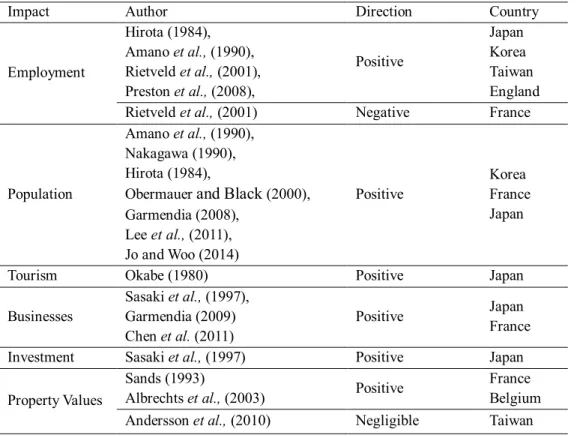
Since infrastructure improvement may be considered a byproduct as well as a necessary condition for development of market and economic growth, it is important to determine whether uneven distribution of transport infrastructure is a key reason behind economic disparities. Therefore, in order to solve regional disparity problem, it is necessary to identify the influence of the development of transport infrastructure including HSR. Various countries have provided evidences of the impacts of HSR on regional economic disparity between regions during the past few decades. These studies showed that there existed various impacts of national spatial change after construction of HSR in different regions with HSR and without HSR, including impacts on population, employment, tourism, business, and property values (see Table 2).
9
Table 2 Impacts of HSR on Regional Economies
Impact Author Direction Country
Employment Hirota (1984), Amano et al., (1990), Rietveld et al., (2001), Preston et al., (2008), Positive Japan Korea Taiwan England
Rietveld et al., (2001) Negative France
Population
Amano et al., (1990), Nakagawa (1990), Hirota (1984),
Obermauer and Black (2000), Garmendia (2008), Lee et al., (2011), Jo and Woo (2014) Positive Korea France Japan
Tourism Okabe (1980) Positive Japan
Businesses Sasaki et al., (1997), Garmendia (2009) Chen et al. (2011) Positive Japan France
Investment Sasaki et al., (1997) Positive Japan
Property Values
Sands (1993)
Albrechts et al., (2003) Positive
France Belgium
Andersson et al., (2010) Negligible Taiwan
Through the various analytical methods, previous researches focusing on empirically investigating the existence of links between HSR and regional economic development mostly argued that HSR investments may lead to increasing regional disparities rather than reducing (Bruinsma et al., 1993; Martin, 1997; Vickerman et al., 1999). Vickerman (1999) noted that the disparity between regions with HSR and without HSR tended to become larger in Japan as HSR created new
10
location advantages for the connected cities and regions, but also disadvantages for cities and regions not served by the new networks. This conclusion is consistent with previous studies investigating the effects on Shinkansen regional development focus on the disparity between regions that are connected to HSR and those that are not (Hirota, 1984; Amano et al., 1990; Brotchie, 1991; Obermauer and Black, 2000; Gutierrze et al., 2001). For example, Hirota (1984) found that cities close to the Tohoku HSR line grew in population by 32% while cities in the same region located further away from the HSR line experienced no population growth; growth rates of employment in the retail, industrial, construction and wholesale sectors were 16 - 34% higher in cities with HSR station than in cities without. At a more general level, Amano (1990) noticed similar results that station locations on the HSR route showed marginally-higher than average population growth and employment growth at station locations were 1.8% higher than 1.3% in non-station locations. In 1991, Brotchie researched the social and economic impact of the Japanese Shinkansen by comparing population growth, employment and economic activity in cities that had an HSR station versus those that did not. The results showed that the cities connected with the Shinkansen performed better on average, especially for employment in information based industries. Obermauer and Black (2000) found that the disparities of population from 1991 to 2001 become larger than from 1981 to 1991 between connected and non-connected cities. Gutierrze (2001) concluded that HSR tended to improve urban agglomerations which already
11
enjoying above-average accessibility levels, therefore increasing regional disparities derived from the development of transport networks in Spain in the period between 1992 and 2004. In France, some early studies showed a positive effect on narrowing the disparities between Paris and the rest cities, and the presence of a HSR station played a role in the regional location choice of firms. The line caused relocation effects within the regions of cities that have a HSR station, for instance, Lyon was able to attract many firms from competing cities like Grenoble and Geneva; and evidence did not suggest that the Paris-Lyon line resulted in firms moving from Lyon to Paris; instead, Branch offices of Parisian firms were set up along the HSR line, particularly in the high-tech sector in the region (Bonnafous, 1987; Pieda, 1991). In a more recent example from the France, HSR was found to enlarge the gap of employment growth for the HSR passing regions. Rietveld et al., (2001) noticed that Paris benefits from the enlarged labor market resulting from the HSR while Le Mans, a city located along the HSR line, experienced decreases in employment.
In Korea, studies on impact of HSR on regional disparity mainly focus on the impact of HSR on the distribution of population. Lee et al., (2004) applied the spatial econometric model to analyze the effect of HSR on regional disparity in terms of population distribution. Results showed that Seoul metropolitan area was the winner to gain positive population influx and found effects of population inflow in HSR passing areas, whereas other regions had high possibility of population
12
outflow. Cho et al., (2005) conducted a survey targeting HSR users and shop owners in regional cities in order to identify the decrease in commercial areas for cities with HSR stations and focus of purchasing power in metropolitan areas. The results showed that department stores and large retailers were already active in many of the regional cities, and through online shopping and other forms, use of HSR as a means of transportation for shopping was extremely rare. Jo (2014) analyzed the impact of HSR on regional economy and balanced development. In this paper, three β-convergence models focusing on the changing of GRDP, population and employment were applied for communities along the Seoul- Busan HSR lines. The results showed that HSR contributed to the divergence of GRDP and population indicating that straw effect that can occur and the regional income inequality along the HSR became wider.
In China, the empirical evidence of the impact of the HSR on regional disparity is still scare due to the relatively short period of operation since its inauguration in 2008. Furthermore, taking into account a uniqueness of economic structure and the rapid growth rate of national income, the impact of HSR on regional development in China is expected to be different from that in other developed countries. In this regard, it would be worthwhile to conduct a comparative analysis of the impact of HSR on regional disparity in China and other country. Considering the geographical proximity and the similarity of the opening year of HSR, it would be suitable to compare the impact of HSR in China and Korea.
13
2.2 Straw Effects and Regional Economies
Growing concern surrounding the existence of ‘straw effects’ was evident in recent studies that reveal how new road network accessibility negatively caused lower economic productivity in lagging areas by increasing the level of local dependency on major metropolitan areas. Many scholars have argued that the construction of new highways and HSR should have a positive impact on enhancing local economic productivity in lagging areas, such as a socioeconomically disadvantaged area (Boarnet, 2014; Cervero, 2002; Cervero, 2003; Chi et al., 2006), other studies revealed a possible negative impact: the so-called ‘straw effect’ (Behrens et al., 2007; Ono and Asano, 2005).
High-speed transport modes such as HSR and highway can significantly increase both the volume and speed of inter-regional migration, and the efficiency of domestic trades at a national level by reducing travel time and cost. Ono and Asano (2005) defined ‘straw effects’ as a negative economic externality of new transport accessibility. A process occurred whereby a large city absorbed the function of local services and industrial activities from neighboring smaller cities and towns. This was as a consequence of the existence of higher accessibility network, which became newly available to the larger city via high-speed transport, such as
14
Shinkansen. The straw effects had been evident in the major cities in Japan where a rapid growth of urban population and employment had been apparent since the construction of the HSR. In contrast, smaller regional towns and rural areas on the HSR pathway had suffered from a decrease in local population and job opportunities. Consequently, dependency on the provision of urban services and workplaces had increased, which resulted in unbalanced regional development. In particular, the number of local employees in typical local businesses, such as accommodation and retail sectors, had dramatically decreased due to a greater ‘range of goods’ provided by neighboring major cities. The straw effects of new transport infrastructure therefore caused unbalanced regional development and higher local dependency on major cities (Kakumoto, 1995).
Recently, the straw effect of HSR received much attention in Korea. Coupled with the opening of HSR, many previous studies provided evidences on of the possibility of straw effect. Straw effect indicates the local human resources and material goods are adversely being concentrated to the metropolitan areas, and harming the local economy where the HSR was being constructed (Kim, 2012). Kim (1994) first reported that a major department store in the regional center, Gangneung City experienced a decrease in the number of customers since the construction of a new highway due to the higher accessibility of superior shopping malls in Seoul. Jun (2004) examined a possible straw effect of the Korean HSR. This study tried to measure a straw effect in the increase of daytime travelers in
15
Seoul Metropolitan Area (SMA) by the HSR. The marginal benefits of the HSR were assumed in the major cities, which accelerated place utility differentials between major cities and local towns. However, this study did not confirm the straw effect due to the limitation of empirical data. Cho (2005) conducted a passenger survey on travel journey, asking trip reasons and related business activities. The sample was collected in the passenger waiting room in the HSR stations at three time intervals: 1 month, 8 months, and 10 months after the HSR introduced. The survey found that the frequency of shopping trips to the Seoul Metropolitan Area (SMA) increased from 60% to 63.7% and its share of shopping trips to other cities decreased over time. However, 63.7% of the respondents said they expected more visitors from SMA rather than those from local cities. Jun (2007) also found a gradual decreased in the local population growth rate in the local areas around the interchanges of the West Coast Highway in Korea. The new highway development affected local people who moved from the lagging areas to the neighboring major cities where better goods and services were readily available. Recent studies also argued that there was little evidence of the straw effect in Korea (Cho et al., 2005; Heo, 2010). Kim (2009) analyzed the straw effect that can occur when new forms of transportation open such as highways and HSR with a more theoretical approach. As a result, the Straw Effect, observed in terms of industrial categories, can show significant results because it excluded the counterbalancing effect, and claims the result depends on the spending habit of the
16
consumers in the region. The study by Heo (2010) also argued that there was no evidence of the straw effect related to the development of the HSR. The study reported that the population growth rate in SMA over the period from 1999 to 2003 before HSR was 16.1% while the rate after the contribution of HSR dropped to 12.5% from 2004 to 2009.
From the results of the above related studies, one can see the analytical methods of regional economic growth in relation to HSR and regional economic growth can cause positive and negative influences. However, studies on empirical analysis on what kinds of influences HSR brings to regional economic growth was still found to be somewhat lacking. Therefore, this paper aims to analyze how the HSR influenced the regional income inequalities of its corresponding regions. For this purpose, it will differentiate itself from other related studies by using regional convergence model and conduct a comparative analysis in order to identify the difference between China and Korea.
2.3 Regional Convergence and Economic inequalities
Since 1990s, a sharp increase in academic interest occurred in the area of regional income convergence or the existence of a decrease in regional inequalities. Barro and Sala-i-Martin (1991) firstly argued that regional income convergence occurred if a poor region tended to grow faster than a rich one, such that the poor region caught up with the region in terms of the level of per capita income; and
17
appropriate changes in conditions that limit growth would help to accelerate it. Following by Barro and Sala-i-Martin, many studies have attempted to test this convergence hypothesis for the USA, and European counties. Sala-i-Martin (1996) studied 90 regions for the period from 1950 to 1990 and found an annual absolute β-convergence rate of 1.5%. Tondl (1997) detected absolute β-convergence trends, at an annual rate of 2.0%, in the study of 122 regions for the period from 1975 to 1994. Armstrong (1995), examining 85 regions for the period from 1960 to 1990, found significantly lower trends of conditional β-convergence, at an annual rate of 1.0%. Neven and Gouyette (1995), examining 141 regions for the period from 1980 to 1990, and Carrington (2003), examining 110 regions for the period from 1989 to 1998, also found weak trends of absolute β-convergence, at annual rates of 0.5% and 0.14%, respectively. Geppert et al. (2005), in their study of 108 regions for the period from 1980 to 2000, also found strong trends of absolute β-convergence, at an annual rate of 2.4%. However, there are many studies that did not support the convergence hypothesis, referring to the existence of selective tendencies, convergence clubs and asymmetric shocks which lead to spatial inequalities. Button and Pentecost (1995), studying 51 regions for the period from 1975 to 1988, Fingleton (1997), studying 138 regions for the period from 1975 to 1993, and Magrini (1999), studying 122 regions for the period from 1979 to 1990, pointed to the emergence of divergence phenomena as a consequence of the oil crises of the 1970s. Quah (1996) examined 78 regions for the period from 1950 to
18
1990 and proposed the classification of European regions into four convergence clubs, each with its own dynamic and potential.
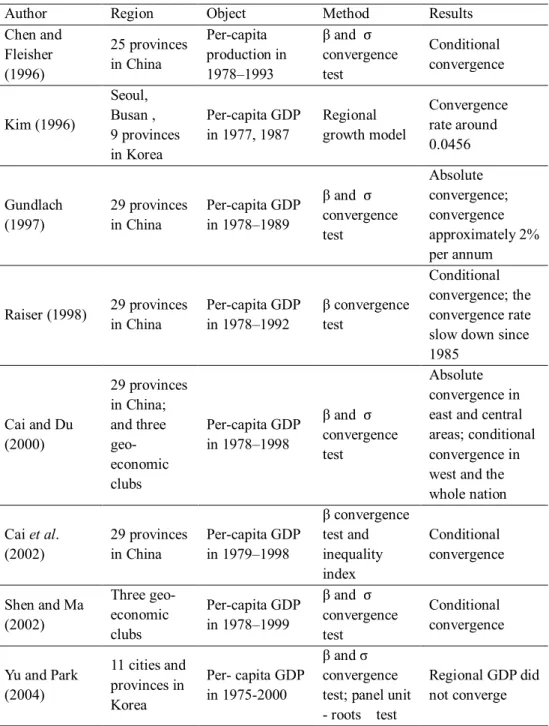
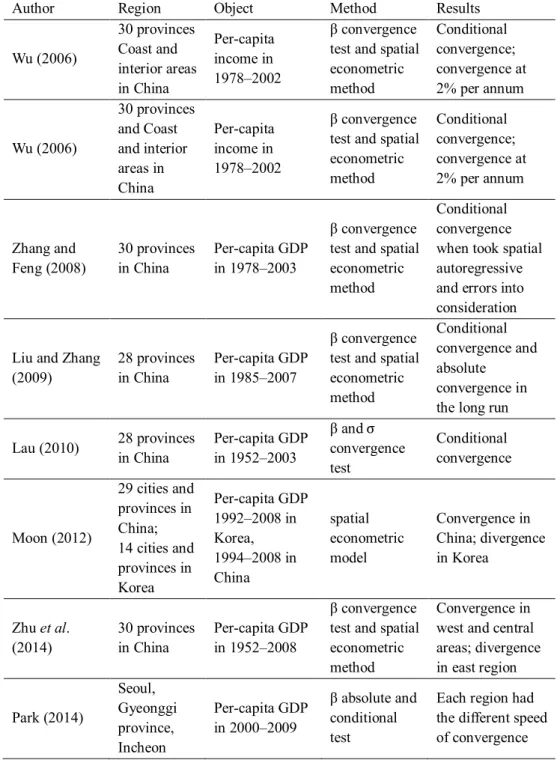
In Korea, many previous studies provided evidences on regional convergence. Kim (1996) set up a regional growth model using Korean regional per capita income data of 1977 and 1987, conclude that Korean economic policies were proved to be biased toward national growth rather than balanced regional growth in both years with a rate of convergence of around 0.0456; And the best way of achieving balanced regional growth was to raise the interregional mobility of production factors, especially the capital stock. Yu and Park (2004) studied convergence of regional income and determinants of regional economic growth in Korea regional panel data in terms of per capita GRDP, human capital and savings rate by β and σ convergence and panel-roots test suggested that regional GRDP did not converge and human capital strongly contributed to economic growth in the long-run. Moon (2012) examined absolute convergence and conditional convergence in Korea and China, using spatial econometrics which consider spatial dependence and spatial heterogeneity and found evidence of convergence hypothesis in the periods from 1994 to 2008 in China and divergence in the periods from 1992 to 2008 in Korea. Park (2014) analyzed the absolute and conditional convergence hypothesis and the determinants of productivity in manufacturing industries from 2000 to 2009 with Seoul metropolitan regions by using panel analysis. The results showed that the speed of absolute convergence are the fastest in Jungnang and Dongjak gu of
19
Seoul, but Gwanak and Nowon gu were the fastest regions in terms of conditional convergence; it was difficult to estimate the speed of convergence due to varying of regional characteristics for the Gyeonggi province, and for the Incheon, each region had the different speed of convergence showing that Ganghwa was 1.72% and Junggu was 1.52%. In addition, manufacturing location and government expenditure per capita coefficient affect to the value-added per capita in Seoul metropolitan regions significantly and suggested the government to develop regional manufacturing industries with R&D activities for the balanced regional development.
20
Table 3 Regional Convergence in China and Korea
Author Region Object Method Results
Chen and Fleisher (1996) 25 provinces in China Per-capita production in 1978–1993 β and σ convergence test Conditional convergence Kim (1996) Seoul, Busan , 9 provinces in Korea Per-capita GDP in 1977, 1987 Regional growth model Convergence rate around 0.0456 Gundlach (1997) 29 provinces in China Per-capita GDP in 1978–1989 β and σ convergence test Absolute convergence; convergence approximately 2% per annum
Raiser (1998) 29 provinces in China Per-capita GDP in 1978–1992 β convergence test
Conditional convergence; the convergence rate slow down since 1985 Cai and Du (2000) 29 provinces in China; and three geo-economic clubs Per-capita GDP in 1978–1998 β and σ convergence test Absolute convergence in east and central areas; conditional convergence in west and the whole nation Cai et al. (2002) 29 provinces in China Per-capita GDP in 1979–1998 β convergence test and inequality index Conditional convergence Shen and Ma (2002) Three geo-economic clubs Per-capita GDP in 1978–1999 β and σ convergence test Conditional convergence Yu and Park (2004) 11 cities and provinces in Korea Per- capita GDP in 1975-2000 β and σ convergence test; panel unit - roots test
Regional GDP did not converge
21
Table 3 Regional Convergence in China and Korea (Continued)
Author Region Object Method Results
Wu (2006) 30 provinces Coast and interior areas in China Per-capita income in 1978–2002 β convergence test and spatial econometric method Conditional convergence; convergence at 2% per annum Wu (2006) 30 provinces and Coast and interior areas in China Per-capita income in 1978–2002 β convergence test and spatial econometric method Conditional convergence; convergence at 2% per annum Zhang and Feng (2008) 30 provinces in China Per-capita GDP in 1978–2003 β convergence test and spatial econometric method
Conditional convergence when took spatial autoregressive and errors into consideration Liu and Zhang
(2009) 28 provinces in China Per-capita GDP in 1985–2007 β convergence test and spatial econometric method Conditional convergence and absolute convergence in the long run Lau (2010) 28 provinces in China Per-capita GDP in 1952–2003 β and σ convergence test Conditional convergence Moon (2012) 29 cities and provinces in China; 14 cities and provinces in Korea Per-capita GDP 1992–2008 in Korea, 1994–2008 in China spatial econometric model Convergence in China; divergence in Korea Zhu et al. (2014) 30 provinces in China Per-capita GDP in 1952–2008 β convergence test and spatial econometric method
Convergence in west and central areas; divergence in east region Park (2014) Seoul, Gyeonggi province, Incheon Per-capita GDP in 2000–2009 β absolute and conditional test
Each region had the different speed of convergence
22
A number of prior empirical studies on Chinese economic convergence have applied this testing approach for various study periods and obtained quite different conclusions regarding the patterns of regional disparities and growth differences in China. The most pertinent question is whether regional real GDP per capita was converging, indicating that the poor regions are reaching the same income levels as rich regions. Chen and Fleisher (1996); Gundlach (1997); Raiser (1998); Cai et al. (2002); Liu and Zhang (2009) and Lau (2010) reported evidence of conditional convergence in real GDP per capita across regions during the reform period, after controlling such covariates as population growth rate, investment rate, initial human capital, openness, technology, inflation rate, transport, telecommunication infrastructure and market distortion. Other studies further investigate the convergence within certain geo-economic clubs. Cai and Du (2000) did not find convergence for the entire nation between 1978 and 1998; however, they provided strong evidence of convergence for East and Central China. Shen and Ma (2002) produced similar results and stated that the East and Central regions converge at 2% per year. Yao and Zhang (2001) also reported evidence of club convergence from 1952 to 1997. Zhang et al., (2001) employed the time series techniques to investigate income convergence during 1952 to 1997, and their results indicated that the East and the West are converging at their own specific steady states.
Although studies on convergence are popular issues and compare with the previous studies, this study is the empirical research to link the convergence of regional
23
income and the impact from HSR. Many studies have focused on the economic impact of HSR on regional growth through various methods, however, relatively little attentions has been paid to the relationship between transportation infrastructure and regional disparity. In this regard, it would be suitable to conduct an empirical analysis using convergence method to find the impact of HSR on regional disparity. Furthermore, through the comparative analysis of the impact of HSR between in Korea and China, the different impacts of HSR on regional development are expected to be found by this study. Taking into account the different economic structures and political systems of the two countries, it would be worthwhile to compare the impact of HSR in China and Korea by the convergence method.
24
3. Analysis
According to the convergence theory introduced by Sala-i-Martin (1990) the phenomena of the β-convergence process analyzed whether poor countries or regions will catch up with rich ones, and describes the rate at which countries are converging. The general specification of the model is as follow.
, ,
= − 1 −
τlog(
,) +
,(1)
Where g represents the average annual growth rate of the GRDP per capita between year t + τ and year t, (1 − ) can be replaced by β which is a parameter
determining the effect of convergence or divergence, λ is the speed of convergence and τ is the relative period of analysis. The convention has been to interpret a negative estimate for β as a support for the convergence hypothesis (poorer regions, on average, grow faster than richer regions) since such an estimate would suggest that the growth rates in per capita incomes over τ year period were negatively correlated with initial income (y). Thus, this form of convergence has been labelled as β-convergence. In order to analyze the regional convergence associated with the development of HSR, this study applies a β-convergence model
25
described as:
(
)log (
) = c + β log (
GRDPP
) + γ
X
+
μ
(2)
: GRDP per capita in terminal year in region i : GRDP per capita in initial year in region i
: Independent variables in region i T: Time period (3 years)
c: Constant
β < 0, regional convergence effect; β > 0, regional divergence effect : Error term
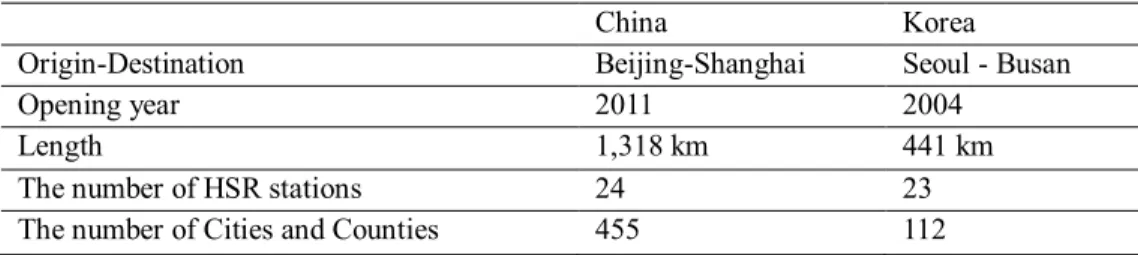
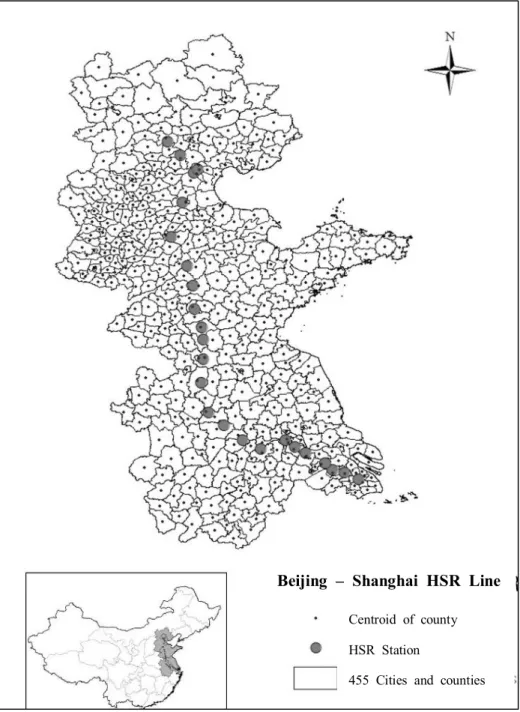
The spatial scope of this paper (see Table 4 and Figure 1) is the regions along the Beijing-Shanghai HSR line across 455 cities and counties within Anhui province, Jiangsu province, Shandong province, Hebei province; 112 cities and counties (guns) along Seoul-Busan HSR line across five provinces and six metropolitan cities (Gyeonggi province, North Chungcheong province, South Chungcheong province, North Gyeongsang province, South Gyeongsang province and Seoul special city, Busan, Daegu, Incheon, Gwangju, Daejeon, Ulsan). This paper also
26
apply the geographic information tool of ArcGIS and Google earth to draw the HSR line in the map and calculate the distance from the centroid of the cities and counties to the nearest HSR station as one of the important explanatory variables in the regression model. We use the cross-section data of two times point for the convergence framework. In Chinese case, the Beijing - Shanghai HSR line opened on 2011, therefore we used the data of 2010 and 2013. Chinese county level GRDP data on 2013 was published in the China Statistical Yearbook for Regional Economy 2014 by National Bureau of Statistics of China on April, 2015. In Korean case, the data is sourced from Korean Statistical Information Service (KOSIS) during the period between 2003 and 2006.
Table 4 Two HSR Lines
China Korea
Origin-Destination Beijing-Shanghai Seoul - Busan
Opening year 2011 2004
Length 1,318 km 441 km
The number of HSR stations 24 23
27
Figure1 Seoul – Busan HSR in Korea
Centroid of county HSR Station
112 Cities and counties Seoul – Busan HSR Line
28
Figure 2 Beijing – Shanghai HSR in China
Beijing – Shanghai HSR Line
Centroid of county HSR Station
29
Table 5 describes the variables used in our models. In order to investigate the impact of proximity of HSR station on regional growth, this study uses distance variable measured by the shortest distance to HSR stations from the centroid of each region, HSR station dummy variable (STATION) and an interaction variable composed of the existence of HSR stations (STATION) and initial GRDP per capita (GRDPP). The interaction term indicates the local convergence effect among regions with HSR station. This model also employs the growth rate of establishments (FIRM), population (POP), the existence of seaport (SEAPORT), airport (AIRPORT), and subway (SUBWAY) to control the other influencing factors on economic growth.
Table 5 Description of Variables
Variables Description GRDPP
GRDPP Ratio of the GRDP per capita in terminal year to that in initial year GRDPP GRDP per capita in initial year
POP Ratio of the population size in terminal year to that in initial year FIRM Ratio of the number of firms in terminal year to that in initial year SEAPORT Seaport dummy (exist =1; not exist = 0)
AIRPORT Airport dummy (exist =1; not exist = 0) SUBWAY Subway station dummy (exist =1; not exist = 0) DISTANCE Distance to nearest HSR station
30
We set three models explaining the economic convergence across whole nation and HSR passing regions in China and Korea. The whole nation level model is equation 3 and HSR passing regions are equation 4 and 5. In order to find the convergence effect of the station cities, two sets of HSR passing regions model (equation 4 and 5) are applied and the difference of the two models is an interaction term composed of among the cities with HSR stations in equation 5. Therefore, we can take three steps in order to analyze the regional convergence effect obtained by HSR: national level, and HSR region level and the HSR station city level.
( )log (
) = βlog (GRDPP ) + γ POP + γ FIRM + γ SEAPORT +
γ AIRPORT + γ SUBWAY + c + (3)
( )log (
) = βlog (GRDPP ) + γ POP + γ FIRM + γ SEAPORT +
γ AIRPORT + γ SUBWAY + γ DISTANCE + γ STATION + + (4)
( )log (
) = βlog (GRDPP ) + γ POP + γ FIRM + γ SEAPORT +
γ AIRPORT + γ SUBWAY + γ DISTANCE + γ STATION + γ log (GRDPP ) ∗
31
Figure 3 outlines the national level growth pattern of GDP per capital in the two counties between 1990 and 2014. From 2000, both two counties showed a trend of decline in GRDP per capita growth and China grew faster than Korea; and the blue line represents China experienced of a growth in GRDP per capita during construction of the HSR around 2009, and Korea experienced the most significant growth of GRDP per capita for the five years after the HSR was completed.
For the provincial level (see Figure 4 and 5), in the case of China, the levels of GRDP per capita in Beijing and Shanghai are much higher than the other regions and the national average, however, the growth rates of GRDP per capita in Beijing and Shanghai are the lowest for the last decade. Jiangsu Province and Anhui Province experienced the most significant growth of GRDP per capita during construction of the HSR. In particular, according to these figures, Shanghai witnessed the country’s slowest GDP growth in 2012 at 7.5%. Following Shanghai, Beijing registered the country’s second slowest GDP growth at 7.7%. Although the figure is the municipality’s weakest in the past 13 years, the quality of the city’s GDP growth has improved significantly. On the other side, the emergence of Anhui and Jiangsu can be justified by their fast economic growth and well-developed manufacturing industries. Besides, the city’s investments in the transportation and infrastructure have become the driving force behind economic growth. Most of the
32
big cities along the line including Beijing and Shanghai are the most developed city in China, and have experienced a long term development since the China’s reform and opening-up in 1970s. However, the other less developed areas get the opportunity to catch up with rich areas under the improving transportation and infrastructure condition after the opening of HSR. In the case of Korea, the levels of GRDP per capita in Ulsan are the highest among cities due to its well-developed manufacturing industries. Besides, the growth rates of GRDP per capita in Seoul and Busan are higher than the other regions and the national average (see Figure 6 and 7). In particular, Incheon, Busan, Ulsan and Seoul experienced the higher growth rate of GRDP per capita than the other regions during 2004 to 2007. The GRDP per capita growth experience a decline trend, however, for the three years after the HSR was completed, Korea enjoyed modest GRDP per capita growth.
0 2 4 6 8 10 12 14 16 1990 2000 2006 2007 2008 2009 2010 2011 2012 2013 2014
33
Figure 3 Annual Growth Rate of GDP per capita in China and Korea
Figure 4 GDP per capita in China
0 2 4 6 8 10 12 2000 2001 2002 2003 2004 2005 2006 2007 2008 2009 2010 2011 2012 2013 2014 China Beijing Shanghai others
34
Figure 5 Annual Growth Rate of GDP per capita in China
Figure 6 GDP per capita in Korea
0 0.05 0.1 0.15 0.2 0.25 0.3 2001 2002 2003 2004 2005 2006 2007 2008 2009 2010 2011 2012 2013 2014
Beijing Shanghai Hebei
Jiangsu Anhui Shandong
0 10,000 20,000 30,000 40,000 50,000 60,000 70,000 2000 2004 2007 2010 2013 2014
35
Figure 7 Annual Growth Rate of GDP per capita in Korea
Table 6 Annual Growth Rate of GDP per capita in China (Unit: $ in US currency)
China
(Constant 2010 price) 2010 2013 Annual growth rate
National Level 4,691 5,752 7.03%
HSR region
Beijing 11,067 12,461 4.03%
Shanghai 11,467 12,025 1.59%
Others 5,910 7,251 7.05%
Table 7 Annual Growth Rate of GDP per capita in Korea (Unit: $ in US currency)
Korea
(Constant 2003 price) 2003 2006 Annual growth rate
National Level 14,003 15,805 4.12% HSR region Seoul 16,627 18,192 3.04% 0 0.05 0.1 0.15 0.2 0.25 0.3 0.35 0.4 0.45 0.5 2004 2007 2010 2013 2014
Seoul Busan Daegu Incheon
36
Busan 10,421 11,611 3.67%
Others 13,834 15,804 4.54%
In order to investigate the impact of HSR on regional inequality, the convergence models are applied to test the effect of HSR on regional growth in terms of GRDP per capita. Table 8 and 9 shows the estimation results of convergence models in China and Korea. We set three models to analyze the convergence pattern associated with the HSR development in two different spatial scales, whole nation and HSR passing regions, for each country comparing the degree of convergence effect between the regions with and without HSR construction.
In the convergence model, the regional income inequality or convergence and their change over time are assessed by estimate of GRDPP variable (β coefficient). We can see all of the estimates of GRDPP variable in the three sets of models are negative and significant indicating that growth rates in per capita incomes over the three-year period were negatively correlated with the initial GRDP per capita in base year. It implies that no matter for the national level or for HSR region level, both China and Korea shows a trend of regional convergence after three years of the opening of HSR indicating that relatively lagged regions grow faster than developed regions. Therefore the gap in terms of GRDP per capita becomes smaller in two counties.
37
Then, we compare the estimate of GRDPP variable in national model and HSR region model without interaction variable. From Table 8, in Chinese case, we can see the estimate of GRDPP variable of HSR region is aslo smaller than the nationwide region (model 1 and 2), which implies that the speed of convergence became faster after the opening of HSR. Therefore, we could infer that the operation of HSR is helpful to accelerate economic growth and reduce the regional inequality in China. In Korean case (model 3 and 4), the estimated coefficient of convergence parameter (GRDPP variable) in both national model and HSR region model are negative and highly significant, indicating that a convergence process exists in these two spatial regions.
38
Table 8 Estimation Results of Convergence Models in China and Korea (1)
China Korea Model (1) Whole Nation Model (2) HSR passing region Model (3) Whole Nation Model (4) HSR passing region CONSTANT GRDPP POP FIRM SEAPORT AIRPORT SUBWAY DISTANCE STATION Adj R-sq. SAMPLE SIZE 0.359 (0.141) *** - 0.006 (0.010) *** - 0.262 (0.119) ** 0.052 (0.027) *** - 0.011 (0.075) 0.007 (0.044) * 0.006 (0.070) 0.326 387 0.492 (0.027) *** - 0.038 (0.005) *** 0.001 (0.065) ** 0.193 (0.185) - 0.032 (0.096) 0.007 (0.038) * 0.137 (0.092) - 0.000 (0.001) *** 0.000 (0.279) 0.366 455 - 0.044 (0.117) *** - 0.006 (0.009) *** - 0.002 (0.101) ** 0.007 (0.035) *** 0.211 (0.087) * 0.031 (0.028) 0.001 (0.066) 0.329 139 - 0.127 (0.184) *** - 0.006 (0.000) *** 0.001 (0.001) ** 0.146 (0.004) *** 0.025 (0.137) 0.103 (0.072) 0.006 (0.068) - 0.000 (0.004) ** 0.034 (0.003) *** 0.322 121 ***: statistically significant at 1% level; **: statistically significant at 5% level; *: statistically
39
Table 9 Estimation Results of Convergence Models in China and Korea (2)
China Korea Model (1) Whole Nation Model (5) HSR passing region Model (3) Whole Nation Model (6) HSR passing region CONSTANT GRDPP POP FIRM SEAPORT AIRPORT SUBWAY DISTANCE STATION GRDPP*STATION Adj R-sq. SAMPLE SIZE 0.359 (0.141) *** - 0.006 (0.010) *** - 0.262 (0.119) ** 0.052 (0.027) *** - 0.011 (0.075) 0.007 (0.044) * 0.006 (0.070) 0.326 387 0.299 (0.107) *** - 0.018 (0.007) *** 0.217 (0.106) ** 0.157 (0.025) *** - 0.015 (0.011) 0.003 (0.038) * 0.012 (0.067) - 0.002 (0.013) *** 0.039 (0.050) * - 0.008 (0.008) ** 0.384 455 - 0.044 (0.117) *** - 0.006 (0.009) *** - 0.002 (0.101) ** 0.007 (0.035) *** 0.211 (0.087) * 0.031 (0.028) 0.001 (0.066) 0.329 139 - 0.035 (0.091) *** - 0.006 (0.000) *** 0.001 (0.110) ** 0.000 (0.020) *** 0.322 (0.013) * 0.011 (0.033) 0.006 (0.041) - 3.51E-8 (0.015) ** 0.022 (0.055) * 0.0004 (0.000) ** 0.336 121 ***: statistically significant at 1% level; **: statistically significant at 5% level; *: statistically
40
Finally, we focus on comparing the estimate of interaction variable in HSR region model in the two counties. From Table 9, in both Chinese and Korean case, we can find the similar estimated coefficient of convergence parameter (GRDPP variable) in both national model (model 1 and 5) and HSR region model (model 3 and 6) with Table 8. The results indicate that at national level, a trend of convergence emerges during the three-year period of analysis in both China and Korea. At the HSR passing area level, HSR contributes to accelerate regional economic convergence and reduce the regional income disparities in China and Korea; however, HSR has different impacts on reducing the regional income inequality in China and Korea considering the HSR station cities.
Regarding the effect of the interaction parameters of GRDPP variable and station dummy variable, we can find a different effect in two counties. In Chinese case, the estimate is negative and significant suggesting that there is a trend of convergence among the cities having HSR station. The degree of convergence becomes greater among the cities having HSR station than the rest regions. This result seems to be consistent with the statistical data (see Table 6) showing that the growth rates of GRDP per capita in Beijing and Shanghai are lower than in the other regions during the three-year period associated with the opening of HSR. Most of the big cities along the line including Beijing and Shanghai are the most developed city in China, and have experienced a long term development since the China’s reform and opening-up in 1970s. However, the other less developed areas get the
41
opportunity to catch up with rich areas under the improving transportation and infrastructure condition after the opening of HSR.
Meanwhile, Korea is also moving to regional economic convergence at the national level and HSR passing region level. However, the positive and significant estimate of the interaction term indicates that divergence appears when only consider the station cities. The GRDP gaps between developed areas and lagged areas among the cities and counties having HSR stations growing wider. This seems to be consistent with previous studies showing a trend of convergence (Kim, et al., 2003), most Korean studies agreed that the inequality reached its peak and then revealed a steady decrease following Wiliamson’s (1965) inverted-U hypothesis (Heo, 2010; Hong and Wang, 2011; Yoo, 2012); however, one of the main regional problems in Korea is the over-concentration of both economic activity and population in the Seoul Metropolitan Area, including Seoul and its adjacent provinces (Kim, et al., 2003).The opening of Korean HSR leads to concentration of economic activity or population in large urban areas, such as Seoul and Busan, in turn absorbing the resources of lagged regions which lead to the regional inequality increase (Kim and Park, 2013). In summary, we can see that regional economic convergence in terms of GRDP show up in the national level and HSR passing areas but it appears to be weakened when only consider the station cities. Although the overall regional disparity in Korea has shown a trend of convergence on the whole, there is no evidence to show that HSR has positive impact on narrowing the
42
regional inequality in Korea; conversely, on the local perspective, the gaps among the cities where HSR station located even became wider.
Turn into the effects of distance variable and existence of HSR station on regional growth representing the proximity to HSR stations. The distance to the nearest HSR station has a significant negative influence on regional growth in both countries while the effects of the existence of HSR station are not significant. The results imply that HSR passing areas grow faster than remote areas supporting that the construction of HSR promotes the economic growth. Also, the HSR station dummy variables also show the positive effect on the regional growth. It means that the regions located nearby the HSR stations experienced a faster economic growth than the remote regions. In summary, among the station regions and non-station regions, proximity to non-stations has a positive impact on regional growth, and growth rates decrease as proximity gets worse in both countries. Besides, variables representing the endowment of transport infrastructure, such as of seaport, airport and subway turns out to have a positive effect on regional growth.
43
4. Conclusions
The purpose of this study is to analyze the impacts of opening the HSR on the regional income inequality in China and Korea. The convergence models are applied to test the effect of the HSR on regional growth in terms of GRDP per capita across 455 cities and counties along the Beijing-Shanghai HSR corridor and 112 cities and counties along the Seoul-Busan HSR corridor respectively. The results indicate that at national level, a trend of convergence emerges during the three-year period of analysis in both China and Korea. At the HSR passing area level, HSR contributes to accelerate regional economic convergence and reduce the regional income disparities in China and Korea. However, HSR has different impacts on reducing the regional income inequality in China and Korea considering the HSR station cities; in Korea, the regional inequality is rather wider among the cities where HSR station located.
For the further research, the quality of the HSR facility should be considered as well, such us ability in intra-modal and inter-modal transfer, the opening time of the station, the speed of the train as the measure of the characteristics of different HSR station. In addition, we could compare the convergence pattern depending on the types of dependent variable such as the growth rate of population, employment or number of firms for exploring the social and economic influence from HSR in various angles from the global aspect. Finally, compared with the developed
44
counties, China's HSR construction started relatively late but made a rapid expansion in last decade. Therefore, under the remarkable development of China HSR networks, it would be worthwhile for the further research to investigate the long-term growth effect on regional growth and balanced development from the HSR.
45
Reference
Albalate, Daniel, and Germà Bel (2012) “High‐Speed Rail: Lessons for Policy Makers from Experiences Abroad”, Public Administration Review. 72 (3): 336 - 349.
Amano, Kozo, and Dai Nakagawa (1990) “Study on Urbanization Impacts by New Stations of High Speed Railway”, Conference of Korean Transportation Association, Dejeon City.
Armstrong, Harvey W. (1995) “Convergence among Regions of the European Union, 1950–1990”, Papers in Regional Science. 74 (2): 143 - 152.
Aschauer, David Alan (1989) “Is Public Expenditure Productive?”, Journal of Monetary
Economics. 23 (2): 177 - 200.
Azzoni, Carlos R. (2001) “Economic Growth and Regional Income Inequality in Brazil”,
The annals of regional science. 35 (1): 133 - 152.
Banister, David, and Yossi Berechman (2001) “Transport Investment and the Promotion of Economic Growth”, Journal of Transport Geography. 9 (3): 209 - 218.
Berechman, Joseph, Dilruba Ozmen, and Kaan Ozbay (2006) “Empirical Analysis of Transportation Investment and Economic Development at State, County and Municipality Levels”, Transportation. 33 (6): 537 - 551.
Beyazit, Eda (2015) “Are Wider Economic Impacts of Transport Infrastructures Always Beneficial? Impacts of the Istanbul Metro on the Generation of Spatio-Economic Inequalities”, Journal of Transport Geography. 45, 12 - 23.
Boarnet, Marlon G. (1996) “The Direct and Indirect Economic Effects of Transportation Infrastructure”, University of California Transportation Center.
Bonnafous, Alain (1987). “The regional impact of the TGV”, Transportation. 14 (2): 127-137.
Brotchie, John F. (1991) “Fast Rail Networks and Socioeconomic Impacts”, In Cities of the
21st Century: New Technologies and Spatial Systems, Brotchie, Batty, Hall, and
Newton, eds., New York: Longman Cheshire: 25 - 37.
Bruinsma, Frank, and Piet Rietveld (1993) “Urban Agglomerations in European Infrastructure Networks”, Urban Studies. 30 (6): 919 - 934.
46
Cai, Fang, Dewen Wang, and Yang Du (2013) “Regional Disparity and Economic Growth in China: The Impact of Labor Market Distortions”, China Economic Review. 13 (2): 197-212.
Campos, Javier, and Gines De Rus (2009) “Some Stylized Facts about High-Speed Rail: A Review of HSR Experiences around the World”, Transport Policy. 16 (1): 19 - 28. Chen, Guineng, and Silva J.A. (2013) “Regional Impacts of High-Speed Rail: A Review of
Methods and Models”, Transportation Letters. 5 (3): 131 - 143.
Cho, Namgeon, Hoonki Lee, and Sihyun Jin (2005) “Analysis on the Straw Effect by the HSR (High Speed Rail): Focusing on the Shopping Trips”, The Korea Spatial
Planning Review. 47, 107 - 123.
De Rus, Ginés, and Vicente Inglada (1997) “Cost-Benefit Analysis of the High-Speed Train in Spain”, The Annals of Regional Science. 31 (2): 175 - 188.
Demurger, Sylvie (2001) “Infrastructure Development and Economic Growth: an Explanation for Regional Disparities in China?”, Journal of Comparative
Economics. 29 (1): 95 - 117.
Evans, Paul, and Georgios Karras (1994) “Are Government Activities Productive? Evidence from a Panel of US States”, The Review of Economics and Statistics. 1 - 11.
Fan, C. Cindy, and Emilio Casetti (1994) “The Spatial and Temporal Dynamics of US Regional Income Inequality, 1950-1989.” The Annals of Regional Science. 28 (2): 177-196.
Forkenbrock, David J., and Norman SJ Foster (1990) “Economic Benefits of a Corridor Highway Investment”, Transportation Research. Part A. 24 (4): 303-312.
Fujita, Masahisa, and Dapeng Hu (2001) “Regional Disparity in China 1985-1994: The Effects of Globalization and Economic Liberalization”, The Annals of Regional
Science. 35 (1): 3-37.
Gillen, David W. (1996) “Transportation Infrastructure and Economic Development: A Review of Recent Literature”, Logistics and Transportation Review. 32 (1): 39. Gutiérrez, Javier (2001) “Location, Economic Potential and Daily Accessibility: An
Analysis of the Accessibility Impact of the High-Speed Line Madrid–Barcelona– French Border”, Journal of Transport Geography. 9 (4): 229 - 242.
47
Haynes, Kingsley E. (1997) “Labor Markets and Regional Transportation Improvements: The Case of High-Speed Trains an Introduction and Review”, The Annals of
Regional Science. 31 (1): 57 - 76.
Heo, Jaewan (2010) “A Critical Review on the Straw Effects of High Speed Train”, Journal
of the Korean Urban Management Association. 23 (4): 59 - 74.
Higgins, Matthew J., Daniel Levy, and Andrew T. Young (2006) “Growth and Convergence across the United States: Evidence from County-Level Data”, The Review of
Economics And Statistics. 88 (4): 671 - 681.
Hirota, Ryogo (1984) “Present Situation and Effects of the Shinkansen”, Transport Policy
and Decision Making.
Hong, Junjie, Zhaofang Chu, and Qiang Wang (2011) “Transport Infrastructure and Regional Economic Growth: Evidence from China”, Transportation. 38 (5): 737 - 752.
Jo, Jaeuk, and Myungie Woo(2014) “The Impacts of High Speed Rail on Regional Economy and Balanced Development: Focused on Gyeongbu and Gyeongjeon Lines of Korea Train Express (KTX)”, Journal of The Korea Planning
Association. 49 (5): 263 - 278.
Jun, Eunha, and Seongwoo Lee (2007) “The Effects of Rapid Rail Transit on Balanced Regional Development”, Seoul Studies. 8 (4): 73 - 87.
Keeler, Theodore E., and John S. Ying (1988) “Measuring the Benefits of a Large Public Investment: The Case of the Us Federal-aid Highway System”, Journal of Public
Economics. 36 (1): 69 - 85.
Kim, Hyun Woo, Duheon Lee and Heesung Park (2013) “The Impact of Gyeongbu High Speed Rail Construction on Regional Economic Growth”, Journal of Civil
Engineering. 17 (6): 1206 - 1212.
Kim, Euijune (1998) “Economic Gain and Loss from Public Infrastructure Investment”,
Growth and Change. 29 (4): 445 - 469.
Kim, Euijune, and Myungsoo Shin (2002) “Estimation on Regional Benefit and Optimal Level of Road Capital Stock”, Journal of Infrastructure Systems. 8 (3): 96 - 102. Kim, Euijune, and Younhee Jeong (2003) “Decomposition of Regional Income Inequality