INTRODUCTION
Communication difficulties are common problems in
indi-viduals with cerebral palsy (CP). The estimated prevalence for communication problems in CP ranges widely from 38% to 78%, depending on the definition of communication disorders.1-5 The Communication Function Classification System (CFCS) was developed to classify functional communication ability into five levels for individuals with CP.6 The Viking Speech Scale (VSS) is a four-level rating scale developed to classify func-tional speech intelligibility in daily life for individuals with CP.7 In addition, the Speech Language Profiles Groups (SLPG) paradigm separates children based on the presence or absence of speech motor involvement and language/cognitive involve-ment.8,9 CFCS, VSS, and SLPG assess communication function, speech intelligibility, and both speech motor and language/
Received: January 25, 2018 Revised: April 10, 2018 Accepted: May 3, 2018
Corresponding author: Eun Sook Park, MD, PhD, Department of Rehabilitation
Medicine, Severance Hospital, Research Institute of Rehabilitation Medicine, Yonsei University College of Medicine, 50-1 Yonsei-ro, Seodaemun-gu, Seoul 03722, Korea. Tel: 82-2-2228-3712, Fax: 82-2-363-2795, E-mail: [email protected]
•The authors have no financial conflicts of interest. © Copyright: Yonsei University College of Medicine 2018
This is an Open Access article distributed under the terms of the Creative Com-mons Attribution Non-Commercial License (http://creativecomCom-mons.org/licenses/ by-nc/4.0) which permits unrestricted non-commercial use, distribution, and repro-duction in any medium, provided the original work is properly cited.
Functional Communication Profiles in Children with
Cerebral Palsy in Relation to Gross Motor Function and
Manual and Intellectual Ability
Ja Young Choi
1, Jieun Park
2, Yoon Seong Choi
3, Yu-ra Goh
1, and Eun Sook Park
11Department of Rehabilitation Medicine, Severance Hospital, Research Institute of Rehabilitation Medicine, Yonsei University College of Medicine, Seoul;
2Department of Rehabilitation Speech-Language Therapy, Severance Rehabilitation Hospital, Seoul; 3Department of Radiology, Severance Hospital, Yonsei University College of Medicine, Seoul, Korea.
Purpose: The aim of the present study was to investigate communication function using classification systems and its association with other functional profiles, including gross motor function, manual ability, intellectual functioning, and brain magnetic reso-nance imaging (MRI) characteristics in children with cerebral palsy (CP).
Materials and Methods: This study recruited 117 individuals with CP aged from 4 to 16 years. The Communication Function Classification System (CFCS), Viking Speech Scale (VSS), Speech Language Profile Groups (SLPG), Gross Motor Function Classi-fication System (GMFCS), Manual Ability ClassiClassi-fication System (MACS), and intellectual functioning were assessed in the chil-dren along with brain MRI categorization.
Results: Very strong relationships were noted among the VSS, CFCS, and SLPG, although these three communication systems provide complementary information, especially for children with mid-range communication impairment. These three commu-nication classification systems were strongly related with the MACS, but moderately related with the GMFCS. Multiple logistic re-gression analysis indicated that manual ability and intellectual functioning were significantly related with VSS and CFCS func-tion, whereas only intellectual functioning was significantly related with SLPG functioning in children with CP. Communication function in children with a periventricular white matter lesion (PVWL) varied widely. In the cases with a PVWL, poor functioning was more common on the SLPG, compared to the VSS and CFCS.
Conclusion: Very strong relationships were noted among three communication classification systems that are closely related with intellectual ability. Compared to gross motor function, manual ability seemed more closely related with communication function in these children.
Key Words: Cerebral palsy, communication, speech, language, functional classification
pISSN: 0513-5796 · eISSN: 1976-2437 Yonsei Med J 2018 Jul;59(5):677-685
cognition ability, respectively.
Among neuroimaging studies, brain magnetic resonance im-aging (MRI) is regarded as the most suitable tool to visualize brain lesion and to obtain insight into the functional outcomes of patient with CP.10,11 However, studies of communication func-tion in relafunc-tion with brain MRIs are still limited. In previous studies,4,5,12 significant associations between CFCS and gross motor function and manual ability were demonstrated. How-ever, the associations of VSS or SLPG with gross motor func-tion and manual ability have not yet been investigated, to the best of our knowledge. According to previous studies, cogni-tive function plays a key role in communication function5,12,13 and speech and language development.14
Therefore, this study intended to investigate communication function using all three communication classification systems in order to comprehensively capture speech, communication, and language abilities, and also to identify relationships be-tween communication function and gross motor function, manual ability, and intellectual function in children with CP.
MATERIALS AND METHODS
Study design and participantsThis prospective, cross-sectional, observational study was con-ducted in a university-affiliated, tertiary-care hospital. Among the children who were admitted to our hospital for intensive therapy between March 2016 and February 2017, children with CP aged from 4 to 16 years whose primary caregivers agreed to participate were recruited for the present study. In total, 117 children with CP participated in the study. The mean age of the subjects was 7.0 years (range 4−16). The general characteristics of the participating children are presented in Table 1.
Informed consent was obtained from the primary caregiver and/or the participants according to the rules of the Institutional Review Board (IRB) of our hospital. This study was conducted after obtaining approval from the IRB in Severance Hospital (approved number: 4-2016-0006).
Communication function
The CFCS was developed to classify functional communica-tion ability into five levels for children with CP aged 2 years and older.6 It seeks to classify overall communication effectiveness in everyday situations based on the individual’s ability to act as both a sender and receiver of information, regardless of the mo-dalities used.8 On the other hand, the VSS is a four-level rating scale developed to classify functional speech intelligibility in daily life for children with CP aged 4 years and older. Both the VSS and CFCS are valid and reliable tools for classifying com-munication function.6-8,15 Thus, it has been proposed to adopt the VSS to classify motor speech abilities, while the CFCS can be used to classify a broader communication function for epi-demiological surveillance of communication function in
chil-dren with CP.15,16
The SLPG paradigm separates children based on the pres-ence or abspres-ence of speech motor involvement and language/ cognitive involvement. It is known as a valid and reliable tool for classifying speech and language ability in children with CP aged 4 years and older.8,9
The VSS, CFCS, and SLPG were determined by a speech-lan-guage pathologist (Park J) with more than 5 years of experi-ence with children with CP. In addition, speech-language pa-thologist classified the CFCS level based on direct observation of the child and also interviews with parents to get the most accurate and comprehensive information about communica-tion from the child in various situacommunica-tions with familiar and unfa-miliar partners. According to a previous study,8 the SLPG can be classified into four major groups: level I (no speech-motor involvement, age appropriate, or impaired language/cogni-tion), level II (speech-motor disorder, age appropriate lan-Table 1. Characteristics of the Participants
Variables n=117 Sex Male 65 (55.6) Female 52 (44.4) Gestational age (wk) 32.8±4.94 (24–42) Preterm 99 (84.6) Term (≥37 wk) 18 (15.4)
Age at assessment (yr) 7.0±3.45 (4–16) GMFCS Level I 25 (21.4) Level II 31 (26.5) Level III 27 (23.1) Level IV 24 (20.5) Level V 10 (8.5) MACS Level I 38 (32.5) Level II 35 (29.9) Level III 16 (13.7) Level IV 19 (16.2) Level V 9 (7.7) Tone abnormality Spastic 110 (94.0) Dyskinetic 3 (2.6) Ataxic 3 (2.6) Mixed 1 (0.9) Motor distribution Unilateral 15 (12.8) Bilateral 102 (87.2) Visual impairment 6 (5.1) Hearing impairment 3 (2.6)
GMFCS, Gross Motor Functional Classification System; MACS, Manual Abili-ty Classification System.
Values are expressed as number of participants (percentage) or mean±SD (range).
guage/cognition), level III (speech-motor disorder, impaired language/cognition), and level IV (anarthria, impaired lan-guage/cognition).
Gross motor, manual ability, and cognitive functional assessment
For each child, Gross Motor Function Classification System (GMFCS)-Expanded and Revised and the Manual Ability Clas-sification System (MACS) functional levels were determined according to the instruction manuals by one of the authors (Choi JY).17,18
The intellectual functioning of the children was assessed using the Korean version of the Wechsler Intelligence Scale for Children, third edition (K-WISC-III), the Korean version of the Wechsler Preschool and Primary Scale of Intelligence, revised edition (K-WPPSI-R), or the Korean version of the Bayley Scales of Infant Development, second edition (K-BSID-II) according to the child’s ability. If the child could not complete the WPPSI, the K-BSID-II tests were applied. Based on the Full Scale Intel-ligence Quotient (IQ) or the mental developmental index (MDI) of the BSID, intellectual disability was defined as Full Scale IQ or MDI <70 according to the American Psychiatric Associa-tion’s Diagnostic and Statistical Manual of Mental Disorders.19 Compared to verbal IQ, performance IQ seems to be more dif-ficult to reflect the intellectual ability of the children due to their motor difficulty, and thus, verbal IQ or MDI <70 was defined as intellectual disability for this study.
Associated impairments
Based on review of the subjects’ medical records and an inter-view with a parent or primary caregiver, the presence of ac-companying impairments, such as epilepsy, severe visual im-pairments, or hearing impairment (HI) requiring hearing aids or cochlear implants, was investigated. Three children had HI. The severity of HI in the better ear at diagnosis was classified using the World Health Organization classification: mild, 26−40 dB HI; moderate, 41−60 dB HI; severe, 61−80 dB HI; and profound, >80 dB HI.20 According to this classification, two chil-dren had mild HI and one child had profound HI. The child with profound HI had undergone cochlear implantation; the other two children wore hearing aids. All of them had improved hearing ability after the intervention. Their functional classifi-cations were VSS/CFCS/SLPG level II or III (II/III=2/1) with GMFCS level I and MACS I or II (I/II=1/2).
Three children had functional blindness in both eyes, while three other children had a percutaneous endoscopic gastros-tomy feeding tube. All of these six children were at GMFCS/ MACS/CFCS level IV (n=1) or V (n=5) with VSS/SLPG level III (n=1) or IV (n=5).
The definition of epilepsy history requires the occurrence of at least one epileptic seizure.21
Brain MRI
All brain MRI studies were performed using either a 1.5 tesla or 3 tesla MRI (Achieva 1.5 Tesla/3.0 Tesla, Philips Medical Sys-tems, Best, the Netherlands). A total of 115 children under-went brain MRI, the results of which were entered into a pic-ture archiving and communication system (PACS). Two patents were excluded because of lack of MRI results in the PACS of our hospital. The brain MRI images were reviewed and classified into normal, congenital malformation, periven-tricular white matter lesion (PVWL), deep gray matter lesion, focal infarct, cortical/subcortical lesion, and others according to a previous study.10 PVWL patients were subgrouped into three levels: mild (hyperintensity in periventricular white matter), moderate (hyperintensity+ventricular wall irregulari-ty), and severe (diffuse PVWL+ventricular dilatation) accord-ing to our previous study.22 The classification of brain MRI was performed by a neuroradiologist (Choi YS) who was blinded to the children’s clinical condition.
Statistical analyses
Statistical analysis was performed using the Statistical Pack-age for the Social Sciences for Windows (SPSS ver. 23.0, IBM Corp., Armonk, NY, USA). Descriptive statistics were calculat-ed for the characteristic of participants. Spearman correlation analysis was used to investigate the associations between the communication classification systems (VSS/CFCS/SLPG) and between communication function and other functional pro-files (GMFCS/MACS). A Spearman’s correlation ≥0.80 was de-fined as very strong, 0.80 to 0.60 as strong, 0.60 to 0.40 as mod-erate, 0.40 to 0.20 as weak, and <0.20 as very weak.23
The chi-square test or Fisher’s exact test was used to compare differences in the distributions of communication classifica-tion systems in relaclassifica-tion with brain MRI characteristics. Post-hoc Bonferroni correction was used for multiple comparisons. Additionally, logistic regression analysis was performed to de-termine the independent risk factor of poor functioning in communication function. Multiple logistic regression analysis was performed on variables with an unadjusted effect and a
p<0.05 on simple logistic regression analysis. For logistic
re-gression analysis, the functional profiles, such as the GMFCS, MACS, VSS, CFCS, and SLPG, were grouped into two groups of good function (level I or II) and poor function (other levels). Sta-tistical significance was set at a p-value <0.05 for all statistics.
RESULTS
Communication function
Speech, gestures, eye gaze, facial expression, or pointing were the only communication methods for all of the children in our study. No one used speech generating devices or communi-cation boards or pictures. Descriptive cross tabulations among the communication functional classification systems are
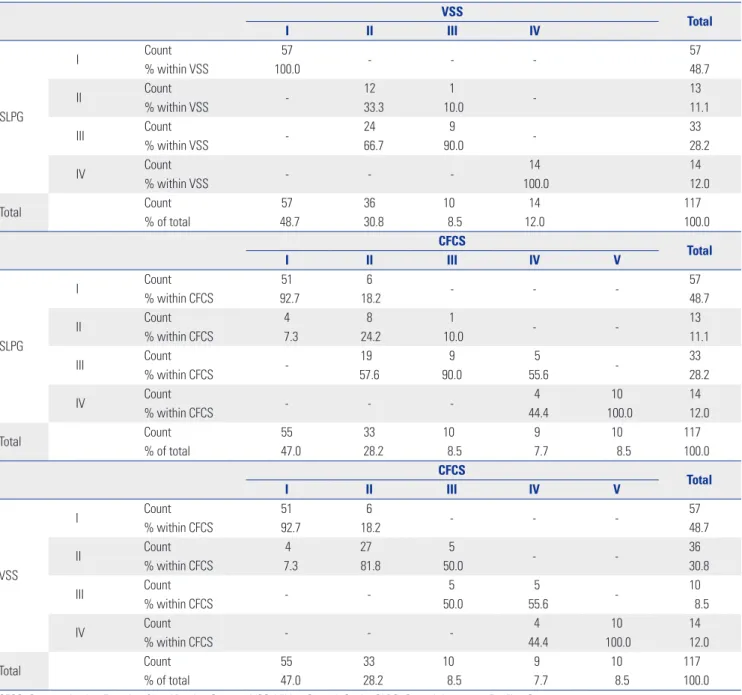
de-scribed in Table 2. The participants at VSS level I and IV were also classified into the corresponding levels of SLPG. On the other hand, VSS level II or III captured children with speech motor impairment but did not differentiate children with lan-guage impairment from children without lanlan-guage
impair-ment. In addition, there were substantial overlaps of the CFCS level with each SLPG or VSS levels. All three communication classification systems were very strongly related with each other (r>0.8, p<0.01) (Table 3).
Table 2. Cross-Tabulation Results among the VSS, CFCS, and SLPG
VSS Total I II III IV SLPG I Count 57 - - - 57 % within VSS 100.0 48.7 II Count - 12 1 - 13 % within VSS 33.3 10.0 11.1 III Count - 24 9 - 33 % within VSS 66.7 90.0 28.2 IV Count - - - 14 14 % within VSS 100.0 12.0 Total Count 57 36 10 14 117 % of total 48.7 30.8 8.5 12.0 100.0 CFCS Total I II III IV V SLPG I Count 51 6 - - - 57 % within CFCS 92.7 18.2 48.7 II Count 4 8 1 - - 13 % within CFCS 7.3 24.2 10.0 11.1 III Count - 19 9 5 - 33 % within CFCS 57.6 90.0 55.6 28.2 IV Count - - - 4 10 14 % within CFCS 44.4 100.0 12.0 Total Count 55 33 10 9 10 117 % of total 47.0 28.2 8.5 7.7 8.5 100.0 CFCS Total I II III IV V VSS I Count 51 6 - - - 57 % within CFCS 92.7 18.2 48.7 II Count 4 27 5 - - 36 % within CFCS 7.3 81.8 50.0 30.8 III Count - - 5 5 - 10 % within CFCS 50.0 55.6 8.5 IV Count - - - 4 10 14 % within CFCS 44.4 100.0 12.0 Total Count 55 33 10 9 10 117 % of total 47.0 28.2 8.5 7.7 8.5 100.0
CFCS, Communication Function Classification System; VSS, Viking Speech Scale; SLPG, Speech Language Profiles Group. Table 3. Correlation Coefficients among the Functional Profiles
GMFCS MACS VSS CFCS SLPG
VSS 0.497* 0.649* - 0.902* 0.969*
CFCS 0.513* 0.693* 0.902* - 0.874*
SLPG 0.485* 0.651* 0.969* 0.897*
-GMFCS, Gross Motor Functional Classification System; MACS, Manual Ability Classification System; VSS, Viking Speech Scale; CFCS, Communication Function Classification System; SLPG, Speech Language Profiles Group.
Associations with other functional classification systems Descriptive cross tabulations of the GMFCS and MACS against the CFCS are presented in Table 4. The children at level I of the GMFCS or MACS showed a wide range in communication function, spanning from level I to IV of the CFCS. In addition, communication function of children at GMFCS or MACS level IV or V spanned the full spectrum of the CFCS.
All three communication classification systems presented moderate relationships with the GMFCS and strong relation-ships with the MACS.
Factors related with communication function
In multiple logistic analysis, intellectual disability and poor functioning of manual ability were independent risk factors
for poor functioning in the CFCS and VSS, while intellectual disability was the only independent risk factor for poor func-tioning of SLPG. In the children with intellectual disability based on verbal IQ/MDI, the odds ratios (ORs) were 25.81 [95% confidence interval (CI), 3.05−218.06] for poor function-ing of CFCS, 12.30 (95% CI, 1.38−109.42) for poor functionfunction-ing of VSS, and 114.26 (95% CI, 20.97−622.69) for poor function-ing of SLPG. As for manual ability, the ORs were 10.91 (95% CI, 1.94−61.22) for poor functioning of CFCS and 20.75 (95% CI, 2.08−207.23) for poor functioning of VSS (Table 5).
Relations with brain MRI patterns
PVWL on brain MRI was the most predominant pattern, fol-lowed by deep gray matter lesion. The distributions of the three Table 4. Cross-Tabulation Results Showing Distributions of GMFCS/ MACS against CFCS
GMFCS MACS
I II III IV V I II III IV V Total
CFCS
I Count 18 18 14 5 - Count 31 18 5 1 - 55
% within GMFCS 72.0 58.1 51.9 20.8 % within MACS 81.6 51.4 31.2 5.3 47.0
II Count 5 10 7 10 1 Count 6 15 4 8 - 33
% within GMFCS 20.0 32.3 25.9 41.7 10.0 % within MACS 15.8 42.9 25.0 42.1 28.2
III Count 2 - 4 4 - Count - 2 6 2 - 10
% within GMFCS 8.0 14.8 16.7 % within MACS 5.7 37.5 10.5 8.5
IV Count - 3 2 3 1 Count 1 - 1 6 1 9
% within GMFCS 9.7 7.4 12.5 10.0 % within MACS 2.6 6.2 31.6 11.1 7.7
V Count - - - 2 8 Count - - - 2 8 10
% within GMFCS 8.3 80.0 % within MACS 10.5 88.9 8.5
Total Count 25 31 27 24 10 Count 38 35 16 19 9 117
% of total 21.4 26.5 23.1 20.5 8.5 % of total 32.5 29.9 13.7 16.2 7.7 100.0 GMFCS, Gross Motor Function Classification System; MACS, Manual Ability Classification System; CFCS, Communication Function Classification System. Table 5. Risk Factors for Poor Communication Function
CFCS VSS SLPG Unadjusted OR (95% CI) (p value) Adjusted OR (95% CI) (p value) Unadjusted OR (95% CI) (p value) Adjusted OR (95% CI) (p value) Unadjusted OR (95% CI) (p value) Adjusted OR (95% CI) (p value) Epilepsy history Yes (Ref: no) 5.37 (2.18−13.23) (<0.001*) 1.63 (0.46−5.79) (0.445) 6.61 (2.45−17.82) (<0.001*) 2.17 (0.59−8.01) (0.245) 4.95 (2.20−11.16) (<0.001*) 2.76 (0.57−13.38) (0.209) Cognition ID (Ref: no ID) 70.56 (9.10−546.87) (<0.001*) 25.81 (3.05−218.06) (0.003*) 48.30 (6.23−374.73) (<0.001*) 12.30 (1.38−109.42) (0.024*) 174.38 (35.34−860.51) (<0.001*) 114.26 (20.97−622.69) (<0.001*) GMFCS Poor functioning (Ref: good functioning)
6.62 (2.31−18.95) (<0.001*) 1.00 (0.19−5.36) (0.997) 9.28 (2.59−33.28) (0.001*) 1.53 (0.25−9.57) (0.647) 4.17 (1.87−9.27) (<0.001*) 0.57 (0.10−3.28) (0.525) MACS Poor functioning (Ref: good functioning)
33.70 (9.16−123.98) (<0.001*) 10.91 (1.94−61.22) (0.007*) 78.86 (10.05−618.89) (<0.001*) 20.75 (2.08−207.23) (0.010*) 15.69 (6.22−39.60) (<0.001*) 5.14 (0.89−29.74) (0.067) OR, odds ratio; CI, confidence interval; Ref, reference for odds ratio calculation, VSS, Viking Speech Scale; CFCS, Communication Function Classification System; SLPG, Speech Language Profiles Group; GMFCS, Gross Motor Function Classification System; MACS, Manual Ability Classification System; ID, intellectual dis-ability.
Communication ability based on CFCS/VSS/SLPG (good vs. poor functioning); Good functioning group refers to VSS, CFCS, SLPG, GMFCS, MACS, level I or II; Poor functioning group refers to VSS, CFCS, SLPG, GMFCS, MACS, level ≥III.
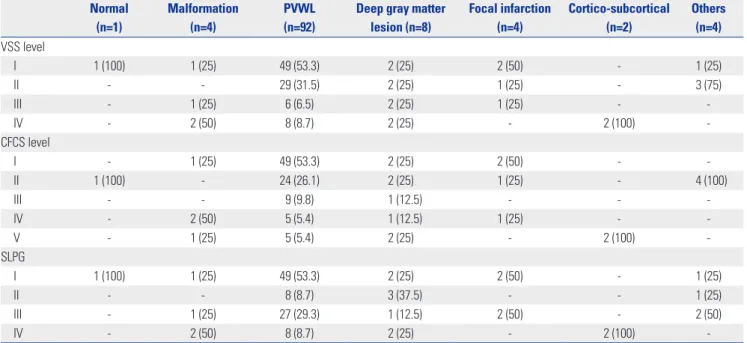
communication classification systems according to brain MRI characteristics are presented in Table 6. Children with PVWL and deep gray matter lesion spanned the full spectrum of clas-sification levels in all three clasclas-sification systems. Ninety-two children had PVWL on brain MRI, and poor functioning was more common in the SLPG than in the VSS or CFCS (p<0.05) (Table 7).
The severity of PVWL was significantly related with SLPG. Post hoc analysis with Bonferroni adjustment revealed that chil-dren with severe PVWL were likely to have more impairment in SLPG, compared to the children with mild PVWL (Table 8).
DISCUSSION
The use of the VSS and CFCS is recommended for classifying speech intelligibility and communication ability, respective-ly.15 On the other hand, Hustad and colleagues8 demonstrated that neither the VSS nor CFCS had sufficient sensitivity to
de-tect the presence of language impairment captured by the SLPG; thus, multiple tools are necessary to comprehensively describe speech, language, and communication profiles in children with CP. The substantial overlap of the CFCS level with each level of VSS and SLPG noted in the present study is consistent with this previous study. In addition, we found strong associations among the three different classifications systems. These findings can be explained by the fact that speech motor impairment is reflected in all three classification systems to a varying degree. In addition, the very close interactions among speech, language, and communication appear to contribute to the very strong associations among them. Although the use of all three communication systems is needed for a compre-hensive picture of speech, language, and communication func-tion in children with CP, the very strong associafunc-tions among the communication classification systems suggest that the use of one classification system, instead of all three, can produce rough information on communication difficulty in these chil-dren for surveillance studies involving retrospective data Table 6. Speech and Language Function according to Brain MRI Characteristics
Normal (n=1) Malformation (n=4) PVWL (n=92)
Deep gray matter lesion (n=8) Focal infarction (n=4) Cortico-subcortical (n=2) Others (n=4) VSS level I 1 (100) 1 (25) 49 (53.3) 2 (25) 2 (50) - 1 (25) II - - 29 (31.5) 2 (25) 1 (25) - 3 (75) III - 1 (25) 6 (6.5) 2 (25) 1 (25) - -IV - 2 (50) 8 (8.7) 2 (25) - 2 (100) -CFCS level I - 1 (25) 49 (53.3) 2 (25) 2 (50) - -II 1 (100) - 24 (26.1) 2 (25) 1 (25) - 4 (100) III - - 9 (9.8) 1 (12.5) - - -IV - 2 (50) 5 (5.4) 1 (12.5) 1 (25) - -V - 1 (25) 5 (5.4) 2 (25) - 2 (100) -SLPG I 1 (100) 1 (25) 49 (53.3) 2 (25) 2 (50) - 1 (25) II - - 8 (8.7) 3 (37.5) - - 1 (25) III - 1 (25) 27 (29.3) 1 (12.5) 2 (50) - 2 (50) IV - 2 (50) 8 (8.7) 2 (25) - 2 (100)
-MRI, magnetic resonance imaging; PVWL, periventricular white matter lesion; VSS, Viking Speech Scale; CFCS, Communication Function Classification System; SLPG, Speech Language Profiles Group.
Values are expressed as number of participants (percentage).
Table 7. Speech and Language Functioning in Children with PVWL
PVWL (n=92) p value VSS CFCS SLPG Overall Post-hoc Good function† 78 (84.8) 73 (79.3) 57 (62.0) 0.001* VSS vs. CFCS>0.999CFCS vs. SLPG=0.045* VSS vs. SLPG=0.003* Poor function‡ 14 (15.2) 19 (20.7) 35 (38.0)
PVWL, periventricular white matter lesion; VSS, Viking Speech Scale; CFCS, Communication Function Classification System; SLPG, Speech Language Profiles Group.
Values are expressed as number of participants (percentage).
*p<0.05 by chi square test, post hoc analysis with Bonferroni correction, †Good functioning group refers to VSS, CFCS, SLPG, level I or II, ‡Poor functioning group refers to VSS, CFCS, SLPG, level ≥III.
analysis.
The associations of the CFCS with the GMFCS and MACS in 222 children with CP were investigated for the first time by Hidecker and colleagues.4 In their study, the CFCS presented moderate associations with the GMFCS and MACS. The strong associations of the CFCS with the GMFCS and MACS were also demonstrated in other previous studies5,12 in which the sample sizes were much smaller than in Hidecker et al.’s report.4 On the other hand, we found strong relationship of CFCS and also VSS and SLPG with MACS. However, the associations were only moderate with GMFCS level. The close links of gross mo-tor and fine momo-tor skills with cognitive, social and language development has been found in typically developing children and also neurodevelopmental disorders.24,25 Recently, more close connection of fine motor skills with language develop-ment, as compared to gross motor function, has been demon-strated in the children with neurodevelopmental disorder. Ac-cording to recently published studies, deficits in language development were found to be more related with fine motor function, compared to gross motor function.25-27 The results of the present study also support the more significant role of man-ual ability for communication function, rather than gross mo-tor function, in children with CP.
The significant role of cognitive function in communication ability was presented in prior studies.5,12,13 We also found sig-nificant associations of cognitive function with all three com-munication function classification systems.
Recently, there has been a trend to delineate the functional outcomes of children with CP based on brain MRI findings in the early stage of life. As part of these efforts, communication
outcomes have been delineated in relation with brain lesion characteristics, although there have only been a few studies. Cortical/subcortical lesion, deep gray matter lesion, and brain malformation are associated with non-verbal status in chil-dren with CP.5,11,28,29 To the best of our knowledge, there has only been one report showing communication function based on the CFCS in relation with brain MRI characterization.5 In that study, PVWL was associated with more functional CFCS levels, while cortical/subcortical and deep gray matter lesions were associated with less functional CFCS levels. Recently, there have been emerging studies describing the wide range of mo-tor or cognitive outcomes in children with PVWL or deep gray matter lesion in relation with the severity of brain lesion.22,30-34 Also, in present study, we noted wide range variability in com-munication function in children with PVWL. In addition, we discovered that the severity of PVWL was only related with SLPG. The significant negative effect of PVWL on cognitive func-tional outcome22,31,35 and also significant associations between the severity of PVWL and cognitive function22 have been pub-lished in prior studies. In this context, the results of our study can be explained by the greater focus of the SLPG on cognitive/ language impairment, compared to the VSS and CFCS. In ad-dition, the children with PVWL were likely to exhibit poor func-tioning in SLPG, compared to VSS and CFCS. These findings also suggest that language/cognition seems to be more prob-lematic than speech intelligibility and communication func-tion in children with PVWL.
Limitations
The major limitation of the present study is in the distribution Table 8. Speech and Language Functioning according to Severity of PVWM
Mild PVWL (n=18) Moderate PVWL (n=42) Severe PVWL (n=32) p value
VSS level 0.099 I 9 (50.0) 26 (54.2) 13 (40.6) II 7 (38.9) 13 (31.0) 9 (28.1) III 2 (11.1) 1 (2.4) 4 (12.5) IV - 2 (4.8) 6 (18.8) CFCS level 0.253 I 11 (61.1) 26 (61.9) 11 (34.4) II 5 (27.8) 9 (21.4) 10 (31.3) III 1 (5.6) 5 (11.9) 4 (12.5) IV 1 (5.6) 1 (2.4) 3 (9.4) V - 1 (2.4) 4 (12.5) SLPG 0.024* I 9 (50.0) 26 (61.9) 13 (40.6) Mild vs. moderate>0.999 Mild vs. severe=0.029* Moderate vs. severe=0.297 II 5 (27.8) 3 (7.1) 1 (3.1) III 4 (22.2) 11 (26.2) 12 (37.5) IV - 2 (4.8) 6 (18.8)
PVWL, periventricular white matter lesion; VSS, Viking Speech Scale; CFCS, Communication Function Classification System; SLPG, Speech Language Profiles Group.
Values are expressed as number of participants (percentage).
of communication function and brain MRI characterization. Compared to previous studies, the ratio of poor communica-tion funccommunica-tion to good funccommunica-tioning was smaller. This may affect the degree of associations between communication functions and other functional levels. However, our results are in line with those of previous studies, and thus, the effect seems not to be significant. Further study is needed with a larger sample of children with poor communication function. As for the re-lation with brain MRI characterization, there were many cases with PVWL; thus, the characteristics of the three communica-tion classificacommunica-tion systems in children with PVWL are worthy of note. However, the number of children with other brain MRI characteristics was too small to provide conclusive data. Thus, further studies are needed on communication function in chil-dren with other types of brain lesions. In addition, the majori-ty of the children were spastic majori-type, another limitation of our study. Compared to the children with bilateral spastic CP, the children with dyskinetic CP had more severe gross motor im-pairment, although there were no statistical differences in com-munication function between groups.5 It might be possible that the degree of associations of communication function with other functions, such as gross motor function and manual abil-ity, may be different according to CP type, and thus, further studies are warranted in terms of the associations of communi-cation function with other functions according to the types of CP. In conclusion, the three communication classification sys-tems were very strongly related with each other. However, the substantial overlapping of the CFCS level with each level of VSS and SLPG suggested that the use of all three communica-tion classificacommunica-tion systems is recommended for a comprehen-sive description of speech, language, and communication abil-ity in children with CP. Intellectual function was also found to be a significant factor related with the functioning of all three communication function classification systems. In addition, more close connection of manual ability with communication function was demonstrated, than gross motor function in these children. In the children with PVWL, a wide range of commu-nication outcomes were noted, and the severity of PVWL was significantly related with SLPG.
ORCID
Ja Young Choi https://orcid.org/0000-0001-9829-8922 Eun Sook Park https://orcid.org/0000-0002-9144-3063
REFERENCES
1. Coleman A, Weir KA, Ware RS, Boyd RN. Relationship between communication skills and gross motor function in preschool-aged children with cerebral palsy. Arch Phys Med Rehabil 2013;94: 2210-7.
2. Parkes J, Hill N, Platt MJ, Donnelly C. Oromotor dysfunction and communication impairments in children with cerebral palsy: a register study. Dev Med Child Neurol 2010;52:1113-9.
3. QCPR. Report of the Queensland Cerebral Palsy Register: 1996-2005 birth years. Fortitude valley (QLD): QPCR; 2012.
4. Hidecker MJ, Ho NT, Dodge N, Hurvitz EA, Slaughter J, Workinger MS, et al. Inter-relationships of functional status in cerebral palsy: analyzing gross motor function, manual ability, and communica-tion funccommunica-tion classificacommunica-tion systems in children. Dev Med Child Neurol 2012;54:737-42.
5. Himmelmann K, Lindh K, Hidecker MJ. Communication ability in cerebral palsy: a study from the CP register of western Sweden. Eur J Paediatr Neurol 2013;17:568-74.
6. Hidecker MJ, Paneth N, Rosenbaum PL, Kent RD, Lillie J, Eulen-berg JB, et al. Developing and validating the Communication Function Classification System for individuals with cerebral palsy. Dev Med Child Neurol 2011;53:704-10.
7. Pennington L, Virella D, Mjøen T, da Grac¸a Andrada M, Murray J, Colver A, et al. Development of the Viking Speech Scale to classify the speech of children with cerebral palsy. Res Dev Disabil 2013;34:3202-10.
8. Hustad KC, Oakes A, McFadd E, Allison KM. Alignment of classi-fication paradigms for communication abilities in children with cerebral palsy. Dev Med Child Neurol 2016;58:597-604.
9. Hustad KC, Gorton K, Lee J. Classification of speech and language profiles in 4-year-old children with cerebral palsy: a prospective preliminary study. J Speech Lang Hear Res 2010;53:1496-513. 10. Bax M, Tydeman C, Flodmark O. Clinical and MRI correlates of
cerebral palsy: the European Cerebral Palsy Study. JAMA 2006; 296:1602-8.
11. Himmelmann K, Uvebrant P. Function and neuroimaging in ce-rebral palsy: a population-based study. Dev Med Child Neurol 2011;53:516-21.
12. Compagnone E, Maniglio J, Camposeo S, Vespino T, Losito L, De Rinaldis M, et al. Functional classifications for cerebral palsy: cor-relations between the gross motor function classification system (GMFCS), the manual ability classification system (MACS) and the communication function classification system (CFCS). Res Dev Disabil 2014;35:2651-7.
13. Vos RC, Dallmeijer AJ, Verhoef M, Van Schie PE, Voorman JM, Wiegerink DJ, et al. Developmental trajectories of receptive and expressive communication in children and young adults with ce-rebral palsy. Dev Med Child Neurol 2014;56:951-9.
14. Choi JY, Choi YS, Park ES. Language development and brain mag-netic resonance imaging characteristics in preschool children with cerebral palsy. J Speech Lang Hear Res 2017;60:1330-8.
15. Virella D, Pennington L, Andersen GL, Andrada Mda G, Greitane A, Himmelmann K, et al. Classification systems of communica-tion for use in epidemiological surveillance of children with cere-bral palsy. Dev Med Child Neurol 2016;58:285-91.
16. Barty E, Caynes K, Johnston LM. Development and reliability of the Functional Communication Classification System for chil-dren with cerebral palsy. Dev Med Child Neurol 2016;58:1036-41. 17. Eliasson AC, Krumlinde-Sundholm L, Rösblad B, Beckung E,
Arner M, Ohrvall AM, et al. The Manual Ability Classification Sys-tem (MACS) for children with cerebral palsy: scale development and evidence of validity and reliability. Dev Med Child Neurol 2006;48:549-54.
18. Palisano RJ, Rosenbaum P, Bartlett D, Livingston MH. Content va-lidity of the expanded and revised Gross Motor Function Classifi-cation System. Dev Med Child Neurol 2008;50:744-50.
19. American Psychiatric Association. Diagnostic and statistical manual-text revision (DSM-IV-TRim, 2000). 4th ed. Washington, DC: American Psychiatric Association; 2000.
20. World Health Organization. Grades of hearing impairment [ac-cessed on 2017 May 25]. Available at http://www.who.int/pbd/
deafness/hearing_impairment_grades/en/.
21. Fisher RS, van Emde Boas W, Blume W, Elger C, Genton P, Lee P, et al. Epileptic seizures and epilepsy: definitions proposed by the International League Against Epilepsy (ILAE) and the Interna-tional Bureau for Epilepsy (IBE). Epilepsia 2005;46:470-2. 22. Choi JY, Rha DW, Park ES. The effects of the severity of
periven-tricular leukomalacia on the neuropsychological outcomes of preterm children. J Child Neurol 2016;31:603-12.
23. Swinscow T, revised by Campbell MJ. Statistics at square one. 9th ed. London: BMJ Publishing Group; 1996.
24. Sala DA, Shulman LH, Kennedy RF, Grant AD, Chu ML. Idiopath-ic toe-walking: a review. Dev Med Child Neurol 1999;41:846-8. 25. Kim H, Carlson AG, Curby TW, Winsler A. Relations among
mo-tor, social, and cognitive skills in pre-kindergarten children with developmental disabilities. Res Dev Disabil 2016;53-54:43-60. 26. Gernsbacher MA, Sauer EA, Geye HM, Schweigert EK, Hill
Gold-smith H. Infant and toddler oral- and manual-motor skills predict later speech fluency in autism. J Child Psychol Psychiatry 2008;49: 43-50.
27. Mody M, Shui AM, Nowinski LA, Golas SB, Ferrone C, O’Rourke JA, et al. Communication deficits and the motor system: explor-ing patterns of associations in autism spectrum disorder (ASD). J Autism Dev Disord 2017;47:155-62.
28. Zhang JY, Oskoui M, Shevell M. A population-based study of communication impairment in cerebral palsy. J Child Neurol
2015;30:277-84.
29. Geytenbeek JJ, Oostrom KJ, Harlaar L, Becher JG, Knol DL, Bark-hof F, et al. Language comprehension in nonspeaking children with severe cerebral palsy: Neuroanatomical substrate? Eur J Pae-diatr Neurol 2015;19:510-20.
30. Choi JY, Choi YS, Rha DW, Park ES. The clinical outcomes of deep gray matter injury in children with cerebral palsy in relation with brain magnetic resonance imaging. Res Dev Disabil 2016;55:218-25.
31. Resic´ B, Tomasovic´ M, Kuzmanic´-Samija R, Lozic´ M, Resic´ J, Solak M. Neurodevelopmental outcome in children with periventricu-lar leukomalacia. Coll Antropol 2008;32 Suppl 1:143-7.
32. Krägeloh-Mann I, Helber A, Mader I, Staudt M, Wolff M, Groenendaal F, et al. Bilateral lesions of thalamus and basal ganglia: origin and outcome. Dev Med Child Neurol 2002;44:477-84.
33. Imamura T, Ariga H, Kaneko M, Watanabe M, Shibukawa Y, Fu-kuda Y, et al. Neurodevelopmental outcomes of children with peri-ventricular leukomalacia. Pediatr Neonatol 2013;54:367-72. 34. Reid SM, Dagia CD, Ditchfield MR, Reddihough DS. Grey matter
injury patterns in cerebral palsy: associations between structural involvement on MRI and clinical outcomes. Dev Med Child Neu-rol 2015;57:1159-67.
35. Woodward LJ, Clark CA, Bora S, Inder TE. Neonatal white matter abnormalities an important predictor of neurocognitive outcome for very preterm children. PLoS One 2012;7:e51879.