INTRODUCTION
Water radiolysis indicates the dissociation of water mole-cules by ionizing radiation. Its intermediates and products include water radical cation (H2O∙++), excited water (H2O*), hydronium ion (H3O++), hydroxyl radical (∙OH), hydrogen ion (H++
), hydrated electron (e
-aq), hydrogen radical (H∙), hyd-rogen peroxide (H2O2), hydroxyl ion (OH-), superoxide anion (O2∙-), and molecular hydrogen (H2) (Spinks and Woods 1990; Zielonka et al. 2006). Among them,∙OH, O2∙-, and H2O2are biologically toxic and damaging to cellular
compo-nents (Cadenas 1989; Lidon and Henriques 1993). In addi-tion, photosynthesis of plants produces another damaging agent, singlet oxygen (1O
2), which is enhanced by gamma irradiation due to the inhibition of zeaxanthin-dependent thermal energy dissipation (Moon et al. 2008; unpublished data). Accordingly, 1O
2also belongs to the reactive oxygen species (ROS) responsible for the radiation-induced biologi-cal damages.
The primary difficulty in most of ROS detecting is due to the short lifetime and reactivity (Ba ˇci´c and Mojoviˇc 2005). To assay ROS, it is necessary to introduce into the biologi-cal system under investigation of a trapping compound that specifically reacts with a ROS, forming a more stable com-pound. Previously, we reported the stability and application of chemical probes for detection of ∙OH and H2O2in
bio-─ ─ 221 ──
Application of Chemical Probes to Detect Superoxide Anion and
Singlet Oxygen in Biological Systems during Gamma Irradiation
Min Hee Lee†, Eun Ju Cho†, Ji Hong Kim, Ji Eun Kim, Byung Yeoup Chung, Jae-Young Cho1, Kang-Soo Lee2and Jin-Hong Kim*
Advanced Radiation Research Institute, Korea Atomic Energy Research Institute, Jeongeup 580-185, Korea
1Bio-environmental Science Major, Chonbuk National University, Jeonju 561-756, Korea 2Crop Production and Technology Major, Chonbuk National University, Jeonju 561-756, Korea
Abstract-- To detect superoxide anion (O2∙∙--) or singlet oxygen (1O2) in biological systems during
gamma irradiation, specific chemical probes, 4,5-dihydroxy-1,3-benzene disulfonic acid (Tiron) or 2,2,6,6-tetramethyl-piperidine (TEMP), were evaluated. Tiron or TEMP spin adducts was struc-turally stable in aqueous solution during gamma irradiation up to 500 or 1,000 Gy, respectively. The signal of Tiron semiquinone radical, a spin adduct of Tiron upon reaction with O2∙∙--, was
slight-ly increased by gamma irradiation. This trend was dose-dependentslight-ly manifested in O2-saturated
aqueous solution using nitro blue tetrazolium (NBT), a common probe for both hydrated electron (e-
-aq) and O2∙∙--. In contrast, a spin adduct of TEMP, was never inducible by gamma irradiation,
while its signal was substantially enhanced by photosensitization of riboflavin. These results sug-gest that Tiron and NBT or TEMP could be utilized to detect O2∙∙-- or 1O2in biological systems
during gamma irradiation, although O2∙∙--or 1O2are not the main reactive oxygen species produced
by water radiolysis.
Key words : Gamma radiation, Reactive oxygen species, Singlet oxygen, Superoxide anion
†These authors contributed equally.
* Corresponding author: Jin-Hong Kim, Tel. +82-63-570-3333, Fax. +82-63-570-3390, E-mail. [email protected]
logical systems during gamma irradiation (Lee et al. 2009). However, we lacked information about the practical use of a chemical probe specific for O2∙-or 1O2under gamma irra-diation.
The objective of this study is to test the stability and appli-cation of trapping chemical probes to detect O2∙-or 1O2in aqueous solution during gamma irradiation using nuclear magnetic resonance (NMR), electron paramagnetic reso-nance (EPR), and spectrophotometric analyses.
MATERIALS AND METHODS
1. Chemical treatments and gamma irradiation Chemical probes for oxygen free radicals or reactive oxy-gen species (ROS) are 4,5-dihydroxy-1,3-benzene disulfonic acid (Tiron) for superoxide anion (O2∙-), 2,2,6,6-tetramethyl-piperidine (TEMP) for singlet oxygen (1O2), and nitro blue tetrazolium (NBT) for both hydrated electron (e-aq) and O2∙ -(Hideg et al. 1994; Peskin et al. 1998; Kovács et al. 1999b; Fryer et al. 2002). These probes were directly added to aque-ous solution, achieving the final concentrations for Tiron, TEMP, and NBT of 200, 50, and 6 mM, respectively. Addi-tionally, riboflavin was added and illuminated for photo-gen-eration of 1O2(Huang et al. 2004).
Gamma irradiation was performed at dose rates of 25~ 250 Gy h-1 for 4 h (100~1,000 Gy) using a 60Co gamma irradiator (IR-222, MDS Nordion Inc., Kanata, Canada) in the Advanced Radiation Technology Institute (ARTI).
2. 1H-NMR analysis of chemical probes
For 1H-NMR analysis, chemical probes and their spin ad-ducts (about 10 mg) in aqueous solution after gamma irradi-ation were freeze-dried and re-dissolved in 1 ml of D2O or CD3OD. NMR spectra were recorded on a NMR spectrome-ter (JNM-ECA 500, Jeol Ltd., Tokyo, Japan).
3. EPR analysis of O2∙∙--and 1O2
The production of O2∙-or 1O2was detected by the EPR spectroscopy with a specific chemical probe, Tiron or TEMP, respectively (Hideg et al. 1994; Hideg and Vass 1996; Pes-kin et al. 1998). EPR-active spin adducts, Tiron semiquin-one radical or a stable nitroxide radical 2,2,6,6-tetramethyl-piperidine-1-oxyl (TEMPO), are formed from Tiron or TEMP
upon reaction with O2∙- or 1O2, respectively. EPR spectra were measured with an ESR spectrometer (JES-FA200, Jeol Ltd., Tokyo, Japan). Spectra were recorded at room tempera-ture with 9.4 GHz microwave frequency, 16 mW or 10 mW microwave power, 0.2 mT modulation amplitude, 100 kHz modulation frequency and 2.0×10 or 5.0×10²amplification for the Tiron or TEMP, respectively. The analyses were con-ducted in three individual experiments and the data analyz-ed by SigmaPlot10.0 (San Jose, CA, USA).
4. Colorimetric analysis of O2∙∙-
-The production of O2∙-by water radiolysis was indirectly estimated by the difference in reduction of NBT in N2- and O2-saturated aqueous solutions during gamma irradiation. The reduction of NBT was measured as increase in absor-bance at 560 nm using a spectrophotometer (UVICON 923, Bio-tek Kontron Instruments, Winooski, VM) (Lee et al. 2009). Since e
-aqproduced by water radiolysis reacts with O2to generate O2∙-, the reduction of NBT should be kept lower in the O2-saturated solution than in the N2-saturated one. The analyses were performed in three individual experi-ments and the data analyzed using SigmaPlot10.0 (San Jose, CA, USA).
RESULTS AND DISCUSSION
1. Chemical probes for O2∙∙--and 1O2
For several decades, diverse chemical probes have been used to trap reactive oxygen species (ROS) in biological systems. Previous reports have shown that Tiron, TEMP, or NBT is a sensitive and selective chemical probe for O2∙-, 1O2, or e
-aqand O2∙-, respectively (Hideg et al. 1994; Peskin et al. 1998; Fryer et al. 2002; Liszkay et al. 2003). These
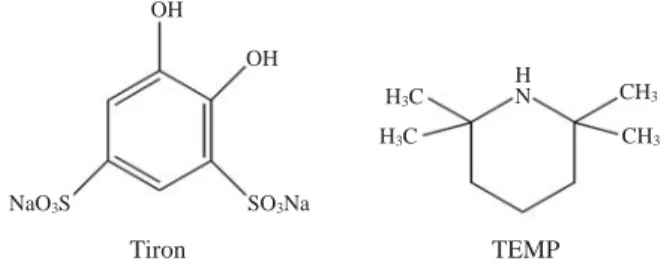
Fig. 1. Structures of the chemical probes specific for detection of
O2∙-and 1O2. OH OH H3C CH3 CH3 H3C H N SO3Na Tiron TEMP NaO3S
probes are not terribly toxic, so they are useful to in vitro/in vivo trapping of O2∙-or 1O2. The resultant adducts of Tiron or TEMP in reaction with O2∙-or 1O2are detectable by spin trapping (Fig. 1).
2. Stability of chemical probes for O2∙∙--or 1O2 to gamma irradiation
As mentioned above, the chemical probes may also be good candidates to detect such ROS produced in biological systems by gamma irradiation. This application necessitates the stability of the probes to gamma radiation. Therefore, we investigated the structural stability of Tiron and TEMP spin adducts to gamma radiations of 100~1,000 Gy, which have been used to industrial irradiation for the food and agricul-tural products. NMR analyses showed that the structure of TEMPO was unaffected by gamma irradiation up to 1,000 Gy (Fig. 2). Previously, it was also reported that NBT was stable to gamma radiations up to 1,000 Gy (Lee et al. 2009). In contrast, Tiron and its spin adducts were broken down at 1,000 Gy, implying that it can not work as a sensitive and selective probe for O2∙-with gamma radiations of 1,000 Gy or above.
3. Detection of O2∙∙--in aqueous solution during gamma irradiation, but not 1O2
Tiron forms a Tiron semiquinone radical upon reaction
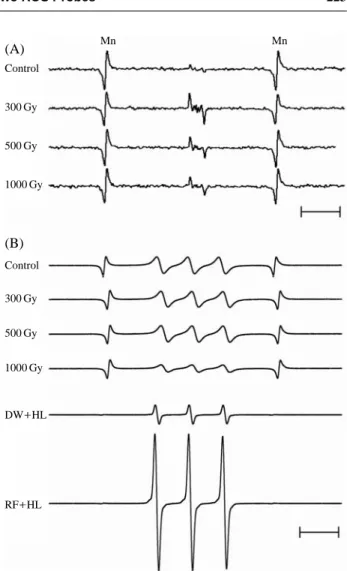
with O2∙-(Peskin et al. 1998). The Tiron radical is an EPR-active spin adduct. When an aqueous solution including 200 mM Tiron was irradiated with different doses of gamma radi-ation, the EPR signal from the Tiron radicals was slightly increased (Fig. 3A). These experiments demonstrate that O2∙-is the major ROS produced in aqueous solution by gam-ma irradiation. Actually, the production of O2∙-by gamma irradiation depends on the amount of O2dissolved in aque-ous solution (Zielonka et al. 2006).
EPR analysis for ROS, O2∙-, using Tiron (Hideg et al. 1994; Hideg and Vass 1996) revealed that the ROS are not mainly produced in aqueous solution by gamma irradiation (Fig. 3A). TEMP can react with another ROS, 1O2, by form-ing TEMPO, a stable nitroxide radical yielded in the reaction Fig. 2. NMR spectra of the probes for detection of O2∙-and 1O2
during gamma radiation. (A) Tiron and/or its spin adducts; (B) TEMPO. Control 100 Gy 200 Gy 300 Gy 500 Gy 1000 Gy ppm Control 100 Gy 200 Gy 300 Gy 500 Gy 1000 Gy ppm 7.6 7.2 1.6 0.8 (A) (B)
Fig. 3. EPR spectra of Tiron and TEMP spin adducts in aqueous
solution during gamma irradiation. (A) Tiron semiquinone radicals; (B) TEMPO. Riboflavin (RF) was used to produce
1O2by photosensitization under the high light (HL). Bars:
(A) and (B)==2 mT. Control 300 Gy 500 Gy 1000 Gy Control 300 Gy 500 Gy 1000 Gy DW++HL RF++HL Mn Mn (A) (B)
of singlet oxygen (Hideg et al. 1994). This ROS is a critical damaging factor in plants exposed to excessively high light. However, the EPR signal from the TEMPO radicals was not changed in aqueous solution by gamma irradiation, while it was remarkably increased by photosensitization of riboflavin (Fig. 3B). This result suggests that 1O2cannot be substantial-ly produced in biological systems by gamma irradiation.
4. Estimation of O2∙∙--production depending on the radiation dose
NBT has been used as a practical probe for both e -aqand O2∙-(Kovács et al. 1999b; Fryer et al. 2002). When the pale yellow NBT reacts with O2∙-, a dark blue insoluble difor-mazan compound is produced (Beyer and Fridovich 1987). Otherwise, the radiation-dependent reduction of NBT in aqueous solution, which is mediated by e-aq, can result in the formation of monoformazan and then diformazan (Kov-ács et al. 1999b). Since the production rate of O2∙-by gam-ma irradiation is generally very low because of the limited amount of O2dissolved in the air-saturated aqueous solution (Zielonka et al. 2006). The radiation-dependent reduction of NBT in aqueous solution has been explained by the increas-ing production of e
-aqrather than O2∙-(Lee et al. 2009). Therefore, the production of O2∙-by gamma irradiation as shown in Fig. 3A was further confirmed by using the reac-tivity of NBT to both e
-aqand O2∙-in aqueous solution. The production rate of O2∙-is expected to be higher in the O2-saturated aqueous solution during gamma irradiation than in
the N2-saturated one (Fig. 4). Instead, since the formation of NBT monoformazan upon reaction with e
-aqis much faster than that of NBT diformazan upon reaction with O2∙-from the initial reaction of O2and e-aq, the radiation-dependent reduction of NBT should be much higher in the N2-saturated aqueous solution than the O2-saturated one (Fig. 4). Accord-ingly, the difference in the radiation-dependent reduction of NBT between the N2- and O2-saturated aqueous solutions was dose-dependently increased during gamma irradiation, implying that the production of O2∙- would be similarly enhanced depending on the radiation dose as well as the concentration of O2.
CONCLUSION
In the present study, we demonstrated that O2∙-or 1O2are not the main reactive oxygen species produced by water radiolysis. In addition, considering the structural stability and specificity of chemical probes tested, we suggest that Tiron and NBT or TEMP could be utilized as semi-quanti-tative chemical probes to estimate the level of O2∙-or 1O2in biological systems during gamma irradiation.
ACKNOWLEDGMENT
This research was supported by the Nuclear R & D Pro-gram of the Ministry of Education, Science and Technology (MEST), Republic of Korea.
REFERENCES
Ba ˇci´c G and Mojoviˇc M. 2005. EPR spin trapping of oxygen radicals in plants: A methodological overview. Ann. N.Y.
Acad. Sci. 1048:230-243.
Beyer WF and Fridovich I. 1987. Assaying for superoxide dis-mutase activity: some large consequences of minor changes in conditions. Anal. Biochem. 161:559-566.
Cadenas E. 1989. Biochemistry of oxygen toxicity. Annu. Rev.
Biochem. 58:79-110.
Fryer MJ, Oxborough K, Mullineaux PM and Baker NR. 2002. Imaging of photo-oxidative stress responses in leaves. J.
Exp. Bot. 53(372):1249-1254.
Hideg É and Vass I. 1996. UV-B induced free radical produc-tion in plant leaves and isolated thylakoid membranes. Plant Fig. 4. Differential reduction of NBT in N2- and O2-saturated
aque-ous solution during gamma irradiation. The NBT reduction was measured as increase in absorbance at 560 nm. Bars
represent means±S.E. (3‹n‹9 from three independent
experiments). 0.30 0.25 0.20 0.15 0.10 0.05 0.00 0 100 200 300 400 500 1000
Dose rate (Gy) N.D. f(x)==0.00025209x-0.0282 r2==0.9612 NBT (A 560 (N 2 )-A560 (O 2 ))
Sci. 115:251-260.
Hideg É, Spetea C and Vass I. 1994. Singlet oxygen production in thylakoid membranes during photoinhibtion as detected by EPR spectroscopy. Photosynth. Res. 39:191-199. Huang R, Choe E and Min DB. 2004. Kinetics for singlet
oxy-gen formation by riboflavin photosensitization and the reac-tion between riboflavin and singlet oxygen. J. Food Sci.
69(9):726-732.
Kovács A, Baranyai M, Wojnárovits L, Moussa A, Othman I and McLaughlin WL. 1999a. Aqueous-ethanol nitro blue tetrazolium solutions for high dose dosimetry. Radiat. Phys.
Chem. 55:799-803.
Kovács A, Wojná rovits L, Baranyai M, Moussa A, Othman I and McLaughlin WL. 1999b. Radiolytic reactions of nitro blue tetrazolium under oxidative and reductive conditions: a pulse radiolysis study. Radiat. Phys. Chem. 55:795-798. Lee MH, Moon YR, Chung BY, Kim JS, Lee KS, Cho JY and
Kim JH. 2009. Practical use of chemical probes for reactive oxygen species produced in biological systems by γ-irradi-ation. Radiat. Phys. Chem. 78:323-327.
Lidon FC and Henriques FS. 1993. Oxygen metabolism in high-er plant chloroplasts. Photosynthetica. 29(2):249-279. Liszkay A, Kenk B and Schopfer P. 2003. Evidence for the
involvement of cell wall peroxidase in the generation of hydroxyl radicals mediating extension growth. Planta 217:
658-667.
Moon YR, Kim JH, Lee MH, Kim JS and Chung BY. 2008. Thermal dissipation of excess light in Arabidopsis leaves is inhibited after gamma-irradiation. J. Plant Biol. 51(1):52-57.
Peskin AV, Labas YA and Tikhonov AN. 1998. Superoxide radical production by sponges Sycon sp. FEBS Lett. 434: 201-204.
Spinks JWT and Woods RJ. 1990. Water and inorganic aque-ous systems. pp. 243-313. In: An Introduction to Radiation Chemistry (Spinks JWT and Woods RJ eds.), John Wiley and Sons, New York, NY.
Thordal-Christensen H, Zhang Z, Wei Y and Collinge DB. 1997. Subcellular localization of H2O2in plants. H2O2 accumula-tion in papillae and hypersensitive response during the bar-ley-powdery mildew interaction. Plant J. 11:1187-1194. Zielonka J, Sarna T, Roberts JE, Wishart JF and Kalyanaraman
B. 2006. Pulse radiolysis and steady-state analyses of the reaction between hydroethidine and superoxide and other oxidants. Arch. Biochem. Biophys. 456(1):39-47.
Manuscript Received: August 12, 2011 Revised: August 16, 2011 Revision Accepted: August 19, 2011