Inter-noise 2014 Page 1 of 3
Measurement of the distributed dynamic stiffness of seats under
compression to analyze dynamic characteristic of seats
Deokman Kim1; Kyongwon Min1; Hyunkyu Park2; Junhong Park1
1 Hanyang University, South Korea 2 Hyundai·Kia Motors, South Korea
ABSTRACT
Supporting stiffness of seats is an important component affecting dynamic characteristics cognized by a passenger. To analyze dynamic characteristic of a seat for vehicles operating on various road conditions, the seat vibration from road irregularity should be understood and compared. In this study, the seat is analyzed as distributed supporting system. The dynamic stiffness is measured using masses on elastic foundation. The deflection of the seat under compression is analyzed using simple numerical model and used in understanding dynamic coupling between arrayed masses. The characteristic of the seats is analyzed by measuring distributed dynamic stiffness. The influence of seat cover, elastic support and flexible polyurethane foam on the measured stiffness was analyzed. The equivalent dynamic stiffness when larger dummy model is used in measurements is compared to the distributed stiffnesses
Keywords: Seat, Distributed dynamic stiffness, Dynamic comfort I-INCE Classification of Subjects Number(s): 49.3.2
1. INTRODUCTION
The seat of the vehicle is important part on the passenger comfort, directly coming into contact with body. It is necessary to improve the dynamic properties of the seat after evaluation of the dynamic comfort of the seat. Currently, the popular method to evaluate dynamic comfort of the seat is the seat effective amplitude transmissibility (S.E.A.T.) value [1,2]. This method evaluates the dynamic comfort cognized by a passenger. To evaluate the static comfort, many factors were considered such as seat shape, subject posture and seat cover. Griffin [3] studied the static characteristics of polyurethane foam cushions and analyzed static stiffness , the gradient of a force-deflection curve and pressure distribution. Similarly if the dynamic stiffness distribution is considered to evaluate the dynamic comfort, the data would be used to objectively analyze the dynamic property of the seat. Also to evaluate the dynamic characteristic of the seat, it is necessary to analyze the displacement, the pressure distribution and various road conditions.
2. Seat modeling and experiments
2.1 Distributed mass-spring model
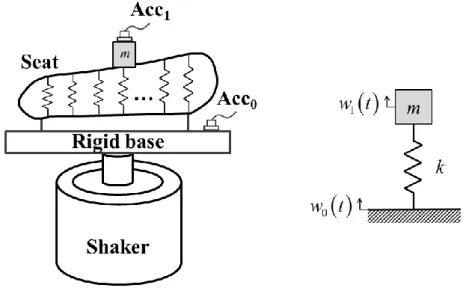
A seat is composed of a frame, elastic support, polyurethane foam, and cover. When passenger sits on the seat, the seat work like a spring. Then the seat is modeled as mass-spring system. It is supposed that the seat is arrayed by springs. We measured the distributed stiffness using small dummy, which is a simple mass, and the equivalent stiffness using a large dummy, which is buttock shape mass. The governing equation of the mass-spring model is mw t1
k w t
1
w t0
and a harmonic solution is assumed as 0 ˆ0 it
x x e . Then transfer function is obtained as
Page 2 of 3 Inter-noise 2014 Page 2 of 3 Inter-noise 2014
i 1 2 0 1 i ˆ ˆ 1 i k w e w k m , (1) where is the amplitude and is the phase of the transfer function, k is the stiffness and isthe loss factor of the seat, m is the weight of the dummy, is the angular velocity, ˆw is the 0 displacement of the road condition and ˆw is the displacement of the dummy. 1
When the transfer function is measured experimentally, Eq. (1) is a function of the complex stiffness, k
1 i
, and can be solved numerically[4].
Figure 1 – Distributed stiffness model of a seat supposed on a shaker and mass-spring system
2.2 Experiment set-up
The seat is supposed on a Bruel & Kjaer V650 shaker, having a maximum displacement of ±12.7 mm. The seat is excited by random vibration induced by a shaker at rms acceleration levels of 1,3,5 m s to consider the road condition. The weight of the seat was 11.16 kg, the weight of the small dummy is 3 kg, the weights of the large dummies are 6.13, 8.63, 11.13 kg. Fig. 1 shows the attached accelerometer to measure input vibration of the road condition. The accelerometer to measure out vibration was attached on the dummies. To measure distributed stiffness, the right half of the seat is divided up into a matrix of 5x3 lines.
3. Results and discussion
3.1 Distributed stiffness and loss factor on the locations
Fig. 2 (a) shows the resulting transfer functions when the small mass is used on the each location to measure the distributed complex stiffness. The measured responses were compared with the predicted values, and there was an excellent agreement in the low frequency range, which is target frequency range for the dynamic comfort. So we confirm that it is possible to model the seat to mass-spring system on the low frequency range. Random vibration input was rms acceleration levels of 3 m s and the transfer function is shifted by the location. Fig. 2 (b) shows the resulting stiffness and loss factor of the seat calculated numerically. The contour map of the distributed stiffness is presented by applying symmetric condition and spline curve.
Inter-noise 2014 Page 3 of 3 Inter-noise 2014 Page 3 of 3 1 10 100 10-3 10-2 10-1 100 101 102 1 4 7 10 13 M-K system Frequency (Hz) 1 10 100 0.0 0.1 0.2 0.3 0.4 0.5 C Lo ss fact o r Frequency (Hz) 0 5 10 15 20 25 30 1 4 7 10 13 Sti ff n ess (k N/m) ` Figure 2 – (a) Measured and predicted transfer functions, (b) obtained dynamic stiffness and loss factor on the each locations
3.2 Equivalent stiffness of the large dummy
The stiffness and loss factor of the large dummy mass which is the shape of the bottom is measured when the weight of the dummy and vibration amplitude were changed. When vibration amplitude increases, the stiffness decreases and the loss factor increases and when weight of the dummy increases, the stiffness and the loss factor increases. To predict the equivalent stiffness of the large dummy, we can integrated the distributed stiffness considering the contact area, calculated by elastic foundation theory.
4. CONCLUSIONS
An experimental method to determine support properties of passenger seat is proposed to objectively analyze the seat characteristic. The 1-DOF mass and spring system in low frequency range is used for estimating the dynamic equivalent stiffness. Effects of various parameters such as location, supporting area, pressure, and vibration on the stiffness and the loss factor is i nvestigated. It is suggested the method to present contour map of the distribut ed stiffness and loss factor and to predict the equivalent stiffness of the large dummy using the distributed stiffness. This information is essential for understanding the seat comfort under dynamic conditions.
ACKNOWLEDGEMENTS
The authors would like to acknowledge Hyundai-Kia Motors for their financial support of this research.
REFERENCES
1. C.H. Lewis and M.J. Griffin evaluating the vibration Isolation of soft seat cushions using an active anthropodynamic dummy J. Sound. Vib. 2002 253(1):295-311
2. A. v. d. Westhuizen and J. L. v. Niekerk Verification of seat effective amplitude transmissibility (SEAT) value as a reliable metric to predict dynamic seat comfort J. Sound. Vib. 2006 295:1060-1075
3. K. Ebe and M. J. Griffin Factors affecting static seat cushion comfort ERGONOMICS 2001 44(10):901-921
4. J. Park Transfer function method to measure dynamic mechanical properties of complex structures J. Sound. Vib. 2005 288:57~79