21 Journal of Engineering Education Research
Vol. 17, No. 4, pp. 21~24, July 2014
The Development of the Engineering Leadership
Program for Engineering Students
In-sook Kim*,† *
Yonsei University
ABSTRACT
The purpose of this study is to develop the engineering students leadership program and evaluate the pilot test. To this end, literature reviews covering various leadership programs were studied and a needs analysis survey was conducted. The needs analysis survey found that student subjects believe leadership to be an important quality, but that the current availability of leadership training programs is lacking. Furthermore, results of the study are as follows, with respective results listed in descending order. The majority of students selected on-line learning as their preferred training method, followed by blended learning and in-person learning. Students also indicated their preferred instructional method to be through on-line courses.
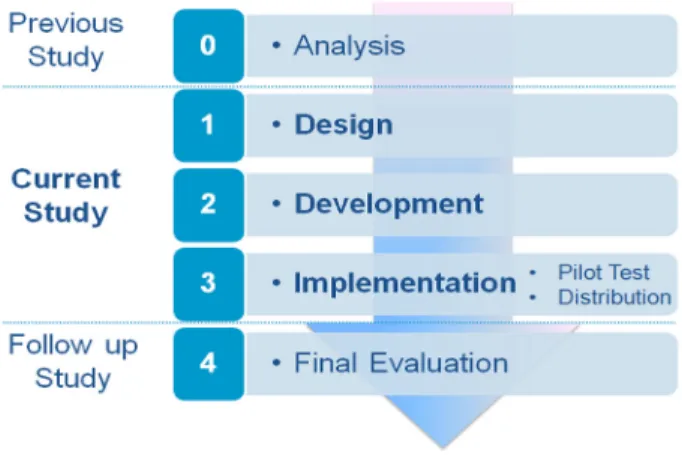
Based on these results, a preliminary pilot program was experimentally launched for only 1 class’s use. This process of the development for the Engineering Leadership Program consists of 4 stages. The first stage is a needs analysis survey, followed by the design of the program based on results from the needs analysis survey. Afterwards comes the development stage, followed by the implementation stage, comprised of two parts; the pilot test and the distribution. The final stage is the overall evaluation step.
We are currently in the first step of the third stage (the pilot test) and only the overall evaluation stage remains. After the distribution, a follow-up study will be conducted to analyze the effectiveness of the implemented program.
Keywords: Engineering Education
I. Introduction
1)Today, the key components of effective engineering leaders are considered to be ability to motivate and equip people by being able to communicate clearly, manage and organize conflicts, foster creative and aptitude in technical tasks. Engineering leadership and management in times of crisis is highly challenging because the risks are high, timeframes are short, and resources are limited.
Engineering leaders will be called upon to foresee developing threats to our environment and sustainability, and they will need to bring their messages effectively to political leaders. They will have to understand and cross multidisciplinary boundaries, because solving the most difficult problems will involve multiple, interacting and conflicting causes and effects. Language skills, cultural competency, and other soft skills will be brought into a
Received 21 June, 2014; Revised 21 June, 2014 Accepted 31 July, 2014
† Corresponding Author: [email protected]
comprehensive systems analysis of their work[1]. Engineering leaders are particularly well suited to provide valuable contributions to our organizations’ survival because of our abilities to analyze and synthesize data and to create solutions that meet specific requirements.
The purpose of this study is to develop the engineering students leadership program and evaluate the pilot test.
II. Methods
1. Study Procedure
The process of the development of the engineering leadership program consists of 4 stages. The first stage is a needs analysis survey, followed by the design of the program based on results from that survey. Afterwards comes the development stage, followed by the implementation stage, comprised of two parts; the pilot test and the distribution. The final remaining stage is the overall evaluation step.
In-sook Kim
공학교육연구 제17권 제4호, 2014 22
Fig. 1 Study Procedure
2. Needs Analysis
In this needs analysis, 270 students were chosen from among the four programs at “A” university’s engineering college. A 15-question survey was created in order to identify how to best develop an effective engineering leadership program. The survey was conducted after being reviewed by a committee composed of three educational professionals. This study used SPSS version 18.0 to conduct its analysis.
3. Pilot Test
This study observed 40 second year students in "B" Program at “A” university. All students were surveyed on the effectiveness of the on-line courses at the end of the program.
III. Engineering Leadership
1. Leadership
Leadership is most fundamentally about changes. What leaders do is create the systems and organizations that managers need, and eventually, elevate them up to a whole new level or change them in some basic ways to take advantage of new opportunities[2]. Leadership is a process whereby an individual influences a group of individuals to achieve a common goal[3]. Leadership is the process of influencing others to understand and agree about what needs to be done and how to do it, as well as the process of facilitating individual and collective efforts to accomplish
shared objectives.
Viewing leadership as a process means that leaders affect and are affected by their followers either positively or negatively[4]. It stresses that leadership is a two-way, interactive event between leaders and followers rather than a linear one-way event in which the leader affects the followers but not vice versa[5].
2. Engineering Leadership
The Engineering leadership is the process of envisioning, designing, developing, and supporting new products and services to a set of requirements, within budget, and to schedule the strategic objectives of an organization. Engineering leaders exist to develop and sustain products and devices using systems engineering principles in project organizations[6]. Engineering leaders and managers need to decompose large systems, investigate their inner workings and hidden mechanisms, create models to describe their behavior, and design systemic solutions for future implementations. They need to work cooperatively with sales, finance, marketing, product development, engineering, manufacturing, and operations teams to reinvent their businesses in a constantly changing landscape. The process of reinvention will be an evolutionary process during which the organization will establish a learning culture capable of assessing new trends and preparing for potentially disruptive events, while managing both risk and opportunities associated with specific organizations[7].
IV. Results
1. Results of the needs analysis
a. Importance of Leadership in Engineering
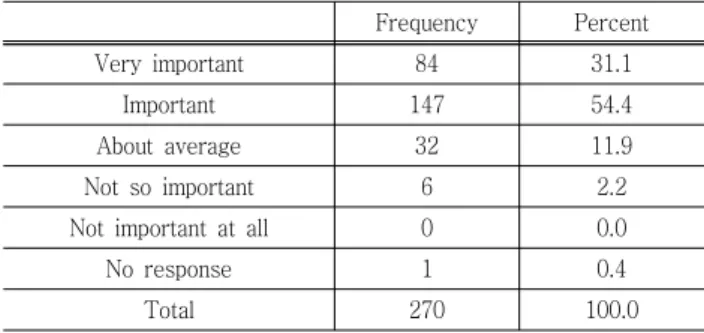
231 respondents reported that leadership in the engineering field is important or very important (85.5%).
b. Engineering Leadership Instructional Methods
When we asked about desired engineering leadership educational methods, 167 respondents answered with on-line learning(61.9%). 54 respondents stated blended learning as their preferred method(20%), and 39 respondents selected in-person training as their preferred learning method(14.4%).
The Development of the Engineering Leadership Program for Engineering Students
Journal of Engineering Education Research, 17(4), 2014 23
Fig. 2 Importance of Leadership in Engineering
Table 1 Importance of Leadership in Engineering. Frequency Percent
Very important 84 31.1
Important 147 54.4
About average 32 11.9
Not so important 6 2.2
Not important at all 0 0.0
No response 1 0.4
Total 270 100.0
c. Difficult Leadership Qualities
Conflict resolution was identified as the most difficult leadership quality, followed by conversation and persuasion, communication, trust, coaching and self-leadership. In this question, only 238 students responded.
Fig. 3 Engineering Leadership Instructional Methods Table 2 Engineering Leadership Instructional Methods
Frequency Percent
In-person learning 39 14.4
On-line learning 167 61.9
On-line learning +In-person learning 54 20.0
Others 9 3.3
No response 1 0.4
Total 270 100.0
Table 3 Difficult Leadership Qualities.
Rank Factor Number Average Standard
Deviation 1 Conflict Resolution 238 4.11 2.729 2 Conversation and Persuasion 238 4.36 2.738
3 Communication 238 5.21 2.871
4 Gaining Trust 238 5.26 2.740
5 Coaching 238 5.48 2.665
6 Self-leadership 238 5.64 3.270
7 Motivation 238 5.72 2.994
2. Final contents structure
The contents of this program consist of seven on-line classes, the duration of each class being 1 hour. The course includes 3 hours of ‘Knowledge’ acquisition, 2 class hours for ‘Practical Skills’, 1 class hour pertaining to ‘Attitude’ awareness, and 1 class hour in which all three parts are integrated into 2 simulated case studies.
In ‘Knowledge’ acquisition, the students will learn about developing their own 'Self Leadership' potential, followed by self-evaluation. During this time, they will also be curating personal portfolios of their academic and professional
Table 4 Final contents structure.
Module Contents Class hours
Knowledge Acquisition
• developing their own self leadership
potential 3 class hrs
Practical Skills
• conflict resolution
• communication tactics 2 class hrs Attitude
awareness
• motivating team members developing trust
• coaching new members
1 class hr Case studies • identify the requirements of leadership 1 class hr
Total 7 class hrs
In-sook Kim
공학교육연구 제17권 제4호, 2014 24
careers so far. In the ‘skills’ portion, the students will learn about conflict resolution and communication tactics. This is followed by ‘Attitude’, which will focus on motivating team members, developing trust, and coaching new members of their staff. Finally, in the last stage, the case study, students can identify the requirements of leadership trough video interviews about good leaders.
3. Results of the pilot Test
On average, overall satisfaction, improvement of the leadership knowledge acquisition and improvement of leadership attitude awareness were ranked high. Improvement of leadership skills was ranked lower about mid-range.
V. Conclusion
Further results of the needs analysis are as follows, with respective results listed in descending order. The majority of students selected on-line learning as their preferred training method, followed by blended learning and online learning. Based on available data, it can be inferred that the majority of respondents prefer on-line learning. All this particular university, students prefer double or triple majors to compete in the job market. For example, a typical engineering student may also major in management and educational instruction. Therefore, time is limited for other courses, despite their importance, including leadership program. Thus it can be inferred that the majority of respondents preferred on-line learning in order to better fit it into their students.
According to the results of the pilot test, all factors were found to be satisfactory, but only ‘improvement of leadership skills’ ranked lower on average. Students also want to observe more case studies than were provided in
this online learning program.
The results of this pilot test will form the basis for the revision of the leadership program, and in addition, further distribute, and finally afterwards, the program overall.
References
1, Davood Salmani, “Engineering Leadership”, http://mbapn. blogfa.com/post-89.aspx,( 2010).
2. Gilbert, D C., Carl DeVilbiss P.E., “Engineering Leadership and Management during Financial Crisis”, Leadership and Management in Engineering, Vol. 10, No. 1, pp. 4-9, (2010). 3. Kotter, J. P., What leaders really do. In Harvard Business
Review on leadership, Boston: Harvard Business School Press, pp. 37-60, (1998).
4. Northouse, P. G., Leadership: Theory and practice(5th ed.), Thousand Oaks, CA: Sage, pp. 46-49, (2010). 5. Rowe, W. G. & Guerrero, L., Cases in Leadership, SAGE
Publications, Inc., California, pp. 52-55, (2011).
6. Yukl, G., Leadership in organizations (6th ed.), Upper Saddle River, NJ: Pearson-Prentice Hall, pp. 25-30, (2006). 7. Emison, Gerald Andrews, “Transformative Leadership for
Engineering in a Time of Complexity”, Leadership and Management in Engineering, Vol. 10, No. 2, pp.97-102, (2011).
Insook Kim
Research Professor, Dept. of Medical Education, College of Medicine, Yonsei University Received BS(1995), MS(2002) and Ph.D. (2005) in Educational Technology from Hanyang University. Her work experiences are Research Professor at Yonsei University(2014‐), Research Professor at Sogang University (2008‐2014), Full‐time Lecturer at Hanyang Women's College (2004‐2008) and Research Team Leader Maeil Business Newspaper(1997‐2001), HR Designer at GS‐Caltex Oil Corporation(1995‐1997). Her current research focuses on the continuous quality improvement of education.
Phone: +82‐2‐2228‐2513 Fax: +82‐2‐364‐5450 E‐mail: [email protected]