185
Open Access
Serological Predictors for the Recurrence of Atrial Fibrillation
After Electrical Cardioversion
Sook Kyoung Kim, MSc1, Hui-Nam Pak, MD1, Jae Hyung Park, BSc1, Kyoung Jeong Ko, RN2,
Jihei Sara Lee, BSc2, Jin Wi, MD1, Jong Il Choi, MD2 and Young-Hoon Kim, MD2
1Yonsei University Health System, Seoul, 2Korea University Cardiovascular Center, Seoul, Korea
ABSTRACT
Background and Objectives: Although electrical cardioversion (CV) is effective in restoring sinus rhythm (SR) in patients with atrial fibrillation (AF), AF frequently recurs in spite of antiarrhythmic medications. We investigated the predictors of failed CV and AF recurrence after successful CV. Subjects and Methods: In 81 patients (M:F= 63:18, 59.1±10.5 years old) with AF who underwent CV, clinical findings and pre-CV serologic markers were evaluated. Results: During 13.1±10.6 months of follow-up, 8.6% (7/81) showed failed CV, 27.16% (22/81) showed early recurrence atrial fibrillation (ERAF; ≤2 weeks), 32.1% (26/81) had late recurrence atrial fibrillation (LRAF; >2 weeks), and 32.1% (26/81) remained in SR and had no recurrence (NR). Plasma levels of transforming growth factor beta (TGF)-β were significantly higher in patients with failed CV than in those with successful CV (p=0.0260). Patients in whom AF recurred were older (60.4±9.0 years old vs. 55.3±12.5 years old, p=0.0220), and had lower plasma levels of stromal cell derived factor (SDF)-1α (p=0.0105). However, there were no significant differences in these parameters between ERAF patients and LRAF patients. Conclusion: Post-CV recurrence com-monly occurs in patients aged >60 years and who have low plasma levels of SDF-1α. High plasma levels of TGF-β predict failure of electrical CV. (Korean Circ J 2010;40:185-190)
KEY WORDS: Atrial fibrillation; Electric countershock; Recurrence.
Introduction
Atrial fibrillation (AF) is the most common cardiac arrhythmia in clinical practice. It leads to significant morbidity and disability and results in a low quality of life.1) It has been reported that appropriate rhythm
con-trol may reduce mortality in patients with AF.2)
Alth-ough electrical cardioversion (CV) is known to be effec-tive in restoring sinus rhythm (SR) in patients with persistent AF (PeAF), AF frequently recurs in spite of concomitant medication with antiarrhythmic drugs.3)4)
Approximately 50% of patients who successfully
cardio-vert initially experience AF recurrence within the first month after CV.5)6) This is due to significant electrical
remodeling,7)8) structural changes in the atrial
myocar-dium in patients with AF,9) and the limitations of
anti-arrhythmic drugs.2)3)5) Although there have been several
reports,11)12) the predictors of successful CV or long-term
maintenance of SR in patients with PeAF are not yet clear. The development of serological predictors for re-currence after CV may reduce the number of unnecess-ary procedures, the risk of complications and medical costs, and may improve the clinical outcome of highly selected patients. Discovering predictors for post-CV recurrence would also contribute to our understand-ing of AF pathophysiology. Therefore, we investigated whether certain parameters related to matrix remodel-ing, fibrosis, atrial stretchremodel-ing, and chemotaxis, can pre-dict failure or recurrence of AF after electrical CV.
Subjects and Methods
Study population
This study was approved by the Institutional Review Board of Anam Hospital of Korea University. All patients
Received: August 8, 2009
Revision Received: September 17, 2009 Accepted: October 20, 2009
Correspondence: Hui-Nam Pak, MD,Yonsei University Health System, 250 Seongsan-ro, Seodaemun-gu, Seoul 120-752, Korea Tel: 82-2-2228-8459, Fax: 82-2-393-2041
E-mail: [email protected]
○ cc This is an Open Access article distributed under the terms of the Creative Commons Attribution Non-Commercial License (http://creativecommons. org/licenses/by-nc/3.0) which permits unrestricted non-commercial use, distribution, and reproduction in any medium, provided the original work is properly cited.
provided written informed consent. Eighty-one patients with PeAF (male:female=63:18, mean age 59.1±10.5 years old) who underwent external electrical CV were included in the study. We excluded patients with a his-tory of any previous CV, significant mitral valvular heart disease, a huge left atrium (LA; > 55 mm), a recent infection, surgery or acute coronary syndrome in the 2 months prior to the collection of blood samples. All pa-tients maintained optimal anticoagulation, had been taking anti-arrhythmic drugs for at least 1 month, and maintained them after CV. Transesophageal echocar-diography was done to exclude an intra-cardiac throm-bus on the same day of CV in every patient. The blood samples for the serologic assays were drawn before seda-tion for external CV.
Electrical cardioversion protocol
After obtaining written informed consent, electrical CV was performed under sedation with intravenous midazolam (0.05 mg/kg) and thiopental sodium (60 mg/kg). A biphasic R wave synchronized shock (Life-pak12, Physiocontrol Ltd. Redmond, WA, USA) was applied to the patients via self-adhesive skin electrodes (TZ Medical Inc., Portland, OR, USA) in an anterior-posterior position. We delivered an initial CV with 70 J. If the initial shock failed to terminate AF, the biphasic shock energy was gradually increased to 100 J, 150 J, and then 200 J serially (5 minutes intervals). If CV terminat-ed AF successfully, the patient’s cardiac rhythm was mo-nitored for 15 minutes to detect an atrial premature beat (APC) or recurrence of AF. If AF returned within 15 mi-nutes of termination of CV, amiodarone 150 mg was ad-ministered intravenously and the same energy shock was repeated. Patients in whom AF remained even after be-ing given a 200 J CV or who exhibited repeated imme-diate recurrence of AF in spite of amiodarone were de-fined as failed CVs.
Biochemical analyses
We acquired a 5 mL sample of peripheral blood im-mediately before CV to measure the plasma levels of se-veral protein markers or chemokines by enzyme linked immuno-sorbent assay: pro-atrial natriuretic peptide (ANP; Biomedica, Antony, France), matrix metallopro-teinase (MMP)-9, transforming growth factor (TGF)-β, and stromal cell derived factor (SDF)-1α (R&D Sys-tems, Minneapolis, MN, USA). High sensitivity C-re-active protein (hs-CRP) was measured on a Hitachi 912 assay system (Roche Diagnostics, Indianapolis, IN, USA) using a Kamiya K-assay (Kamiya Biomedical Corp., Seat-tle, WA), which quantitatively determines CRP by a latex particle-enhanced immuno-turbidimetric assay. Follow-up of patients
After CV, all patients were prospectively followed up
at an outpatient clinic at 1, 2, 4, 8 weeks, and then every 3 months thereafter. Elecrocardiography (ECG) was performed at every visit or anytime the patient re-ported palpitations. A Holter ECG (24 hours or 48 hours) and/or event recorder was evaluated at 2 months in patients who did not experience recurrence. We clas-sified patients into 4 different groups according to cli-nical outcome as follows: 1) failed CV, 2) early recurr-ence of AF (ERAF; within 2 weeks), 3) late recurrrecurr-ence of AF (LRAF; after 2 weeks), and 4) no recurrence (NR) after 2 months.
Statistical analysis
We evaluated the clinical factors {e.g., age, sex, LA size, ejection fraction (EF), spontaneous echo contrast (SEC)} and serologic factors (MMP-9, SDF-1α, TGF-β, pro-ANP, and hs-CRP) in terms of success or failure of CV and the timing of recurrence. Comparisons between gr-oups were analyzed by the Mann-Whitney test or a t-test. In order to identify the predictors of failed CV or the re-currence of AF after successful CV, uni-variate and mul-tivariate logistic regression analyses were performed. AF free rates were compared in terms of clinical, electrophy-siological, and serological parameters by utilizing Kaplan-Meier curves. We chose cutoff numbers that were simi-lar to the mean that divided 2 groups with simisimi-lar num-bers of the patients. All values are expressed as mean± SD. All statistical analyses were performed using Statis-tical Package for the Social Sciences (SPSS) version 12.0 and a p<0.05 was considered statistically significant.
Results
Patient characteristics and clinical outcomes We performed external electrical CV in 81 patients (59.1±10.5 years old, 63 males) with PeAF or perma-nent AF. The mean LA size was 45.5±6.0 mm, and the mean EF of the LV was 48.7±15.1%. All patients had been taking antiarrhythmic drugs for at least 1 month before and after CV (amiodarone 60.5%, other class IC anti-arrhythmic drugs 39.5%). The mean num-ber of electrical shocks performed was 1.9±1.4, the final successful CV energy was 96.7±32.3 J, and the cumulative CV energy was 170.4±178.5 J. Among the 81 patients, 8.6% (7/81) showed failed CV and 91.4% (74/81) underwent successful CV. We followed up the 74 patients after their successful CV for an average of 13.2±11.0 months. Of the 74, 22 (29.7%) showed AF recurrence within 2 weeks (ERAF), 26 (35.1%) after 2 weeks (LRAF), and 26 (35.1%) remained in SR and had NR during the follow-up period.
Serological predictors for failed electrical cardioversion
biochemical parameters in patients with successful and failed electrical CV. There were no significant differences in age, sex, LA size, EF, the existence of SEC, or medi-cations. However, the prescription rate of amiodarone was lower in patients with failed CV compared to those with successful CV (28.6% vs. 64.9%, p=0.0301). Both the final energy (121.4±26.7 J vs. 93.7±31.8 J, p=0.0154) and the incidence of the requirement of intravenous amiodarone (100% vs. 14.9%, p<0.0001) were higher in patients with failed CV. The pre-CV plasma level of TGF-β, which reflects the degree of fibrosis, was signi-ficantly higher in patients with failed CV (22.7±22.9 ng/mL) than in those with successful CV (13.5±9.8 ng/mL, p=0.0260).
Predictors for recurrence after successful cardioversion
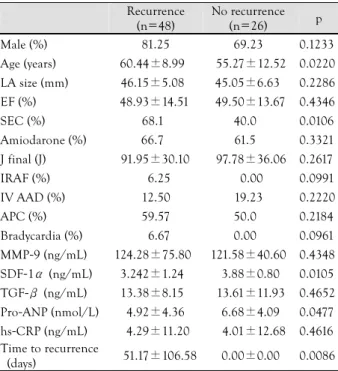
The recurrence rate of AF after successful CV was 64.9% (48/74) during the 13.2±11.0 months follow-up. Table 2 summarizes comparisons of clinical, elec-trophysiological, and serological parameters. The patients who showed recurring AF after CV were older than those without recurrence (60.4±9.0 years old vs. 55.3±12.5 years old, p=0.0220). There was no significant differ-ence in either LA size or EF. Pre-CV plasma levels of SDF-1α (3.2±1.2 ng/mL vs. 3.9±0.8 ng/mL, p= 0.0105) were significantly lower in patients with
recur-rent AF than in those without recurrence. In univari-ate logistic regression analyses, it was found that old age {odds ratio (OR) 1.053, 95% confidence interval (CI) 1.004-1.053, p=0.035} and lower SDF-1α (OR 0.603, 95% CI 0.379-0.960, p=0.033) may predict the recur-rence of AF after successful CV. In multivariate logistic regression analysis, low SDF-1α (OR 0.537, 95% CI 0.302-0.954, p=0.034) was an independent risk factor for AF recurrence after successful CV. In Kaplan-Me-ier analyses, the AF recurrence rate was higher in pa-tients who were older than 60 (p=0.0295) and had pla-sma SDF-1α <3.0 ng/mL (p=0.0114) (Fig. 1). Timing of recurrence
Among 48 patients whose AF recurred during the follow-up period after successful CV, 45.8% (22/48) recurred within 2 weeks (ERAF), while 54.2% (26/48) recurred after 2 weeks (LRAF) (Table 3). The mean time to LRAF was 85.5±134.7 days. However, we failed to find a significant difference in clinical and serological parameters between ERAF and LRAF groups (Table 3). Left atrium size dependent factors
We compared patients with LA ≥45 mm to those with LA <45 mm. In patients with LA ≥45 mm, the incidence of SEC (69.8% vs. 45.5%, p=0.0164) was higher. However, the failure rate of CV and the recurr-Table 1. Comparison of patients with failed CV and successful
CV Failed CV (n=7) Successful CV (n=74) p Male (%) 085.71 77.03 <0.3013 Age (years) 63.71±8.50 58.62±10.58 <0.1104 LA size (mm) 42.53±6.90 45.76±5.90 <0.1037 EF (%) 44.73±24.36 49.13±14.12 <0.2326 SEC (%) 050.00 58.33 <0.3480 Amiodarone (%) 028.60 64.90 <0.0301 J final 121.4±26.7 93.73±31.83 <0.0154 IRAF (%) 071.43 04.05 <0.0001 IV AAD (%) 100.00 14.86 <0.0001 APC (%) 028.57 56.16 <0.0830 Bradycardia (%) 000.00 04.29 <0.2911 MMP-9 (ng/mL) 89.77±41.27 123.13±62.80 <0.0882 SDF-1α (ng/mL) 3.64±1.09 3.47±1.14 <0.3519 TGF-β (ng/mL) 22.68±22.92 13.48±9.84 <0.0260 Pro-ANP (nmol/L) 6.62±3.56 5.54±4.32 <0.2624 hs-CRP (ng/mL) 3.68±6.21 4.18±11.71 <0.4559 Recurrence (%) 100.00 64.38 <0.0380 CV: cardioversion, LA: left atrium, EF: ejection fraction, SEC: sp-ontaneous echo contrast, J final: final CV energy (J), IRAF: imme-diate recurrence of AF after CV, AAD: anti-arrhythmic drug, APC: atrial premature contractions, MMP-9: matrix metalloproteinase-9, SDF-1α: stromal cell derived factor-1α, TGF-β: transforming gr-owth factor-β, ANP: atrial natriuretic peptide, hsCRP: high sen-sitive-C reactive protein, AF: atrial fibrillation
Table 2. Comparison of patients with recurrence of AF and no recurrence of AF after successful CV
Recurrence (n=48) No recurrence (n=26) p Male (%) 81.25 69.23 0.1233 Age (years) 60.44±8.99 55.27±12.52 0.0220 LA size (mm) 46.15±5.08 45.05±6.63 0.2286 EF (%) 48.93±14.51 49.50±13.67 0.4346 SEC (%) 68.10 40.00 0.0106 Amiodarone (%) 66.70 61.50 0.3321 J final (J) 91.95±30.10 97.78±36.06 0.2617 IRAF (%) 06.25 00.00 0.0991 IV AAD (%) 12.50 19.23 0.2220 APC (%) 59.57 50.00 0.2184 Bradycardia (%) 06.67 0.000 0.0961 MMP-9 (ng/mL) 124.28±75.80 121.58±40.60 0.4348 SDF-1α (ng/mL) 3.242±1.24 3.88±0.80 0.0105 TGF-β (ng/mL) 13.38±8.15 13.61±11.93 0.4652 Pro-ANP (nmol/L) 4.92±4.36 6.68±4.09 0.0477 hs-CRP (ng/mL) 4.29±11.20 4.01±12.68 0.4616 Time to recurrence (days) 51.17±106.58 0.00±0.00 0.0086 AF: atrial fibrillation, CV: cardioversion, LA: left atrium, EF: ejec-tion fracejec-tion, SEC: spontaneous echo contrast, J final: final CV en-ergy (J), IRAF: immediate recurrence of AF after CV, AAD: anti-ar-rhythmic drug, APC: atrial premature contractions, MMP-9: matrix metalloproteinase-9, SDF-1α: stromal cell derived factor-1α, TGF-β: transforming growth factor-β, ANP: atrial natriuretic peptide, hs-CRP: high sensitive-C reactive protein
ence rate of AF after successful CV were not affected by LA size. Although the serological parameters were not different between the two groups, MMP-9 (139.6 ±49.97 ng/mL vs. 107.78±65.15 ng/mL, p=0.0285) and SDF-1α (3.76±1.26 ng/mL vs. 3.24±0.99 ng/mL, p=0.0261) were significantly higher in patients with LA ≥48 mm than in those with LA <48 mm.
Discussion
In the present study, we prospectively explored pre-dictors for failure of CV and recurrence of AF after
sys-temic electrical CV. We found that post-CV recurrence of AF commonly occurred in patients aged >60 years and low SDF-1α. High plasma levels of TGF-β dicted failure of electrical CV. Pre-determination of pre-dictors for failure of CV or recurrence of AF after suc-cessful CV might be useful for clinical decisions on rhy-thm control strategies and for increasing our underst-anding of the pathophysiology of AF.
Serological factors predicting atrial fibrillation re-currence after cardioversion
In this study, a low plasma level of SDF-1α was an independent risk factor for AF recurrence after success-ful CV. The chemokine SDF-1α has been shown to play a key role in hematopoietic or endothelial progenitor cell trafficking in the myocardial ischemia model,13-15) and
the non-ischemic titrated cardiac injury model during catheter ablation of AF.16) However, the role of SDF-1α
has been poorly explored in the pathophysiology of AF. Goette et al.17) report that SDF-1α levels are higher in
PeAF than PAF or controls, and SDF-1α plays some role in the restitution of hematopoietic progenitor cells after failed CV. The reason for the high recurrence of AF in patients with low plasma levels of SDF-1α remains to be studied. Although it has been reported that high levels of hs-CRP are associated with an increased risk of re-currence of AF,12)18) our data and data of Conway et al.19)
failed to prove its predictive value in the clinic. The plas-ma level of hs-CRP plas-may be associated with the perplas-man- perman-ence of AF related to systemic inflammation or proth-rombotic status.20)
Left atrium size and recurrence of atrial fibrillation after cardioversion
The pathophysiology of AF is heterogeneous, and, like heart failure, includes various kinds of heart dise-ase.21) Like the diversity of AF pathophysiology, the
factors related to failed CV or recurrence after success-ful CV might be widespread. An enlarged LA may re-flect the degree of structural remodeling and LA pres-Table 3. Comparison of patients in whom AF recurred within 2
weeks or after 2 weeks of successful CV
ERAF (≤2 weeks) (n=22) LRAF (>2 weeks) (n=26) p Male (%) 81.00 81.00 0.4938 Age (years) 62.82±9.86 59.27±8.20 0.1666 LA size (mm) 46.77±4.40 45.68±6.27 0.2571 EF mean (%) 48.07±13.62 49.62±15.43 0.3606 SEC (%) 63.64 72.00 0.2748 J final (J) 96.50±34.68 85.0±27.39 0.1190 IRAF (%) 04.54 07.70 0.3309 IV AAD (%) 13.64 11.54 0.4156 APC (%) 68.19 52.00 0.1345 Bradycardia (%) 04.76 08.33 0.3205 MMP-9 (ng/mL) 109.84±73.19 137.92±77.74 0.1399 SDF-1α (ng/mL) 3.25±1.31 3.24±1.21 0.4871 TGF-β (ng/mL) 12.92±7.63 13.82±8.80 0.3741 Pro-ANP (nmol/L) 4.48±4.53 5.30±4.26 0.2629 hs-CRP (ng/mL) 1.69±2.67 6.33±14.59 0.0961 Time to recurrence (days) 8.67±4.16 85.5±134.71 0.0062 LA: left atrium, EF: ejection fraction, SEC: spontaneous echo con-trast, J final: final CV energy (J), IRAF: immediate recurrence of AF after CV, AAD: anti-arrhythmic drug, APC: atrial premature con-tractions, MMP-9: matrix metalloproteinase-9, SDF-1α: stromal cell derived factor-1α, TGF-β: transforming growth factor-β, ANP: atrial natriuretic peptide, hsCRP: high sensitive-C reactive protein, CV: cardioversion, AF: atrial fibrillation
Post-CV days p<0.05 AGE ≤60 (n=39) AGE >60 (n=35) 0 50 100 150 200 250 1.0 0.8 0.6 0.4 0.2 0.0 AF fr ee ra te p<0.05 SDF-1α >3.0 ng/mL(n=48) SDF-1α ≤3.0 ng/mL (n=26) 0 50 100 150 200 250 1.0 0.8 0.6 0.4 0.2 0.0 AF fr ee ra te Post-CV days A B
Fig. 1. Kaplan-Meier curves suggest a higher recurrence rate of AF after successful CV in patients aged >60 years (A) and SDF-1α ≤3.0 ng/mL (B). AF: atrial fibrillation, CV: cardioversion.
sure, and is one of the predictors for recurrence after RFCA of AF.22) However, LA diameter was not related
to the failure of CV or recurrence of AF in this study or in other previous studies.10)23) With this in mind,
one may ask why the meaning of LA diameter is dif-ferent after electrical CV and RFCA. First, anti-arrhy-thmic drugs were maintained after CV, but stopped within the 3rd month after RFCA in most institutes.22)
Second, CV does not change atrial critical mass, but RFCA reduces it, which contains multiple reentries.21)
Third, the risk of recurrence after AF ablation is high in patients with an enlarged LA because of the poten-tial conduction gap on the long distance of linear abla-tion or non-pulmonary vein foci.25) Fourth, patient
se-lection bias also contributes. In contrast, the mean LA diameter was 45.5 mm in this study, whereas LA di-mensions >65 mm have been reported to be associated with AF recurrence after CV.24) We previously reported
that poor mechanical reserve of the LA appendage pre-dicts AF recurrence after CV,11) and prolonged atrial
stunning after electrical CV is also related to poor clinical outcomes.26) Therefore, mechanical function of
the atria may be more important in clinical outcomes after CV than morphological changes in the atria. The roles of upstream therapy
Although approximately 50% of patients who are successfully cardioverted initially experience AF recurr-ence within the first month after CV,5)6) anti-arrhythmic
drugs24) and upstream medical therapy are effective in
preventing this. Nakashima et al.27) first suggested the
potential role of angiotensin II inhibitors for prevent-ing atrial electrical and structural remodelprevent-ing, and Ma-drid et al.28) proved its effect in a prospective
randomiz-ed clinical study in patients with AF after electrical CV. ACE inhibitors29) and statins30) also play roles in the
in-hibition of AF recurrence after CV. These upstream ther-apies may reduce the recurrence rate of AF after elec-trical CV by preventing atrial structural remodeling. Limitations
The patients included in this study were a highly se-lected group chosen for their rhythm control; and the number of patients was limited. The exclusion of pa-tients with large atria (bigger than 55 mm) may influ-ence the outcomes related to LA size. The peripheral blood samples may only partially reflect the remote pro-cess in the atria. Although we used anti-arrhythmic drugs in all patients before and after CV, the proportion tak-ing amiodarone was 60.5%. In this study, mean age was higher in patients with recurrence after CV, and old age with low regenerating power may partially affect the low plasma level of SDF-1α. However, the low plas-ma level of SDF-1α was still a statistically significant predictor for AF recurrence even after adjustment for
age by Cox regression analysis {hazard ratio (HR) 0.443, CI: 0.245-0.803, p=0.007}. Although SDF-1α has been known to be related to stem cell homing and inflamma-tory processes, the mechanism underlying it effect on the recurrence of AF is beyond our purpose and remains to be studied.
Conclusion
A high level of TGF-β was associated with failed CV. Post-CV recurrence was more common in patients aged >60 and low SDF-1α levels. However, LA size did not predict recurrence after CV. These predictors for AF recurrence after CV might provide additional informa-tion in clinical decisions for rhythm vs. rate control and RFCA vs. repeated CV, in addition to increasing our understanding of the pathophysiology of AF.
Acknowledgments
This work was supported by a The Korean Society of Circulation Industry-University Cooperation Grant to H-N Pak.
REFERENCES
1) Benjamin EJ, Wolf PA, D’Agostino RB, Silbershatz H, Kannel WB, Levy D. Impact of atrial fibrillation on the risk of death:
the Framingham Heart Study. Circulation 1998;98:946-52. 2) Corley SD, Epstein AE, DiMarco JP, et al. Relationships between
sinus rhythm, treatment, and survival in the Atrial Fibrillation
Follow-Up Investigation of Rhythm Management (AFFIRM)
St-udy. Circulation 2004;109:1509-13.
3) Roy D, Talajic M, Dorian P, et al. Amiodarone to prevent
recurr-ence of atrial fibrillation. Canadian Trial of Atrial Fibrillation Investigators. N Engl J Med 2000;342:913-20.
4) Singh BN, Singh SN, Reda DJ, et al. Amiodarone versus sotalol
for atrial fibrillation. N Engl J Med 2005;352:1861-72. 5) Wyse DG, Waldo AL, DiMarco JP, et al. A comparison of rate
control and rhythm control in patients with atrial fibrillation. N Engl J Med 2002;347:1825-33.
6) van Gelder IC, Hagens VE, Bosker HA, et al. A comparison of
rate control and rhythm control in patients with recurrent persis-tent atrial fibrillation. N Engl J Med 2002;347:1834-40. 7) Hwang GS, Kim YH, Lee HS, et al. Electrical remodeling in
hu-man atrial fibrillation influences post-cardioversion atrial me-chanical dysfunction and early relapse. Korean Circ J 1999;29: 788-95.
8) Goette A, Honeycutt C, Langberg JJ. Electrical remodeling in
a-trial fibrillation: time course and mechanisms. Circulation 1996; 94:2968-74.
9) Ausma J, Wijffels M, Thone F, Wouters L, Allessie M, Borgers M. Structural changes of atrial myocardium due to sustained
at-rial fibrillation in the goat. Circulation 1997;96:3157-63. 10) Park MY, Shim WJ, Shin SH, et al. Structural and functional
changes of heart after cardioversion of atrial fibrillation. Korean Circ J 2003;33:918-27.
11) Park MY, Shin SH, Oh WJ, et al. Prognostic implication of the
left atrial appendage mechanical reserve after cardioversion of atrial fibrillation. Circ J 2008;72:256-61.
12) Malouf JF, Kanagala R, Al Atawi FO, et al. High sensitivity
C-reactive protein: a novel predictor for recurrence of atrial fibrill-ation after successful cardioversion. J Am Coll Cardiol 2005;46: 1284-7.
engraftment and repopulation of NOD/SCID mice on CXCR4. Science 1999;283:845-8.
14) Kim CH, Broxmeyer HE. In vitro behavior of hematopoietic
progenitor cells under the influence of chemoattractants: stromal cell-derived factor-1, steel factor, and the bone marrow environ-ment. Blood 1998;91:100-10.
15) Askari AT, Unzek S, Popovic ZB, et al. Effect of
stromal-cell-de-rived factor 1 on stem-cell homing and tissue regeneration in is-chaemic cardiomyopathy. Lancet 2003;362:697-703.
16) Kim SK, Pak HN, Park JH, et al. Non-ischaemic titrated cardiac
injury caused by radiofrequency catheter ablation of atrial fi-brillation mobilizes CD34-positive mononuclear cells by non-st-romal cell-derived factor-1 alpha mechanism. Europace 2009;11: 1024-31.
17) Goette A, Jentsch-Ullrich K, Lendeckel U, et al. Effect of atrial
fibrillation on hematopoietic progenitor cells: a novel pathophy-siological role of the atrial natriuretic peptide? Circulation 2003; 108:2446-9.
18) Kallergis EM, Manios EG, Kanoupakis EM, et al. The role of the
post-cardioversion time course of hs-CRP levels in clarifying the relationship between inflammation and persistence of atrial fi-brillation. Heart 2008;94:200-4.
19) Conway DS, Buggins P, Hughes E, Lip GY. Predictive value of
in-dexes of inflammation and hypercoagulability on success of car-dioversion of persistent atrial fibrillation. Am J Cardiol 2004; 94:508-10.
20) Conway DS, Buggins P, Hughes E, Lip GY. Relationship of
in-terleukin-6 and C-reactive protein to the prothrombotic state in chronic atrial fibrillation. J Am Coll Cardiol 2004;43:2075-82. 21) Nattel S, Opie LH. Controversies in atrial fibrillation. Lancet
2006;367:262-72.
22) Shin SH, Park MY, Oh WJ, et al. Left atrial volume is a
predic-tor of atrial fibrillation recurrence after catheter ablation. J Am
Soc Echocardiogr 2008;21:697-702.
23) Duytschaever M, Haerynck F, Tavernier R, Jordaens L. Factors
influencing long term persistence of sinus rhythm after a first electrical cardioversion for atrial fibrillation. Pacing Clin Elec-trophysiol 1998;21:284-7.
24) Hyon MS, Lee SH, Cho SJ, Park SH, Kim MA. Electrical
car-dioversion of chronic nonvalvular atrial fibrillation under trans-esophageal echocardiographic guidance. Korean Circ J 1997;27: 488-500.
25) Pak HN, Hwang C, Lim HE, Kim JW, Lee HS, Kim YH.
Elec-troanatomic characteristics of atrial premature beats triggering atrial fibrillation in patients with persistent versus paroxysmal atrial fibrillation. J Cardiovasc Electrophysiol 2006;17:818-24. 26) Climent V, Marin F, Monmeneu JV, Garcia de Burgos F, Sogorb
F. Atrial stunning as predictor of early relapse into atrial
fibrill-ation after cardioversion. Int J Cardiol 2006;110:427-8. 27) Nakashima H, Kumagai K, Urata H, Gondo N, Ideishi M,
Ara-kawa K. Angiotensin II antagonist prevents electrical
remodel-ing in atrial fibrillation. Circulation 2000;101:2612-7.
28) Madrid AH, Bueno MG, Rebollo JM, et al. Use of irbesartan to
maintain sinus rhythm in patients with long-lasting persistent at-rial fibrillation: a prospective and randomized study. Circulation 2002;106:331-6.
29) Yin Y, Dalal D, Liu Z, et al. Prospective randomized study
com-paring amiodarone vs. amiodarone plus losartan vs. amiodarone plus perindopril for the prevention of atrial fibrillation recurr-ence in patients with lone paroxysmal atrial fibrillation. Eur He-art J 2006;27:1841-6.
30) Fauchier L, Pierre B, de Labriolle A, Grimard C, Zannad N, Ba-buty D. Antiarrhythmic effect of statin therapy and atrial
fibrill-ation a meta-analysis of randomized controlled trials. J Am Coll Cardiol 2008;51:828-35.