저작자표시-비영리-변경금지 2.0 대한민국 이용자는 아래의 조건을 따르는 경우에 한하여 자유롭게
l 이 저작물을 복제, 배포, 전송, 전시, 공연 및 방송할 수 있습니다. 다음과 같은 조건을 따라야 합니다:
l 귀하는, 이 저작물의 재이용이나 배포의 경우, 이 저작물에 적용된 이용허락조건 을 명확하게 나타내어야 합니다.
l 저작권자로부터 별도의 허가를 받으면 이러한 조건들은 적용되지 않습니다.
저작권법에 따른 이용자의 권리는 위의 내용에 의하여 영향을 받지 않습니다. 이것은 이용허락규약(Legal Code)을 이해하기 쉽게 요약한 것입니다.
Disclaimer
저작자표시. 귀하는 원저작자를 표시하여야 합니다.
비영리. 귀하는 이 저작물을 영리 목적으로 이용할 수 없습니다.
변경금지. 귀하는 이 저작물을 개작, 변형 또는 가공할 수 없습니다.
보건학 석사학위논문
Mathematical model for scrub typhus and its application to
disease control
쯔쯔가무시증의 수리적 모델 구축을 이용한 효과적인 관리방안
연구
2015년 2월
서울대학교 대학원 보건학과 보건학전공
민 경 덕
보건학 석사학위논문
Mathematical model for scrub typhus and its application to
disease control
쯔쯔가무시증의 수리적 모델 구축을 이용한 효과적인 관리방안
연구
2015년 2월
서울대학교 대학원 보건학과 보건학전공
민 경 덕
Mathematical model for scrub typhus and its application to
disease control
지도교수 조 성 일
이 논문을 보건학석사학위논문으로 제출함
2014년 10월
서울대학교 대학원 보건학과 보건학전공
민 경 덕
민경덕의 석사학위논문을 인준함 2014년 12월
위 원 장 성 주 헌 (인)
부 위 원 장 원 성 호 (인)
위 원
조 성 일 (인)
ABSTRACT
Kyungduk MIN Department of Public Health The Graduate School of Public Health Seoul National University
Recently, the incidence rate of scrub typhus increase rapidly in the Republic of Korea. Previous researches have pointed out that climate change and increase of outdoor activities may cause the increase trend, but the clear explanation with definite evidences still remains unknown. In this paper, I proposed application of mathematical models to define these unknown aspects, since mathematical models have been used as valuable methodology in infectious diseases epidemiology. Even though there were several researches done with mathematical methodologies, the results barely consider the practical aspects. The impracticality of mathematical models are derived from lack of underlying information, so it is not feasible to avoid even in this study. Considering these unavoidable limitation, we focus on maximizing practical application of the models with parameters accorded with context of Korea. The results indicate that effect of control either rodents or mite are very limited. Therefore reducing contact rate between human and mite is a practical and effective strategy, but intensity of control may not be sufficient due to growing number of mite population.
keywords : scrub typhus, mathematical model, transmission dynamics.
Student Number : 2013-21866
Table of Contents
INTRODUCTION ... 1
- Diseases profile of Scrub typhus ... 1
- Epidemiologic characteristics of scrub typhus and incidence situation in Korea ... 2
- Mathematical model ... 4
METHOD ... 6
- Model description ... 6
- Analysis ... 17
RESULT ... 18
- Simulation result of Model 1 and sensitivity analysis .... 18
- Single control measure assessment ... 26
- Threshold analysis for scrub typhus control ... 28
DISCUSSION ... 32
CONCLUSION ... 39
REFERENCE ... 40
ABSTRACT [KOREAN]
List of Figures
FIGURE 1 Incidence of scrub typhus in ROK from 2001 to 2013 .... 3 FIGURE 2 Schematic diagram and differential equations of Model 1 .... 8 FIGURE 3 Schematic diagram and differential equations of Model 2 .. 11 FIGURE 4 Simulation result by Model 1; Solid line indicates
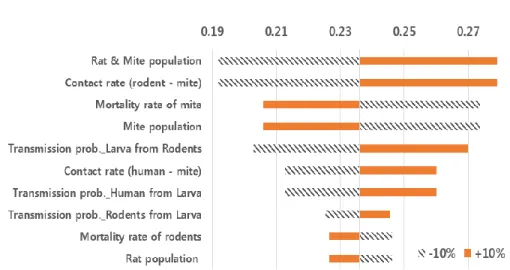
susceptible groups and dotted line is for infectious groups ... 18 FIGURE 5 Tornado plot for model 1; one way sensitivity of each
parameters for force of infection (per 100,000) ... 19 FIGURE 6 Tornado plot for model 1; one way sensitivity of each
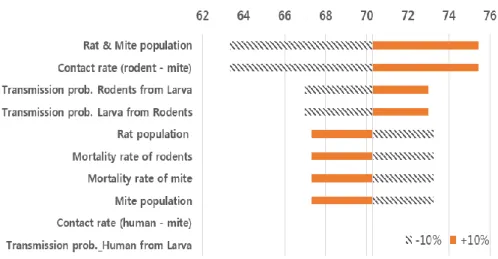
parameters for proportion of infectious rodents group (Ri) ... 20 FIGURE 7 Tornado plot for model 1; one way sensitivity of each
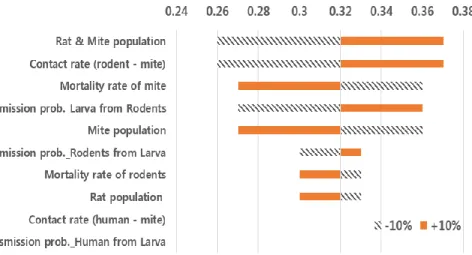
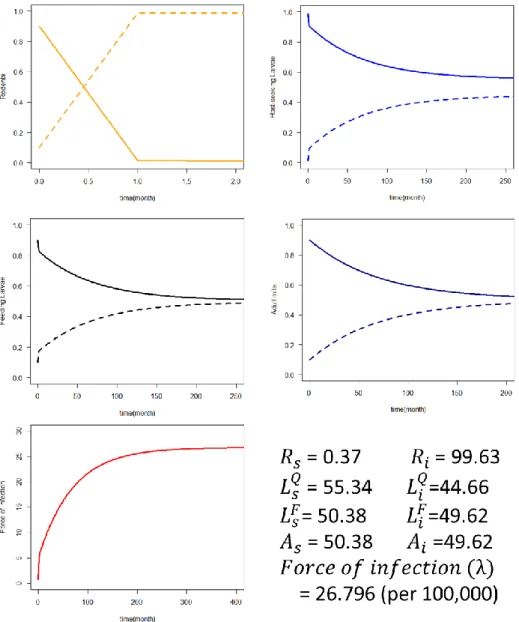
parameters for proportion of infectious mite group (Mi) ... 20 FIGURE 8 Simulation result by Model 2; Solid line indicates
susceptible groups and dotted line is for infectious groups ... 22 FIGURE 9 Tornado plot for model 2; one way sensitivity of each
parameters for force of infection (per 100,000) ... 23 FIGURE 10 Tornado plot for model 2; one way sensitivity of each
parameters for proportion of infectious rodents (Ri) ... 24 FIGURE 11 Tornado plot for model 2; one way sensitivity of each
parameters for proportion of infectious questing larva (LQi) ... 24 FIGURE 12 Single control measure assessment by Model 1 ... 26 FIGURE 13 Single control measure assessment by Model 2 ... 26 FIGURE 14 Increment of force of infection by increasing population
ratio of human to vector species ... 28 FIGURE 15 Control level needed to reduce force of infection by 50%
as population ratio of human to vectors increase ... 29
FIGURE 16 Minimum compliance level for each effectiveness of contact-reducing strategy in different population size of rodents and mite (Model 1) ... 31 FIGURE 17 Minimum compliance level for each effectiveness of
contact-reducing strategy in different population size of rodents and mite (Model 2) ... 31
List of Tables
TABLE 1 Parameter used in model 1 ... 15 TABLE 2 Parameter used in model 2 ... 16 TABLE 3 Minimum compliance level for each effectiveness of contact-reducing strategy in different population size of rodents and mite ... 30 TABLE 4 Discrepancies between reality and simulation results ... 33
1
INTRODUCTION
- Diseases profile of Scrub typhus
Scrub typhus, also known as tsutsugamushi, is one of major zoonotic disease in East Asia region, which is called tsutsugamushi triangle, caused by gram negative bacteria Orientia tsutsugamushi. Its clinical symptoms include headache, anorexia, myalgia with pathognomonic eschar and lymphadenopathy. [1]
Transmission of scrub typhus occurs through contact with infectious mite, mostly by family Trombiculidae. Globally, more than 1,600 species of Trombiculidae are reported and 44 species out of them detected in Republic of Korea (ROK). It is known that 7 species act as main vectors for tsutsugamushi in ROK, such as Leptotrombidium pallidum (L. pallidum), L. scutellare, L. palpale, L. orientale, L. zetum, Euschoengastia koreaensis and Neotrombicula japonica.
Life cycle of the mite consists of seven stages; egg, pre-larvae, larvae, proto-nymph, deuto-nymph, trito-nymph, adult. The mite in a larvae stage are also called as chigger, and they have parasitic (host-seeking) behavior only in this period of time. After growing to nymph stage, they no longer need hosts for feeding. Their major habitat is place with humid and flourishing vegetation, such as meadow and wetlands, because of high density of their hosts. [2]
2
- Epidemiologic characteristics of scrub typhus and incidence situation in Korea
Although scrub typhus occurs throughout the year, it is generally accepted that tsutsugamushi is strongly related with season, since 90%
incidences are concentrated on October and November. It is assumed that the seasonality derived from ecology of mite because peak spawning season of Trombiculidae is accordant to that of incidence cases. [3] Besides seasonality, demographic and socioeconomic status is also influence incidence. 58% of scrub typhus patients are people aged over 60, and there are more female patients than male’
s unlike other vector borne diseases. And 50% of patients engage in agriculture. it is because farmer group has more chance to contact with infectious mite than other job, and type of agricultural work among female is more static, so that women are vulnerable to avoid bite by mite [4]
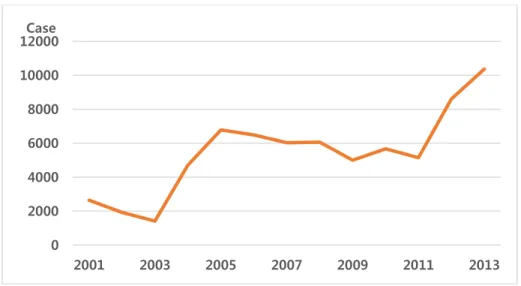
In Korea, scrub typhus was designated as notifiable infectious disease class III from 1993, and less than 300 incidence cases were reported annually until 1997. However the reported cases increased rapidly in 1998 as more than 1000. And it surged in 2004 as more than 5,000 cases and the figure maintained until 2011. And again, it increased dramatically from 2011 to 2013, recording over 10,000 cases (Figure 1). This figure indicates that scrub typhus is the most frequent vector-borne disease in the ROK.
3
FIGURE 1 Incidence of scrub typhus in ROK from 2001 to 2013
The explanation for this increase trend of scrub typhus is still not clear, but generally, popularization of outdoor activities and climate change have been considered. For example, Kong et al [5] reported that the incidence of tsutsugamushi is associated with annual precipitation and temperature.
Along with considerable impact on public health, Economic loss from tsutsugamushi is also non-negligible. Kim et al found that direct loss, such as treatment cost and reduction of the labor forces, would be about 10 billion won, and the damage would surge with ripple effect.
[6] Moreover, the burden is expected to increase in the future due to climate change [7]
Therefore increasing incidence rate and huge economic impact imply that we need a systematic control strategy for scrub typhus.
0 2000 4000 6000 8000 10000 12000
2001 2003 2005 2007 2009 2011 2013
Case
4
- Mathematical model
From 1990s, mathematical model was used as methodology of epidemiologic study, and more researchers adopted mathematical models with advent of advanced computing technology. The utility of mathematical models is maximized especially for infectious diseases.
It is because, unlike non communicable diseases, pathogen itself is the most principle risk factor, implying that transmission dynamics is very important to understand diseases, and differential equations make this happen. Moreover it helps researchers to figure out appropriate prevention strategies, by implementing theoretical experiments.
Varying some parameter values, researchers easily obtain several results from imaginary control measures. [8]
Fundamental mathematical model is susceptible – infected (infectious) – recovered (SIR) model within one species. Susceptible group indicate group of people who are possible to get the diseases, and infected group is, literally, people who have the disease, and who are able to spread to others, and recovered group depicts population who are cured from the diseases and obtain immunity against it. In this study, I constructed models with SI and SIS structures in order to calibrate ecologic characteristics of tsutsugamushi transmission in the real situation. Detail information of model structures is described in the next chapter.
There have been many researches on scrub typhus. However until 2000, the researches focused mainly on case reports for rare
5
symptoms and co-infection with HIV-AIDS, or ecologic studies for density of trombiculidae, and mite [9-12]. After 2000, more researches with various aspects were conducted, such as spatial analysis with GIS technology, [5] economic damage assessment [6], and incidence prediction in the future with climate change [7].
However only few studies are conducted with mathematical models.
To author’s knowledge, only two researches in Korea developed mathematical model of scrub typhus. Lee et al (2009) [13] adopted mathematical model of single-species SIR to predict future trend of tsutsugamushi incidence, but they did not consider natural reservoir of the diseases, mite and rodents, and focused only on human population. the research conducted by Kim et al (2010) [14], which is used as a fundamental frame of our study, constructed SI model with two species, mite and its natural hosts. Its underlying assumptions mirrored ecologic characteristics of mite and disease transmission, and the model produced basic reproductive number between the two species with implication of control strategy.
However they did not include human population and parameters used in the model is not derived from the context of Korea.
In this study, I developed mathematical models of scrub typhus for understanding transmission dynamics of tsutsugamushi, and draw the best control strategies from them [15]
6
METHOD
- Model description
In this study, two dynamic models of scrub typhus are developed.
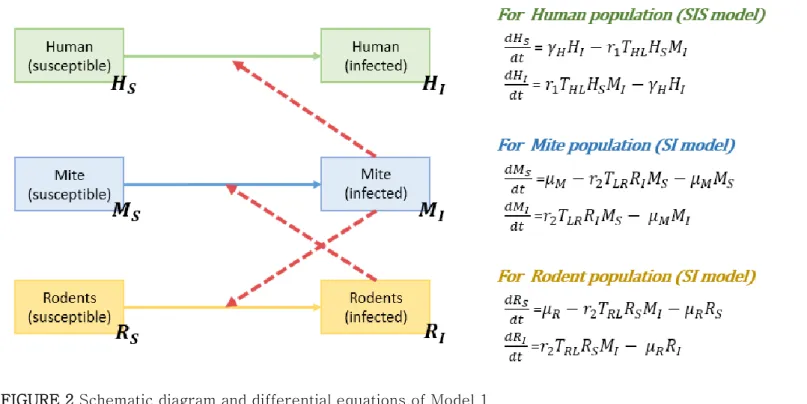
First model (model 1; figure 2) reflects fundamental ecology of tsutsugamushi transmission with 3 species population, human, mite, and natural host of mite. It describes that the disease circulate between mite and their natural host population, and spreading to human population occurs accidently (spill-over effect) [16].
Theoretically, the transmission from human to mite is feasible, but it is ignored, in the sense that the possibilities that infectious people experience mite bite is very low, and even then, its effect on transmission dynamics would be very slight, unlike mosquito- vectored diseases. It is also assumed that there is only one host species for parasitic mite which is rodent. In the real situation, most mammals, such as elk, raccoon dogs, act as natural hosts of parasitic mite, and their characteristics as hosts are different among them. This assumption imply that all parameters related with natural host population are uniformized.
Understanding that lifespan of rodents and mite is too short to develop immunity, we set up a Susceptible – Infectious (infected) model (SI model) for rodents and mite groups. On the other hand, Human group is thought to have Susceptible – Infectious – Susceptible model (SIS model) [17] because there are many subtype of scrub typhus infection and the immunity can last less than 2 years. For simplification, closed population, without birth and death, is assumed
7
for human, unlike rodent and mite population.
8
FIGURE 2 Schematic diagram and differential equations of Model 1
9
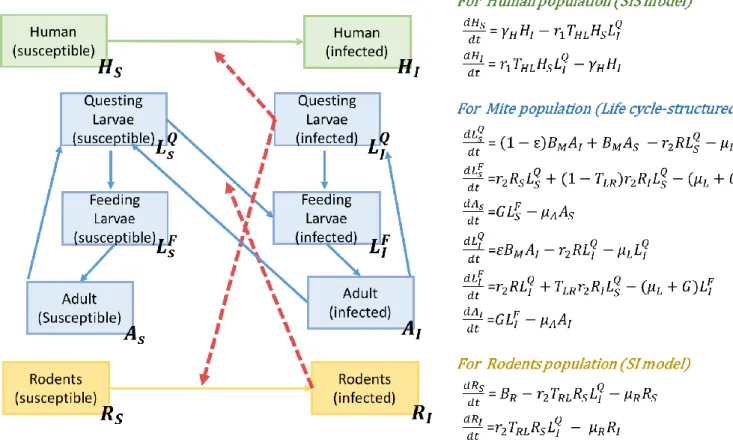
Second model (model 2; figure 3) represents more realistic transmission dynamics of scrub typhus with more complicated structure than model 1. The fundamental assumptions of model 1 are same in model 2, but differences are derived by putting a life cycle-structure on mite population. Family Trombiculidae, main vector for scrub typhus, has following 5 life cycle; egg, pre-larvae, larvae, proto-nymph, deuto-nymph, trito-nymph, and adult. However in the model, the life cycle is reclassified as three stages; questing larvae (pre-larvae), feeding larvae (larvae) and adult (nymph and adult), because the important aspect for disease dynamic system is interaction with susceptible hosts.
In the model 2, it is assumed that only infectious questing larvae (infectious Host seeking larva) can transmit to rodent or human population in order to reflect ecology of Trombiculid mite.
Trans-ovarian transmission, from adult mite to their offspring, is also considered.
In the model of sessile vector-borne diseases, such as tick- and flea- borne diseases, general assumptions for vector population is that there are two stages; free-living and feeding on host, and vectors can move bidirectional way, from free-living to feeding and from feeding to free-living. [17] However in the model of this paper, mite can change their stages only from free-living to feeding (from questing larva to feeding larva as described above),
10
because, unlike other sessile vectors, parasitic period of mite trombiculid is less than one week (usually 3 days) [2], so the chance of becoming questing stage is considered to be negligible.
11
FIGURE 3 Schematic diagram and differential equations of Model 2
12
As indicated above, there are some underlying assumptions support the models, and they are summarized as below:
Assumption 1.
Homogenous mixing (Frequent-dependent, mass action rule) Assumption 2.
Total number of each population is maintained (equilibrium) Assumption 3.
Infected human cannot spread pathogen to mite population.
Assumption 4.
There is only one natural host species for mite.
Assumption 5. (model 2)
Only free-living larva stage can transmit the pathogen to other population.
Assumption 6. (model 2)
The feeding larva cannot turn back to questing larva stage.
Assumption 7. (model 2)
There is a trans-ovarian transmission in mite population.
Assumption 8.
Population size ratio of Human : Rodents : Mite is 1 : 103 : 106
13
- Parameters used
Most parameters are adopted from published articles.
Understanding the ecological system of mite and rodents are greatly influenced by environmental diversity, we use parameters from researches in South Korea in order to maximize practicability.
Unlike other parameters, estimating the rate of contact between species (r1, r2) is impractical, so there is no appropriate research result for them. Therefore the contact rate is derived in an alternative way. For contact rate between human and mite (r1), we use the number of scrub typhus incidence. In 2013 approximately 10,000 cases are reported, so we assume that 600,000 contacts with bite occurred per year (transmission probability per bite is 75%, prevalence among mite is 2% [18]).
Parameter r2, contact rate between rodents and mite, is calculated from chigger index, which the number of mite on a host, in the same way.
As we already indicated above, constant number of population is presumed. With this assumption several parameters are calculated from other parameters. For example, in model 1, birth rate and natural mortality rate of mite group (BM, μM) are equal, same as those of rodents group (BR, μR). For model 2, we fixed mortality rate of adult mite(μA) and birth rate of mite(BM), and growth rate(G), mortality rate of questing larvae(μLQ) and
14
mortality rate of feeding larvae(μLF) are derived from equations below:
𝐆 = 𝝁𝑨× 𝑨 𝑳⁄ 𝑭
𝝁𝑳𝑸= 𝑨 × 𝑩𝑴⁄𝑳𝑸− 𝒓𝟐 × 𝑹 𝝁𝑳𝑭 = 𝑹 × 𝒓𝟐 × 𝑳𝑸⁄𝑳𝑭− 𝑮
Symbol R, A, LQ, LF indicate the number of each population.
15 TABLE 1 Parameter used in model 1
Parameter Meaning Value Reference
r1 Contact rate between a larva and a person 2e-17 Assumed*
r2 Contact rate between a larva and a rodent 2e-11 Assumed**
μR Mortality rate of rodents 1 Same as BR#
μM Mortality rate of mite 20 Same as BM#
γH Recovery rate of infected human 2 [1]
THL Transmission probability of human from a larva bite 0.75 Same as TRL§ TRL Transmission probability of rodents from a larva bite 0.75 [19]
TLR Transmission probability of larva from a rodent contact 0.09 [20]
BR Birth rate of rodents 1 [21]
BM Birth rate of mite 20 [2]
* Calculated from incidence case per year
** Calculated from chigger index of rodents
# To satisfy the assumption of fixed population size
§ Rough approximation due to lack of available data
16 TABLE 2 Parameter used in model 2
Parameter Meaning Value Reference
r1 Contact rate between a larva and a person 2e-17 Assumed*
r2 Contact rate between a larva and a rodent 2e-11 Assumed*
μR Mortality rate of rodents 1 Same as BR*
μLQ Mortality rate of questing larva 1.5 Calculated**
μLF Mortality rate of feeding larva 7.92 Calculated**
μA Mortality rate of adult mite 0.08 [22]
γH Recovery rate of infected human 2 [1]
THL Transmission probability of human from a larva bite 0.75 Same as TRL* TRL Transmission probability of rodents from a larva bite 0.75 [19]
TLR Transmission probability of larva from a rodent contact 0.09 [20]
BR Birth rate of rodents 1 [21]
BM Birth rate of mite 20 [2]
ε Trans-ovarian transmission probability of mite 0.9 [23]
G Growth rate 0.084 Calculated**
* Same as model 1 parameter
** To satisfy the assumption of fixed population size (calculation process is described in the text )
17
- Analysis
The main analysis in this study is constructing mathematical dynamic models with different setting and sensitivity test of each parameters used.
With constructed model, we examine dynamics of each population with graph, and compare the results with observed data with considering the reason of discrepancies. And one way sensitivity test is conducted with tornado plot. And finally, we assess single control measures, and explore optimal strategies for preventing scrub typhus.
In a sensitivity test and assessment of control measures we focus on variation of force of infection (λ) by changing parameters. The meaning of force of infection is transmission rate per 1 human individual, as described blow:
𝛌 = 𝒓𝟏 × 𝑻𝑯𝑳 × 𝑳𝑸𝒊 (𝑴𝒊)
𝑟1 × 𝑇𝐻𝐿 indicates an effective (causing transmission) contact rate between a person and a mite(questing larva in model 2), therefore by multiplying the number of infectious mite, it becomes transmission rate per 1 person. Throughout this paper, Howeverλ represents transmission rate per 100,000, instead Basically, R v.3.1.1. (package “deSolve”) is used to solve differential equations, and package “rootSolve” is used for equilibrium analysis
18
RESULT
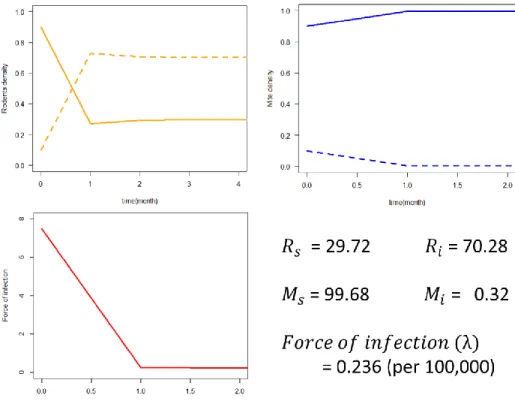
- Simulation result of Model 1 and sensitivity analysis Figure 4 shows simulation results by model 1. As the graphs display here, all population reaches equilibrium state within 2 month. The force of infection at equilibrium state was 0.236 (per 100,000), and prevalence in rodent population and mite population at equilibrium state were 70.28%, 0.32% respectively.
And interestingly, as prevalence in rodents groups increase, the force of infectious decrease in an initial period (0-1 month)
FIGURE 4 Simulation result by Model 1; Solid line indicates susceptible groups and dotted line is for infectious groups
19
FIGURE 5 Tornado plot for model 1; one way sensitivity of each parameters for force of infection (per 100,000)
Figure 5 depicts one way sensitivity test results for λ.
Population size of rat and mite, and contact rate between them were most influential parameters, and as they increased, the value of λ also increased. On the other hand, λ was decreased when mortality rate of mite and mite population size increased.
Since the contact rate was automatically adjusted as each population size varies, the relation between mite population size and λ is not proportional, rather it was inverse proportional. TLR
has proportional relationship with λ and less sensitive than mite population size. Since both r1, THL is proportional to λ by its definition, their sensitivity is same. Mortality rate of rodents and population size of rodents turned out to have least effect on λ, and their association with λ were inverse proportional.
20
FIGURE 6 Tornado plot for model 1; one way sensitivity of each parameters for proportion of infectious rodents group (Ri)
FIGURE 7 Tornado plot for model 1; one way sensitivity of each parameters for proportion of infectious mite group (Mi)
21
Figure 6 depicts one way sensitivity test results for Ri. Population size of rat and mite, and contact rate between them were most influential parameters, and as they increased, the value of Ri also increased. TRL and TLR is less sensitive than r2, but the association with Ri was same, proportional. On the other hand, Ri was decreased when mortality rate of mite and rodents, and population size of mite and rodents increased. Since r1 and THL is not involved in the equation of rodents group, there was no impact on Ri.
Figure 7 depicts one way sensitivity test results for Mi. Since λ has proportional association with Mi, sensitivity test results are similar with λ (Figure 5). However there was no effect of r1, and THL on Mi by its definition
Overall, rodents and mite population and r2 were the most sensitive parameters for model 1. Sensitivity index for λ, Ri, Mi
were 1.85, 0.86 and 1.72, respectively.
22
Simulation result of Model 2 and sensitivity analysis
FIGURE 8 Simulation result by Model 2; Solid line indicates susceptible groups and dotted line is for infectious groups
23
As displayed in figure 8, the simulation results with model 2 were different from those of model 1. First, it took longer time to reached equilibrium state among mite population. And prevalence at equilibrium is higher as 99.63% and 44.66%, in rodents and free living larvae population respectively. Force of infection at equilibrium was 26.796 (per 100,000) which is also higher than in model 1. Relationship between infectious rodents and λ was turned out to be proportional unlike model 1.
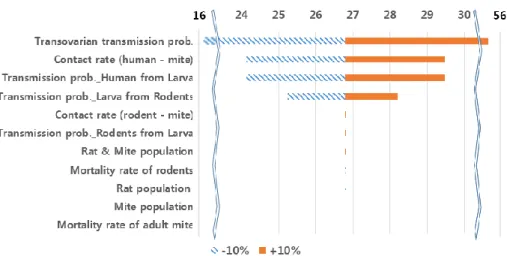
FIGURE 9 Tornado plot for model 2; one way sensitivity of each parameters for force of infection (per 100,000)
Figure 9 illustrates that trans-ovarian transmission is the most sensitive parameter for λ, followed by r1, THL and TLR. The value of λ in model 2 is robust to the parameters of r2, TRL, mortality and population. Especially Mite population and their mortality do not have any impact on λ (sensitivity index was 0)
24
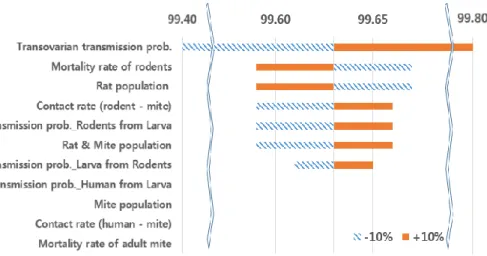
FIGURE 10 Tornado plot for model 2; one way sensitivity of each parameters for proportion of infectious rodents group (Ri)
FIGURE 11 Tornado plot for model 2; one way sensitivity of each parameters for proportion of infectious questing larva group (LQi) Figure 10 depicts one way sensitivity test results for Ri. Trans- ovarian transmission was the most influential parameters, and as
25
they increased, the value of Ri also increased. Mortality rate of rodents and its population size had second-largest effect on Ri
with inverse proportion relationship. Sensitivity of r2, TRL, mite
& rodent population size and TLR followed them. r1 and THL did not have any influence on Ri as a definition, and population size of mite and its mortality also did not have any effect.
Figure 11 depicts one way sensitivity test results for Mi. Since λ has proportional association with Mi, sensitivity test results are similar with λ (Figure 9). However there was no effect of r1, and THL on Mi by its definition
Overall, Trans-ovarian transmission was the most sensitive parameters for model 2. Sensitivity index for λ, Ri, LQi were 69.73, 6.97 and 0.02, respectively. And there was no effect of adult mite mortality and total mite population size.
26
- Single control measure assessment
FIGURE 12 Single control measure assessment by Model 1
FIGURE 13 Single control measure assessment by Model 2
27
To assess control strategies against scrub typhus by structured models, mortality rate of mite, mortality rate of rodents, and r1
were selected as “controllable” parameters, which mean that they can represent control measure in the real situation.
Mortality rate of mite and rodents indicate level of mite control and rodent control intensity respectively. Since population size cannot affected by transient intervention under density regulation theory, it is supposed that only mortality rate can be affected by control interventions. The parameter r1 is also considered as adjustable parameter in the real situation, indicating wearing protective gear, spraying repellent agents.
Figure 12 shows intensity of single control measures needed in order to reduce force of infection by 50% in model 1. λ decreased non-linearly as increase level of mite mortality, and 1.9 times higher mortality rate of mite was needed to reduce λ by 50%. On the other hand, 2.2 times higher mortality rate of rodents was needed for the same purpose. When it comes to r1, it need to become half by definition of λ
Figure 13 shows intensity of single control measures needed in order to reduce force of infection by 50% in model 2. As shown in sensitivity results, there was no effect of mortality of mite, so I did not suggest result of mite mortality. Unlike model 1, more than 200 times higher rodent mortality was needed to obtain 50%
of λ. In the case of r1, the result was same by definition of λ
28
- Threshold analysis for scrub typhus control
FIGURE 14 Increment of force of infection by increasing population ratio of human to vector species
Population ratio(n)* = Human : n x rodents : n x mite
Figure 14 shows changes in force of infection by increasing population size of vectors including mite and rodents. In the model 1, force of infection increased up to 5.24 times higher than initial value, as the size of vector population doubled. Whereas in the case of model 2, the increment was 2 times as the size of vector population doubled. The relationship between force of infection and vector population size is very close to linear, but not exactly.
29
FIGURE 15 Control level needed to reduce force of infection by 50% as population ratio of human to vectors increase
Population ratio(n)* = Human : n x rodents : n x mite
𝒓
𝟏∗= 𝒓
𝟏× (𝟏 − 𝑿)
𝒓𝟏∗ = 𝑒𝑥𝑝𝑒𝑐𝑡𝑒𝑑 𝑐𝑜𝑛𝑡𝑎𝑐𝑡 𝑟𝑎𝑡𝑒 𝑡𝑜 𝑜𝑏𝑡𝑎𝑖𝑛 𝜆 2⁄ , 𝑋 = 𝐶𝑜𝑛𝑡𝑟𝑜𝑙 𝑖𝑛𝑡𝑒𝑛𝑠𝑖𝑡𝑦 𝑙𝑒𝑣𝑒𝑙
Figure 15 shows expected control level in order to obtain 50%
force of infection by the equation above. The control level is increase as total population size of rodents and mite, increase, since it causes higher force of infection.
It turned out that when the population of rodents and mite grow up to 2 time, 0.75 or 0.90 of control intensity level(X in the equation above) is needed (model 1, model 2 respectively) to achieve 50% of infection force.
30
TABLE 3 Minimum compliance level for each effectiveness of contact- reducing strategy in different population size of rodents and mite
( H : R : M ) = ( 1 : n x 103 : n x 106 )
Effectiveness
0.5 0.6 0.7 0.8 0.9
Model 1
n = 1 1 0.83 0.71 0.63 0.56 n = 1.25 - - - 0.90 0.80 n = 1.5 - - - - 0.91 n = 1.75 - - - - 0.97
n = 2 - - - - 1
Model 2
n = 1 1 0.83 0.71 0.63 0.56 n = 1.25 - 1 0.86 0.75 0.67 n = 1.5 - - 0.96 0.84 0.74 n = 1.75 - - - 0.89 0.79 n = 2 - - - 0.94 0.83
Table 3 shows that minimum compliance levels for strategies of reducing r1. Dash mark means that needed compliance level exceed 1, so it is considered as impossible to reduce r1 by 50%.
In the gross, as population ratio (n) increase higher intensity of control strategy needed. Result of model 1 shows that when population ratio increased 1.5 times, only control measures with 90% effectiveness can attain 50% of contact rate. On the other hand, the result of model 2 was moderate than model 1, so effectiveness of 80% can cover 2 times higher size of reservoirs population.
Figure 16 and 17 illustrate the result of table 3 with three- dimensional graphics
31
FIGURE 16 Minimum compliance level for each effectiveness of contact-reducing strategy in different population size of rodents and mite (Model 1)
FIGURE 17 Minimum compliance level for each effectiveness of contact-reducing strategy in different population size of rodents and mite (Model 2)
32
DISCUSSION
The main purpose of this study is constructing mathematical models with parameters reflecting transmission dynamics of scrub typhus in the context of the Republic of Korea, and searching proper control strategies by application of the models.
In the simulation results of model 1, prevalence proportion of rodent group at equilibrium state is 70.28%, and that of mite is 0.32%. Previous researches [18, 24] for sero-prevalence survey among rodents and mite, have revealed that prevalence of rodents ranges from 45% to 52%, and that of mite ranges from 1.37% to 1.77%. Therefore model 1 produced results that prevalence of rodents is over-estimated whereas prevalence of mite is under-estimated. When it comes to force of infection, since the value in reality is 1.67 (10,350 cases were reported in 2013), the model 1 underestimated λ as well (the value in the model 1 was 0.236; 7 times lower than real value). There are many reasons for discrepancies between mathematical model and real situation [17]. The higher prevalence of rodents would be derived from the assumption that there is no scrub typhus induced death in rodent population or underestimation of natural death rate of rodent. In the case of mite, however, even though whole mite population assumed to have parasitic life, which means higher chance of being infected from infectious rodents,
33
the prevalence at equilibrium was lower than reality. It could be caused by the assumption that there is no trans-ovarian transmission. The underestimated λ is, with no doubt, from the lower value of Mi proportion.
In the model 2, both prevalence of rodents and larvae was over- estimated as 99.63% and 49.62% respectively. The possible causes for overestimated rodent prevalence would be same as that of model 1, but the extent of discrepancy is amplified by overestimated prevalence of mite. In case of prevalence of mite, the discrepancy could be from the existence of trans-ovarian transmission in the model. Since the prevalence of rodents and mite is higher than reality, the value of λ is also overestimated, so it has 16-times higher value.
TABLE 4 Discrepancies between reality and simulation results Reality Model 1* Model 2*
Prevalence of rodent 45- 52% 70.28% 99.63%
Prevalence of mite 1.37 -1.77% 0.32% 49.62%
Force of infection** 1.667 0.236 26.796
* The values come from equilibrium states
** Can be interpreted as incidence rate (per 100,000 person*month) As I described above, none of models developed in this paper were calibrated with the value of reality. However the purpose of models is not reproducing phenomena of real world, but understanding the disease dynamics by simplification. Therefore
34
these discrepancies are not the matter of reliability.
The purpose of sensitivity analysis in this paper was not only to figure out which parameters have great influence on the outcome value but also to suggest future studies needed to construct theoretical model with better parameterize. In the sensitivity analysis of model 1, rat & mite population and r2 have the greatest effect on every outcome values tested, λ, Ri, and Mi. On the other hand, in the sensitivity analysis of model 2, trans- ovarian transmission has huge impact on the outcome value, especially λ. But it shows limited or none of effect of population size or mortality rate of mite and rodent.
The discrepancies comes from several facts and model assumption. First of all, the reason why model 2 dose not respond to the change of mortality rate is that I suppose fixed size of population. Therefore population loss by mortality rate is complemented by other parameters. For example if mortality rate of adult mite increased, parameter G, which is growth rate from feeding larvae to adult mite, also increase, and if mortality rate of questing larva increase, the spawning rate (birth rate) of mite increase as well, automatically. It seems to be too theoretical and unrealistic, but it is generally accepted that nature’
s capacity for each species are fixed by the local fauna and flora.
So the assumption is not too strong to be adopted. Secondly, the
35
different sensitivity of r2 on λ or Mi also come from the assumption of fixed population size, since change of r2 is compensated by inverse change of mortality of questing larva.
The strong sensitivity of trans-ovarian transmission could be a result of high reference value (0.9). Since the sensitivity is calculated with variation of reference value (-10%, +10%), the upper limit of ε was 0.99 which means nearly 100% of transmission probability. the 100% of trans-ovarian transmission directly means that there is no way to increase proportion of susceptible group, and the direction would be only from susceptible from infectious, consecutively the prevalence of mite and λ increased drastically. However, it is clear that accuracy of ε is critical for reliability of the model 2.
In the single control measure assessment, only r1, μM and μR
are considered as controllable parameters in the real situation, because it is assumed that the total capacity of mite and rat cannot be changed by intervention, so what we can practice is increase of mortality rate of mite and rodent and these design is accordance with previous researches for vector-borne disease modelling [15]. The interpretation of the results are relatively simple. Model 1 indicates that about 2 times higher mortality rate of rodent and mite is needed to achieve reducing the incidence and much stronger intensity of rodent control is needed in model
36
2. This is because the effect of rodents on mite prevalence is very weak. Even in the result of model 1, making two times higher mortality rate of rodents and mite is not practical due to lack of accessibility to their habitat and economic or human resources. Therefore only reducing contact rate between human and mite turned out to be practical. [25]
Korean Center for Disease Control and Prevention (KCDC) has implemented intensive control programs for endemic scrub typhus since 2006. The program mainly consist of providing oversleeves and repellent to local residents with several education program. In a modelling framework, these control strategies are translated as reducing r1. Therefore, again, distancing from mite is the only practical methodology, so we needed to focus on the next question, how intensive the control program should be.
In the model 1 and 2, as population size of rodents and mite increase, λ also increase up to 5.24 and 2 times higher each, so lower level of r1 is required to maintain or reduce λ. The value of r1 with control strategy (r1*) can be represented as below:
𝒓𝟏∗ = 𝒓𝟏× (𝟏 − 𝜶𝜷),
𝑤ℎ𝑒𝑟𝑒, 𝛼 = 𝑒𝑓𝑓𝑒𝑐𝑡𝑖𝑣𝑒𝑛𝑒𝑠𝑠 𝑜𝑓 𝑐𝑜𝑛𝑡𝑟𝑜𝑙 𝑚𝑒𝑎𝑠𝑢𝑟𝑒 𝛽 = 𝑐𝑜𝑚𝑝𝑙𝑖𝑎𝑛𝑐𝑒 𝑙𝑒𝑣𝑒𝑙 Table 3 shows the value of β by each effectiveness and
37
simulation scenarios. The increase of λ by increasing size population of rodent and mite population is more rapid in model 1 than model 2, so higher compliance level is required in the model 1 at the same level of effectiveness and scenarios. The difference is caused by the simulation result of model 2. Since the prevalence of rodents is already too high in model 2, there is not enough room to increase by increasing population size of mite.
Therefore it also can be inferred that the effect of population size variation increase in the lower value of trans-ovarian transmission rate because it has very huge impact on prevalence of rodents at the equilibrium.
In Korea, the effectiveness of oversleeves and repellent was reported as 50% in the case-control study. [26] Therefore it seems to be an invalid method neither to reduce nor even to maintain incidence as the population ratio increase. It implies that the reason why incidence of scrub typhus has been keep increasing even though the control program has implemented with increasing its scale and intensity. Since it is generally accepted that the number of rodents and mite increase with climate change such as warmer temperature and higher precipitation, [27, 28] force of infection in the real situation also increase by the growing number of rodents and mite, and it could not be neutralized by current intensity of distancing strategies with lack of budget. [29]
38
The reliability of mathematical model in epidemiology often evaluated by accuracy of parameters and reality of model structures. In contrast to other directly transmissible diseases, such as pulmonary tuberculosis and influenza, background knowledge about vector borne diseases is far less cumulated. In this regard, developing a highly reliable models for vector borne diseases could be unachievable, so the limitation also exist in this study with parameter uncertainty especially trans-ovarian transmission probability.
Since this paper is the first research of developing mathematical model of scrub typhus, it could be expanded to various way including seasonal-forcing, spatial-forcing or inverse modelling (calibration) etc.
39
CONCLUSION
In this paper, I reaffirmed that reducing contact rate between human and mite is the only practical methodology to control tsutsugamushi incidence, on the other hand, control of mite or rodents is only have limited effect. Especially in the model 2, mite control does not have any protective effect, because it is neutralized by trans-ovarian transmission from adult mite.
It is generally accepted that population size of mite or rodents are closely related with climate change, implying that they expected to grow. As this study reveals, however, current control program would be not enough to reduce, even nor maintain incidence rate among human group. Therefore more intensive control program should be considered to deal with increasing vector population
40
REFERENCE
1. Plamer, S.R., et al., Oxford Textbook of Zoonoses (2nd edi.). Oxford. 2011. 112-116.
2. Kim, K., et al., hygienic entomology. 2002: sinkwangmunhwasa.
3. Lee, I.-Y., H.-I. Ree, and H.-K. Hong, Seasonal prevalence and geographical distribution of trombiculid mite (Acarina:
Trombiculidae) in Korea. Korean J Zool., 1993. 36: p. 408-415.
4. Lee, G., The Evaluation of Health Program for Prevention Scrub Typhus in Rural Area. 2010.
5. Woo-seok, K., et al., Time-Spatial Distribution of Scrub Typhus and Its Environmental Ecology. Journal of the Korean Geographical Society, 2007. 42(6): p. 863-878.
6. KIM, J., Socioeconomic Loss of Tsutsugamushi Disease. 2009, KCDC.
7. Shin, H.-s. and D.-J. Kim, Climate change and burden of infectious disease. 2008, KIHASA.
8. Lloyd-Smith, J.O., et al., Epidemic dynamics at the human- animal interface. Science, 2009. 326(5958): p. 1362-7.
9. Choi, M.S., et al., Seroepidemiological Survey of Scrub Typus in Korea, 1995-1996. The Journal of the Korean Society for Microbiology, 1997. 32: p. 219-225.
10. Hyun-Jae, S., et al., Population density of chigger mites, the vector of tsutsugamushi disease in Chollanam-do, Korea.
Korean Journal of Parasitology, 1996. 34(1): p. 27-33.
11. Woo-Hyun, C., et al., Seroepidemiological Survey of Scrub Typhus in Korea,1992. The Journal of the Korean Society for Microbiology, 1994. 29(2): p. 153-160.
12. Yoon-Won, K., et al., Patterns of Acute Febrile Illness(Murine Typhus, Scrub Typhus, Leptospirosis and Hemorrhagic Fever with Renal Syndrome) from 1986 to 1990 in Korea. The Journal of the Korean Society for Microbiology, 1991. 26(5): p. 431- 441.
13. Lee, J.-H., M.S. Murshed, and J.-S. Park, Estimation of infection distribution and prevalence number of Tsutsugamushi fever in Korea. Journal of the Korean Data and information science society, 2009. 20(1): p. 149-158.
14. Kim, B., L. Gordillo, and Y. Kim, A model for the transmission dynamics of Orientia tsutsugamushi among itsnaturalreservoirs.
41
Journal of Theretical Biology, 2010. 266: p. 154-161.
15. Bowman, C., et al., A mathematical model for assessing control strategies against West Nile virus. Bull Math Biol, 2005. 67(5):
p. 1107-33.
16. Luz, P.M., C.J. Struchiner, and A.P. Galvani, Modeling transmission dynamics and control of vector-borne neglected tropical diseases. PLoS Negl Trop Dis, 2010. 4(10): p. e761.
17. Keeling, M.J. and P. Rohani, Modeling infectious diseases in human and animals. 2008: princeton university press.
18. Ree, H.-I., et al., Detection of Orientia tsutsugamushi DNA in individual trombiculids using polyerase chain reaction in Korea.
The japan society of medical entomology and zoology, 1997.
48(3): p. 197-209.
19. Lerdthusnee, K., et al., Efficiency of Leptotrombidium chiggers (Acari: Trombiculidae) at transmitting Orientia tsutsugamushi to laboratory mice. J Med Entomol, 2002. 39(3): p. 521-5.
20. Takahashi, M., et al., Transmission of Rickettsia tsutsugamushi from Apodemus speciosus, a wild rodent, to larval trombiculid mites during the feeding process. Jpn J Exp Med, 1990. 60(4):
p. 203-8.
21. Yoon, M., et al., The mammals of Korea. 2004: Dongbang media.
22. Yu, X.J. and R.B. Tesh, The Role of Mites in the Transmission and Maintenance of Hantaan Virus (Hantavirus: Bunyaviridae).
J Infect Dis, 2014. 210(11): p. 1693-1699.
23. Shin, E.H., et al., Transovarial transmission of Orientia tsutsugamushi in Leptotrombidium palpale (Acari:
Trombiculidae). PLoS One, 2014. 9(4): p. e88453.
24. Ree, H.I., et al., Determination and geographical distribution of Orientia tsutsugamushi serotypes in Korea by nested polymerase chain reaction. Am J Trop Med Hyg, 2001. 65(5):
p. 528-34.
25. Li, J., A. Sharma, and A.K. Misra, A mathematical model for control of vector borne diseases through media campaigns.
Discrete and Continuous Dynamical Systems - Series B, 2013.
18(7): p. 1909-1927.
26. Kweon, S.S., et al., A community-based case-control study of behavioral factors associated with scrub typhus during the autumn epidemic season in South Korea. Am J Trop Med Hyg, 2009. 80(3): p. 442-6.
27. Gage, K.L., et al., Climate and vectorborne diseases. Am J Prev Med, 2008. 35(5): p. 436-50.
42
28. Van Peenen, P.F., et al., Correlation of chigger abundance with temperature at a hyperendemic focus of scrub typhus. J Parasitol, 1976. 62(4): p. 653-4.
29. Kwan, L., et al., Comparison of the Awareness and Knowledge of Scrub Typhus between Case and Control Groups. Journal of Agricultural Medicine&Community Health, 2012. 37(1): p. 1- 11.
43
국문초록
쯔쯔가무시증의 수리적 모델 구축을 이용한 효과적인 관리방안 연구
쯔쯔가무시증은 Orienta tsutsugamushi 감염에 의해 일어나는 질 병으로 털진드기 (Family Trobombiculid ) 에 의해 주로 매개되는 감 염병이다. 이러한 쯔쯔가무시증은 최근 한국에서 연간 10,000건을 넘어서며 급증하고 있는 추세이지만 아직까지 명확하게 그 원인에 대해 설명하는 연구는 이루어지지 않고 있다. 이러한 맥락에서 수리 적 모형 구축을 통해 쯔쯔가무시증 전파의 역학(dynamics)를 파악하 고, 이를 바탕으로 가장 효과적으로 발생을 억제할 수 있는 방안을 모색해보려 하였다.
연구결과, 털진드기와 설치류의 개체 수 및 그들의 치사율의 변화, 그리고 사람과 진드기의 접촉률(rate)이 사람집단의 감염 위험에 영 향을 준다는 것을 확인할 수 있었다. 다만 경란전파를 고려한 모델 에서 털진드기 및 설치류의 방제는 사람에서의 감염위험에 전혀 영 향을 주지 못하거나 효과가 매우 미비하였고, 오직 사람에서 진드기 와의 접촉감소가 현실적인 방법으로 나타났다. 또한 같은 접촉율이 라도 털진드기와 설치류의 개체수 증가에 따라 발생율이 증가하는 것을 보아, 기후변화에 따라 이들의 개체수가 증가하게 되면 더욱 강력한 접촉감소전략이 요구된다는 것을 확인 할 수 있었다.
본 연구는 인구집단을 포함시킨 최초의 쯔쯔가무시증 수리적 모 델이라는 점에서 의의가 있으며 추후 타당도가 더 높은 모수의 활 용 및 계절성 고려, 혹은 공간분석 등 모형확장을 통해 더 발전시켜 야 할 것이다.
주요어 : 쯔쯔가무시, 수리적모델, 관리정책 학번 : 2013-21866