저작자표시-비영리-변경금지 2.0 대한민국 이용자는 아래의 조건을 따르는 경우에 한하여 자유롭게
l 이 저작물을 복제, 배포, 전송, 전시, 공연 및 방송할 수 있습니다. 다음과 같은 조건을 따라야 합니다:
l 귀하는, 이 저작물의 재이용이나 배포의 경우, 이 저작물에 적용된 이용허락조건 을 명확하게 나타내어야 합니다.
l 저작권자로부터 별도의 허가를 받으면 이러한 조건들은 적용되지 않습니다.
저작권법에 따른 이용자의 권리는 위의 내용에 의하여 영향을 받지 않습니다. 이것은 이용허락규약(Legal Code)을 이해하기 쉽게 요약한 것입니다.
Disclaimer
저작자표시. 귀하는 원저작자를 표시하여야 합니다.
비영리. 귀하는 이 저작물을 영리 목적으로 이용할 수 없습니다.
변경금지. 귀하는 이 저작물을 개작, 변형 또는 가공할 수 없습니다.
Master’s Thesis of Arts
Building Colombia's National Memory Museum:
Implications for non-
formal education and culture of peace
August 2021
Global Education and Cooperation Major Graduate School of Education
Seoul National University
Ana Catalina Velasco Sanchez
Building Colombia's National Memory Museum:
Implications for non-
formal education and culture of peace Thesis Advisor: Kevin Kester
Submitting a master ’ s thesis of arts
August, 2021
Graduate School of Education Seoul National University
Global Education and Cooperation Major Ana Catalina Velasco
Confirming the master’s thesis written by Ana Catalina Velasco
August, 2021
Chair Vice Chair
Examiner
Abstract
Colombia’s National Memory Museum represents a unique and exciting opportunity as it is one of the only public spaces that promotes historic memory and that portrays experiences, anecdotes and stories that have been lived by Colombian victims throughout the territory. The museum’s objectives are to clarify the truth (at least different perspectives on “truth”), to promote respect for the multiple memories and life stories about conflict, to symbolically repair victims of conflict, and to be a space that promotes dialogue and reflections of historic memory to avoid the resurgence of violent acts.
Even though the museum was not thought of being a peace education strategy, its goals, and objectives on working towards the non-repetition of violent conflict in the Colombian territory align with peace education strategies, more specifically with the goal of creating a culture of peace. As little is still known of the possibilities the museum may have to help in the construction of a culture of peace as a non-formal education institution, this thesis intends to explore and present the various possibilities non-formal educational institutions, like Colombia’s National Memory Museum, have in helping in the construction of a culture of peace in conflict affected settings like Colombia.
To accomplish these research objectives, this thesis uses a critical-constructivism as a methodological stand point and uses qualitative research methods to analyze interviews with five museum workers along with document analysis from sources like podcasts, newspapers and museum documents. It later uses a thematic analysis on data to find what are the possibilities the museum can have to help in the construction of a culture of peace.
Two are the themes found that represent an exciting opportunity for other educators around the world to understand, improve and use non-formal education strategies as complements in the creation of a sustainable culture of peace.
Keywords: Culture of peace, non-formal education, peace education, critical constructivism, museum education, thematic analysis
Student ID: 2019-22815
본 논문작성자는 한국정부초청장학금(Global Korea Scholarship)을 지원받은 장학생임 The author of this thesis is a Global Korea Scholarship scholar sponsored by the Korean
Government
T ABLE OF C ONTENTS
Table of figures and images ...viii
Chapter I. Introduction ... 1
1.1 Background of the study... 1
1.1.1 The National Memory Museum... 2
1.2 Statement of the research problem ... 2
1.3 Purpose of the study and research questions... 3
1.4 Overview of the chapters... 3
Chapter II. Literature Review ... 6
2.1 Understanding the terms “culture of peace”, “culture” and “peace” and their roles in peace education... 6
2.1.1 Conceptualizing the term “culture of peace” ... 6
2.1.2 Contrasting views on the term “Culture”... 7
2.1.3 Reviewing peace theory and its influence in the conception of a culture of peace 9 2.2 Peace education and the creation of a Culture of Peace ... 12
2.2.1 Possibilities of peace education to promote a culture of peace: International organizations and critical theory – top-down and bottom-up approaches ... 13
2.2.2 Peace education in formal education contexts to promote a culture of peace: State-based education ... 14
2.2.3 Peace education in non-formal education contexts to promote a culture of peace: Peace Museums as transformative experiences ... 18
2.2.4 Peace Education and the creation of a culture of peace in the Colombian context 20 2.2.5 Peace education strategies in non-formal education contexts: An evident research lacuna ... 22
2.3 Relevance of the study ... 24
Chapter III. Methodology and Research Design ... 26
3.1 Methodology ... 26
3.1.1 Researcher’s positionality ... 26
3.1.2 Onto-epistemic positioning ... 28
3.2 Methods ... 30
3.2.1 Sampling of participants ... 31
3.2.2 Data Collection Procedures ... 32
3.2.3 Data Analysis: Thematic Analysis ... 35
3.2.4 A culture of peace analytical framework ... 37
3.2.5 Ethics and participants’ safety ... 38
3.2.6 Study Limitations ... 38
Chapter IV. Findings and Analysis ... 40
4.1 Not everything is black and white, there is gray in between ... 40
4.1.1 Either Black or White: A Summary of Colombia’s Conflict Polarization ... 41
4.1.2 The Museum as a peace laboratory ... 43
4.1.3 The museum as a safe space for dangerous conversations ... 45
4.1.4 Strings of power: Reimposing verticality ... 46
4.2 Analysis of Theme 1 ... 48
4.3 Emotions, multiple intelligences and art ... 49
4.3.1 Art: sharing life stories and experiences that are impossible to tell through words 50 4.3.2 The museum as a place to create empathy through emotions ... 54
4.3.3 Multisensorial experiences: creating a deeper effect in visitors through the usage of common life items ... 56
4.3.4 The objective of the museum: to promote social transformation ... 57
4.4 Analysis of Theme 2 ... 58
Chapter V. Discussion ... 61
5.1 Transforming the individual ... 61
5.1.1 An intergenerational gateway: becoming aware of the past, the present and the future 62 5.2 Transforming Society ... 63
5.2.1 Using emotional nodes to create mutual understanding ... 64
Chapter VI. Conclusion ... 66
6. References ... 69
T ABLE OF FIGURES AND IMAGES
Table 1 Galtung typology of violence (1996, p.31) ... 10
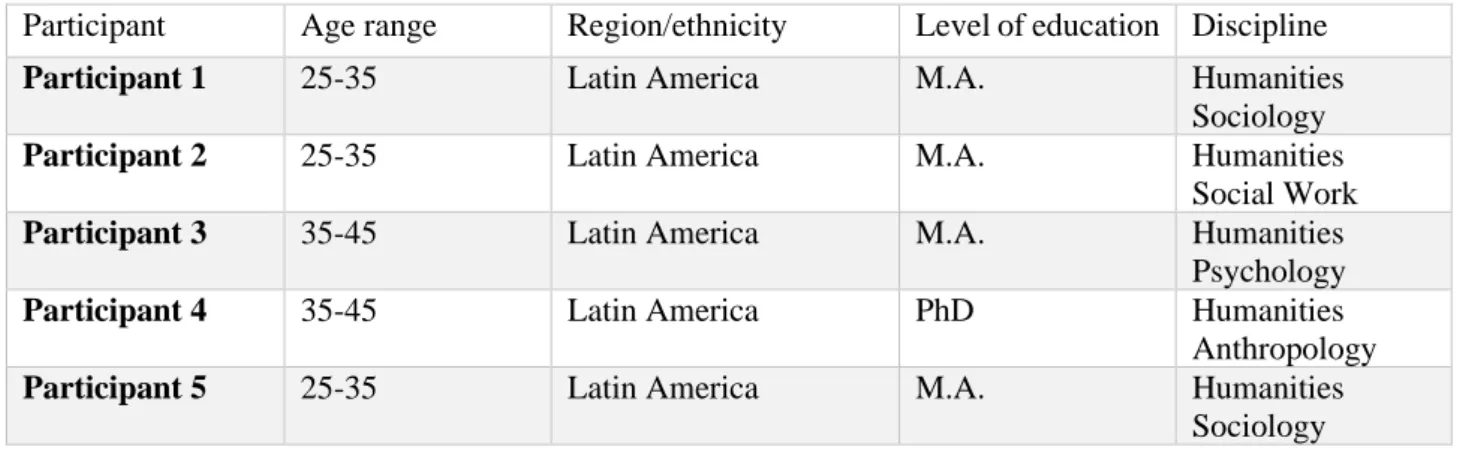
Table 2 Museum workers participants’ sample ... 31
Table 3 Semi-structured questionnaire used in 1:1 interviews with participants ... 33
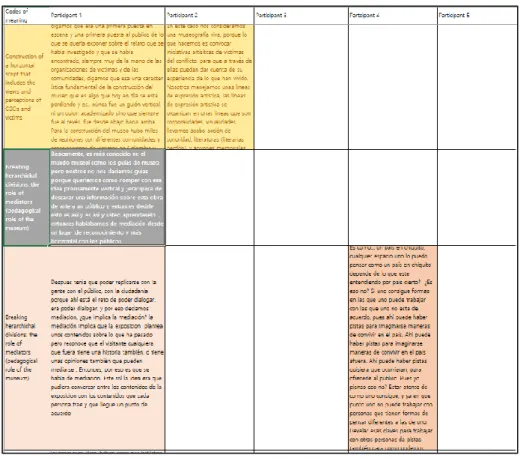
Figure 1: Sample of analysis matrix ... 36
Image 1 Interactive work of art presented at the first pilot exhibition in Cali Colombia 52 Image 2 Community created maps on how the conflict has changed water... 52
Image 3 Tocando la marea - Teather play created by victims’ collectives as a way to denounce their stories in Colombia’s Conflict ... 53
Image 4 Concert Ancestral Singings for Empowering Life ... 54
Image 5 "The Matachines" Teather/dance performance ... 55
Image 6 Multisensorial exhibitions ... 57
C HAPTER I. I NTRODUCTION
“They have killed us for so long, and taken so much away from us, that along that process they also took away the fear to speak up, to tell our stories, to let the rest of the world know
that almost 50 years of violent conflict does not leave any good behind.”
-- Indigenous social leader from the Cauca community, quote presented in the first pilot exhibition of the Colombia’s National Memory Museum in 2017
1.1 B
ACKGROUND OF THE STUDYColombia has had one of the longest internal violent conflicts around the world dating back to the 1950s (CNRR, 2013). Different from other internal conflicts, the Colombian conflict includes a multiplicity of belligerents ranging from guerrilla groups (FARC-EP and ELN), paramilitary death squads, Colombian military and police, narcotraffic gangs and organized crime bands. Not until 2011, under the presidency of Juan Manuel Santos, did the government officially recognize that Colombia was/is in a state of war and that there are several instances throughout the Conflict in which the multiple parties have caused serious violations to human rights and irreversible damages to civilians’ livelihoods (Cortés, 2013). Yet this securitization of the conflict as a “war” by the national government is a contested one. Due to economic and international development objectives at the time, Santos’ presidency decided to pursue an agenda for “peace” in which he enacted a series of laws and projects in which the Colombian government had the necessity to respond to the multiple injustices and human rights violations of victims during the years of the conflict.
In 2011, the law of Victims 1448 was created with the objective of providing victims the right to truth, justice and reparation with a guarantee of non-repetition. From this law the Center of Historic Memory was created with the intention of creating a historic memory file for reconstructing the conflict from the victims’ perspectives. Besides, under the scope of the law, the Center of Historic Memory was given the task to create Colombia’s National Memory Museum.
1.1.1
The National Memory MuseumThe National Memory Museum (Memory Museum, for short) represents a unique and exciting opportunity as it is one of the only public spaces that promotes historic memory and that portrays experiences, anecdotes and stories that have been lived by Colombian victims throughout the territory. The museum’s objectives are to clarify the truth (at least different perspectives on “truth”), to promote respect for the multiple memories and life stories about conflict, to symbolically repair victims of conflict, and to be a space that promotes dialogue and reflections of historic memory to avoid the resurgence of violent acts. Although the Memory Museum does not have a physical building yet, it has held several itinerary exhibitions.
Its first pilot exhibition took place in 2018 as a commemoration of the peace agreement signed between FARC and the Santos’ government in 2016.
Thanks to the enacted Victims Law 1448 of 2011 and to the 2016 Colombian peace agreement, there has been an increase in research on the various dimensions of Colombia’s peacebuilding (Diazgranados et al., 2014; Echavarría & Cremin, 2019; Pinzon-Salcedo & Torres-Cuello, 2018). Although Colombian conflict has not yet finished, research has helped to trace the challenges and opportunities the various peacebuilding strategies are having in Colombia.
Research related to peace education in Colombian formal education has also been taking place.
Most recent studies related to peace education strategies try to define and evaluate the role that formal educational institutions are having in the promotion of a culture of peace in Colombia (Barros et. al, 2020; del Pozo et. al, 2018; Madrigal, 2020; Maldonado, 2019; Velasco, 2015).
However, research regarding the role non-formal education has in the construction of culture of peace in Colombia is still very limited .
1.2 S
TATEMENT OF THE RESEARCH PROBLEMEven though the museum was not thought of being a peace education strategy, its goals, and objectives on working towards the non-repetition of violent conflict in the Colombian territory align with those of peace education strategies. For example, the museums core objectives rest in empowering minorities and victims into telling new stories about conflict, cultivating respect for others, and fostering debating skills as a way to settle differences rather than using clashing violence. All of these objectives seem to align with those proposed by culture of peace frameworks created by UNESCO and reviewed and enhanced by authors such as Betty Reardon
3
(1999, 2001; 2002), David Adams (1989; 1997; 1991), and Werner Wintersteiner (2004; 2013, 2016).
For this reason, as little is still known of the possibilities the museum may have to help in the construction of a culture of peace as a non-formal education institution, this thesis intends to explore and present the various possibilities non-formal educational institutions, like the Memory Museum, have in helping in the construction of a culture of peace in Colombia.
1.3 P
URPOSE OF THE STUDY AND RESEARCH QUESTIONSThis study does not attempt to evaluate the extent and effectiveness of the Memory Museum programs to mainstream a Culture of Peace, as this thesis will not use a positivist methodological stance nor quantitative methods to measure effectiveness. Rather, the intention of this thesis is to qualitatively explore and present the possibilities non-formal education institutions have in mainstreaming a culture of peace. More specifically, this thesis intends to explore the possible role Colombia’s National Memory Museum will have in mainstreaming a Culture of Peace in a conflict-affected society like Colombia. This exploration can be used as a first step into future research in the field of non-formal education, culture of peace and conflict affected societies. Besides, the exploration of the opportunities and challenges can also offer educators around the world alternative modalities which to promote a culture of peace beyond schools.
For this reason, this study is guided by the following research questions:
- What possibilities can non-formal peace education strategies like Colombia’s National Memory Museum offer to construct a culture of peace in conflict affected settings like Colombia?
- What lessons could be learned from the Colombian National Memory Museum that might be useful for educators in other similar or diverse contexts?
1.4 O
VERVIEW OF THE CHAPTERSTo answer the guiding research questions, this thesis is divided into six main chapters. Chapter 2 will review the literature related to peace education and the construction of a culture of peace.
The literature review will first start by exploring the definition of concepts related to the main
topic such as “peace”, “culture” and a “culture of peace” and then it will give a thorough account of up-to-date research that states the connection between peace education strategies and the construction of a culture of peace. Lastly, it will identify the research lacuna this research aims to address.
Chapter 3 will present the methodology and methods used to answer the research questions. It will first outline my positionality along with my epistemic positioning that has informed and permeated the way this study was developed. Besides, it will also present why is case study research methodology suitable for the objective of this research.
Later, it will present the primary data collection method, interviews, and the secondary data collection method, document analysis. Guided by a critical constructivist onto-epistemology and an interpretivist epistemology, this chapter will also outline how thematic analysis was chosen as a way to analyze data extracted from the interviews and document analysis. Later, it will describe the analytical framework of a culture of peace used for analysis of the findings and discussion. This chapter finishes by presenting how participants’ safety was kept throughout the study, some possible ethical concerns, and limitations of the study.
Chapter 4 presents two themes that emerged from the thematic analysis of data. The first theme “Not everything is black and white, there is gray in between” presents how for participants one of the biggest possibilities the museum provided in the construction of a culture of peace was in deconstructing pre-conceived political imaginaries that foster a binary polarization in Colombia. This deconstruction required the museum to use a bottom-up script that included new narratives of how communities lived, and resisted conflict. The chapter then outlines how the theme correlates with a culture of peace analytical framework in its attempts to go beyond binary distinctions.
The second theme “Emotions, multiple intelligences and art” presents how participants believe that the museum has an inherent pedagogical role in the construction of a culture of peace.
Different from traditional forms of education, the museum acts as a multisensorial experience that can awake shared emotions and interpersonal understanding to promote social transformation. The chapter finishes by presenting how the theme is related to the culture of peace analytical framework.
5
Chapter 5 then presents discussions on how the museum has a role in the creation of a culture peace more broadly by promoting both individual transformation through transformative learning experiences, and by promoting social change through mutual understanding by using emotional social nodes between the pedagogical material and the visitor.
The study concludes in Chapter 6 by summarizing the main findings of the thesis, offering some discussion for limitations of the study, and addressing multiple experiences the Memory Museum can offer to educators around the world to engage in improving and engaging non- formal education as valuable pedagogical and transformative experiences that help in constructing a culture of peace. It is my hope that this thesis might provide useful insights for those wishing to use non-formal education in other national and cultural contexts to support sustainable peacebuilding.
C HAPTER II. L ITERATURE R EVIEW
The objective of this chapter is to organize and analyze thematically up-to-date research on peace education to identify research lacunas on the role that non-formal education has in the construction of peace in the Colombian context. To do so, this chapter will start by overviewing peace education literature with a special focus on the concepts “nation/culture”, “peace”, and
“peace education”, and the influence the terms/concepts have received from peace theory. Then, it will move on to review literature regarding the role peace education has in the promotion of a “culture of peace”. Lastly, it will narrow down its focus to review literature regarding formal and non-formal peace education in the Colombian context focusing particularly on post- conflict literature.
2.1 U
NDERSTANDING THE TERMS“
CULTURE OF PEACE”, “
CULTURE”
AND“
PEACE”
AND THEIR ROLES IN PEACE EDUCATION2.1.1 Conceptualizing the term “culture of peace”
In an attempt to deconstruct the term culture of war, Professor David Adams (1989) along with a group of prominent scholars created the Seville Statement on Violence giving a turning point on the conception of war as natural and intrinsic to human beings, to a concept that is socially conceived and constructed. Later adopted and revised by UNESCO, the project for “inventing peace” rather than “inventing war” came to be conceptualized as the creation of a “culture of peace” (UNESCO, 1991). It is the ideal of creating a society that does not enter clashing conflict to resolve its problems but rather of citizens capable of using constructive approaches to dialogue to settle differences and achieve a goal in common. The Seville Statement also crucially challenges the common conception that war and violence are inherent to the human condition; instead the statement argues that war and violence are human creations, and can therefore be mitigated. A culture of peace provides citizens with a variety of tools to understand, respect and appreciate cultural differences, ensure human rights, and respect the integrity of all living beings (Reardon, 2001).
International organizations that work towards the promotion of a culture of peace like UNESCO (1995) believe that the aim of peace education programs is to help in the construction of a culture of peace through the development and promotion of a holistic education framework that prepares individuals for being capable of understanding and applying “a sense of universal
7
values and types of behaviour on which a culture of peace is predicated” (para. 6) through values of freedom, respect for diversity, and the resolution of conflicts in a non-violent manner:
The ultimate goal of education for peace, human rights and democracy is the development in every individual of a sense of universal values and types of behaviour on which a culture of peace is predicated. It is possible to identify even in different socio-cultural contexts values that are likely to be universally recognized. (UNESCO, 1995, para. 6)
UNESCO also states that peace education helps in fostering attitudes necessary to defuse potential conflicts:
Education for non-violence and peace includes training, skills and information directed towards cultivating a culture of peace based on human rights principles. This education not only provides knowledge about a culture of peace, but also imparts the skills and attitudes necessary to defuse and recognize potential conflicts, and those needed to actively promote and establish a culture of peace and non-violence. (UNESCO, 2008, p. 3)
To contrast UNESCO’s definition, authors like Jiménez (2004) and Sánchez (2009) analyzed the concept of a culture of peace through deconstructing the terms that compose the concept, that is, “culture” and “peace”. The analysis proves useful to give a glimpse into the idea that a culture of peace is not an objective to be reached but rather a series of processes and constructs that are changed and improved daily according to the variety of contexts they are embedded.
Besides, the deconstruction of the term culture of peace is also useful to examine the way the concept of “culture” has been conceptualized and used in contrasting contexts.
2.1.2 Contrasting views on the term “Culture”
An analysis on the contrasting views on the concept of culture is useful, on the one hand, to call attention on how “culture” has been used as a concept that imposes exclusivity and belonginess to a certain nation-state or ethnicity fostering issues like exclusion or racism. On the other hand, the analysis can also show how the concept of “culture”, like in the case of a culture of peace, has been evolving as a shared project for encouraging horizontality, dialogue, and transcultural experiences.
2.1.2.1 “Culture” as an exclusion device
For many years, culture has been a concept bounded to an isomorphic relation with nation- states (Williams, 1993). That is to say culture has been understood as conflated to a cultural nationalism where it is presumed that one politically defined unit and territory are equal to one nation, one culture, one people. As presented by Anderson (1991), nations are sovereign imagined political communities in which even “members of the smallest nation will never know most of their fellow-members, meet them, or even hear of them, yet in the mind of each lives the image of their communion” (p. 6).
This conceptualization however proves to be problematic because culture as a concept conflated with nation-states is understood as representative of a homogenous group that certainly does not correlate with those ‘alien’ to their own culture, and characterize themselves as being superior from other groups that might have different physical appearance, or that might think and believe differently (Binsbergen, 1999; Williams, 1993).
For example, Bekerman and Zembylas (2017) analyze how belonging to a certain culture has been synonymized as a classification of the periphery, of those who do not belong with the
“superior” culture. This issue of cultures of superiority is not only marked on a global scale, e.g., Eurocentrism, but also on national scales, and even on more local issues related to race or gender, e.g., white privilege, sexism, etc. Addressing cultures as structures that facilitate the constructions of identities without resolving the conception of cultures as hierarchical devices would only foster issues related to oppression.
2.1.2.2 The flaws on addressing culture as an inflexible label
In many cases, certain groups in power were the ones in charge of delimitating how a certain behavior or a certain ethnicity was grouped under the label of culture (Binsbergen, 1999) to perpetuate their influence at the spheres of power. However, the concept of culture is argued by some to be nothing more than a social construction (González, 1999). The idea that humans have a defined and exclusive culture they belong to seems retrograde as there is no discussion on how a human can or cannot feel represented by his or her nation state, or by his or her ethnicity (Binsbergen, 1999). Similar to the discussion that Bush and Salterelli (2000) have on the “two faces of education”, culture can also have a positive connotation as a shared structure in which humans can freely belong. Rather than being a concept that is strictly adhered to as a
9
nation, it could also be seen as a changing term that refers to a global structure that draws from multiple ideas from cultures around the world.
2.1.2.3 A global concept of culture: culture of peace
Wintersteiner (2016) addresses that the concept of culture of peace must be understood not as the culture of a specific civilisation or country, but rather “on cultural practices at large, which are, in one way or another to be found in every civilization”, that is to say, “as a transcultural, global project of rejecting violence, but cultivating the best positive experiences of each culture”
(p. 126).
For this reason, the promotion of a culture of peace cannot be understood as a simple structure in which individuals can shape their identity and future responses but it can be seen as a framework that helps in redesigning the way a local, national or global culture may foster ideas of superiority and exclusion into structures in which horizontal relations and multiple realities are taken into account and fostered.
2.1.3 Reviewing peace theory and its influence in the conception of a culture of peace
Understanding how a culture of peace can be a global project to reject violence requires to first examine how the concept draws from peace theory at the grassroots so to clarify its scope and its possibilities. Culture of peace along with multiple terms on the peacebuilding subject have been heavily influenced by Johan Galtung’s peace theory.
Galtung’s (1969, 1990, 1996) peace theory has been associated with one of the most prominent theories in peace studies as it conveys that violence and peace are attached to various sectors in a society and that both, violence and peace, take place in different forms and spaces.
Commonly, the absence of clashing violence is understood as the final objective of peace, however it is impossible to characterize peace as the simple act of not being at war as this is a complex and holistic term that involves all individuals and institutions within a society.
Galtung describes three kinds of violence: direct violence, structural violence and cultural violence(Galtung, 1990). Each type of violence is related to different spaces related to intra-
personal and inter-personal relations. Chart 1. summarizes Galtung precepts of spheres of violence:
Actor or direct violence
Any verbal or physical action that is intended to harm the body, mind or spirit leaving behind traumas that eventually will reciprocate violence cycle.
Structural violence
Any structure either personal, social or global that perpetuates violence in political, repressive and economic, exploitative manners and that is supported through penetration, segmentation, fragmentation and marginalization.
Cultural Violence
Referred as the legitimization of direct and structural violence so that actors resort to direct violence or simply ignore issues that promote structural violence. This type of violence is promoted through contents such as religion, law and ideology, language, art, science and through institutions and carriers such as universities, schools and media.
Table 1 Galtung typology of violence (1996, p.31)
Adding to Galtung’s typology of violence there is also the term ‘epistemic violence’ that refers to the construction of epistemic (knowledge) frameworks that legitimise and enshrine practices of domination (Galván-Alvarez, 2010, p. 12). Colombian philosopher Santiago Castro-Gomez (2019) analyses the modern nation state as a machinery that does “not only require a monopoly on violence, but also uses it to rationally “direct” the activities of its citizens in accordance with previously established scientific criteria’ (p. 213). Thus, the state and/or the groups in power will keep legitimizing the use of other forms of violence through enacting epistemic oppression that marks everything that differs from the “dominant knowledge” as invalid. This issue of epistemic dominance is addressed as “epistemicide” by Boaventura de Soussa Santos and is understood as a form of epistemic violence on how the global South and other peripheral communities’ knowledges and systems of understanding have been excluded and oppressed by the global North (and other Southern) hegemonic knowledges.
Accordingly, the promotion of peace has diverse responses depending on the kind of violent act that is taking place in a society. As explained by Ramsbotham et al. (2011), direct violence ends when conflict behavior changes, structural violence ends by removing structural contradictions and injustices and cultural violence ends by changing attitudes. Each of these
11
responses relates respectively to three broader peace strategies: peacekeeping, peace-making and peace-building (Johnson & Johnson, 2005; Ramsbotham et. al, 2011). For example, Cremin, Echavarría and Kester (2018) highlight how transrational peacebuilding education can help to dismantle epistemic violence through “elicitive values” in which “learners are encouraged to discover peace and conflict in themselves-not only outside the classroom in conflict situations removed from their personal lives” (p. 300). To challenge and change systems of epistemic oppression, that in turn legitimize other forms of violence, one needs to become aware of his/her own epistemological system so as “to create alternative epistemologies that foster social change.”
Additionally, peace can be negative, referring to the stop of direct violence between nations, groups and individuals, or positive, referring to the overcoming of structural and cultural violence (Roach, 1993) by promoting ‘legitimacy’ and ‘justice’ (Ramsbotham et. al, 2011).
Understanding the interplay between negative and positive peace as targeting the roots of all kinds of violence within a society can be helpful to understand that peace is not only the prevention of clashing conflict but it is a project that tries to resolve thousands of unjust and unequal power structures that may boost issues such as racism, patriarchy, lack of self- determination and so on. As Galtung proposes:
• Violence of any kind breeds violence of any kind;
• Peace of any kind breeds peace of any kind;
• Positive peace is the best protection against violence. (Galtung, 1996, p. 32)
Accordingly, a culture of peace is based on the precept that not only the encouragement of negative peace is necessary, but that there must be a daily dynamic social construction of a structure where societies are capable of rejecting structural and cultural violence and of promoting positive peace through mutual understanding, conflict resolution skills, social justice and human rights so that individuals within a society can create their own responses and behaviours to solve future violent situations of any kind without requiring violent and/or repressive tools. As peace scholar Betty Reardon states:
“Peace is not a fixed goal. It is the changeable, positive social and political circumstances in which goals can be pursued and differences resolved without harm to other or the environment… ‘Peace is a process, a way of solving problems.’” (Reardon, 2001, p. 33)
For UNESCO (1995, 2008), one of the direct mechanisms to promote a culture of peace is education, more specifically, peace education:
“The ultimate goal of education for peace, human rights and democracy is the development in every individual of a sense of universal values and types of behaviour on which a culture of peace is predicated. It is possible to identify even in different socio-cultural contexts values that are likely to be universally recognized.” (UNESCO, 1995, para. 6)
UNESCO’s definition inherently attaches peace education programs as capable of promoting a culture of peace. However, this connection needs to be justified through a research corpus that has previously explored the role that peace education programs can have in promoting a culture of peace. Thus, the following section will identify and analyze several studies that have explored peace education’s role in the promotion of a culture of peace in a variety of contexts.
2.2 P
EACE EDUCATION AND THE CREATION OF AC
ULTURE OFP
EACEJust as diverse as conflicts can be, so too are peace education strategies. As stated by Harris (2004), the vast ontological perceptions surrounding the term “peace” have helped create the various forms of peace education each locally suited and tailored to the necessities of specific communities. Thus, peace education strategies are not only implemented in traditional education settings such as primary schools or universities (Harber & Sakade, 2009; Bajaj &
Hantzopoulos, 2016) but also in non-formal educational spaces such as libraries or museums (Apsel, 2016). Both formal and non-formal educational strategies have different target populations and diverse logistics that need to be analyzed if this research is to explore the connections between peace education strategies and the creation of a culture of peace. Thus, this section addresses studies that show a correspondence between peace education and a culture of peace in various global settings in either formal or non-formal educational contexts.
The latter section will then cover specific studies that address how peace education strategies in Colombia are mainstreaming a culture of peace in the country.
13
2.2.1 Possibilities of peace education to promote a culture of peace: International organizations and critical theory – top-down and bottom-up approaches From a top-down perspective, Fountain (1999) and Smith (2010) show that multilateral agencies such as UNICEF and UNESCO think of peace education as a promoter of global values that further the prevention of violent conflict as it helps create a toolbox for children, youth, and adults to resolve conflict peacefully and to create the conditions conducive to peace at an intrapersonal, interpersonal, intergroup, national or international level. From UNESCO’s perspective (2015), the position that education holds for establishing a culture of peace is crucial as it holds the key for social transformation. Wintersteiner (2016) describes this key as the capacity peace education has to be a substantial part of an integrated framework of a Culture of Peace in which “elements of the deep-rooted culture of war with a culture of peace are replaced” (Wintersteiner, p. 126). For Wintersteiner, peace education acts not as a separate institution, but rather as a corner stone in the creation of a complex and holistic framework for establishing a culture of peace. Peace education holds the potential to slowly but sustainably
“delegitimatize violent solutions and war, raise the awareness for peace and open up spaces for people to participate and act as members of a society” (Wintersteiner, p. 130).
In the same line of thought Guetta (2013) describes how peace education has been included in various UNESCO and United Nations’ agendas as having an imminent role in the promotion of a culture of peace in societies through its capacity to foster values, attitudes and behaviors appropriate and coherent with peace actions. However, if education is to have a role of mainstreaming a culture of peace in societies there is an evident necessity of various integrated society levels so to support the objective peace education has within a society. For example, Guetta mentions that information and knowledge flux along with sustained support for gender equality is vital to support education’s role on culture of peace promotion (Guetta, 2013).
From a bottom-up perspective, Bajaj sets peace education not as a passive promoter for peace implementation from above but rather peace education needs to have a critical grassroots component if it is to have a real influence in the construction of a culture of peace. “Rooted in similar commitments to more just and equitable societies, such counter-positioning… pushes peace education to be more flexible, responsive, and relevant in discussions of educational
policy, teacher education, and grounded practice within and beyond schools.” (Bajaj, 2015, p.
157). For Bajaj and Brantmeier (2011) critical peace education aims not to reproduce the same status quo but to empower learners to be transformative change agents in their local contexts.
This seeks learners to be active in the construction of a culture of peace as they are crucial to identify possible structural, cultural and epistemic violence, and to propose new forms on how to transform and disable various forms of violence.
2.2.2 Peace education in formal education contexts to promote a culture of peace: State-based education
Narrowing down from a global perspective to a direct focus on literature that explores and evaluates the possibilities peace education has in promoting a culture of peace locally, authors like Korostelina (2013), Cabezudo (2012), Murphy et. al (2016), and Zembylas (2016) have focused on researching about a variety of peace education strategies that take place in formal education contexts. The scholars discuss the various challenges peace education strategies are facing around the world and propose new opportunities on how peace education delivered in formal educational contexts can promote a culture of peace based on local realities.
Korostelina (2013), for example, proposes a systematic multidisciplinary approach to the formation of social identity in history education and its role in the development of a culture of peace. Korostelina analyzed a variety of textbooks and history curricula in places like Armenia, China, Serbia and Northern Ireland noticing that in many cases history education curricula does not foster promotive values of discussion, but rather it reinforces ideas of nationalism, enemies and cultural differences towards others. Korostelina considers that history education curricula must be readdressed as it has the possibility of reducing intergroup differences, promoting critical thinking and developing transcultural and intercultural dialogue. For this reason, the author proposes a systematic multidisciplinary approach that changes how history education can be counted as a peace education strategy and as a vital strategy in the construction of a culture of peace through: 1) de-constructing all possible national identities and giving strong emphasis to commonalities between ingroups and outgroups, 2) justifying intergroup relations through the reduction of negative attitudes and the acknowledgement of other perspectives to
15
boost intergroup cooperation and 3) creating national polices that boost equity and justice through the legitimization of power structures and mobilization of collective action.
Other authors like Cabezudo (2012) show that although formal education in Latin America have certain components of peace education, it is still a marginal subject as it does not have a connection with the reality students live nor with the curriculum that is being taught in other areas. Cabezudo states that if Latin American countries like Colombia want to promote a culture of peace through formal education it is necessary that peace education strategies include topics such as memory, truth, justice, and human rights so that they become relevant for students. By doing so, students will become dynamic actors in the promotion of a culture of peace in their own social spheres (Cabezudo, 2012, p. 4).
From a comparative study between Northern Ireland and South African’s peace educational actions for promoting peacebuilding, Murphy, Pettis and Wray (2016) discuss how peace education in formal educational contexts holds an important role on creating generational tools to sustain civil society and to nurture the defense of human rights in order to promote a culture of peace in post-conflict societies. For the authors it is necessary that peace education provides subsequent generations with the skills, dispositions and behaviors that support and sustain the defense of human rights. By doing so, not only peace education will be helping younger generations to reconstruct their society but it will also help them promoting widespread behaviours that foster a culture of peace in their local contexts.
In Korea, authors like Kwon et. al (2018) highlight how a culture of peace needs to be embedded in educational contexts if it is to have an effect to counter cultures of violence. Kwon et al. show through a critical ethnographic study that there are several cultural elements of everyday schooling system in South Korea that are exacerbating direct violence. For example, military culture and male chauvinism are still present in some schools along with colonialist ideologies regarding the power and violence of Iljin students1, competition as the main force
1 “‘Iljin’ is a local name for a group of young troublemakers involved in school violence. Iljin lexically means a group of military personnel – ‘a squad’ or a pro-Japanese orientation. It is a term
for economic development and Neoliberalism and individualism as moving forces behind educational efforts. Kwon et. al emphasize that changing “a violent culture to a peace culture requires transformation at the individual and school level and requires a new pedagogy” (p.
44). On the other hand, in the Philippines, Toh and Cawagas (2017) open up the possibility of engaging the promotion of a culture of peace not only through the promotion of peace education but also as part of an enriched framework that includes Global Citizenship Education (GCED).
This framework will allow “interconnections of GCED with peace education support children's development as global (as well as local and national) citizens, with the holistic knowledge, values, and empowerment essential for building a culture of peace” (p. 537).
2.2.2.1 Teacher training as a peace education strategy to promote a culture of peace If peace education strategies are to thrive in societies, not only modifications and changes in curricula and pedagogy are necessary, but also a clear and proper capacity-building for teachers and trainers in issues related to a culture of peace is required. Reardon (2011) emphasizes the idea that mainstreaming a culture of peace through education needs to be done strategically as it must involve both the education of students at young ages and the preparation of educators into understanding concepts that are involved in fostering a culture of peace (Reardon, 2001).
Educators, teachers, education practitioners and so on must be knowledgeable on the possibilities to solve differences in non-colliding ways as well as on how to face their own inner conflicts to be able to promote in students’ tools that prepare them when they face conflictive situations of violence of any sort.
A good example of focusing on teacher training as a peace education strategy to boost a culture of peace is well illustrated by Michalinos Zembylas (2016) and his own experience living during the Greek-Cypriot war. Zembylas et al. (2016) noted that educators hold an immense role in translating education policies in daily practices as their own opinions and perceptions about violent situations may be conflicting with peace education paradigms. Without proper
commonly used in these ways in school contexts. Iljin form a culture, known locally as the culture of iljin” (Kwon et. al, 2018, p. 33).
17
training educator’s doubts and own personal opinions might distort certain peace education contents when presented to students, as Zembylas expresses when quoting Ball, “Teacher’s power to ideologically reconfigure educational discourses in context and, ultimately, ‘affect, inflect and deflect’ them” (Ball, 1998 as cited in Zembylas, 2016, p. 42). If a culture of peace is to be mainstreamed through education, it must include proper training for educators as they are key in fostering behaviors and in helping to shape students’ future actions when responding to violence. As Zembylas (2016) mentions educators are “key policy actors” (p.12).
2.2.2.2 Transformative learning to promote a culture of peace
Although there is not much literature connecting transformative learning to the creation of a culture of peace, there are some studies relevant for this thesis as they present transformative learning experiences as capable of assisting in the creation of a culture of peace. For Goodman (2002), transformative learning involves a shift of consciousness on basic premises of thought, feelings and actions that alters learners’ way of being in the world. She states, “such a shift involves our understanding of ourselves and our location; our relationships with other humans and with the natural world; our understanding of relations of power in interlocking structures of class, race and gender and our sense of possibilities for social justice and peace and personal joy” (Goodman, 2002, p. 197). This consciousness shift generated by transformative learning is crucial for the creation of a culture of peace as learners become aware that the construction of peace depends not in a single person but requires everyone’s conscious personal engagement.
Turay and English (2008) also describe the possibilities of analyzing peace education strategies from a transformative learning perspective for the construction of a culture of peace. Through the analysis of three peace education models (University of Peace, Costa Rica; Pearson Peace Center, Canada; The Institute of Extra-Mural Studies, Sierra Leone), they propose a transformative model of peace education (TMPE) based on the premise that learners need to critically analyze “the root causes of violence, wars, conflicts and social injustices, and develop alternatives to violence” (p. 288). TMPE is presented as having five key sensitivities: diversity, participatory learning, globalized perspectives, indigenous knowing, and spiritual underpinnings, all directed towards the construction of a culture of peace and with specific variations depending on the context.
Turay and English (2008) state that their proposed TMPE requires facilitators to think through peace education as a transformative educational process that seeks to construct a local and global culture influenced by peace. Also, Dada and Olupona (2019) present transformative learning as pivotal to peace education. If peace education is thought as a practice for transforming society from a culture of war to a culture of peace, then there is a necessity for a transformative learning processes to take place if individuals are to break out from the culture of war they are embedded into.
2.2.3 Peace education in non-formal education contexts to promote a culture of peace: Peace Museums as transformative experiences
Stepping outside research related to peace education strategies that take place in formal educational settings and looking into research that has focused on peace education strategies that take place in non-formal educational contexts, van den Dungen and Yamane (2015) research on ‘peace museums as peace education promoters’ concerning how non-formal educational settings can be much more engaging and reaching than traditional forms of education in the promotion of a culture of peace. Visits to a museum “not only provide
insights into informational content but also at transformation of how the visitors perceive and interact with the world and view themselves” (Garner, Kaplan & Pugh, 2016, p.341.)
Museums are places where interactive and meaningful learning can take place, and where the gap between educator and student breaches. The idea that all-generations within a society can engage with learning experiences proves useful to understand the role cultural and recreational spaces have within the lifelong learning process of humans. In museum visitors themselves become objects for discovery, interpretation, critical appraisal and appreciation (Garner, Kaplan, & Pugh, 2016). Accordingly, peace museums across the world, different from war museums, can help societies approach the voices of victims and create empathy so to enable intergenerational, interfaith and international understanding (van den Dungen & Yamane, 2015).
Peace museums vary greatly depending on the in-situ context but they all share in common
“the objective to educate their visitors and the aspiration to contribute to a more peaceful, less violent society whether in the local community or at the global level” (van den Dungen &
19
Yamane, 2015, p. 8). Peace museums’ objectives can be correlated in some degree to popular education strategies as “community or popular education should be conceived as a process of permanent education that will continue throughout the lifetime of individuals and groups.”(Yoo, 2007, p. 90). In the case of the peace museums, as well as for popular education strategies in Latin America, participation in cultural and educational activities are crucial for societies as there is a strong emphasis on how the museums grant “the right of all persons to participate on a same plane of equality” (ibid, p. 90) in the education processes.
Tamashiro and Furnari (2015) also deepen the idea that contemporary peace museums have an important role on developing the idea of “many peaces” rather than peace as an absence of violence. They performed a critical analysis on peace museums across the globe and propose three scales in which peace is taught within museums: 1) museums where peace is shown as the absence of violent conflict such as the No Gun Ri Peace Memorial Park and Museum in South Korea or the War Remnants Museums in Ho Chi Minh city; 2) museums where peace is presented as the cultural conditions for justice, human rights, and sustainability such as the Museum of Tolerance in Los Angeles or the Kyoto Museum for World Peace ; and 3) museums where peace is shown as the inner dispositions and consciousness individuals make such as the redesigned International Red Cross/Red Crescent Museum in Geneva or the Gandhi Memorial Museum in Madurai.
Tamishiro and Furnari (2015) conclude that Contemporary Peace Museums must serve not only as places to promote repugnance to war, but as gateways of personal reflection, in which visitors make personal assumptions that peace is not only a matter of states nor military corps, but of visitor’s own “inescapable participation and responsibility for socially sanctioned, structural violence” (Tamishiro & Furnari, 2015, p. 11). The role of peace museums on helping in the construction of a culture of peace is helping visitors understanding the multiple perspectives embedded in years of conflict and how visitors can become agents of social change after interacting with peace museums’ exhibitions.
This section covered research studies that showed a correspondence between peace education and a culture of peace by addressing: 1) studies regarding the possibilities of peace education to promote a culture of peace from the perspective of international organizations; 2) studies
that analyzed the possibilities peace education strategies have in formal education contexts to promote a culture of peace with a special focus on local contexts; 3) research regarding the importance of teacher training in the promotion of culture of peace; and finally, 4) studies regarding how non-formal forms of peace education like peace museums are necessary in the promotion of a culture of peace. In most of the studies reviewed the idea of defending and promoting human rights seems to be prominent as well as the promotion of equality, active citizenship, and the construction of a shared identity in the promotion of a culture of peace.
The following sub-section of the literature review will narrow down its scope to research that exclusively focuses on Colombian context and on peace education and its relationship with a culture of peace.
2.2.4 Peace Education and the creation of a culture of peace in the Colombian context
The 2016 peace agreement has put forward a series of challenges and opportunities to be explored and analyzed within Colombian society. Literature related to the creation of a culture of peace has increased exponentially during the last decade (before and after the peace agreement) as it is vital to understand the correspondence various areas are having in the construction of peace in the country. Peace education in Colombia, like the literature above, occurs within formal as well as non-formal contexts. Colombia’s sustained conflict has inflicted long lasting divisions among the society and has caused direct influence on creating other sources of structural and cultural violence. For this reason, the objective of this section is to review literature regarding how Colombia’s peace education strategies are helping to promote a culture of peace within the local context, and to highlight possible research lacunas . 2.2.4.1 Peace education strategies in formal education contexts: Colombia’s
context
Scholars like Barros et al. (2020) have explored how there is a disconnection between Colombia’s educational policies regarding the promotion of a culture of peace and the reality students are living. Through a comparative analysis of educational policies, the authors highlight that peace education strategies in Colombia need to be more transversal and multidimensional so to be more meaningful in students’ lives. For the authors, peace education curriculum taught at Colombia’s schools needs to include citizenship education because the
21
promotion of a culture of peace does not only include learning about peace concepts such as solidarity, empathy and human rights, but also it requires active citizens knowledgeable in participation, civility, democracy, historic memory and social understanding. Thus, it is necessary for educational institutions in Colombia to adopt new methodologies and techniques so that peace education transforms into a toolbox that students can use as active members in their communities.
In an effort to add peace education into the mandatory curriculum of Colombian schools, La Catedra de la Paz (The Catédra Paz) was established in 2015. The main objective of The Catedra Paz was to foster knowledges and competences related to Colombia’s territory, culture, social context, and historical memory as a way to reconstruct social tissue, to boost social well- being, and to ensure the implementation of constitutional rights and duties in the country (District's Mayor Office, 2018). Catedra de la Paz was taught of boosting a particular Colombian peace that combines elements such as territory, recognition, justice and livelihood that have had a strong significance for Colombians throughout the sustained years of conflict.
This “Colombian peace” has been denominated as territorial peace and its objective is mainly focused on preventing the resurgence of violence in the territory. However, as suggested by Echavarría and Cremin (2019), the ways and goals proposed to further territorial peace have not been very successful as territorial peace heavily relies on modern definitions of peace such as urban-centrism, promotion of liberalism, UN-agencies approaches on global order. Besides, they have not taken into account “other peaces” into the multiplicity of contexts that concur in Colombia. As highlighted by the Echavarria and Cremin (ibid) the implementation of “other peaces” can be of great help to target the challenges found in mainstreaming peace in the country.
2.2.4.2 Teacher training as a peace education strategy in Colombia
Another issue that arises in peace education is that local professional educators are not receiving proper training related to issues such as the construction of peace and peace education in school settings. Del Pozo et al. (2018) state that there is a disconnection between academic settings and realities being lived by students. Educators’ lack of training regarding types of violence, emotional understanding, trauma and social pedagogy results in an inappropriate
guidance for students who are involved in daily violence or for preparing students to understand the importance of peace. By training not only teachers at schools but also specialized education professionals (early childhood educators, special needs educators, multicultural educators, etc.) on how to engage students on peace education under the scope of social pedagogy and social education greater changes can be made in creating a culture of peace within communities (Del Pozo et al., 2018).
Thus, taking advantage of the open definition and instruction given on how to implement Catedra de la Paz into traditional education institutions, Echevarría and Cremin (2019) created a series of teacher training workshops based on the thematic iPEACEs model (see Cremin and Bevington, 2017, for more on this model). The objective of these workshops was to introduce
new approaches to conflict transformation based on the
Innsbruck school’s five families of peaces and the key concepts of Elicitive Conflict Mapping (ECM) (Dietrich, 2012). Interestingly, teachers that participated in these workshops rarely conceive of themselves as conflict and peace workers proving that there has not been much effort on capacity building programs for teachers to deal with conflict, to foster peace, and to foster a culture of peace within the country (Echavarría & Cremin, 2019)
2.2.5 Peace education strategies in non-formal education contexts: An evident research lacuna
Most of the reviewed literature provides guidelines and proposals on how to engage peace education strategies for the creation of a culture of peace in Colombia. Interestingly, descriptive and analytical studies evaluating the role certain strategies are already having in Colombia are not yet widely available, a lacuna that is typical amongst peace education research globally especially in the early years of a conflict or post-conflict environment. Besides, most of the recommendations have focused on issues related to formal educational settings (i.e., schools, universities, teacher’s capacity building) but there is little to no coverage related to the role non-formal educational institutions like museums, libraries, civic and cultural centers are having in the promotion of a culture of peace.
From the little amount of literature related to life-long learning institutions and the role they hold in the creation of a culture of peace there are two particular studies that are worth
23
mentioning so to prove how important these institutions are in the construction of a culture of peace.
Firstly, Qvortrup (2017) investigates the idea that libraries hold a vital role in building peace and a culture of peace in societies and presents how Colombian libraries have a role on promoting social change. She collects and systematically assesses empirical evidence regarding public libraries and access to information as pivotal points for post-conflict societies in their peacebuilding processes. Astonishingly, Qvortrup found that Colombia has produced considerable academic foundation to establish public libraries as social institutions that are capable of promoting social values and of creating community lead to the creation of a culture of peace. Libraries “must help rebuild a traumatized society […]it is necessary to bring about proposals that can make the library a generator of peace” (Zapata et al., 2009, as cited in Qvortrup, 2017, p. 25). The author presents the idea that public libraries, not only in Colombia but also in other parts of the globe, can act as institutions where communities are made, and where, thanks to ready to access materials provided in libraries, there can a be healing process on finding the truth/s in past conflicts so to build trust and belongingness in the community (Qvortrup, 2017).
Secondly, Arango and Girarldo’s (2019) analysis on the government-led TVET program (Arando La Educación) provides an insightful analysis study on the real challenges that are facing standardized peace education programs in “introducing” FARC ex-combatants to the normative system of education. Arango and Girarldo explain that even though the program tried to give ex-combatants the possibility to enroll into standardized education schemes such as primary school and then into vocational training programs, the program fails to be tailored to the abilities and knowledges ex-combatants already had. The curriculum proposed for these programs was mostly based on Euro-centric models of education and it does not give the possibility of mixing local knowledges, cultures, real life experiences in conflict, trauma, emotions that can be vital for ex-combatants to feel included during the learning process. One of the interviewees in Arango and Giraldo’s research that worked at the TVET program states his personal perspective regarding the program’s efficacy:
“How can you teach a third-grade primary school curriculum to someone that already has 15 years of experience working as a nurse in the guerilla ranks thanks to his/her local knowledge on Amazon medicinal plants and in-situ training?... These programs are designed to provide basic literacy and numeracy teachings that were planned to be taught at schools in the capital or in the cities. Ex-combatants already have technical skills that are way beyond the topics the program covers.” (p. 90)
This shows that current non-formal peace education programs in Colombia are not very common, or well developed, and little is known of the relation non-formal peace education programs are having in the construction of a culture of peace. Therefore, this study aims to investigate further the contribution of non-formal education to the cultivation of a culture of peace in Colombia.
2.3 R
ELEVANCE OF THE STUDYThe literature regarding non-formal education, like the Colombian National Memory Museum, and their role as peace education strategies has proven to be scarce. Thus, there is a necessity for studies to explore further the role memory museums may have in the construction of a culture of peace within Colombia as they open the possibility to understand from multiple perspectives and angles social dynamics that are crucial for social change. These approaches also offer educators alternative modalities through which to promote a culture of peace beyond schools. Given this dearth of literature, this thesis will address the following questions:
- What possibilities can non-formal peace education strategies like Colombia’s National Memory Museum offer to construct a culture of peace in conflict affected settings like Colombia?
- What lessons could be learned from the Colombian National Memory Museum that might be useful for educators in other similar or diverse contexts?
Peace museums hold an important role in molding past events and public memory and the diverse ways in which all generations can face, change, and bring into play already acquired knowledge regarding violence. Museums hold the ability to interact with what it is previously
25
known and to play with emotions, memory, trauma, loss, livelihood, territory and link them with peace-related efforts more implicitly (Apsel, 2016). Thus, by exploring the role this museum has in mainstreaming a culture of peace, this thesis tries to highlight the possible challenges and opportunities non-formal forms of peace education have in the construction of a culture of peace in Colombia. Besides, this study might be relevant to explore the role life- long learning education institutions have into promoting a culture of peace in post conflict societies.
In order to address these research questions, and as the National Memory Museum is still in construction, this thesis analyses the perspectives of the Memory Museum’s workers and researchers to shed light on how the Memory Museum is being created to promote a culture of peace in the country. Museum workers’ perspectives are vital to identify the museum’s pedagogical and social role in the construction of peace in Colombia. Besides, perspectives analysis is also helpful to highlight what discourses were museum workers confronted with when planning and developing the exhibitions to be displayed in the museum. This analysis proves relevant to understand the museum’s role of a new social construction of the reality of war and violence in Colombia.
The following chapter will present a thorough account on the research parameters used to choose data collection methods along with the philosophical underpinnings supporting the research objective. It will also describe the data analysis methods used to identify relevant themes in the data and describe the limitations of the methods.
C HAPTER III. M ETHODOLOGY AND R ESEARCH D ESIGN
The distinction between methodology and methods is crucial to understand the objective of a research project. Methods relate to the way data can be collected for a certain study whereas methodology refers to philosophical underpinnings that create a valid analytical framework to be take upon in a research project (Harding, 1987). Thus, identifying methodology cannot only be useful to portrait credibility in research outcomes, but it also helps to identify how a research project is approaching and interpreting reality (Jackson, 2013). For this reason, this chapter has