저작자표시-비영리-변경금지 2.0 대한민국 이용자는 아래의 조건을 따르는 경우에 한하여 자유롭게
l 이 저작물을 복제, 배포, 전송, 전시, 공연 및 방송할 수 있습니다. 다음과 같은 조건을 따라야 합니다:
l 귀하는, 이 저작물의 재이용이나 배포의 경우, 이 저작물에 적용된 이용허락조건 을 명확하게 나타내어야 합니다.
l 저작권자로부터 별도의 허가를 받으면 이러한 조건들은 적용되지 않습니다.
저작권법에 따른 이용자의 권리는 위의 내용에 의하여 영향을 받지 않습니다. 이것은 이용허락규약(Legal Code)을 이해하기 쉽게 요약한 것입니다.
Disclaimer
저작자표시. 귀하는 원저작자를 표시하여야 합니다.
비영리. 귀하는 이 저작물을 영리 목적으로 이용할 수 없습니다.
변경금지. 귀하는 이 저작물을 개작, 변형 또는 가공할 수 없습니다.
의학석사 학위논문
Prospective, Randomized and Controlled Trial on Ketamine infusion
during Bilateral Axillo-Breast Approach (BABA) Robotic or Endoscopic Thyroidectomy
: Effects on postoperative pain and recovery profiles
로봇 또는 내시경적 갑상선 절제술에서 수술 중 케타민 지속주입이
수술 후 통증 및 회복에 미치는 영향에 대한 무작위배정비교임상시험
2017년 2월
서울대학교 대학원 의학과
김 동 호
Prospective, Randomized and Controlled Trial on Ketamine infusion
during Bilateral Axillo-Breast Approach (BABA) Robotic or Endoscopic Thyroidectomy
: Effects on postoperative pain and recovery profiles
지도교수 유 정 희
이 논문을 의학 석사학위논문으로 제출함
2017년 2월
서울대학교 대학원 의학과
김 동 호
ABSTRACT
Background Robotic or endoscopic thyroidectomy using bilateral axillo-breast approach (BABA) is frequently performed for excellent cosmesis. However, postoperative pain is remained as concerns due to the extent tissue dissection and tension during the operation.
Ketamine is a non-competitive NMDA receptor antagonist that reduces acute postoperative pain. We evaluated the effects of intraoperative ketamine infusion on postoperative pain control and recovery profiles following BABA robotic or endoscopic thyroidectomy.
MethodsFifty-eight adult patients scheduled for BABA robotic or endoscopic thyroidectomy were randomized into a control group (n = 29) and ketamine group (n o= 29). Following induction of anesthesia, patients in each group were infused with the same volume of saline or ketamine solution (1 mg/kg bolus, 60 μg/kg/h continuous infusion). Total intravenous anesthesia with propofol and remifentanil was used to induce and maintain anesthesia. Pain scores (101-point numerical rating scale, 0 = no pain, 100 = the worst imaginable pain), the consumption of rescue analgesics, and other postoperative adverse effects were assessed at 1 h, 6 h, 24 h, and 48 h postoperatively.
Conclusion Intravenous ketamine infusion during anesthesia resulted in lower postoperative pain scores following BABA robotic or endoscopic thyroidectomy, with no increase in adverse events.
Keywords: endoscopic thyroidectomy, ketamine, postoperative pain, robotic thyroidectomy
Student Number: 2015-22013
CONTENTS
Abstract ...i
Contents ...iii
List of tables….. ... iv
List of figures…..……….v
Introduction ... 1
Methods ... 3
Results ... 7
Discussion ... 14
References ... 17
Abstract in Korean ... 20
List of Tables
Table 1. Patient, surgery and anesthetic characteristics ---9 Table 2. The need of postoperative rescue analgesics ---10 Table 3. Postoperative recovery profiles ---11
List of Figures
Figure 1. CONSORT diagram for the trial ---12 Figure 2. Postoperative pain scores of each area in the control and ketamine group ---13
Introduction
Endoscopic techniques have revolutionized many fields of surgery. In particular, robotic and endoscopic thyroidectomy has gained popularity for the treatment of thyroid disease over the past few decades due to markedly improved cosmetic satisfaction [1]. Compared to conventional open thyroidectomy, the bilateral axillo-breast approach (BABA) robotic or endoscopic thyroidectomy o offers superior aesthetic results, as no scar is left on the anterior neck area [2]. However, large flap dissection of the anterior chest and cervical area and significant tension in the tissue flap due to insufflation with CO2 is required to obtain a satisfactory view during the surgery. It has been reported that patients who undergo endoscopic or robotic surgery on the neck or thyroid suffer from moderate to severe neck, anterior chest, and axillary pain following surger [1, 3]. In addition, about 70% of patients complain of anterior chest discomfort within 4 days after endoscopic thyroidectomy [4], and hypoesthesia with discomfort to the anterior chest area may persist for 3 months following surgery [5]. Postoperative pain is associated with reduced quality of recovery, delayed mobilization, prolonged hospitalization, and the development of chronic pain syndrome.
Acute pain control following BABA robotic or endoscopic thyroidectomy is essential for quality of recovery and to prevent chronic pain [5].
Opioids are the first-line postoperative analgesia; however, the high incidence of postoperative nausea and vomiting (PONV) limits their use following thyroidectomy [6].
Several trials with non-opioid analgesics have been carried out for the management of acute pain following BABA robotic or endoscopic thyroidectomy [7-9]. In one study, perioperative administration of intravenous paracetamol was effective for pain management in patients with robot-assisted thyroidectomy performed via the transaxillary approach; however, this required infusion over 24 h [7]. In another study, pregabalin was administered from the day
before surgery to 2 days postoperatively in patients who had undergone robot-assisted thyroidectomy; this was effective for reducing early postoperative pain, but in some cases led to dizziness and sedation [8]. Ryu et al., [9] investigated the effects of spraying 0.25%
levobupivacaine on the dissected area, and reported reduced pain in the anterior chest region for 2 days postoperatively following BABA robotic thyroidectomy. The use of nonsteroidal anti-inflammatory drugs (NSAIDs) as a systemic analgesic should be avoided due to the increased risk of bleeding complications [10], which may lead to fatal airway obstruction following thyroidectomy; however, the clinical impact of NSAIDs on postoperative bleeding remains unclear.
Ketamine is a phencyclidine derivative, and was first developed as a general anesthetic in the 1960s [11]. It also acts as a non-competitive N-methyl-D-aspartate (NMDA) receptor antagonist, which reduces acute postoperative pain and prevents the development of chronic postoperative pain [11]. It may be administered perioperatively for postoperative pain as an adjuvant to systemic opioids, with fewer adverse effects [12]; however, the effects of perioperative ketamine infusion on postoperative pain following BABA robotic or endoscopic thyroidectomy have not been investigated. We hypothesized that low doses of ketamine infused during surgery would reduce postoperative pain. This randomized, double-blinded, placebo-controlled study investigated the effects of perioperative ketamine infusion on acute postoperative pain and recovery profiles in patients who underwent BABA robotic or
Methods
Protocol & Patients
The Institutional Review Board of Seoul National University Bundang Hospital (B- 15.9/314-009) approved this prospective, randomized, and double blinded controlled trail and the protocol was registered at http://cris.nih.go.kr (registration number KCT0001887).
Written informed consent was obtained from all patients. A total of 58 patients, American Society of Anesthesiologists (ASA) physical status I or II, 19–69 years of age, scheduled for elective BABA robotic or endoscopic thyroidectomy from November 2015 to June 2016 were enrolled for this study.
Inclusion criteria are thyroid mass smaller than 4 cm in benign cases and smaller than 2 cm in potentially malignant cases without evidence of extracapsular soft tissue invasion or metastasis. Exclusion criteria are patients with a history of chronic pain, allergy or hypersensitivity to ketamine, chronic use of analgesics or opioids for > 2 weeks before the surgery, previous history of surgery on chest or neck area and those who were not able to understand a numerical rating scale (NRS) were excluded.
Anesthesia
Patients were transferred to the operating room after midazolam premedication (0.03 mg/kg).
On arrival at the operating room, patients were monitored with standard monitoring including electrocardiography, noninvasive arterial pressure and pulse oximetry. Total intravenous anesthesia with propofol and remifentanil was used for the induction and maintenance of anesthesia using an Orchestra® infusion pump system (Fresenius vial, Brezins, France) to maintain bispectral (BIS) index monitoring (A-2000 BISTMmonitor; Aspect Medical Systems, Inc., Natick, MA, USA) between 40 and 60. Rocuronium bromide 0.6 mg/kg was injected to
administered during operation to maintain 1-2 twitches on train-of-four stimulation of ulnar nerve. The ventilator was set to maintain end-tidal CO2 between 35-40 mmHg with oxygen and medical air (FiO2 0.5). After surgery, neuromuscular blockade was reversed with neostigmine 0.04 mg/kg and glycopyrrolate 0.01 mg/kg. Patients were extubated after they were fully recovered and transferred to the post-anesthesia care unit (PACU).
Surgery
A single experienced surgeon (J.Y.C) performed all the operations to maintain a uniform application of surgical stimulus. The operating procedures for endoscopic or robotic (with the aid of the da Vinci Robot System [Intuitive Surgical, Inc., Mountain View, CA, USA] assisted thyroidectomy using BABA approaches have been described previously[9] . Patients were placed in a supine position with a slight neck extension using a pillow under the shoulders.
Skin flaps were outlined and 200mL of 1:200,000 diluted epinephrine was injected along the upper chest and subplatysmal space for vasoconstriction. Then, two superomedial circumareolar marginal incisions (right, 1.2 cm; left, 0.8 cm) and two axillary skin incisions (0.8 cm each) were made for the instrumental ports. Flap dissections were initially carried out using endoscopic instruments and extended to the thyroid cartilage superiorly, 3 cm below the clavicle inferiorly, and laterally from just beyond the lateral border of one sternocleidomastoid muscle to the other. The surgical space was insufflated with CO2 gas
thyroid pedicles, the recurrent laryngeal nerve, and the superior and inferior parathyroid glands. After unilateral thyroidectomy, the thyroid specimen was removed through the left axillary incision using an endoplastic bag. The contralateral lobe was dissected in a similar manner.
After thyroidectomy, antiadhesive solution (Guardix-SG, 6 g; Hanmi Pharmaceutical, Seoul, Korea) was sprayed onto the whole flap. One Jackson-Pratt drains were inserted through left axillar incision. A surgical brassiere was used to provide compression of the flaps.
Randomization and intervention
Randomization was performed before the induction of anesthesia by an anesthesiologist who is only in charge of the randomization. A computer generated random number table (Random Allocation Software Version 1.0) with block size 4 was used. From a table of random numbers, patients were allocated to control group (n = 29) or ketamine group (n = 29). Patients, anesthesiologists responsible for the patients and outcome assessors were blinded to the group assignment. Study solutions (normal saline for control group or ketamine 1 mg/kg bolus, 60 μg/kg/h continuous infusion for ketamine group) were infused right after the induction of anesthesia by the anesthesiologist as identical syringes (50 ml) to ensure blinding until the end of surgery (skin closure).
Outcomes
The primary endpoint was the postoperative pain scores. Postoperative pain in each area (neck, axilla and anterior chest) was evaluated by the patients on a 101-point NRS (0 = no pain, 100 = the worst imaginable pain) at 1, 6, 24, and 48 h after surgery. Secondary endpoints were recovery profiles including postoperative rescue analgesics and adverse events. Patients were evaluated every 15 min using the modified Aldrete scoring system until
ready for discharge from the PACU and the criterion used for patient discharge from PACU was the achievement of a modified Aldrete score of 9 [13]. In the PACU, first-line rescue analgesic was fentanyl 50 μg and second-line was intravenously ketorolac tromethamin 30 mg if NRS is more than 30. After that, intravenous ketorolac tromethamin 15 mg was used as the rescue analgesics in the ward if NRS was more than 30 or the patient wanted the analgesic drug. Ketamine related adverse events such as sedation or diplopia were recorded if it occurred. In addition, postoperative adverse effects such as postoperative nausea and vomiting (PONV), shivering, headache, dizziness, or drowsiness were also recorded during the study period.
Statistical Analysis
Sample size calculation was based on mean pain scores of 6 (3.5) 1h after robot-assisted thyroidectomy (Kim et al. [8] ) using G* power 3.0. We considered that a decrease of 2 in the mean pain scores would be clinically significant. Twenty six patients per group were required (an alpha value of 0.05 and power of 80%) and a total of 58 patients were finally decided to be needed considering 10% drop-out rate.
Statistical analysis was performed using SPSS 21 (SPSS Inc., Chicago, IL, USA). The test of normal distribution was assessed with the Shapiro–Wilk test. Student’s t test was used to compare normally distributed variables (tumor size, resected thyroid weight and discharge
Results
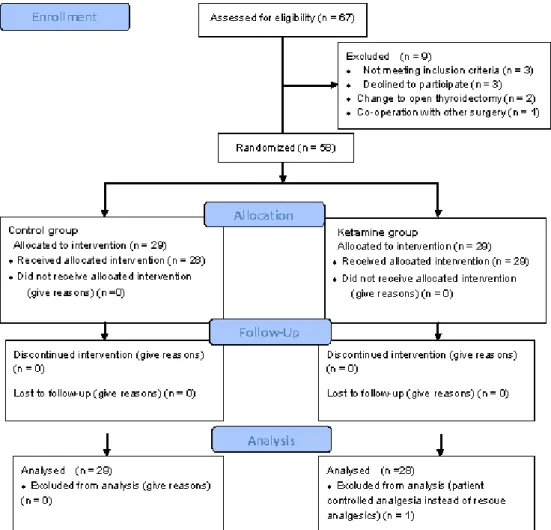
Sixty-seven patients were screened for eligibility and 58 patients were randomized for the study. Of the 58 patients enrolled in the study, one patient was eliminated from the data collection and a total of 57 patients were included in the final analysis. One patient from ketamine was excluded after randomization for the patient controlled analgesia instead of rescue analgesics (Fig.1).
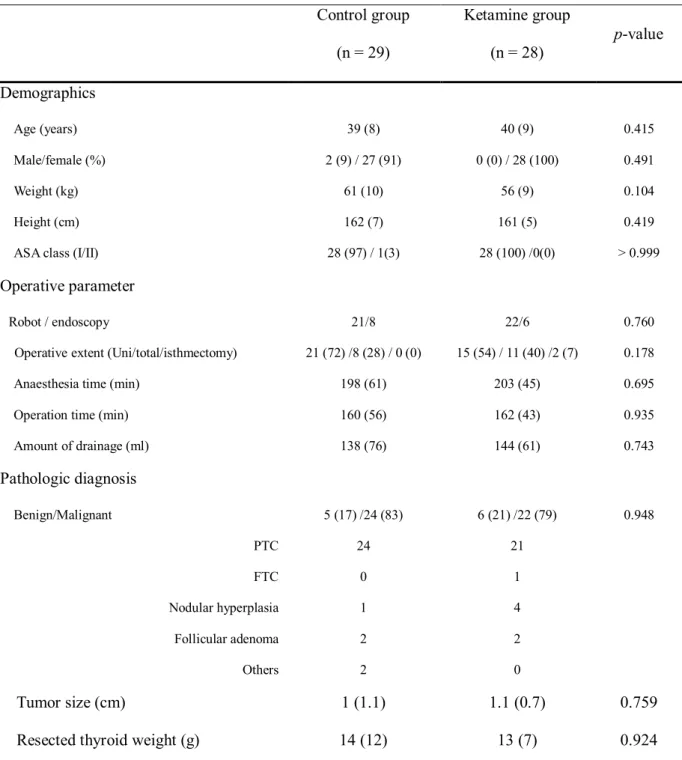
Clinical characteristics are summarized in the table 1. Patient, surgery and anesthetic characteristics were similar between the two groups (Table 1). There were 55 females and 2males with mean age of 39 or 40. All surgeries were completed successfully and no cases were converted to open thyroidectomy. Forty-five and fourteen patients were operated with robotic and endoscopic thyroidectomy, respectively. Postoperative pathology of the patients showed 45 patients with papillary carcinoma, 1 with follicular carcinoma, 5 with nodular hyperplasia, and 4 with follicular adenoma. There were no significant differences in tumor size or pathologic type between the two groups.
Postoperative pain scores were evaluated in each area of the surgery (neck, axilla, and chest) using 101 NRS at postoperative 1h, 6 h, 24 h and 48 h. There are statistically significant differences in pain scores between control and ketamine group during postoperative 48 h although pain scores at postoperative 1 h were not different between the two groups. Pain scores of the ketamine group were significantly lower than those of control group in the neck area at 6h (30 [30] vs. 50 [30]; P = 0.017), 24 h (20 [10] vs. 30 [20]; P < 0.001), and 48 h (10 [10] vs. 20 [15]; P = 0.005) postoperatively (Fig. 2). Patients in ketamine group showed lower pain scores in the axilla area than those in control group at postoperative 24 h (15 [27]
vs. 30 [20]; P = 0.024) and 48 h (10 [20] vs.20 [20]; P = 0.005) (Fig. 2). Pain in the chest area of the ketamine group was lower than control group at postoperative 48 h (10 [10] vs. 20 [20];
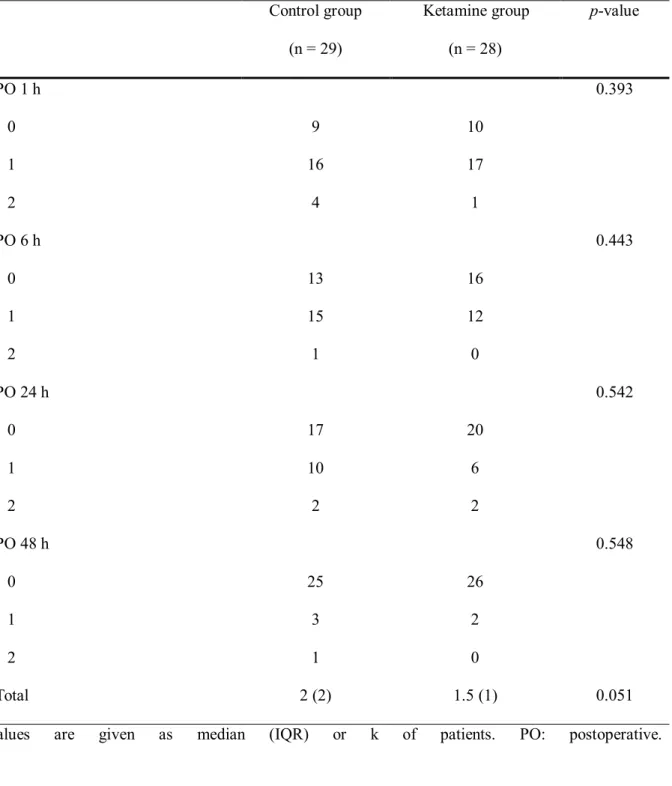
There were no statistically significant differences in the need of rescue analgesics between the two groups (Table 2). The total numbers of rescue analgesic administration were smaller in ketamine group than in control group during the study period though they could not reach statistically significant differences (1.5 [1] vs. 2 [2]; P = 0.051) (Table 2).
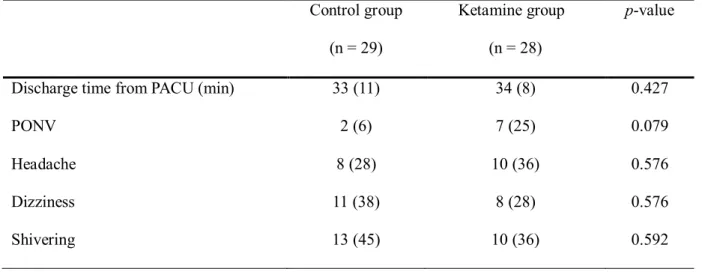
Discharge times from PACU were similar between the two groups (Table 3). Major complication related with ketamine infusion did not occur in this study. Postoperative adverse events including PONV, headache, dizziness and shivering were recorded during the study period and there were no significant differences in postoperative complications between the two groups (Table 3)
Table 1. Patient, surgery and anesthetic characteristics.
Control group (n = 29)
Ketamine group (n = 28)
p-value
Demographics
Age (years) 39 (8) 40 (9) 0.415
Male/female (%) 2 (9) / 27 (91) 0 (0) / 28 (100) 0.491
Weight (kg) 61 (10) 56 (9) 0.104
Height (cm) 162 (7) 161 (5) 0.419
ASA class (I/II) 28 (97) / 1(3) 28 (100) /0(0) > 0.999
Operative parameter
Robot / endoscopy 21/8 22/6 0.760
Operative extent (Uni/total/isthmectomy) 21 (72) /8 (28) / 0 (0) 15 (54) / 11 (40) /2 (7) 0.178
Anaesthesia time (min) 198 (61) 203 (45) 0.695
Operation time (min) 160 (56) 162 (43) 0.935
Amount of drainage (ml) 138 (76) 144 (61) 0.743
Pathologic diagnosis
Benign/Malignant 5 (17) /24 (83) 6 (21) /22 (79) 0.948
PTC 24 21
FTC 0 1
Nodular hyperplasia 1 4
Follicular adenoma 2 2
Others 2 0
Tumor size (cm) 1 (1.1) 1.1 (0.7) 0.759
Resected thyroid weight (g) 14 (12) 13 (7) 0.924
Values are given as mean (SD), median (IQR) or number of patients (%). ASA class: American Society of Anesthesiologist physical class; Uni: Unilateral thyroidectomy; PTC: papillary thyroid carcinoma; FTC: follicular thyroid carcinoma.
Table 2. The need of postoperative rescue analgesics.
Control group (n = 29)
Ketamine group (n = 28)
p-value
PO 1 h 0.393
0 9 10
1 16 17
2 4 1
PO 6 h 0.443
0 13 16
1 15 12
2 1 0
PO 24 h 0.542
0 17 20
1 10 6
2 2 2
PO 48 h 0.548
0 25 26
1 3 2
2 1 0
Total 2 (2) 1.5 (1) 0.051
Table 3. Postoperative recovery profiles.
Discharge time: the achievement of a modified Aldrete score of 9. All values are given as median (IQR) or number (%). PACU: post-anesthesia care unit; PONV: postoperative nausea-vomiting.
Control group (n = 29)
Ketamine group (n = 28)
p-value
Discharge time from PACU (min) 33 (11) 34 (8) 0.427
PONV 2 (6) 7 (25) 0.079
Headache 8 (28) 10 (36) 0.576
Dizziness 11 (38) 8 (28) 0.576
Shivering 13 (45) 10 (36) 0.592
Figure 1.CONSORT diagram for the trial. Fifty eight patients were randomized and 1 patients were
Figure 2. Postoperative pain scores of each area in the control and ketamine group. Box polt with median (solid line), IQR (box), and valu
within 1.5 IQR from each side of the box (whiskers). VNRS: Verbal numerical rating scale; * P < 0.05 compared with control groups.
Discussion
We set out this prospective, randomized and controlled trial to determine whether intraoperative ketamine infusion would decrease postoperative pain following BABA robotic or endoscopic thyroidectomy. The principal finding was that low-dose ketamine infusion during anesthesia significantly reduced postoperative pain, with no increased incidence of adverse events.
During BABA robotic or endoscopic thyroidectomy, a subplatysmal skin flap is dissected from the axilla to the anterior neck, and forcefully lifted to enable visualization of the surgical space [14]. To expose the thyroid, the dissected area is wider during robotic or endoscopic thyroidectomy than with conventional open thyroidectomy, which explains the significant postoperative pain following robotic or endoscopic thyroidectomy [14]. BABA leads to additional operative trauma along the route to the thyroid; therefore, this technique may be expected to result in greater postoperative pain compared to conventional open thyroidectomy [15]. In this study, a subanesthetic dose of ketamine was infused intravenously.
The postoperative pain scores in the neck, axilla, and chest area were significantly lower in the ketamine group than in the control group during the first 48 h postoperatively. Pain scores at 1 h postoperatively did not differ between the two groups in all areas; however, this can be explained by considering the residual anesthetic effect.
Ketamine is a non-competitive NMDA receptor antagonist related to pain sensitivity, and
ketamine for postoperative pain control has not yet been established; however, most trials have used ketamine in subanesthetic doses during the perioperative period [18]. Reviews and meta-analyses that have evaluated the preemptive analgesic effects of ketamine for postoperative pain have concluded that subanesthetic doses of ketamine (0.15–0.5 mg/kg bolus, 60–120 μg/kg/h continuous infusion) result in preemptive analgesic effects that can reduce postoperative opioid usage with no adverse effects [12, 18] .
There were no statistically significant differences in the requirement for rescue analgesics between the two groups, although the total number of administrations of rescue analgesics was smaller in the ketamine group than in the control group. Rescue analgesics were used in preference to opioid-based patient control analgesia (PCA), because the most distressing obstacle during postoperative pain management for thyroidectomy patients is PONV due to the routine use of opioids. Moreover, the incidence of PONV following thyroidectomy appears to be higher than with other surgeries [18].
No major complications were associated with ketamine infusion, consistent with the results of a review on the use of ketamine for postoperative analgesia [12]. The recovery time (discharge time from PACU) and incidence of postoperative adverse effects did not differ between the two groups. Two patients in the control group and seven in the ketamine group exhibited PONV, although this difference was not statistically significant. No trials have provided extractable data regarding the effects of ketamine on PONV, because PONV has not been the primary outcome of pain control studies. Intraoperative ketamine infusion has not been shown to reduce PONV, and may even have a negative effect on the severity of nausea following lumbar spinal surgery [19]. However, a reduction in PONV has been reported with ketamine usage because of the reduced opioid dosage it enables [20]. In this study, there were no statistically significant differences in the requirement for rescue analgesics, including
A major limitation of the current study is that the effects of ketamine infusion on acute postoperative pain were evaluated for only 2 days postoperatively, with no assessment of chronic pain. Acute pain control may be predictive of the development of long-term sensory disturbances or discomfort, and these chronic symptoms may persist for up to 3 months following robot- or endoscopy-assisted thyroidectomy [5]. Tae et al. [21] reported that postoperative anterior chest pain scores were higher following robotic thyroidectomy than after conventional open thyroidectomy for the first week postoperatively but that there was no difference between the two groups after 1 or 3 months. However, Song et al.[5] found that anterior chest discomfort and sensory disturbance were greater and required longer recovery times following robotic thyroidectomy than did conventional open thyroidectomy. Therefore, ketamine may reduce the development of chronic postoperative pain via NMDA receptor blockade, which reduces wind-up and central sensitization [11].
Conclusion
This study addressed the efficacy and safety profiles of intraoperative ketamine infusion during for BABA robotic or endoscopic thyroidectomy. Ketamine in subanesthetic dose (1 mg/kg bolus, 60 μg/kg/h continuous infusion) may be a useful adjunct in that it reduced postoperative pain scores during postoperative 48 h after BABA robotic or endoscopic thyroidectomy without adverse effect. Further studies on optimal dose of ketamine and the effect of intraoperative ketamine infusion on chronic postsurgical pain with long-term follow-
References
1. Duncan TD, Rashid Q, Speights F, Ejeh I (2007) Endoscopic transaxillary approach to the thyroid gland: our early experience. Surgical endoscopy 21:2166-2171
2. Jeong JJ, Kang SW, Yun JS, Sung TY, Lee SC, Lee YS, Nam KH, Chang HS, Chung WY, Park CS (2009) Comparative study of endoscopic thyroidectomy versus conventional open thyroidectomy in papillary thyroid microcarcinoma (PTMC) patients. J Surg Oncol 100:477- 480
3. Song CM, Ji YB, Sung ES, Kim DS, Koo HR, Tae K (2016) Comparison of Robotic versus Conventional Selective Neck Dissection and Total Thyroidectomy for Papillary Thyroid Carcinoma. Otolaryngol Head Neck Surg
4. Ikeda Y, Takami H, Sasaki Y, Takayama J, Niimi M, Kan S (2003) Clinical benefits in endoscopic thyroidectomy by the axillary approach. Journal of the American College of Surgeons 196:189-195
5. Song CM, Ji YB, Bang HS, Park CW, Kim H, Tae K (2014) Long-term sensory disturbance and discomfort after robotic thyroidectomy. World journal of surgery 38:1743- 1748
6. Moon YE, Joo J, Kim JE, Lee Y (2012) Anti-emetic effect of ondansetron and palonosetron in thyroidectomy: a prospective, randomized, double-blind study. British journal of anaesthesia 108:417-422
7. Hong JY, Kim WO, Chung WY, Yun JS, Kil HK (2010) Paracetamol reduces postoperative pain and rescue analgesic demand after robot-assisted endoscopic thyroidectomy by the transaxillary approach. World journal of surgery 34:521-526
8. Kim SY, Jeong JJ, Chung WY, Kim HJ, Nam KH, Shim YH (2010) Perioperative administration of pregabalin for pain after robot-assisted endoscopic thyroidectomy: a
randomized clinical trial. Surgical endoscopy 24:2776-2781
9. Ryu JH, Yom CK, Kwon H, Kim KH, Choi JY, Jung JW, Kim SW, Oh AY (2015) A prospective, randomized, controlled trial of the postoperative analgesic effects of spraying 0.25 % levobupivacaine after bilateral axillo-breast approach robotic thyroidectomy. Surgical endoscopy 29:163-169
10. Moiniche S, Romsing J, Dahl JB, Tramer MR (2003) Nonsteroidal antiinflammatory drugs and the risk of operative site bleeding after tonsillectomy: a quantitative systematic review. Anesthesia and analgesia 96:68-77, table of contents
11. Sawynok J (2014) Topical and peripheral ketamine as an analgesic. Anesthesia and analgesia 119:170-178
12. Jouguelet-Lacoste J, La Colla L, Schilling D, Chelly JE (2015) The use of intravenous infusion or single dose of low-dose ketamine for postoperative analgesia: a review of the current literature. Pain medicine (Malden, Mass) 16:383-403
13. Trevisani L, Cifala V, Gilli G, Matarese V, Zelante A, Sartori S (2013) Post-Anaesthetic Discharge Scoring System to assess patient recovery and discharge after colonoscopy. World J Gastrointest Endosc 5:502-507
14. Kang SW, Jeong JJ, Nam KH, Chang HS, Chung WY, Park CS (2009) Robot-assisted endoscopic thyroidectomy for thyroid malignancies using a gasless transaxillary approach.
Journal of the American College of Surgeons 209:e1-7
17. Kissin I (2000) Preemptive analgesia. Anesthesiology 93:1138-1143
18. Yang L, Zhang J, Zhang Z, Zhang C, Zhao D, Li J (2014) Preemptive analgesia effects of ketamine in patients undergoing surgery. A meta-analysis. Acta cirurgica brasileira / Sociedade Brasileira para Desenvolvimento Pesquisa em Cirurgia 29:819-825
19. Song JW, Shim JK, Song Y, Yang SY, Park SJ, Kwak YL (2013) Effect of ketamine as an adjunct to intravenous patient-controlled analgesia, in patients at high risk of postoperative nausea and vomiting undergoing lumbar spinal surgery. British journal of anaesthesia 111:630-635
20. Lonjaret L, Bataille B, Gris C, Fourcade O, Minville V (2012) Ketamine and postoperative nausea and vomiting: role of the morphine-sparing effect. Journal of clinical anesthesia 24:601-602
21. Tae K, Ji YB, Jeong JH, Lee SH, Jeong MA, Park CW (2011) Robotic thyroidectomy by a gasless unilateral axillo-breast or axillary approach: our early experiences. Surgical endoscopy 25:221-228
국문 초록
서론
양측 겨드랑이 가슴 접근법을 통한 로봇 또는 내시경적 갑상선 절제술은 미용적인 이점이 있어 최근에 많이 시행하고 있는 수술법이다. 그러나 수술 중 넓은 부위의 박 리와 장력에 의해 수술 후 통증이 일반 갑상선 절제술보다 크다. 케타민은 비경쟁적 인 NMDA수용체 길항제인데 급성 수술 후 통증을 줄여주는 것으로 알려져 있다. 그 래서 수술 중 케타민의 지속적 주입이 양측겨드랑이 가슴 접근법(BABA)을 통한 로 봇 또는 내시경적 갑상선 절제술에서 수술 후 통증에 어떠한 영향을 미치는지 연구 하였다.
연구 방법
59명의 BABA 로봇 또는 내시경 갑상선 절제술을 받는 사람을 무작위로 케타민 주입군(29명)과 대조군(29명)으로 배정하였다. 통상적인 마취 유도 후 케타민군은 케타민(1mg/kg bolus, 60mcg/kg/h continuous infusion)을 수술 중 지속 정맥주 입하였고 대조군은 케타민에 상응하는 양의 생리식염수를 수술 중 지속 정맥 주입
군보다 통증점수가 낮았다. 구조적진통제 소비횟수와 부작용은 두 군간에 유의미하 게 차이가 있지 않았다.
결론
BABA 로봇 또는 내시경 갑상선 절제술을 받는 환자에서 수술 중 케타민의 지속 적 정맥 주입은 부작용 없이 수술 후 통증을 줄여 준다.
주요어: 로봇 갑상선절제술, 케타민, 수술 후 통증, 내시경 갑상선절제술
학번: 2015-22013