Environmental Science
Vol. 30, No. 3, pp. 285-292, August, 2014 http://dx.doi.org/10.7747/JFS.2014.30.3.285
Essential Oil Yields and Chemical Compositions of Chamaecyparis obtuse Obtained from
Various Populations and Environmental Factors
Young Min Kang1,#, Ji Yun Min2,# and Myung Suk Choi3,*
1Herbal Medicine Resources Group, Herbal Medicine Research Division, Korea Institute of Oriental Medicine (KIOM), Daejeon 305-811, Republic of Korea
2Sancheong Oriental Medicinal Herb Institute, Sancheong 666-831, Republic of Korea
3Division of Environmental Forest Science, Gyeongsang National University, Jinju 660-701, Republic of Korea
Abstract
Essential oil yields and chemical compositions from 5 populations of Chamaecyparis obtusa with several environmental factors were investigated through essential oil extracted distillation apparatus and metabolite profiling by GC-MS analysis.
Among the populations, content of essential oil at Gokseong was significantly higher than other populations. To compare the several environmental factors affecting on chemical composition and essential oil yields from C. obtuse at Gokseong, the environmental factors (soil condition, temperature, humidity, and moisture content) were measured during 1 year.
The essential oils at Goksung based on humidity on March, July, and November was significantly different from other months. The essential oils at Goksung based on temperature on July and August was significantly different from other months. The essential oils at Goksung based on the moisture content on September were significantly different from other months. The percentage of T-N, OM, and yield of oil at Gokseong were significantly different on from other populations. The main constituents of C. obtusa at all populations were α-pinene, β-pinene, α-terpinene, γ-terpinene, terpinene-4-ol, isobonyl acetate, terpinyl acetate, and cedar acetate. Specially, Essential oil compositions (%) of α-terpinene and cedar acetate were higher at Gokseong than at other populations. The chemical compositions of essential oils were variable depend on populations and environmental conditions. Therefore, this study might be used as fundamental research on study for selection of high productive terpenoids and for understanding about biosynthesis of essential oils in C. obtusa.
Key Words: Chamaecyparis obtusa, chemical composition, essential oil yields, environmental factors, terpenoids
Received: October 15, 2013. Revised: April 1, 2014. Accepted: April 5, 2014.
Corresponding author: Myung Suk Choi
Division of Environmental Forest Science, Gyeongsang National University, Jinju 660-701, Republic of Korea Tel: 82-55-772-1856, Fax: 82-42-863-9434, E-mail: [email protected]
#These authors were contributed equally to this work (co-first authors).
Introduction
Since the crude herbal extracts of aromatic plants on an- cient times have been used for different purposes such as food, drugs, and perfumery. Essential oils are the mixtures of volatile oils from various parts of plants and are consid-
ered as important antimicrobial, antifungal, and insecticidal or insect-repelling agents present in plants (Cowan 1999).
Also, they have been reported to endow antioxidant, anti-in- flammatory, antitumor, antiaging, antimutation, and seda- tive effects (Hammer et al. 1999). Monoterpenes, sesqui- terpenes, and their oxygenated derivatives such as alcohols,
aldehydes, esters, ethers, ketones, and phenols are the pres- ent main components in essential oils involved in its physio- logical and biological activities (Harkenthal et al. 1999;
Zhang et al. 2008). Essential oils from Chamaecyparis obtusa leaves were found to possess strong antimicrobial activity against microorganisms. The major components of essential oil from C. obtusa leaves were monoterpenes (56-68%) and sesquiterpenes (18-29%) (Seo et al. 2003). However, their actual compositions and biological activities are quite differ- ent among the plants, even in the same species, depending on their environmental and genetic variations (Connor et al.
2002). Additionally, the chemical and biological properties are quite different from the essential oils depending on the part of the same plant, which makes it difficult to under- stand systematically the biosynthesis of essential oils.
C. obtusa, belong to the family Cupressaceae, is a native plant of Asia. C. obtusa is evergreen with a narrow conical shape and tolerates partial shade, although it prefers a sun- ny location, cool, and moist soil. C. obtusa is one of the most economically important conifers due to its good quality wood and timber characteristics (Maruyama et al. 2005).
Essential oils in C. obtusa may be an alternative source of stored-product insect-control agents, because they con- stitute a rich source of bioactive chemicals (Park et al.
2003). However, the determination of variation and bio- synthetic factors of essential oil of C. obtusa have not been researched. The aim of this study is to evaluate the variation essential oil in population and individual tree of C. obtusa.
Also, several environmental factors affecting essential oil yield and change of terpenoids composition from C. obtusa were determined. Therefore, we attempted to the study about the effect of seasonal climatic changes on biomass yield, essential oil yield, and terpenoids composition of C.
obtusa in present investigation. The aim of this study was to compare the several environmental factors affecting on chemical composition and essential oil yields from C. obtusa.
It might be useful fundamental information for selection of high productive terpenoids and for understanding about bi- osynthesis of essential oils in C. obtusa.
Materials and Methods
Plant materials and essential oil extraction
The healthy and mature leaves of 30-40 years old C. obtu-
sa were collected from five different populations (Jangseong, Gokseong, Suncheon, Jinju, and Namhae) and randomly selected individual 20 trees, respectively, around the top of the tree. Leaves were maintained in ice box right away and immediately extracted using extraction apparatus or kept at deep freezer -20oC until the used.
Extraction of essential oil
Extraction of essential oil using extraction apparatus re- ported Seo et al. (2003). C. obtusa collected leaves were cut (1-2 cm) 50 g and crushed 50 g into pieces. They were di- luted with distilled water 500 mL in a 2 L round flask and steam distilled (100oC). Distillation continued for 5 hr.
Essential oil yield was calculated according to the dry weight of the plant material. The extracted oil was stored in a refrigerator at 4oC until experiments. The yields of essen- tial oil were calculated by the following equation:
×
Variations of essential oils for each population were ana- lyzed from the 20 sampled individuals per population.
Determination of temperature and humidity in ex- perimental populations
In order to environmental factors affecting on essential oil yield, temperature and moisture content were measured during one year (1 month interval). Temperature and hu- midity in experimental populations were surveyed accord- ing to Korea Meteorological Administration reported at sampling time (www.kma.go.kr).
Determination of seasonal variation on essential oil yield
Moisture content was determined from C. obtusa leaves, which were essential oil containing trees selected at Gokseong population. Moisture content and essential oil were measured 1 month interval during one year. All above experiments were conducted in five replications, and the data were averaged.
Determination of soil chemical properties
The soil samples were collected from five different areas (Jangseong, Gokseong, Suncheon, Jinju and Namhae).
Fig. 1. Contents of essential oil based on population sites. “*” indicates sig-
nificantly difference (alpha=0.05). Fig. 2. Variation of essential oil yield from individual trees of all populations.
These samples of 5 population were collected from the soil surface layer (0-15 cm) and soils were air-dried, crushed, and passed through a 2 mm sieve, then finely grounded with an agate mortar. Soil chemical properties were de- termined as follows; pH of 1:5 water extract (pH meter;
720A, Orion, USA), content of organic matter (Tyurin method), content of total nitrogen (micro-Kjeldahl diges- tion method), contents of available P2O5 (Lancaster meth- od), and exchangeable cation (K, Ca, Mg, Na) : 1N-Ammonium acetate (pH 7.0).
Analysis of essential oil through GC/MS analysis Composition of volatile essential oil components by five different populations of C. obtusa was determined through GC/MS qualitative analysis. The extracted essential oils were analyzed on gas chromatography-mass spectrometer (HP 5890II USA). The GC column was HP-IMS capil- lary column (60 m x 0.25 mm i.d. 0.25μm). Working with the following temperature program; 50oC for 5 min, ramp of 3oC/min up to 240oC, injector temperature 250oC, car- rier gas Helium (1 mL/min), and injection of 1 μL.
MS spectra were obtained in the EI monde with 70 eV ionization potential. The sector mass analyzer was set to scan from 50 to 800 amu for 2s. Adjusted retention time for each peak was determined by subtracting the retention time. Components were identified base on comparison of mass spectra with those in the mass spectra library (The Wiley Registry of Mass Spectral Data, 6th ed.). Contents of
terpenoid compounds were determined through relatively area (%) on analyzed peaks.
Statistical analysis
Statistical analysis of contents of essential oil, variation of essential oil yield, environmental factors, and soil chemical characteristics were performed were performed by two-way analysis of variance (ANOVA) and Tukey's test (alpha=
0.05) using SAS program (SAS 9.1, SAS Institute Inc., Cary, NC).
Results
Population and individual variation on essential oil yield
The analysis of essential oil for each population showed somewhat differences among populations (Fig. 1). As Fig.
1 was mentioned, the contents of essential oil at Gokseong was significantly different (alpha=0.05) from other pop- ulation site at the given time. Among the experimental pop- ulations, content of essential oil at Goksung as 45 μL/g DW was significantly higher than other populations.
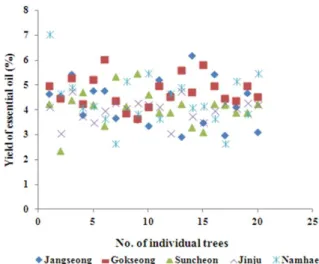
However, content of essential oil at Sunchun as 40 μL/g DW and Jinju populations as 41 μL/g DW were lower compared to other populations. The yields of essential oils showed highly variable among the individual trees (Fig. 2).
Variation of essential oil yield from individual trees of all populations did not make any significant differences among
Table 1. Essential oil contents and soil chemical characteristics in populations
Population pH (H2O) T-N (%) OM (%) Av-P2O5
(mgkg-1)
CEC (coml.+kg-1)
Ex-cation (cmol+kg-1) Yield of oil K+ Ca++ Mg++ Na+ (%)
Jangseong Gokseong Suncheon Jinju Namhae
4.53 4.55 4.25 4.46 4.82
0.88 1.68*
1.00 0.93 1.00
9.25 17.73*
10.49 10.22 10.49
16.96 9.99 21.67 10.87 9.42
9.71 6.21 10.21 8.25 9.75
0.19 0.06 0.20 0.16 0.24
0.20 0.07 0.26 0.14 1.53
0.22 0.09 0.25 0.31 0.45
0.07 0.05 0.05 0.05 0.05
4.28 4.80*
4.09 4.00 4.59
“*” indicates significantly difference (alpha=0.05).
Fig. 3. Relationship among essential oil contents, temperature, and humid- ity during 1 year. “*” indicates significantly difference (alpha=0.05).
all populations. Fig. 2 might provide the pattern of in- dividual tree for representative variation. Content of essen- tial oil among individual trees in all population ranged from 2.1% to 7.1%.
Interaction between essential oil contents and soil chemical characteristics
Soil characteristics in each population were investigated as Table 1. Soil pH of five populations ranged from 4.25 to 4.82 (Table 1). Total nitrogen (T-N) was variable in 0.88 to 1.68%. T-N content was higher in Gokseong population as 1.68%, however, Jangseong population was low as 0.88%.
Organic matter was varied 9.25 to 17.73% in five populations. Among populations, Gokseong population was highly contained as 17.73% organic matters. Av-P2O5
level was highly variable 9.42 to 21.67 mg/kg. The highest proportion of Av-P2O5 (21.67 mg/kg) was revealed in Sunchun population. CEC content was not variable range from 6.21 to 10.21 cmol+ /kg. Ex-cation content was also variable based on population (Table 1). In each Ex-cation component as K, Ca, Mg and Na were not a difference among each component.
As Table 1 was indicated, there were represented charac- teristics of soil chemicals and essential oils in all populations. The percentage of T-N, OM, and yield of oil at Gokseong were significantly different (alpha=0.05) from other populations. Mean yield of essential oil was maximum 4.8% at Gokseong population and minimum 4.0% at Jinju. Generally, high concentrations of T-N and OM in the soil are positive biosynthesis of essential oil in C.
obtusa. In contrast, Av-P2O5, CEC, and Ex-cation were in- hibiting biosynthesis of essential oil in C. obtusa.
Interaction between environmental factors and es- sential oil contents
Interaction between moisture and temperature and es- sential oil content was determined in essential oil rich tree during 1 year (Fig. 3). As Fig. 3 was represented, the hu- midity and essential oil on March, July, and November were significantly different (alpha=0.05) from other months. Additionally, temperature on July and August were significantly different (alpha=0.05) from other months.
Temperature in experimental site was range from the -3oC (Jan.) to 28oC (August). Temperature was increased to August, and then it was dramatically decreased. Content of essential oil was high at early spring and early winter.
Humidity was decreased to May and increased to July and then decreased to November. However, content of essential oil have nothing to do with temperature and humidity.
Additionally, relationship between essential oil contents and leaf moisture content during 1 year were investigated as Fig. 4. Soil pH of five populations ranged from 4.25 to
Table 2. Components profiling of C. obtusa leaf essential oil by GC/MS analysis
No. RT (min) Compounds Essential oil composition (%)
A B C D E
1 2 3 4 5 6 7 8 9 10 11 12 13 14 15 16 17 18 19 20 21
18.11 18.77 20.28 20.28 21.08 22.31 22.35 23.22 24.55 24.62 29.64 30.39 35.65 35.91 38.63 42.06 42.16 42.64 45.21 51.91 62.98
Alpha-pinene Camphene Alpah-pinene isomer Beta-pinene Myrcene isomer Alpha-terpinene Alpha-terpinene isomer Limonene
Gamma-terpinene Gamma-terpene isomer Borneol
Terpinene-4-ol Isobornyl acetate Alpha-terpinyl acetate Terpinyl acetate Beta-caryophyllene Cadinene Cedar acetate Epizonarene Alpha-bisabolol Kaur-15-ene
0.01 0.55 0.00 6.40 0.00 1.59 1.15 4.48 0.11 3.12 0.59 3.11 5.73 0.00 10.13 0.42 0.01 2.48 0.00 0.60 0.18
4.60 0.29 0.00 0.21 0.00 1.69*
0.00 3.04 2.22 0.00 0.01 2.06 3.92 0.03 7.85 0.39 3.32 2.87*
2.92 0.57 0.13
7.83 0.20 0.00 0.01 0.00 1.57 0.00 2.61 2.71 0.00 0.01 2.99 3.03 0.00 8.78 0.63 0.01 1.19 1.61 0.29 0.14
1.59 0.36 5.91 0.26 2.85 0.97 0.00 3.47 3.51 0.00 0.01 2.74 4.10 9.74 0.00 0.87 0.02 3.12 4.12 1.20 0.32
1.19 0.36 0.00 0.21 0.00 0.02 0.84 3.34 2.44 0.00 0.01 2.16 4.29 8.23 0.00 0.43 6.62 0.59 3.97 0.00 0.01 RT, Retention time; A, Jangseong; B, Gokseong; C, Suncheon; D, Jinju; E, Namhae.
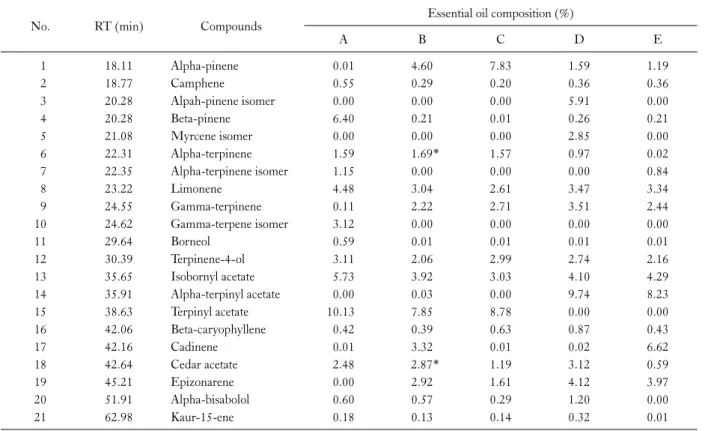
*The essential oil compositions (%) at Gokseong were higher than at other populations.
Fig. 4. Relationship between essential oil contents and leaf moisture content during 1 year. “*” indicates significantly difference (alpha=0.05).
4.82. The essential oil on March and on November were significantly different (alpha=0.05) from other months.
The moisture content on September was significantly dif- ferent (alpha=0.05) from other months.
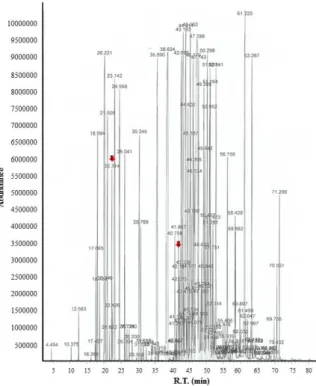
Components of essential oil based on population The chemical composition of essential oil obtained from C. obtusa leaves were analyzed by GC MS analysis (Table 2) including the representative data at Gokseong (Fig. 5). The main constituents of essential oil were α-pinene, β-pinene, α-terpinene, γ-terpinene, terpinene-4-ol, isobonyl acetate, terpinyl acetate and cedar acetate. The chemical composi- tions of essential oil was variable depend on population.
Specific compound in Jangseong was α-terpiene isomer, γ- terpene isomer and terpinyl actate. Essential oil composi- tions (%) of α-terpinene and cedar acetate were higher at Gokseong than at other populations. Also, terpinyl acetate was found in Sunchun population. α-Pinene, β-pinene and terpinyl acetate was specific compound in Jinju population.
In Namhae population, α-terpinene isomer, α-terpinyl ace- tate and cadinene were determined as specific compounds.
Fig. 5. The representative data of GC-MS at Gokseong. Allow 1 indicates alpha-terpinene (RT: 22.31 min) and allow 2 indicates cedar acetate (RT:
42.64 min).
Discussion
Population studies on the pattern of variation in many plant existences of localized populations each adapted to the particular environmental conditions of their habitat. From the chemical point of view, the essential oil composition fre- quently changes in individual plant. Quite often, between the different organs of the plant even within one individual plant. Variation of the essential oil yield is caused by genetic and environmental factors. The impact of environmental factors such as temperature, relative humidity, irradiance, photoperiod and cultivation practices influence the compo- sition of essential oils (Hernandez et al. 1988). Polymor- phism is also often found of individual plants of one species (Johnson et al. 2004). Schnitzler et al. (2004) proposed a genetic background that leads to differences in the ex- pression of terpenoids synthesis for individual trees accord- ing to their parent genes.
In general the effect on pH was the greatest at higher concentrations and the fall in pH was the greatest in the nu- trient broth. Hood et al. (2004) reported that the addition
of Backhousia citriodora essential oil to nutrient broth re- sulted in a fall in pH from 7.29 +/- 0.02 (no oil) to 5.2 +/- 0.03 (10% oil). Accordingly, nutrient in soil plays an im- portant role in the biosynthesis of essential oil.
Baranauskienne et al. (2003) reported that increasing N and P levels increased the oil content, and increasing K re- duced it. However, N fertilization has been reported to re- duce essential oil content in creeping juniper (Robert 1986).
Monoterpene emission rates were investigated for differ- ent seasons, tree ages, and leaf moistures; the result showed that the highest emission rates were found during spring months rather than during summer months (Kim 2001). In this study, these results were not entirely consonant with other reports. However, higher content in spring season was in concordance with other reports. The higher emis- sions during spring might be associated with the growing rates of plants and their metabolisms. Monoterpene emis- sions from coniferous plants are mainly reported to be only temperature-dependent. However, only a little is known about the seasonal variability of standard emission rates of monoterpenes (Komenda et al. 2002).
Moisture content in leaf was decreased to May and in- creased to September and then decreased. Generally, higher irrigation frequency and a brief water stress period in- creased essential oil yield (James et al. 1992). This result was consistent with the other reports. Biosynthesis of essen- tial oil influences on various factors as environmental as temperature, humidity and leaf moisture.
The quantitative composition of the essential oils in many aromatic plants is greatly influenced by the genotype and agronomic conditions, such as harvesting time, plant age, and crop density (Marotti et al. 1994). However, their actual compositions and biological activities are quite dif- ferent among the plants, even in the same species, depend- ing on their environmental and genetic variations (Connor et al. 2002). Additionally, the chemical and biological prop- erties are quite different from the essential oils depending on the part of the same plant, which makes it difficult to un- derstand systematically the biosynthesis of essential oils.
In production of secondary metabolites in plants, the growth of biomass and the production of essential oils are in inverse proportion to each other (Seo et al. 2003; Park et al.
2004; Choi and Kang 2013). The content of essential oils at
Gokseong was significantly higher than others. The envi- ronmental factors (humidity, temperature, moisture con- tent, and soil composition) might be effect on production of essential oils (Lamarche et al. 1984; Park et al. 2004; Seong et al. 2014; Son et al. 2014). There were significant varia- tions on specific months based on humidity, temperature, and the moisture content at Gokseong. The percentage of T-N, OM, and yield of oil at Gokseong were significantly different on from other populations. Specific environmental variations at Gokseong may made positive biosynthesis of essential oils in C. obtusa. Especially, environmental factors may be affected on growth of biomass in C. obtuse at Gokseong. The C. obtuse at Gokseong may produce more essential oils in order to be survived and to be adapted from dramatic environmental conditions (Seo et al. 2003; Lin et al. 2011; Choi and Kang 2013). As provided in Fig. 4 and Fig. 5, the essential oils of alpha-terpiene (RT: 22.31 min) and cedar acetate (RT: 42.31 min) at Gokseong were high- er than at other populations. These compounds are very im- portant compounds of Chamaecyparis Species (Lin et al.
2011). Additionally, total essential oil contents were also higher at Gokseong than at other populations.
Therefore, we attempted to the study about the effect of seasonal climatic changes on biomass yield, essential oil yield, and terpenoid composition of C. obtusa. The aim of this study was to compare the several environmental factors affecting on chemical composition and essential oil yields from C. obtusa. with fundamental research on study for se- lection of high productive terpenoids and for under- standing about biosynthesis of essential oils in C. obtusa.
Acknowledgements
This study was carried out with the support of Forest Science & Technology Projects (Project No. S211010L20120) provided by Korea Forest Service. Also, this work was par- tially supported by Development of Basic Technologies for the Domestic Cultivation of Herbal Medicine Resources (K14417), the Korea Institute of Oriental Medicine (KIOM) to the Ministry of Science, ICT & Future Planning (MSIP), Republic of Korea.
References
Baranauskiene R, Venskutonis PR, Viskelis P, Dambrauskiene E.
2003. Influence of nitrogen fertilizers on the yield and composi- tion of thyme (Thymus vulgaris). J Agric Food Chem 51:
7751-7758.
Choi MS. Kang YM. 2013. Application and production of useful compounds in scoplia rhizome as Korean herbal medicine.
Korean Herbal Medicine Informatics 1: 66-72.
Connor AM, Luby JJ, Hancock JF, Berkheimer S, Hanson EJ.
2002. Changes in fruit antioxidant activity among blueberry cul- tivars during cold-temperature storage. J Agric Food Chem 50:
893-898.
Cowan MM. 1999. Plant products as antimicrobial agents. Clin Microbiol Rev 12: 564-582.
Hammer KA, Carson CF, Riley TV. 1999. Antimicrobial activity of essential oils and other plant extracts. J Appl Microbiol 86:
985-990.
Harkenthal M, Reichling J, Geiss HK, Saller R. 1999.
Comparative study on the in vitro antibacterial activity of Australian tea tree oil, cajuput oil, niaouli oil, manuka oil, kanu- ka oil, and eucalyptus oil. Pharmazie 54: 460-463.
Hernandez JM, de Mola LML, Rios GG, Rasimbazafy JM, Perez AR. 1988. Study of the chemical composition of essential oil of Eucalyptus globules Labill ssp. Bicostata obtenido. Cuba. Rev.
Cubana Farm 22: 76-85.
Hood JR, Cavanagh HM, Wilkinson JM. 2004. Effect of essential oil concentration on the pH of nutrient and Iso-sensitest broth.
Phytother Res 18: 947-949.
Johnson CB, Kazantzis A, Skoula M, Mitteregger U, Novak J.
2004. Seasonal, populational and ontogenic variation in the vola- tile oil content and composition of individuals of Origanum vul- gare subsp. Hirtum, assessed by GC headspace analysis and by SPME sampling of individual oil glands. Phytochem Anal 15:
286-292.
Kim JC. 2001. Factors controlling natural VOC emissions in a southeastern US pine forest. Atmos Environ 35: 3279-3292.
Komenda M, Koppmann R. 2002. Monoterpene emissions from Scots pine (Pinus sylvestris): Field studies of emission rate variabilities. J Geo Res 107: ACH1-1-13.
Korea Forest Research Institute (KFRI). 2005. Sustainable man- agement and use of Cryptomeria japonica Forests.
Lamarche VC Jr, Graybill DA, Fritts HC, Rose MR. 1984.
Increasing atmospheric carbon dioxide: tree ring evidence for growth enhancement in natural vegetation. Science 225:
1019-1021.
Lin CY, Chen YJ, Cheng SS, Chang ST. 2011. Rapid differ- entiation of three Chamaecyparis species (Cupressaceae) grown in Taiwan using solid-phase microextraction-gas chromatog- raphy/mass spectrometry, cluster analysis, and principal compo- nent analysis. J Agric Food Chem 59: 10854-10859.
Marotti M, Piccaglia R, Giovanelli E, Deans SG, Eaglesham E.
1994. Effects of variety and ontogenic stage on the essential oil composition and biological activity of fennel (Foeniculum vulgare Mill.). J Essential Oil Res 6: 57-62.
Maruyama E, Ishii K, Hosoi Y. 2005. Efficient plant regeneration of Hinoki cypress (Chamaecyparis obtusa) via somatic embryo- genesis. J For Res 10: 73-77.
Park IK, Lee SG, Choi DH, Park JD, Ahn YJ. 2003. Insecticidal activities of constituents identified in the essential oil from leaves of Chamaecyparis obtusa against Callosobruchus chinensis (L.) and Sitophilus oryzae (L.). J Stored Prod Res 39: 375-384.
Park JE, Song JE, Cho MK, Lee JS, Son KC. 2004. Effect of ab- sorption of essential oil (Chamaecyparis obtusa) on improvement of short-term memory and concentration, and reduction of stress in students. Kor J Hort Sci Technol 22: 28.
Park YG, Kim SJ, Jung HY, Kang YM, Kang SM, Prasad DT, Kim SW, Choi MS. 2004. Variation of ginkgolides and biloba- lide contents in leaves and cell cultures of Ginkgo biloba L.
Biotechnol Bioprocess Eng 9: 35-40.
Robert MD. 1986. Plant physiology. Robert Johnson Publisher (PWS) A division of Wadsworth Inc., Boston, USA.
Schnitzler JP, Steinbrecher R, Zimmer I, Steigner D, Fladung M.
2004. Hybridization of European oaks (Quercus ilex × Q. robur)
results in a mixed isoprenoid emitter type. Plant Cell and Environ 27: 585-593.
Seo WT, Yang JK, Kang BG, Park UJ, Hong SC, Kang YM, Jung HY, Kim YD, Kang SM, Kim SW, Choi MS. 2003. Extraction and biological activities of essential oil from Thuja occidentalis leaves. Korean J Med Crop Sci 11: 364-370.
Seong HS, Goh E, Choi IH. 2014. Effects of inhalation of wood essential oil (Chamaecyparis obtusa) on the change of concen- tration and mood states. J For Sci 30: 62-70.
Simon JE, Reiss-Bubenheim D, Joly RJ, Charles DJ. 1992. Water stress-induced alterations in essential oil content and composi- tion of sweet basil. J Essent Oil Res 4: 71-75.
Son HJ, Kim YS, Kim NY, Lee HB, Park WG. 2014. A consid- eration of the possibility of planting Cryptomeria japonica and Chamaecyparis obtusa on the east sea area in gangwon-province by tree ring dating and climatic factor analysis. J For Sci 30:
36-44.
Zhang C, Li H, Yun T, Fu Y, Liu C, Gong B, Neng B. 2008.
Chemical composition, antimicrobial and antioxidant activities of the essential oil of Tibetan herbal medicine Dracocephalum het- erophyllum Benth. Nat Prod Res 22: 1-11.