Clinical Outcomes of Initial Dexamethasone Treatment Combined with a Single High Dose of Intravenous Immunoglobulin for Primary Treatment of Kawasaki Disease
Yun Ju Lim
1and Jo Won Jung
21Department of Pediatrics, Hallym University Dongtan Sacred Heart Hospital, Hwaseong;
2Division of Pediatric Cardiology, Department of Pediatrics, Severance Cardiovascular Hospital, Yonsei University College of Medicine, Seoul, Korea.
Received: July 10, 2013 Revised: November 12, 2013 Accepted: December 16, 2013 Corresponding author: Dr. Jo Won Jung, Division of Pediatric Cardiology, Department of Pediatrics, Severance Cardiovascular Hospital, Yonsei University College of Medicine, 50-1 Yonsei-ro, Seodaemun-gu, Seoul 120-752, Korea.
Tel: 82-2-2228-8470, Fax: 82-2-312-9538 E-mail: [email protected]
∙ The authors have no financial conflicts of interest.
© Copyright:
Yonsei University College of Medicine 2014 This is an Open Access article distributed under the terms of the Creative Commons Attribution Non- Commercial License (http://creativecommons.org/
licenses/by-nc/3.0) which permits unrestricted non- commercial use, distribution, and reproduction in any medium, provided the original work is properly cited.
Purpose: To investigate the clinical effects of a single high dose intravenous immu- noglobulin (IVIG) combined with initial dexamethasone as a primary treatment on Kawasaki disease (KD). Materials and Methods: Between January 2008 and De- cember 2010, we reviewed the medical records of 216 patients with complete KD patients that were admitted to a single medical center. 106 patients were treated with a single high dose of IVIG (2 g/kg) alone and 110 patients received IVIG and dexa- methasone (0.3 mg/kg per day for three days). Results: The combined IVIG plus dexamethasone patient group had a significantly shorter febrile period and duration of hospital stay (1.4±0.7 days vs. 2.0±1.2 days, p<0.001; 5.8±1.7 days vs. 6.9±2.5 days, p<0.001, respectively) than the IVIG alone group. The combined IVIG plus dexamethasone group required IVIG retreatment significantly less than the IVIG only group (12.7% vs. 32%, p=0.003). After completion of the initial IVIG, C-reac- tive protein levels in the combined IVIG plus dexamethasone group were signifi- cantly lower than those in the IVIG only group (2.7±4.0 mg/dL vs. 4.6±8.7 mg/dL, p=0.03). In the combined IVIG plus dexamethasone group, the incidence of coro- nary artery lesions tended to be lower without worse outcomes at admission after ini- tial infusion of IVIG and in follow-up at two months; however, the differences were not significant (8.2% vs. 11.3%, p=0.22; 0.9% vs. 2.8%, p=0.29). Conclusion: Ini- tial combined therapy with dexamethasone and a single high-dose of IVIG resulted in an improved clinical course, in particular a shorter febrile period, less IVIG re- treatment, and shorter hospital stay without worse coronary outcomes.
Key Words: Dexamethasone, high-dose intravenous immunoglobulin, combined therapy, Kawasaki disease
INTRODUCTION
Kawasaki disease (KD) is a form of acute vasculitis that occurs during childhood
with clinical features of fever, rash, oral mucositis, conjunctival injection, change
of extremities and cervical lymphadenopathy. As a serious complication in Kawa-
saki disease, coronary aneurymal alteration leads to acquired coronary heart dis-
rash; and cervical lymphadenopathy.
1The duration of fever was significantly related to increased risk and progression of CAL. Exclusion criteria included a previous diagnosis of KD, presence of a previous CAL, incomplete KD with fewer than four features of KD, and initial consultation af- ter a febrile duration longer than 10 days, as these condi- tions may have an effect on clinical results and CAL out- comes. This study was approved by the Institutional Review Board of Ajou University Hospital.
Treatment protocols
One hundred and ten patients out of 216 patients were treat- ed intravenously with 0.3 mg/kg of dexamethasone per day (0.1 mg/kg, 3 times a day) for three consecutive days, begin- ning on the same day as the initial IVIG infusion (2 g/kg) as a primary treatment of acute KD, and comprised the com- bined IVIG plus dexamethasone (IVIG+DEX) group. The 0.3 mg/kg per day dose of dexamethasone used in this study has equivalent anti-inflammatory potency to 2 mg/kg per day of prednisolone used in a previous study.
9,10Additionally, oral acetylsalicylic acid (80 mg/kg per day) was started to- gether with IVIG and dexamethasone. A group of 106 con- trol KD patients received standard therapy with a single high- dose infusion of IVIG (2 g/kg) only plus oral aspirin (80 mg/
kg per day). Non-responsiveness to initial therapy is defined as persistent or recrudescent fever longer than 48 hours af- ter completion of the initial IVIG infusion. Non-responsive patients received an additional IVIG (1 g/kg/dose, 1--2 dos- es) with oral aspirin. Laboratory investigations were per- formed at admission before treatment and at 1 week after initial IVIG infusion, as well as at 2 weeks and 2 months later in two groups. CAL was defined when the luminal di- ameter exceeded 3.0 mm in a child under the age of 5 years or 4.0 mm in a child aged 5 years or older, when the inter- nal diameter of a segment was at least 1.5 times that of an adjacent segment, or when the luminal contour was clearly irregular.
1A two-dimensional echocardiogram was con- ducted 2 days after completion of the initial IVIG therapy and again at 2 weeks and 2 months thereafter. The exami- nation of the adverse effects of dexamethasone in the IVIG plus DEX group were examined with blood pressure and an echocardiogram for the analysis of thrombosis or ectasia in the coronary arteries.
Statistical analysis
The results are presented as mean±standard deviation. For comparison of the two groups, the numeric values were an- ease in children. Coronary artery lesions (CAL) develop in
approximately 15% to 25% of untreated cases and standard therapy with intravenous immunoglobulin (IVIG) has been reported to be effective in reducing the incidence of CAL in KD patients.
1However, 11% to 23% of KD patients still have a persistent fever or recurrent fever after completion of IVIG.
2These patients, who are non-responsive to the ini- tial treatment regimen, are recommended a retreatment with IVIG and additional regimens, such as methylprednis- olone pulse therapy, infliximab and cyclophosphamide.
1,3-6Since Kato, et al.
6reported that corticosteroids increase the risk of CAL, corticosteroid therapy for treatment of KD has been limited. Recently, steroid therapy with pulsed methylprednisolone was introduced to children whose fever is not alleviated despite more than two infusions of IVIG in refractory KD. Corticosteroids reduce fever and prevent the progression of coronary artery complications as a result of KD and suggest the possibility of a steroid regimen com- bined with IVIG as an initial therapy in KD.
7-9Dexametha- sone with long-acting anti-inflammatory activity is more po- tent than methylprednisolone and is clinically used in pulsed steroid therapy. In a previous study, it improved pre-extuba- tion pulmonary edema and cerebral vasogenic edema in brain tumor and meningitis.
10In vitro, it experimentally in- hibits three relevant cell-types, monocytes, T lymphocytes, and human coronary arterial endothelial cells, all of which play a role in vasculitis and tissue edema, along with coro- nary complications, observed in KD patients.
11We studied the clinical effects of high-dose IVIG combined with initial dexamethasone as a primary treatment for KD.
MATERIALS AND METHODS
Subjects
From January 2008 to December 2010, we enrolled patients
at Ajou University Hospital. We retrospectively reviewed
the medical records and laboratory data of KD patients. KD
was diagnosed according to the criteria as defined by the
American Heart Association. All patients exhibited at least
five of the following features: fever lasting longer than 5
days (axillary or ear temperature exceeding 38.0°C); non-
exudative conjunctival injection; changes in the orophar-
ynx, including mucosal erythema, dry cracked red lips, and
strawberry tongue; changes in the extremities, including
palmar and plantar erythema, edema of the hands and feet,
and periungual desquamation; generalized polymorphorous
0.001 by the t-test). The mean duration of hospital stay in the IVIG plus DEX group was also significantly shorter than that in the IVIG only group (5.8±1.7 days vs. 6.9±2.5 days, mean±SD; p<0.001). The mean total dosage of IVIG on ad- mission in the IVIG plus DEX group was remarkably lower than that in the IVIG only group (2.1±0.3 g/kg vs. 2.4±0.5 g/
kg, mean±SD; p<0.001). Non-responsive rate to the initial therapy was 22.2% (48/216) for the entire patient popula- tion; 14 patients were in the IVIG plus DEX group and 34 patients belonged to the IVIG only group. The percentage of non-responsive patients was lower in the IVIG+DEX group than that in the IVIG only group (12.7% vs. 32%; p=0.003 by the chi-squared test). Patients in the IVIG plus DEX group showed more rapid clinical improvement and required less immunoglobulin treatment. Some patients after initial ther- apy were readmitted for recurrent fever and other features consistent with KD. The rate of readmission in the IVIG plus DEX group was lower than that in the IVIG only group;
however, the difference was not significant (5.4% vs. 10.4%;
p=0.12 by the chi-squared test) (Table 2).
On the serial echocardiograms after treatment, the inci- dence of CAL in the IVIG plus DEX group was less fre- quent than the control group 2 days after completion of ini- tial IVIG therapy, at two weeks, and at two months (8.2%
vs. 11.3%, p=0.22; 4.5% vs. 7.5%, p=0.26; 0.9% vs. 2.8%, p=0.29) (Table 3). These differences were not significant between the two groups. Most findings regarding CAL im- proved at two months after the initial treatment, and persis- tent CAL was infrequent as it was observed in only 4 patients (4/216, 1.9%) in our study. There was no giant coronary an- eurysm defined as an internal diameter >8 mm. CAL of one patient in the IVIG plus DEX group presented with a dila- tation of the left coronary artery (diameter 6 mm). Three patients in the IVIG only group had a medium to large alyzed using the independent samples t-test for unpaired val-
ues. Categorical data were assessed by the chi-squared test.
A p value <0.05 was considered statistically significant. The statistical analyses were conducted using the SPSS statistical package, version 12.0 (SPSS Inc., Chicago, IL, USA).
RESULTS
Patient population
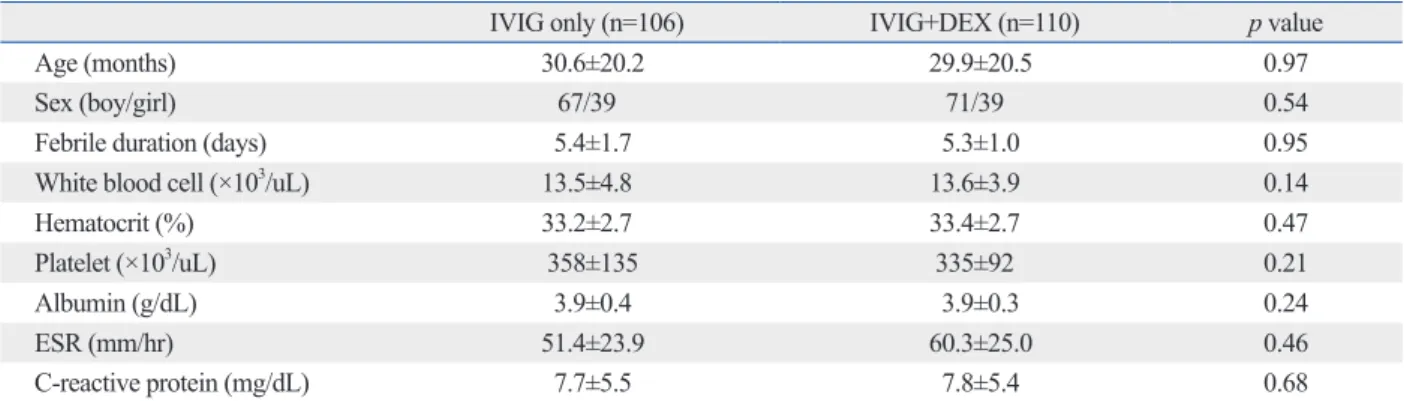
The demographic and laboratory data for both the experi- mental and control groups before treatment are summarized in Table 1. There were no significant differences in age (30.6±20.2 months vs. 29.9±20.5 months, mean±standard deviation; p=0.97 by the t-test), sex distribution (boy/girl, 67/39 vs. 72/39; p=0.54 by the chi-squared test) and febrile duration on admission (5.4±1.7 days vs. 5.3±1.0 days, mean±SD; p=0.95 by the t-test) between the control IVIG only group and the IVIG plus DEX groups. The groups were well balanced with respect to demographic and clini- cal characteristics. The laboratory data of the two groups on admission were not significantly different with regards to white blood cell counts, hematocrit, platelet counts, albu- min, erythrocyte sedimentation rate, and C-reactive protein (Table 1). All patients were monitored for at least two months (range, 2 to 38 months). No serious adverse effects such as hypertension or thromboses were reported in any of the KD patients, including those in the IVIG plus DEX group.
Clinical outcomes
The average febrile duration after the initial treatment in the IVIG plus DEX group was significantly shorter than that in the IVIG only group (1.7±0.7 vs. 2.0±1.2, mean±SD; p<
Table 1. Demographic and Laboratory Comparison of the Two Groups before Treatment (n=216)
IVIG only (n=106) IVIG+DEX (n=110) p value
Age (months) 30.6±20.2 29.9±20.5 0.97
Sex (boy/girl) 67/39 71/39 0.54
Febrile duration (days) 5.4±1.7 5.3±1.0 0.95
White blood cell (×103/uL) 13.5±4.8 13.6±3.9 0.14
Hematocrit (%) 33.2±2.7 33.4±2.7 0.47
Platelet (×103/uL) 358±135 335±92 0.21
Albumin (g/dL) 3.9±0.4 3.9±0.3 0.24
ESR (mm/hr) 51.4±23.9 60.3±25.0 0.46
C-reactive protein (mg/dL) 7.7±5.5 7.8±5.4 0.68
IVIG, intravenous immunoglobulin; DEX, dexamethasone; ESR, erythrocyte sedimentation rate.
Mean±SD, independent t-test and chi-squared test, p<0.05.
13.8 ×10
3/uL vs. 517±14.8 ×10
3/uL, mean±SE; p<0.001, 322±6.9 ×10
3/uL vs. 361±8.5 ×10
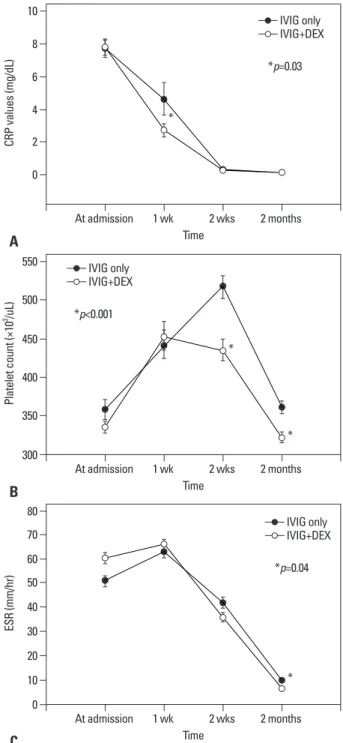
3/uL, mean±SE; p<0.001) (Fig. 1B). At two months, the mean erythrocyte sedimenta- tion rate (ESR) in the IVIG plus DEX group also decreased significantly, compared to the IVIG only group (6.7±0.7 mm/
hr, vs. 9.6±1.2 mm/hr, mean±SE; p=0.04) (Fig. 1C). Also, in non-responsive patients, platelet counts at 2 months in the IVIG plus DEX groups were significantly lower than those in the IVIG only group (316±81 ×10
3/uL vs. 369±80 ×10
3/ uL, mean±SD; p=0.04). ESR in the IVIG plus DEX group was also lower significantly than that in the IVIG only group (5.0±3.7 mm/hr vs. 11.6±1.4 mm/hr, mean±SD; p=0.02) for non-responsive patients.
DISCUSSION
Standard therapy with IVIG and aspirin for the treatment of KD has significantly reduced the incidence of coronary ar- tery abnormalities since Furusho, et al.
12reported the benefi- cial effects of high-dose IVIG treatment for KD. Nonethe- less, when a high-dose of IVIG is administered, approxima- tely 5% of children with KD experience transient coronary artery dilatation and 1% of them develop large aneurysms.
Approximately 15% of KD patients exhibit persistent or re- current fever after IVIG completion, which puts then at an increased risk of CAL.
13-15Recent studies have recommend- ed novel treatments for non-responsive patients including repeated doses of IVIG, intravenous pulse methylpredniso- lone, plasma exchange, ulinastatin, abciximab, infliximab, sized dilatation of the right and left coronary arteries (each
diameter 4.3 mm, 5 mm, 7 mm). CAL in two patients with diameters of 4.3 mm and 5 mm, regressed within 18 months of illness. The absolute number of CAL’s reported for the IVIG plus DEX group was less than that reported in the control group. An annual echocardiogram was conducted for patients with large aneurysms without development of CAL. None of the patients had adverse effects with regards to thrombosis in the coronary artery on echocardiogram.
For the non-responsive cases, the incidence of CAL was not different between the two groups, however, each group had only a small number of cases, 1 case in the IVIG plus DEX group and 2 cases in the IVIG only group.
Laboratory data for the IVIG plus DEX group and the IVIG only group
After completion of the initial IVIG treatment, the average level of C-reactive protein (CRP) in the IVIG plus DEX group was significantly lower than that in the IVIG only group (2.7±0.04 mg/dL vs. 4.6±0.06 mg/dL, mean±standard error; p=0.03). The magnitude of decrease in the CRP levels in the IVIG plus DEX group was larger than that in the IVIG only group at 1 week after completion of the initial IVIG.
Both of the mean CRP levels decreased to the same level as the normal range observed at two months (Fig. 1A). The seri- al platelet count in the IVIG plus DEX group was elevated early and decreased to levels lower than those obtained for the IVIG only group. The platelet counts at two weeks and two months were decreased significantly more in the IVIG plus DEX group than those in the IVIG only group (435±
Table 2. Comparison of Clinical Outcomes after Treatment (n=216)
IVIG only (n=106) IVIG+DEX (n=110) p value
Febrile duration after treatment (day) 2.0±1.2 1.7±0.7 <0.001*
Hospitalized duration (day) 6.9±2.5 5.8±1.7 <0.001*
IVIG total dosage (g/kg) 2.4±0.5 2.1±0.3 <0.001*
Non-responsive cases (No.%) 34/106 (32.0) 14/110 (12.7) <0.003*
Readmission (No. %) 11/106 (10.4) 6/110 (5.4) 0.12
IVIG, intravenous immunoglobulin; DEX, dexamethasone.
Mean±SD, independent t-test and chi-squared test.
*p<0.01.
Table 3. The Incidence of Coronary Artery Lesions
Time IVIG only (n=106) IVIG+DEX (n=110) p value
After initial IVIG therapy (%) 12 (11.3) 9 (8.2) 0.22
At 2 wks (%) 8 (7.5) 5 (4.5) 0.26
At 2 months (%) 3 (2.8) 1 (0.9) 0.29
IVIG, intravenous immunoglobulin; DEX, dexamethasone.
Incidence %, chi-squared test, p<0.05.
including Dr. Kawasaki. Before the first report of IVIG effi- cacy in KD, corticosteroid therapy was used as the initial treatment for KD. There were several reports regarding the use of corticosteroids in KD due to its potential to amelio- rate blood vessel damage by suppressing inflammatory ef- fectors that lead to endothelial cell injury and weakening of the vessel wall.
18,19Nevertheless, in the pre-IVIG era, many clinicians thought that steroid therapy might be harmful, as steroid might cause coronary thrombosis and aneurismal change in KD. An early study by Kato, et al.
6suggested a high incidence of coronary artery aneurysms in KD patients treated with prednisolone alone (11 of 17 patients), and as a result, steroids were thought to be harmful. In the post- IVIG era, corticosteroid therapy was used with or after the additional IVIG regimen as a rescue therapy in refractory KD. The pulsed steroid therapy in KD patients who pre- sented with recrudescent fever was associated with an im- provement of fever and CAL progression. In the study by Dahlem, et al.
20pulsed intravenous methylprednisolone was effective in relieving persistent fever and large pericardial effusions unresponsive to multiple treatments with IVIG.
Additionally, Dale, et al.
21reported that oral prednisolone (2 mg/kg/day, for 14 days) and aspirin were effective for se- vere complications in KD patients treated with initial IVIG therapy (2 g/kg). Previously, Hashino, et al.
5demonstrated the efficacy and safety of additional pulsed steroid therapy after multiple IVIG infusions in shortening febrile duration and lowering medical costs. As well, Wright, et al.
3report- ed the effectiveness of intravenous pulse methylpredniso- lone as a rescue therapy for non-responsive KD patients in comparison to standard IVIG therapy. The results from re- cent research have led to recommendations of an additional steroid regimen of intravenous pulse methylprednisolone (30 mg/kg/day, for 3 days) for KD patients, as additional infusions with IVIG have proven ineffective in relieving persistent fever and acute inflammation.
3,5The steroid treatment combined with IVIG was intro- duced recently as a primary therapy for KD. Shinohara, et al.
22reported that a regimen of prednisolone and immuno- globulin (200--400 mg/kg/d for 5 days) with aspirin is asso- ciated with shorter febrile duration and a decreased inci- dence of CAL when used as a primary therapy for acute KD. Sundel, et al.
9suggested that the initial methylprednis- olone therapy with IVIG as a primary therapy in KD led to faster resolution of fever, rapid improvement in inflamma- tory markers, and shorter length of hospitalization. Labora- tory measurements, such as serum CRP, and clinical mark- and cyclosphamide.
1,16,17However, the effectiveness and
adverse potentially adverse effects of several of these treat- ment options are uncertain due to the limited number of participants in the studies.
Corticosteroids are a strong anti-inflammatory agent used for the treatment of vasculitis, and have been mentioned to be of potential use in treatment of KD by many clinicians
Fig. 1. Changes in laboratory findings between the IVIG only group and IVIG plus dexamethasone group (DEX+IVIG): (A) for mean C-reactive protein (CRP), (B) for mean platelet count, and (C) for mean erythrocyte sedimenta- tion rate (ESR). *p<0.05, IVIG only group vs. DEX+IVIG group. DEX, dexa- methasone; IVIG, intravenous immunoglobulin.
Time
Time
Time 0
300
0 2
350
10 20 30 4
400
40 6
450
50 8
500
70 60 10
550
80 CRP values (mg/dL)Platelet count (×103 /uL)ESR (mm/hr)
At admission
At admission
At admission 1 wk
1 wk
1 wk
2 wks
2 wks
2 wks
2 months
2 months
2 months
A
B
C
IVIG only IVIG+DEX
IVIG only IVIG+DEX
IVIG only IVIG+DEX
*p=0.03
*
*p<0.001
*p=0.04
*
*
*
combination of dexamethasone and a single high-dose infu- sion of IVIG (2 g/kg) demonstrated a more favorable clinical course with decreased febrile duration and length of hospi- tal stay. The combined dexamethasone therapy decreased the need for additional IVIG treatments and lowered non- responsive rates to initial treatment. These results were sup- ported by serial results of clinical inflammatory markers, such as CRP and ESR. The levels for both CRP and ESR decreased more sharply and normalized faster in the combi- nation therapy group than the IVIG only group. In regards to coronary outcomes, CALs were not worse in the combined therapy group than the IVIG only group. Our results on cor- onary outcomes are in direct contrast to the pre-IVIG era re- ports of increased risks of coronary aneurysm in KD pa- tients treated with corticosteroid.
Our study had a few limitations including small number of patients in the combined dexamethasone and IVIG group that did not show better coronary outcomes. Recent trends regarding treatment choices for patients that do not respond to IVIG treatment for KD have included additional infusions of one or two more doses of IVIG, secondary pulsed steroid therapy with intravenous methylprednisolone 30 mg/kg/day for three days, and finally treatment with a tumor necrotizing factor-α blocker, such as infliximab. However, the therapeu- tic superiority thereof has been not been proven.
30Although the number of cases was very small, there were fewer non- responsive cases in the combined dexamethasone therapy than in the IVIG only group. Nevertheless, our results sug- gest combined dexamethasone therapy may decrease fever sooner and require less additional therapy such as infliximab whose effects on refractory KD still remain uncertain. As another limitation of our study, the levels of selected cyto- kines were not analyzed in relation to the combined steroid therapy in KD. We suggest that levels of inflammatory cyto- kines could support the efficacy of the combined steroid therapy. Further studies with a large number of patients will be required to definitively demonstrate the effectiveness of combined dexamethasone as an initial therapy in KD.
REFERENCES
1. Newburger JW, Takahashi M, Gerber MA, Gewitz MH, Tani LY, Burns JC, et al. Diagnosis, treatment, and long-term management of Kawasaki disease: a statement for health professionals from the Committee on Rheumatic Fever, Endocarditis, and Kawasaki Dis- ease, Council on Cardiovascular Disease in the Young, American Heart Association. Pediatrics 2004;114:1708-33.
ers of the disease, such as a febrile duration, also improved more quickly in patients treated with IVIG and corticoste- roids than those treated with IVIG alone.
23,24In a meta-anal- ysis by Wooditch and Aronoff
25eight studies encompassing 862 children with KD in whom combined corticosteroid therapy with aspirin and IVIG were the initial treatment, were assessed. This form of initial treatment significantly re- duced the incidence of coronary artery aneurysms. In se- quential studies of oral prednisolone plus IVIG therapy as a primary regimen in KD patients, Inoue, et al.
26reported that this treatment regimen improved the overall clinical course and outcomes of CAL without any adverse effects in acute KD. However, the rate of recurrence in the group treated with a combination of oral prednisolone plus IVIG was in- creased compared to the standard IVIG treated group (4.4%
vs. 2.2%, p=0.682). In another study of a large number of KD patients [IVIG group (n=896) and IVIG plus predniso- lone group (n=110)], the IVIG plus prednisolone treatment was associated with improved clinical and coronary out- comes in patients at a high risk of failure to respond to the IVIG treatment.
24Dexamethasone, as a fluoridated glucocorticoid, has been
clinically used for pulse steroid therapy with favorable re-
sults. It is a long acting drug, with a half-life of 36--72 hours,
and exerts negligible mineralocorticoid effects, almost with-
out salt retention. Compared to methylprednisolone, used
pulse steroid regimen, dexamethasone is less expensive and
6.7 times more potent with small equipotent volume.
27,28Dexamethasone lowers primarily vasogenic edema in brain
tumors and meningitis by decreasing the capillary permea-
bility of the blood brain barrier.
10With regards to the patho-
genesis of KD, vascular leakage with systemic edema is an
important pathologic finding in severe KD. The corticoste-
roid dexamethasone attenuates the cytokine reactions that
play a role in the pathogenesis of KD.
23Patients with CAL
were found to have increased levels of cytokines, compared
to those with normal coronary arteries.
23These cytokines
may mediate vascular damage and lead to CAL in KD.
29In
an experimental study, high-dose IVIG inhibited the activa-
tion of monocytes, macrophages, and coronary arterial en-
dothelial cells, whereas dexamethasone inhibited these cells,
in addition to T cells, in vitro.
11Jibiki, et al.
8introduced a
combined regimen of intravenous dexamethasone with hep-
arin and multiple infusions of IVIG (400 mg/kg/day for five
days) for primary therapy in KD. The combined dexametha-
sone and IVIG were safe and accelerated the resolution of
systemic inflammation. In our study, the group treated with a
16. Weiss JE, Eberhard BA, Chowdhury D, Gottlieb BS. Infliximab as a novel therapy for refractory Kawasaki disease. J Rheumatol 2004;31:808-10.
17. Furukawa T, Kishiro M, Akimoto K, Nagata S, Shimizu T, Yamashiro Y. Effects of steroid pulse therapy on immunoglobulin- resistant Kawasaki disease. Arch Dis Child 2008;93:142-6.
18. Burns JC. Revisiting steroids in the primary treatment of acute Kawasaki disease. J Pediatr 2006;149:291-2.
19. Shulman ST. Is there a role for corticosteroids in Kawasaki dis- ease? J Pediatr 2003;142:601-3.
20. Dahlem PG, von Rosenstiel IA, Lam J, Kuijpers TW. Pulse meth- ylprednisolone therapy for impending cardiac tamponade in im- munoglobulin-resistant Kawasaki disease. Intensive Care Med 1999;25:1137-9.
21. Dale RC, Saleem MA, Daw S, Dillon MJ. Treatment of severe complicated Kawasaki disease with oral prednisolone and aspirin.
J Pediatr 2000;137:723-6.
22. Shinohara M, Sone K, Tomomasa T, Morikawa A. Corticosteroids in the treatment of the acute phase of Kawasaki disease. J Pediatr 1999;135:465-9.
23. Okada Y, Shinohara M, Kobayashi T, Inoue Y, Tomomasa T, Ko- bayashi T, et al. Effect of corticosteroids in addition to intravenous gamma globulin therapy on serum cytokine levels in the acute phase of Kawasaki disease in children. J Pediatr 2003;143:363-7.
24. Kobayashi T, Inoue Y, Otani T, Morikawa A, Kobayashi T, Takeu- chi K, et al. Risk stratification in the decision to include predniso- lone with intravenous immunoglobulin in primary therapy of Ka- wasaki disease. Pediatr Infect Dis J 2009;28:498-502.
25. Wooditch AC, Aronoff SC. Effect of initial corticosteroid therapy on coronary artery aneurysm formation in Kawasaki disease: a meta-analysis of 862 children. Pediatrics 2005;116:989-95.
26. Inoue Y, Okada Y, Shinohara M, Kobayashi T, Kobayashi T, To- momasa T, et al. A multicenter prospective randomized trial of corticosteroids in primary therapy for Kawasaki disease: clinical course and coronary artery outcome. J Pediatr 2006;149:336-41.
27. Sinha A, Bagga A. Pulse steroid therapy. Indian J Pediatr 2008;75:
1057-66.
28. Schimmer BP, Parker KL. Adrenocorticotropic hormones; adreno- cortical steroids and their synthetic analog; inhibitors of the syn- thesis and actions of adrenocortical hormone. In: Brunton L, Lazo J, Parker K, editors. Goodman & Gilman’s The Pharmacological Basis of Therapeutics. 11th ed. New York: McGraw-Hill Profes- sional; 2006. p.1587-612.
29. Kwak JH, Song J, Kang IS, Huh J, Lee HJ. Changes in coronary perfusion after occlusion of coronary arteries in Kawasaki disease.
Yonsei Med J 2014;55:353-9.
30. Burns JC, Best BM, Mejias A, Mahony L, Fixler DE, Jafri HS, et al. Infliximab treatment of intravenous immunoglobulin-resistant Kawasaki disease. J Pediatr 2008;153:833-8.
2. Han RK, Silverman ED, Newman A, McCrindle BW. Manage- ment and outcome of persistent or recurrent fever after initial in- travenous gamma globulin therapy in acute Kawasaki disease.
Arch Pediatr Adolesc Med 2000;154:694-9.
3. Wright DA, Newburger JW, Baker A, Sundel RP. Treatment of immune globulin-resistant Kawasaki disease with pulsed doses of corticosteroids. J Pediatr 1996;128:146-9.
4. Blaisdell LL, Hayman JA, Moran AM. Infliximab treatment for pediatric refractory Kawasaki disease. Pediatr Cardiol 2011;32:
1023-7.
5. Hashino K, Ishii M, Iemura M, Akagi T, Kato H. Re-treatment for immune globulin-resistant Kawasaki disease: a comparative study of additional immune globulin and steroid pulse therapy. Pediatr Int 2001;43:211-7.
6. Kato H, Koike S, Yokoyama T. Kawasaki disease: effect of treat- ment on coronary artery involvement. Pediatrics 1979;63:175-9.
7. Kijima Y, Kamiya T, Suzuki A, Hirose O, Manabe H. A trial pro- cedure to prevent aneurysm formation of the coronary arteries by steroid pulse therapy in Kawasaki disease. Jpn Circ J 1982;46:
1239-42.
8. Jibiki T, Terai M, Kurosaki T, Nakajima H, Suzuki K, Inomata H, et al. Efficacy of intravenous immune globulin therapy combined with dexamethasone for the initial treatment of acute Kawasaki disease. Eur J Pediatr 2004;163:229-33.
9. Sundel RP, Baker AL, Fulton DR, Newburger JW. Corticosteroids in the initial treatment of Kawasaki disease: report of a random- ized trial. J Pediatr 2003;142:611-6.
10. Rosenberg GA. Brain Edema and Disorders of Cerebrospinal Fluid Circulation. In: Bradley WG, Daroff RB, Fenichel GM, Jankovic J, editors. Neurology in Clinical Practice. 2nd ed. Boston: Butter- worth-Heinemann Limited; 2000. p.1545-9.
11. Makata H, Ichiyama T, Uchi R, Takekawa T, Matsubara T, Furu- kawa S. Anti-inflammatory effect of intravenous immunoglobulin in comparison with dexamethasone in vitro: implication for treat- ment of Kawasaki disease. Naunyn Schmiedebergs Arch Pharma- col 2006;373:325-32.
12. Furusho K, Kamiya T, Nakano H, Kiyosawa N, Shinomiya K, Hayashidera T, et al. High-dose intravenous gammaglobulin for Kawasaki disease. Lancet 1984;2:1055-8.
13. Dajani AS, Taubert KA, Gerber MA, Shulman ST, Ferrieri P, Freed M, et al. Diagnosis and therapy of Kawasaki disease in chil- dren. Circulation 1993;87:1776-80.
14. Newburger JW, Takahashi M, Beiser AS, Burns JC, Bastian J, Chung KJ, et al. A single intravenous infusion of gamma globulin as compared with four infusions in the treatment of acute Kawasa- ki syndrome. N Engl J Med 1991;324:1633-9.
15. Sato N, Sugimura T, Akagi T, Yamakawa R, Hashino K, Eto G, et al. Selective high dose gamma-globulin treatment in Kawasaki disease: assessment of clinical aspects and cost effectiveness. Pe- diatr Int 1999;41:1-7.