This study was performed to review clinical research studies involving acupuncture treatment for primary headache disorders to provide a basic reference for future studies.
Clinical studies of primary headache disorders treated with acupuncture were retrieved from 3 Korean electronic databases (NDSL, OASIS, and RISS). The studies were classified by year of publication, type of study, type of acupuncture, outlined acupoints, methods used for filiform needles, pharmacopuncture, auricular acupuncture, and thread-embedding acupuncture.
Thirty-eight trials were reviewed, of which 33 used filiform needles, 6 pharmacopuncture, 1 auricular acupuncture, and 1used thread-embedding. Most of the studies reported that acupuncture treatment was effective in treating primary headache disorders.
Some studies reported statistically significant effects, but the results overall were inconsistent. Therefore, there is insufficient evidence to support the treatment of acupuncture to resolve headaches. On the basis of these results, further studies should be performed to qualitatively and quantitatively determine the efficacy of acupuncture treatment for primary headache disorders.
©2019 Korean Acupuncture & Moxibustion Medicine Society. This is an open access article under the CC BY- NC-ND license (http://creativecommons.org/licenses/by-nc-nd/4.0/).
Article history:
Submitted: July 25, 2019 Revised: August 8, 2019 Accepted: September 2, 2019 Keywords:
acupuncture, headache, pharmacopuncture, auricular acupuncture
https://doi.org/10.13045/jar.2019.00185 pISSN 2586-288X eISSN 2586-2898
J Acupunct Res 2019;36(4):187-196
Review Article
A Review of Acupuncture Treatment for Primary Headache Disorders in Korea
Doo-ree Hwang 1 , Ju-hyun Lee 1 , Seung-hyo Hong 1 , Hyun-min Choi 2 , Hyun-ae Park 1, *
1 Department of Acupuncture and Moxibustion Medicine, Dongseo Oriental Hospital, Seoul, Korea 2 Department of Korean Medicine Rehabilitation, Dongseo Oriental Hospital, Seoul, Korea
ABSTRACT
Journal of Acupuncture Research
Journal homepage: http://www.e-jar.org
Introduction
Headache refers to any pain or discomfort originating from pain- sensitive regions covering the orbit to the larynx [1], and is a very common condition. According to the International Classification of Headache Disorders, 3rd edition (ICHD-III) published in 2018 by the Headache Classification Committee of the International Headache Society (IHS), headaches are classified into 3 categories:
primary headaches, secondary headaches, and neuropathies and facial pains [2]. Most headaches fall into the primary headache category and are caused by the headache itself, rather than secondary headaches, which are caused by physical problems or underlying diseases. Therefore, it is important to diagnose headaches appropriately under the headache classification system based on medical history and physical and neurological exams [3].
Although acetaminophen, aspirin, nonsteroidal anti- inflammatory drugs, triptans, narcotics, and barbiturates can be used to treat headaches, this could result in the paradoxical problem of turning transient headaches into chronic daily
headaches [4]. Accordingly, drugs with minimized side effects or non-pharmacological treatment methods are becoming increasingly necessary to reduce pain and improve patient quality of life. Furthermore, it has been reported that acupuncture treatment can be effective for the treatment of frequent headaches or when headaches progress to chronic pain that does not respond very well to analgesics [5].
In this context, the present study analyzed the types of acupuncture treatment used in clinical research for primary headaches in Korea to provide a basic reference for future studies.
Materials and Methods
Research subject and search methods
To examine acupuncture trends in the treatment of primary headaches in Korea, research articles from 2000 onwards were retrieved from the National Discovery for Science Leaders (NSDL), Research Information Sharing Service (RISS), and Oriental
* Corresponding author.
Department of Acupuncture and Moxibustion Medicine, Dongseo Oriental Hospital, Seoul, Korea E-mail: [email protected]
ORCID: Doo-ree Hwang https://orcid.org/0000-0002-3438-7755, Hyun-ae Park https://orcid.org/0000-0003-1329-4813
©2019 Korean Acupuncture & Moxibustion Medicine Society. This is an open access article under the CC BY-NC-ND license (http://creativecommons.org/licenses/by-nc- nd/4.0/).
026
Medicine Advanced Searching Integrated System (OASIS).
“Headache”, “primary headache” and “acupuncture” were used as keywords. The retrieval was conducted on June 20, 2019 and reviewed on July 8, 2019.
Studies excluded were research articles and literature reviews
whose full text had restricted access, did not mention acupuncture treatment, were animal studies, and research that reported on headaches resulting from underlying causes.
Based on these criteria, a total of 38 studies were selected and analyzed (Fig. 1).
These were classified by published year, type of study, and type of acupuncture. Acupoints, methods used for filiform needles, pharmacopuncture, auricular acupuncture, and thread-embedding acupuncture were also outlined.
Results
Classification by year
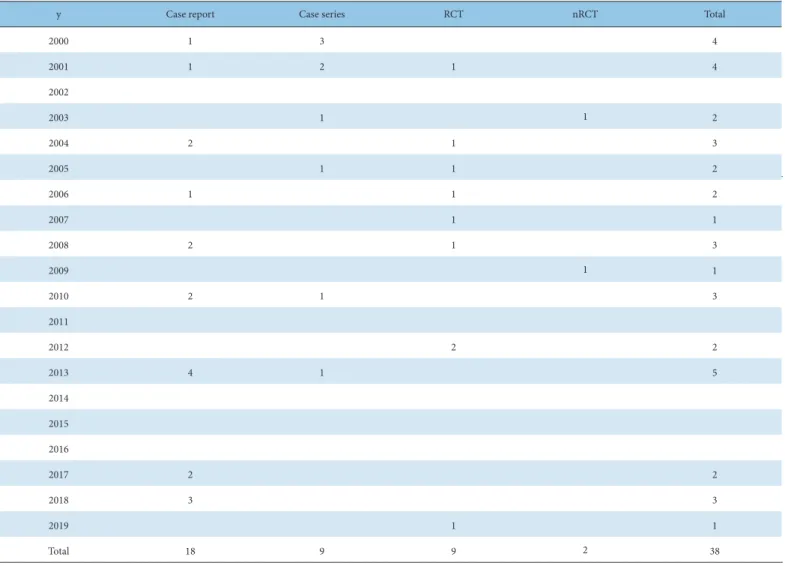
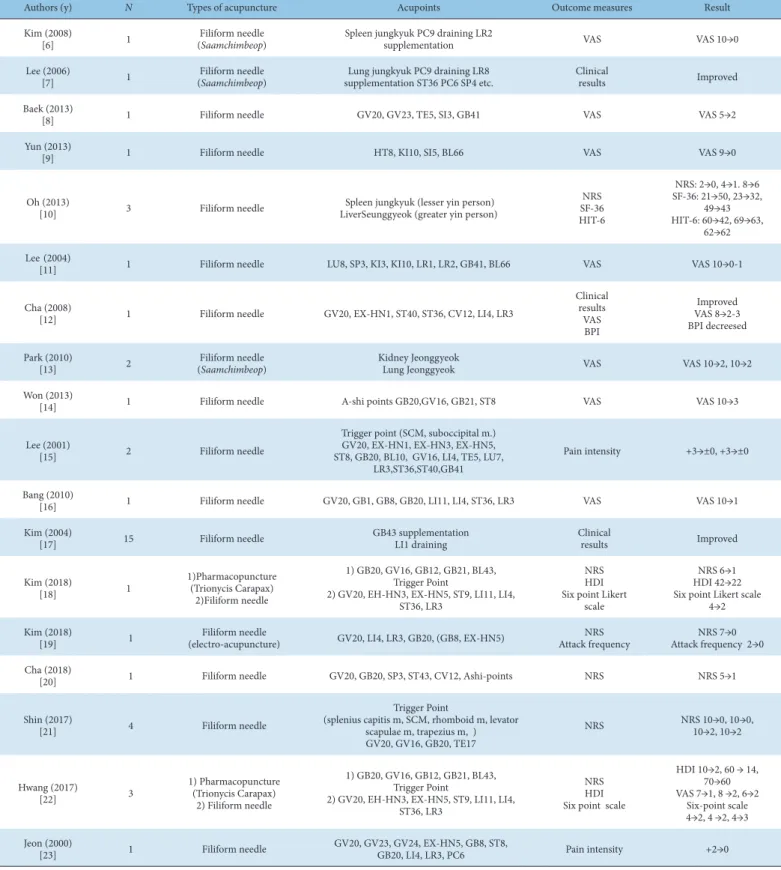
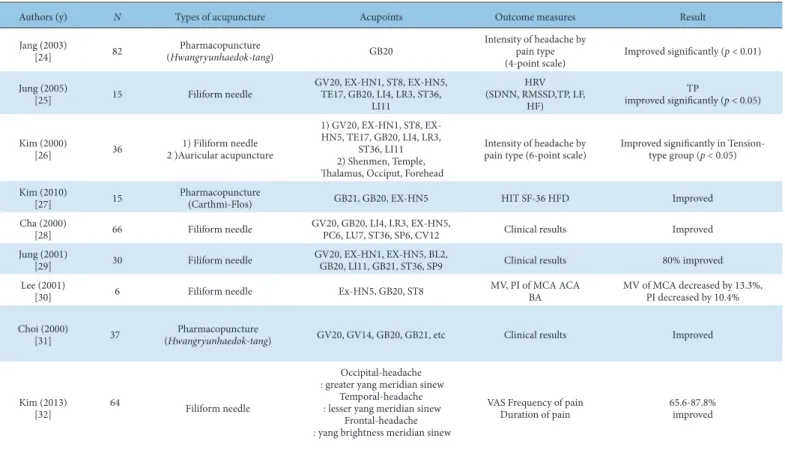
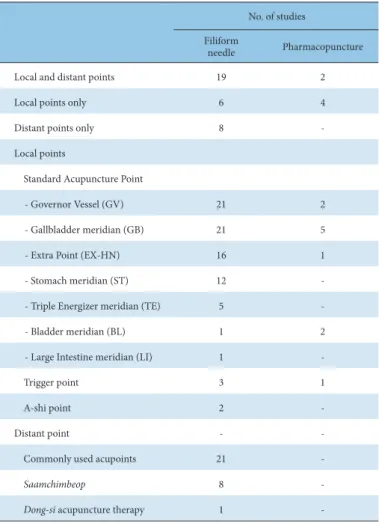
Except for 2002, 2014, 2015, and 2016, studies had been conducted consistently. Out of the 41 studies, there were 18 case reports [6-23], 9 case series [24-32], 9 randomized controlled trials [33-41], and 2 non-randomized controlled trials [42,43] (Tables 1-5).
Classification by type of needle used for treatment
Of the 38 studies included in this review, 30 used filiform
Fig. 1. Article selection flow chart.
NDSL, National Discovery for Science Leaders; OASIS, Oriental Medicine Advanced Searching Integrated System; RISS, Research Information Sharing Service.
307 of articles identified through database searching - NDSL (n = 37)
- RISS (n = 117) - OASIS (n = 153)
Duplicated articles (n = 143)
Articles excluded
: Not related with primary headache disorder (n = 52) : Not related with acupuncture (n = 37) : Animal studies (n = 1) : Not clinical studies (n = 27) : Not found whole text (n = 9) Articles screened (n =164)
Articles included : Clinical studies (n = 38)