Differential Effects of Two Individual Acupuncture Points (BL62, KI6) on Heart Rate Variability in Healthy Volunteers : A Randomized, Single-Blind,
Self-Controlled Trial
Ji-Hye Lee1*⋅Young-Joon Choi1*⋅Byung-Chul Shin2⋅Sung-Tae Koo1
1Division of Meridian and Structural Medicine, School of Korean Medicine, Pusan National University, Yangsan, Korea
2Division of Clinical Medicine, School of Korean Medicine, Pusan National University, Yangsan, Korea
건강한 지원자에서 두 경혈(신맥, 조해)이 심박변이도에 미치는 영향의 차이 : 무작위, 단일 맹검, 자기 대조군 임상시험
이지혜1*, 최영준1*, 신병철2, 구성태1
1부산대학교 한의학전문대학원 경락구조의학부2 부산대학교 한의학전문대학원 임상의학부 Abstract
목적 : 이 연구는 서로 다른 두 경혈이 심박변이도에 미치는 영향을 비교하고, 자율신경계에 미치는 영향을 평가 하기 위해 수행하였다.
재료 및 방법 : 13명의 지원자가 3개의 세션에 균등하게 무작위 배정되었다. 각 세션에서 지원자들은 신맥(BL62), 조해(KI6), 또는 비경혈에 각각 침처치를 받았다. 10분간 휴식을 한 후에 자침 전, 유침기간, 발침 후 기간에 5분 동안 심박변이도 측정을 하였다. 유침기간에는 2분 간격을 두고 2회 심박변이도를 측정하였다.
결과 : 신맥에 자침한 군에서는 자침후 기간에 total power(TP)와 standard deviation N-N interval(SDNN)이 유의 하게 증가하였다. 유침기간 중 첫 5분 동안의 TP와 SDNN은 자침전 값과 유의한 차이가 없었으며 유침기간 중 마지막 5분 동안에는 다소 증가하는 경향은 있었지만 통계적인 유의성은 없었다. 반면에 조해와 비경혈에 자침한 군에서는 TP와 SDNN에 유의한 변화가 관찰되지 않았다. 발침 후에 신맥자침군에서는 조해와 비경혈 자극군과 비교해서 TP가 유의하게 변화하였다. 그러나 SDNN은 발침 후에 세 군 사이에 유의한 차이가 없었다.
결론 : 이 실험 결과는 조해와 비교했을 때 신맥에 자침한 경우 심장 기능 및 자율신경계와 관련이 있는 대체적인 활성이 증가한다는 것을 보여주었다. 이 결과는 신맥 자침이 자율신경계와 관계되어 있는 심장의 기능에 미치는 영향을 통해서 경혈의 특이성을 관찰할 수 있음을 의미한다.
Key words : acupuncture, heart rate variability, autonomic nervous system, BL62, KI6
⋅교신저자 : Sung-Tae Koo, Beomeo-ri Mulgeum-eup, Yangsan Republic of Korea
Divison of Meridian and Structural Medicine School of Korean Medicine, Pusan National University Tel. +82(51)510-8474, Fax. +82(51)510-8420 E-mail:[email protected]
⋅* These authors contributed equally to this work.
⋅This work was supported for two years by Pusan National University Research Grant.
⋅투고 : 2010/11/11 심사 : 2010/12/09 채택 : 2010/12/14
Ⅰ. Introduction
Recently, many studies which indicate that acupuncture is influential on autonomic nervous system (ANS) have been published. It is generally believed that acupuncture modulates the imbalance of autonomic nervous system.1,2)Nowadays, increasing number of researchers take into account of changes in ANS system when studying the processes of altered physiological states.3) A great deal of acupuncture research related to ANS has been done with quantitative markers calculated from electrocardiogram (ECG) such as heart rate variability (HRV).
Until now, most acupuncture studies related to ANS were focused on the effects of a single acupuncture point. The present study was carried out to make comparisons of the two different acupoints under the same subjects and testing conditions, as well as the comparison between pre and post acupuncture stimulations of each acupoint.
We chose two acupoints, sinmaek (BL62) and johae (KI6), which have different and even contrary effects associated with sleep control, to evaluate their specificities. In particular, we looked at the specificities of the two acupoints in modulating the ANS responses by measuring the HRV changes in the subjects. We hypothesized that the manual stimulations of the two acupoints would induce different ANS responses based on the specificities of the two acupoints. Two individual acupoints,
BL62 and KI6 on extraordinary meridians (Yin and Yang Stepping Vessels) have different effects on balancing Yin and Yang in the divergent organs.
Acupoints such as BL62 and KI6 are connected to Yang Stepping Vessels and Yin Stepping Vessels respectively, and their different roles are controlled by their different ways of balancing the Qi flow.4) It would be reasonable to suggest that the two different acupuncture points chosen for this study would produce different therapeutic effects on the ANS activity.
Frequency-domain analysis of HRV is a sophisticated noninvasive tool for detection of heart regulation by ANS. Spectral analysis of HRV in a normal subject during the controlled resting condition is characterized by three major components that account for almost all the power variance, total power (TP) of the variability signal.
Two major components at low (LF: 0.04-0.15 Hz) and high (HF: 0.15-0.40 Hz) frequencies are usually detectable. Frequency fluctuations in the range of 0.04-0.15 Hz (LF) are with some controversy, considered to be a marker of sympathetic activity, and high frequency fluctuations in the range of 0.15-0.40 Hz (HF) are considered to be a marker of parasympathetic or vagal activity.5) The LF/HF ratio is considered to mirror sympathovagal balance6) or to reflect the sympathetic modulations.5,7)
The aim of this study was to compare the effects of acupuncture applied on different acupoints, BL62 and KI6, by using power spectral analysis of the HRV changes in normal subjects. This comparison allowed us to investigate the ANS responses following acupuncture stimulations on different acupoints.
Ⅱ. Materials & Methods
1. Human subjects
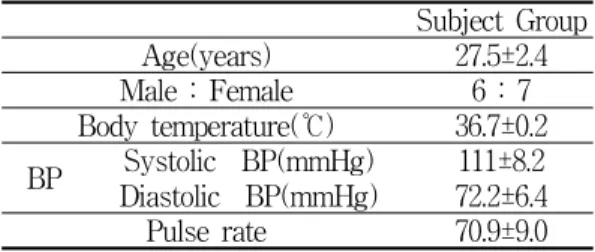
The experiment procedures were approved by Korean Medicine Clinical Research Center IRB (Institutional Review Board) of Pusan National University (KCRC IRB 2009-01) and were performed in accordance with the ethical standards laid down in the 1964 Helsinki Declaration. Thirteen healthy male and female volunteers aged 24~35, recruited from students within university were scheduled to participate in the study (Table 1).
The subjects were healthy as confirmed by their medical histories and they did not suffer from cardiovascular or autonomic disease. They also had never experienced any adverse effects related to acupuncture nor did they suffer from skin lesions from acupuncture previously. All volunteers were not on any medications and they were abstained from caffeine on the day of the study.
Written informed consent was obtained from each subject before they participated in the study.
Subject Group
Age(years) 27.5±2.4
Male : Female 6 : 7
Body temperature(℃) 36.7±0.2 BP Systolic BP(mmHg) 111±8.2 Diastolic BP(mmHg) 72.2±6.4
Pulse rate 70.9±9.0
Table 1. General Characteristics
2. Experimental design
As this trial was crossover-designed, 13 normal subjects participated in each of the three randomly distributed sessions. There were three different sessions that included the acupoints, BL62 and KI6, and one non-acupoint used as the control.
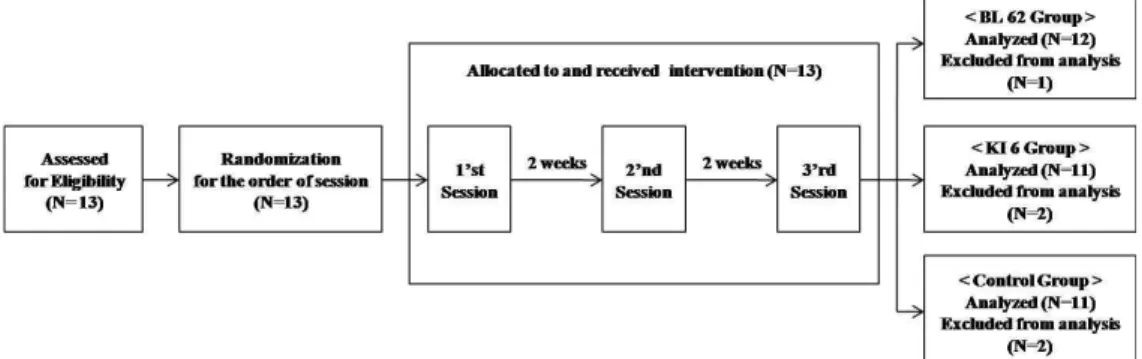
The order of sessions was given by a computer -generated randomization sequence unknown to subjects. We took 2 weeks break between each session to wash off the acupuncture effects. Two subjects from the KI6 and the control groups, and one subject from the BL62 group violated the protocols, so we excluded them from our data (Fig. 1). Every session was scheduled to be at the same time (between 4:00 p.m. and 6:00 p.m.) and the room temperature was maintained to 24~25°C.
Fig. 2 shows the experimental procedure. For each session all subjects rested in the supine position for 10 min before their basal HRV values were measured for 5 min. Acupuncture was then given to the three different acupoints, as illustrated below. The skin was cleaned with alcohol prior to needling at the site of insertion. The needles were left in place for 12 mins (the HRV was measured in the first and the last 5 mins of the 12 min period with a 2 min interval), and then they were removed. Finally, the subjects rested for 5 mins while they remained in the same supine position during the post-stimulation period recording.
Fig. 1. A flow chart showing the enrollment of the subjects and the outcome of group randomizations.
13 normal subjects participated in each of the three randomly distributed sessions. There are three different sessions that consist of the BL62the KI6, and the control groups. The order of the sessions was given by a computer-generated randomization sequence that was unknown to the subjects. Two subjects from the KI6 and the control group, and one subject from the BL62 group violated the protocolso they were excluded from the data.
Fig. 2. The study design of the test sessions.
The subjects had 10mins of resting period before their baseline HRV components were measured for 5 mins (Pre-acu).
The HRV components were then measured two more times on the subjects during the acupuncture period for 12 mins followed by the post-acupuncture period for 5 mins (Post-acu).
3. Acupuncture
Session for the BL62 and the KI6 groups.
Acupuncture needles (0.30-mm diameter, 50mm, Dong Bang Acupuncture Inc.) were inserted bilaterally into the BL62 point (on the lateral side of the foot, in the depression, 0.5 cun directly below the external malleolus) or into the KI6 point (on the medial side of the foot, in the depression slightly below the tip of the medial malleolus) with 1 cm depth and manual stimulations were given at these two points for 10s to achieve the De-Qi sensation, which consisted of feelings of heaviness, fullness, or soreness.
Session for the control group. Acupuncture needles (0.25-mm diameter, 40mm, Dong Bang Acupuncture Inc.) were inserted bilaterally and superficially (1mm) into the non-acupoint (on the medial side of the foot, in the depression between the tip of the medial malleolus and Achilles tendon; 1cm above the KI 3 point) and no manipulations were given to these points.
4. Measurements of heart rate variability
The analysis of the recorded measurement of heart rate variability was processed with SA- 3000P (Medicore Co. Ltd. Korea). All human subjects rested in the supine position and the HRV electrodes were positioned on both of their wrists and their right ankle for the measurements.
The heart rate (HR), standard deviation of N-N intervals (SDNN), total power (TP), low-frequency (LF, 0.04-0.15 Hz), high-frequency (HF, 0.15-0.40 Hz), and the LF/HF ratio were used as the indices of autonomic nerve system.
The experiment was carried out to test the hypothesis that acupuncture has an effect on the cardiac vagal regulation and/or it has a suppressive
effect on sympathetic regulation. The HRV measuring technique was especially used to monitor the effects of needling the acupoints, BL62 and KI6 on ANS.
5. Statistical analysis
Results were given as mean ± SE. The significance of differences within each group was compared using one-way repeated measures ANOVA (SPSS version 17). The significance of differences among groups was compared using one-way ANOVA. Post-hoc test was processed in Dunnett's method. Probability values of <0.05 were considered statistically significant.
Ⅲ. Results 1. General Characteristics
The mean age of the subjects was 27.5 ± 2.4 yr, and the subjects consisted of 6 males and 7 females (Table 1). The physiological parameters of the volunteers were within the normal range (Table 1). There were no differences of general characteristics across all the three groups: the BL62 group, the KI6 group and the control group.
2. The comparison of the HRV parameters
before, during and after acupuncture
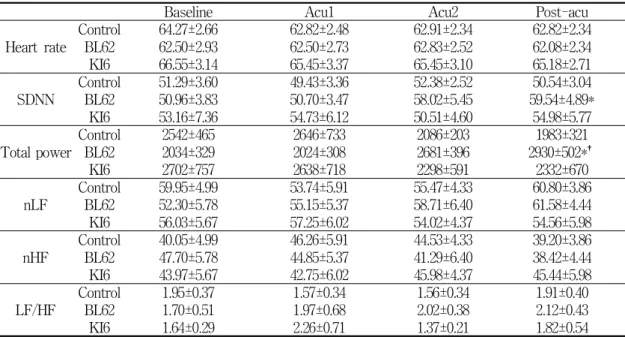
As we compared the HRV components measured during the acupuncture and the post-acupuncture periods with those measured during the baseline period in the control group, the BL62 group and the KI6 group, we discovered that the acupuncture stimulation induced statistically significant changes in the TP and the SDNN indices, but it had no significant effects on other indices including the heart rate (HR), LF activity, HF activity and LF/HF ratio. Table 2 presents the mean values of the HRV components during the baseline, the acupuncture and the post-acupuncture periods in each of the three groups.
Acupuncture applied to the BL62 point induced a significant increase of TP (P=0.012) and SDNN (P=0.024) in the post-acupuncture period as compared to the baseline period. However, TP and SDNN in the first five minutes of the acupuncture period remained more or less the same as those of the baseline period and only in the last five minutes did these parameters show a minor increase of no statistical significance. In contrast, acupuncture applied to the KI6 point and the superficial acupuncture applied to non-acupoint induced no significant changes in TP and SDNN.
These data are summarized in Fig. 3 and Fig. 4.
Baseline Acu1 Acu2 Post-acu Heart rate Control 64.27±2.66 62.82±2.48 62.91±2.34 62.82±2.34
BL62 62.50±2.93 62.50±2.73 62.83±2.52 62.08±2.34
KI6 66.55±3.14 65.45±3.37 65.45±3.10 65.18±2.71
SDNN Control 51.29±3.60 49.43±3.36 52.38±2.52 50.54±3.04
BL62 50.96±3.83 50.70±3.47 58.02±5.45 59.54±4.89*
KI6 53.16±7.36 54.73±6.12 50.51±4.60 54.98±5.77
Total power Control 2542±465 2646±733 2086±203 1983±321
BL62 2034±329 2024±308 2681±396 2930±502*†
KI6 2702±757 2638±718 2298±591 2332±670
nLF Control 59.95±4.99 53.74±5.91 55.47±4.33 60.80±3.86
BL62 52.30±5.78 55.15±5.37 58.71±6.40 61.58±4.44
KI6 56.03±5.67 57.25±6.02 54.02±4.37 54.56±5.98
nHF Control 40.05±4.99 46.26±5.91 44.53±4.33 39.20±3.86
BL62 47.70±5.78 44.85±5.37 41.29±6.40 38.42±4.44
KI6 43.97±5.67 42.75±6.02 45.98±4.37 45.44±5.98
LF/HF Control 1.95±0.37 1.57±0.34 1.56±0.34 1.91±0.40
BL62 1.70±0.51 1.97±0.68 2.02±0.38 2.12±0.43
KI6 1.64±0.29 2.26±0.71 1.37±0.21 1.82±0.54
All data are expressed as mean ± SEM for the values of the HRV components including heart rate (HR), standard deviation of N-N intervals (SDNN), total power (TP), low frequency power (LF), high frequency power (HF) and the LF/HF ratio during the baseline, the acupuncture and thepost acupuncture periods in the control group, the BL62 and the KI6 groups.
The baseline period corresponds to the pre-acupuncture period; Acu1 is the first five minutes of the acupuncture stimulation period; Acu2 is the last five minute of the acupuncture stimulation period; Post-acu corresponds to the post-acupuncture period after the removal of the needles.
*P<0.05 acupuncture or post-acupuncture versus baseline
†P<0.05 multiple comparison versus control group
Table 2. Differential effects of acupoints on the heart rate variability (HRV) components
Fig. 3. Changes in standard deviation of N-N intervals (SDNN) during the baseline, the acupuncture and the post acupuncture periods.
Pre-acu, pre-acupuncture period ; Acu1, first five minutes of acupuncture stimulation period ; Acu2, last five minutes of acupuncture period ; Post-acu, post-acupuncture period after the removal of the needles.
*Different from the values of “baseline”in each group
(One way repeated measures ANOVA,P<0.05)
Fig. 4. Changes in total power (TP) during the baseline, the acupuncture and the post acupuncture periods.
Pre-acu, pre-acupuncture period Acu1, first five minutes of acupuncture stimulation period Acu2, last five minutes of acupuncture period Post-acu, post-acupuncture period
after the removal of the needles.
*Different from the values of “baseline" in each group (One way repeated measures ANOVA, P<0.05)
3. The comparison of the HRV parameters between the BL62, the KI6 and the control groups
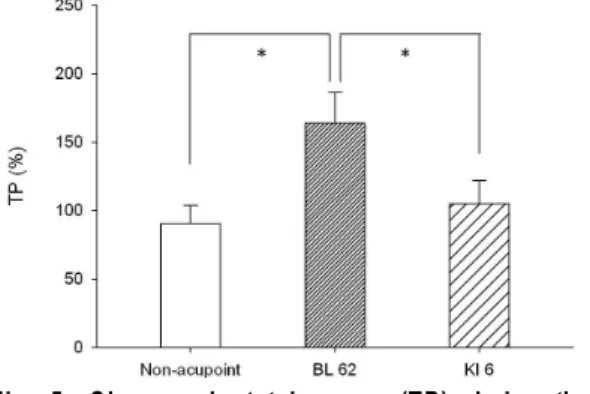
All the mean values of the HRV components measured during the baseline period had no significant differences across all the three groups consisting of the BL62 group, the KI6 group and the control group. There were also no statistically significant differences between the control group and the BL62 group in TP and SDNN during the baseline period. After stimulation, the value of TP, which was expressed as the percentage of the baseline value, was significantly changed in the BL62 group compared to the control group (Fig.
5). However, SDNN showed no significant differences among all three groups during the post-acupuncture period. There were also no significant differences in the other HRV indices including HR, LF, HF and the LF/HF ratio during the acupuncture as well as the post-acupuncture periods among the three groups.
Fig. 5. Changes in total power (TP) during the post-acupuncture period.
All data are expressed as the percentage of the mean
values of the baseline period in each group
*Different from the values of the other groups (One way ANOVA, P<0.05)
Ⅳ. Discussion
According to the classical literatures of East Asian medicine, a prominent feature of acupuncture involves eliciting specific effects on a particular organ system of body by needling certain points that located remotely from that organ system.
From this, it can be inferred that acupoints have their own specific effects on different organ systems of body: this is known as acupoint specificity.
However, the concept of acupoint specificity is still a controversial research topic.8) It was claimed that acupuncture may be effective even when the needle is inserted anywhere in appropriate points.9) There have been many clinical trials and experimental studies on specificity of acupoints.
Previous studies of acupuncture indicated a rising number of research studies on specificity of acupoints in morphological structures (nerves, blood vessels, connective tissues, etc) biophysical characteristics (electricity, thermology, and electromagnetism) and pathological responses.10-12)However, these research studies were basically at the stage of phenomenon -observation and thus more definite or convincing results were needed to support some key factors influencing acupoint specificity.
Recently, in the hope of gaining more accurate data to support the existence of acupoint specificity, noninvasive brain imaging techniques such as functional magnetic resonance imaging (fMRI) were developed, which enabled scientists to study the human brain directly.13,14)Nevertheless, the existence of specificity of acupoint has not been entirely supported by the results of the fMRI studies.15)
There are also some theories that are widely accepted as quite valid in explaining many different aspects of acupuncture.
In the present study, acupuncture applied to different acupoints exerted different influences on HRV. Acupuncture applied to BL62 induced significant changes of SDNN and TP, while that applied to KI6 and the superficial acupuncture applied to the non-acupoint did not induce any significant changes in those values. SDNN is most commonly used in time domain measure of HRV and its increased level of quantity appears to be one of the better indicators for increased ability of heart to meet changing situational demands.16) Previous studies demonstrated that in practice, reduced SDNN best predicted both total cardiac mortality and malignant arrhythmias.17,18) TP is the sum of VLF, LF and HF activities and its increase demonstrates overall enhancement in activity of ANS. One study reported that TP is highly correlated with SDNN because both are influenced by the same physiological inputs and also because of their mathematical relationships, in that SDNN is the square root of the total variance in normal N-N intervals, whereas TP is the equivalence of the total variance.19) Consistent to these findings, our study results showed that the mean values of both SDNN and TP increased in the BL62 group. The overall higher values of variability in the BL62 group suggest that acupuncture applied to BL62 rather than KI6 was more effective in activating the heart function associated with ANS in resting states of healthy subjects.
The different results obtained in the present study for the two groups, the BL62 and the KI6 groups, where both groups received same acupuncture
needles but at different locations, could provide as an evidence for specificity of acupoints. Previous studies reported that acupuncture-like stimulations at different areas of body such as limbs and abdomen produced different sympathetic nerve activities in rats,20) and electro-acupuncture applied to different acupoints with stimulations induced different cardiovascular reflex responses in humans.21) Another study reported that stimulations of acupoints or non-acupoints had different influences on sympathetic and parasympathetic nerve activities of the subjects who were driving.22) In order to discover the existence of acupoint specificity, we chose two acupoints that have different and even contrary effects on sleep and eye-opening according to the theory of Traditional East Asian Medicine.4) These points are located adjacent to each other on a foot. Some clinical trials earlier showed that acupuncture applied to KI6 and BL62 had a therapeutic effect on not only insomnia but also narcolepsy.23) However, in the view of mildly stimulating method as same in present study, it is a reasonable view that KI6 could be used to treat insomnia and BL62 could be used to treat narcolepsy. Similar to these trials, acupuncture applied to KI6 and BL62 were stimulated mildy in the present study, but our results led to a reasonable assumption that that KI6 could be used to treat insomnia and BL62 could be used to treat narcolepsy. One study on the central neural pathways related to acupuncture points suggested that the areas labeled by the overlapped neural tracers, which projected to both BL62 and KI6 were related with the cardiovascular reflex and emotional pathway in the central autonomic center, while the areas labeled by specific tracer that projected to BL62 only were related to the
changes of alertness, arousal and heart rate reflected in sympathetic nucleus.24) The different properties of BL62 and KI6 explored by this study could be used to explain the different effects observed in HRV between the two acupoints in the present study. However, it still remains in question as to why the results of the KI6 group were not significantly different from those of the control group, which produced no significant changes. KI6 is used to treat insomnia and calm the mind in cases of anxiety and restlessness.25) Indeed, the recent study describing application of acupuncture at KI6 reported that psychological factors such as anxiety levels may be necessary for physiological effects of some acupoints to take place.26) In this regard we assumed that since all the procedures in our study were performed during the resting states of healthy subjects, acupuncture applied to KI6 did not show significant effects on HRV. It is also possible that the stimulation -induced effects of KI6 were delayed and, as a result, its ability to change the HRV components was not observed within the limited measurement period. In contrast, acupuncture applied to BL62, which has an effect of raising alertness and arousal, was likely to induce the effects on HRV earlier than that applied to KI6. Thus we extrapolated that if our subjects had been under stressful and anxious states the HRV measurements might have revealed conflicting results to our current one. Similarly, if the longer measurement time after the acupuncture stimulation had been used the results of HRV between the two groups might have revealed differently to the present one.
In considering our methodology, we chose the cross-over design to minimize the variations of the baseline HRV values among the subjects, which
would strengthen the reliability of the results obtained for all the groups. This established methodology allows the present study to serve as a pilot study for future prospective studies on investigating specificities of acupoints in relation to HRV.
In the present study, no group produced significant changes in the LF/HF ratio after acupuncture. It is generally accepted that the LF /HF ratio reflects the balance of sympathetic nerve activity (SNA) and parasympathetic nerve activity (PNA).27) Our results indicated that acupuncture applied to BL62 and KI6 had no effects on the sympathovagal modulation. These results are in agreement with other studies, which showed that acupuncture given at resting states of normal subjects reduced vagal tone or did not modify the sympatho-vagal balance, while that given during stressful states or in abnormally sympatho-excited subjects attenuated sympathoexcitation.28-30) In addition, it is worth drawing our attention to the fact that there was a slight increase in normalized LF power and a slight decrease in normalized HF power in the BL62 group although these changes were not statistically significant. Since the HF and the LF components serve as a marker of the vagal efferent nerve activity and an index of SNA,27) our results implied that acupuncture applied to BL62 induced the overall enhancement of ANS by exciting sympathetic activity from its passive state in resting healthy subjects. In one study, it was inferred that there was a negative correlation between the basal SNA and the increase of SNA in response to acupuncture stimulation.31) In another study about patients with minor depression or anxiety, acupuncture applied to classical acupoints including BL62
facilitated the physiological regulatory function of ANS in response to alterations of patients’
psychological states or external environments.32) Based on these findings, we could assume that if the subjects had been affected by psychological or environmental variables or if their basal HRV levels had been deviated far from normal, acupuncture applied to BL62 might have had a sympathovagal modulatory effect or induced the significant ANS modulatory responses
Limitation
Even though the present study had significant results, we recognized several limitations to it.
Firstly, the states of subjects and the measurement periods chosen were not optimal for acupuncture to be able to produce its full potential effects.
Secondly, although we manipulated for 10s to achieve the De-Qi sensation, which has been used as a measure for effectiveness and adequacy of acupuncture stimulation,33,34) we did not check if the subjects felt the specific sensations (heaviness, fullness, or soreness). Thus, the stimulation may not have been enough to induce the De-Qi sensation. One recent study reported that the changes of ANS after acupuncture were correlated with the variations of De-Qi sensation.35) Finally, there is an issue of whether an adequate control group was used in the present study. The different results obtained between the BL62 group and the control group may not serve as a sufficient evidence for existence of specificity of acupuncture points. Recent studies showed that sham acupuncture such as superficial needling on non-acupoints may have been as effective as true acupuncture in many clinical trials.36) Thus, it is not obvious whether the different results obtained between the
two groups were due to the effects derived solely from the needling process or due to the difference in the locations of acupuncture points. There were also some statistical limitations such as the shortage in the number of subjects and the usage of low power in the statistical analysis.
In summary, in the present study we analyzed the different influences on HRV induced by acupuncture applied to different acupoints. The outcome showed that acupuncture applied to BL62 significantly enhanced the overall activity related to heart function and ANS in comparison with KI6. From these results, we reached the conclusion that some acupoints may have stronger influences on HRV than others, and that specificity of acupoints could be observed in the human body through the effects of BL62 on the heart function associated with ANS.
Acknowledgement
This work was supported for two years by Pusan National University Research Grant.
References
1. Nishijo K, Mori H, Yosikawa K, Yazawa K.
Decreased heart rate by acupuncture stimulation in humans via facilitation of cardiac vagal activity and suppression of cardiac sympathetic nerve. Neurosci Lett. 1997 ; 227(3) : 165-8.
2. Imai K, Kitakoji H. Comparison of transient heart rate reduction associated with acupuncture stimulation in supine and sitting subjects.
Acupunct Med. 2003 ; 21(4) : 133-7.
3. Pagani M, Lucini D, Mela GS, Langewitz W, Malliani A. Sympathetic overactivity in subjects
complaining of unexplained fatigue. Clin Sci (Lond). 1994 ; 87(6) : 655-61.
4. Wang Ju-Yi JDR, editor. Applied channel theory in Chinese medicine : Wang Ju-Yi's lectures on channel therapeutics. Seattle: Eastland Press;
2008.
5. Cardiology TFotESo. Heart rate variability:
standards of measurement, physiological interpretation and clinical use. Task Force of the European Society of Cardiology and the North American Society of Pacing and Electrophysiology. Circulation. 1996 ; 93(5) : 1043-65.
6. Montano N, Ruscone TG, Porta A, Lombardi F, Pagani M, Malliani A. Power spectrum analysis of heart rate variability to assess the changes in sympathovagal balance during graded orthostatic tilt. Circulation. 1994 ; 90(4) : 1826-31.
7. Pagani M, Montano N, Porta A, Malliani A, Abboud FM, Birkett C, et al. Relationship between spectral components of cardiovascular variabilities and direct measures of muscle sympathetic nerve activity in humans. Circulation.
1997 ; 95(6) : 1441-8.
8. Zhang H, Bian Z, Lin Z. Are acupoints specific for diseases? A systematic review of the randomized controlled trials with sham acupuncture controls. Chin Med. 2010 ; 5 : 1.
9. Moffet HH. Sham Acupuncture May Be as Efficacious as True Acupuncture: A Systematic Review of Clinical Trials. J Altern Complem Med. 2009 ; 15(3) : 213-6.
10. Thomas D, Collins S, Strauss S. Somatic Sympathetic Vasomotor Changes Documented by Medical Thermographic Imaging during Acupuncture Analgesia. Clin Rheumatol. 1992
; 11(1) : 55-9.
11. Ohsawa H, Okada K, Nishijo K, Sato Y.
Neural mechanism of depressor responses of arterial pressure elicited by acupuncture-like stimulation to a hindlimb in anesthetized rats.
J Auton Nerv Syst. 1995 ; 51(1) : 27-35.
12. Zhen HL, Wang Y, Liu XJ. Observation on therapeutic effect of warming needle moxibustion on chronic pelvic inflammation of cold-damp stagnation type. Zhongguo Zhen Jiu. 2008 ; 28(10) : 736-8.
13. Biella G, Sotgiu ML, Pellegata G, Paulesu E, Castiglioni I, Fazio F. Acupuncture produces central activations in pain regions. Neuroimage.
2001 ; 14(1 Pt 1) : 60-6.
14. Zhang WT, Jin Z, Luo F, Zhang L, Zeng YW, Han JS. Evidence from brain imaging with fMRI supporting functional specificity of acupoints in humans. Neurosci Lett. 2004 ; 354(1) : 50-3.
15. Campbell A. Point specificity of acupuncture in the light of recent clinical and imaging studies. Acupunct Med. 2006 ; 24(3) : 118-22.
16. Subbalakshmi NK, Basha A, Ramesh B. Impact of acute respiratory stress on cardiac autonomic control in young healthy subjects explored by time and frequency domain methods. Chin J Physiol. 2009 ; 52(5) : 299-305.
17. Kleiger RE, Miller JP, Bigger JT, Jr., Moss AJ. Decreased heart rate variability and its association with increased mortality after acute myocardial infarction. Am J Cardiol.
1987 ; 59(4) : 256-62.
18. La Rovere MT, Bigger JT, Jr., Marcus FI, Mortara A, Schwartz PJ. Baroreflex sensitivity and heart-rate variability in prediction of total cardiac mortality after myocardial infarction.
ATRAMI(Autonomic Tone and Reflexes After Myocardial Infarction) Investigators. Lancet.
1998 ; 351(9101) : 478-84.
19. Kleiger RE, Stein PK, Bigger JT, Jr. Heart rate variability: measurement and clinical utility.
Ann Noninvasive Electrocardiol. 2005 ; 10(1) : 88-101.
20. Sato A, Sato Y, Suzuki A, Uchida S. Reflex modulation of catecholamine secretion and adrenal sympathetic nerve activity by acupuncture -like stimulation in anesthetized rat. Jpn J Physiol. 1996 ; 46(5) : 411-21.
21. Tjen ALSC, Li P, Longhurst JC. Medullary substrate and differential cardiovascular responses during stimulation of specific acupoints. Am J Physiol Regul Integr Comp Physiol. 2004 ; 287(4) : R852-62.
22. Li Z, Jiao K, Chen M, Wang C. Effect of magnitopuncture on sympathetic and parasympathetic nerve activities in healthy drivers-assessment by power spectrum analysis of heart rate variability. Eur J Appl Physiol.
2003 ; 88(4-5) : 404-10.
23. Wang SG. Clinical observation on acupuncture at Zhaohai(KI6) and Shenmai(BL62) for treatment of insomnia. Zhongguo Zhen Jiu.
2005 ; 25(11) : 771-2.
24. Kim Su-Hyun LC-H, Yuk Sang-Won, Lee Kwang -Gyu, Lee Tae-Young, Lee Sang-Ryoung.
Central Neural Pathways Projecting to the Acupoints B62 and K6 Using the Neural Tracer. The Journal of Korean Acupuncture &
Moxibustion Society. 2001 ; 18(2) : 51-66.
25. Maciocia G, editor. The channels of acupuncture : clinical use of the secondary channels and eight extraordinary vessels. Edinburgh: Churchill Livingstone; 2006.
26. Vickland V, Rogers C, Craig A, Tran Y.
Anxiety as a factor influencing physiological effects of acupuncture. Complement Ther Clin Pract. 2009 ; 15(3) : 124-8.
27. Heart rate variability: standards of measurement, physiological interpretation and clinical use.
Task Force of the European Society of Cardiology and the North American Society of Pacing and Electrophysiology. Circulation. 1996
; 93(5) : 1043-65.
28. Li Z, Wang C, Mak AF, Chow DH. Effects of acupuncture on heart rate variability in normal subjects under fatigue and non-fatigue state.
Eur J Appl Physiol. 2005 ; 94(5-6) : 633-40.
29. Middlekauff HR, Hui K, Yu JL, Hamilton MA, Fonarow GC, Moriguchi J, et al.
Acupuncture inhibits sympathetic activation during mental stress in advanced heart failure patients. J Card Fail. 2002 ; 8(6) : 399-406.
30. Haker E, Egekvist H, Bjerring P. Effect of sensory stimulation(acupuncture) on sympathetic and parasympathetic activities in healthy subjects. J Auton Nerv Syst. 2000 ; 79(1) : 52-9.
31. Kimura K, Masuda K, Wakayama I. Changes in skin blood flow and skin sympathetic nerve activity in response to manual acupuncture stimulation in humans. Am J Chin Med. 2006
; 34(2) : 189-96.
32. Agelink MW, Sanner D, Eich H, Pach J, Bertling R, Lemmer W, et al. Does acupuncture influence the cardiac autonomic nervous system in patients with minor depression or anxiety disorders?. Fortschr Neurol Psychiatr. 2003 ; 71(3) : 141-9.
33. Helms JM, editor. Acupuncture energetics : a clinical approach for physicians. Berkeley,
Calif., U.S.A.: Medical Acpuncture Publishers;
1995.
34. Langevin HM, Churchill DL, Fox JR, Badger GJ, Garra BS, Krag MH. Biomechanical response to acupuncture needling in humans. J Appl Physiol. 2001 ; 91(6) : 2471-8.
35. Sakai S, Hori E, Umeno K, Kitabayashi N, Ono T, Nishijo H. Specific acupuncture sensation
correlates with EEGs and autonomic changes in human subjects. Auton Neurosci. 2007 ; 133(2) : 158-69.
36. Moffet HH. Sham acupuncture may be as efficacious as true acupuncture: a systematic review of clinical trials. J Altern Complement Med. 2009 ; 15(3) : 213-6.