2015, 26
(6)
,1327–1334
논문 리뷰를 통한 암성통증에 대한 침을 이용한 양한방 통합치료 효과 연구
†
곽상규
1
· 손기철2
· 신임희3
· 김상경4
· 정현정5
· 이아진6
· 조윤정7
· 김달호8
123467대구가톨릭대학교 의과대학5대구한의대학교 한의과대학 8경북대학교 통계학과
접수 2015년 9월 1일, 수정 2015년 11월 5일, 게재확정 2015년 11월 9일
요 약
난치성 암환자의 암성통증은 암환자의 삶의 질을 지극히 떨어뜨리는 중요한 요인이다. 전 세계적
으로 암성 통증을 줄이기 위한 노력으로 양방과 한방의 통합적 치료방법이 증가하는 추세이다. 국내
외 적으로도 통합적 접근을 통한 암성통증과 관련된 연구가 지속적으로 이루어지고 있으며 암 치료에 있어서는 화학요법으로 인한 오심이나 구토를 조절하기 위해 표준화된 항구토제와 병용한 침 치료가 효과적임을 보고한 무작위대조군 임상연구가 있다. 여러 연구에서 암으로 인한 피로, 방사선 치료로 인한 구강 건조증, 그리고 불면, 불안, 삶의 질 등에 침치료가 효과적이라고 보고한 바 있다. 그러나 침치료의 실제적인 임상적 효과와 다양한 증례 보고 에도 불구하고, 침을 이용한 통합치료의 진통 감 소효과의 유의성에 대해서는 아직 이견이 많다. 이에 따라 본 연구에서는 전 세계 출판된 논문검색을 통하여 침을 이용한 양 한방 통합치료로 인해 암성통증의 감소효과를 파악하고 각 논문에서 제시하는 값을 종합하여 침을 이용한 통합치료의 효과가 어느 정도인지를 평가하기 보았다.
주요용어: 암성통증, 양방, 침치료, 통합의료, 한방.
1. 서론
최근우리나라에서 난치성 암환자의 발생률과 생존율이 증가하고 있다. 특히 암은 전 세계적으로 사 망률 1위를 차지하고 있고, 의료 기술의 발달에도 불구하고 발생률은 지속적으로 증가하는 추세이다.
Lee (2011)에 따르면 1995년에서 2000년 사이 암 발생 환자 수는 405,945명인데, 2005년에서 2009년 사이에발생한 암 환자 수는 770,536명으로 집계되었으며, 반면 5년 생존율은 1996년에서 2000년 사이 에는 44%였으나, 2005년에서 2009년 사이에는 62%로 증가하였다.
난치성 암환자의 암성통증은 암환자의 삶의 질을 지극히 떨어뜨리는 중요한 요인이다. Patrick 등 (2003)은 현대의학의 비약적인 발전에도 불구하고, 암은 여전히 환자들이 가장 두려워하는 질환의 하나
†
본 연구는 보건복지부 보건산업육성지원 통합의료센터 건립지원 연구사업에 의하여 이루어 진 것임
(과제번호 : 20-11-0-090-091-3000-3033-320).
1
교신저자: (705-718) 대구광역시 남구 대명4동 3056-6, 대구가톨릭대학교 의과대학 의학통계학교실, 교수.
E-mail: [email protected]
2
(705-718) 대구광역시 남구 대명4동 3056-6, 대구가톨릭대학교 의과대학 예방의학교실, 교수.
3
(705-718) 대구광역시 남구 대명4동 3056-6, 대구가톨릭대학교 의과대학 의학통계학교실, 교수.
4
(705-718) 대구광역시 남구 대명4동 3056-6, 대구가톨릭대학교 의과대학 진단검사의학교실, 교수.
5
(706-828) 대구광역시 수성구 상동 165, 대구한의대학교 한의과대학 한의학진단학교실, 교수.
6
(705-718) 대구광역시 남구 대명4동 3056-6, 대구가톨릭대학교 의과대학 진단검사의학교실, 교수.
7
(705-718) 대구광역시 남구 대명4동 3056-6, 대구가톨릭대학교의료원 가정의학과, 교수.
8
(702-701) 대구광역시 북구 산격동 1370, 경북대학교 자연과학대학 통계학과, 교수.
이며, 이는 낮은 치료율, 생존율과 함께 병의 진행과정에서 겪게 되는 잘 조절되지 않는 증상들에 의해 서기인하게 된다고 보고하고 있다. 이러한 증상들 중 암의 종류와 무관하게 나타나는 공통적 증상으로 불면, 통증, 우울, 피로 등이 있다.
특히 진행성 암 환자의 경우 60∼90%의 환자들이 통증으로 고생하고 있으며, WHO 통계에 따르면 4백만 정도의 암 환자들이 통증으로 고생하고 있다. 이들의 극심한 통증은 삶의 질 자체도 크게 손상시 키며 특히 임종이 이르는 마지막 2∼3개월에 심각한 고통을 겪게 되고 암성 통증이 잘 조절되지 않으면 환자의 피로, 쇠약, 인지력 감소 등의 암의 다른 증상을 악화시킬 뿐만 아니라, 언제 통증이 올지도 모른 다는 불안감, 우울증에 빠지게 되며, 항암치료 자체에도 의지가 약해지게 된다.
전 세계적으로 암성 통증을 줄이기 위한 노력으로 양방과 한방의 통합적 치료방법이 증가하는 추세이 다 (Jeon 등, 2015). 암환자에게서 나타나는 여러 증상의 조절에 대해서 보완대체의학의 치료가 점차 널리 사용되고 있다. Ernst 등 (2007)에 따르면 미국 인구의 40% (2006년), 유럽의 35.9% (2004년), 일본 인구의 44.6% (2004년)가 암과 관련하여 보완대체요법을 사용한다고 보고되어 있다. 또한 Chang 등 (2006)에 따르면 우리나라의 경우 2006년에 발표된 1,150명의 암환자를 대상으로 한 연구에 의하면 암환자의 보완요법 사용률이 75%에 달한다고 보고하고 있다. 일반적으로 이들은 통상치료에 대한 대 체요법 또는 보완요법으로 사용되고 있으며, 이는 통합의료의 형태로써 통상치료와 병용하여 사용하는 것이 권장된다. 미국 국립 보완대체의학 센터에서 정의한 바에 의하면 통합 의학이란 안전성과 유효성 에서 높은 수준의 과학적인 근거가 있는 관습적인 의학적 치료법과 대체 치료법을 포함하는 것으로, 적 절하게 활용된다면, 통합의학은 ‘대안 요법’이 아니라 ‘최선의 치료’이다. Seo 등 (2001)에 따르면 현 재 국내에서통합의료 서비스의 신모델을 시도하고 있는 병원의 수는 점차 증가하고 있어서, 2000년에 93개 병원에서 시행하던 것이 2008년에는 115개로 증가하는 추세이다. 이와 더불어 보건복지부에서도 2010년 1월 31일부터 한의학, 의학, 치의학의 협진과목의 종류와 병원급 이상의 의료기관 내에 교차고 용 등을 내용으로 하는 의료법 시행규칙 개정안이 시행되면서, 통합의료 서비스를 도입하는 병원의 수는 더욱 늘어날 것으로 예상된다. 이에 따라 일반적 통증뿐 아니라 암성통증에 대한 양방, 한방의 전반적인 고찰을 통해, 진단 및 조절 모델에 대한 통합의료관점을 제시가 필요하며 양방적 치료인 진통제의 용량 조절, 투여시기, 약제 내성에 대한 적극적인 가이드라인 제시가 필요하다.
국내외 적으로도 통합적 접근을 통한 암성통증과 관련된 연구가 지속적으로 이루어지고 있으며 암 치 료에 있어서는 화학요법으로 인한 오심이나 구토를 조절하기 위해 표준화된 항구토제와 병용한 침치료 가 효과적임을 보고한 무작위대조군 임상연구가 있다. 여러 연구에서 암으로 인한 피로, 방사선 치료 로 인한 구강 건조증, 그리고 불면, 불안, 삶의 질 등에 침치료가 효과적이라고 보고한 바 있다 (Lee, 2013).
그럼에도 불구하고 통합적 접근을 통한 암성통증에 대한 침치료 효과에 대해서는 연구의 수가 미비한 실정이다. 보고된 바를 살펴보면 다양한 양상의 신경병증성 통증에 대한 이침의 유효성을 보고한 무작 위 대조군 임상연구, 비소세포폐암 환자의 개흉술 후 통증에 대한 침치료, 유방암, 방광암, 전립선암, 난 소암 등의 환자들의 수술 후 통증에 대한 침치료의 효과를 보고한 무작위 대조군 임상연구 등이 있다.
그러나침치료의 실제적인 임상적 효과와 다양한 증례 보고 에도 불구하고, 침치료의 진통 효과의 유의 성에 대해서는 아직 이견이 많다.
이에 따라본 논문에서는 전 세계 출판된 논문검색을 통하여 침을 이용한 통합치료로 인해 암성통증을 감소시킬 수 있는 정도를 파악하고 논문에서 제시하는 값을 종합하여 침을 이용한 통합치료의 효과가 어 느 정도인지를 평가하기 보았다. 여러 논문의 결과를 종합하는 연구는 활발히 진행 중이며 특히 메타분 석을 이용한 중재의 효과를 살펴보는 연구는 다양하다 (Woo 등, 2014; Shin 등, 2015).
본 논문은 다음과 같이 구성하였다. 2절에서 관련된 논문을 검색한 방법과 본 연구에 포함한 논문에 대해서 소개한다. 그리고 각 중재별 관측변수별 효과크기를 산출하는 방법에 대해서 소개한다. 3절에서
는검색한 논문을 종합한 결과에 대해서 소개하고 4절에서는 결론을 기술한다.
2. 관련 논문 검색
2.1. 논문 검색식
침을 이용한 통합치료로 암성통증 치료한 논문을 검색엔진에서 찾아보기 위하여 우선 침치료 관련 검 색식으로 electro-acupuncture, auricular acupuncture, scalp acupuncture, needle, acupuncture point, acupoint, acupuncture treatment 그리고 acupuncture therapy를 사용하여 검색하여 보았고 암성통증 검색식으로 (cancer OR tumour OR neoplasm) AND (pain)과 (cancer OR tumor OR neoplasm OR pain) 등을 사용하여 보았으나 대표적인 논문 검색엔진인 Pub-med와 Cochran Library에서 본 연구와 관련되지 않은 논문들이검색되었다. 이에 따라 수정 및 보완을 거쳐 최종 검색식으로“(acupuncture OR meridian OR acupoint) AND (cancer OR tumour OR neoplasm) AND (pain)”을 설정하여 검색 엔진에서 검색하여 관련된 논문을 검색하였다.
2.2. 논문 검색결과
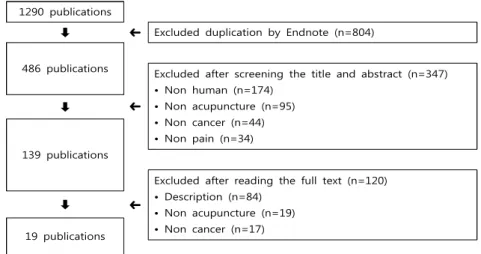
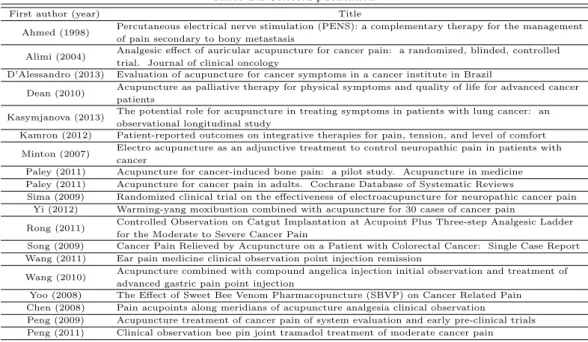
각 검색엔진에서 검색된 논문의 수는 Medline : 313, EMBASE : 614, CINAHL : 0, PsycInfo : 0, The Cochrane Library 2013 (Issue 7) : 59. Korean Studies Information : 40, DBPIA : 5, Korean Institute of Science and Technology Information (KISTI) : 10, KoreaMed : 5, the Korean National Assembly Library (KNAL) : 5, the Chinese Medical Database of the China Academic Journal (CNKI) : 51, NDSL : 188 편으로 검색되었다. 검색은 2014년 1월 기준으로 검색하였고 지금까지 발표 된모든 연구를 검색하였다. 이 중 중복되는 논문을 제외하고 총 486개의 논문을 본 연구와 관련된 논문 리스트로 작성을 하고 Endnote 로 정리하였다. 다음으로 486개의 논문 리스트 중 논문의 제목, 초록, 키워드를 확인하여 본 연구와 관련이 전혀 없는 것으로 판단되는 논문 347개를 제외하고 139개의 논문 에 대한 출력본 (Hard Capy)을 찾았다. 139개의 논문은 임상경력이 충분한 한의사 1명, 전문의 2명, 박사 1명이 검토를 하였고 결과를 종합하지 않고 내용을 나열해 놓은 논문이거나 사람을 대상으로 임상 시험하지 않은 논문 등은 삭제를 하고 최종적으로 19개의 논문이 본 연구에 선택되었다. 논문 선택은 Figure 2.1과 같이 진행되었으며 선택된 논문의 리스트는 Table 2.1과 같다.
1290 publications
Excluded duplication by Endnote (n=804) 486 publications
Excluded after screening the title and abstract (n=347)
• Non human (n=174)
• Non acupuncture (n=95)
• Non cancer (n=44)
• Non pain (n=34)
139 publications
Excluded after reading the full text (n=120)
• Description (n=84)
• Non acupuncture (n=19)
• Non cancer (n=17)
19 publications
Figure 2.1 Flow chart for the publication selection process
Table 2.1 Selected publication
First author (year) Title
Ahmed (1998) Percutaneous electrical nerve stimulation (PENS): a complementary therapy for the management of pain secondary to bony metastasis
Alimi (2004) Analgesic effect of auricular acupuncture for cancer pain: a randomized, blinded, controlled trial. Journal of clinical oncology
D’Alessandro (2013) Evaluation of acupuncture for cancer symptoms in a cancer institute in Brazil
Dean (2010) Acupuncture as palliative therapy for physical symptoms and quality of life for advanced cancer patients
Kasymjanova (2013) The potential role for acupuncture in treating symptoms in patients with lung cancer: an observational longitudinal study
Kamron (2012) Patient-reported outcomes on integrative therapies for pain, tension, and level of comfort Minton (2007) Electro acupuncture as an adjunctive treatment to control neuropathic pain in patients with
cancer
Paley (2011) Acupuncture for cancer-induced bone pain: a pilot study. Acupuncture in medicine Paley (2011) Acupuncture for cancer pain in adults. Cochrane Database of Systematic Reviews
Sima (2009) Randomized clinical trial on the effectiveness of electroacupuncture for neuropathic cancer pain Yi (2012) Warming-yang moxibustion combined with acupuncture for 30 cases of cancer pain
Rong (2011) Controlled Observation on Catgut Implantation at Acupoint Plus Three-step Analgesic Ladder for the Moderate to Severe Cancer Pain
Song (2009) Cancer Pain Relieved by Acupuncture on a Patient with Colorectal Cancer: Single Case Report Wang (2011) Ear pain medicine clinical observation point injection remission
Wang (2010) Acupuncture combined with compound angelica injection initial observation and treatment of advanced gastric pain point injection
Yoo (2008) The Effect of Sweet Bee Venom Pharmacopuncture (SBVP) on Cancer Related Pain Chen (2008) Pain acupoints along meridians of acupuncture analgesia clinical observation Peng (2009) Acupuncture treatment of cancer pain of system evaluation and early pre-clinical trials Peng (2011) Clinical observation bee pin joint tramadol treatment of moderate cancer pain
각 논문에서 조사된 자료는 일정한 형태의 코딩 폼을 통하여 수집하였으며, 연구대상자의 수, 중재 의 종류, 관측된 변수의 종류, 변수의 값, 관측시점 등을 수집하였다. 중재의 종류는 침치료, 침을 이용 한 통합치료, 침을 이용하지 않은 치료에 따라 treatment 군, mixed 군, control 군으로 총 3가지 군으 로 나누었으며 관측된변수의 종류는 통증과 관련된 변수와 비통증과 관련된 변수로 그룹화를 하였다.
VAS (Visual Analog Score), NRS (Numeric Rating Scale), NPS (Neuropathy Pain Scale), ESAS (Edmonton Symptom Assessment System Score), BPI (Brief Pain Inventory) 중 pain interference, severity 등은 통증과 관련된 변수로는 분류를 하였으며 SLDS (Satisfaction with Life Domains Scale), SCL (Symptom Checklist), RSC (Rotterdam Sympton Checklist), QOL (Quality of Life), 통증재 발시간, ACS, 진통재발시간, 전위차, PMS (Profile of Mood State) 중 anger, confusion, depression, fatigue, tension, total negative mood, vigor 등은 비통증과 관련된 변수로 분류하였다.
2.3. 효과크기 산출방법
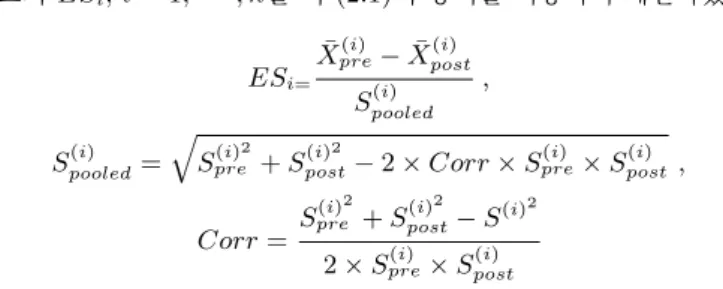
침, 침+다른 중재, 침 아닌 중재에 따라 침치료군, 침을 이용한 통합치료 군, 침을 사용하지 않은 치 료 군으로 총 3가지 군에 따라서 관측된 변수의 종류별로 중재 전과 후의 변화량에 대한 효과크기를 산 출하고자 한다. 관측된 변수의 값은 baseline과 일정시점이 지난 후의 값을 수집하였고 중재 전과 후의
변화량에 대한 효과크기 ESi, i = 1, · · · , n를 식 (2.1)의 공식을 이용하여 계산하였다.
ESi=
X¯pre(i) − ¯Xpost(i) Spooled(i)
,
Spooled(i) = q
Spre(i)2+ Spost(i)2 − 2 × Corr × S(i)pre× Spost(i) , (2.1)
Corr = Spre(i)2+ Spost(i)2 − S(i)2 2 × Spre(i) × S(i)post
여기서, barX(i)pre는 i번째 중재 전 관측된 변수의 평균 값, barX(i)post는 i번째 중재 후 관측된 변수의 평 균값, Spre(i)는 i번째 중재 전 관측된 변수의 표준편차 값, Spost(i) 는 i번째 중재 후 관측된 변수의 표준편차 값, S(i)는 i번째 관측된 변수의 변화량의 표준편차 값이나 각 연구에서 제시하지 않은 경우 다른 연구의 값으로 대체할 수 있다 (Kim 등, 2014).
다음으로 전체적인 효과크기 ES를 산출하기 위하여 식 (2.2)의 공식을 이용하여 계산하였다.
ES = Pn
i=1ESiwi
Pn i=1wi
, wi= 1
var(ESi) (2.2)
여기서, wi는 i번째 관측 값의 가중치를 의미한다.
3. 결과 및 해석
침, 침+다른 중재, 침 아닌 중재에 따라 침치료군, 침을 이용한 통합치료 군, 침을 사용하지 않은 치 료 군별 관측변수별 중재 전 후 변화량에 대한 효과크기는 Table 3.1과 같이 산출되었다.
Table 3.1 Result of effect size for each variable by 3 groups
Variable Group, ES (SD)
p-value Variable Group, ES (SD)
p-value
C M T C M T
non-pain 0.56 (0.75) 6.99 (1.82) 1.61 (0.27) 0.000*
C<T<M†
pain 2.31 (0.42) 3.07 (0.52) 2.86 (0.53) 0.519
Etc 6.61 (1.84) 13.69 (2.65) 0.10 (1.47) 0.000*
T<C<M†
Etc - - 5.59 (5.32) -
potential difference
0.09 (1.32) - 1.322 (2.04) 0.673 BPI - - 2.574 (0.102) -
Pain period 12.88 (5.11) 4.04 (4.09) 1.85 (2.62) 0.111 BPQ 2.69 (0.67) 3.52 (0.68) - 0.344 Pain recur
period
4.43 (2.79) 5.90 (4.39) 2.85 (2.74) 0.808 ESAS - - 3.50 (2.95) -
ACS - - 20.396 (0.74) - NPS 2.4 (5.75) - 1.88 (6.42) 0.959
ESAS - - 1.13 (0.93) - NRS 3.31 (0.76) 2.53 (0.77) 2.67 (1.79) 0.876
PMS - - 1.67 (0.52) - VAS 1.15 (0.81) 10.50 (3.12) 3.10 (0.72) 0.001*
C,T<M†
QOL -0.64 (1.71) - -1.57 (1,35) 0.722
RSC - - 2.63 (1,02) -
SCL 0.16 (2.52) - 0.82 (3.03) 0.895
SLDS - - -2.27 (1,06) -
C : Control, M : Mixed, T : Treatment
* : Statistically significant with p <0.05
†: Multiple comparison result by Scheffe
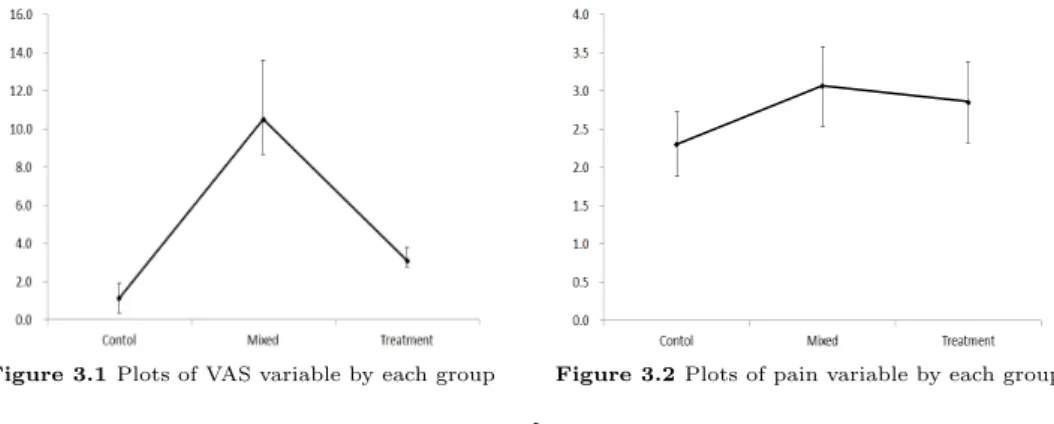
통증 중 VAS 관측변수에 대해서는 침을 사용하지 않은 치료 군, 침을 이용한 통합치료 군, 침치 료 군에서각각 VAS 변화량의 효과크기가 1.152, 10.504, 3.098로 통계적으로 유의한 차이를 보였으 며(p=0.001) 사후검정 결과 침을 사용하지 않은 치료군과 침 치료군은 유의한 차이를 보이지 않았으며 침을 이용한 통합치료 군과는 유의한 차이를 보였다 (Figure 3.1). 암성통증 환자에게 침치료 군은 VAS
변수에 대해서는 침을 사용하지 않은 치료군보다 1.946 만큼의 효과크기가 더 크게 나타났고, 침을 이용 한 통합치료 군은 침을 사용하지 않은 치료군보다 더 9.352 만큼의 효과크기가 크게 나타났다. VAS 변 수는 통증을 측정하는 대표적인 변수인 것으로 살펴볼 때 침을 이용한 통합치료가 다른 치료보다 암성통 증을 많이 해소해 줄 수 있는것으로 사료된다. 또한 통증 변수 전체에 대해서 살펴보면 침을 사용하지 않은 치료 군, 침을 이용한 통합치료 군, 침치료 군에서 각각 효과크기가 2.318, 3.075, 2.861로 통계적 으로 유의한 차이를보이지 않았으며 (p=0.519) 침을 사용하지 않은 치료군, 침치료군, 침을 이용한 통 합치료 군의 순서로 통증 변수 전체에서 차이를 보였다 (Figure 3.2). 통증 변수 전체에 대해서는, 침치 료 군은 침을 사용하지 않은 치료군보다 0.543 만큼의 효과크기가 크게 나타났고, 침을 이용한 통합치료 군은 침을 사용하지 않은 치료군보다 0.757 만큼의 효과크기가 크게 나타났다.
Figure 3.1 Plots of VAS variable by each group Figure 3.2 Plots of pain variable by each group
4. 결 론
통증으로 고생하는 환자들을 치료하는 방법으로 침이 많이 사용되고 있으며 특히 암으로 인해 통증을 격고 있는 환자들에게도 침치료를 많이 시행하고 있는 경향이라는 것을 관련논문 검색을 통하여 알 수 있었다. 통증과 가장 관련이 높은 변수인 VAS 변수에 대해서 살펴보면 침치료 환자가 침을 사용하지 않은 환자보다 VAS의 중재 전후 감소 정도가 높게 나타났고 침을 이용한 통합치료를 받은 경우 상대적 으로 상당히 많은감소 정도를 보였다. 따라서 침을 이용한 통합치료로 인하여 암성통증을 상당히 치료 할가능성이 높다는 것을 확인 할 수 있었다. 그러나 본 연구는 검색된 19편의 논문의 수량이 비교적 적 고 수집된 관측 변수명이 모든 군에서 수집되지 않아 비교를 할 수 없는 경우가 있어 이는 본 연구의 한 계점이라 할 수 있다. 또한 중재 후의 측정 시점이 다양하여 이를 종합하여 결과로 제시하지 못한 점 또 한본 연구의 한계점이라 할 수 있다.
References
Ahmed, H. E., Craig, W. F., White, P. F. and Huber, P. (1998). Percutaneous electrical nerve stimulation (PENS), a complementary therapy for the management of pain secondary to bony metastasis. The Clinical Journal of Pain, 14, 320-323.
Alimi, D., Rubino, C., Pichard, E., Fermand, S., Dubreuil, M. L. and Hill, C. (2004). Analgesic effect of auricular acupuncture for cancer pain: A randomized, blinded, controlled trial. Journal of the American Society of Clinical Oncology, 21, 4120-4126.
Chang, S. B., Lee, T. W., Kim, S., Yoo, I. Y., Kim, I. S., Kang, K. H., Lee, M. K. and Jang, Y. H. (2006). A study of complementary and alternative medicine used by cancer patients in Korea. Journal of Korean Academy of Adult Nursing, 18, 92-101.
Chen, Z. (2008). Pain acupoints along meridians of acupuncture analgesia clinical observation, Master Thesis, China Academy of Traditional.
D’Alessandro, E,, Brito, C., Cecatto, R., Saul, M., Atta, J. A. and Lin, C. A. (2013). Evaluation of
acupuncture for cancer symptoms in a cancer institute in Brazil. Acupuncture in Medicine, 31, 23-26.
Dean, C. E., Doherty, A. M., Keshaviah, A., Baker, F., Kaw, C., Lu, W., Manola, J., Penson, R. T., Matulonis, U. A. and Rosenthal, D. S. (2010). Acupuncture as palliative therapy for physical symptoms and quality of life for advanced cancer patients. Integrative Cancer Therapies, 9, 158-167.
Ernst, E. and Cassileth, B. R. (1998). The prevalence of complementary/alternative medicine in cancer a systemic review. Cancer , 83, 777-782.
Jeon, J. H., Yoon, J., Cho, C. K., Jung, I. C., Kim, S., Lee, S. H. and Yoo, H. S. (2015). Effect of acupuncture for radioactive-iodine-induced anorexia in thyroid cancer patients, a randomized, double blinded, sham controlled pilot study. Integrative Cancer Therapy, 14, 221-230.
Kasymjanova, G., Grossman, M., Tran, T., Jagoe, R. T., Cohen, V., Pepe, C., Small, D. and Agulnik, J. (2013). The potential role for acupuncture in treating symptoms in patients with lung cancer, an observational longitudinal study. Current Oncology, 20,152-157.
Kamron, K., Alan, S., Stephanie, L., Paige, W., Amie, B., Shelli, F., Cheary, H., George, C., Belen, M., MaryAnn,, D., Norman Z., Thomas, M. B. and Dan, S. Z. (2012). Patient-reported outcomes on integrative therapies for pain, tension, and level of comfort. Journal of Clinical Oncology, 30.
Kim, D. H., Jang, E. J. and Hwang, J. S. (2014). Meta analysis using R & WinBUGS , Freeacademy, Korea.
Lee, H. R. (2013). Management of non-pain symptoms in terminally ill cancer patients, based on national comprehensive cancer network guidelines. The Korean Journal of Hospice and Palliative Care, 16, 205-215.
Lee, J. S. (2011). Annual report of cancer statistics in Korea in 2011 , National Cancer Center, Korea.
Minton, O. and Higginson, I. J. (2007). Electroacupuncture as an adjunctive treatment to control neuro- pathic pain in patients with cancer. Journal of pain and symptom management , 33,115-117.
Paley, C. A. and Johnson, M. I. (2011). Acupuncture for cancer-induced bone pain, a pilot study. Journal of the British Medical Scupuncture Society, 29, 71-72.
Pale,y C. A., Johnson, M. I., Tashani ,O. A. and Bagnall, A. M. (2011). Acupuncture for cancer pain in adults,Cochrane Database of Systematic Reviews, John Wiley & Sons, Ltd, USA.
Patrick, D. L., Ferketich, S. L. and Frame, P. S. (2003). National Institutes of health state of the science conference statement, symptom management in cancer, pain, depression and fatigue. Journal of the National Cancer Institute, 95, 1110-1117.
Peng, H. (2009). Acupuncture treatment of cancer pain of system evaluation and early pre-clinical trials, Master Thesis, Changchun Institute.
Peng H. (2011). Clinical observation bee pin joint tramadol treatment of moderate cancer pain , Master D.
Thesis, Hunan University of Traditional Chinese Medicine.
Rong, Z., Jiang, Y., Yi, N., Chen, Y., Chen, X., Huang, Q., Xu, M. (2011). Controlled observation on catgut implantation at acupoint plus three-step analgesic ladder for the moderate to severe cancer pain. Journal of Chinese Medicine, 1, 101-103.
Seo, D. Y., Moon, O. R. and Lee, Y. H. (2001). A study on the cooperative practices of the oriental &
western medicine in Korea. The Journal of Namseoul University, 7, 445-468.
Shin, D. H., Lee, M. S., Park, J. H. and Lee Y. S. (2015). A meta analysis of the climate change impact on rice yield in South Korea. Journal of the Korean Data & Information Science Society, 26, 355-365.
Sima, L. and Yin, C. (2009). Randomized clinical trial on the effectiveness of electro acupuncture for neuropathic cancer pain. Annals of Oncology, 20, ii70.
Song, J., Jerng, U., Jeong, J., Park, J., Yoon, S. (2009). Cancer pain relieved by acupuncture on a patient with colorectal cancer, single case report. Journal of Korean Traditional Oncology, 14, 37-44.
Wang, Tianhua Q., Liang G., Mediate, Huang X., Chenxue Z., Li H., Yangyao L, Chenyin S., Shen Q.
and Huang Z. (2011). Pain medicine clinical observation point injection to alleviate ear. New Chinese Medicine, 01, 113-115.
Wang, S. Y., Hongbo, L. and Weifeng. (2010). Acupuncture combined with compound angelica injection initial observation and treatment of advanced gastric pain point injection. Chinese journal of cancer prevention and treatment , 18, 1487-1488.
Woo, K. S. and Shin, Y. J. (2014). A systematic review of studies using time series analysis of health and welfare in Korea. Journal of the Korean Data & Information Science Society, 25, 579-599.
Yi, G., Li, Z., Huang, R., Wei, S. and Chen, B. (2012). Warming-yang moxibustion combined with acupunc- ture for 30 cases of cancer pain. World Journal of acupuncture, 22, 41-44.
Yoo, H. S. and Kim, J. S. (2008). The effect of sweet bee venom pharmacopuncture (SBVP) on cancer related
pain, a randomized controlled trial and double blinded - pilot study. Journal of Pharmacopuncture,
11, 21-29.
2015, 26
(6)
,1327–1334
Study of comprehensive and integrative treatment using acupuncture for cancer pain through publication review
†
Sang Gyu Kwak
1
· Ki Cheul Sohn2
· Im Hee Shin3
· Sang Gyung Kim4
· Hyun-Jung Jung5
· A-Jin Lee6
· Yoon-Jeong Cho7
· Dal Ho Kim8
123467
Catholic University of Daegu, School of Medicine
5Daegu Haany University, College of Korean Medicine
8Kyungpook National University, Department of Statistics
Received 1 September 2015, revised 5 November 2015, accepted 9 November 2015
Abstract
Cancer pain is a very important factor in cancer patients refractory to drop the quality of life of cancer patients. The worldwide trend is an integrated effort by both the western medicine and korean traditional medicine of treatment increases to reduce cancer pain. There are many studies related to cancer pain through an integrated medicine approach. Many study was reported that acupuncture treatment is effective for fatigue, xerostomia, insomnia, anxiety and quality of life. However, despite the practical clinical effects and various case reports of acupuncture, many still disagree about the significance of an integrated treatment of pain reduction with acupuncture.
Therefore, we has identified that reduce effect of comprehensive and integrative treat- ment using acupuncture for cancer pain through publication review. And we evaluated effect of comprehensive and integrative treatment using acupuncture through summary of values in each publication.
Keywords: Acupuncture, cancer pain, comprehensive & integrative medicine, Korean traditional medicine, western medicine.
†
This study was supported by grant of Korea of Health & Welfare, Republic of Korea (Project No:
20-11-0-090-091-3000-3033-320).
1
Corresponding author: Professor, Department of Medical Statistics, School of Medicine, Catholic Uni- versity of Daegu, Daegu 705-718, Korea. E-mail: [email protected].
2
Professor, Department of Preventive Medicine, School of Medicine, Catholic University of Daegu, Daegu 705-718, Korea.
3
Professor, Department of Medical Statistics, School of Medicine, Catholic University of Daegu, Daegu 705-718, Korea.
4
Professor, Department of Laboratory Medicine, School of Medicine, Catholic University of Daegu, Daegu 705-718, Korea.
5
Professor, Department of Diagnostics College of Korean Medicine, Daegu Hanny University,Daegu 706-828, Korea
6
Professor, Department of Laboratory Medicine, School of Medicine, Catholic University of Daegu, Daegu 705-718, Korea.
7
Professor, Department of Family Medicine, School of Medicine, Catholic University of Daegu, Daegu 705-718, Korea.
8