임상연구의 고혈압 침치료법에 대한 고찰
정소영1, 박지은1, 김정은1, 김애란1, 최선미1
1한국한의학연구원 의료연구부 침구경락연구그룹
Original Article
Review of Acupuncture Treatment for Hypertension in Clinical Trials
So-Young Jung1, Ji-Eun Park1, Jung-Eun Kim1, Ae-Ran Kim1, Sun-Mi Choi1
1Acupuncture, Moxibustion & Meridian Research Group, Division of Medical Research, Korea Institute of Oriental Medicine Objectives: This study evaluated clinical trials of acupuncture treatment for hypertension and to assess their methodology and results.
Methods: Eight Korean databases and four international databases were searched for clinical trials of acupuncture treatment for hypertension up to June 2011. Study quality was assessed using the risk of bias (ROB) tool.
Results: Twenty-four trials of acupuncture for hypertension were included. There were 14 randomized and 1 non-randomized controlled trials and 9 before-after studies. The most frequently used acupuncture points were zsnli (ST36), qch (LI11), fngch (GB20), snynjio (SP06), snjin (LI03) and hgu (LI04). In more than half of the studies, needle retention time was 20~30 minutes. Compared to baseline, change of blood pressure after treatment was significant in all studies. However, the results of effect on blood pressure between acupuncture and control were not consistent.
Conclusions: There is insufficient evidence to suggest that acupuncture is an effective treatment for hypertension.
Further well-designed clinical trials will be required to evaluate the effects and safety of acupuncture treatment for hypertension.
Key Words : Hypertension, acupuncture, acupuncture points, clinical trial
⋅Received:4 October 2011 ⋅Revised:4 November 2011 ⋅Accepted:9 November 2011
⋅Correspondence to:최선미(Sun-Mi Choi)
대전시 유성구 유성대로 1672 한국한의학연구원 의료연구부 침구경락연구그룹
Tel:+82-42-868-9485, Fax:+82-42-863-9464, E-mail:[email protected] 서 론
최근 인구 고령화 현상이 심화되면서 국민들의 주요 질병 양상이 과거 급성기 질환 중심에서 고혈 압, 당뇨, 암, 뇌졸중 등 만성 퇴행성 질환으로 변화 하고 있으며, 이러한 변화에 부응하기 위한 노력으 로 종전의 급성 질환 치료를 위한 양방 의료기관의 이용 못지않게 한방을 포함한 보완 대체의료에 대한 필요성이 증대되고 있다1).
이 중 고혈압은 만성 순환기계 질환 중 발생빈도 가 매우 높고 뇌중풍, 심부전, 관상동맥질환 등의 합
병증을 유발할 수 있어 이에 대한 적극적 관리와 치 료가 중요한 질환이다2). 미국 제 7차 합동 위원회 (Joint National Committee on Detection Pressure, JNC-VII)의 보고에 의하면 120mmHg/80mmHg 미 만인 경우를 정상으로 분류하고, 120~139mmHg/80~
89mmHg에 속하는 경우를 전고혈압, 140mmHg/
90mmHg 이상인 경우를 고혈압으로 분류한다2). 2002년 세계보건기구(World Health Organization, WHO)에서는 전 세계 고혈압 유병인구는 10억이 넘고, 매년 7백만의 사람들이 고혈압으로 인해 조기 사망한다고 보고하였다3). 또한, 전 세계적으로 25 %
이상이 고혈압 환자로, 이는 점점 증가할 것으로 보 이며4), 한국인은 30세 이상의 32 %, 65세 이상의 65 %가 고혈압으로 진단되었다5). 약물치료 및 생활 방식의 변화 등이 본태성 고혈압에 효과가 있다고 밝혀져 있지만6-8), 치료에 대한 환자의 낮은 순응도, 의료관리에 대한 접근이 어려운 점, 혹은 경제적 부 담 때문에 적절히 조절 및 관리되지 않는 비율이 높 다9)는 점이 한계점으로 지적된다.
침은 한국 뿐 아니라, 중국, 일본에서도 오래 전 부터 사용되어 왔고, 서양에서도 최근 보완대체의학 으로 그 사용범위가 넓어지고 있는 실정이다. 침치 료는 고혈압에 대해 잠재적인 효과가 있는 대안적인 치료로 제시되고 있고, 고혈압에 대한 침의 치료효 과를 증명하는 연구는 정상인을 대상으로 하여 기전 을 밝히는 연구부터, 임상연구까지 꾸준히 이루어지 고 있다. 하지만 고혈압에 대한 침치료의 효과를 뒷 받침할 엄격한 과학적인 근거는 아직 부족한 실정이 다. 혈압을 낮추는 것에 대한 혹은 고혈압에 대한 침치료의 효과는 기존의 체계적 문헌고찰 (systematic review: SR)을 통해서 연구된 바 있다. 그러나 두 편의 SR에 포함된 임상연구가 양적, 그리고 질적으로 미흡 한 수준으로 확고한 결론을 내리지 못하고 있다10,11).
고혈압에 대한 침치료 임상연구를 살펴보면, 침치 료 혈위부터 자극법, 변증여부까지 굉장히 다양하게 이루어지고 있는 것을 알 수 있는데, 이러한 다양한 침치료 법을 모두 묶어 효과를 논하기에는 어려움이 있어 보인다. 고혈압에 대한 침치료의 효과를 결론 짓기 전에, 우선 기존의 고혈압 침 연구들이 어떠한 대상과 평가변수를 가지고 어떠한 치료법으로 접근 하였는지 살펴볼 필요가 있다.
그래서 본 연구에서는 무작위대조군 임상연구 (randomized controlled trial: RCT)에 국한하지 않 고, 비무작위 대조군 임상연구 (non-randomized con- trolled trials), 전후비교연구 (before-after study) 등 모든 형태의 임상연구를 대상으로, 고혈압에 대한 침치료가 어떻게 이루어졌는지에 중점을 두고 살펴 보고자 한다. 이는 임상에서 다양한 대상자 및 평가 변수를 반영하여 고혈압에 대한 침치료의 근거를 판
단할 때 도움을 줄 뿐만 아니라, 향후 과학적이고 체계적인 RCT를 수행하는데 기초자료로 활용할 수 있을 것이다.
연 구 방 법
본 연구는 검색된 논문들의 연구 결과들을 종합 하여 비교분석하는 체계적 고찰 기법을 사용하였다.
임상시험은 근거중심의학 (evidence based medicine:
EBM)에 있어서 합리적인 근거를 제시하기 위해 최 근 많이 시행되고 있으며, 양질의 임상시험을 모아 더욱 신뢰할 만한 결론을 제시하는 것이 체계적 고 찰이다12).
각 데이터베이스의 자료제공일로부터 2011년 6 월까지 출판된 논문을 대상으로‘acupuncture’ and
‘hypertension’or 'blood pressure'를 검색어로 설정하 여 검색하였고, 8건의 국내검색엔진 (DBPIA, 국회 도서관, 학술정보서비스, 국립중앙도서관, 학술데이 터서비스검색사이트, 침구학회지, 한의학회지, NSDL논문)과 4건의 국외검색엔진 (Pubmed, Cochrane, Ovid, Web of Science)을 대상으로 조사 하였다. 또한 검색된 원문의 참고문헌 및 관련된 원 문 역시 필요시 추적하여 수기 검색하였다.
1. 국내 DB와 해외 DB에서 찾은 고혈압에 대한 무작위 대조군 연구, 비무작위 대조군 연구, 증 례연구, 포스터까지 모두 포함하여 고혈압에 대해 이루어진 침치료 방법 및 혈자리를 고찰 하였다.
2. 검색된 논문 및 관련저널의 참고문헌 등을 수 기검색 하였다.
3. 검색된 논문들의 원문에서 본태성 고혈압에 대한 임상연구나 증례보고, 치료법으로 침이나 전침을 이용 (단독으로 쓰인 경우와 병용된 경 우 모두 포함)한 논문 중 영어나 한국어로 쓰 인 논문을 조사하였고, 초록만 제공되는 경우 라도 본 분석에 필요한 정보가 포함되어 있을 경우 선정하였다.
4. 동물 실험, 이침, 레이저 침, 전극, 사혈침, 침 과 다른 약물을 병행한 경우, 고혈압 외에 다 른 질환자가 대상자에 포함된 경우, 정상인을 대상으로 혈압에 미치는 영향을 보기 위한 기 전 연구는 제외하였다.
5. 모든 논문은 대상기준, 치료방법, 평가도구, 결 과 등을 정리하여 임상시험 대상자, 시험군과 대조군 형태, 평가변수, 혈자리, 자극의 방법, 치료횟수와 기간 등에 대하여 조사 분석하였 다. 윤리적인 측면을 살펴보기 위해 임상시험 연구윤리심사위원회 (institutional review board: IRB)의 승인 여부와 동의서 작성여부를 검토하였으며, 선정된 연구의 질 평가는 The Cochrane collaboration’s tool for Risk of Bias (ROB)로 하였다. ROB Tool은 특정중재법의 효과 및 안전성을 평가하기 위하여 제안된 도 구를 적용하여 근거의 비뚤림 유입 위험성을 평가한 결과를 표로써 제시한 것으로13), Random Sequence Generation, Allocation Concealment, Blinding of Participants and Personnel, Blinding of Outcome Assessment, Incomplete Outcome Data, Selective Reporting, Other Bias에 대한 7가지 항목으로 이루어져 있다. 이 중 Selective Reporting과 Other Bias는 대부분의 연구에서 판단근거가 충분하지 않아 이 두 항목을 제외 한 5가지 항목으로 평가했다. 각 항목에 대한 평가는 Low Risk of Bias (적절한 방법에 의해 진행되었고 논문에 언급), High Risk of Bias (시행하지 않았거나 부적절한 방법을 사용하 였을 경우), Unclear Risk of Bias(언급이 없거 나 모호하게 표현)로서 각 문헌의 비뚤림 위험 을 표기하였다.
결 과
1. 논문 검색 결과
최종 분석에 포함된 24편의 논문 중 무작위 대조 군 임상연구가 14건, 비무작위 대조군 임상연구 1
건, 전후비교연구가 9건이었다. 분석된 논문중 cross- over 연구가 2건14,15)이 포함되었는데 이는 RCT 연 구에 포함시켰다. Before-after study 중 2건16,17)의 연구는 정상인과 고혈압 환자를 별도로 구분하여 침 치료 전후의 변화를 분석했기 때문에, 본 연구에서 는 고혈압 환자의 데이터만을 추출하여 Before-after study에 포함시켰다.
2. 분석 결과
1) 질환 대상자별 분류
고혈압을 대상자로 한 전체 24건 중 4건에서는 전단계 고혈압도 포함하였다. 전체 24건 중 7건에서 는 대상자의 혈압기준에 대해 명확한 수치를 제시하 였고, 4건에서는 stage로 제시하였다.
2) 시험군과 대조군 설정
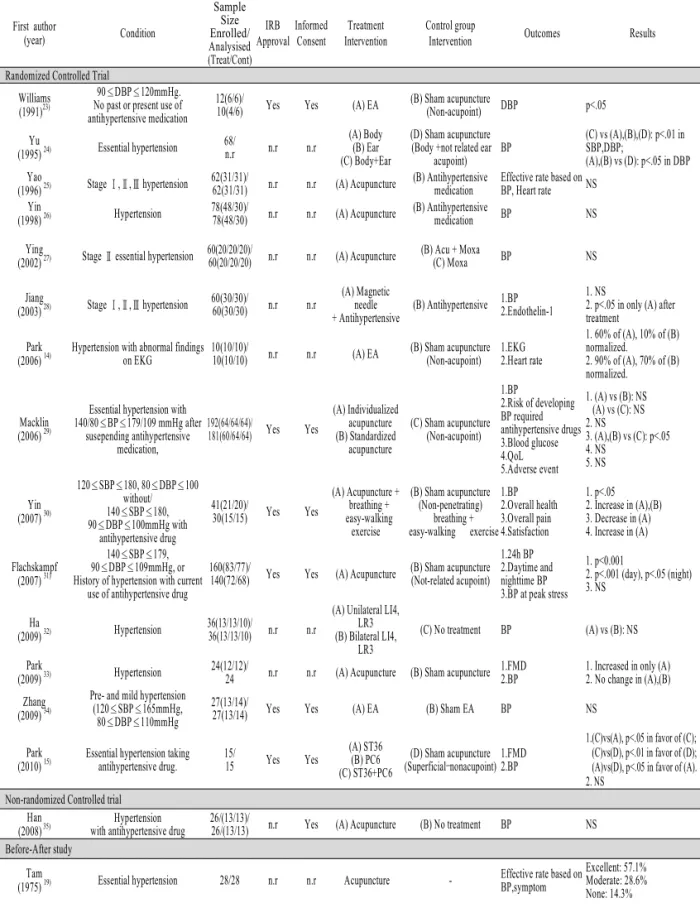
시험군과 대조군 설정에 관해 분석한 결과 시험 군에서는 24편의 논문 중 2편을 제외하고는 모두 침 치료만 시행하였는데, 22건의 침치료 중 4건에서는 전침을 사용하였다. 침치료를 하지 않았던 2편 중에 서 1건은 침과 함께 혈압약을 사용했고, 다른 1건에 서는 호흡요법 및 운동을 병행하였다. 또 4건의 연 구에서는 체침과 이침, individualized acupuncture와 standardized acupuncture, 혈자리 등을 다르게 하여 이를 비교하였다. 대조군을 사용한 15건 중 거짓침 (Sham acupuncture)은 9건, 혈압약을 사용한 경우는 3건, 무처치가 2건이었고, 나머지 1건에서는 뜸을 대조군으로 사용하였다. 거짓침에는 비경혈 자극 (non-acupoint)이 4건으로 가장 많았고, 경혈 중 관 련없는 혈자리를 사용한 경우가 2건, 비침습 침을 사용한 경우와 거짓 전침이 각각 1건이었다. 1건에 서는 거짓침에 대해 자세한 기술이 되어있지 않았다 (Table 1).
3) 평가변수
24편의 논문 중 22편의 논문에서는 모두 평가변 수로 blood pressure(BP)를 사용하였고, 나머지 2편 에서는 심전도기록 (Electrocardiography)와 Second
First author
(year) Condition
Sample Size Enrolled/
Analysised (Treat/Cont)
IRB Approval
Informed Consent
Treatment Intervention
Control group
Intervention Outcomes Results
Randomized Controlled Trial Williams
(1991)23)
90≤DBP≤120mmHg.
No past or present use of antihypertensive medication
12(6/6)/
10(4/6) Yes Yes (A) EA (B) Sham acupuncture
(Non-acupoint) DBP p<.05 Yu
(1995) 24) Essential hypertension 68/
n.r n.r n.r
(A) Body (B) Ear (C) Body+Ear
(D) Sham acupuncture (Body +not related ear
acupoint) BP
(C) vs (A),(B),(D): p<.01 in SBP,DBP;
(A),(B) vs (D): p<.05 in DBP Yao
(1996) 25) Stage Ⅰ,Ⅱ,Ⅲ hypertension 62(31/31)/
62(31/31) n.r n.r (A) Acupuncture (B) Antihypertensive medication
Effective rate based on BP, Heart rate NS Yin
(1998) 26) Hypertension 78(48/30)/
78(48/30) n.r n.r (A) Acupuncture (B) Antihypertensive
medication BP NS
Ying
(2002) 27) Stage Ⅱ essential hypertension 60(20/20/20)/
60(20/20/20) n.r n.r (A) Acupuncture (B) Acu + Moxa
(C) Moxa BP NS
Jiang
(2003) 28) Stage Ⅰ,Ⅱ,Ⅲ hypertension 60(30/30)/
60(30/30) n.r n.r
(A) Magnetic needle + Antihypertensive
(B) Antihypertensive 1.BP 2.Endothelin-1
1. NS
2. p<.05 in only (A) after treatment
Park (2006) 14)
Hypertension with abnormal findings on EKG
10(10/10)/
10(10/10) n.r n.r (A) EA (B) Sham acupuncture (Non-acupoint)
1.EKG 2.Heart rate
1. 60% of (A), 10% of (B) normalized.
2. 90% of (A), 70% of (B) normalized.
Macklin (2006) 29)
Essential hypertension with 140/80≤BP≤179/109 mmHg after
susepending antihypertensive medication,
192(64/64/64)/
181(60/64/64) Yes Yes
(A) Individualized acupuncture (B) Standardized
acupuncture
(C) Sham acupuncture (Non-acupoint)
1.BP
2.Risk of developing BP required antihypertensive drugs 3.Blood glucose 4.QoL 5.Adverse event
1. (A) vs (B): NS (A) vs (C): NS 2. NS
3. (A),(B) vs (C): p<.05 4. NS
5. NS
Yin (2007) 30)
120≤SBP≤180, 80≤DBP≤100 without/
140≤SBP≤180, 90≤DBP≤100mmHg with
antihypertensive drug
41(21/20)/
30(15/15) Yes Yes
(A) Acupuncture + breathing + easy-walking
exercise
(B) Sham acupuncture (Non-penetrating)
breathing + easy-walking exercise
1.BP 2.Overall health 3.Overall pain 4.Satisfaction
1. p<.05 2. Increase in (A),(B) 3. Decrease in (A) 4. Increase in (A) Flachskampf
(2007) 31)
140≤SBP≤179, 90≤DBP≤109mmHg, or History of hypertension with current
use of antihypertensive drug
160(83/77)/
140(72/68) Yes Yes (A) Acupuncture (B) Sham acupuncture (Not-related acupoint)
1.24h BP 2.Daytime and nighttime BP 3.BP at peak stress
1. p<0.001
2. p<.001 (day), p<.05 (night) 3. NS
Ha
(2009) 32) Hypertension 36(13/13/10)/
36(13/13/10) n.r n.r
(A) Unilateral LI4, LR3 (B) Bilateral LI4,
LR3
(C) No treatment BP (A) vs (B): NS Park
(2009) 33) Hypertension 24(12/12)/
24 n.r n.r (A) Acupuncture (B) Sham acupuncture 1.FMD 2.BP
1. Increased in only (A) 2. No change in (A),(B) Zhang
(2009) 34)
Pre- and mild hypertension (120≤SBP≤165mmHg,
80≤DBP≤110mmHg
27(13/14)/
27(13/14) Yes Yes (A) EA (B) Sham EA BP NS
Park (2010) 15)
Essential hypertension taking antihypertensive drug.
15/
15 Yes Yes
(A) ST36 (B) PC6 (C) ST36+PC6
(D) Sham acupuncture (Superficial–nonacupoint)
1.FMD 2.BP
1.(C)vs(A), p<.05 in favor of (C);
(C)vs(D), p<.01 in favor of (D);
(A)vs(D), p<.05 in favor of (A).
2. NS Non-randomized Controlled trial
Han (2008) 35)
Hypertension
with antihypertensive drug 26/(13/13)/
26/(13/13) n.r Yes (A) Acupuncture (B) No treatment BP NS Before-After study
Tam
(1975) 19) Essential hypertension 28/28 n.r n.r Acupuncture - Effective rate based on BP,symptom
Excellent: 57.1%
Moderate: 28.6%
None: 14.3%
Table 1. Characteristics of Article of Acupuncture for Hypertension
Sugioka
(1977) 20) Essential hypertension 8/n.r n.r Yes Acupuncture -
1.BP 2.Pulse 3.Catecholamines, DBH, renin activity
1. NS 2. NS 3. NS Ionescu-Tirgoviste
(1978) 36) Essential hypertension 94/94 n.r n.r Acupuncture - BP Decrease 23-36mmHg in SBP,
and 3-10mmHg in DBP
Chiu
(1994) 37) Hypertension 50/n.r n.r n.r Acupuncture -
1. BP 2. Heart rate 3. Renin activity 4. Cortisol, sodium,potassium, osmolality,hematocrit
1. p<.01 2. p<.01 3. p<.01 4. NS
Chiu (1997) 16)
Essential hypertension 50/n.r n.r Yes Acupuncture -
1. BP 2. Heart Rate 3. Renin activity 4. Vasopressin, Cortisol
p<0.01 p<0.01 p<.01 NS
Robinson (2004) 18) Normal to stage 1 hypertension n.r n.r n.r EA -
BP 2. 24hr BP 3. Sympathetic nerve traffic
Decrease 4mmHg in SBP, not decrease in DBP NS Decrease Han
(2006) 38)
120≤SBP≤139mmHg 80≤DBP≤89mmHg.
Essential hypertension 14/14 n.r Yes Acupuncture -
1.BP 2.Pulse 3.QOL
p<0.05 in SBP, DBP NS
NS Han
(2006) 39)
120≤SBP≤139mmHg 80≤DBP≤89mmHg Essential hypertension
30/30 n.r Yes Acupuncture - BP
Pulse
p<0.001 in SBP, DBP NS
Rivas
(2007) 17) Untreated hypertension. 25/n.r Yes Yes Acupuncture -
1. SDDVPAI 2. B:A ratio 3. D:A ratio
p<.05 p<.05 p<.05
*AI: Aging Index, B:A: Ratio of the absolute value of the height of the ‘b’ wave to that of the ‘a’ wave, D:A ratio: Ratio of the absolute value of the height of the ‘d’ wave to that of the ‘a’ wave, DBH: Dopamine Beta-Hydroxylase activity, EA: Electrical Acupuncture, EKG: Electrocardiography, FMD:
Flow-Medicated Dilation, IRB: Institutional Review Board, NS: Not significant, n.r: not reported, SDDVP: Second Derivative of Digital volume pulse, QoL:
Quality of Life
derivative of digital volume pulse를 평가변수로 사 용하였다. 혈압 외의 평가변수로는 7편에서 맥박을 사용하였고, 2편에서 혈관확장반응 (FMD:Flow-medi- ated dilation)을 사용하였으며, 그 외 카테콜라민과 같은 혈압관련 호르몬, 증상의 개선, 삶의 질 등이 사용되었다.
4) 혈자리
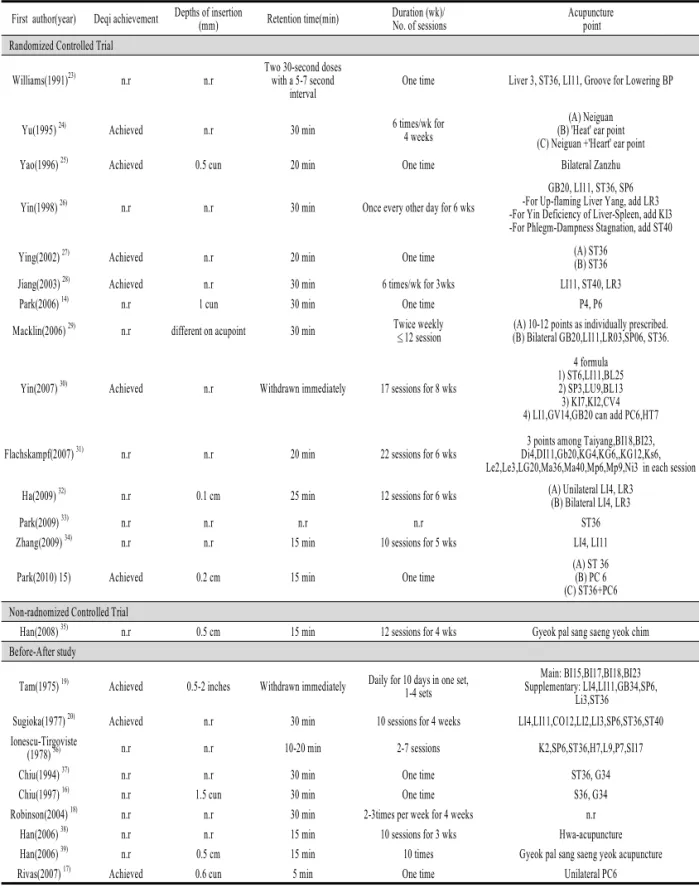
논문에서 제시한 혈자리를 분석해 보면 1편18)를 제외한 23편에서 구체적인 혈자리를 제시하였는데, 가장 빈용된 혈자리는 족삼리(ST36)가 11편, 곡지 (LI11) 7편, 풍지(GB20)와 삼음교(SP06)가 4편, 삼 간(LI03)과 합곡(LI04)이 3편으로 나타났다. 이것은 기본 혈자리만 분석한 것으로 피험자에 따라 추가되 는 각각의 혈자리는 제외하였다(Table 2).
5) 자극의 방법
피험자나 시술자가 득기를 느끼거나, 혹은 soreness,
numbness 등 득기감으로 여겨지는 감각을 느낄 때 까지 침자극을 했다고 기술한 논문은 24편 중 9편 (37.5%)이였고, 나머지 논문에서는 득기를 언급하지 않았다. 자침 깊이는 5mm~2inch로 다양하였으며 언 급하지 않은 논문들도 많았다. 유침 시간은 논문의 13편(54.2%)에서 20~30분 정도였으며, 5~20분 이하 가 7편(29.2%), 나머지 4편(16.7%)에서 간헐적으로 또는 유침 시간을 기술하지 않았다.
6) 치료 횟수와 기간
치료 횟수는 1회 침치료 한 경우부터 최대 22회 까지 시행하여 다양하였으며, 1회인 경우가 8편 (33.3%)로 가장 많았고, 4편(16.7%)에서 10회, 6회 와 12회가 각각 3편씩 (12.5%)나타났다. 치료횟수와 기간이 기술된 13편의 논문을 살펴보았을 때, 치료 기간이 4주와 6주인 연구가 각각 4편(30.8%)으로 가장 많았고, 그 외의 논문에서는 3주에서 8주까지 다양하였다. 치료빈도를 살펴보면 평균적으로 주 2
First author(year) Deqi achievement Depths of insertion
(mm) Retention time(min) Duration (wk)/
No. of sessions
Acupuncture point Randomized Controlled Trial
Williams(1991)23) n.r n.r
Two 30-second doses with a 5-7 second
interval
One time Liver 3, ST36, LI11, Groove for Lowering BP
Yu(1995) 24) Achieved n.r 30 min 6 times/wk for
4 weeks
(A) Neiguan (B) 'Heat' ear point (C) Neiguan +'Heart' ear point
Yao(1996) 25) Achieved 0.5 cun 20 min One time Bilateral Zanzhu
Yin(1998) 26) n.r n.r 30 min Once every other day for 6 wks
GB20, LI11, ST36, SP6 -For Up-flaming Liver Yang, add LR3 -For Yin Deficiency of Liver-Spleen, add KI3 -For Phlegm-Dampness Stagnation, add ST40
Ying(2002) 27) Achieved n.r 20 min One time (A) ST36
(B) ST36
Jiang(2003) 28) Achieved n.r 30 min 6 times/wk for 3wks LI11, ST40, LR3
Park(2006) 14) n.r 1 cun 30 min One time P4, P6
Macklin(2006) 29) n.r different on acupoint 30 min Twice weekly
≤12 session (A) 10-12 points as individually prescribed.
(B) Bilateral GB20,LI11,LR03,SP06, ST36.
Yin(2007) 30) Achieved n.r Withdrawn immediately 17 sessions for 8 wks
4 formula 1) ST6,LI11,BL25 2) SP3,LU9,BL13 3) KI7,KI2,CV4 4) LI1,GV14,GB20 can add PC6,HT7
Flachskampf(2007) 31) n.r n.r 20 min 22 sessions for 6 wks
3 points among Taiyang,BI18,BI23, Di4,DI11,Gb20,KG4,KG6,,KG12,Ks6, Le2,Le3,LG20,Ma36,Ma40,Mp6,Mp9,Ni3 in each session
Ha(2009) 32) n.r 0.1 cm 25 min 12 sessions for 6 wks (A) Unilateral LI4, LR3
(B) Bilateral LI4, LR3
Park(2009) 33) n.r n.r n.r n.r ST36
Zhang(2009) 34) n.r n.r 15 min 10 sessions for 5 wks LI4, LI11
Park(2010) 15) Achieved 0.2 cm 15 min One time
(A) ST 36 (B) PC 6 (C) ST36+PC6 Non-radnomized Controlled Trial
Han(2008) 35) n.r 0.5 cm 15 min 12 sessions for 4 wks Gyeok pal sang saeng yeok chim
Before-After study
Tam(1975) 19) Achieved 0.5-2 inches Withdrawn immediately Daily for 10 days in one set, 1-4 sets
Main: BI15,BI17,BI18,BI23 Supplementary: LI4,LI11,GB34,SP6,
Li3,ST36 Sugioka(1977) 20) Achieved n.r 30 min 10 sessions for 4 weeks LI4,LI11,CO12,LI2,LI3,SP6,ST36,ST40 Ionescu-Tirgoviste
(1978) 36) n.r n.r 10-20 min 2-7 sessions K2,SP6,ST36,H7,L9,P7,SI17
Chiu(1994) 37) n.r n.r 30 min One time ST36, G34
Chiu(1997) 16) n.r 1.5 cun 30 min One time S36, G34
Robinson(2004) 18) n.r n.r 30 min 2-3times per week for 4 weeks n.r
Han(2006) 38) n.r n.r 15 min 10 sessions for 3 wks Hwa-acupuncture
Han(2006) 39) n.r 0.5 cm 15 min 10 times Gyeok pal sang saeng yeok acupuncture
Rivas(2007) 17) Achieved 0.6 cun 5 min One time Unilateral PC6
*n.r: not reported.
Table 2. Methods of Stimulation and Acupuncture Point used in the Trials of Acupuncture for Hypertension
회 치료한 경우가 13편 중 9편(69.2%)로 가장 많았 다. 3주 치료한 2건의 연구 중 1건에서는 유의한 혈 압변화가 나타나지 않았는데, 4주와 6주 치료한 경 우에서도 모두 4건 중 3건에서 혈압변화가 유의하 지 않았다. 8주 치료한 경우는 결과가 유의하게 나 타났으나 1건에 불과하여, 치료기간과 혈압변화와의 관련성을 파악하기는 어려웠다.
7) 침 치료 효과
본 연구에 포함된 무작위 대조군 임상연구 중에 서 치료군과 대조군 간의 치료효과 차이를 p-값을 사용하여 보고한 13편의 논문 중 4편에서 치료군이 대조군에 대해 유의한 효과를 나타내었다. 거짓침을 대조군으로 사용한 9건의 연구 중 2건에서는 군간 유의한 차이가 나타나지 않았지만, 나머지 7건에서 는 대조군보다 유의하게 혹은 대조군에 비해 큰 혈 압강하효과가 나타났다. 그러나 혈압약 대조군을 사 용한 연구와 무처치 대조군을 사용한 연구에서는 모 두 치료군과 대조군의 혈압강하효과가 유의하게 나 타나지 않았다. 비무작위 대조군 연구 1편에서는 유 의성을 보이지 않았으며, 전후비교연구 중 p-값을 보고한 6편의 논문 중 5편에서 유의한 효과를 나타 내었다.
8) 윤리심사위원회(IRB) 승인과 동의서 작성 여부 24편의 논문 중 IRB 승인과 동의서 작성 여부를 기록한 논문은 7편(29.2%)이고, 동의서 작성만 받은 논문은 5편(20.8%), 둘 다 기록하지 않은 논문은 12 편(50%)으로 전체의 반을 차지하였다. 기록하지 않 은 논문들 중 IRB 승인과 동의서 작성을 하였지만 단지 논문에 기술하지 않았는지, 아니면 실제 수행 을 하지 않았는지에 대해서는 정확히 알 수는 없다.
본 연구에 포함된 논문들의 편수가 적어 정확한 판 단을 하기는 어렵지만 최근 임상연구 수행에서 IRB 승인과 동의서 작성 등 연구윤리에 관련된 항목을 준수한 연구가 증가되고 있는 실정이어도 아직도 상 당수의 임상연구에서 기본적인 연구윤리항목에 대 하여 고려하고 있지 않는 것으로 파악된다.
9) ROB Tool을 이용한 평가 결과
5가지 항목 중 incomplete outcome data에서 low risk of bias가 14건의 RCT 중 10건으로 가장 많은 비율의 논문에서 적절하게 시행된 것으로 나타났으 며, random sequence generation에서는 4건의 연구 가 low risk, 1건의 연구가 high risk로, allocation concealment에서는 3건의 연구가 low risk, 2건의 연 구가 high risk로 평가되었다. Blinding of partici- pants and personnel에서는 8건의 연구가 low risk, 5 건의 연구가 high risk로, blinding of outcome assessment에서는 5건의 연구가 low risk, 2건의 연 구가 high risk로 평가되었다. 각 임상연구에 대한 평가 결과는 다음과 같다(Table 3).
고찰 및 결론
본 연구에 포함된 대부분의 before-after study는 중도탈락자의 인원이나 이유가 기술되지 않아서, 실 제로 분석에 포함된 sample 수를 정확히 파악하기 힘들다. 또한 분석 대상 논문들이 방법론적으로 질 이 낮거나 불충분한 보고를 함으로써 본 분석결과에 영향을 미쳤을 수도 있다. 이는 본 연구의 ROB 평 가에서 unclear로 기술된 항목이 많은 것에서도 확 인할 수 있는데, 향후 다양한 체계적 고찰 및 이를 위한 풍부하고 질 높은 임상연구의 수행이 절실하 다. 또한 연구에 대한 결과를 보고할 때에도 방법론 적인 측면에 대해 구체적인 기술을 해야한다.
모든 치료법은 그 근거가 지속적으로 개발되고 평가됨에 따라 달라지기 마련이다. 그래서 선행연구 를 고찰할 때도 오래 전의 치료법은 설득력이 떨어 지기 마련이지만, 본 연구에서 나타난 고혈압에 대 한 침치료 방법은 혈자리나 자극방법, 유침 시간 등 에서도 많은 변화를 나타내지 않았다. 이는 한의학 치료방법의 토대가 되는 이론이 변하지 않기 때문이 라 여겨진다. 다만 침치료 방법을 검증하기 위한 디 자인이나 방법론적인 측면은 더 엄격하고, 정밀해지 고 있다. 따라서 고혈압 침치료법의 신뢰성있는 효 과 검증을 위해서는 향후 더 많은 대규모 RCT가 필
First author (year)
Random sequence generation
Allocation concealment
Blinding of participants and
personnel
Blinding of outcome assessment
Incomplete outcome data Randomized Controlled Trial
Williams(1991)23) Low Unclear Low Low Low
Yu(1995) 24) Unclear Unclear Low Unclear Unclear
Yao(1996) 25) Unclear Unclear High Unclear Low
Yin(1998) 26) Unclear Unclear High Unclear Low
Ying(2002) 27) Unclear Unclear High Unclear Low
Jiang(2003) 28) Unclear Unclear High Unclear Low
Park(2006) 14) High High Unclear High Low
Macklin(2006) 29) Low Low Low Low Unclear
Yin(2007) 30) Low Unclear Low Low Low
Flachskampf
(2007) 31) Unclear Low Low Unclear Low
Ha(2009) 32) Unclear Unclear High High Unclear
Park(2009) 33) Unclear Unclear Low Unclear Unclear
Zhang(2009) 34) Low High Low Low Low
Park(2010) 15) Unclear Low Low Low Low
Non-randomized Controlled trials
Han(2008) 36) - - High Unclear Low
* High : High risk of bias, Low : Low risk of bias, Unclear : Unclear risk of bias Table 3. Quality Scores for Included Article by Risk of Bias
요할 것이다.
본태성 고혈압이라도 현재 혹은 과거에 혈압약을 복용한 사람을 포함시키는 연구가 있는가 하면, 제 외시킨 연구도 있었다. 또 대상자의 stage 혹은 혈압 분포 역시 연구마다 다르게 선정되었는데, Tam19)의 연구에서는 유병기간이 짧을수록 침치료가 보다 만 족스러운 결과를 나타내었다고 보고하였다. 이렇듯 같은 고혈압이라도 약의 복용유무나 유병기간, 증상 의 정도가 다르게 나타나므로, 침치료가 어떠한 특 징을 가진 환자군에서 효과적인지, 혹은 집단에 따 라 다른 침치료법이 필요한지에 대한 추가적인 연구 가 필요할 것이다. 또한 Tam19)의 연구는 변증을 사 용하였는데, 주요 혈자리를 4개, 보조혈자리를 6개 선정하여, 신경불안, 두통, 불면증, 심계항진 등 정 신적인 증상유무와 이완기혈압의 수준을 보고 혈자 리 선정을 달리하였다. Sugioka20)의 경우에서도 고 혈압에 효과적인 혈자리를 선정한 후 이를 5개의 침
치료법으로 조합하여, 이를 순서에 따라 사용하여 효과를 비교하였다. 이처럼 개개인의 특성을 고려한 개별화된 침 처방이나 변증은 한의학의 중요한 특성 이므로 이를 반영한 임상연구가 향후에도 이루어져 야 할 것이다.
본 연구에 포함된 연구들은 보면 Park15)의 연구 결과는 침치료가 고혈압 환자에게서 내피기능부전 (endothelial disfunction)을 개선시킨다고 보고한바 있고, 내피의 산화질소 (endothelial notric oxide)의 생성을 강화시킨다는 연구결과도 제시된 바 있다21). 또한 혈압을 낮추는 기전으로 교감신경활성 (sym- pathetic activity)을 감소시킨다는 연구결과도 있는 데22), 침치료를 통한 혈압강하효과를 증명하는 임상 연구와 함께, 기전에 대한 연구도 같이 이루어져야 침의 고혈압 치료효과에 대한 과학적인 신뢰도를 높 일 수 있을 것이라 사료된다.
본 연구 논문들의 ROB 평가 결과 모든 논문에
서 high risk of bias나 unclear risk of bias가 각각 하나 이상 있었다. 영역별로는 blinding of participants 와 incomplete outcome data 이외의 다른 영역에서 는 low risk of bias의 비율이 50%를 넘지 않았다(21∼ 36%). 추후 임상연구 계획시 비뚤림을 최소화하도 록 설계하는 노력이 필요할 것이다.
본 연구결과를 보았을 때 대조군으로 거짓침을 사용한 경우 결과가 유의하게 나타나는 경우가 많았 으나, 포함된 선행연구 수가 적어서 적절한 대조군 이나 평가변수, 치료기간 등을 제시하기에는 부족하 여, 본 연구의 결과만으로 침 치료가 고혈압에 효과 적이라는 결정적인 근거를 제시하기는 어렵다고 판 단된다.
향후 고혈압에 대해 침치료 효과를 평가하기 위 한 RCT에서는 보다 구체적인 대상자 선정과 함께, 침치료 방법 뿐만 아니라 적절한 대조군에 대해서도 심도있는 논의가 병행되어야할 것이다. 뿐만 아니라 혈압이나 맥박 외에도 심전도, FMD, 삶의 질 등 침 치료의 효과를 나타낼 수 있는 다양한 평가변수에 대한 고민도 필요하다.
결 론
고혈압에 대한 침치료 논문을 국내외의 검색사이 트를 사용하여 조사하였으며, 검색된 논문을 평가 분석한 결과 다음과 같은 결론을 얻었다.
1. 24편의 논문을 분석한 결과 무작위 대조군 임 상연구가 14건, 비무작위 대조군 임상연구 1 건, 전후비교연구가 9건이었다.
2. 시험군과 대조군의 intervention 은 시험군에서 는 2편을 제외한 22편에서 침치료만 단독시행 하였으며, 22편 중 4편에서는 전침을 사용하였 다. 대조군에서는 거짓침이 9편, 혈압약은 3편, 무처치가 2편, 뜸과 거짓전침이 각각 1편이었 다.
3. 고혈압에 사용된 Acupuncture point를 살펴보 면 가장 빈용된 Acupuncture point는 ST36이
었고, 그 다음은 곡지(LI11), 풍지(GB20), 삼음 교(SP36), 상간(LI03), 합곡(LI04) 순이었다.
4. 24편의 논문 중 22편에서 평가변수로 BP를 사 용하였고, 그 외 평가변수로는 심전도기록, 혈 관확장반응, Second derivative of digital volume pulse. 혈압관련 호르몬, 증상 및 삶의 질 등이 사용되었다.
5. 고혈압 침치료에서 나타난 자침 깊이는 5mm~
2inch로 다양하였으며, 유침시간은 20~30분이 많았다.
6. 치료 횟수는 1회 치료인 경우가 8편으로 가장 많았고, 10회, 6회, 12회 순이었다. 치료기간은 1회 치료를 제외하고는, 4주와 6주, 그리고 3 주 순이었다.
7. 연구에 포함된 무작위 대조군 임상연구의 경 우 p-값을 보고한 13편의 논문 중 4편에서 치 료군이 대조군에 대해 유의한 효과를 보였다.
거짓침을 대조군으로 사용한 9건의 연구 중 2 건에서는 군간 유의한 차이가 나타나지 않았 지만, 나머지 7건에서는 대조군보다 유의하게 혹은 대조군에 비해 큰 혈압강하효과가 나타 났다. 비무작위 대조군 연구 1편에서는 유의성 을 보이지 않았고, 전후비교연구에서는 p-값을 보고한 6편의 논문 중 5편에서 유의한 효과를 나타내었다.
8. 윤리심사위원회(IRB) 승인과 동의서 작성 여 부에서는 24편의 논문 중 IRB 승인과 동의서 작성 여부를 기록한 논문은 7편(29.2%)이고, 동의서 작성만 받은 논문은 5편(20.8%), 둘 다 기록하지 않은 논문은 12편(50%)으로 전체의 반을 차지하였다.
9. ROB Tool을 이용한 평가 결과에서는 ‘incom- plete outcome data’에서 low risk of bias가 14 건의 RCT 중 10건으로 가장 많은 비율의 논 문에서 적절하게 시행된 것으로 나타났다. 연 구에 포함된 논문들의 ROB 평가 결과 모든 논문에서 high risk of bias나 unclear risk of bias가 각각 하나 이상 있었다. 영역별로는
blinding of participants와 incomplete outcome data 이외의 다른 영역에서는 low risk of bias 의 비율이 50%를 넘지 않았다.
감사의 글
본 연구는 한국한의학연구원 “고혈압위험군에 대 한 침구경락요법 효과 근거확립과제”(K11203)의 지 원을 받았음.
참고문헌
1. Lee SH, Kim JI, Cho WH, Lee JJ. A Study on the Patient Satisfaction Survey at the General Hospitals in Korea. Journal of Korean Society of Quality Assurance in Health Care.
1998;5(1):42-57.
2. 전국한의과대학심계내과학교실. 心系內科學. 2006:
154-5.
3. Guilbert JJ. The world health report 2002- Reducing risks, promoting healthy life. Educ Health. 2003;16:230.
4. Kearney PM, Whelton M, Reynolds K, Muntner P, Whelton PK, He J. Global burden of hyperten- sion: analysis of worldwide data. Lancet. 2005;
365(9455):217-23.
5. Statistics Korea, Korea national health & nutrition examination survey, 2009.
6. Ketola E, Sipila R, Makela M. Effectiveness of individual lifestyle intervention in reducing car- diovascular disease and risk factors. Annals of Medicine. 2000;32(4):239-51.
7. Sacks FM, Svetkey LP, Vollmer WM, Appel LJ, Bray GA, Harsha D, et al. Effects on blood pressure of reduced dietary sodium and the Dietary Approaches to Stop Hypertension (DASH) diet. N Engl Med. 2001;344:3-10.
8. Neal B, MacMahon S, Chapman N. Effects of ACE inhibitors, calcium antagonists, and other
blood-pressure-lowering drugs: resutls of pros- pectively designed overviews of randomized trials. Lancet. 2000;356:1955-64.
9. Mensah GA. The global burden of hypertension:
good news and bad news. Cardiol Clin. 2002;20 (2):181-5.
10. Kim LW, Zhu J. Acupuncture for essential hypertension. Alternative therapies. 2010;16(2):
18-29.
11. Lee HL, Kim SY, Park JB, Kim YJ, Lee HJ, Park HJ. Acupuncture for lowering blood pressure:
Systemic review and meta-analysis. American Journal of Hypertension. 2009;22(1):122-8.
12. Sackett DL, Rosenberg WM, Gray JA, Haynes RB, Richardson WS. Evidence Based Medicine : what it is and what it isn’t. BMJ. 1996;312 (7023):71-2.
13. Higgins JPT, Altman DG (editors). Cochrane Hand-book for Systematic Reviews of Interventions Version 5.0.1 (updated September 2008) Chapter 8: Assessing risk of bias in included studies.
2008. Available at: URL:http://www.cochrane.
handbook.org. Accessed Aug. 2, 2011.
14. Park CJ, Lee SR. Effect of electro acupuncture at Kugmun(P4) and Naegwan(P6) on EKG of hypertension patients. Korean Journal of Meridian
& Acupoint. 2006, 23(4):123-33.
15. Park JM, Shin AS, Park SU, Sohn IS, Jung WS, Moon SK. The Acute Effect of Acupuncture on Endothelial Dysfunction in Patients with Hyper- tension: A Pilot, Randomized, Double-Blind, Placebo-Controlled Crossover Trial. Journal of Alternative and Complementary Medicine. 2010;
16(8):883-8.
16. Chiu YJ, Chi A, Reid IA. Cardiovascular and endocrine effects of acupuncture in hypertensive patients. Clinical & Experimental Hypertension (New York). 1997;19(7):1047-63.
17. Rivas-Vilchis JF, Hernandez-Sanchez F, Gonzalez- Camarena R, Suarez-Rodriguez LD, Escorcia-
Gaona R, Cervantes-Reyes JA, et al. Assessment of the vascular effects of PC6(Neiguan) using the second derivative of the finger photoplethysmogram in healthy and hypertensive subjects. The American Journal of Chinese Medicine. 2007;35(3):427-36.
18. Robinson RC, Wang Z, Victor RG, Vongpatanasin W, Zhang W, Abbas A, et al. Lack of effect of repetitive acupuncture on clinic and ambulatory blood pressure. American Journal of Hypertension.
2004;17:33A.
19. Tam KC, Yiu HH. The effect of acupuncture on essential hypertension. American Journal of Chinese Medicine. 1975;3(4):369-75.
20. Sugioka K, Mao W, Woods J, Mueller RA. An unsuccessful attempt to treat hypertension with acupuncture. American Journal of Chinese Med- icine. 1977; 5(1):39-44.
21. Kim DD, Pica AM, Duran RG, Duran WN.
Acupuncture reduces experimental renovascular hypertension through mechanisms involving nitric oxide synthases. Microcirculation. 2006;13 (7):577-85.
22. Michikami D, Kamiya A, Kawada T, Inagaki M, Shishido T, Yamamoto K, et al. Short-term electroacupuncture at Zusanli resets the arterial baroreflex neural arc toward lower sympathetic nerve activity. American Journal of Physiology Heart and Circulatory Physiology. 2006;291:318- 26.
23. Williams T, Mueller K, Cornwall MW. Effect of acupuncture-point stimulation on diastolic blood pressure in hypertensive subjects: a preliminary study. Journal of the American Physical Therapy.
1991;71(7):523-9.
24. Yu YT, Tang LM. Investigation into the potential synergism between body and auricular acupuncture points for the treatment of hypertension. American Journal of Acupuncture. 1995;23(2):184-5.
25. Yao W, Liu H. Clinical observation on the immediate hypotensive effect of zanzhu point.
Journal of Traditional Chinese Medicine. 1996;
16(4):273-4.
26. Yin ZF. Acupuncture treatment of hypertension.
International Journal of Clinical Acupuncture.
1998;9(1):57-60.
27. Ying Z. Clinical study on decreasing blood pressure by different acupuncture therapies.
International Journal of Clinical Acupuncture.
2002;13(2):95-9.
28. Jiang X. Effects of magnetic needle acupuncture on blood pressure and plasma ET-1 level in the patient of hypertension. J Tradit Chin Med. 2003;
23(4):290-1.
29. Macklin EA, Wayne PM, Kalish LA, Valaskatgis P, Thompson J, Pian-Smith MCM, et al. Stop Hypertension with the Acupuncture Research Program (SHARP) - Results of a randomized, controlled clinical trial. Hypertension. 2006;48 (5):838-45.
30. Yin CS, Seo BK, Park HJ, Cho MR, Jung WS, Choue R, et al. Acupuncture, a promising adjunctive therapy for essential hypertension: a double-blind, randomized, controlled trial. Neuro- logical Research. 2007;29(1):98-103.
31. Flachskampf FA, Gallasch J, Gefeller O, Gan J, Mao J, Pfahlberg AB, et al. Randomized trial of acupuncture to lower blood pressure. Circulation.
2007;115(24):3121-9.
32. Ha BC. The effect of acupuncture stimulation of Hapgok Taechung points and Sagwan Four joints points on lowering blood pressure of essential hypertension patients. Gyeonggi-do Pocheon: The Graduate School of Complementary & Alternative Medicine, CHA University; 2009.
33. Park SU, Jung WS, Park JM, Ko CN, Bae HS, Lee IW. Effects of acupuncture at ST36 on blood pressure and endothelial dependent vasodilation in hypertensive patients. Atherosclerosis Supple- ments. 2009;10(2).
34. Zhang J, Derek Ng, Amy Sau. Effects of
electrical stimulation of acupuncture points on blood pressure. Journal of Chiropractic Medicine.
2009;8(1):9-14.
35. Han CH, Han CH, Shin MS, Kang BK, Kim GJ, Park SH, et al. The antihypertensive effect of acupuncture treatment(Gyeok pal sang saeng yeok chim) in hypertension patients; control study. Journal of Korean Acupuncture & Moxibu- tion Society. 2008;25(6):13-22.
36. Ionescu-Tirgoviste C, Bigu V, Danciu A, Cheta D. Results of acupuncture in treatment of essential arterial-hypertension. American Journal of Acupuncture. 1978; 6(3):185-90.
37. Chiu YJ, Chi A, Reid IA. Acupuncture decreases
blood pressure and plasma renin activity in hypertensive patients. Faseb Jounal. 1994;8(4):
A580.
38. Han CH, Park KH, Shin MS, Shin SH, Chio SM.
The depressive effect of Hwa-acupuncture treat- ment in hypertension patients. Journal of Korean Acupuncture & Moxibution Society. 2006;23(6):
165-76.
39. Han CH, Han CH, Shin MS, Shin SH, Chio SM.
The antihypertensive effect of Gyeok pal sang saeng yeok chim acupuncture treatment in hypertension patients. Journal of Korean Acup- uncture & Moxibution Society. 2006;23(4):49-60.