Different Age Distribution between Campylobacteriosis and Nontyphoidal Salmonellosis in Hospitalized Korean Children with Acute Inflammatory Diarrhea
We investigated recent epidemiologic trends regarding campylobacteriosis vs. nontyphoidal salmonellosis (NTS), a previously known leading cause of bacterial enterocolitis in Korean children. Among 363 hospitalized children with acute inflammatory diarrhea,
Campylobacter (18.7%) was the most frequently detected pathogen using multiplex polymerase chain reaction tests followed by Salmonella (15.4%). Children with
campylobacteriosis were older than children with NTS (112.6 months [interquartile range (IQR) 66.0–160.1] vs. 53 months [IQR 31.0–124.0], P < 0.001) and had higher prevalences of abdominal cramping and stool hemoglobin. Campylobacteriosis may be suspected as a primary cause of acute inflammatory diarrhea in hospitalized school-aged Korean children and adolescents.
Keywords: Children; Campylobacter; Nontyphoidal Salmonella; Age Jung Ok Shim,1 Ju Young Chang,2,3
Ahlee Kim,2 and Sue Shin4,5
1Department of Pediatrics, Korea University College of Medicine, Seoul, Korea; 2Department of Pediatrics, Seoul National University College of Medicine, Seoul, Korea; 3Department of Pediatrics, Seoul Metropolitan Government-Seoul National University Boramae Medical Center, Seoul, Korea;
4Department of Laboratory Medicine, Seoul National University College of Medicine, Seoul, Korea;
5Department of Laboratory Medicine, Seoul Metropolitan Government-Seoul National University Boramae Medical Center, Seoul, Korea
Received: 30 January 2017 Accepted: 28 March 2017 Address for Correspondence:
Ju Young Chang, MD, PhD
Department of Pediatrics, Seoul National University College of Medicine, Seoul Metropolitan Government-Seoul National University Boramae Medical Center, 20 Boramae-ro 5-gil, Dongjak-gu, Seoul 07061, Korea
E-mail: [email protected]
Funding: This study was supported by a grant from a Basic Science Research Program through the National Research Foundation of Korea (NRF), funded by the Ministry of Science, ICT & Future Planning (NRF-2012R1A1A3010058), Korea University Research Fund (K1523541), and Seoul National University Hospital Research Fund (0420160440).
https://doi.org/10.3346/jkms.2017.32.7.1202 • J Korean Med Sci 2017; 32: 1202-1206
Worldwide, Campylobacter and nontyphoidal Salmonella are among the 4 most common causes of foodborne acute diarrhe- al diseases (1). Recently, Campylobacter and nontyphoidal Sal- monella epidemiologic trends have changed in Western coun- tries. Campylobacter replaced Salmonella as the most common bacterial pathogen since 1995 in Switzerland (2). In European Union countries, the prevalence of campylobacteriosis was sta- tionary while that of nontyphoidal salmonellosis (NTS) declined during 2009–2013 (3).
In Korea, the rates of culture-proven Campylobacter spp. and nontyphoidal Salmonella spp. notifications, using stool samples from acute diarrheal patients including adults, were 0.6%–1.4%
and 2.1%–2.9%, respectively, according to the 2011–2016 annu- al reports from the Korea Centers for Disease Control and Pre- vention (KCDC) sample surveillance system (4). In a recent Ko- rean study including adults, Campylobacter was the most fre- quent bacterial pathogen from diarrheal stools; multiplex poly- merase chain reaction (PCR) tests were used for detection (5).
Few data are available on Campylobacter enterocolitis trends in Korean children. We examined bacterial enteropathogens among hospitalized Korean children with acute inflammatory diarrhea and investigated clinical features of campylobacterio- sis vs. NTS, formerly a leading cause of bacterial enterocolitis in Korean children.
This study involved 2 hospitals in southwest Seoul. At hospi- tal A, from 2011 to 2016, fecal samples were collected from hos- pitalized children aged < 18 years suspected of having acute gastroenteritis as described previously (6,7); samples from those with acute inflammatory diarrhea were tested for bacterial path- ogens. Acute inflammatory diarrhea was defined as acute diar- rhea accompanied by at least one of the following: 1) fever with abdominal cramping, tenesmus, or nighttime diarrhea; 2) leu- kocyte-positive stool; 3) acute bloody diarrhea or hemoglobin- positive stool; or 4) colonic wall thickening or colitis findings on abdominal sonography or computed tomography. Children with immunosuppressive chronic illnesses, including inflammatory BRIEF COMMUNICATION
Pediatrics
2017-03-16 https://crossmark-cdn.crossref.org/widget/v2.0/logos/CROSSMARK_Color_square.svg
bowel diseases or malnutrition were excluded. Informed con- sent was obtained from the guardians and/or children. Clinical information was collected including age, sex, hospitalization date and duration, fever duration, duration and maximum num- ber of episodes of diarrhea and vomiting, and medications. Mod- ified Vesikari scores (8) were calculated and laboratory exami- nations (complete blood cell count, C-reactive protein level, and leukocyte and hemoglobin stool tests) were conducted.
Storage and processing of fecal samples including DNA ex- tractions were performed as described previously (6,7). Multi- plex PCR was performed using the Seeplex Diarrhea-B1 and -B2 ACE detection kits (Seegene Inc., Seoul, Korea) according to the manufacturer’s instructions to detect Vibrio spp., Clos- tridium difficile toxin B, Salmonella spp., Shigella spp., Campy- lobacter spp., Clostridium perfringens, Yersinia enterocolitica, Escherichia coli O157, E. coli H7, verotoxin-producing E. coli, and Aeromonas spp. (9).
By reviewing medical records from 2014 to 2016, the afore- mentioned clinical data (except Vesikari scores) and the results of multiplex PCR tests for bacterial pathogens were obtained for children at hospital B with the same inclusion criteria. Mul- tiplex PCR was performed using the same kits at hospital A. More- over, medical records from 2001 to 2010 of children with stool- culture-proven NTS from the 2 hospitals were reviewed to ex- amine epidemiologic NTS trends. The aforementioned clinical characteristics (except Vesikari scores) were retrospectively an- alyzed. Statistical analyses were performed using SPSS version 20.0 (IBM Corp., Chicago, IL, USA). The study protocol was ap-
proved by the Institutional Review Board of Seoul Metropolitan Government-Seoul National University Boramae Medical Cen- ter (IRB No. 02-2011-11, 06-2012-151, 16-2015-78) and Korea University Guro Hospital (KUGH16354). Informed consent was confirmed by the IRB at Boramae Medical Center.
Total 363 children (246 from hospital A, 117 from hospital B) from 2011 to 2016 were included. As the distributions of major bacterial pathogens from the 2 hospitals were mostly similar, combined data are presented (Fig. 1). Among enteropathogenic bacteria (n = 189, 52.1%; hospitals A and B: n = 130 and 59, 52.8%
and 50.4%, respectively), Campylobacter spp. (n = 68, 18.7%; hos- pitals A and B: 20.7% and 14.5%, respectively) was most com-
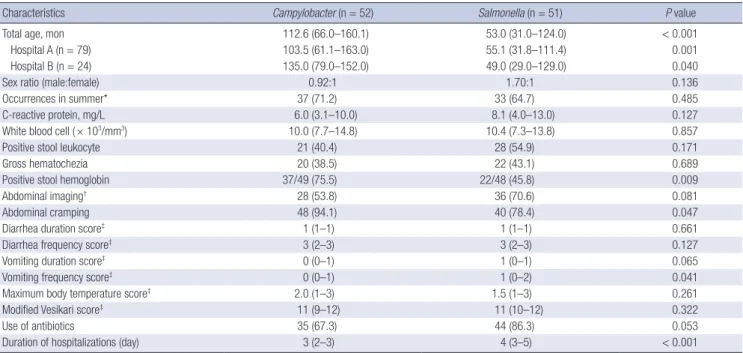
Table 1. Clinical characteristics of children hospitalized with acute gastroenteritis due to Campylobacter or nontyphoidal Salmonella monoinfection (n = 103)
Characteristics Campylobacter (n = 52) Salmonella (n = 51) P value
Total age, mon 112.6 (66.0–160.1) 53.0 (31.0–124.0) < 0.001
Hospital A (n = 79) 103.5 (61.1–163.0) 55.1 (31.8–111.4) 0.001
Hospital B (n = 24) 135.0 (79.0–152.0) 49.0 (29.0–129.0) 0.040
Sex ratio (male:female) 0.92:1 1.70:1 0.136
Occurrences in summer* 37 (71.2) 33 (64.7) 0.485
C-reactive protein, mg/L 6.0 (3.1–10.0) 8.1 (4.0–13.0) 0.127
White blood cell ( × 103/mm3) 10.0 (7.7–14.8) 10.4 (7.3–13.8) 0.857
Positive stool leukocyte 21 (40.4) 28 (54.9) 0.171
Gross hematochezia 20 (38.5) 22 (43.1) 0.689
Positive stool hemoglobin 37/49 (75.5) 22/48 (45.8) 0.009
Abdominal imaging† 28 (53.8) 36 (70.6) 0.081
Abdominal cramping 48 (94.1) 40 (78.4) 0.047
Diarrhea duration score‡ 1 (1–1) 1 (1–1) 0.661
Diarrhea frequency score‡ 3 (2–3) 3 (2–3) 0.127
Vomiting duration score‡ 0 (0–1) 1 (0–1) 0.065
Vomiting frequency score‡ 0 (0–1) 1 (0–2) 0.041
Maximum body temperature score‡ 2.0 (1–3) 1.5 (1–3) 0.261
Modified Vesikari score‡ 11 (9–12) 11 (10–12) 0.322
Use of antibiotics 35 (67.3) 44 (86.3) 0.053
Duration of hospitalizations (day) 3 (2–3) 4 (3–5) < 0.001
Values are presented as median (IQR) or number (%). Mann-Whitney test or the Kruskal-Wallis test was used.
IQR = interquartile range.
*From June to September; †Sonography or computed tomography; ‡Only data for children from hospital A are included. Scores were measured according to the modified Vesi- kari scoring system.
Fig. 1. Prevalence of enteropathogenic bacteria in children with acute inflammatory diarrhea (n = 363). Among enteropathogenic bacteria (n = 189, 52.1%), Campylo- bacter spp. (n = 68, 18.7%) was most common followed by Salmonella spp. (n = 56, 15.4%). Children coinfected with other bacterial enteropathogens are also shown.
Number of children
0 10 20 30 40 50 60 70 80 Campylobacter
Salmonella C.perfrigens C.difficile Aeromonas
Yersinia Shigella Vibrio Verotoxin-producing
E. coli Monoinfection
Coinfection
mon followed by Salmonella spp. (n = 56, 15.4%; hospitals A and B: 17.0% and 12.0%) (Table 1). Of the children, 4.1% were coinfected with Campylobacter spp. and other bacterial entero- pathogen(s); 1.6% were coinfected with Salmonella spp. and another bacterial enteropathogens. There was no significant seasonal difference between campylobacteriosis and NTS; both were most prevalent during summer (Table 1).
Clinical characteristics were compared between children with campylobacteriosis and those with NTS monoinfection (n = 103).
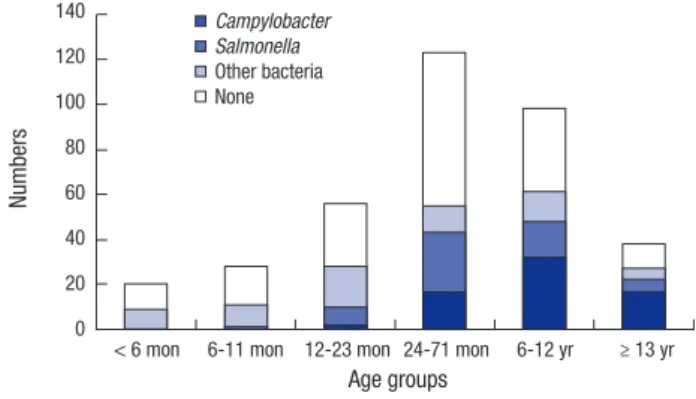
Because the main analysis results were not significantly differ- ent between the hospitals, combined data are presented in Ta- ble 1. Children with campylobacteriosis were significantly older than children with NTS; 112.6 months (interquartile range [IQR], 66.0–160.1 months) vs. 53 months (IQR, 31–124 months), re- spectively (P < 0.001). Campylobacteriosis and NTS showed significantly different age distributions (Fig. 2). Relative ratios of campylobacteriosis to NTS were 0, 0.29, 0.59, 1.50, and 2.60 among children aged 6–11 months, 12–23 months, 24–71 months, 6–12 years, and over 13 years, respectively (P = 0.001). Abdominal cramping (P = 0.047) and stool hemoglobin (P = 0.009) were more frequent in children with campylobacteriosis; higher vom- iting frequency scores (P = 0.041) and longer hospitalizations were observed in the NTS group (P < 0.001).
Because differing age distributions were noted for campylo- bacteriosis and NTS from 2011 to 2016, ages of children with NTS from 2001 to 2016 (n = 280) were analyzed. Children with stool-culture-proven NTS from 2001 to 2010 were significantly younger than those with NTS or campylobacteriosis from 2011 to 2016 (34.1 months [IQR, 18.7–61.4] vs. 53.0 months or 112.6 months, P < 0.001, respectively); results were similar at both hospitals.
Our study results suggest that campylobacteriosis and NTS may be among the 2 leading causes of acute inflammatory di- arrhea in hospitalized Korean children, at least in southwest Seoul. A unique finding is that children with Campylobacter enterocolitis were significantly older than children with NTS; to
our knowledge, this is one of the first age-based observations among children. Although it is unclear why this difference in host age exists, it could help to suspect more potential patho- gens in children hospitalized with acute inflammatory diarrhea.
In younger Korean children, NTS could be suspected as a pri- mary cause; in school-aged children and adolescents, campy- lobacteriosis could be given priority. This may be helpful for quick decision making regarding initial empirical antimicrobial agents, if necessary.
One assumption regarding this age difference is differing sourc- es of exposure to Campylobacter and Salmonella. It was report- ed that Campylobacter in broilers had a significant impact on campylobacteriosis in humans with a 2-week lag (10). In Kore- an studies, 50%–66% of chicken had Campylobacter jejuni (11).
Ingestion of contaminated or undercooked chicken may be as- sociated with a higher prevalence of campylobacteriosis in old- er children, because fast food such as fried chicken may repre- sent the majority of chicken consumption in this age group. Egg products and meat products such as pork were reported to be main sources of NTS (12). Further epidemiologic studies com- paring food consumption patterns of Korean children with cam- pylobacteriosis vs. those with NTS might help explain this age difference. Another explanation could be related to the differ- ent minimum amounts of these 2 bacteria causing clinical ill- ness. The minimum infectious dose of Salmonella spp. was great- er than that of Campylobacter spp. (13). Thus, under the same exposure conditions, younger children with less gastric acid pro- duction may be more prone to salmonellosis than older children.
In the literature, NTS was more common in children younger than 5 years than in older children (14-16).
In our study, we noted that the median age of the children with NTS has increased recently, which concurred with the re- sults from a previous Korean study (14). However, the underly- ing reasoning remains unclear. Another Korean study reported an association between serotypes and children’s ages (16); how- ever, no significant association between serotypes or serotype changes and age trends was noted in our study, explaining the recent increase observed in the ages of patients with NTS.
The Campylobacter group showed hemoglobin-positive stool and abdominal cramping more frequently than the Salmonella group. However, there was no significant difference in the rates of positivity for leukocytes in stool samples or the need for ab- dominal imaging. There was a tendency toward higher vomit- ing severity in NTS, which may suggest greater small bowel in- volvement. Further large-scale studies are needed to confirm the differences in these clinical findings, considering the rela- tively low significance noted in a modest number of children.
Longer hospitalizations in the Salmonella group might be relat- ed to younger age. Younger children need supportive care more frequently and can be dehydrated more frequently, which leads to longer hospitalizations.
Fig. 2. Enteropathogen notifications in children with inflammatory diarrhea by ages during 2011–2016. An increase in the number of notifications for Campylobacter in- fection, particularly in older children and school-aged children, is observed (n = 363, P < 0.001).
Numbers
Age groups
< 6 mon 6-11 mon 12-23 mon 24-71 mon 6-12 yr ≥ 13 yr 140
120 100 80 60 40 20 0
Campylobacter Salmonella Other bacteria None
In our study, several children with campylobacteriosis or NTS were coinfected with other bacterial enteropathogens; this has been increasingly reported recently (17). However, it appears that the clinical severity of bacteria-bacteria coinfection (com- pared with monoinfection) has not been well documented. In our cases, there was no significant difference in clinical severity between monoinfected children and coinfected children.
Because we only included children with acute inflammatory diarrhea, higher notification rates for overall bacterial entero- pathogens may have been obtained compared to previous ones (18,19). Higher positive rates for bacteria may be related to use of multiplex PCR tests for detecting bacterial enteropathogens, particularly Campylobacter spp., as they are more sensitive than culture methods (9).
In conclusion, there was a high incidence of intestinal cam- pylobacteriosis in hospitalized Korean children. Although the median age of children with NTS increased recently, children with campylobacteriosis were significantly older than those with NTS; they showed more intestinal bleeding and abdominal cramp- ing and less vomiting. We could consider campylobacteriosis rather than NTS as a leading cause of foodborne enterocolitis in hospitalized school-aged Korean children and adolescents.
ACKNOWLEDGMENT
We thank Kyung Mi Choi (Seoul Metropolitan Government- Seoul National University Boramae Medical Center) for the ex- pert technical assistance.
DISCLOSURE
The authors have no potential conflicts of interest to disclose.
AUTHOR CONTRIBUTION
Conceptualization: Shim JO, Chang JY. Formal analysis: Shim JO, Chang JY, Kim A, Shin S. Investigation: Shim JO, Chang JY.
Writing - original draft: Shim JO, Chang JY.
ORCID
Jung Ok Shim https://orcid.org/0000-0001-6449-7819 Ju Young Chang https://orcid.org/0000-0002-4760-6777 Ahlee Kim https://orcid.org/0000-0002-0803-0402 Sue Shin https://orcid.org/0000-0003-4791-8671 REFERENCES
1. World Health Organization. Campylobacter [Internet]. Available at http://
www.who.int/mediacentre/factsheets/fs255/en/ [accessed on 2 January 2017].
2. Schmutz C, Mäusezahl D, Jost M, Baumgartner A, Mäusezahl-Feuz M.
Inverse trends of Campylobacter and Salmonella in Swiss surveillance data, 1988–2013. Euro Surveill 2016; 21: 30130.
3. Eurosurveillance editorial team. The 2013 joint ECDC/EFSA report on trends and sources of zoonoses, zoonotic agents and food-borne outbreaks published. Euro Surveill 2015; 20: 21021.
4. Korea Center for Disease Control and Prevention. Communicable dis- eases weekly report [Internet]. Available at http://www.cdc.go.kr/CDC/
[accessed on 2 January 2017].
5. Cho MC, Noh SA, Kim MN, Kim KM. Direct application of multiplex PCR on stool specimens for detection of enteropathogenic bacteria. Korean J Clin Microbiol 2010; 13: 162-8.
6. Shim JO, Chang JY, Shin S, Moon JS, Ko JS. Changing distribution of age, clinical severity, and genotypes of rotavirus gastroenteritis in hospitalized children after the introduction of vaccination: a single center study in Seoul between 2011 and 2014. BMC Infect Dis 2016; 16: 287.
7. Kim A, Chang JY, Shin S, Yi H, Moon JS, Ko JS, Oh S. Epidemiology and factors related to clinical severity of acute gastroenteritis in hospitalized children after the introduction of rotavirus vaccination. J Korean Med Sci 2017; 32: 465-74.
8. Guarino A, Ashkenazi S, Gendrel D, Lo Vecchio A, Shamir R, Szajewska H; European Society for Pediatric Gastroenterology, Hepatology, and Nu- trition; European Society for Pediatric Infectious Diseases. European So- ciety for Pediatric Gastroenterology, Hepatology, and Nutrition/Europe- an Society for Pediatric Infectious Diseases evidence-based guidelines for the management of acute gastroenteritis in children in Europe: up- date 2014. J Pediatr Gastroenterol Nutr 2014; 59: 132-52.
9. Onori M, Coltella L, Mancinelli L, Argentieri M, Menichella D, Villani A, Grandin A, Valentini D, Raponi M, Russo C. Evaluation of a multiplex PCR assay for simultaneous detection of bacterial and viral enteropathogens in stool samples of paediatric patients. Diagn Microbiol Infect Dis 2014;
79: 149-54.
10. Wei W, Schüpbach G, Held L. Time-series analysis of Campylobacter in- cidence in Switzerland. Epidemiol Infect 2015; 143: 1982-9.
11. Pursem VN, Peeroo BM, Mangar TI, Sohawon FM, Seheri LM, Mphahlele MJ, Mwenda JM, Manraj SS. Epidemiology of rotavirus diarrhea and di- versity of rotavirus strains among children less than 5 years of age with acute gastroenteritis in Mauritius: June 2008 to December 2010. Pediatr Infect Dis J 2014; 33 Suppl 1: S49-53.
12. Kittl S, Kuhnert P, Hächler H, Korczak BM. Comparison of genotypes and antibiotic resistance of Campylobacter jejuni isolated from humans and slaughtered chickens in Switzerland. J Appl Microbiol 2011; 110: 513-20.
13. Shaw AN, Heresi GP, Murphy JR. Campylobacter. In: Kliegman R, Stanton B, St Geme JW 3rd, Schor NF. Nelson Textbook of Pediatrics. 20th ed. Phil- adelphia, PA, Elsevier, 2016, p1403-6.
14. Noh SH, Yu KY, Kim JS, Hwang PH, Jo DS. Salmonellosis in children: anal- ysis of 72 Salmonella-positive culture cases during the last 10 years. Ko- rean J Pediatr 2009; 52: 791-7.
15. Park HK, Rhie K, Yeom JS, Park JS, Park ES, Seo JH, Lim JY, Park CH, Woo HO, Youn HS, et al. Differences in clinical and laboratory findings between group D and non-group D non-typhoidal Salmonella gastroenteritis in children. Pediatr Gastroenterol Hepatol Nutr 2015; 18: 85-93.
16. Ford L, Glass K, Veitch M, Wardell R, Polkinghorne B, Dobbins T, Lal A, Kirk MD. Increasing incidence of Salmonella in Australia, 2000–2013. PLoS One 2016; 11: e0163989.
17. Wensley A, Coole L. Cohort study of a dual-pathogen point source out- break associated with the consumption of chicken liver pâté, UK, Octo- ber 2009. J Public Health (Oxf) 2013; 35: 585-9.
18. Cho IJ, Yim J, Lee Y, Kim MS, Seo Y, Chung HS, Yong D, Jeong SH, Lee K, Chong Y. Trends in isolation and antimicrobial susceptibility of entero-
pathogenic bacteria in 2001–2010 at a Korean tertiary care hospital. Ann Clin Microbiol 2013; 16: 45-51.
19. Lee J, Kim J, Cho H, Oh K, Uh Y, Yoon KJ. Detection of bacterial and viral pathogens in stool specimens using multiplex PCR. J Lab Med Qual As- sur 2015; 37: 141-7.