ABSTRACT
Background: Underdiagnosis and undertreatment of allergic rhinitis (AR) in patients with asthma can worsen treatment outcomes. There is limited evidence of clinical practices for management of coexistent AR-asthma in Thailand.
Methods: A multicountry, cross-sectional study (Asia-pacific Survey of Physicians on Asthma and allergic Rhinitis) to evaluate physician perceptions and management practices related to AR-asthma overlap in 6 Asian countries was conducted. For Thailand specifically, AR-asthma linkage questionnaires were developed and translated to Thailaland. General physicians (GPs) or pediatricians, randomly selected from hospitals in urban cities, routinely treating
>10 asthma patients/month were interviewed. Here we present the results for Thailand.
Results: Two hundred physicians (100 GPs and 100 pediatricians), of whom 70% worked in government hospitals, were interviewed. In their experience, 50% of asthma patients had AR and 28% of AR patients had asthma. Among diagnosed asthma patients, 65% of physicians routinely asked for any AR symptoms at every visit. Among diagnosed AR patients, 63% of physicians routinely asked for any asthma symptoms at every visit. In patients with coexisting AR-asthma, 91% of physicians treated both diseases simultaneously, while 6% of physicians treated asthma as a chronic disease but managed AR symptomatically. The most preferred treatment options for patients with AR-asthma were inhaled corticosteroids with intranasal steroids (46% in GPs, 71% in pediatricians).
Conclusion: The physicians interviewed in Thailand are aware about coexistent asthma-AR.
There is a need to increase the awareness further for coexistent AR-asthma and to educate nonspecialist physicians in the proper management of AR-asthma patients.
Keywords: Allergic rhinitis; Asthma; Comorbidity; Physician survey; Thailand
Original Article
Received: Dec 3, 2018 Accepted: Jun 24, 2019
*Correspondence to Torsak Bunupuradah
GlaxoSmithKline Limited, 12th Floor, Wave Place, 55 Wireless Road, Lumpini, Patumwan, Bangkok 10330, Thailand.
Tel: +662-659-3156 Fax: +662-659-3147
E-mail: [email protected] Copyright © 2019. Asia Pacific Association of Allergy, Asthma and Clinical Immunology.
This is an Open Access article distributed under the terms of the Creative Commons Attribution Non-Commercial License (https://
creativecommons.org/licenses/by-nc/4.0/) which permits unrestricted non-commercial use, distribution, and reproduction in any medium, provided the original work is properly cited.
ORCID iDs Torsak Bunupuradah
https://orcid.org/0000-0002-2037-4152 Conflict of interest
All authors meet the International Committee for Medical Journal Editors criteria for authorship. TB, DH, SS (Sumitra Shantakumar), AM and BA are GSK employees.
Sudawan Siriaksorn reports no relevant competing interests.
Author Contributions
Conceptualization: Torsak Bunupuradah, Sudawan Siriaksorn, David Hinds, Sumitra Shantakumar, Aruni Mulgirigama, Bhumika Aggarwal. Data curation: Torsak Bunupuradah, Sudawan Siriaksorn, David Hinds, Sumitra Shantakumar, Aruni Mulgirigama, Bhumika Aggarwal. Formal
Torsak Bunupuradah 1,*, Sudawan Siriaksorn2, David Hinds3, Sumitra Shantakumar4, Aruni Mulgirigama5, and Bhumika Aggarwal4
1GlaxoSmithKline Limited, Bangkok, Thailand
2Chiang Mai Ram Hospital, Chiang Mai, Thailand
3GlaxoSmithKline Limited, Philadelphia, PA, USA
4GlaxoSmithKline Limited, Singapore
5GlaxoSmithKline Limited, Middlesex, UK
A survey of management practices in
coexistent allergic rhinitis and asthma
(Asia-pacific Survey of Physicians on
Asthma and allergic Rhinitis): results
from Thailand
analysis: Torsak Bunupuradah, David Hinds, Bhumika Aggarwal. Funding acquisition:
Sudawan Siriaksorn, Aruni Mulgirigama, Bhumika Aggarwal. Investigation: Torsak Bunupuradah, Sudawan Siriaksorn, David Hinds, Sumitra Shantakumar, Aruni Mulgirigama, Bhumika Aggarwal. Project administration: Torsak Bunupuradah, Bhumika Aggarwal. Resources: Torsak Bunupuradah, Bhumika Aggarwal.
Supervision: Sudawan Siriaksorn, Aruni Mulgirigama, Bhumika Aggarwal. Validation:
Torsak Bunupuradah, Sudawan Siriaksorn, David Hinds, Sumitra Shantakumar, Aruni Mulgirigama, Bhumika Aggarwal. Writing - original draft: Torsak Bunupuradah, Sudawan Siriaksorn, David Hinds, Sumitra Shantakumar, Aruni Mulgirigama, Bhumika Aggarwal. Writing - review & editing:
Torsak Bunupuradah, Sudawan Siriaksorn, David Hinds, Sumitra Shantakumar, Aruni Mulgirigama, Bhumika Aggarwal.
INTRODUCTION
Allergic rhinitis (AR) is a common disease with bothersome symptoms including sneezing, nasal itching, congestion, and dripping [1]. Prevalence of AR in Asia has been reported to vary between 1.14%–53% [2]. Recently, prevalence of AR from a study in Thailand was 58.5% [3]. Uncontrolled AR is associated with lost productivity, absenteeism and reduction in professional performance [4]. AR is associated with comorbidities such as sleep disturbances, fatigue, learning impairment, conjunctivitis, rhinosinusitis, and asthma [5].
The link between AR and the subsequent development of asthma is well established [6, 7].
Symptomatic AR impairs asthma control whilst patients with coexisting AR-asthma experience more asthma exacerbations, emergency room visits, and hospitalizations compared to patients with asthma alone [8, 9]. Treating concomitant AR in asthma patients is associated with significant reductions in risk of emergency room visits and hospitalizations for asthma [10].
Underdiagnosis and undertreatment of concomitant AR were reported in 32% of teenagers and adults with asthma in Denmark and 53% of children with asthma in United States.
However, there is limited published data on clinical practices in patients with AR-asthma in Asia-Pacific. In this study, we describe the coexistence, diagnosis, and treatment practices for patients from Thailand with AR-asthma among general physicians (GPs) and pediatricians.
MATERIALS AND METHODS
Asia-pacific Survey of Physicians on Asthma and allergic Rhinitis (ASPAIR) is a multicountry (China, India, Malaysia, Philippines, Vietnam, and Thailand), cross-sectional survey to evaluate perceptions and management practices related to AR-asthma in GPs) and pediatricians (Peds) [11]. GPs and pediatricians who routinely treat at least 10 asthma patients/month were interviewed between October and December 2017. Participation was voluntary and anonymous. Here we present the results for Thailand. Participating physicians were randomly selected from hospitals in 4 urban areas in Thailand (Bangkok; capital city of Thailand, Chiang Mai; North of Thailand, Nakhon Si Thamarat; South of Thailand, and Ubon Ratchathani; North-East of Thailand). A total of 200 interviews were conducted.
Questionnaires and administration
AR-asthma questionnaires, 37 questions, first developed in English, focused on physicians' perspectives regarding attitudes and beliefs about concomitant AR-asthma with regards to treatment, knowledge and adherence to AR and asthma management guidelines [11]. The English version questionnaires were translated to Thai and validated by 2 Thai physicians.
Physicians were interviewed by trained interviewers onsite via Computer-Assisted-
Personal-Interviewing tablets. The interview length was around 30 minutes per participant.
Depending on the size of the hospitals, up to 12 physicians were included per hospital. A maximum of 3 interviewers per hospital were allowed. The study complied with ethical guidelines established by CASRO (Council of American Survey Research Organizations), the ESOMAR (European Society for Opinion and Market Research), and the AMF (Asia Marketing Federation).
Statistics
As this is a descriptive study to illustrate physicians' beliefs and practices in AR-asthma management, 200 physicians recruited to participate in this study from Thailand. There was no formal sample size calculation. Descriptive statistics were conducted by IBM SPSS Statistics ver. 22.0 (IBM Co., Armonk, NY, USA)
RESULTS
Characteristics of interviewed physicians
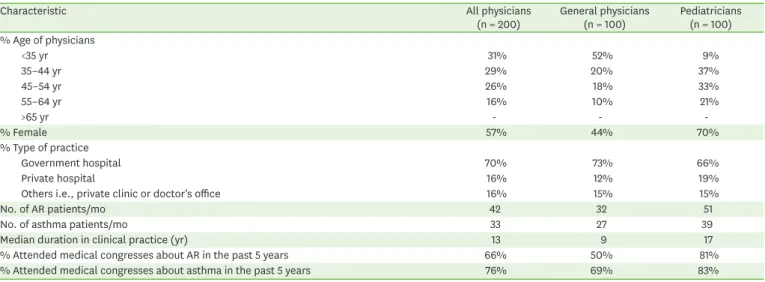
Two hundred physicians, 100 GPs and 100 pediatricians, were interviewed (Table 1). Median duration in clinical practice was 9 years of the interviewed GPs and 17 years of the interviewed pediatricians.
Diagnosis and burden of AR-asthma comorbidities
Overall, 99% of physicians agreed that AR and asthma coexist. In GPs' clinical experience, 45% of asthma patients had AR and 28% of AR patients had asthma. In pediatricians' clinical experience, 55% of asthma patients had AR and 28% of AR patients had asthma (Table 2).
For patients with asthma, 60% of GPs and 69% of pediatricians routinely screen for AR symptoms at every visit i.e., nasal congestion, running nose. Extranasal symptoms/diagnosis that reminded physicians to look for AR diagnosis were allergic conjunctivitis symptoms, such as watery eyes (67% in GPs; 84% in pediatricians), throat irritation or throat clearing (40% in GPs; 63% in pediatricians), and worsening or lack of asthma control (38% in GPs;
58% in pediatricians). On the other hand, for patients with AR, 61% of GPs and 65% of pediatricians routinely asked for any asthma symptoms i.e., wheezing, cough or shortness of breath at every visit.
Regarding the impact of AR-asthma coexistence, 60% of physicians reported that AR- asthma patients had more burdensome symptoms than asthma alone (Table 2) and 77% of physicians reported that AR-asthma patients had more negative impact on quality of sleep than asthma alone.
Table 1. Characteristics of participating physicians
Characteristic All physicians
(n = 200) General physicians
(n = 100) Pediatricians (n = 100)
% Age of physicians
<35 yr 31% 52% 9%
35–44 yr 29% 20% 37%
45–54 yr 26% 18% 33%
55–64 yr 16% 10% 21%
>65 yr - - -
% Female 57% 44% 70%
% Type of practice
Government hospital 70% 73% 66%
Private hospital 16% 12% 19%
Others i.e., private clinic or doctor's office 16% 15% 15%
No. of AR patients/mo 42 32 51
No. of asthma patients/mo 33 27 39
Median duration in clinical practice (yr) 13 9 17
% Attended medical congresses about AR in the past 5 years 66% 50% 81%
% Attended medical congresses about asthma in the past 5 years 76% 69% 83%
AR, allergic rhinitis.
Management of coxistent AR-asthma patients and concerns
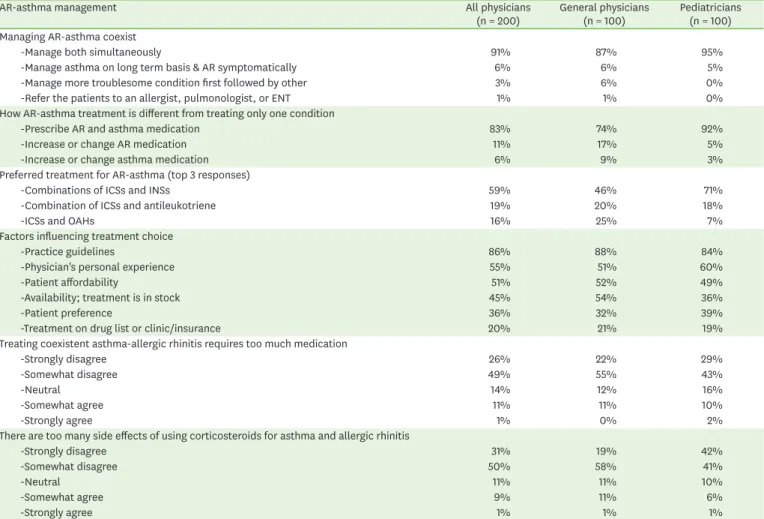
In patients with AR-asthma, 87% of GPs and 95% of pediatricians treated both diseases simultaneously, 6% of GPs and 5% of pediatricians treated asthma on a long-term basis but managed AR symptomatically (Table 3). The most preferred treatment option for patients with AR-asthma was inhaled corticosteroids (ICSs) in addition to intranasal steroids (INSs) (46% in GPs, 71% in pediatricians).
The most impactful factor influencing treatment choice among interviewed physicians was practice guidelines (88% in GPs, 84% in pediatricians) (Table 3). However, there were concerns about too many medications for patients with AR-asthma in 11% of GPs and 12% of pediatricians. Moreover, 12% of GPs and 7% of pediatricians were concerned that there are too many side effects of using corticosteroids for patients with AR-asthma. Regarding the pediatric population, 11% of GPs and 3% of pediatricians reported that ICSs should be delayed in children until they are adults and 9% of GPs and 4% of pediatricians reported that INSs should be delayed until they are adults.
DISCUSSION
From clinical experience of interviewed physicians, half of patients with asthma had AR and around one-third of patients with AR had asthma. Around two-thirds of physicians reported that they routinely asked patients with asthma about AR symptoms at every visit and the majority of them treat both diseases simultaneously. Practice guidelines are the main factor influencing their treatment.
Table 2. Diagnosis and burden of AR-asthma comorbidities
Diagnosis and burden All physicians
(n = 200) General physicians
(n = 100) Pediatricians (n = 100)
% of asthma patients with AR 50% 45% 55%
% of AR patients with asthma 28% 28% 28%
Ask asthma patients about AR symptoms
-At every visit 65% 60% 69%
-Depending on symptoms 48% 52% 43%
-Depending on triggers 11% 10% 12%
Ask AR patients about asthma symptoms
-At every visit 63% 61% 65%
-Seasonally 12% 13% 11%
-If there is an increase in pollution 9% 10% 7%
-Annually 3% 3% 2%
Diagnosis
Criteria to diagnose AR (top 3 responses)
-History of nasal symptoms 100% 100% 99%
-History of eyes symptoms 82% 84% 80%
-Family history of AR and/or atopy 78% 72% 83%
Criteria to diagnose asthma (top 3 responses)
-Clinical history of wheezing, shortness of breath, chest tightness, and/or cough 97% 96% 98%
-Family history of asthma and/or atopy 78% 71% 85%
-Exposure to common asthma triggers (e.g., animal dander, exhaust, exercise) 67% 67% 67%
Burden of diseases
Physicians agree AR-asthma overlap in more burdensome than AR alone 74% 73% 75%
Physicians agree AR-asthma overlap in more burdensome than asthma alone 60% 61% 58%
AR-asthma had negative impact on sleep than asthma alone
-A lot worse 17% 22% 12%
-Somewhat worse 60% 50% 69%
-About the same 23% 28% 19%
AR, allergic rhinitis.
According to the Allergic Rhinitis and its Impact on Asthma guideline, over 80% of
asthmatics have rhinitis [1]. From an international cross-sectional study, 74%–81% of adults with asthma had symptoms of AR [12]. In our survey, the interviewed physicians reported only half of asthma patients have AR. Moreover, only 65% of physicians routinely asked for any AR symptoms in patients with asthma. Therefore, there is a need to increase awareness among physicians to detect AR symptoms, confirming diagnosis of concomitant disease and optimizing management of patients with asthma. In our study, both GPs and pediatricians equally reported that in their experience of coexistent asthma in patients with AR was 28%
which is similar to the previous publications [13, 14].
Duration and experience of clinical practice can influence on quality of patient care. In our study, pediatricians were older, managed a higher case load for AR and asthma, had been in clinical practice longer, had a higher rate of attendance for medical training about AR and asthma in the past 5 years, and were more likely to routinely ask about AR symptoms in patients with asthma than GPs. Our findings support data from a previous study that the proportion of primary care practitioners unaware of AR guidelines was significantly higher in a younger age group (25–44 years) compared to the older primary care practitioners aged 45–65 years (48% vs. 37%; p = 0.0002) [4].
Table 3. Management AR-asthma coexist patients
AR-asthma management All physicians
(n = 200) General physicians
(n = 100) Pediatricians (n = 100) Managing AR-asthma coexist
-Manage both simultaneously 91% 87% 95%
-Manage asthma on long term basis & AR symptomatically 6% 6% 5%
-Manage more troublesome condition first followed by other 3% 6% 0%
-Refer the patients to an allergist, pulmonologist, or ENT 1% 1% 0%
How AR-asthma treatment is different from treating only one condition
-Prescribe AR and asthma medication 83% 74% 92%
-Increase or change AR medication 11% 17% 5%
-Increase or change asthma medication 6% 9% 3%
Preferred treatment for AR-asthma (top 3 responses)
-Combinations of ICSs and INSs 59% 46% 71%
-Combination of ICSs and antileukotriene 19% 20% 18%
-ICSs and OAHs 16% 25% 7%
Factors influencing treatment choice
-Practice guidelines 86% 88% 84%
-Physician's personal experience 55% 51% 60%
-Patient affordability 51% 52% 49%
-Availability; treatment is in stock 45% 54% 36%
-Patient preference 36% 32% 39%
-Treatment on drug list or clinic/insurance 20% 21% 19%
Treating coexistent asthma-allergic rhinitis requires too much medication
-Strongly disagree 26% 22% 29%
-Somewhat disagree 49% 55% 43%
-Neutral 14% 12% 16%
-Somewhat agree 11% 11% 10%
-Strongly agree 1% 0% 2%
There are too many side effects of using corticosteroids for asthma and allergic rhinitis
-Strongly disagree 31% 19% 42%
-Somewhat disagree 50% 58% 41%
-Neutral 11% 11% 10%
-Somewhat agree 9% 11% 6%
-Strongly agree 1% 1% 1%
AR, allergic rhinitis; ENT, ear, nose, and throat; ICS, inhaled corticosteroid; INS, intranasal steroid; OAH, oral antihistamine.
The coexistence of AR in asthma is associated with more asthma exacerbations, emergency room visits, hospitalizations compared to patients with asthma alone [9, 15]. There are several possible mechanisms to explain a link between AR and exacerbations in coexistent asthma i.e.; (1) lack of nasal function to warm and humidify inspired air, (2) post nasal drip, and (3) nasobronchial reflex [5]. Patients with AR-asthma had significantly lower quality of life than patients with either disease alone [16]. Majority of physicians in our study agreed that there is a higher disease burden for patients with AR-asthma compared to either alone.
Treatment of AR is associated with potential clinical improvement for symptoms of asthma to some extent. Among patients with AR-asthma, most of the interviewed physicians in ASPAIR Thailand reported that they treated both diseases simultaneously in line with the AR [1] and asthma guidelines [17]. INSs are considered a first-line treatment to control upper airway inflammation in AR [1, 18, 19]. From a meta-analysis, benefits of INSs on asthma outcomes, including improvement of lung function, reduced symptom scores, and decreased rescue medication use, were reported [20]. Although, the interviewed physicians agreed that both asthma and AR should be treated simultaneously when they coexist, some were concerned about polypharmacy and side effects with ICSs and INSs. This highlights the discrepancy between the awareness of the guidelines and actual management of patients with coexistent disease. Further education regarding appropriate AR management in asthma patients including diagnosis, classifications of AR, and treatment guidelines would be beneficial.
The main factor influencing treatment choice in this survey for both GPs and pediatricians was reported to be AR guidelines (in 86% of interviewed physicians) which contrasts from a survey in 1,200 primary care practitioners in Australia, Brazil, Canada, France, Germany, Italy, Spain and the UK, where only 3% of them reported to follow the AR guidelines, and 27% acknowledged that they adapted their management based on AR guidelines for individual patient treatment [4]. From a survey in China, respiratory medicine specialists had high-level knowledge of asthma management (>90%) but there were areas identified for improvement in their perception of AR and coexistent asthma [21]. Beside patient affordability, and drug availability, patient preference is an important factor influencing treatment choice. An important consideration in patient preference and adherence to INS are sensory attributes, including aftertaste, nose runout, throat rundown, and smell [19].
There are some study limitations: (1) This cross-sectional survey included data based from physicians' recall i.e., number of patients and percentage of their AR-asthma treatment practice which may be open to recall bias. (2) The participating GPs and pediatricians were from urban provinces and the results may be different for the rural provinces of Thailand.
Future studies should be done in other settings i.e., physicians in rural hospitals or in the other specialist areas, e.g., ENT (ear, nose, and throat) specialists.
In conclusion, AR-asthma is commonly found in Thailand with likely negative impact on patients' quality of life. Approximately two-thirds of physicians interviewed were looking for coexistent AR in patients with asthma. However, there is an opportunity to further increase awareness of coexistent AR among physicians in Thailand to shorten the time to diagnosis and patients being appropriately managed. Overall, among patients with AR-asthma, most of the interviewed physicians treated both diseases simultaneously and aligned to AR guidelines.
ACKNOWLEDGEMENTS
The results of this study (ASPAIR Thailand) were presented in Joint Congress of the Asia Pacific Association of Allergy, Asthma and Clinical Immunology & the Asia Pacific Association of Pediatric Allergy, Respirology and Immunology 2018 (APAAACI & APAPARI 2018), Bangkok, Thailand, 11-14 October 2018, poster number P-58.
ASPAIR study was funded by GSK (funding number: 206753).
The authors would like to thank all participants and the ASPAIR study team who were responsible for the study oversight: Indu Khosla, Maria Isabel Atienza, Maria Cristina Balotro-Torres, Pham Le An, Tran Anh Tuan, and Hooi Lai Ngoh.
REFERENCES
1. Bousquet J, Khaltaev N, Cruz AA, Denburg J, Fokkens WJ, Togias A, Zuberbier T, Baena-Cagnani CE, Canonica GW, van Weel C, Agache I, Aït-Khaled N, Bachert C, Blaiss MS, Bonini S, Boulet LP, Bousquet PJ, Camargos P, Carlsen KH, Chen Y, Custovic A, Dahl R, Demoly P, Douagui H, Durham SR, van Wijk RG, Kalayci O, Kaliner MA, Kim YY, Kowalski ML, Kuna P, Le LT, Lemiere C, Li J, Lockey RF, Mavale- Manuel S, Meltzer EO, Mohammad Y, Mullol J, Naclerio R, O'Hehir RE, Ohta K, Ouedraogo S, Palkonen S, Papadopoulos N, Passalacqua G, Pawankar R, Popov TA, Rabe KF, Rosado-Pinto J, Scadding GK, Simons FE, Toskala E, Valovirta E, van Cauwenberge P, Wang DY, Wickman M, Yawn BP, Yorgancioglu A, Yusuf OM, Zar H, Annesi-Maesano I, Bateman ED, Ben Kheder A, Boakye DA, Bouchard J, Burney P, Busse WW, Chan-Yeung M, Chavannes NH, Chuchalin A, Dolen WK, Emuzyte R, Grouse L, Humbert M, Jackson C, Johnston SL, Keith PK, Kemp JP, Klossek JM, Larenas-Linnemann D, Lipworth B, Malo JL, Marshall GD, Naspitz C, Nekam K, Niggemann B, Nizankowska-Mogilnicka E, Okamoto Y, Orru MP, Potter P, Price D, Stoloff SW, Vandenplas O, Viegi G, Williams D; World Health Organization; GA(2)LEN; AllerGen.
Allergic Rhinitis and its Impact on Asthma (ARIA) 2008 update (in collaboration with the World Health Organization, GA(2)LEN and AllerGen). Allergy 2008;63 Suppl 86:8-160.
PUBMED | CROSSREF
2. Chong SN, Chew FT. Epidemiology of allergic rhinitis and associated risk factors in Asia. World Allergy Organ J 2018;11:17.
PUBMED | CROSSREF
3. Sapsaprang S, Setabutr D, Kulalert P, Temboonnark P, Poachanukoon O. Evaluating the impact of allergic rhinitis on quality of life among Thai students. Int Forum Allergy Rhinol 2015;5:801-7.
PUBMED | CROSSREF
4. Van Cauwenberge P, Van Hoecke H, Kardos P, Price D, Waserman S. The current burden of allergic rhinitis amongst primary care practitioners and its impact on patient management. Prim Care Respir J 2009;18:27-33.
PUBMED | CROSSREF
5. Cingi C, Gevaert P, Mösges R, Rondon C, Hox V, Rudenko M, Muluk NB, Scadding G, Manole F, Hupin C, Fokkens WJ, Akdis C, Bachert C, Demoly P, Mullol J, Muraro A, Papadopoulos N, Pawankar R, Rombaux P, Toskala E, Kalogjera L, Prokopakis E, Hellings PW, Bousquet J. Multi-morbidities of allergic rhinitis in adults:
European Academy of Allergy and Clinical Immunology Task Force Report. Clin Transl Allergy 2017;7:17.
PUBMED | CROSSREF
6. Lau S, Matricardi PM, Wahn U, Lee YA, Keil T. Allergy and atopy from infancy to adulthood: messages from the German birth cohort MAS. Ann Allergy Asthma Immunol 2019;122:25-32.
PUBMED | CROSSREF
7. Shaaban R, Zureik M, Soussan D, Neukirch C, Heinrich J, Sunyer J, Wjst M, Cerveri I, Pin I, Bousquet J, Jarvis D, Burney PG, Neukirch F, Leynaert B. Rhinitis and onset of asthma: a longitudinal population- based study. Lancet 2008;372:1049-57.
PUBMED | CROSSREF
8. Price D, Zhang Q, Kocevar VS, Yin DD, Thomas M. Effect of a concomitant diagnosis of allergic rhinitis on asthma-related health care use by adults. Clin Exp Allergy 2005;35:282-7.
PUBMED | CROSSREF
9. Gaugris S, Sazonov-Kocevar V, Thomas M. Burden of concomitant allergic rhinitis in adults with asthma. J Asthma 2006;43:1-7.
PUBMED | CROSSREF
10. Corren J, Manning BE, Thompson SF, Hennessy S, Strom BL. Rhinitis therapy and the prevention of hospital care for asthma: a case-control study. J Allergy Clin Immunol 2004;113:415-9.
PUBMED | CROSSREF
11. Aggarwal B, Shantakumar S, Hinds D, Mulgirigama A. Asia-Pacific Survey of Physicians on Asthma and Allergic Rhinitis (ASPAIR): physician beliefs and practices about diagnosis, assessment, and treatment of coexistent disease. J Asthma Allergy 2018;11:293-307.
PUBMED | CROSSREF
12. Leynaert B, Neukirch C, Kony S, Guénégou A, Bousquet J, Aubier M, Neukirch F. Association between asthma and rhinitis according to atopic sensitization in a population-based study. J Allergy Clin Immunol 2004;113:86-93.
PUBMED | CROSSREF
13. Greisner WA 3rd, Settipane RJ, Settipane GA. Co-existence of asthma and allergic rhinitis: a 23-year follow-up study of college students. Allergy Asthma Proc 1998;19:185-8.
PUBMED | CROSSREF
14. Fireman P. Rhinitis and asthma connection: management of coexisting upper airway allergic diseases and asthma. Allergy Asthma Proc 2000;21:45-54.
PUBMED | CROSSREF
15. Clatworthy J, Price D, Ryan D, Haughney J, Horne R. The value of self-report assessment of adherence, rhinitis and smoking in relation to asthma control. Prim Care Respir J 2009;18:300-5.
PUBMED | CROSSREF
16. Sritipsukho P, Satdhabudha A, Nanthapisal S. Effect of allergic rhinitis and asthma on the quality of life in young Thai adolescents. Asian Pac J Allergy Immunol 2015;33:222-6.
PUBMED
17. Global Initiative for Asthma. Global strategy for asthma management and prevention [Internet]. Fontana (WI): Global Initiative for Asthma; 2018 [cited 2018 Oct 31]. Available from: www.ginasthma.org 18. Wise SK, Lin SY, Toskala E, Orlandi RR, Akdis CA, Alt JA, Azar A, Baroody FM, Bachert C, Canonica
GW, Chacko T, Cingi C, Ciprandi G, Corey J, Cox LS, Creticos PS, Custovic A, Damask C, DeConde A, DelGaudio JM, Ebert CS, Eloy JA, Flanagan CE, Fokkens WJ, Franzese C, Gosepath J, Halderman A, Hamilton RG, Hoffman HJ, Hohlfeld JM, Houser SM, Hwang PH, Incorvaia C, Jarvis D, Khalid AN, Kilpeläinen M, Kingdom TT, Krouse H, Larenas-Linnemann D, Laury AM, Lee SE, Levy JM, Luong AU, Marple BF, McCoul ED, McMains KC, Melén E, Mims JW, Moscato G, Mullol J, Nelson HS, Patadia M, Pawankar R, Pfaar O, Platt MP, Reisacher W, Rondón C, Rudmik L, Ryan M, Sastre J, Schlosser RJ, Settipane RA, Sharma HP, Sheikh A, Smith TL, Tantilipikorn P, Tversky JR, Veling MC, Wang Y, Westman M, Wickman M, Zacharek M. International Consensus Statement on Allergy and Rhinology: Allergic Rhinitis. Int Forum Allergy Rhinol 2018;8:108-352.
PUBMED | CROSSREF
19. Seidman MD, Gurgel RK, Lin SY, Schwartz SR, Baroody FM, Bonner JR, Dawson DE, Dykewicz MS, Hackell JM, Han JK, Ishman SL, Krouse HJ, Malekzadeh S, Mims JW, Omole FS, Reddy WD, Wallace DV, Walsh SA, Warren BE, Wilson MN, Nnacheta LC; Guideline Otolaryngology Development Group. AAO- HNSF. Clinical practice guideline: allergic rhinitis. Otolaryngol Head Neck Surg 2015;152 (1 Suppl):S1-43.
PUBMED | CROSSREF
20. Lohia S, Schlosser RJ, Soler ZM. Impact of intranasal corticosteroids on asthma outcomes in allergic rhinitis: a meta-analysis. Allergy 2013;68:569-79.
PUBMED | CROSSREF
21. Su N, Lin J, Liu G, Yin K, Zhou X, Shen H, Chen P, Chen R, Liu C, Wu C, Zhao J, Lin Y. Asthma with allergic rhinitis management in China: a nationwide survey of respiratory specialists at tertiary hospitals.
Int Forum Allergy Rhinol 2015;5:221-32.
PUBMED | CROSSREF