Alternating Development Strategies in Jeju Island, Korea
Sangcheol Kwon*
제주도 발전 전략의 교호적 변화
권상철*
Abstract:Islands are vulnerable to outer influences due to their small size and isolation. Tourism often becomes an important development focus because of their unique culture and nature. Jeju-do, as well as other islands, has experienced such development mostly led by central government, and the regional change was understood as the outcome of global influences without much concern with the local response or strategy. Thus, vulnerability has been the key theme in island development studies. This paper examines the current state of island development as an outcome of locals’ alternating strategy in which the islanders accept the central government’s plan, but express their demands to modify them. It is reflected in the electoral preference for ruling or oppositional parties, local movements against central government’s development plans, and the spatial organization of tourism sites from a few growth centers to more dispersed, balanced development. These suggest that the current state of island development is not derived from unidirectional global forces, even if islands are peripheral. Rather, it is the outcome of an alternating strategy of Jeju locals accepting the central government development plans while managing them for local benefits.
Key Words : island development, alternating strategy, electoral preference, local movements, spatial organization
요약:섬지역은 작은 규모와 고립된 특성으로 인해 취약한 경제기반으로 특징지워 진다. 여기에 오랜 고립에 따른 독특한 문화와 자 연경관은 관광 중심의 개발로 이어지게 된다. 제주도도 세계 다른 섬지역과 마찬가지로 이러한 개발을 경험하는데, 이러한 지역변화 는 섬지역의 취약성에 초점을 맞추어 대다수 중앙정부 주도로 이루어진 것으로 지역에서의 대응은 축소되어 이해되고 있다. 본 논문 에서는 섬지역 주민들은 자신들의 취약성에 기초해 중앙정부의 정책을 수용하면서 자신들에게 유리하게 변용하는 교호적 전략을 구 사해 왔다고 이해한다. 교호적 전략은 3가지 측면에 반영되고 있는데, 첫째 제주도는 국회의원 선거에서 무소속 후보를 선호해 오다 근래에는 여당 후보 그리고 야당 후보를 교대로 선출하는 모습을 보여준다. 둘째 중앙정부의 지역개발정책에 대한 반대운동을 통해 주민생활의 향상과 개선을 반영하는 수정을 요구하여 왔다. 셋째 중앙정부 주도의 개발정책이 효율성을 극대화하는 거점중심의 관광 지 개발을 지역의 균형발전 요구로 대응하며 제주전역으로 개발을 확대시켰다. 이러한 개발 과정과 결과는 중앙정부의 관광개발 정 책을 견제, 섬으로서의 제주지역의 취약함에서 찾아낸 교호적 전략의 결과로 볼 수 있을 것이다.
주요어 : 섬발전, 교호적 전략, 선거 선호, 지역 운동, 공간 조직
* Professor, Geography Education Major, Cheju National University, [email protected]
Journal of the Korean Geographical Society, Vol. 43, No. 2, 2008(171~187)
1. Introduction
Islands are the places characterized by unique culture preserved by insularity and natural environment. Jeju-do is the largest island in Korea and a well known tourism destination with its unique culture and nature. Arising from its small size, islands are characterized by a peripheral economy making islands vulnerable to outer influences. Tourism became a dominant development path in numerous islands including Jeju-do (Royle, 2001; Treadgold, 1999; Ko et al, 1999; Lee, 1998).
Studies concerned with the island development focus on the vulnerability in which small size and insularity led to their dependence characterized by out-migration and inflow of investments, and tourism development based on the unique island culture and nature (Betram, 2006; McElroy, 2003).
Limited resources and political clout are often discussed as components of island vulnerability in which island developments are largely driven from mainland or central government plans and investments. On the other hand, the focus on local identity tends to emphasize local consciousness and culture. They are often highlighted in the local movements against central government-led development and independence movements from their mainland part. The inherent dilemma of development and local identity in islands became the concern of study (Royle, 2001). Recently, new developments include offshore banking, special economic zones, and shipping registry as resilient island economies with innovative strategies (Baldacchino, 2006). The vulnerability, local identity, and resilience are the efforts to understand island development. As global forces shape island destiny and the island locals adapt to the outer influences, the global and local are intricately related but their relations are not
explicitly elaborated in these efforts.
This paper examines the current state of Jeju Island development as an outcome of locals’
alternating strategy taking the central government plans while managing them to their own benefit.
It assumes that islanders want to pursue economic development but their weak and isolated nature makes them maneuver between the central government-led development and the island well-being as a strategy for survival. As such, the central government plans are curbed regularly by Jeju locals for their benefit. This way of examining island development is based on the fact that numerous plans have been implemented in Jeju, but both central government and locals do not seem to be satisfied with the outcomes.
Some critics point out that the problem is too many special laws to be different from each other for Jeju development. It is the inherent dilemma that Jeju, similar to other islands has between national economy and local well-being. Jeju locals have to follow central government plans to overcome their isolated, limited, and peripheral state while balancing their local identity.
In the following, I will first present an overview of island characteristics and development path and the experiences of Jeju Island. Second, alternating strategy is presented in three aspects:
electoral preference, local movements against development plans, and the spatial organization of tourism sites development. Finally, these aspects are summarized to understand the current state of island development as the outcome of central government forces and locals’ alternating strategies to modify them. It brings Jeju locals to the fore who exert survival strategies between central government growth imperatives and local well-being. It is an appealing framework to understand the regional changes taking place across islands.
2. Island Development and Jeju
Most of the islands in the world are subject to diverse constraints associated with their insularity.
Constraints such as remoteness, smallness, and being peripheral are universal across islands. In particular, small islands with insufficient resources are prone to economic effects from external boom and bust cycles. They are fragile places without power and at risk to natural disaster (Royle, 2001; C. Lee, 1992).
1) Perspectives on the Island Economies
Emerged from the colonial era, many islands have experienced development driven by (inter)national economic policies. In the unequal mainland and island development contexts, most islands are the recipients of international aid or central government investment. Tourism in most islands in particular is a common sectoral development strategy imposed upon the unique cultural and natural assets under the national spatial division of labor (McElroy, 2003; Cho, 2003; Lee, 1998). It is often a choice developed by central government for a source of cash income. Tourism is justified as a development path to compensate for the weak self-sustainable resource base, but economic dependency on the mainland also increased for investments and visitors (Baldacchino, 2006; Guthunz and Krosigk, 1996; Lee and Song, 1999).
Studies on island development revealed distinctive aspects such as out-migration, which is viewed as a part of local adaptation to the island circumstance and remittances go hand in hand with out-migration. Aid or investment from the mainland takes a relatively large portion of local economy which engenders large body of bureaucracy as a consequence. The MIRAB (migration, remittance, aid and bureaucracy)
model signifies the weak, insular, dependent, and peripheral island economies. It originated in an attempt to model the stylized facts of modern economic development in a number of small Pacific islands. In this, the devoted tourism and specialty agricultural products are to be the policy outcomes from the metropolis in the mainland (Bertram, 2006). The public sector investments in infrastructure assets are found in numerous tourism development projects across islands directed by central government plans (Armstrong and Read, 2006).
This kind of approach to island development is grasped by the vulnerability paradigm. It emphasizes that islands suffer disadvantages associated with the troika of smallness, insularity and peripherality, and the highly mountainous entities in addition (Briguglio and Cordina, 2006;
Armstrong and Read, 2006). In particular, remoteness or isolation of small islands is regarded as being the source of economic vulnerability which reinforces the marginalization of islands from global markets (Armstrong and Read, 2002). The environmental consequences of economic development also become the question of sustainable island development (Wong, 2006;
Kwon, 2001). The dependence on the outer market, insularity and remoteness, and fragile environments are the elements often used to construct vulnerability index across islands (Briguglio and Cordina, 2006; Armstrong and Read, 2002). Certainly, vulnerability is an indicator of the disadvantageous growth potential of islands; development in small islands is likely to be vulnerable to exogenous economic, political, and strategic factors given their narrow economic structures and resources compared to the larger mainland part. Vulnerability is thus seen both endemic to small islands and exaggerated by exogenous influences.
In addition to the previous islandness as negative correlation to economic development,
local identity has been eager to emphasize a defensive stance against the overall globalizing forces (Kang, 2006; S. Yang, 1999). Local identity or consciousness is strong enough to bring internal unity and leads whether intended or unintended to refusing outer influences in some islands (Cho, 2003; Yu, 1984). Sometimes, new local identities arise with the increasing external influences (Dalby and Mackenzie, 1999; Bu, 1995). Along with these local concerns, recognition of resilience recently garnered attention since several successful islands are found with their new development paths (Baldacchino, 2006; Betram, 2006). Most of islands have great experience coping with and in some cases benefiting from the forces of globalization. Mostly distinguishable is tourism development, modeled SITEs (Small Islands Tourism Economies) or TOURAB adding tourism instead of out-migration to previous MIRAB economies (Guthunz and Krosigk, 1996; McElroy, 2003; Goss, 1993). Successful small island tourist economies include Bali, Guam, and Barbados.
Islands are amongst the world’s most penetrated tourism locations. Tourism is to be a critical economic activity for most islands in terms of income and employment generation while not necessarily leaving much profit to the local economy (McElroy, 2003).
Contrary to the claims that islands are too small, too weak, and places without power, some other islands effectively manage resources to compensate for their islandness. These management strategies include the development of offshore banking, designating special economic zones with special tax and duty free concessions, light manufacturing, the association among small islands and tourism branding, transport and communications infrastructure, and some degree of administrative autonomy managing to extract some special advantages from their respective metropolis (Baldacchino,
2006). The innovative strategies taken by islands tend to have low reliance on aid and remittances to sustain local incomes and therefore allow islands to acquire stronger autonomy and special discretion. These strategic developments apply to islands which operate as offshore banking centers and tax heavens, ship registries and military outposts such as Bahamas, Isle of Man, Cyprus, and Malta (Bertram, 2006). They comprise the management of external relations. But unlike the MIRAB, this is done by means of both outer policy formulation and local innovative development strategies (Baldacchino, 2006).
These recent innovative strategies are the choices made under the mainland policy decisions by islander communities to overcome insularity. The articulation of local with global markets implies a perspective of seeing island development in mainland-island relations.
Contrary to the previous vulnerability paradigm, it puts more emphasis on the island locals and represents an optimizing response to the external field of threats and opportunities. Actors at smaller scales can influence the outer forces occurring at larger scales by expressing their voices in various forms. The concrete outcomes and processes need to be considered with the inter-scalar confrontations and compromises (B.
Park, 2005). As such, island development needs to be approached from the national-local relations that led to certain unexpected consequences.
In this regard, the vulnerability and local identity approaches emphasizing the global and local forces respectively are only theoretical extremes far from the real world situation. The idea of regional change under the globalizing world characterized by deterministic global forces and competition among regions is popular to take the better position under the spatial division of labor given by national economy (Lee, 2006; J.
Song, 1997).1)Local identity is far from the reality
as well where islands cannot enjoy higher level of economic well-being. As the resilience study considers the previous two extreme approaches into an integrated model, it is plausible to understand the development of island economies as the outcome of global and local interactions.
Putting more emphasis on the island locals, it could be argued that islanders know that their available resources are always limited and that they seek to further their opportunities by engaging with those who are not of the island (Stratford, 2006). It could be called island pragmatism (Ko et al., 1999), in which many island populations engage in the processes of economic globalization in which expressing islandness brings benefits not in itself, but in the course of coping with the outer influences for their well-being.
Elaborating the notion of global force and local response in regional change, the local response could be understood in its role as a modifier of global force to fit with island contexts.2) This paper understands the current state of Jeju Island development as an outcome of the locals’
alternating strategy in which Jeju locals know their limited resources, thus accepting the central government plans while modifying them to their needs. The island consciousness often emphasized in local identity is not constant in this regard, but an inevitable situational choice as a strategy for survival. It is an attempt to overcome the island vulnerability that was proposed in early island development studies and the local consciousness resisting global forces. It understands the development experiences of islands with respect to the global-local relations in which the weak locals are to accept central government plans but modify them to their side.
2) Jeju-do and its Economic Development Jeju is the largest island in Korea with a 2006
population of about 563,000 residents. As an island, it had been an isolated agriculture-fishery region until tourism development began in the 1960s by the central government. The peripheral region was reshaped as a tourism center from its historic place of exile, colonial Japanese military outpost and agriculture-fishery region. Early in 1963, Jeju was planned to be developed as a free tourism region. Tourism was allocated in the spatial-functional division based on the natural and cultural uniqueness of the island. The role given by central government was to attain foreign currencies in alternative methods when the export-oriented national economy was slack.
Targeting foreign tourists, the investments were first concentrated on the basic infrastructural provision such as airport, roads, and drinking water production (Lee, 1998; Bu, 1995).
Limited fund and efficiency set a plan concentrating investments spatially on a few designated areas. The accompanying infrastructural investments were less than expected and limited only to the construction of hotels. After the sluggish development, the central government had another plan to facilitate the tourism by implementing the Jeju Special Development Act in 1990. The goal was to facilitate investments for tourism by easing regulations and procedures.
Due to the deficiency in the first target investment, private investments were strongly urged to be brought into Jeju. The local governor appointed by the central government had the authority to facilitate the progress of tourism development (Bu, 1995). Private investment on tourism meant a huge inflow of profit-driven foreign capitals that would have different consequence from the infrastructural investment from the government.
In these, Jeju locals began to realize that place well-being does not necessarily go hand in hand with people well-being. Locally initiated small scale bottom-up development was called upon
against the large scale top-down development.
The local identity was brought in raising antipathy against outer investments. Local organization is also formed to bring attention to local consciousness. The islandism is often reflected succinctly in daily expression: we (the island) versus they (the continent), separating locals from the majority or the mainlanders (Yu, 1984). Even the term insular is a challenge conceived from the continental perspective (Royle, 2001). The historic local identity characterized by independent individual and cooperative mentality and the exclusive local consciousness raised during the development experiences do not seem to go well with tourism development (S. Song, 1996). Tourism development bringing large amounts of investment and population while eroding local culture was a challenge to the locals with its roots in islandism.
At any rate, tourism in the Jeju economy became important in terms of gross regional domestic product, employment and other indicators (Table 1). The magnitude of regional change can be seen in the percentage changes of the primary and tertiary industrial sectors. The
importance of the primary sector has been decreased from half of the GRDP to about 14 percent while the specialization of citrus production has increased 67 percent in the primary sector.3) More drastic is the increased importance of tourism which takes about 26.7 percent, more than a quarter of the gross regional domestic products.
Citrus production and tourism are the two founding stones of the Jeju economy. Citrus production even if not so high in percentage terms, often provides leverage for the locals voicing a balanced development of agriculture- fishery with tourism. The tourism side argues a lack of tourism infrastructure and attractive programs as well (Choi, 1998). This could be thought of as a local schism between agriculture and tourism sectors. However, the threats from the WTO and FTA agreements on agriculture and from an increasing number of outgoing international travelers and visitors, including travel to North Korea, bring unified local consciousness to cope with the outer threats. In a local cultural perspective, the mainland was always a weary welcome to the islanders since competition in economic terms is not a possible
Table 1. Gross Regional Domestic Products and Tourism and Citrus Production
GRDP in Industrial and Specific Sectors Year Primary Secondary Tertiary
1976 60,000 31,100 56,650
GRDP(million won) (50.0) (3.0) (47.0)
(% by sector)
2006 983,464 191,453 5,743,542
(14.2) (2.8) (83.0)
1976 6,753
Tourism(million won) (5.6/11.9)
(% in total GRDP/Ter. GRDP)
2006 1,846,820
(26.7/32.2)
1976 16,138
Citrus Prod.(Gross Receipts, million won) (10.9/26.9) (% in total GRDP/Pri. GRDP)
2006 660,288
(9.5/67.1) Source: Jeju Province, 1977, 2007, Jeju Statistical Yearbook.
option in productivity when opened after a long period of isolation and small size (Armstrong and Read, 2002; J. Song, 1997).
As tourism becomes the important part of the economy, it became a question of for whom and the we-they division became more discernible.
Since then, the concern with the threat of dominance from the outsiders brought out as a recurrent theme in Jeju Island. These are often discussed in confrontation between global and local stances especially during the period of enacting the Jeju Special Development Act. The rise of the Jeju identity was brought in with the increase of tourism development. Rather than understanding global influences as a matter of either expelling the challenge or enhancing identity, it would be necessary to consider that majorities do not want to position themselves in extremes of the global and the local. Even the emphasis on local culture would be for raising attractive tourism brand (Choi, 1998; Goss, 1993).
More plausible is the situational consideration of local identity interacting with external influences.
The once prevailing local movements do not support reinstating local identity. Rather they are for unifying divided local voices to respond the global forces to their material benefits. It would be that the locals take alternating strategies to keeping their way of living while pursuing tourism-oriented economic growth.
This paper is an attempt to understand the Jeju Island development in an interactive perspective beyond the global or local focus. Global forces are consistently knocking Jeju for extracting more profits and local identity is situational heightened when global central governmental plans are promulgated and elections are near. It is an attempt to understand island development situational rather than constant perspective.
Specially, Jeju locals’ alternating strategy could be revealed in the fields of election, development plans, and spatial organization of tourism sites. It
is an attempt to extend the general approach of global force and local response in regional change more dynamic manner and apply it to the case of island which is in more inferior situation.
The inferior situation instigates discerning survival strategy to cope with the global influence. In the case of Jeju, numerous plans have been implemented in the small island, but they were short lived, low returns, and virtually never sustained in a steady manner. And neither central government nor Jeju locals seem to be satisfied with the outcomes.
Recently, new development plans were proposed in Jeju Free International City and Jeju Special Self-Governing Province. Environmental protection was added to locals weighing their side with public concern.5) The global-local relations are going on continuously where central government growth imperatives meet with Jeju locals’ alternating strategies for their well-being.
3. Locals’ Alternating Strategies in Jeju Development
Jeju-do is a well known tourist destination just as numerous other islands. It is the role given under the national spatial division of labor evolved during the economic development era. It is often considered internally as a posed threat to local identity and consciousness often expressed in local movements against central government- led development plans. Under limited room for maneuver with small economic base and powerless political clout, the island development was under upper level central government control. Local response is assumed to be subordinate to the global influences or emphasized exclusively against the global force.
But beyond the stance of global and local, this paper suggests a sensible approach of alternating
strategy based on the experiences of Jeju development. It considers that Jeju locals realize their limited resource base and their vulnerability to outer influences. In this, the role given to Jeju under the growth imperatives of the national economy was accepted with certain modification to Jeju locals’ well-being.
The leverages Jeju locals have are the electoral preferences, local movements against central government plans, and the concern with the spatial organization of development projects. It reveals periodic ups and downs according to the central government plans and locals’ responses for their economic well-being. This approach is based on the interaction between the central government and Jeju locals. Rather than treating them in equal dual stance, Jeju locals are shrewd to alternate the central government plans with their local formal and informal clouts fulfilling both the growth imperatives of central government and local benefits. It is a sensible and dynamic approach using locals as active agents in the shaping of Jeju development under the dominant global influences.
1) Elections: Non-partisan Preference and alternating Ruling and Opposition Parties
Elections in Jeju for regional representatives to the national assembly are characterized by higher voter turn-outs, the rare consecutive seat preservation, and non-partisan preference (C.
Yang, 2001; Kim, 1998). The higher voter turn-out ratios are a dimension revealing locals’ strong concern with the island’s development path which is directed mostly by the central government.6)Jeju locals have higher expectation from the locally elected representatives who can exert influences and deliver local matters to the central government decision making. The high expectation created an adverse evaluation against the incumbent assemblymen who even have to take responsibility for the mistakes of the local governor (C. Yang, 2001). The success story of the non-partisan candidate in Jeju is well-known which is often interpreted as the in-between attitude in the dualized social structure:
agriculture-fishery and service, traditional and modern, and rural and urban in Jeju contexts.
Table 2. Election Results for the National Assembly
Year Elected for National Voter Turnout Ratio Voting Ratio for Ruling Party Candidate
(Period) Assembly in Parties* Jeju Nation Rank** Jeju Nation Rank**
1973(9th) NP 1 RP 1 75.9 72.9 4/11 35.8 38.7 6/11
1978(10th) NP 1 RP 1 86.2 77.1 1/11 23.9 31.7 11/11
1981(11th) NP 2 85.3 78.4 3/11 23.9 35.6 11/11
1985(12th) NP 1 RP 1 88.9 84.6 3/13 31.9 35.2 10/13
1988(13th) NP 2 OP 1 82.6 75.8 3/14 36.0 34.0 8/14
1992(14th) NP 3 78.6 71.9 1/15 34.1 38.5 11/15
1996(15th) RP 3 71.1 63.9 2/15 37.2 34.5 5/15
2000(16th) RP 2 OP 1 67.2 57.2 1/16 49.4 35.9 4/16
RP 1 OP 2 (57.6)*** (29.7)***
2004(17th) RP 3 61.1 60.6 6/16 49.4 42.0 4/16
2008(18th) OP 3 53.5 46.0 1/16 41.4 28.6 4/16
* Number of seats was 2 until the 1985, and then increased to 3; ** among the Metropolitan and Provincial regions; *** election for vacant seats from election law violation NP: Non-partisan Party; RP: Ruling Party; OP: Oppositional Party
Also worth mentioning is that Jeju has no regional affiliation with the political parties. But more relevant is that Jeju locals are conscious about their identity and development which need to be expressed in elections (Kim, 1998).
As shown in Table 2, the preference for non- partisan candidates is clearly revealed until the 1992 election. After the local self-governing system begun in 1995, however, Jeju locals shifted their preference to the ruling party candidates. Interestingly, voting for the ruling party became higher after the self-governing system began. It is a reversal to the general prospects that Jeju locals are inclined to the central government which has been the strong propellant of Jeju development. It indicates that locals realized their limited resources, and thus their reliance on the central government was expressed more explicitly. This, in turn, could overcome the impediments to self-directed growth potential. The local self-governing system, different from the previous non-partisan preference, renders more reliance on the central government.7)
While selecting a ruling party candidate, managing central government influence is exerted in the first local governor election in 1995. The elected was a non-partisan over the ruling party candidate. Relying simply on the central government does not seem to be valid in this regard. Once touched upon the self-esteem, Jeju locals chose a governor propagating ‘self- determination.’ It is argued that both his propaganda seemed to appeal to locals arguing for locally based development away from central government influences. What followed were self- supported development projects such as constructing the Convention Center and World Cup Soccer Stadium, hosting Inter-Islands Tourism Policy Forum,8)and selling underground drinking water to expand local revenue sources.
A public corporation was established for self-
generating revenues and public-private partnership appealed positively to locals as practiced in the successful local fund-raising for Convention Center.
These numerous local developments had not been so successful, however, due to the lack of investment funds and central government support. A vote for the ruling party governor in the coming election could be interpreted that locals realized the limits in capital and market size, and their difficulty to move ahead without the central government support. Since the self- autonomous local government system began, the preference to the ruling party candidates has continued except the most recent election which was the total reverse to vote for the oppositional party candidates. The continued preference for the ruling party would be the demonstration of central government support under the weak local revenue base and dwindling growth rate in citrus and tourism earnings. Again, however, in the election after the growth oriented new central government took position, Jeju locals voted for the oppositional party candidates to express their stance. It reflects locals’ alternating strategies toward development while managing them with their expectations.
2) Local Movements against Central Government Development Plans
Developments in Jeju have been mostly planned by the central government toward developing tourism centers which are supportive to the growth of national economy (S. Lee, 1998).
The development plans have been boom and bust in investments along with the needs of cash incomes. Especially when the national economy slackened, new plans were implemented with new names while the goal stayed the same:
developing Jeju as a place playing a role in the national economy. As a subsidiary to the national
economy, development plans have been implemented continuously. But most were virtually never sustained with low returns. It is partly because of the boom and bust of investments along with the national economic conditions. In the early 1970s, efficiency was the goal of Jeju development due to the lack of investment capital. It faced local opposition because Jeju locals asked for certain consideration of their well-being over the sacrifice for the national economy. With the beginning of the local self-governing system, diverse local development projects were put into practice while the results were less than expected. Calls for large scale development projects and foreign capital investments were increased to achieve efficiency over local equity.
Once unwanted large scale development projects such as golf courses and tourism complex are not deserted anymore and even welcomed in the Jeju Free International City plan (Jeju Development Institute, 2001; S. Lee, 1998).
In these changes, locals’ movements were in
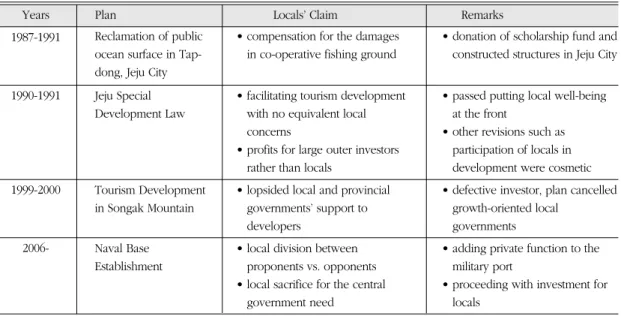
play against the central government plans (Bu, 1997; Cho, 2003). Small and large scale movements have taken place until recently claiming compensation and rejecting central and local governmental development plans, respectively (Table 3). The early locals’
movements were asking for compensation in small local communities for the damages from the development projects including public ocean reclamation and golf course construction.
But there is a clear distinction before and after the extensive 1990 movement protesting against the Jeju Special Development Plan. The plan was begun with the presidential promise of more efficient Jeju development. The expectations from the locals were somewhat different from previous tourism centered, foreign capital based development. It would reverse previous problems of profit leakage out of Jeju and speculative land purchase by mainlanders expelling local residents from their fields. Locals expected small scale developments which would reduce the dependency on outer capital. They are local
Table 3. Development Plans and Locals’ Anti-Movements
Years Plan Locals’ Claim Remarks
1987-1991
1990-1991
1999-2000
2006-
• compensation for the damages in co-operative fishing ground
• donation of scholarship fund and constructed structures in Jeju City Reclamation of public
ocean surface in Tap- dong, Jeju City
• facilitating tourism development with no equivalent local concerns
• profits for large outer investors rather than locals
• passed putting local well-being at the front
• other revisions such as participation of locals in development were cosmetic Jeju Special
Development Law
• local division between proponents vs. opponents
• local sacrifice for the central government need
• adding private function to the military port
• proceeding with investment for locals
Naval Base Establishment
• lopsided local and provincial governments’ support to developers
• defective investor, plan cancelled growth-oriented local
governments Tourism Development
in Songak Mountain
tradition based facilities rather than resort facilities distant from the traditional culture and balanced consideration of agriculture to overcome the impoverishing rural areas which still provide important employment opportunities. However, the plans were prepared without paying attention to locals’ expectations. It was just an empty promise to develop people well-being rather than place well-being. The protests were expansive all over the Jeju and lasted about one and a quarter years.
The protests evolved into confrontation between the central government and Jeju locals, top-down and bottom-up approach, tourism and agricultural-fishery, their and our profit and so on (Yu, 1984; Bu, 1997). The Plan in a revised version was passed in 1995 which was effective until 2001. Several changes could be pointed out:
improve locals’ well-being instead of developing (inter)national tourism center, development plans set by local municipalities rather than by the appointed governor, and reinvest profits for local development (Bu, 1995; S. Lee, 1998). These are, however, cosmetic changes, just naming locals as the development agencies since most development projects should rely on the foreign capital investments which would go for tourism development rather than the locals’ living conditions.
Since the local self-governing system, locals chose a ‘self-deterministic’ non-partisan candidate governor to portray locally based alternative development path. Several locally initiated projects were implemented as mentioned earlier.
But they were not going well without the support from central government.9) This was especially prevalent during the IMF crisis which made the whole nation lower regulations and eager to bring in foreign capital investments. Jeju seemed to be chosen as the safety valve of liberalization pressure from globalization with the name of Jeju Free International City (Kim and Ahn, 2006; B.
Park, 2005).
After the slack development period of local self-governing system, another round of local movements began in the reverse direction. The inclination to local growth pursued for any available capital investments and projects. The mega resort projects should rely on foreign capital investments with attractive tax reduction, land provision, and other concessions. We see the Mt. Songak development plan to construct recreational facilities on and around the geologically rare double volcanic craters and attracting naval base establishment to the Southern sea villages. In these development projects, local movements take complex shape;
the small local communities want certain developments whereas the movements against such developments were initiated in the wider scale environmental groups and the overall Jeju- do residents against the Mt. Songak and naval base, respectively. While environmental conservation and peace island promotion are the justification of the anti-movements, the directly expressed local growth demands are curbed by wider level residents and organizations. These local movements are not political; locals do not stick to keeping the transcendental island identity and self-containment. Rather they are the movements to draw a mediated path from the extreme top-down central government plans and bottom-up local community-led developments in constantly changing circumstances.
3) Spatial Organization: Concentration and Dispersion
As mentioned earlier, central government-led tourism development had to be concentrated in a few designated areas due in part to the lack of available funds and the efficient growth-pole theory prominent at that time. Initially, the central government designated 3 tourist sites with
investments in tourism facilities during the 1970s.
The development goals for tourism and regional development expanded to designating 3 tourism complex and 14 tourism sites in the 1980s. To those, locals requested the local government to add 13 additional tourism sites and later one more to the previous sites under the comprehensive regional development plan. In 1994 after the turmoil of the Jeju Special Development Law, the designated tourism sites were reduced to large 3 complexes and small 10 sites to overcome the slow progress. The 3 large complexes are the tourist centers receiving most of the investments. The first 5 small zones were designated for providing recreational and accommodation facilities and then an additional 5 zones were added for achieving balanced regional development (Jejudo, 1994). But in 1997, just a year after the local self-governing system, 10 more sites were added to mitigate locals’
opposition for balanced regional development mostly in the western part of Jeju who are excluded in the designation (Figure 1).
The added small scale zones were wide-spread across the island and they were to employ locally available resources for small scale developments, and allow locals to take part in the development
process and profit-sharing. However, it does not mean that this type of development is satisfactory to the locals. In fact, investments and progress do not follow up into the designated areas. A survey result reveals that IMF circumstance is the major reason, but the other important reasons are the government regulations in environmental impact assessment and difficulty in purchasing land which is highly priced by locals (Hwang and Chang, 1998). Other reasons state that too many similar facilities in a small island would not guarantee profits from investments. Residents even if their property is designated as a tourism site are reluctant to sell their lands without confidence of reaping development profits to their localities. It indicates that locals want tourism development but for their own interests.
Several attempts have been exerted to develop Jeju with local resources and capital under the local self-governing system. But these were during the slack periods of few visitors and low tourism investments. Another round redirecting the development path was proposed in large scale foreign capital developments such as mega- resort construction accommodating more than one million visitors sweeping out the existing numerous small dispersed tourism sites, casino
Figure 1. Spatial Organization of Jeju Tourism
and other sports and recreational facilities and cable car to Mountain Halla. Reduced increase in the number of tourists, KTX operation, and the opening of a North Korea tour are often emphasized to justify the large scale development. In this context, the plan of Jeju Free International City is easily accepted as a compromise between the national policy to fulfill the growing liberalization demand in spatially selective manner and the locals’ growth expectations. The core of the Jeju Free International City is to develop the seven leading projects: Residential resort complex, Jungmun recreational complex, Seogwipo Tourism port, High-tech Science Park, Free trade zone, Shopping outlet, and Mythology and history park (Y. Yang, 1999).10) The core projects are in a sense similar to the previous growth center oriented development which had to face opposition for the balanced regional development. But in this case, the projects are welcomed by Jeju locals and there is even competition among localities to attract them within their boundary. This is a reflection of locals’ alternating strategy in spatial organization.
4) Jeju Island’s Alternating Strategy for Local Development
Claims that islands are too small and too weak to manage their own development have been the dominant approach to island development.
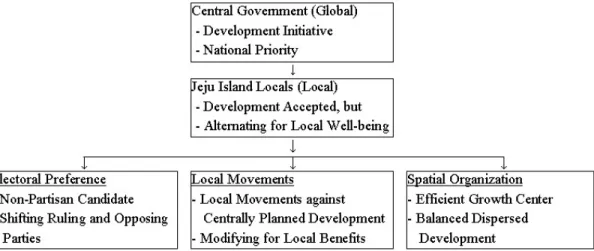
Seeing islands as places without power is a tempting assertion resulted from the island vulnerability paradigm. As such, the current states of development in Jeju and other islands are viewed as the outcome exogenously determined by central governmental plans. Recent local movements underscore local identity as a confrontation between global versus local or development versus conservation. This paper takes the global-local relations and moves forward to put the locals at the fore in a mediated manner. That is, Jeju locals recognize their weakness, thus accepting central government development plans while managing them to their well-being by expressing their voices in available opportunities. These opportunities are the election for the national assembly, direct local movements against development plans, and the spatial organization of development projects.
They are inter-related in real world (Figure 2).
The well known non-partisan preference in
Figure 2. Approaching Local Development with Locals’ Alternating Strategies
election reflects the local neutral stance to the central government until the local self-governing system began. It has its roots in island insulation.
Since then, electoral preference expecting more support from central government moved to the ruling party candidates. But under the most recent neoliberal ruling party government, Jeju locals chose the oppositional party candidate, revealing their strategy alternating between ruling and oppositional parties. Concerted local movements against central government plans in Jeju are also not to abandon foreign or central government plans, but to express their interests in people well-being rather than place well-being.
Often it is presented as a matter of growth versus conservation, global versus local, and others. But local movements are not political and eternal, but to draw a mediated development path alternating the top-down central government plan to the locals’ benefits. Related with these, the spatial organization of tourism sites was begun with unbalanced growth center based development which is efficient with limited amount of investments to the demands of locals. It shifted to spatially dispersed tourism site designation for locals’ well-being. However, the spatially dispersed site developments did not proceed well due to the limited local resources, and the numerous sites were not attractive to outer investors seeking profits. As a consequence, shift to large scale developments occurred, as seen in projects such as mega resort facilities and the core leading projects in the Jeju Free International City plan.
The changes in electoral preference, local movements and spatial organization reflect the alternating strategy Jeju locals take to express their concern along with the influential central government growth imperatives and associated plans. The central government pays attention to Jeju when the national economy is slack. Jeju Island locals acknowledge their powerlessness,
thus accepting central government plans while modifying them to their side. The local voices are expressed in election, local movements, and the spatial organization of development projects.
They are inter-related in shaping the Jeju development. This would be a shrewd stance and solution to overcome the weak economic and political clout that islands have evolved with.
4. Summary and Conclusion
Jeju-do, as other islands in the world, has experienced drastic change from an isolated agriculture-fishery to a tourism centered economies. Tourism development was the frequent choice as an economic pillar in numerous islands. Island developments are viewed as a highly subsidized outcome which relies heavily on the external forces. On the contrary, local consciousness and identity are often brought into the front to challenge global dominance. Previous approaches to understand island development were in two extremes based on either the vulnerability or local consciousness.
Sticking purely to the global or the local would hinder the understanding of insular survival strategies in the open competitive world. Recently some innovative development strategies are discussed for island resilience such as offshore banking, ship registry, special economic zone and others. While the success stories of some islands are presented with locally based innovative strategies, they need to be elaborated in relation to global or outer forces.
This paper proposes an alternating strategy from the perspective of the national-local relations. It posits that island locals recognize their disadvantages from a limited resource base and accept central government development plans with their local voices modifying them for
their well-being. Specifically, the long lasted non- partisan preference is often considered as the neutral island locals’ political stance. It changed, however, to the ruling party preference since the beginning of local self-governing system in 1995.
It indicates that Jeju locals realized the importance of central government support under the limited local resources and weak political clout contexts. The electoral preference shifted again to the oppositional party when the new central government put priority on the efficient development over balanced regional development. The local movements against the central government-led Jeju Special Development Plan were so concerted to be regarded to revert to local identity or determination. It turned out, however, that they exerted against the plan set by the central government that had few local considerations without any political background.
The spatial organization of the development projects also shifted between the extremes of large scale, foreign capital based concentration and small scale, local based decentralization.
Initially, a few growth center based development plan were set by the central government. Later, locals claiming balanced development added numerous small scale tourism sites. But recently foreign capital based large scale projects have come to the front to overcome sluggish investments and increase in tourism.
These aspects of Jeju Island development experiences reveal the alternating strategies chosen by Jeju locals between the extremes of global forces and local identity. The alternating strategy takes both the vulnerability and resilience understanding of island development in which the resilience is elaborated in a conscious survival strategy of vulnerable islands under the influential global forces. It is a way of understanding the island reality where numerous policies emerge and live shortly, and then new plans rise again without producing satisfactory outcomes to either
the central government or the island locals. It seems to be more intact with what the locals want both in satisfying development needs and keeping their identities. It could be an alternative way of understanding the vulnerable and resilient island development experiences in global-local relations with a dynamic and situational perspective.
Notes
1) Tourism seems to be deeply rooted in island development. As tourism depends on visitors coming from other regions, the island dependency is reflected in election pledges, such as securing more central government budget and lobbying to bring government projects to Jeju.
2) In the context of the Saemangeum reclamation project, the deliberate strategy to proceed local growth between development and conservation confrontation is compared to the swing of the pendulum in-between the extremes (S. Park, 2002). One can also use this metaphor to describe the interactive understanding of two extremes in the alternating strategy presented in this paper.
3) Public sector represents about 23.6 percent of the GRDP in 2006 including electricity, gas, and water supply, public administration and social security, education, health and social work. This data fits with the MIRAB economy model and, if considered with tourism industry, Jeju economy could be called a TOBU (tourism and bureaucracy) economy.
4) If there is an extreme anti-government policy movement, it is in part supported by the citrus production. Largely owned by locals, it provides the second largest income after tourism as well as a base for arguing their interests against foreign-dominated tourism development. Even if the GRDP in agriculture is low, their employment in local economy nonetheless accounts for a relatively higher proportion.
5) This is reflected in the name changes of the local non- governmental organization, from ‘Pan-Jeju Locals for Participatory Self-Governing’ to ‘Solidarity of Jeju for Participatory Self-Governing and Environmental Conservation.’
6) Basically, the higher voter turnouts could be explained by ease of voting access in the small island. But, a more plausible explanation would be close concerns with local community and development matters (C. Yang, 2001;
Jung, 1996).
7) Easily found in the election advertisement pamphlets are phrases promising to attract government projects and lobbying for more financial allocation and infrastructural investments.
8) Participating islands included Bali, Indonesia, Hainan, China, Okinawa, Japan, and Jeju, Korea. The forum was first suggested by the governor of Jeju Island in 1997.
9) ITOP forum continues without many productive outcomes; the World Island Festival ceased due to a continuing deficit; the Convention Center has higher operation costs than earnings; Samdasoo drinking water makes profit but Jeju-do takes only 20percent and the others are reaped by the distribution and marketing agency, Nongshim (a food corporation established and operated by a brother of the Lotte conglomerate).
10) Similar to but separate from the Jeju Free International City Plan are the construction of the 2nd Airport for extended operation time and the designation of all of Jeju-do as a tax free zone.
Reference
Armstrong, Harvey and Read, Robert, 2002, The Phantom of Liberty?: Economic Growth and the Vulnerability of Small States, Journal of International Development, 14, 435-458.
Armstrong, Harvey and Read, Robert, 2006, Geographical ‘handicaps’ and small states: Some implications for the Pacific from a global perspective, Asia Pacific Viewpoint, 47, 79-92.
Baldacchino, G., 2006, Innovative Development Strategies from Non-Sovereign Island Jurisdictions? A Global Review of Economic Policy and Governance practices, World Development, 34, 852-867.
Betram, 2006, The MIRAB model in the twenty-first century, Asia Pacific Viewpoint, 47, 1-13.
Briguglio, Lino and Cordina, Gordon, 2006, Economic Vulnerability and Resilience in Small
Jurisdictions, Journal of Korean Urban Geographical Society, 9, 11-24.
Bu, Man-gun, 1997, Local Residents’ Movements in Jeju (in Korean), Cheju Natational University Press, Jeju.
Bu, Man-gun, 1995, A Study on the Special Development Act of Jeju Island focusing on the Locals’ Anti- movement (in Korean), Onnuri Publication, Jeju.
Cho, Sungyun, 2003, Regional Development Plans and the Prospects of Residents’ Movement in Jeju-do (in Korean), in Jeju Buddist Society Center (ed.), Reflections and Direction of Jeju Regional Development Policy in Transition Period, Gak Publication, Jeju.
Choi, Sung-dam, 1998, Jeju Tourism: losed competition and regaining plan (in Korean), in The Committee of Int’l Jeju and Cheju Univ., Tourism Research Center (eds.), Tourism Industry in the 21C and the Future of Jeju Tourism, O-rum Publication, Jeju.
Dalby, Simon and Mackenzie, Fiona, 1997, Reconceptualising local community: environment, identity, and threat, Area, 29(2), 99-108.
Goss, J.D., 1993, Placing the market and marketing place: tourist advertising of the Hawaiian Islands, 1972-1992, Environment and Planning D: Society and Space, 11, 663-688.
Guthunz, Ute and Krosigk, Friedrich, 1996, Tourism Development in Small Island States: from Mirab to Tourab? in Briguglio, Lino et al. (eds.), Sustainable Tourism in Island and Small States Issues and Policies, Pinter, London.
Hwang, Kyung-su and Chang, Sung-su, 1998, Reasons of Shrinked Tourism Development and the Role of Development Agencies (in Korean), Jeju Development Review, 2, 143-176.
Hwang, Myungchan, 1988, Jeju Development: Centrally Concentrated or Regionally Dispersed? (in Korean), in Cheju National University, Problems in Jeju Development, 9-12.
Jeju Development Institute, 2001, Public Opinion concerning the 2nd Jeju Comprehensive Development Plan (in Korean).
Jejudo, 1994, Jeju Comprehensive Development Plan.
Jung, Dae-yun, 1996, The Election Behavior of Jeju
residents (in Korean), Jeju Review, 1, 12-20.
Kang, Namgyu, 2006, Finding Self-identity in Jeju Tourism (in Korean), Korean Tourism Policy, 24, 106-113.
Kim, Junewoo and Ahn, Youngjin, 2006, Background and Dynamics of Free Economic Zones in Korea (in Korean), Journal of Korean Urban Geographical Society, 9(3), 79-87.
Kim, Suk-jun, 1998, Election in Jeju, 1948-1992 (in Korean), in Shin, Hangchul et al. (eds.), Discourses of Jeju Society 2, Hanul Publishing, Seoul.
Ko, Changhoon et al., 1999, A Survival Strategy for Islands: A Model for Cheju-Do International Free Zone as Practical Thoughts About Goal Sharing Between Islanders and Foreign Investors, Journal of Island Studies, 2(1), 7-27.
Kwon, Sangcheol, 2001, Tourism Development Imperative and Environmental Concern in Jeju- do (in Korean), Nature Conservation, 114, 51-55.
Lee, Chan-gi, 1992, The Sociocultural Characteristics and Environment of Jeju Island-the mechanisms of Challenge, Adaptation, Transcendence (in Korean), Journal of Jeju Studies, 9, 17-35.
Lee, Jangchoon and Song, Jaeho, 1999, Alternative Island Tourism: Political Ecological Approach (in Korean), Research of Tourism Policy, 5(2), 7-36.
Lee, Sang-chul, 1998, Development Policies at Jeju and Attitudinal Change of Locals (in Korean), in Shin, Hangchul et al., eds., Discourses of Jeju Society 2, Hanul Publication, Seoul.
McElroy, J., 2003, Tourism development in small islands across the world, Geofrafiska Annaler B, 85, 231-242.
Park, Bae-gun, 2005, Globalization and the Local Political Economy: the Multi-scalar Approach, Global Economic Review, 34, 397-414.
Park, Soon-Yawl, 2002, The Saemangeum Reclamation Project and its Advocate: Strategies of the Cheonbuk Growth Coalition (in Korean), ECO, 2, 172-201.
Royle, Stephen, 2001, Geography of Islands: Small island insularity, Routledge, London.
Shon, Jim, 1998, Philosophies of Development in Hawaii, Journal of Island Studies, 1, 46-51.
Song, Jae-ho, 1997, International Tourism and Island:
Change and Identity (in Korean), Journal of Jeju Studies, 14, 193-223.
Song, Sung-dae, 1996, The Seamanship Spirit of Jeju Locals (in Korean), Papirus Publication, Jeju.
Stratford, Elaine, 2006, Technologies of agency and performance: Tasmania Together and the constitution of harmonious island identity, Geoforum, 37, 273-286.
Treadgold, Malcolm, 1999, Breaking out of the MIRAB mould: historical evidence from Norfolk Island, Asia Pacific Viewpoint, 40, 235-249.
Wong, Poh Poh, 2006, Island Tourism Development Strategies: Implications for Jeju, Journal of Korean Urban Geographical Society, 9, 25-33.
Yang, Chang-Yoon, 2001, The Regional Political Culture and the Elections: Stressed on the General Elections in Jeju Province (in Korean), Journal of Korean Political Association, 173-196.
Yang, Sun-a, 1999, ‘Cultural Tourism’ of the Local and the Reconstruction the Case of Jejudo (in Korean), Master’s Thesis, Seoul National University.
Yang, Youngchul, 1999, A Critical Examination of the Jeju International City Policy (in Korean), Law and Policy, 5, 91-110.
Yu, Chul-in, 1984, Daily Lives and Insularity: Cognitive- Anthropological Approach toward the Jeju Culture (in Korean), Journal of Jeju Studies, 1, 119-144.
Correspondence: Sangcheol Kwon, Geography Education Major, Cheju National University, Jeju City, Jeju 690- 756, Korea (e-mail: [email protected], phone: 064- 754-3234)
교신: 권상철, 제주도 제주시 제주대학교 지리교육전공, 690- 756 (이메일: [email protected], 전화: 064-754- 3234)
Recieved May 27, 2008 Accepted June 23, 2008