Influence of time-of-day on respiratory function in normal healthy subjects
Purpose: Human body have biological rhythmic pattern in a day, which is affected by internal and external environmental factors. We investigated whether respiratory function was fluctuated according to the influence of time-of-day (around at 9 am, 1 pm, and 6 pm) in health subjects, using pulmonary function test (PFT).
Methods: Eighteen healthy volunteers (8 men, mean ages; 22.4±1.6, mean heights; 166.61±9.60, mean weight; 59.3±10.3) were recruited. Pulmonary function test (PFT) was measured at three time points in day, around 9 am, 1 pm, and 6 pm in calm research room with condition of under 55dB noise level, using a spirometer (Vmax 229, SensorMecis, USA). Forced vital capacity (FVC), forced expiratory volume at one second (FEV1), FVC/ FEV1, and peak expiratory flow (PEF) were acquired.
Results: In comparison of raw value of PFT among three time points, subjects showed generally better respiratory function at 9 am, than at other points, although no significance was found. In comparison of distribution of ranking for respiratory function in each individual, only PEF showed significant difference. In general, distributional ratio of subjects who showed best performance of respiratory function in a day was high.
Conclusion: These findings showed that circadian rhythm by diurnal pattern was not detected on respiratory function throughout all day. But, best performance on respiratory function was observed mostly in the morning, although statistical significance did not exist
Key Words:Respiratory function, Circadian rhythm, Time-of day
plSSN 1229-0475·elSSN 2287-156X J Korean Soc Phys Ther Vol.25, No.6, December 2013
Yong Hyun Kwon
Department of Physical Therapy, Yeungnam University College of Science and Technology
The Journal of Korean Society of Physical Therapy Original articles
Ⅰ. Introduction
Respiratory function is one of essential components to sustain cell metabolism that is necessary for vital function, and enable to perform motor activity in human body.
Pathologic condition of respiratory system causes to have functional limitation of daily activity of life and to threat human life, according to degree of its parenchymal damage.
Copylight ⓒ 2013 The Korea Society of Physical Therapy
This is an Open Access article distribute under the terms of the Creative Commons Attribution Non-commercial License (Http:// creativecommons.org/license/by-nc/3.0.) which permits unrestricted non-commercial use, distribution,and reproduction in any medium, provided the original work is properly cited.
Received Nov 11, 2013 Revised Dec 2, 2013 Accepted Dec 5, 2013
Corresponding author Yong Hyun Kwon, [email protected]
Therefore, clinical professions associated with respiration function have been interested in assessment of its function status and therapeutic intervention1, 2. In clinical setting, these respiratory functions are measured by pulmonary function test (PFT). PFT is one of diagnostic tools for severity of pulmonary impairment, and for identification of remedial effect following therapeutic interventions. In PFT, various respiratory indexes that reflect functional capacity of lung are acquired, in terms of forced vital capacity (FVC), forced expiratory volume at one second (FEV1), FVC/ FEV1, and peak expiratory flow (PEF). These indexes of PFT provide clinicians with diagnostic information whether pulmonary dysfunction is caused by obstructive ventilator impairment by limitation of air flow or restrictive ventilator impair by
Yong Hyun Kwon : Time-of-day on respiratory function
decrease of pulmonary capacity 3-5.
Human body have diurnal rhythmic pattern in physiologic and neurologic features, which is expressed as circadian rhythm6-8. It is usually affected by automatic physiologic mechanism, such as body temperature, sleep cycle, and cardiac rhythm, as well as various external environmental factors such as daylight, temperature, social interaction, and timing of meals9,10. In other words, biological function including cognitive, physical, metabolic abilities is fluctuated throughout 24 hours in a day, by the above mentioned internal and external factors. Many previous studies reported that a variety of bio-physiologic functions were fluctuated during 24 hours period8,11-13. In addition, recent investigations regarding time-of-effect on motor action have been published14, suggesting that circadian variation was existed on the following motor aspects; handwriting1,2, counter-flicking target performance13, maximum voluntary muscular force15,16, and anaerobic exercise17,18. To the best of our knowledge, no evidences regarding circadian variation on respiratory function were published until the present.
Therefore, we attempted to investigate the question of whether respiratory function was fluctuated by diurnal pattern, and the question of which time was the best on its function, during three different time points in terms of 9 am, 1 pm, and 6 pm.
II. Methods
1. Subjects
Eighteen healthy volunteers were recruited in this study, who were 8 men and 10 women with 22.4±1.6 mean ages, 166.61±9.60 mean heights, and 59.3±10.3 mean weight.
They satisfied following inclusive criterions; 1) 20’s healthy volunteer without history of neurological symptoms, 2) no history of medication uptake for any medical problem with 1 month, 3) no neuropsychiatric impairments, 4) no history of pulmonary dysfunction within past 1 years. Participants were instructed to take enough sleep for over 7 hours, and not to take alcohol in the previous day of the experiment. All subjects understood purpose of this study, and gave written informed consent before participation of the experiment.
2. Measurement of respiratory function
Respiratory function was measured at three time points in day, around 9 am, 1 pm, and 6 pm, using pulmonary function test (PFT). Measurements of PFT were repeated in an counterbalanced order across the subjects for elimination of learning effect. In other words, one-third of participants took the testing procedures in order of time sequence such as 9A, 13P, and 18P, and another one-third of them took the tests at 13P, 18P, and 9A of the following day, and the rest of them took the tests at 18P, 9A and 13P of the following day. All tests were performed in calm research room with condition of under 55dB noise level. All subjects were asked not to perform vigorous physical activities on the day of experiment, and just to perform general activity of daily life such as walking, stair down/up, and so forth.
PFT was tested by one examiner who had over five experienced physical therapist throughout the entire experiment, using a spirometer (Vmax 229, SensorMecis, USA). Subjects sat down on a chair with a backrest. They were asked to breathe in, and then to breathe out though a mouth piece, as deeply and rapidly as possible. PFT was measured two times with a rest time for at least 5 minutes between each trial, in order to prevent hyperventilation.
In the best trial of two, forced vital capacity (FVC), forced expiratory volume at one second (FEV1), FVC/ FEV1, and peak expiratory flow (PEF) were adopted.
3. Statistical analysis
All statistical analysis was conducted using statistical software, PAWS 18.0 (SPSS, Chicago, IL, USA). One- way ANOVA were analyzed for comparison of respiratory functions among three different time points (i.e., at 9 am, 1 pm, and 6 pm), in terms of FVC, FEV1, FVC/ FEV1, and PEF. Post-hoc analysis was performed by Bonferroni procedure. Statistical significance was considered at the level of P< 0.05.
III. Results
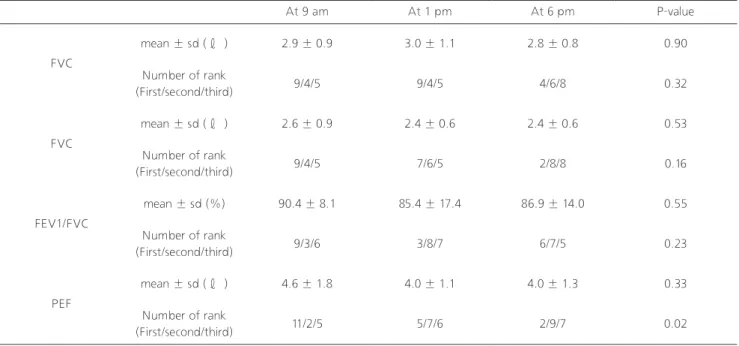
Table 1 indicates comparison of respiratory function among three different time points (i.e., at 9 am, at 1 pm, and at
Yong Hyun Kwon : Time-of-day on respiratory function
6 pm), in terms of FVC, FEV1, FEV1/FVC, and PEF. All respiratory functions were fluctuated in time of day from in the morning to in evening time. In comparison of raw values in respiratory function, subjects showed generally higher performance at 9 am, compared with at 1 pm and 6 pm, except FVC, although there was statistically no significant different. In addition, distributional ratio of subjects who showed best performance of respiratory function in a day was generally higher at 9 am than other time points. In comparison of distribution of ranking for respiratory function among three different time points in each individual, significant difference was found in only PEF.
IV. Discussion
This study was designed to investigate effect of time-of- day on respiratory function by diurnal pattern at three different time points (i.e., at 9 am, at 1 pm, and at 6 pm). As results of comparison of respiratory function among three different time points, no significant differences were found in FVC, FEV1, FEV1/FVC, and PEF. However, although statistical significance was not detected in comparison among three different time points, all dependent
variables of respiratory function except FVC was generally higher score at 9 am, compared with at 1 pm and at 6 pm.
For the reason of this non significance in direct comparison of raw value on respiratory function, we thought that it might be due to extreme diversity of intra-individual difference in each of time points. For example, subject 2 showed 4.7 and 4.0 in FVC and FEV1 at 9 am, whereas subject 13 showed 2.1 and 1.6 in the same variables at 9 am.
In addition, diversity of inter-individual circadian fluctuation was somewhat highly observed. For example, subject 3 showed 3.6, 2.8, and 3.4 at 9 am, 1 pm, and 6 pm in FVC, respectively, whereas subject 2 showed 4.7, 3.9, and 2.9 at three time points in FVC. We re-analyzed distribution of order priority for respiratory ability among three different time points such as at 9 am, 1 pm, and 6 pm, because of these non-significant findings for comparison of raw independent value. As results,distributional ratio of subject number who had the best performance of respiratory function throughout all day was generally higher at 9 am than at 1 pm and 6 pm. However, only significant difference was found in PEF, in comparison of distribution of order priority among three different time points. Therefore, we found out that circadian rhythm by diurnal pattern was not detected on respiratory function in terms of FVC, FEV1, and Table 1. Comparison of respiratory function among three different time points
At 9 am At 1 pm At 6 pm P-value
FVC
mean ± sd ( ℓ ) 2.9 ± 0.9 3.0 ± 1.1 2.8 ± 0.8 0.90
Number of rank
(First/second/third) 9/4/5 9/4/5 4/6/8 0.32
FVC
mean ± sd ( ℓ ) 2.6 ± 0.9 2.4 ± 0.6 2.4 ± 0.6 0.53
Number of rank
(First/second/third) 9/4/5 7/6/5 2/8/8 0.16
FEV1/FVC
mean ± sd (%) 90.4 ± 8.1 85.4 ± 17.4 86.9 ± 14.0 0.55
Number of rank
(First/second/third) 9/3/6 3/8/7 6/7/5 0.23
PEF
mean ± sd ( ℓ ) 4.6 ± 1.8 4.0 ± 1.1 4.0 ± 1.3 0.33
Number of rank
(First/second/third) 11/2/5 5/7/6 2/9/7 0.02
Table 1. General characteristic of subjects
FEV1/FVC throughout all day. However, best performance on respiratory function was observed mostly in the morning, although statistical significance did not exist.
These findings could not be compared with previous studies, because of lack of publication suggesting the time- of-day effect on respiratory function by circadian rhythm.
However, many recent studies indicated that cognitive and physical functions were fluctuated throughout all day, according to biological circadian rhythm in human body 1,2,14. In particular, in field of physical medicine and sports science, several prior investigations suggested that effect of time- of-day had a consistent influence on postural control ability 10,19-21. However, these publications produced different outcomes, regarding question of when best performance on balance ability was among three time points, in term of in the morning, in the afternoon, and in evening. Gribble et al21. reported that performance of dynamic postural control was better in the morning than in the afternoon and evening.
Jorgensen et al10 demonstrated that postural balance was influence by effect of time-of-day in older adults, and that better performance was observed in the afternoon, relatively to in the morning and evening, in terms of confidence ellipse area, total way length, sway area, and velocity moment.
Bourgard et al20 indicated that center of pressure surface area was lower at 6 pm, than at 10 am and the 2 pm.
Moreover, our previous findings revealed that performance time and total distance in center of pressure were changed by circadian rhythm, and the best balance performance was observed in the morning, and that static and dynamic postural balance ability were worst at 1 pm19. We could not describe the reason why these discrepancies occurred.
However, it is obvious converging evidence that circadian rhythm on motor performance by diurnal pattern is existed.
As several possible explanations for non-significant findings in this study, we assumed that these might be attributed to extreme small amount of variation on respiration function in all day and difficulty of elimination of various internal and external environmental factors.
In other word, we speculate that changeable capacity of respiration function is not wide enough to detect the effect of time-of-day. In addition, our study did not control the
amount of intensity and duration of physical activity, consumption of beverages or water, time of sleep in previous day, prior to each testing session. Rather, familiarization of task procedure on respiratory function test is also one of possible factors. According to previous studies9,10, these internal and external factors were known to influence the effect of time-of-day.
In summary, it is well known that circadian rhythmic pattern in human body precisely existed, in cognitive function, physical performance, metabolism, and so forth2,9,13,22. However, our findings did not present that respiratory function was influence by effect of time-of-day at three different time point in day. For non-significant findings in our outcome, we assumed, it might be due to small amount of inter-individual variation on effect of time-of-day and lack of control for internal and external factors which can be affected to diurnal rhythmic pattern. Respiratory function is essential component of vital function to maintain human life. Therefore, it is valuable to elucidate the effect of time- of-day on respiratory function, on account that decision of evaluation time point on its function in a day is an important clinical issue. In further study, we expect that effect of time- of-day will be clarified, considering large sample size and control variable which can be affected circadian rhythm.
Acknowledgement
This study was supported by Basic Science Research Program through the National Research Foundation of Korea (NRF) funded by the Ministry of Education, Science and Technology (2012R1A1B4003477).
References
1. Kim SY, Kim N, S., Jung JH et al. Effect of forward head posture on respiratory function in young adults. J Korean Soc Phys Ther. 2013;25(5):311-5.
2. Lee HY, Kang DY, Kim K. Analysis of correlation between respiratory characteristics and physical factors in healthy elementary school childhood. J Korean Soc Phys Ther.
2013;25(5):330-6.
3. Kim YN. Comparison of effectiveness of breathing intervention program for improvement of pulmonary functions according
Yong Hyun Kwon : Time-of-day on respiratory function Table 1. General characteristic of subjects
Yong Hyun Kwon : Time-of-day on respiratory function
to prevalence period in patients with copd. J Korean Soc Phys Ther. 2013;24(5):355-61.
4. Shin HK. The effects of water-based exercise on respiratory function in children with spastic diplegic cerebral palsy. J Korean Soc Phys Ther. 2012;24(3):198-201.
5. Berry CE, Wise RA. Interpretation of pulmonary function test: Issues and controversies. Clin Rev Allergy Immunol.
2009;37(3):173-80.
6. Webb W. Biological rhythms, sleep, and performance. New York, NY: John Wiley and Sons, Ltd; 1982.
7. Nicolas A, Gauthier A, Trouillet J et al. The influence of circadian rhythm during a sustained submaximal exercise and on recovery process. J Electromyogr Kinesiol. 2008;18(2):284-90.
8. Saunders D. Introduction to biological rhythms. Glasgow, Scotland, England: Blackie; 1977.
9. Hoyer D, Clairambault J. Rhythms from seconds to days.
Physiological importance and therapeutic implications. IEEE Eng Med Biol Mag. 2007;26(6):12-3.
10. Jorgensen MG, Rathleff MS, Laessoe U et al. Time-of-day influences postural balance in older adults. Gait Posture.
2012;35(4):653-7.
11. Bessot N, Moussay S, Gauthier A et al. Effect of pedal rate on diurnal variations in cardiorespiratory variables. Chronobiol Int.
2006;23(4):877-87.
12. Davenne D, Lericollais R, Sagaspe P et al. Reliability of simulator driving tool for evaluation of sleepiness, fatigue and driving performance. Accid Anal Prev. 2012;45677-82.
13. Edwards B, Waterhouse J, Reilly T. Circadian rhythms and their association with body temperature and time awake when performing a simple task with the dominant and non-dominant
hand. Chronobiol Int. 2008;25(1):115-32.
14. Gueugneau N, Papaxanthis C. Time-of-day effects on the internal simulation of motor actions: Psychophysical evidence from pointing movements with the dominant and non- dominant arm. Chronobiol Int. 2010;27(3):620-39.
15. Gauthier A, Davenne D, Martin A et al. Time of day effects on isometric and isokinetic torque developed during elbow flexion in humans. Eur J Appl Physiol. 2001;84(3):249-52.
16. Guette M, Gondin J, Martin A. Time-of-day effect on the torque and neuromuscular properties of dominant and non- dominant quadriceps femoris. Chronobiol Int. 2005;22(3):541-58.
17. Souissi N, Souissi M, Souissi H et al. Effect of time of day and partial sleep deprivation on short-term, high-power output.
Chronobiol Int. 2008;25(6):1062-76.
18. Reilly T, Down A. Investigation of circadian rhythms in anaerobic power and capacity of the legs. J Sports Med Phys Fitness. 1992;32(4):343-7.
19. Kwon YH, Choi YW, Nam SH et al. The influence of time of day on static and dynamic postural control in normal adults.
Journal of Physical Therapy Science. In press
20. Bougard C, Lepelley MC, Davenne D. The influences of time- of-day and sleep deprivation on postural control. Exp Brain Res. 2011;209(1):109-15.
21. Gribble PA, Tucker WS, White PA. Time-of-day influences on static and dynamic postural control. J Athl Train.
2007;42(1):35-41.
22. Bessot N, Moussay S, Clarys JP et al. The influence of circadian rhythm on muscle activity and efficient force production during cycling at different pedal rates. J Electromyogr Kinesiol. 2007;17(2):176-83.