• 검색 결과가 없습니다.

An Alternative Surgical Technique for Repair of Anomalous Origin of the Left Coronary Artery from the Pulmonary Artery

N/A
N/A
Protected

Academic year: 2021

Share "An Alternative Surgical Technique for Repair of Anomalous Origin of the Left Coronary Artery from the Pulmonary Artery"

Copied!
5
0
0

로드 중.... (전체 텍스트 보기)

전체 글

(1)

Department of Thoracic and Cardiovascular Surgery, Samsung Medical Center, Sungkyunkwan University School of Medicine Received: September 2, 2013, Revised: October 21, 2013, Accepted: October 25, 2013, Published online: June 5, 2014

Corresponding author: Tae-Gook Jun, Department of Thoracic and Cardiovascular Surgery, Samsung Medical Center, Sungkyunkwan University School of Medicine, 81 Irwon-ro, Gangnam-gu, Seoul 135-710, Korea

(Tel) 82-2-3410-3484 (Fax) 82-2-3410-0089 (E-mail) [email protected]

C

The Korean Society for Thoracic and Cardiovascular Surgery. 2014. All right reserved.

CC

This is an open access article distributed under the terms of the Creative Commons Attribution Non-Commercial License (http://creative- commons.org/licenses/by-nc/3.0) which permits unrestricted non-commercial use, distribution, and reproduction in any medium, provided the original work is properly cited.

Young-su Kim, M.D., Mina Lee, M.D., Yang Hyun Cho, M.D., Ji-Hyuk Yang, M.D., Tae-Gook Jun, M.D.

Background: For the surgical management of anomalous origin of the left coronary artery from the pulmonary ar- tery (ALCAPA), there have been various techniques that reduce the tension and kinking of the coronary artery dur- ing reimplantation to the aorta. The aim of this study is to describe the results of our modified technique of coro- nary reimplantation for the treatment of ALCAPA. Methods: Between October 2003 and February 2011, seven pa- tients underwent coronary reimplantation with the modified technique (tubing formation with the sinus wall of the pulmonary artery and trapdoor formation at the site of implantation in the aorta). The median follow-up duration was 52 months (range, 4 to 72 months). Clinical outcomes and serial echocardiographic data were reviewed.

Results: There was no mortality. One patient had a small amount of cerebral hemorrhage postoperatively and im- proved without any sequelae. Another patient had left diaphragm palsy and underwent diaphragm plication.

Follow-up echocardiogram showed that all patients had normal ventricular function without chamber enlargement.

Conclusion: Our modified technique (tubing formation with the sinus wall of the pulmonary artery and trapdoor for- mation at the site of implantation in the aorta) demonstrated successful clinical outcomes. We conclude that this surgical technique can be a potential alternative for the treatment of ALCAPA.

Key words: 1. Coronary vessel anomalies 2. Bland white Garland syndrome 3. Replantation

4. Congenital heart disease

INTRODUCTION

Anomalous origin of the left coronary artery from the pul- monary artery (ALCAPA) is a rare congenital heart disease, with a reported rate of 1 in 300,000 newborns. It is charac- terized by high infant mortality, and if untreated, 90% of the patients die within their first year [1-4]. During the prenatal period, myocardial development is normal due to the oxy- genated pulmonary arterial blood and high pulmonary arterial pressure (PAP). After birth, however, the left coronary artery

(LCA) supplies deoxygenated blood at a low pressure to most

of the left ventricular myocardium [5,6]. Thus, the anomalous

origin must be corrected as early as possible [6,7]. Direct

coronary artery reimplantation and various modifications have

been introduced [8-10]. We have developed a modified, ten-

sion-free reimplantation technique using only native pulmo-

nary arterial and aortic tissue. Herein, we introduce our tech-

nique and the related clinical outcomes.

(2)

Fig. 2. (A) The left coronary artery is freed from the pulmonary artery, and the aortic trapdoor is opened anteriorly. (B) The pulmonary artery flap is folded to make a tube-like conduit.

Fig. 1. (A) The main pulmonary ar- tery is transected above the origin of the LCA. (B) The pulmonary ar- tery flap and aortic trapdoor are de- signed as shown. RC, right coronary artery; LCA, left coronary artery.

METHODS 1) Patients

We identified 7 patients who had undergone surgery for ALCAPA at the Samsung Medical Center from October 2003 to February 2011. Permission to perform a retrospective re- view of medical records was obtained from the institutional review board of Samsung Medical Center; the need for in- dividual consent for the study was waived. We reviewed their medical records. The median follow-up duration was 52 months (range, 4 to 72 months).

2) Surgical technique

Surgery was performed via standard median sternotomy

and cardiopulmonary bypass (CPB) using moderate hypothermia. Immediately after starting CPB, we clamped both pulmonary arteries. Cardioplegia was delivered via cath- eters in both the aorta and the pulmonary artery. We trans- ected the main pulmonary artery above the LCA. The tissue around the origin of the LCA was resected anteriorly and posteriorly. The longitudinal pulmonary arterial tissue was folded at a 90-degree angle and sutured superiorly and in- feriorly with 8-0 polypropylene to make a tubular conduit.

Then, the appropriate site for anastomosis was identified and

a trapdoor incision was made. The tubular coronary artery

conduit was anastomosed to the aorta with a continuous 7-0

polypropylene suture. The defect in the pulmonary artery was

repaired using glutaraldehyde-treated autologous pericardium

(3)

Fig. 3. (A) The LCA is anasto- mosed to the aortic trapdoor ante- riorly and directly to the aorta posteriorly. (B) The pulmonary artery is repaired with autologous pericar- dium, and the main pulmonary artery is reconstructed. LCA, left coronary artery; RCA, right coronary artery.

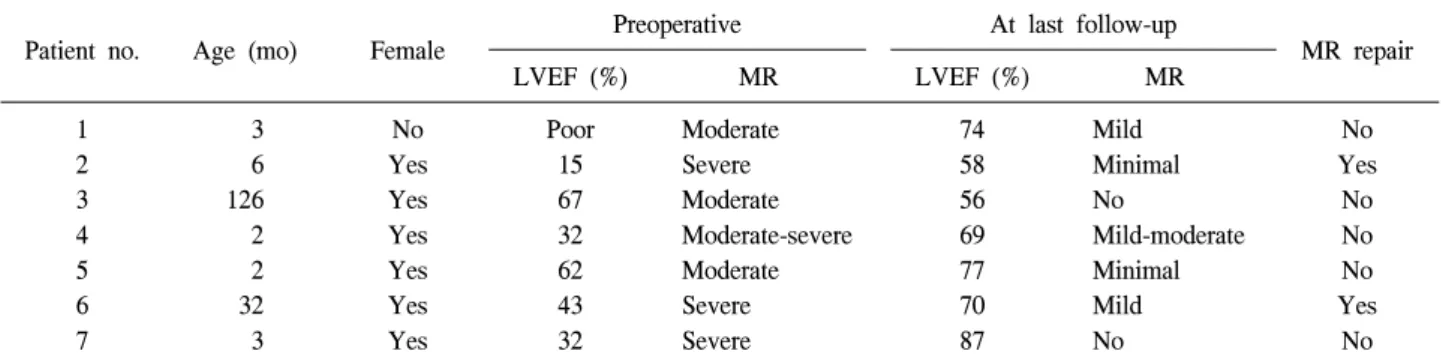
Table 1. Patient characteristics

Patient no. Age (mo) Female Preoperative At last follow-up

MR repair

LVEF (%) MR LVEF (%) MR

1 2 3 4 5 6 7

3 6 126 2 2 32 3

No Yes Yes Yes Yes Yes Yes

Poor 15 67 32 62 43 32

Moderate Severe Moderate Moderate-severe Moderate Severe Severe

74 58 56 69 77 70 87

Mild Minimal No

Mild-moderate Minimal Mild No

No Yes No No No Yes No LVEF, left ventricular ejection fraction; MR, mitral regurgitation.

(Figs. 1–3). Two patients who had a severe degree of mitral valve regurgitation with poor left ventricle (LV) function also underwent mitral valve repair.

RESULTS

The median age of the patients was 3 months (range, 2 to 126 months). There were six female patients and one male.

Six patients were younger than 12 months at the time of sur- gery, and one was 10 years old. The patients had a diverse range of symptoms including poor oral intake, cyanosis, leth- argy, and tachypnea. One patient did not have any symptoms and was diagnosed with ALCAPA incidentally. Echocardio- graphy was diagnostic in all patients and demonstrated a sig- nificant left ventricular distension and mitral regurgitation in all patients (Table 1).

The median CPB and cross-clamp times were 164 minutes (range, 123 to 171 minutes) and 83 minutes (range, 59 to

103 minutes), respectively. There was no mortality. Two pa- tients had postoperative complications. A three-month-old pa- tient had cerebral hemorrhage but recovered well without sequelae. A two-month-old patient had left diaphragm palsy and was treated with diaphragm plication.

Left ventricular contractility was normal before discharge in two patients, and the left ventricular ejection fractions were normal at the last follow-up (Fig. 4). Three patients un- derwent follow-up computed tomography angiography or cor- onary angiography, which showed good coronary patency (Figs. 5, 6).

DISCUSSION

ALCAPA was first described by Brooks in 1885 [1] and

was categorized into the infant type and adult type according

to the timing of symptomatic presentation [4]. The infant type

is more common than the adult type, since more than 90% of

(4)

Fig. 6. One year later, patient 7 underwent coronary angiography, which verified the patent left coronary artery.

Fig. 5. Follow-up computed tomography angiography was per- formed 5 years after surgery. It showed good coronary patency.

Fig. 4. Follow-up echocardiography showed enhancing LVEF.

LVEF, left ventricular ejection fraction; Preop, preoperative; Postop, postoperative.

patients who do not undergo surgery die within the first year of birth [11]. Myocardial ischemia is the most common cause of death. In infant-type ALCAPA, there is almost no collater- al formation. Therefore, the myocardial perfusion pressure is low, causing acute infarction. The adult type, on the other hand, has an abundance of collaterals. Even so, myocardial circulation resistance is greater than PAP, and flow reversal occurs, which can progress to ischemia. This is referred to as the “steal phenomenon” and eventually requires surgical cor- rection as well [2,11].

Surgical correction was first attempted by Potts in 1953 by producing an aortopulmonary shunt to elevate the pulmonary artery pressure and saturation. The first successful case was performed by Sabiston, in which correction was made to a one-coronary system with LCA ligation [5]. LCA ligation is currently not recommended due to high early and late mortal- ity [6].

The currently accepted principle of surgical correction is to maintain the two-coronary system through various techniques such as coronary button transfer, the Takeuchi procedure, and coronary artery bypass graft combined with ligation of the anomalous LCA [11]. Among these techniques, coronary but- ton transfer is used most frequently for the infant type with excellent results [11,12]. In the LCA button transfer techni- que, the anastomosis should be tension free without any kinks. Because extended LCA dissection can injure branch vessels, modified operational techniques have been used by various centers, including adjustment of the position of the anastomosis in accordance with the origin of the LCA [8] or creation of a pulmonary artery flap to increase the length [7,13-16]. We have used the pulmonary artery tube flap and aortic trapdoor techniques. These techniques allow for ten- sion-free anastomosis without kinking. Thus, we did not ex- perience any coronary artery complications.

It is common for ALCAPA to be accompanied by mitral

(5)

Simultaneous correction of MR during ALCAPA surgery re- mains controversial [9,12,17,18]. In this study, we selectively used mitral annuloplasty in two patients, and no patients had significant MR at the last follow-up.

In conclusion, our modified coronary transfer technique, consisting of a pulmonary artery flap tube and aortic trap- door, is safe and useful. This technique provides a large and long left main coronary artery without extensive dissection.

CONFLICT OF INTEREST

No potential conflict of interest relevant to this article was reported.

REFERENCES

1. Brooks HS. Two cases of an abnormal coronary artery of the heart arising from the pulmonary artery: with some re- marks upon the effect of this anomaly in producing cirsoid dilatation of the vessels. J Anat Physiol 1885;20(Pt 1):26-9.

2. Backer CL, Stout MJ, Zales VR, et al. Anomalous origin of the left coronary artery: a twenty-year review of surgical management. J Thorac Cardiovasc Surg 1992;103:1049-57.

3. Kreutzer C, Schlichter AJ, Roman MI, Kreutzer GO. Emer- gency ligation of anomalous left coronary artery arising from the pulmonary artery. Ann Thorac Surg 2000;69:

1591-2.

4. Wesselhoeft H, Fawcett JS, Johnson AL. Anomalous origin of the left coronary artery from the pulmonary trunk: its clinical spectrum, pathology, and pathophysiology, based on a review of 140 cases with seven further cases. Circulation 1968;38:403-25.

5. Edwards JE. The direction of blood flow in coronary arteries arising from the pulmonary trunk. Circulation 1964;29:163-6.

6. Jin Z, Berger F, Uhlemann F, Schroder C, et al. Improve- ment in left ventricular dysfunction after aortic reimplan- tation in 11 consecutive paediatric patients with anomalous origin of the left coronary artery from the pulmonary artery:

early results of a serial echocardiographic follow-up. Eur

8. Neches WH, Mathews RA, Park SC, et al. Anomalous origin of the left coronary artery from the pulmonary artery: a new method of surgical repair. Circulation 1974;50:582-7.

9. Vouhe PR, Tamisier D, Sidi D, et al. Anomalous left coro- nary artery from the pulmonary artery: results of isolated aortic reimplantation. Ann Thorac Surg 1992;54:621-6.

10. Turley K, Szarnicki RJ, Flachsbart KD, Richter RC, Popper RW, Tarnoff H. Aortic implantation is possible in all cases of anomalous origin of the left coronary artery from the pul- monary artery. Ann Thorac Surg 1995;60:84-9.

11. Pena E, Nguyen ET, Merchant N, Dennie G. ALCAPA syn- drome: not just a pediatric disease. Radiographics 2009;29:

553-65.

12. Dodge-Khatami A, Mavroudis C, Backer CL. Anomalous origin of the left coronary artery from the pulmonary artery:

collective review of surgical therapy. Ann Thorac Surg 2002;74:946-55.

13. Alsoufi B, Sallehuddin A, Bulbul Z, et al. Surgical strategy to establish a dual-coronary system for the management of anomalous left coronary artery origin from the pulmonary artery. Ann Thorac Surg 2008;86:170-6.

14. El-Rassi I, Soueide A, Sweid O, Chabb B. Transfer techni- que of an anomalous coronary artery from the anterior pul- monary artery. Ann Thorac Surg 2012;93:1738-40.

15. Barth MJ, Allen BS, Gulecyuz M, Chiemmongkoltip P, Cuneo B, Ilbawi MN. Experience with an alternative techni- que for the management of anomalous left coronary artery from the pulmonary artery. Ann Thorac Surg 2003;76:

1429-34.

16. Kang CH, Kim WH, Seo HJ, et al. Surgical treatment of anomalous origin of coronary artery from the pulmonary ar- tery: postoperative changes of ventricular dimensions and mitral regurgitation. Korean J Thorac Cardiovasc Surg 2004;37:19-26.

17. Azakie A, Russell JL, McCrindle BW, et al. Anatomic re- pair of anomalous left coronary artery from the pulmonary artery by aortic reimplantation: early survival, patterns of ventricular recovery and late outcome. Ann Thorac Surg 2003;75:1535-41.

18. Caspi J, Pettitt TW, Sperrazza C, Mulder T, Stopa A.

Reimplantation of anomalous left coronary artery from the

pulmonary artery without mitral valve repair. Ann Thorac

Surg 2007;84:619-23.

수치

Fig. 2. (A) The left coronary artery  is freed from the pulmonary artery,  and the aortic trapdoor is opened  anteriorly
Table 1. Patient characteristics
Fig. 6. One year later, patient 7 underwent coronary angiography,  which verified the patent left coronary artery.

참조

관련 문서

Now that you have the right bike for you, it is important to learn the right riding position.. A poor riding position can lead to injuries

44 글의 첫 번째 문장인 The most important thing in the Boat Race is harmony and teamwork.을 통해 Boat Race에서 가장 중요한 것은 조 화와 팀워크임을

Independently of the question of seduction, our patient, while he was a child, found in his sister a n inconvenient com- petitor for the good opinion of

Modern Physics for Scientists and Engineers International Edition,

If both these adjustments are considered, the resulting approach is called a bootstrap-BC a -method (bias- corrected-accelerated). A description of this approach

③ A student who attended Korean course at KNU Korean Language Program and holds TOPIK Level 3 or a student who completed Korean course Level 4 at the KNU Korean Language

· 50% exemption from tuition fee Ⅱ for the student with a TOPIK score of level 3 or higher or completion of level 4 or higher class of the Korean language program at the

14 For individuals with a triglyceride concentration of 200–499 mg/dL, pharmacological therapy should be considered to lower triglyceride concentration after