Effects of Mobile Phone Use on Aviation Students' English Learning
Na-Young Kim
Department of General Education, Sehan University
모바일폰 사용이 항공대학 학생들의 영어 학습에 미치는 영향
세한대학교 교양학부김나영
Abstract The present study aims to investigate the effects of mobile phone use on aviation students' English language learning. Considering that affective factors have impacts on English language learning, this study focuses on confidence, motivation, and anxiety in English learning. For the current study, 46 college students were recruited. The participants were divided into one experimental group (n = 24) and one control group (n = 22) at random. During 16 weeks, the experimental group joined in chat via mobile phone while the control group did not. To understand the participants’ experience of mobile phone use and to compare the attitudes towards English language learning, a survey was performed.
Major findings are as follows: The experimental group showed more positive attitudes towards English learning than the control group did. Specifically, the participants who engaged in chat via mobile phone became more confident and motivated to learn English but less anxious about English learning. These results provide insights into the engagement in chat via mobile phone for aviation students' English learning. This study also suggests ways how CTL at universities can support their students' English language learning using mobile phones.
요 약 본 연구는 모바일폰 사용이 항공대학 학생들의 영어 학습에 미치는 영향을 조사하는 것을 목적으로 특히 외국어 학습에 정서적 요인이 미치는 영향을 고려하여 영어 학습에서의 자신감, 동기 및 불안감에 중점을 둔다. 본 실험을 위해 46명의 참가자들을 실험집단(n = 24)과 통제집단(n = 22)으로 무작위로 나누어, 16주 동안 실험집단에 속한 학생들에게 모바일폰을 이용한 총 10회의 영어 채팅에 참가하도록 하였다. 실험이 끝난 후 실험집단의 영어 학습을 위한 모바일폰 사용 경험을 파악하고, 실험집단과 통제집단의 영어 학습에 대한 태도를 비교하기 위해 설문 조사를 실시하였다. 주요 연구 결과는 다음과 같다. 실험집단의 참가자들은 통제집단의 참가자들보다 영어 학습에 대해 긍정적인 태도를 보였다.
특히, 모바일폰을 사용한 참가자들은 그렇지 않은 참가자들에 비해 영어에 대한 자신감이 더 높았고, 영어를 배우고자 하는 동기가 더 강했으며, 영어 학습에 대한 불안감은 더 낮은 것으로 나타났다. 이러한 결과는 항공대학 학생들의 성공 적인 영어 학습을 위한 모바일폰 활용에 대해 통찰력을 제공함으로서, 각 대학의 교수학습지원센터(CTL)가 맡고 있는 역할에 시사점을 준다.
Keywords : Mobile Phone Use, English Learning, Confidence, Motivation, Anxiety
This paper was supported by the Sehan University Research Fund in 2019.
*Corresponding Author : Na-Young Kim(Sehan Univ.) Tel: +82-41-359-6145 email: [email protected]
Received February 12, 2019 Revised March 19, 2019 Accepted May 3, 2019 Published May 31, 2019
1. Introduction
Mobile learning, an education system, is also known as m-learning. It refers to education through the use of portable devices including mobile phones, tablet PCs, laptop computers, and so on. With the help of mobile devices, mobile learning supports a continuous access to learning process. Students can learn whenever and wherever they want with these mobile devices.
These mobile devices have been known to support language learning. Particularly, they have been believed to facilitate foreign language learning. According to Kim [1], mobile phones can help foreign language students to improve their English skills. In her study, the use of mobile technology relieved the foreign language students' anxiety, increased their confidence, and enhanced their motivation.
In light of this, Centers for Teaching and Learning (CTL) at universities, which support students with their studies, need to use mobile technology for their students' foreign language learning. In other words, they should help their students to enhance the culture of English language learning and to excel in English language learning by increasing the quality of education with mobile devices. According to Kim [2], CTL in universities in Korea have increased in number in the past few years, and they have actually tried to support students to improve their various competencies.
However, CTL have faced challenges in supporting teaching and learning, with the rapid expansion and importance of technology [3]. In addition, a few experimental studies have been carried out regarding mobile-assisted language learning [4]. That is, the literature still remains in need of studies examining the effects of the use of mobile technology for language learning, especially for foreign language learning. From this point of view, the current study tries to
explore how mobile technology affects students’
foreign language learning and how CTL can plan and support program that is suitable for foreign language learning using mobile devices.
In particular, this study focuses on aviation students' English language learning with mobile phones in Korea. According to Hsu [5], as the language of opportunity, English has been considered as one of the most important standards for employability. Specifically, it has been used as a working language particularly in airline business [6]. Nonetheless, as Poorahmadi [7] pointed out, aviation students still have difficulty in English learning even though they take English classes before attending aviation courses. Therefore, it is needed to figure out an effective way to help aviation students improve their English language learning.
Considering that mobile technology can support foreign language learning, the present study aims to investigate the effects of mobile phone use on aviation students' English language learning. Research questions are posed as follow:
1. How can mobile phone use affect aviation students' confidence in English learning?
2. How can mobile phone use affect aviation students' motivation to learn English?
3. How can mobile phone use affect aviation students' anxiety about learning English?
2. Literature Review
2.1 English Learning via Mobile Phone
An abundance of evidence from previous studies has suggested that m-learning or learning through mobile technology has great potential in providing foreign language students with large exposure to the target language [8]. According to Kim [4], students who are learning English as a foreign language can take advantage of anytime
anywhere learning with mobile devices. In addition, the students can learn at their own pace using their own devices.
Among the mobile devices, the use of mobile phones in Asia keeps climbing [9]. Concerning m-learning in general, Pecherzewska and Knot [10] also noted that the majority of mobile-assisted language learning activities make use of mobile phones. According to Prensky [11], mobile phones are particularly useful because students always carry their mobile phones in a pocket and almost always keep their phones on.
This portability and immediacy allow foreign language students to learn their target language in their preferred time and place.
The bite-sized lessons through mobile phones are another appeal to busy students these days.
According to McNicol [12], students feel that the lessons provided by mobile-phone learning programs are more manageable compared to the lengthy and too detailed lessons on paper. In other words, paper-based lessons are usually unmanageable and unappealing to the students.
The benefit of the probability and immediacy of mobile phones are not generated with paper-based learning.
Previous studies regarding mobile phone use for foreign language learning have focused on learning opportunities. Most of them have used the mobile device to deliver materials such as vocabulary and idioms [13] and quizzes [12].
However, these studies have supported the use of mobile technology to deliver content rather than encouraging students to communicate with others [14]. Given that mobile phones were developed to allow communication with others, foreign language learning via mobile phones should make use of this affordance [9].
Although several studies have promoted student interaction via mobile phone [15], there have been little published research in the areas of mobile-assisted language learning in Korea [4]. That is, there is absence of a full exploitation
of mobile phones. It needs the sufficiency of evidence in order to prove their efficacy in language learning.
2.2 Confidence, Motivation, and Anxiety in
English Learning
Many studies have explored the reasons why foreign language students have difficulty when they learn their target language [16]. They concluded that the reasons are very complicated and include multiple variables such as confidence, motivation, anxiety, and etc. Kim [1]
cited foreign language students' few opportunities to practice the language as reasons. She pointed out that because the opportunities for communication in a foreign language are limited, students are afraid of using the language.
Foreign language teachers have acknowledged the seriousness of the problem and tried to find interactive opportunities for students to communicate with others in their target language [17]. The importance of opportunities for communication in a foreign language has been highlighted continuously. Luckily, the development of technology has made enough opportunities to practice the foreign language.
With these increased opportunities, students can reduce negative attitudes and increase positive attitudes toward foreign language learning.
Specifically, the use of technology for foreign language learning can enhance students' confidence and motivation while reducing their anxiety [1]. Beauvois [18], particularly, suggested that online chat can play an important role for this. According to them, chat can boost foreign language students' confidence, enhance motivation, and release anxiety by providing them with sufficient opportunities to practice the target language. Consequently, this allows students to improve their foreign language skills.
Moreover, bin Tahir [15] suggested that chat improves English language students' speaking skills, and consequently, the students become
interested in English learning.
According to Gonzalez [19], chat refers to synchronic communicative spaces incorporated into online activities. Chat activities have been used especially in foreign language courses, due to the opportunities to interact with others.
Foreign language teachers, therefore, have been interested in using chat for educational purposes.
Tsui [20] concluded that chat is a useful tool because it can create a community where foreign language students share their feelings, ideas, thoughts, and opinions with others.
In Korea, Kim [21] found out that chat can enhance students’ foreign language proficiency and promote positive attitudes. Specifically, she concluded that chat strengthens the foreign language students’ confidence and motivation by increasing their English skills. Kim [1] also suggested that chat via mobile phone allows English language students improve their language skills by increasing the students' confidence and motivation and relieving their anxiety in English learning.
According to Takahashi and Takahashi [22], these affective factors such as confidence, motivation, and anxiety, have great impact on foreign language learning. Brown [23] also asserted that the achievement of foreign language performance is highly correlated with students' attitudes towards learning. Therefore, it is important to make sure that foreign language students have positive attitudes toward foreign language learning.
3. Methodology
3.1 Participants
Participants in the current study consisted of 46 college students taking a 16-week English class in Korea. They were freshmen students who enrolled in the same class, Aviation English 1.
The class was designed to improve their English
skills. Over the 16-week experimental period, the participants engaged in class every week for two and a half hours from the 8-year experienced instructor in teaching English as a foreign language. According to Sittattrakul and Laovoravit [6], English has been used as a working language in airline business.
For this study, the participants were classified into two groups at random: experimental group (n = 24) and control group (n = 22). The participants' age ranged from 20 to 22.
3.2 Instruments
Participants in the experimental group took part in ten chat sessions via mobile phone over the entire experimental period. They joined in chat for 10 minutes a week. For chat activities, the participants talked about their everyday life by engaging in chat via mobile phone. Topics were varied from school life to family relations.
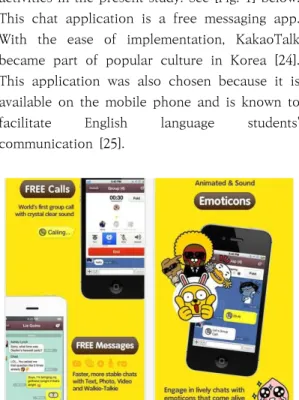
KakaoTalk application was employed for chat activities in the present study. See [Fig. 1] below.
This chat application is a free messaging app.
With the ease of implementation, KakaoTalk became part of popular culture in Korea [24].
This application was also chosen because it is available on the mobile phone and is known to facilitate English language students' communication [25].
Fig. 1. KakaoTalk Application
Participants in the control group did not join the chat. Even though both the two groups - experimental and control groups - received the same English instruction during the regular teaching time period, the participants in the control group received no treatment at all.
After 10 chat sessions ended, a survey was performed to compare the experimental and the control group attitudes towards foreign language learning. Therefore, a structured-questionnaire was given to all participants. Based on the previous studies [26-28], 21 questionnaire items were employed related to confidence (7 items), motivation (7 items), and anxiety (7 items).
A five-point Likert response scale was employed: A numerical value of 1 was equated with "strongly disagree," 2 with "disagree," 3 with
"neither agree nor disagree," 4 with "agree," and 5 with "strongly agree." Cronbach's alpha reliability coefficient for these questionnaire items was .975. This suggests that the items had adequate internal consistency.
3.3 Data Analysis
Data collected from survey results were analyzed using SPSS 18.0 software. For the quantitative analysis, descriptive statistics (i.e.
means and standard deviations) were firstly calculated. And then, in order to compare mean differences between the experimental and control groups, an independent t-test was run. P value was set at .05.
4. Results and Discussion
4.1 Effects of Mobile Phone Use on
Confidence in English Learning
In order to understand participants' experiences of mobile-assisted foreign language learning, a survey was performed. First, to compare the experimental and the control group
confidence in English learning, a confidence questionnaire was given to all participants.
[Table 1] below represents descriptive statistics and independent t-test results. There were significant group differences between the experimental and control groups regarding confidence in English learning (t = 3.244, p = .002).
Experimental Control
t p
M SD M SD
Confidence 3.67 0.70 3.00 0.69 3.244 .002 Table 1. Confidence in English Learning
As seen from [Table 1] above, participants in the experimental group showed more positive attitudes towards English learning than did the control group regarding confidence in English learning. Specifically, the experimental group revealed that they are confident to learn English, with the mean score of 3.67. Compared to those in the experimental group, participants in the control group appeared to be less confident, with the mean score of 3.00.
It is notable that the experimental group is more confident than the control group. In other words, mobile phone use positively affected aviation students' confidence in English learning.
Brown [23] asserted that the achievement of foreign language performance is highly correlated with students' confidence in the foreign language. That is, English language students cannot communicate in English freely without some degree of confidence. Given this, it can be interpreted that chat via mobile phone can play a positive role in improving English skills by increasing students' confidence.
4.2 Effects of Mobile Phone Use on
Motivation to Learn English
Another purpose of the present study was to investigate whether the mobile phone use affect
aviation students' motivation to learn English. In order to compare the experimental and the control group motivation to learn English, a motivation questionnaire was also distributed to all participants in both two groups.
Descriptive statistics and independent t-test results related to motivation are represented in [Table 2] below. There were significant group differences between the experimental and control groups concerning motivation to learn English (t = 3.255, p = .002).
Experimental Control
t p
M SD M SD
Motivation 3.29 0.62 2.69 0.65 3.255 .002 Table 2. Motivation to Learn English
As can be seen from [Table 2] above, participants in the experimental group appeared to have more positive attitudes towards English language learning than the control group did in terms of motivation to learn English. To be specific, the experimental group demonstrated that they are motivated to learn English, with the mean score of 3.29. In comparison with those in the experimental group, participants in the control group turned out to be less motivated in learning English, with the mean score of 2.68.
Cahya [29] claimed that the increase in English language students' motivation leads to an increase in their language proficiency. As far as motivation is concerned, findings in the current study also revealed that mobile phone use positively influenced aviation students' motivation in English language learning. Previous studies have confirmed that the use of technology in language learning can boost students' motivation [30].
Considering that motivation is a crucial factor in foreign language learning, it is necessary to make their language learning process more motivating.
The survey results in the present study proved the positive effects of mobile phone use for
English learning related to motivation.
4.3 Effects of Mobile Phone Use on Anxiety
about Learning English
Lastly, in an effort to understand participants' anxiety about learning English, all participants in both the experimental and control groups were required to fill out the questionnaire asking about their anxiety about English language learning.
[Table 3] below shows descriptive statistics and independent t-test results related to anxiety.
There were statistically significant group differences between the experimental group and the control group regarding anxiety about learning English learning (t = 2.334, p = .024).
Experimental Control
t p
M SD M SD
Anxiety 2.82 0.73 3.33 0.76 2.334 .024 Table 3. Anxiety about Learning English
As shown in [Table 3] above, participants in the experimental group demonstrated more positive attitudes towards English learning than those in the control group did, in relation to anxiety about learning English. To be specific, the experimental group showed that they are anxious about learning English, with the mean score of 2.82. Compared to those in the experimental group, participants in the control group turned out to be more anxious about English learning, with the mean score of 3.33.
About anxiety, Horwitz, Horwitz, and Cope [28]
pointed out that anxious students tend to avoid studying or skip classes. That is, the negative perception of learning negatively can affect their learning performance. Such demotivation can lead students to easily give up easily when they face situations where they are not confident enough and to choose other tasks they find easier or more attractive.
However, findings as shown in [Table 3]
present that the experimental group participants were less anxious about English learning, indicating that chat via mobile phone help alleviate their anxiety. Given that English language students often feel worried and nervous when communicating in English [31], mobile phone use can play a positive role relieving the students' anxiety about English learning without any pressure or stress.
This supports previous research, suggesting that mobile phones can help turn negative emotions into positive ones, which can result in successful foreign language learning [1].
5. Conclusion
Mobile phones are accessible at any time from any location. Considering that mobile phones were developed to allow both oral and written interaction, foreign language learning via mobile phone should make use of this affordance. In other words, as the interaction function of mobile phones allows foreign language students to use the language, mobile phone use should be highlighted in foreign language learning. Particularly, given that students in Korea have few opportunities to practice English [1], mobile phones seem to be valuable as English language learning tools.
However, a few experimental studies have been carried out regarding mobile phone use for foreign language learning in Korea [4]. Since the literature remains in need of studies investigating the effects of mobile phone use for English language learning in Korea, the present study explored how mobile phone use affects students' English learning.
Particularly, the current study focused on aviation students' English learning with mobile phones, considering that aviation students have difficulty in English language learning even though they take English classes before attending aviation courses [7]. In order to figure out an
effective way to help aviation students improve their English language learning, this study used mobile phones in English language learning process.
Through the attitude survey, it was possible to understand the participants' experiences of mobile-assisted foreign language learning. Based on previous studies [26-28], a perception questionnaire regarding confidence, motivation, and anxiety was given to all participants to compare the experimental and the control group attitudes towards foreign language learning.
There were significant group differences between the experimental and control groups in all three aspects: confidence in English learning, motivation to learn English, and anxiety about learning English. Participants in the experimental group showed more positive attitudes towards English language learning than those in the control group did. Specifically, the results of this study indicate that engaging in chat via mobile phone significantly results in positive attitudes towards English language learning in all aspects:
confidence, motivation, and anxiety.
To summarize, aviation students who engaged in chat via mobile phone were more confident and motivated to learn English but less anxious about English learning, compared to those who did not. According to Takahashi and Takahashi [22], these affective factors such as confidence, motivation, and anxiety, has impacts on foreign language learning. Given that affective domain plays an important role for successful English language learning, engaging in chat via mobile phone seems valuable.
There is very little exposure to communication practice when learning a foreign language. This leads foreign language students to be really nervous and insecure. The lack of confidence makes the students believe that communicating in English in front of others is embarrassing and they are criticized and laughed at. The students become demotivated and frustrated, and this can negatively affect their language learning [4].
However, findings of the present study represent that engagement in chat via mobile phone made beneficial effects on English language students' confidence, motivation, and anxiety in English learning. Considering that affective domain is an important factor for successful foreign language learning [22], it is remarkable that mobile phone use was valuable, positively influencing the aviation students' attitudes towards English language learning.
Therefore, CTL at universities need to continuously explore, promote, and support excellence in learning with diverse technologies including mobile phones. As Roschelle, Sharples, and Chan [8] put, it is important to realize that learning management can be best enhanced by a combination of mobile technology and human assistance.
Unfortunately, this study doesn't show how mobile phone use affects students' English language performance. Brown [23] asserted that the achievement of foreign language performance is highly correlated with students' confidence. Cahya [29] also claimed that the increase in students’ motivation leads to an increase in their foreign language proficiency.
Similarly, Kim [1] suggested that when negative emotions such as anxiety and nervousness turn into positive ones, successful foreign language learning can take place. Therefore, further studies are needed to determine whether mobile phone use actually improves the students' English skills.
References
[1] N.-Y. Kim, "Effects of Voice Chat on EFL Learners' Speaking Ability according to Proficiency Levels,"
Multimedia Assisted Language Learning, Vol.19, No.4, pp.63-88, 2016.
DOI: http://doi.org/10.15702/mall.2016.19.4.63 [2] J. Kim, "Exploring on the Job Competence of the Staff
in Center for Teaching and Learning," Journal of the Korea Academia-Industrial Cooperation Society, Vol.14, No.12 pp.6163-6172, 2013.
DOI: http://doi.org/10.5762/KAIS.2013.14.12.6163
[3] M. D. Sorcinelli, A. E. Austin, P. L. Eddy, & A. L. Beach, Creating the Future of Faculty Development: Learning from the Past, Understanding the Present, Bolton, MA:
Anker, 2006.
[4] N.-Y. Kim, "Computer Chat versus Mobile Chat: Effects of Different Chat Tools on EFL Speaking and Writing,"
STEM Journal, Vol.19, No.2, pp.145-167, 2018.
DOI: http://doi.org/10.16875/stem.2018.19.2.145 [5] L. Hsu, "Exploring Variables of Hospitality and
Tourism Students' English Communicative Ability in Taiwan: An Structural Equation Modeling Approach,"
International Journal of English and Education, Vol.3, No.3, pp.114-126, 2014. Available from:
http://www.ijee.org/yahoo_site_admin/assets/docs/12.
184143812.pdf (accessed Sep. 15, 2018)
[6] J. Sittattrakul, & V. Laovoravit, "Instructors' Code-Switching in ESP Classrooms for Thai Aviation Students: Functions and Benefits," Kasem Bundit Journal, Vol.19, pp.398-406, 2018. Available from:
https://www.tci-thaijo.org/index.php/jkbu/article/do wnload/119042/99169/ (accessed Mar. 20, 2018) [7] M. Poorahmadi, "The Effect of Note- Taking Strategy
on Aviation Listening Comprehension Improvement,"
In M. Mohammadi (Ed.), Proceedings of the 15th International TELLSI Conference (pp.109-117), Tehran, Iran: Islamic Azad University, 2017. Available from:
http://tellsi15.conference.riau.ac.ir/Files/News/Poora hmadi.pdf (accessed Dec. 19, 2018)
[8] J. Roschelle, M. Sharples, & T. W. Chan, "Introduction to the Special Issue on Wireless and Mobile Technologies in Education," Journal of Computer Assisted Learning, Vol.21, No.3, pp.159-161, 2005.
DOI: http://doi.org/10.1111/j.1365-2729.2005.00123.x [9] M. Lu, "Effectiveness of Vocabulary Learning via
Mobile Phone," Journal of Computer Assisted Learning, Vol.24, No.6, pp.515-525, 2008.
DOI: http://doi.org/10.1111/j.1365-2729.2008.00289.x [10] A. Pecherzewska, & S. Knot, "Review of Existing EU
Projects Dedicated to Dyslexia, Gaming in Education and M-Learning," WR08 Report to CallDysc Project,
2007. Available from:
http://www.docstoc.com/docs/40115316/WR08-Existi ng-EU-Projects-review (accessed Sep. 25, 2017) [11] M. Prensky, "What Can You Learn from a Cell Phone?
Almost Anything!" Innovate: Journal of Online Education, Vol.1, No.5, pp.1-8, 2005. Available from:
http://nsuworks.nova.edu/cgi/viewcontent.cgi?referer
=https://www.google.com/&httpsredir=1&article=1173
&context=innovate (accessed Mar. 20, 2018)
[12] T. McNicol, "Language E-learning on the Move," Japan Media Review, 2005. Available from:
http://ojr.org/japan/wireless/1080854640.php (accessed Jan. 2, 2019)
[13] R. Andrews, "Lrn Welsh by Txt Msg," 2003. Available from:
http://news.bbc.co.uk/2/hi/uk_news/wales/2798701.st m (accessed Oct. 2, 2018)
[14] A. Kukulska-Hulme, & L. Shield, "An Overview of Mobile Assisted Language Learning: From Content Delivery to Supported Collaboration and Interaction,"
ReCALL, Vol.20, No.3, pp.271-289, 2008.
DOI: http://doi.org/10.1017/S0958344008000335 [15] S. Z. bin Tahir, "Students’ Speaking Skill through
Voice Chat at University of Iqra Buru," Journal of Modern Education Review, Vol.5, No.3, pp.296-306, 2015.
DOI: http://doi.org/0.15341/jmer(2155-7993)/03.05.2015/009 [16] P. D. MacIntyre, Z. Dörnyei, R. Clément, & K. A. Noels,
"Conceptualizing Willingness to Communicate in a L2:
A Situational Model of L2 Confidence and Affiliation,"
The Modern Language Journal, Vol.82, No.4, pp.545-562, 1998.
DOI: http://doi.org/10.1111/j.1540-4781.1998.tb05543.x [17] J. Bernstein, A. Najmi, & F. Ehsani, "Subarashii:
Encounters in Japanese Spoken Language Education,"
CALICO Journal, Vol.16, No.3, pp.361-384, 1999. DOI:
http://doi.org/10.1558/cj.v16i3.361-384
[18] M. H. Beauvois, "E-talk: Attitudes and Motivation in Computer-assisted Classroom Discussion," Computers and the Humanities, Vol.28, No.3, pp.177-190, 1995.
Available from: http://www.jstor.org/stable/30204580 (accessed Dec. 12, 2016)
[19] D. Gonzalez, "Teaching and Learning through Chat: A Taxonomy of Educational Chat for EFL/ESL,"
Teaching English with Technology, Vol.3, No.4,
pp.57-69, 2003. Available from:
http://cejsh.icm.edu.pl/cejsh/element/bwmeta1.eleme nt.desklight-176e6886-2cb5-4ec2-b202-5323a4d89ed 0 (accessed Sep. 15, 2018)
[20] A. B. M. Tsui, "Maximizing Computer- mediated Communication as a Collaborative Learning Environment for ESL Teachers," Information Technology & Multimedia in English Language Teaching, 2001. Available from:
http://elc.polyu.edu.hk/conferencepapers/tsui.html (accessed Dec. 1, 2015)
[21] S. Kim, "The Pedagogical Value of Voice-based CMC,"
Multimedia Assisted Language Learning, Vol.11, No.1,
pp.85-102, 2008. Available from:
http://kmjournal.bada.cc/wp-content/uploads/2013/0 5/11-1-4Kim.pdf (accessed Dec. 12, 2016)
[22] A. Takahashi, & H. Takahashi, "Learners' Self-esteem and its Relationships with Motivation for Learning English, Self-perceived and Actual English Proficiency," Niigata Studies in Foreign Languages and Cultures, Vol.18, pp.1-12, 2013. Available from:
http://dspace.lib.niigata-u.ac.jp/dspace/bitstream/101 91/23942/1/18_1-12.pdf (accessed Aug. 11, 2018) [23] H. D. Brown, Teaching by Principles: An Interactive
Approach to Language Pedagogy. Englewood Cliffs, NJ: Prentice Hall Regents, 1994.
[24] A. Pollard, "Increasing Awareness and Talk Time through Free Messaging Apps," English Teaching Forum, Vol.53, No.1, pp.25-32, 2015. Available from:
https://americanenglish.state.gov/files/ae/resource_fil
es/pollard_increasing_awareness_and_talk_time_throu gh_free_messaging_apps.pdf (accessed Jan. 2, 2019) [25] J.-I. Han, & N.-Y. Kim, "The Effects of Post-Task CMC
Activities and Task Types on Korean EFL Learners' Oral Performance," STEM Journal, Vol.17, No.2, pp.109-135, 2016.
DOI: http://doi.org/10.16875/stem.2016.17.2.107 [26] Y. Aida, "Examination of Horwitz, Horwitz, and Cope’s
Construct of Foreign Language Anxiety: The Case of Students of Japanese," The Modern Language Journal, Vol.78, No.2, pp.155-168, 1994.
DOI: http://doi.org/10.2307/329005
[27] C. M. Ely, "An Analysis of Discomfort, Risktaking, Sociability, and Motivation in the L2 Classroom,"
Language Learning, Vol.36, No.1 pp.1-25, 1986.
DOI: http://doi.org/10.1111/j.1467-1770.1986.tb00366.x [28] E. K. Horwitz, M. B. Horwitz, & J. A. Cope, "Foreign
Language Classroom Anxiety," The Modern Language Journal, Vol.70, No.2, pp.125-132, 1986.
DOI: http://doi.org/10.1111/j.1540-4781.1986.tb05256.x [29] P. Cahya, "The Correlation between Students' L2
Motivation and Their EFL Proficiency," Ethical Lingua:
Journal of Language Teaching and Literature, Vol.4, No.2, pp.176-183, 2017.
DOI: http://dx.doi.org/10.30605/ethicallingua.v4i2.633 [30] R. Greenfield, "Collaborative E-Mail Exchange for
Teaching Secondary ESL: A Case Study in Hong Kong," Language Learning & Technology, Vol.7, No.1, pp.46-70, 2003. DOI: http://doi.org/10125/25187 [31] L. Lee, "Learners' Perspectives on Networked
Collaborative Interaction with Native Speakers of Spanish in the U. S.," Language Learning &
Technology, Vol.8, No.1, pp.83-100, 2004.
DOI: http://doi.org/10125/25231
Na-Young Kim [Regular Member]
• Aug. 2012 : M.A., International Office Administration, Ewha Woman's University
• Feb. 2017 : Ph.D., English Education, Ewha Woman's University
• Mar. 2015 ~ Feb. 2018 : Visiting Professor, Hanshin University
• Mar. 2018 ~ Present : Assistant Professor, Sehan University
<Research Interests>
English Education, Business Education