• 검색 결과가 없습니다.

A Systematic Review from the Journals of the Korean Oriental Medical Society.

N/A
N/A
Protected

Academic year: 2021

Share "A Systematic Review from the Journals of the Korean Oriental Medical Society."

Copied!
9
0
0

로드 중.... (전체 텍스트 보기)

전체 글

(1)

A Systematic Review from the Journals of the Korean Oriental Medical Society.

Jun-Yong Choi

2

, Ji-Hyung Bang

1

, Feng-Yan Shen

1

, Hee-Jae Jung

1

, Sung-Ki Jung

1

1

Division of Allergy, Immune & Respiratory System, Department of Internal Medicine, College of Oriental Medicine, Kyung Hee University

2

Acupuncture, Moxibustion and Meridian Research Center, Korea Institute of Oriental Medicine

Objectives: This study aimed to evaluate any clinical research regarding asthma published by the Korean Oriental Medical Society and its sub-societies for future rigorous clinical research.

Methods: Every article relevant to asthma was initially obtained from journals in the Korean Oriental Medical Society and its sub-societies by electronic search at journal web sites or manual search. Journals were limited to those registered by the Korea Research Foundation. From initial findings, two independent reviewers selected clinical articles and these articles were further analyzed separately into predefined criteria according to prospective and retrospective studies. For prospective studies, quality assessment was also conducted.

Results: From 99 articles initially obtained, 19 were finally analyzed. 14 were prospective whereas 5 were retrospective. Among the prospective articles, there were no randomized controlled trials and the non-randomized studies had no control groups, with several problems of quality regarding pre-calculated study size and unbiased assessment. None of the retrospective studies described asthma diagnosis objectively and outcome measures were either non-relevant to asthma or non-validated.

Conclusions: Well-designed randomized controlled studies for asthma are needed and more rigorous non-randomized controlled studies should be conducted.

Key Words : review, asthma, case reports, randomized controlled trial

대한한의학회지 및 대한한의학회 산하 정회원 학회의 학술진흥재단 등재지에 대한 천식 임상연구의 체계적 고찰

최준용

2

, 방지현

1

, 심봉암

1

, 정희재

1

, 정승기

1

1

경희대학교 한의과대학 폐계내과학 교실,

2

한국한의학연구원 침구경락연구센터

Original article

⋅Received:6 July 2009 ⋅Revised:31 August 2009 ⋅Accepted:31 August 2009

⋅Correspondence to:정승기(Sung-Ki Jung)

서울시 동대문구 회기동 1번지 경희의료원 부속한방병원 한방5내과 의사실

Tel:+82-2-958-9147, Fax:+82-2-958-9148, E-mail:[email protected] 서 론

천식은 전세계적으로 유병률이 증가하고 사회 경 제적 부담이 증가하여 각 나라마다 심각한 건강 문 제로 대두 되고 있다. 우리나라에서도 2007년도 국 민건강영양조사 통계자료에 의하면 천식의 유병률

은 20~60세에서 2.3%~8.9%, 70세 이상 노인에서

15.6% 에 도달하였으며 2003년도 건강보험 청구자

료에 의하면 천식으로 인한 사회 경제적 비용이 약

1220 억원 내지 1750억원에 이르는 것으로 추산되었

1,2)

. 최근 천식의 병인 및 기전이 새롭게 밝혀지고

있음에도 불구하고, 천식으로 인한 사망률은 줄어들

(2)

Journals URL

Journal of Constitutional Medicine http://www.esasang.com

Journal of Korean Oriental Internal Medicine http://www.oim.or.kr

Journal of Korean Pharmacopuncture Institute http://pharmacopuncture.co.kr

Journal of Oriental Neuropsychiatry http://www.onp.or.kr

Journal of Oriental Rehabilitation Medicine http://www.ormkorea.org

Korean Journal of Oriental Physiology and Pathology http://www.ksomp.or.kr The Journal of Korean Acupuncture and Moxibustion Society http://www.acumoxa.or.kr

The Journal of Korean Medical Classics http://www.wonjeon.or.kr

The Journal of Korean Oriental Medical Ophthalmology & Otolaryngology &Dermatology http://www.ood.or.kr

The Journal of Korean Oriental Medicine http://www.koms.or.kr

The Journal Of Korean Oriental Pediatrics http://www.akop.or.kr

The Journal of Oriental Obstetrics and Gynecology http://www.oobgy.org

The Korea Journal of Herbology http://www.herbology.or.kr

The Korean Journal of Meridian &Acupoint http://www.acupoint.org

Table 1. Eligible Journals under Korean Oriental Medical Society, Registered in Korea Research Foundation 지 않고 있는 실정이다

3)

.

천식에 대한 국제적인 서양의학적 치료 지침은 1995년 최초로 제정된 이래, 현재까지 지속적으로 갱신되어 전세계적으로 배포되고 있으며 국내에서 도 이를 바탕으로 한 진료 지침이 보급된 상황이다

4)
. 그러나 이와 같은 서양의학적 관리에도 불구하고 많은 환자들이 천식으로 고통을 겪고 있으며, 한방 치료 등 새로운 천식 치료에 많은 관심이 집중되고 있다

5)

. 국외에서는 천식에 대한 침 치료 혹은 한약 치료 등 대체보완 의학과 관련된 체계적 고찰이 이 루어져 있는데 이러한 치료에 대한 뚜렷한 근거는 밝혀내지 못하는 실정이다

6,7)

.

또한 서양의학과는 독립적으로 우리나라의 의료 의 한 축을 담당하고 있는 한방 의료에서 사람을 대 상으로 보고된 천식 관련 연구들에 대한 체계적 고 찰을 통해 현재까지의 연구 실태를 파악하고 이를 바탕으로 향후 과학적이고 엄격하면서 한의학적인 임상연구를 통해 국민 건강에 기여해야 할 필요성이 제기되고 있는 실정이다. 이에 국내 한의계에 보고 된 천식 관련 임상 연구를 체계적으로 고찰하여 분 석 결과를 보고하는 바이다.

연구대상 및 방법

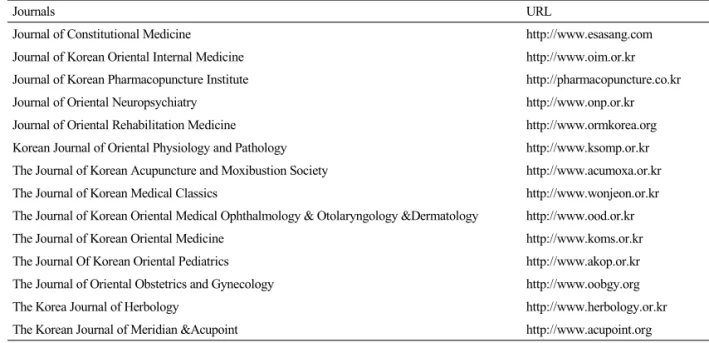
대한한의학회지 및 대한한의학회 산하 정회원 학 회의 정기 간행 학술지 중 2009년 3월 현재 한국 학 술 진흥 재단 등재지 (경락경혈학회지, 대한본초학 회지, 대한약침학회지, 대한침구학회지, 대한한방내 과학회지, 대한한방부인과학회지, 대한한방소아과학 회지, 대한한의학원전학회지, 대한한의학회지, 동의 생리병리학회지, 동의신경정신과학회지, 사상의학회 지, 한방안이비인후피부과학회지, 한방재활의학과학 회지) 에 실린 모든 연구논문에 대해 기본적으로 각 학술지의 인터넷 홈페이지 (Table 1) 에 접속하여 천식 및 asthma 를 주제어로 검색을 시행하였으며 접속이 불가능한 논문들은 수작업을 통해 천식과 관 련된 논문들을 조사하였다. (Table 1 위치) 조사 대 상 연구 논문들의 출판 기간은 1963년 5월 이후부 터 2009년 3월까지이며 이를 통해 검색 되어진 천 식 관련 모든 연구 논문들을 1차 분석 대상으로 삼 았다. 본 연구의 계획은 문헌 검색 이전에 설정되었 으며 세부 내용은 다음과 같다.

1. 1차 검색된 논문들에 대해 원문을 읽어서 이

들 중 고찰 논문, in vitro/in vivo 연구, 프로토

(3)

Relevant articles identified and retrieved for more detailed evaluation

(n=98)

Further evaluation for original study on human (n=30)

Articles included in the systematic review (n=19)

Articles excluded: (n=68)

• in vivo, vitro (n=45)

• review articles (n=23)

Articles excluded: (n=11)

• foreign study (n=3)

• survey articles (n=3)

• complication of other diseases (n=5)

Fig. 1. Flow chart of the retrieved literature 콜 연구, 해외에서 이루어진 연구, 조사연구,

천식 이외의 중대한 합병증이 동반된 임상 연 구 등을 제외한 임상 연구들을 최종적으로 선 정하여 분석을 진행하였다.

2. 최종 선발된 연구들은 연구 방법에 따라 무작 위 대조군 임상연구 (RCT)과 비무작위 대조군 임상연구로 분류하였으며 비 무작위 대조군 연구는 다시 김 등의 분류

8)

에 따라 세분하여 분석하였다.

3. 모든 임상 연구는 연구 방법 별로 나누어 대상 질환, 치료 방법, 연구의 질 평가, 평가도구, 병 용치료, 결과 등을 조사 분석하였다. 선정된 연 구 중 무작위 대조군 임상연구의 질 평가는 Jadad score

9)

로 분석하기로 하였으며, 비무작 위 대조군 임상연구 중 전향적으로 시행된 임 상연구는 MINORS 평가 기준

10)

에 따라 질 평 가를 수행하기로 하였다.

MINORS 평가 기준은 1) 분명한 목적이 있는지, 2) 환자가 연속적으로 포함되었는지, 3) 데이터가 전향적으로 수집되었는지, 4) 연구목적에 적절한 결 과인가, 5) 연구결과가 비뚤림없이 평가되었는가, 6) 추적기간은 적절했는가, 7) 탈락이 5% 미만인지, 8) 연구크기가 전향적으로 계산되었는지 등의 공통항 목이 있고, 대조군이 있는 경우, 9) 적절한 대조군이 있었는지, 10) 연구군 모집이 동시적이었는지, 11) 연구군이 기저 상태에서 유사한지, 12) 적절한 통계

분석이 이루어졌는가에 대한 항목을 평가하도록 되 어 있다. 비교가 없는 비무작위 연구는 1-8번까지 공통항목 8개만을 평가하며 비교대상이 있는 연구 에 대한 항목이 9-12번까지 4개를 추가하여 평가하 도록 되어 있다. 각각의 MINORS문항에 대해서는 0 점(not reported), 1점(reported but inadequate), 2점 (reported and adequate) 으로 나누어 점수를 측정하 여 총점을 대조군이 없는 경우 16점, 대조군이 있는 경우 24점 만점으로 되어 있다.

4. 모든 연구들에 대해 수행된 질 평가는 독립된 한의사 2인이 시행하였으며 각 논문에 대해 일치하지 않는 평가가 나왔을 경우 제 3자가 이를 중재하여 조절하였다. 또한 질 평가 이외 에 분석된 연구의 각 항목들에 대해 연구자들 의 토의를 거쳐 평가를 진행하였다.

결 과

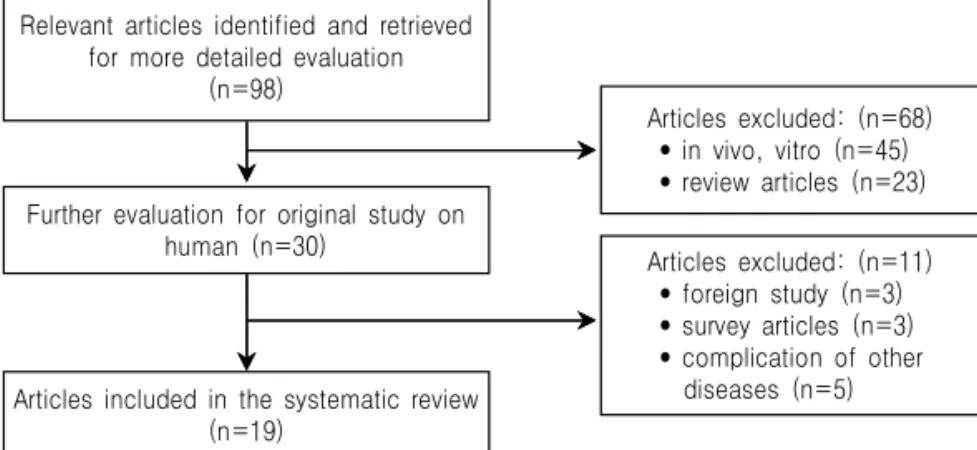
총 98개의 논문들이 asthma 또는 천식 주제어를 통해 검색되었으며 이들 중 in vivo 및 vitro 45 건, 고찰논문 23 건, 해외연구 3건, 조사 연구 3 건, 기 타 합병증 동반된 연구5 건, 프로토콜 논문 1건이 제외되어 최종 분석에 사용된 문헌은 19 편이었다 (Fig. 1).

최종 분석에 포함된 논문 중 무작위 대조군 임상

시험은 한 건도 없었으며, 비무작위 대조군 임상연

(4)

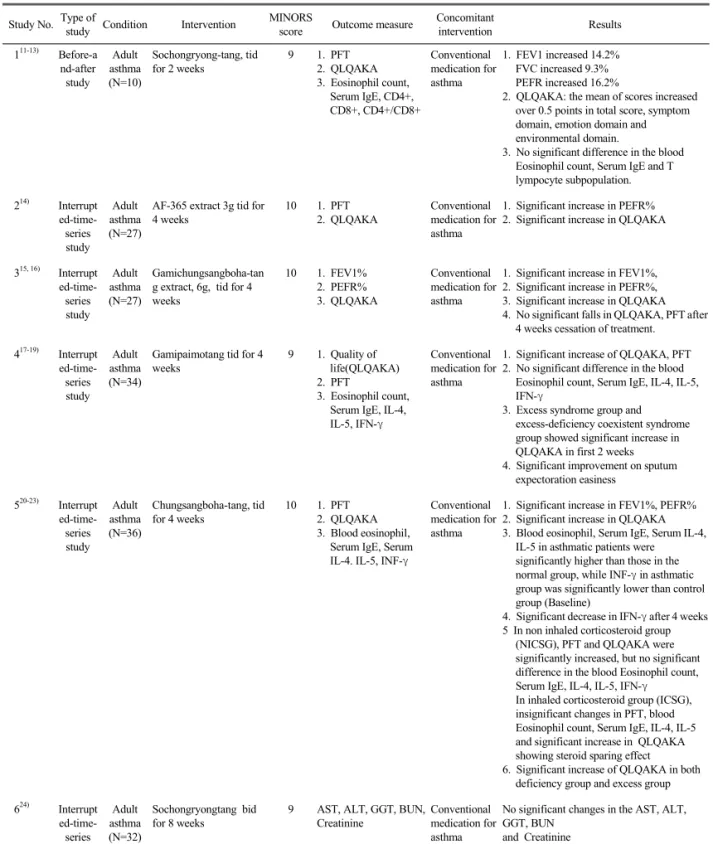
구 중에도 대조군이 있는 연구는 없었다. 비무작위 대조군 임상연구 중 전향적으로 설계되어 baseline 과 primary endpoint 에서 평가변수들을 측정하여 통계적으로 검정한 문헌들은 14편이었으며, 후향적 설계로 보고된 연구로는 단일 증례 보고 1건, 사례 군 연구가 4건이었다. 전향적으로 설계된 논문 14편 의 설계는 전후 연구가 3편, 단속적 시계열 연구가 11편이었다. 이중 전후 연구 3편

11,13)

은 동일한 연구 ( 연구 1)

11,13)

의 결과를 분리해서 발표한 논문이었으 며 9편의 단속적 시계열 연구에서도 동일 연구에 결 과를 분리하여 발표한 논문들이 있어 이들을 감안한 연구 건수는 5건 (연구2

14)

, 연구3

15,16)

, 연구4

17,19)

, 연 구5

20,23)

, 연구6

24)

) 이었다 (Table 2). 연구 1-6 모두 성인 천식 환자를 대상으로 하였으며 치료 수단은 모두 한약의 경구 투여였다. 치료 방법은 연구 1-5 는 일 3회였으며 연구 6은 일 2회였다. 치료 기간은 연구 1에서 2주, 연구 2-4에서 4주간 그리고 연구 6 에서 8주간이었다. MINORS 질적 평가는 연구 1-6 까지 모두 1) 분명한 목적이 있는지, 2) 환자가 연속 적으로 포함되었는지, 3) 데이터가 전향적으로 수집 되었는지, 4) 연구목적에 적절한 결과인가 에 대해 서는 모두2점을 얻었으며 5) 연구결과가 비뚤림없이 평가되었는가, 8) 연구크기가 전향적으로 계산되었 는지 항목에서는 연구 1-6 모두 0점을 얻었다. 6) 추 적기간은 적절했는가 문항에서는 연구 2, 3, 5에서 1 점을 얻었고 7) 탈락이 5% 미만인지에 대해서는 연구1-6 모두 1점을 얻었다. 연구 1, 2, 3, 4, 5에서 공동적으로 폐기능 검사 및 천식 환자의 삶의 질 설 문을 주된 평가 도구로 사용하였다. 연구 6에서는 안전성 평가를 위해 혈청 AST, ALT, GGT, BUN, Creatinine 만을 평가 도구로 사용하였다. 혈청 연구 1,4,5 에서는 혈청 IgE, Eosinophil count를 측정하였 으며, 이중 연구 1에서는 추가로 혈청 CD4+, CD8+, CD4+/CD+8 수치의 변화를 측정하였다. 연구 1-6 모두 서양의학적 천식 치료를 허용했다. 연구 1-5의 결과에서 폐기능 검사 항목 중 하나 이상에서 유의 한 상승을 나타내었고, 천식 관련 삶의 질의 유의한 호전이 있었다. 연구 6에서는 소청룡탕의 8주간 투

여 전후로 혈청 AST, ALT, GGT, BUN, Creatinine 의 유의한 변화가 없었음을 발표했다.

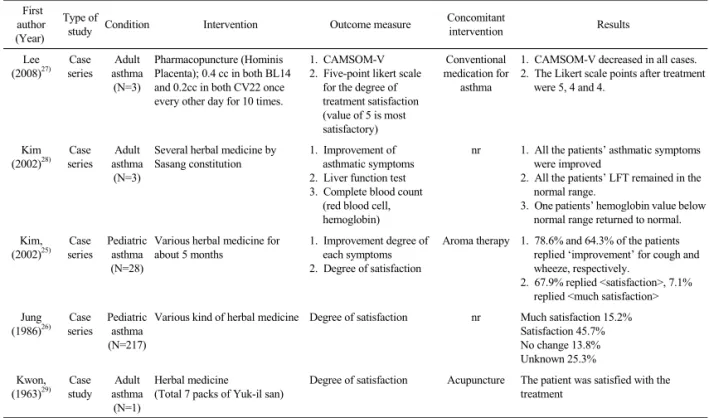
후향적인 방법에 의해 보고된 연구들은 총 5건이 었으며 김의 연구

25)

및 정 등

26)

의 연구 2건은 소아 천식 환자를 대상으로, 나머지 3건

27,29)

은 성인 천식 환자를 대상으로 보고하였다. 주된 치료 방법은 이 등

27)

은 자하거 약침을 사용하였고 다른 연구들은 모 두 한약을 사용하였다. 평가 변수로는 이 등

27)

은 CAMSOM-V

30)

라는 천식 중증도 평가 기준 및 치 료 만족도에 대해 5점 리커트 척도를 평가 도구로 사용하였으며 김 등

28)

은 별도의 평가도구 없이 3명 의 천식환자에 대해 개별적으로 증상들의 호전을 기 술하였고 간기능 검사 및 CBC 검사를 관찰하였다.

25)

의 연구에서는 천식 증상들에 대해 호전을 보인 환자들의 비율과 만족도의 정도를, 정 등

26)

의 연구 에서는 치료에 대한 환자의 만족 정도를 평가 도구 로 사용했다. 권

29)

의 증례보고에서는 개별 환자의 천식 증상의 변화를 주관적으로 서술하였다. 병용치 료에 있어 이 등

27)

의 연구에서는 침치료 및 서양의 학적 천식 치료를 함께 유지했으며, 김

25)

의 연구에 서는 아로마 요법을 시행하였다고 보고하였다. 권

29)

의 증례보고에서는 침치료를 함께 시행했다. 김 등

28)

의 연구 및 정 등

26)

의 연구에서는 병용치료에 대한 언급은 없었다. 모든 후향적 연구 보고에서는 각 평 가 방법에 대해 환자들에게 호전이 나타냈다고 보고 하였다.

고 찰

본 연구에서 천식에 대한 무작위 대조군 임상연

구는 존재하지 않았다. 한방 치료 연구에서 무작위

대조군 임상시험의 경우 상대적으로 많은 비용이 소

요되고 위약 제조 등 대조군 설정 제조의 어려움 그

리고 질환 특성상 응급처치의 한의학적 치료 한계

등이 존재하기 때문에 현재까지 제대로 이루어지지

못한 측면이 있었던 것으로 보인다. 본 연구에 포함

된 전향적 비무작위 대조군 임상연구들(Table 2)은

또한 모두 단일군에 대한 전후 연구 혹은 단속적 시

(5)

Study No. Type of

study Condition Intervention MINORS

score Outcome measure Concomitant

intervention Results

1

11-13)

Before-a nd-after study

Adult asthma (N=10)

Sochongryong-tang, tid for 2 weeks

9 1. PFT

2. QLQAKA 3. Eosinophil count,

Serum IgE, CD4+, CD8+, CD4+/CD8+

Conventional medication for asthma

1. FEV1 increased 14.2%

FVC increased 9.3%

PEFR increased 16.2%

2. QLQAKA: the mean of scores increased over 0.5 points in total score, symptom domain, emotion domain and environmental domain.

3. No significant difference in the blood Eosinophil count, Serum IgE and T lympocyte subpopulation.

2

14)

Interrupt ed-time- series study

Adult asthma (N=27)

AF-365 extract 3g tid for 4 weeks

10 1. PFT 2. QLQAKA

Conventional medication for asthma

1. Significant increase in PEFR%

2. Significant increase in QLQAKA

3

15, 16)

Interrupt ed-time- series study

Adult asthma (N=27)

Gamichungsangboha-tan g extract, 6g, tid for 4 weeks

10 1. FEV1%

2. PEFR%

3. QLQAKA

Conventional medication for asthma

1. Significant increase in FEV1%, 2. Significant increase in PEFR%, 3. Significant increase in QLQAKA 4. No significant falls in QLQAKA, PFT after

4 weeks cessation of treatment.

4

17-19)

Interrupt ed-time- series study

Adult asthma (N=34)

Gamipaimotang tid for 4 weeks

9 1. Quality of life(QLQAKA) 2. PFT

3. Eosinophil count, Serum IgE, IL-4, IL-5, IFN-γ

Conventional medication for asthma

1. Significant increase of QLQAKA, PFT 2. No significant difference in the blood

Eosinophil count, Serum IgE, IL-4, IL-5, IFN-γ

3. Excess syndrome group and excess-deficiency coexistent syndrome group showed significant increase in QLQAKA in first 2 weeks 4. Significant improvement on sputum

expectoration easiness 5

20-23)

Interrupt

ed-time- series study

Adult asthma (N=36)

Chungsangboha-tang, tid for 4 weeks

10 1. PFT 2. QLQAKA 3. Blood eosinophil,

Serum IgE, Serum IL-4. IL-5, INF-γ

Conventional medication for asthma

1. Significant increase in FEV1%, PEFR%

2. Significant increase in QLQAKA 3. Blood eosinophil, Serum IgE, Serum IL-4,

IL-5 in asthmatic patients were significantly higher than those in the normal group, while INF-γ in asthmatic group was significantly lower than control group (Baseline)

4. Significant decrease in IFN-γ after 4 weeks 5 In non inhaled corticosteroid group

(NICSG), PFT and QLQAKA were significantly increased, but no significant difference in the blood Eosinophil count, Serum IgE, IL-4, IL-5, IFN-γ In inhaled corticosteroid group (ICSG), insignificant changes in PFT, blood Eosinophil count, Serum IgE, IL-4, IL-5 and significant increase in QLQAKA showing steroid sparing effect 6. Significant increase of QLQAKA in both

deficiency group and excess group 6

24)

Interrupt

ed-time- series study

Adult asthma (N=32)

Sochongryongtang bid for 8 weeks

9 AST, ALT, GGT, BUN, Creatinine

Conventional medication for asthma

No significant changes in the AST, ALT, GGT, BUN

and Creatinine

MINORS: Methodological items for non-randomized studies; nr: not reported; PFT: pulmonary function test; QLQAKA: quality of life questionnaire for Korean asthmatics; CAMSOM-V: clinical asthma measurement scale in oriental medicine-Ⅴ

Table 2. Characteristics of Non-randomized Controlled Studies Regarding Asthma Reported in Journals under Korean

Oriental Medical Society

(6)

First author (Year)

Type of

study Condition Intervention Outcome measure Concomitant

intervention Results

Lee (2008)

27)

Case series

Adult asthma (N=3)

Pharmacopuncture (Hominis Placenta); 0.4 cc in both BL14 and 0.2cc in both CV22 once every other day for 10 times.

1. CAMSOM-V 2. Five-point likert scale

for the degree of treatment satisfaction (value of 5 is most satisfactory)

Conventional medication for

asthma

1. CAMSOM-V decreased in all cases.

2. The Likert scale points after treatment were 5, 4 and 4.

Kim (2002)

28)

Case series

Adult asthma (N=3)

Several herbal medicine by Sasang constitution

1. Improvement of asthmatic symptoms 2. Liver function test 3. Complete blood count

(red blood cell, hemoglobin)

nr 1. All the patients’ asthmatic symptoms were improved

2. All the patients’ LFT remained in the normal range.

3. One patients’ hemoglobin value below normal range returned to normal.

Kim, (2002)

25)

Case series

Pediatric asthma (N=28)

Various herbal medicine for about 5 months

1. Improvement degree of each symptoms 2. Degree of satisfaction

Aroma therapy 1. 78.6% and 64.3% of the patients replied ‘improvement’ for cough and wheeze, respectively.

2. 67.9% replied <satisfaction>, 7.1%

replied <much satisfaction>

Jung (1986)

26)

Case series

Pediatric asthma (N=217)

Various kind of herbal medicine Degree of satisfaction nr Much satisfaction 15.2%

Satisfaction 45.7%

No change 13.8%

Unknown 25.3%

Kwon, (1963)

29)

Case study

Adult asthma (N=1)

Herbal medicine (Total 7 packs of Yuk-il san)

Degree of satisfaction Acupuncture The patient was satisfied with the treatment

Table 3. Characteristics of Case Study and Case Series Regarding Asthma Reported in Journals under Korean Oriental Medical Society

계열 연구로써 대조군이 존재하지 않았다. 최근에 한 의학 저널에 실린 비무작위 대조군 임상연구의 질 평가에 대한 연구에서도 약 65%의 연구가 비교 대상이 존재하지 않았다고 보고했다.

8)

따라서 향후 임상연구 방법론에 대한 심도 깊은 논의가 필요할 것으로 보인다. MINORS 점수 평가를 통한 전향적 비무작위 대조군 임상연구들의 평가에서는 16점 만 점에 9점에서 10점의 낮은 분포를 나타내었는데, 특 히 5)연구결과가 비뚤림 없이 평가되었는가, 및 8) 연구크기가 전향적으로 계산되었는지의 항목에서는 모두 0점을 기록하였다. 따라서 5)번 평가항목 점수 의 개선을 위해 대조군이 있는 임상연구에서는 반드 시 맹검에 대한 고려 및 이의 명시가 필요하고 단일 군에 대한 임상 연구에 있어서는 평가자 맹검 혹은 이중 맹검이 불가능한 상황을 향후 논문에 언급해야 할 것으로 보인다. 8)번 항목의 개선을 위해서는 다 양한 통계적 분석 방법에 따른 연구 크기의 계산 및 기존 연구들의 자료를 참고하여 연구 규모를 전향적

으로 계산하려는 노력이 요구된다. 7)번 항목의 탈 락률에 대한 보고는 본 연구에 포함된 전향적 연구 들이 소규모 였으며 탈락률이 5%를 초과하여 1점을 얻는데 그쳤다. 4)번 연구목적에 적절한 결과인가 에 대해서는 모든 전향적 연구들이 폐기능 검사 및 타당성이 검증된 삶의 질 설문지

31)

라는 객관적인 평 가도구를 사용하여서 2점을 획득했다. 이외에도 한 의학적인 특성을 반영할 수 있는 다양한 평가도구를 개발하여 이를 임상연구에 사용하려는 노력이 필요 할 것이다.

6)

추적기간은 적절했는가 문항에서는 연 구 2, 3, 5에서 약물 투여가 끝난 후 추적기간을 가 지긴 했으나 천식의 만성적인 질환 특성상 좀 더 긴 기간을 추적하는 것이 바람직할 것으로 판단하여 1 점을 얻었다.

본 연구에서 분석된 전향적 임상 연구에 사용된

치료는 모두 경구 한약 투여였으며 한약 투여 이외

에 침, 뜸 등의 다른 치료방법에 대한 전향적 임상

연구들이 필요할 것으로 보인다. 또한 연구 1-6 모

(7)

두 서양의학적 치료의 병용을 허용하였는데 연구 5 에서만 스테로이드 절약 효과를 보고하였을 뿐 병용 투여되는 서양의학적 치료에 대한 연구 기간 중의 변동 사항에 대해서는 언급이 없었다는 문제점이 있 었다. 따라서 서양의학적 치료를 병행하는 환자에 대해서는 이에 대한 자세한 조사를 동시에 진행해야 할 필요성이 있어 보인다.

본 연구에서 분석된 후향적 연구들(Table 3)은 모 두 환자들에 대해 폐기능 검사와 같은 객관적인 방 법에 의한 천식 진단에 대한 언급이 없다는 심각한 문제점들이 드러났다. 또한 평가 방법에 있어서도 단순 증상의 호전을 서술하거나

28,29)

치료 만족도를 언급하거나

25,26)

타당성이 검증되지 않은 설문의 사 용

27)

등의 문제가 있었다. 따라서 증례 보고 및 후향 적 임상 연구에 있어서 환자의 천식 진단에 대한 정 보 및 치료 경과에 따른 객관적 평가도구의 사용이 절실하다. 이상에서 본 바와 같이 전향적 혹은 후향 적 비무작위 대조군 임상 연구에서 객관적인 진단 및 평가와 적절한 연구방법의 채택을 통해 연구 수 준을 제고하여야 할 것이다. 덧붙여서 한의학 고유 의 특수한 치료 목표를 감안한 새로운 평가도구의 개발 혹은 평가항목의 추가 등도 향후 임상 연구에 서 고려해 볼 수 있을 것이다.

근거중심의학이라는 세계적인 조류는 한의학을 비롯한 전통 의학 분야에도 영향을 미쳐 다양한 체 계적 고찰을 통해 임상연구와의 피드백을 시도하고 있다. 그리고 호흡기 관련 분야에서 일본 및 중국 등에서 전통의학 연구들을 비교 고찰하려는 시도가 최근에 있어 왔다

31-34)

. 이들 연구의 특징은 단순히 대체 보완의학의 영역에 대한 고찰보다는 자국의 특 수성을 최대한 반영하는 경향을 보인다는 점이다.

본 연구는 호흡기 분야 질환에서는 최초로 국내 한 의학계의 연구들을 체계적으로 고찰한 것이다. 향후 다양한 체계적 고찰 및 이를 위한 풍부하고 질 높은 임상연구의 수행이 절실하다.

그간 호흡기 질환에서 무작위 대조군 임상 연구 는 여러 제약으로 인해 이루어지지 못하였으나 최근 발표된 프로토콜 논문

35)

에서는 전향적 무작위 대조

군 임상연구의 계획 및 수행을 보고하여 향후 결과 가 주목된다. 그런데 비록 무작위 대조군 임상 연구 가 근거 중심 의학에서 중요한 위치를 차지하나 대 조군이 없는 연구라 하더라도 임상적 효과를 관찰하 는데 중요한 의의가 있으므로

36)

임상에서의 근거 수 립에 기여를 할 수 있을 것이다.

결 론

대한한의학회지 및 대한한의학회 산하 회원 학회 의 학술진흥재단에 등재된 학술지를 대상으로 한 천 식에 대한 체계적 고찰을 통해 저자들은 다음과 같 은 결론을 얻었다.

천식에 대한 무작위 대조군 임상연구는 존재하지 않았다.

비무작위 대조군 임상연구 중 전향적으로 설계된 연구는 총 6건이었으며 모두 대조군이 존재하지 않 았으며 MINORS에 의한 질적 평가에서 9점 내지 10점의 분포를 나타내었다.

비무작위 대조군 임상연구 중 후향적으로 이루어 진 연구는 총 5건이었으며 모두 천식의 객관적 진단 및 적절한 치료효과의 평가가 이루어지지 않았다.

향후 무작위 대조군 임상연구의 수행이 필요하며 보다 객관적이고 높은 질을 갖춘 비무작위 임상연구 가 필요하다.

참고문헌

1. Division of Chronic Disease Surveillance, Korea Centers for Disease Control and Prevention.

National Health Statistics 2007 : The 4th Korea National Health and Nutrition Examination, 1st year. Seoul: Korea Center for Disease Control and Prevention. 2008:71.

2. Park CS, Kwon I, Kang DR, Jung HY, Kang HY.

Cost-of-illness Study of Asthma in Korea:

Estimated from the Korea National Health

Insurance Claims Database. J Prev Med Public

(8)

Health 2006;39(5):397-403.

3. Moorman JE, Rudd RA, Johnson CA, King M, Minor P, Bailey C, et al.; Centers for Disease Control and Prevention (CDC). National surveill- ance for asthma-United States, 1980-2004.

MMWR Surveill Summ 2007;56(8):1-54.

4. Bateman ED, Hurd SS, Barnes PJ, Bousquet J, Drazen JM, FitzGerald M, et al. Global strategy for asthma management and prevention: GINA executive summary. Eur Respir J 2008;31(1):

143-78.

5. Blanc PD, Trupin L, Earnest G, Katz PP, Yelin EH, Eisner MD. Alternative therapies among adults with a reported diagnosis of asthma or rhinosinusitis : data from a population-based survey. Chest 2001;120(5):1461-7.

6. Passalacqua G, Bousquet PJ, Carlsen KH, Kemp J, Lockey RF, Niggemann B, et al. ARIA update:

I-Systematic review of complementary and alternative medicine for rhinitis and asthma. J Allergy Clin Immunol 2006;117(5):1054-62.

7. Martin J, Donaldson AN, Villarroel R, Parmar MK, Ernst E, Higginson IJ. Efficacy of acupuncture in asthma: systematic review and meta-analysis of published data from 11 rando- mised controlled trials. Eur Respir J 2002;20 (4):846-52.

8. Kim HJ, Kim SY. Quality Assessment of Non- Randomized Studies in the Korean Journal of Family Medicine. Kor J Fem Med 2009;30(2):

129-37.

9. Jadad AR, Moore RA, Carroll D, Jenkinson C, Reynolds DJ, Gavaghan DJ, et al. Assessing the quality of reports of randomized clinical trials:

is blinding necessary? Control Clin Trials 1996;17(1):1-12.

10. Slim K, Nini E, Forestier D, Kwiatkowski F, Panis Y, Chipponi J. Methodological index for non-randomized studies (minors): development and validation of a new instrument. ANZ J Surg

2003;73(9):712-6.

11. Heo TS, Hwang WS, Ju CY, Jung HJ, Rhee HK, Jung SK. The Effects of Sochongryong-tang on Pulmonary Function and Quality-of-Life in Asthmatic Patients. J Korean Oriental Med 2001;

22(4):131-41.

12. Hwang WS, Chung KJ, Ju CY, Hong JP, Lee JS, Jung HJ, et al. J Korean Oriental Med 2002;

23(4):651-60.

13. Hwang WS, Jung HJ, Ju CY, JS Lee, KK Lee, Rhee HK, et al. A Study on Changes in Blood Eosinophil, Serum IgE and T Lympocyte Subpo- pulation after Sochongryongtang to Asthmatic Patients. Korean J Orient Int Med 2002;23 (1):83-90.

14. Jeong SY, Lee JS, Choi JY, Lee KY, Jung HJ, Rhee HK, et al. Clinical Effects of AF-365 for Maintenance Therapy in Chronic Stages of Asthmas. Korean J Orient Int Med 2005;26(1):

1-11.

15. Jung SK, Jung HJ, Lee JS, Lee KY, Jeong SY, Rhee HK, et al. The Clinical Effects of Gamic- huongsangboha-tang (Jiaweiqingshangbuxia-tang) extract in Asthmatic Patients Based on Severity.

J Korean Oriental Med 2004;25(2):110-8.

16. Lee KY, Jeong SY, Choi JY, Lee JS, Jung HJ, Rhee HK, et al. The Clinical Changes Following Cessation of Gamichungsangboha-tang(Jiaweiq- ingshangbuxia-tang) extract Treatment in Patients with Controlled Asthma. Korean J Orient Int Med 2004;aut:56-64.

17. Hwang WS, Lee JS, Choi JY, Jung HJ, Rhee HK, Jung SK. Is Gamipaimo-tang (Jiaweibeimu-tang) More Effective in Asthma of Excess Syndrome?

Korean J Orient Int Med 2003;aut:49-58.

18. Hwang WS, Choi JY, Lee JS, Jung HJ, Rhee HK,

Jung SK. The Effects of Gamipaimo-tang on

blood Eosinophil, serum IgE and Cytokines in

Asthmatic Patients. Korean J Orient Int Med

2003;24(4):747-58.

(9)

19. Choi JY, Hwang WS, Lee JS, Jung HJ, Rhee HK, Jung SK. The Clinical Effects of Gamipaimo- tang in Asthmatic Patients According to the Easiness of Sputum Expectoration. Korean J Orient Int Med 2003;24(3):588-96.

20. Jung SK, Hwang WS, Ju CY, Lee JS, Cho IH, Jung HJ. Clinical effects of Chuongsangboha- tang in asthmatic patients. J Korean Oriental Med 2002;23(4):151-60.

21. Hwang WS, Choi JY, Lee JS, Jung HJ, Rhee HK, Jung SK. The Clinical Effects Following Discontinuation of Chungsangboha-tang(Qings- hangbuxia-tang) Treatment in Patients with Controlled Asthma. J Korean Oriental Med 2003;24(3):184-91.

22. Hwang WS, Choi JY, Lee JS, Ju CY, Jung HJ, Rhee HK, et al. The Steroid Sparing Effects of Cheongsangboha-tang in Asthmatic Patients.

Korean J Orient Int Med 2003;24(1):1-10.

23. Choi JY, Hwang WS, Lee JS, Jung HJ, Rhee HK, Jung SK. An Analysis of Therapeutic Effects of Chungsangboha-tang in 36 Cases of Asthma Based on Criteria for Deficiency-Excess Differ- entiating Syndromes of Asthma. Korean J Orient Int Med 2003;aut:91-9.

24. Hwang WS, Ju CY, Lee JS, Jung HJ, Rhee HK, Jung SK. Evaluation for Side Effects of Socheo- ngryong-tang in Asthmatic Patients. Korean J Orient Int Med 2002;aut:49-55.

25. Kim YH. A Clinical study on Pediatric Bronchial Asthma. J Korean Oriental Pediatrics 2002;16(1):

133-48.

26. Jeong GM, Kim DG, Lee DH. A clinical Study on Pediatric Bronchoarthma (Ⅱ). J Korean Oriental Pediatrics 1986;1(1):79-87.

27. Lee SY, Choi SY, Shin KM, Hong JM, Bae KR, Kim HK. The Clinical Study on the Effect of Hominis Placenta Pharmacopuncture on Asthma.

J Korean Institute of Phamacopuncture 2008;11 (4):79-86.

28. Kim JH, Shin DY, Kim HW, Song JM. A Case Study of 3 Asthma Patients-Soeumin, Soyangin, Taeumin. J Sasang Const Med 2002;14(1):112-7.

29. Kwon YS. A Clinical Experience on Summer Asthma. J Korean Oriental Med. 1963;1(6):9-10.

30. Herbal Medicine Evaluation Team, The Korean Food and Drug Administration (KFDA). the Guidelines for Clinical Trials of Herbal (Oriental) Drugs (Antiasthmatic Drugs). Government Publi- cations Registration Number 11-1470000-001466 -01; 2007.

31. Park JW, Cho YS, Lee SY, Nahm DH, Kim YK, Kim DK, et al. Multi-center study for the utilization of quality of life questionnaire for adult Korean asthmatics (QLQAKA). J Asthma Allergy Clin Immunol. 2000;20(3):467-479.

31. Suzuki M, Yokoyama Y, Yamazaki H. Research into acupuncture for respiratory disease in Japan:

a systematic review. Acupunct Med. 2009;27(2):

54-60.

32. Wu T, Zhang J, Qiu Y, Xie L, Liu GJ. Chinese medicinal herbs for the common cold. Cochrane Database Syst Rev. 2007;(1):CD004782.

33. Shi Y, Gu R, Liu C, Ni J, Wu T. Chinese medicinal herbs for sore throat. Cochrane Database Syst Rev. 2007;(3):CD004877.

34. Wei J, Ni J, Wu T, Chen X, Duan X, Liu G, et al. Chinese medicinal herbs for acute bronchitis.

Cochrane Database Syst Rev. 2008;(1):CD004560.

35. Choi JY, Oh DS, Roh YL, Jung HJ, Jung SK, Choi SM. Acupuncture, an Adjunct Therapy for Asthma: a Pilot Study Protocol of Randomized Controlled Trial. Journal of Meridian & Acupoint 2008;25(3):43-51.

36. White A, Wayne PM, MacPherson H. Exploring treatment effects: studies without control groups.

In: MacPherson H. eds. Acupuncture research:

strategies for establishing an evidence base. 1st

ed. New York: Churchill Livingstone. 2007:95-

110.

수치

Table 1. Eligible Journals under Korean Oriental Medical Society, Registered in Korea Research Foundation지 않고 있는 실정이다3).천식에 대한 국제적인 서양의학적 치료 지침은1995년 최초로 제정된 이래,  현재까지 지속적으로갱신되어 전세계적으로 배포되고 있으며 국내에서도 이를 바탕으로 한 진료 지침이 보급된 상황이다4)
Fig. 1. Flow chart of the retrieved literature콜 연구,  해외에서 이루어진 연구,  조사연구, 천식 이외의 중대한 합병증이 동반된 임상 연구 등을 제외한 임상 연구들을 최종적으로 선정하여 분석을 진행하였다.2.최종 선발된 연구들은 연구 방법에 따라 무작위 대조군 임상연구 (RCT)과 비무작위 대조군임상연구로 분류하였으며 비 무작위 대조군연구는 다시 김 등의 분류8)에 따라 세분하여분석하였다.3.모든 임상 연구는 연구
Table 2.  Characteristics of Non-randomized Controlled Studies Regarding Asthma Reported in Journals under Korean Oriental Medical Society
Table 3.  Characteristics of Case Study and Case Series Regarding Asthma Reported in Journals under Korean Oriental Medical Society 계열 연구로써 대조군이 존재하지 않았다

참조

관련 문서

william James Hall, M.D., Medical Missionary to the Slums of New York; Pioneer Mission of Korean Native Costumes, China Medical Journal, 1916.3; Medical Needs of Korean

Objective: This study aims to identify the levels of anxiety and depression of the medical institution workers regarding COVID-19, and to provide the database for the

In setting future goals, social-oriented future goals that contribute to the spirit of service and society and family-oriented future goals that emerge

The academic journals used at the time were ‘The Mathematical Education’ of The Korean Society of Mathematical Education, ‘Journal of Educational Research

Modern society is rapidly aging as the average life expectancy and elderly population increase due to the development of medical technology and science,

The purpose of this study is to research prevalence of nonnutritive sucking for Korean preschool children, evaluate the relation of contributing factors

Objectives: The aim of this study was to study the relationship between smoking, alcohol drinking and vitamin D level among Korean adults using data from the

Objective: The purpose of this study is to use it as a basis for the health care guidelines for the muscle mass and cardiovascular disease of Korean population by