경락경혈학회지 Vol.27, No.3, pp.1 23, 2010∼ Korean Journal of Acupuncture
Hyang-Sook Lee , Su-Jin Cha , Hi-Joon Park , Jung-Chul Seo , Jong-Bae J. Park , Hye-Jung Lee Acupuncture & Meridian Science Research Center, College of Korean Medicine, Kyung Hee University, Seoul, Korea
WooriKyunghee Oriental Medical Clinic, Gumi, Korea
Asian Medicine and Acupuncture Research, Dept. of Physical Medicine & Rehabilitation, University of North Carolina at Chapel Hill, NC, USA
Hugh MacPherson , Douglas G. Altman , Richard Hammerschlag , Li youping , Wu Taixiang , Adrian White , David Moher , on behalf of the STRICTA Revision Group
Department of Health Sciences, University of York, York, United Kingdom, Centre for Statistics in Medicine, University of Oxford, Oxford, United Kingdom,
Department of Research, Oregon College of Oriental Medicine, Portland, Oregon, United States of America, Chinese Cochrane Centre, Chinese Evidence-Based Medicine Centre, West China Hospital, Sichuan University, China, Primary Care Research, Peninsula Medical School, Universities of Exeter and Plymouth, Plymouth, United Kingdom, Ottawa Methods Centre, Ottawa Hospital Research Institute ; Department of Epidemiology and Community
Medicine, Faculty of Medicine, University of Ottawa, Ottawa, Canada
Abstract
Objectives and methods : The Standards for Reporting Interventions in Clinical Trials of Acupuncture (STRICTA) were published in five journals in 2001 and 2002. These guidelines, in the form of a checklist and explanations for use by authors and journal editors, were designed to improve reporting of acupuncture trials, particularly the interventions, thereby facilitating their interpretation and replication. Subsequent reviews of the application and impact of STRICTA have highlighted the value of STRICTA as well as scope for improvements and revision. To manage the revision process a collaboration between the STRICTA Group, the CONSORT Group, and the Chinese Cochrane Centre was developed in 2008. An expert panel with 47 participants was convened that provided electronic feedback on a revised draft of the
process, the explanations for each item have been elaborated, and examples of good reporting for each item are provided. In addition, the word "controlled" in STRICTA is replaced by
"clinical", to indicate that STRICTA is applicable to a broad range of clinical evaluation designs, including uncontrolled outcome studies and case reports.
Conclusions : It is intended that the revised STRICTA, in conjunction with both the main CONSORT Statement and extension for nonpharmacologic treatment, will raise the quality of reporting of clinical trials of acupuncture.
Key words : Acupuncture, STRICTA, CONSORT, Intervention, Reporting, Checklist
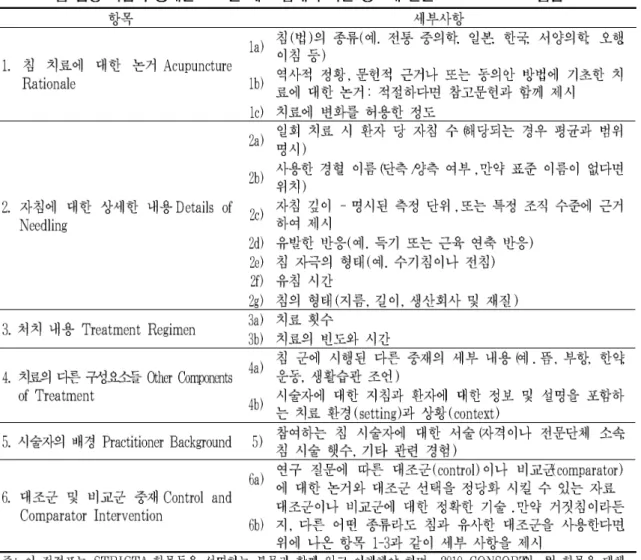
Table 1. 2010 STRICTA
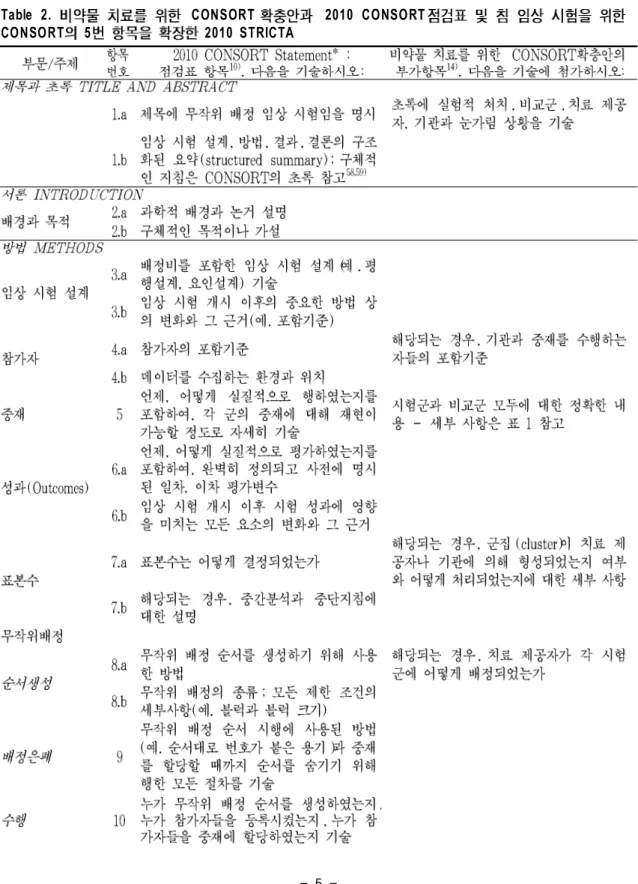
Table 2. CONSORT 2010 CONSORT
CONSORT 5 2010 STRICTA