ISSN 2234-3806 • eISSN 2234-3814
616 www.annlabmed.org https://doi.org/10.3343/alm.2018.38.6.616 Ann Lab Med 2018;38:616-618
https://doi.org/10.3343/alm.2018.38.6.616
Letter to the Editor
Diagnostic Genetics
Clinical Features of Multiple Acyl-CoA Dehydrogenase Deficiency With ETFDH Variants in the First Korean Cases
Yoo Jinie Kim, M.D.1, Jung Min Ko , M.D., Ph.D.,1, Junghan Song, M.D., Ph.D.2, and Kyung-A Lee, M.D., Ph.D.3
1Department of Pediatrics, Seoul National University College of Medicine, Seoul National University Children’s Hospital, Seoul, Korea; 2Department of Laboratory Medicine, Seoul National University College of Medicine, Seoul, Korea; 3Department of Laboratory Medicine, Yonsei University College of Medicine, Seoul, Korea
Dear Editor,
Multiple acyl-CoA dehydrogenase deficiency (MADD; OMIM#
231680) is an autosomal recessive fatty acid oxidation disorder [1]. Through the expanded newborn screening test (NST), its prevalence has been estimated to be 1 in 750,000–2,000,000 newborns [2]. MADD is divided into three clinical types [3]: the neonatal onset form with (type I) or without (type II) congenital anomalies [4], and the late-onset form (type III), which is often asymptomatic [5]. MADD is caused by defects in electron trans- fer flavoprotein (ETF) or electron transfer flavoprotein ubiqui- none oxidoreductase (ETFDH) [6, 7]. Approximately 300 pa- tients worldwide have been diagnosed as having MADD by ge- netic analysis, and 100 ETFDH mutations have been reported to date [8]. We report two MADD patients carrying novel, likely pathogenic variants, in ETFDH for the first time in Korea. Writ- ten informed consent was obtained from the patients’ parents.
Patient 1 was a newborn boy who was transferred to the neo- natal intensive care unit of our hospital on the sixth day of life, following onset of hypotonia, metabolic acidosis, hyperammone- mia, and hypoglycemia 24 hours after birth. He was born full- term with a weight of 3,650 g (50–90th percentile) to healthy,
non-consanguineous parents. An older brother had died on the third day of birth due to undetermined causes. An older sister was typically developing and, thus far, without illness.
At the referring hospital, intravenous hydration with multivita- mins was administered for a week with supplementation of L- carnitine (300 mg/kg/day) and carglumic acid (100 mg/kg/day), but metabolic acidosis showed no improvement. When he first arrived at the hospital, he showed mild tachypnea and his ante- rior fontanel was large, but normotensive. He was hypotonic with an absent Moro reflex. A severe “sweaty feet” odor was noted. Laboratory tests revealed hyperammonemia (153 μg/dL;
normal range, 15–51 μg/dL) and metabolic acidosis (pH, 7.250;
HCO3-, 15.1 mmol/L) without hypoglycemia. Tiny renal cysts were detected by ultrasonography, and hypoplastic bilateral temporal opercula were noticed on brain magnetic resonance images. Biventricular hypertrophy with normal contractility func- tion was observed by echocardiography.
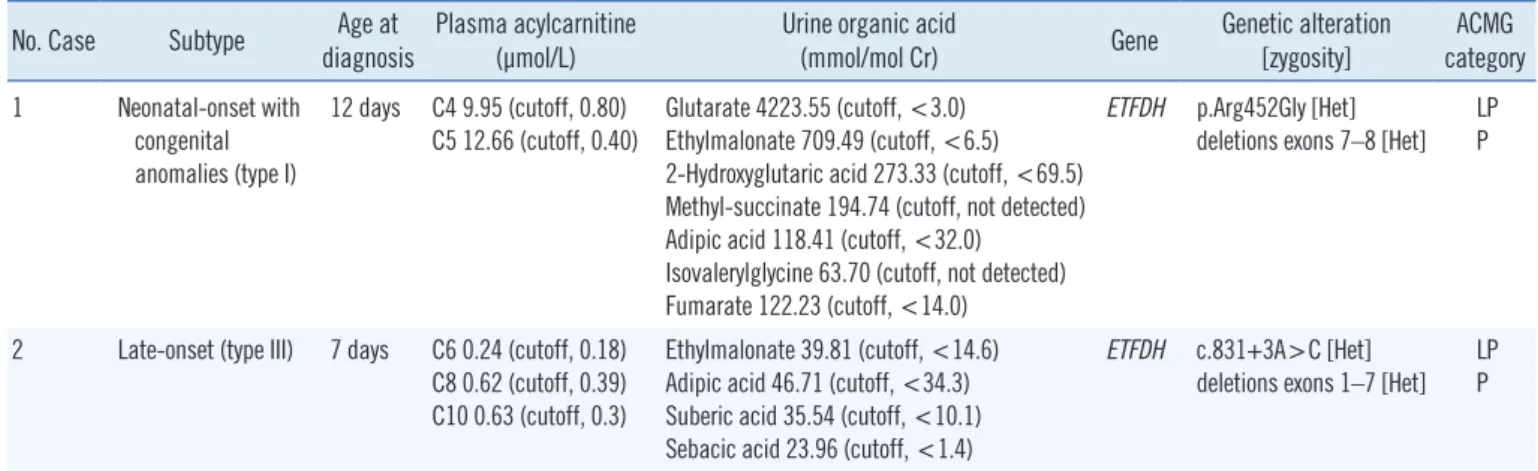
Acylcarnitine profiling by tandem mass spectrometry (TMS) and urine organic acid analysis suggested MADD type I (Table 1). A high dose of riboflavin (100 mg/day) was started immedi- ately after obtaining the abnormal metabolic results, with a low-
Received: December 17, 2017 Revision received: February 20, 2018 Accepted: June 19, 2018
Corresponding author: Jung Min Ko https://orcid.org/0000-0002-0407-7828
Department of Pediatrics, Seoul National University College of Medicine, 101 Daehak-ro, Jongno-gu, Seoul 03080, Korea
Tel: +82-2-2072-3570, Fax: +82-2-743-3455, E-mail: [email protected]
© Korean Society for Laboratory Medicine
This is an Open Access article distributed under the terms of the Creative Commons Attribution Non-Commercial License (http://creativecommons.org/licenses/by-nc/4.0) which permits unrestricted non-commercial use, distribution, and reproduction in any medium, provided the original work is properly cited.
1 / 1 CROSSMARK_logo_3_Test
2017-03-16 https://crossmark-cdn.crossref.org/widget/v2.0/logos/CROSSMARK_Color_square.svg
Kim YJ, et al.
First Korean cases of genetically confirmed MADD
https://doi.org/10.3343/alm.2018.38.6.616 www.annlabmed.org 617
fat diet and L-carnitine supplementation (300 mg/kg/day). The ammonia level was nearly normal after continuous intravenous infusion of sodium benzoate (250 mg/kg/day), and the patient showed slightly increased muscle tone. However, metabolic aci- dosis persisted, and elevated C-reactive protein with decreased urine and distended abdomen implied the progress of sepsis.
Antibiotics and an antifungal agent were administered to treat peritonitis and cellulitis on the abdominal wall. Respiratory sup-
port was needed due to pulmonary edema. Even with antibiotics and inotropes, the patient died of sepsis with multiple organ fail- ure 38 days after birth (Table 1).
Patient 2 was a boy born full-term with a weight of 3,480 g (10–50th percentile) to healthy, non-consanguineous parents.
He had no symptoms at birth, but NST by TMS on the third day after birth showed elevated plasma acylcarnitines, suggesting MADD. Plasma acylcarnitine profile normalized on repeated
Table 1. Biochemical and genetic data of two male Korean patients with multiple acyl-CoA dehydrogenase deficiency No. Case Subtype Age at
diagnosis Plasma acylcarnitine
(μmol/L) Urine organic acid
(mmol/mol Cr) Gene Genetic alteration
[zygosity] ACMG category 1 Neonatal-onset with
congenital anomalies (type I)
12 days C4 9.95 (cutoff, 0.80) C5 12.66 (cutoff, 0.40)
Glutarate 4223.55 (cutoff, <3.0) Ethylmalonate 709.49 (cutoff, <6.5) 2-Hydroxyglutaric acid 273.33 (cutoff, <69.5) Methyl-succinate 194.74 (cutoff, not detected) Adipic acid 118.41 (cutoff, <32.0)
Isovalerylglycine 63.70 (cutoff, not detected) Fumarate 122.23 (cutoff, <14.0)
ETFDH p.Arg452Gly [Het]
deletions exons 7–8 [Het]
LP P
2 Late-onset (type III) 7 days C6 0.24 (cutoff, 0.18) C8 0.62 (cutoff, 0.39) C10 0.63 (cutoff, 0.3)
Ethylmalonate 39.81 (cutoff, <14.6) Adipic acid 46.71 (cutoff, <34.3) Suberic acid 35.54 (cutoff, <10.1) Sebacic acid 23.96 (cutoff, <1.4)
ETFDH c.831+3A>C [Het]
deletions exons 1–7 [Het]
LP P
Abbreviations: Het, heterozygote; LP, likely pathogenic; P, pathogenic; ACMG, American College of Medical Genetics and Genomics.
Fig. 1. Family pedigrees of two male Korean patients with multiple acyl-CoA dehydrogenase deficiency, carrying recessively inherited ETFDH variants. (A) Patient 1. (B) Patient 2. Affected and unaffected individuals are indicated by closed and open symbols, respectively.
ETFDH alleles are represented by ‘[=]’ (wild-type), ‘p.Arg452Gly (c.1354A>G)’, ‘c.831+3A>C’. Exon deletions and mutant alleles were identified by quantitative PCR and Sanger sequencing, respectively.
A Patient 1 B Patient 2
Kim YJ, et al.
First Korean cases of genetically confirmed MADD
618 www.annlabmed.org https://doi.org/10.3343/alm.2018.38.6.616 testing, but urine glutarate increased slightly. Monitoring of urine
organic acids after 8 hours of fasting by TMS revealed mildly el- evated blood C6, C8, and C10, and increased urinary metabo- lites (Table 1). Based on these findings, a low-fat diet supple- mented with medium-chain triglyceride milk, L-carnitine (100 mg/kg/day), and riboflavin (100 mg/day) was initiated at the age of four months.
Following treatment initiation, plasma acylcarnitines normal- ized, and urinary ethylmalonate decreased. The patient is cur- rently 24 months old. He has normal height (50–75th percen- tile) and weight (25–50th percentile), and is achieving normal developmental milestones.
For genetic diagnosis, we first sequenced ETFA, ETFB, and ETFDH, and identified one variant of ETFDH in each patient:
c.1354A>G (p.Arg452Gly) for Patient 1 and c.831+3A>C for Patient 2 (Table 1). We investigated the other allele using quan- titative (q)PCR to identify exon deletions. We used genomic DNA from two normal infants as controls, and qPCR was run in triplicate using 13 primer pairs for each exon. Data were ana- lyzed by the 2–ΔΔCt method [9], and mean values are presented.
Patient 1 had exon 7–8 deletion, and Patient 2 had multiple de- letions in exons 1–7 (Fig. 1). Both parents of each patient were heterozygous carriers of each variant detected in their offspring;
they were molecularly confirmed as compound heterozygotes with c.1354A>G (p.Arg452Gly) and exon 7–8 deletion for Pa- tient 1, and with c.831+3A>C and exon 1–7 deletion for Patient 2. The two sequence variants were absent from population da- tabases, located in highly conserved regions, and considered damaging to protein function or structure by in-silico prediction.
The variants were in trans with the other exon deletions in each patient as indicated by parental analyses. Therefore, p.Arg- 452Gly and c.831+3A >C could be classified as likely patho- genic according to the 2015 American College of Medical Ge- netics and Genomics standards/guidelines [10] (Fig. 1).
Early diagnosis and immediate treatment during the neonatal period determines the outcome in MADD. Expanded NST has increased the detection rate; however, accurate diagnosis may not be achieved with biochemical profiling alone. Thus, genetic analysis is likely necessary for either confirmative diagnosis or exclusion.
Authors’ Disclosures of Potential Conflicts of Interest
The authors claim that there are no conflicts of interest.
Acknowledgment
We are grateful to the patients and their parents for their partici- pation in this study. This study was supported by a grant from the Korean Health Technology R&D Project, Ministry of Health
& Welfare, Korea (A120030).
REFERENCES
1. Przyrembel H, Wendel U, Becker K, Bremer HJ, Bruinvis L, Ketting D, et al. Glutaric aciduria type II: report on a previously undescribed meta- bolic disorder. Clin Chim Acta 1976;66:227-39.
2. Lindner M, Hoffmann GF, Matern D. Newborn screening for disorders of fatty-acid oxidation: experience and recommendations from an ex- pert meeting. J Inherit Metab Dis 2010;33:521-6.
3. Grünert SC. Clinical and genetical heterogeneity of late-onset multiple acyl-coenzyme A dehydrogenase deficiency. Orphanet J Rare Dis 2014;
9:117.
4. Lehnert W, Wendel U, Lindenmaier S, Böhm N. Multiple acyl-CoA de- hydrogenation deficiency (glutaric aciduria type II), congenital polycystic kidneys, and symmetric warty dysplasia of the cerebral cortex in two brothers. Europ J Pediat 1982;139:56-9.
5. Al-Essa MA, Rashed MS, Bakheet SM, Patay ZJ, Ozand PT. Glutaric aciduria type II: observations in seven patients with neonatal- and late- onset disease. J Perinatol 2000;2:120-8.
6. Olsen RK, Olpin SE, Andresen BS, Miedzybrodzka ZH, Pourfarzam M, Merinero B, et al. ETFDH mutations as a major cause of riboflavin-re- sponsive multiple acyl-CoA dehydrogenation deficiency. Brain 2007;
130:2045-54.
7. Chen M, Peng J, Wei W, Wang R, Xu H, Liu H. A novel ETFDH mutation in an adult patient with late-onset riboflavin-responsive multiple acyl- CoA dehydrogenase deficiency. Int J Neurosci 2018;128:291-4.
8. Yotsumoto Y, Hasegawa Y, Fukuda S, Kobayashi H, Endo M, Fukao T, et al. Clinical and molecular investigations of Japanese cases of glutaric acidemia type 2. Mol Genet Metab 2008;94:61-7.
9. Livak KJ and Schmittgen TD. Analysis of relative gene expression data using real-time quantitative PCR and the 2(-Delta Delta C(T)) method.
Methods 2001;402-8.
10. Richards S, Aziz N, Bale S, Bick D, Das S, Gastier-Foster J, et al. Stan- dards and guidelines for the interpretation of sequence variants: a joint consensus recommendation of the American College of Medical Genet- ics and Genomics and the Association for Molecular Pathology. Genet Med 2015;17:405-24.