Printed in the Republic of Korea DOI 10.5012/jkcs.2011.55.3.412
3-Benzylidine/Furfurylidine/(Pyridyl/Thienyl-2’-methylene) imino-5-p-sulphonamido phenyl azo-2-thiohydantoins와 UO
2(VI), ZrO(IV) 및 Th(IV) 이온의 동종이핵
착물에 대한 합성 및 특성
D. C. Dash*, A. Mahapatra, P. Naik, R. K. Mohapatra, and S. K. Naik School of Chemistry, Sambalpur University, Jyoti Vihar, Burla, Sambalpur-768019, Orissa, India
(접수 2009. 9. 22; 수정 2010. 9. 7; 게재확정 2010. 12. 14)
Synthesis and Characterization of Homobinuclear Complexes of UO
2(VI), ZrO(IV) and Th(IV) ions with 3-Benzylidine/Furfurylidine/(Pyridyl/Thienyl-2’-methylene)
imino-5-p-sulphonamido phenyl azo-2-thiohydantoins
D. C. Dash*, A. Mahapatra, P. Naik, R. K. Mohapatra, and S. K. Naik
School of Chemistry, Sambalpur University, Jyoti Vihar, Burla, Sambalpur-768019, Orissa, India,
*E-mail: [email protected]
(Received September 22, 2009; Revised September 7, 2010; Accepted December 14, 2010)
요 약. [M2L(NO3)n(H2O)m]의 일반식을 갖는 일련의 동종이핵 착물을 합성하여 원소분석, 열분석, 몰 전기전도도, 자기모 멘트 및 분광학적 방법(IR, UV-vis 및 1H-NMR)을 통해 특성을 조사하였다. 이 경우, 일반식에 있어서 M=UO2(VI), ZrO(IV), Th(IV); L=3-benzylidine-imino-5-p-sulphonamido phenyl azo-2-thiohyatoin(bispt), 3-furfurylidine-imino-5-p- sulphonamido phenyl azo-2-thiohydantoin(fispt),3-pyridyl-2’-methylene-imino-5-p-sulphonamido phenyl azo-2-thiohydantoin (pmispt) 및 3-thienyl-2’-methylene-imino-5-p-sulphoanamido phenyl azo-2-thiohydantoin(tmispt); Th(IV)에 대해서 n=8 그 외 의 것에 대해서는 n=4, bispt에 대해서는 m=4 그 외의 것에 대해서는 m=3을 의미한다. 이러한 결과에서 얻은 정보를 통해 리간드들은 4배위를 하는 것으로 확인되었는데, 즉 한 중심금속은azomethine 질소 및 카르보닐 산소에 배위되는 반면, 또 다른 중심금속은 아조 질소 및 thioimido 질소에 배위되어 위의 조성을 갖는 동종이핵 착물을 이룬다. 몇 가지 병원균에 대한 리간드와 그들의 지르코닐 착물의 독성 연구도 수행하였다.
주제어: 3-치환된 thiohydantoin, 구조 및 열적 성질, IR 및 1H NMR 스펙트럼
ABSTRACT. A series of homobinuclear complexes of the type [M2L(NO3)n(H2O)m] where M=UO2(VI), ZrO(IV), Th(IV);
L=3-benzylidine-imino-5-p-sulphonamido phenyl azo-2-thiohyatoin(bispt), 3-furfurylidine-imino-5-p-sulphonamido phenyl azo-2-thiohydantoin(fispt),3-pyridyl-2’-methylene-imino-5-p-sulphonamido phenyl azo-2-thiohydantoin(pmispt) and 3-thie- nyl-2’-methylene-imino-5-p-sulphoanamido phenyl azo-2-thiohydantoin(tmispt); n=8 for Th(IV) and 4 for others, m=4 for bispt and 3 for others have been synthesized and characterized on the basis of elemental analysis, thermal analysis, molar con- ductance, magnetic moment and spectroscopic data (IR, electronic and 1H-NMR). In the light of this information, the ligands can be visualized as tetradentate co-ordinating through azomethine nitrogen, carbonyl oxygen to one metal centre where as azo nitrogen and thioimido nitrogen to the other metal centre yielding homo binuclear complexes of the above composition.
The fungi toxicity of the ligands & their zirconyl complexes against some fungal pathogen has been studied.
Keywords: 3-substituted thiohydantoin, Structure and Thermal Properties, IR and 1HNMR spectra
INTRODUCTION
Multimetallic complexes have received much attention in connection with their potential relevance to bioinor- ganic chemistry.1 The polydentate and compartamental ligands can form such multimetallic clusters by binding two or more metal centres in close proximity. The homo- multimetallic molecular complexes are of interest in areas
like multimetallic enzymes, homogeneous catalysis and heterogeneous catalysis. Many enzymes in biological sys- tem are homo-metallic that perform their biological func- tion by redox co-operativity.2 The toxicological importance of the ligands containing –N-C=S moiety and their metal complexes has been well established as potential antifun- gal and antibacterial agent.3 Therefore, the studies of such bioactive ligands and their complexation behaviour have
received much importance now-a-days. In continuation of our consistent effort towards synthesis and characteriza- tion of such type of complex,4,5 we report here the syn- thesis and characterization of hither to unknown homobinuclear complexes with the title ligands, bispt, fispt, pmispt and tmispt obtained by replacing one H-atom of methylene group at the 5th position of the thiohydan- toin moiety in 3-benzilidine/furfurylidene (pyridyl/thie- nyl-2’-methylene) imino-2-thiohydantoin by p-sulphonamido phenyl azo group as given in Fig. 1 with UO2(VI), ZrO (IV) and Th(IV) ions. This is our continuing investigation on the coordination chemistry of multidentate ligands containing NOS donors.6-9
EXPERIMENTAL Material and Method
Reagent grade chemicals were used in the present study.
The solvents were purified before use by standard process.
The starting materials such as 3-benzylidine/furfuryli- dine/(pyridyl/thienyl-2’-methylene) imino-2-thiohydan- toin by the method reported earlier.10
Preparation of Ligands (L), L=bispt/fispt/pmispt/
tmispt: Sulphanilamide (0.1 mol) dissolved in glacial acetic acid and water (25 mL) was diazotized with NaNO3 in an ice bath. The resulting dilute solution was added gradually with stirring to previously cooled solu- tion of 3-benzylidine immino-2-thiohydantoin (0.1 mol) in NaOH kept in ice bath. After addition, the mixture was mechanically stirred for half an hour during which the yellow colour azo dye separated out. It was filtered and recrystallized from ethanol. The ligands fispt, pmispt and tmispt were prepared by adopting the similar procedure as adopted for bispt from 3-furylidene(pyridyl/
thienyl-2’-methylene) imino-2-thiohydantoin respectively.
Preparation of the complexes of the type [M2L(NO3)n (H2O)m] where M=UO2(VI), ZrO(IV), Th(IV): A hot ethanolic solution of ligand(L) was mixed with corre- sponding hydrated UO2(VI)/ZrO(IV)/Th(IV) nitrates dis-
solved in minimum volume of ethanol in 1:2 molar proportion and the pH of the resulting solution was adjusted to ~6.5-7 by drop wise addition of dilute ammo- nia. UO2(VI) complexes separated out immediately while complexes of ZrO(IV) and Th(IV) were obtained only after refluxing for 7 to 8 hours on a water bath. In each case microcrystalline coloured complex was obtained which was filtered off washed several times with ethanol followed by ether and finally dried in vacuo over fused CaCl2.
Analysis and Physical measurements: The metal con- tents in the complexes were determined gravimetrically following standard procedure.11 A weighed quantity of compound (0.2~0.3 g) was treated with a few drops of conc. H2SO4 and 1mL of conc. HNO3. It was heated till the organic matter decomposed and sulphur trioxide fumes came out. The same process was repeated two to three times to decompose the substance completely. Then it was dissolve in water and the resulting solution was used for analysis of metal ions. Uranium, zirconium and thorium were precipitated as ammonium diuranate, zir- conium mandelate and thorium oxalate followed by suf- ficient ignition to their respective oxide as U3O8, ZrO2 and ThO2. Sulphur was determined as BaSO4. The molar con- ductance measurements were carried out at room tem- perature with a Toshniwal conductivity Bridge (model CL-01-06, cell constant 0.5 cm-1) using 1×10⁻³M solution of the complexes in DMSO. Carbon, hydrogen and nitro- gen contents of the complexes were determined by using a MLW-CHN micro analyser. FTIR spectra in KBr pallets were recorded on a Varian FTIR spectrophotometer, Aus- tralia. The electronic spectra of the complexes in DMSO were recorded on a Perkin-Elmer spectrophotometer.
Thermogravimetric analyses were done by Netzch-429 thermoanalyzer. The 1H-NMR spectra of the complexes were recorded in DMSO-d6 medium on JEOL, GSX-400 model equipment.
RESULTS AND DISCUSSION
The complexes were formulated from the analytical data and molar conductance data support the suggested formulae (Table 1). The complexes are highly coloured and insoluble in water and common organic solvent such as ethanol, methanol, acetone, CCl4,CHCl3, benzene and ether but moderately soluble in highly coordinating sol- vents such as DMF and DMSO. They are diamagnetic, non hygroscopic, highly stable under normal conditions and all of them decompose above 250oC. The molar con- Fig. 1.
ductance data values in DMSO for the complexes indi- cate them to be non-electrolyte in nature. However the conductivity values are higher than those expected for non-electrolytes probably due to partial solvolysis of the complexes in DMSO medium.12
IR Spectra
The introduction of p-sulphonamido azophenyl group at 5th position of 2-thiohydantoin moiety of 3-benzylidine /furfurylidine/(pyridyl/thienyl-2’ methylene)-2-thiohy- dantoin did not cause any shift of the band position due to νN-H (~3400 cm-1) and thioimido-I (~1450 cm-1), II (~1320 cm-1), III (~1080 cm-1), IV (~840 cm-1), νC=O (~1710 cm-1) and azomethine νC=N (~1640 cm-1) of thiohydantoin moiety. Only additional band system of three strong bands
at ~3300, ~1360 and ~1175 cm-1 due to sulphonamido group13 and a band of medium intensity at ~1600 cm-1 due to stretching vibration of azo(-N=N-) group were observed in the IR spectrum of the ligands. On comparing IR spec- tra of the ligands with complexes, stretching bands cor- responding to azomethine, νC=O group, azo group and thioimido (NH) groups were found to be invariable shifted by 20-30 cm-1 towards lower frequency region indicating the co-ordination of azomethine nitrogen, carbonyl oxy- gen, azonitrogen and thioimidic nitrogen to the metal ions consequently the band occurring at ~1050 cm-1 due to νN- N of the ligand is blue shifted to ~1070 cm-1 in all the com- plexes. The presence of furan ring in fispt is also indicated by the appearance of band at 1500 cm-1 due to νC-O-C group of furan ring.14 The position of this band is shifted Table 1. Analytical and physical data of the complexes
Sl no Compounds Colours Λam C Found
(Calcd)
H Found (Calcd)
N Found (Calcd)
S Found (Calcd)
M Found (Calcd)
1 bispt Yellow - 47.71
(47.76)
3.42 (3.48)
20.81 (20.89)
15.87
(15.92) -
2 fispt Light brown - 42.81
(42.85)
3.04 (3.06)
21.37 (21.42)
16.29
(16.32) -
3 pmispt grey - 44.62
(44.66)
3.19 (3.22)
24.27 (24.31)
15.83
(15.88) -
4 tmispt Light yellow - 41.13
(41.17)
2.87 (2.94)
20.54 (20.58)
23.47
(23.52) -
5 (UO2)2bispt(NO3)4(H2O)4 Brown 24.56 15.17 (15.21)
1.71 (1.74)
11.06 (11.09)
5.05 (5.07)
37.69 (37.71) 6 (ZrO)2bispt(NO3)4(H2O)4 Silver grey 23.87 20.46
(20.50)
2.31 (2.34)
14.92 (14.95)
6.81 (6.83)
19.43 (19.47) 7 (Th)2bispt(NO3)8(H2O)4 Pale yellow 33.65 13.35
(13.38)
1.51 (1.53)
13.63 (13.66)
4.43 (4.46)
32.33 (32.35) 8 (UO2)2fispt(NO3)4(H2O)3 Canary yellow 25.66 13.59
(13.61)
1.41 (1.45)
11.31 (11.34)
5.14 (5.18)
38.55 (38.57) 9 (ZrO)2fispt(NO3)4(H2O)3 Cabinet grey 22.27 18.41
(18.49)
1.96 (1.98)
15.39 (15.41)
7.01 (7.04)
20.03 (20.07) 10 (Th)2fispt(NO3)8(H2O)3 Straw yellow 34.49 11.91
(11.94)
1.26 (1.28)
13.91 (13.94)
4.51 (4.55)
32.7 (33.0) 11 (UO2)2pmispt(NO3)4(H2O)3 Dark yellow 18.95 14.42
(14.45)
1.49 (1.52)
12.34 (12.36)
5.12 (5.14)
38.20 (38.23) 12 (ZrO2)2pmispt(NO3)4(H2O)3 Straw yellow 23.15 19.49
(19.50)
2.04 (2.06)
16.72 (16.75)
6.94 (6.96)
19.80 (19.83) 13 (Th)2pmispt(NO3)8(H2O)3 Dirty white 35.54 12.64
(12.70)
1.32 (1.34)
14.79 (14.82)
4.52 (4.56)
32.71 (32.74) 14 (UO2)2tmispt(NO3)4(H2O)3 Dark brown 24.19 13.41
(13.44)
1.40 (1.44)
11.17 (11.20)
7.64 (7.68)
38.04 (38.08) 15 (ZrO)2tmispt(NO3)4(H2O)3 Steel grey 22.85 18.09
(18.13)
1.91 (1.94)
15.07 (15.11)
10.33 (10.36)
19.60 (19.64) 16 (Th)2tmispt(NO3)4(H2O)3 Greyish white 21.95 10.08
(10.12)
1.22 (1.26)
13.75 (13.78)
6.71 (6.75)
32.59 (32.63)
aOhm-1 cm2 mole-1
to lower frequency region in the metal complexes sug- gesting participation of oxygen atom of furan ring in com- plexation.
In addition to thioimide bands and a band due to azome- thine ν(C=N), a system of bands at ~1580, ~1430, ~1000 and ~600 cm-1 corrosponding to antisymmetric ring stretch- ing, symmetric ring stretching, ring breathing and in plane deformation mode of pyridine nucleus were observed in IR spectrum of the ligand pmispt.14 It became difficult to arrive at any conclusion from the bands occurring at fin- ger print region due to overlapping nature, regarding the co-ordination behaviour of ring nitrogen atom of pyridine moiety, however the shifting of band at 600 cm-1 to high frequency region by 20-30 cm-1 in the present complexes suggested the involvement of pyridine ring nitrogen atom to the metal ion.15 The ligand tmispt contains both the thiophene ring and thioimide groups. All the bands due to above groups were not observed in the IR spectrum of tmispt. Instead IR spectrum of this ligand only exhibits bands at ~1440, ~1310, ~1070 cm-1 assignable to thio- imide I, II and III bands respectively being overlap with ring stretching vibration of thiophene ring, where as the bands observed at ~840 cm-1 and 800 cm-1 may be assigned due to thioimide IV band and νC-S-C vibration respec- tively.13 The characterstics IR bands due to νC-S-C (thiophene ring) shifted their position to lower frequency region thereby indicating the coordination of ring sulphur atom to the metal ion.14 The IR spectra of all the complexes show additional bands at ~1390 and ~1020 cm-1 which unambiguously suggest the presence of coordinated nitrate anions in unidentate manner corresponding to ν2 and ν4
mode of vibration of coordinated nitrate ion under C2v
symmetry.16 The presence of nitrate ion in the coordina- tion sphere of all the complexes has also been supported
by non-electrolytic nature of complex in DMSO. Besides the bands observed at ~3500(S), ~880(m) cm-1 may assigned to ν(OH), and ρ(r) of co-ordinated water, which is further confirmed by thermal analysis.
The occurrence of new bands at ~530-515 and ~460- 450 cm-1 in the spectra of the complexes further suggest the coordination of metal ions through oxygen and nitro- gen respectively. The uranyl complexes exhibit a strong band a ~940-900 cm-1 and the medium intensity band at
~835-820 cm-1 assignable to νas(O=U=O) and νs(O=U=O) mode respectively.17 The zirconyl complexes exhibit one strong band in the region ~900-870 cm-1 which can be attributed to the ν(Zr=O) indicating the presence of (Zr=O)2+
moiety in these complexes.18
Thermal analysis
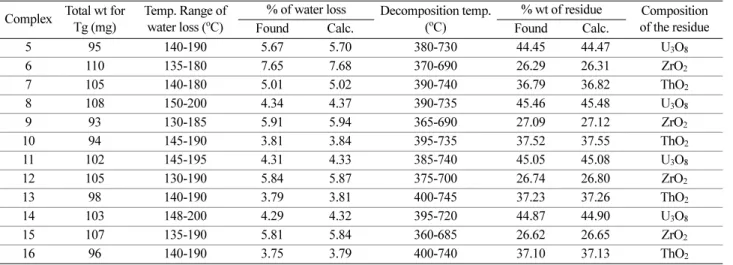
All these complexes follow the same pattern of thermal decomposition. The thermogram of the complexes exhib- ited the characteristics of co-ordinate water. The com- plexes remain almost unaffected up to ~140oC. There after a slight depression up to ~200oC is observed. The weight loss at this temperature is equivalent to four water molecule for bispt complexes and three water molecules for other complexes indicating them to be coordinated water19 in conformity with our earlier observations from analytical and IR spectral investigation. Simultaneous elimination of coordinated water suggests them to be in the same chemical environment. The anhydrous complexes remain stable up to 400oC and there after the complexes shows rapid degradation presumably due to decomposi- tion of organic constituents of the complexes molecules as indicated by the steep fall in the percentage of weight loss.
The decomposition temperature varies for different com- plexes as shown in Table 2.
Table 2. Important features of thermo gravimetric analysis (TGA) Complex Total wt for
Tg (mg)
Temp. Range of water loss (oC)
% of water loss Decomposition temp.
(oC)
% wt of residue Composition of the residue
Found Calc. Found Calc.
5 95 140-190 5.67 5.70 380-730 44.45 44.47 U3O8
6 110 135-180 7.65 7.68 370-690 26.29 26.31 ZrO2
7 105 140-180 5.01 5.02 390-740 36.79 36.82 ThO2
8 108 150-200 4.34 4.37 390-735 45.46 45.48 U3O8
9 93 130-185 5.91 5.94 365-690 27.09 27.12 ZrO2
10 94 145-190 3.81 3.84 395-735 37.52 37.55 ThO2
11 102 145-195 4.31 4.33 385-740 45.05 45.08 U3O8
12 105 130-190 5.84 5.87 375-700 26.74 26.80 ZrO2
13 98 140-190 3.79 3.81 400-745 37.23 37.26 ThO2
14 103 148-200 4.29 4.32 395-720 44.87 44.90 U3O8
15 107 135-190 5.81 5.84 360-685 26.62 26.65 ZrO2
16 96 140-190 3.75 3.79 400-740 37.10 37.13 ThO2
Electronic spectra
The electronic spectra of complexes in DMSO are quite similar. The present system of ligands where 2-thiohy- dantion is coupled at 3-position with benzylidene/furfu- rylidene/(pyridyl/thienyl-2’-methylene) imino group and at 5 position with-p-sulphonamido-phenyl azo group dis- play only two bands corresponding to λmax, 280-300 nm and 350-400 nm assignable to π-π* and n-π* transition respectively indicating extensive conjugation. The UO2(VI) complexes display mainly one weak band at 440 nm and a highly intense band in the range ~300 nm which may be due to 1Σg+→3πu transitions and charge transfer being overlapped with π–π* transition respectively.20 It may be noted that the band occurring at 370 nm is due to uranyl moiety because of apical oxygen →ƒo(U) transition is being merged with the ligand band due to n→π* transi- tion as evident from broadness and intensity. The elec- tronic spectra of ZrO(IV) and Th(IV) complexes exhibit only highly intensive additional band in the region 370- 400 nm which may be due to charge transfer besides the ligand bands.
1H NMR spectra
The 1H NMR spectra of the ligands as well as the com- plexes are recorded in DMSO-d6 medium. The 1H NMR spectra of the ligands show a complex broad multiplet at δ 8.4-7.3 ppm corresponding to nine aromatic protons for bispt, While the ligands like fispt, pmispt and tmispt show addinational multipletes at δ 7.5-6.20 ppm corresponding to three protons of furan moiety of fispt, at δ 8.0-8.7 ppm corresponding to four aromatic protons for pyridine moi- ety of pmispt and at δ 7.78-7.22 ppm corresponding to three protons of thiophene moiety of tmispt, besides the multiplet at δ 8.7-8.5 ppm due to four phenyl ring pro- tons.21 The former multipletes undergo downfield shift to some extent probably due to involvement of ring O-atom, ring N-atom, ring S-atom in complextation, because of lowering of electron density in the ring system as evi- denced from IR investigation while the latter multiplet remains practically unalterted.
Another set of three distinct 1H NMR peaks were observed at δ ~9.5 ppm (1H), δ ~9.1 ppm (1H) and at δ
~3.42 ppm in the present system of ligands corresponding to N=C-H proton, -NH proton and -CH protons (thiohy- dantoin moiety). The signals due to H-C=N proton and N- H proton show a downfield shift by δ 0.3~0.4 ppm indi- cating the coordination of azomethine nitrogen and amidic nitrogen to the metal ions. However, the position of peaks due to –CH proton does not change appreciably because
Fig. 2. (M=UO22+, ZrO2+) (UO2)2(bispt)(NO3)4(H2O)4 (ZrO)2(bispt) (NO3)4(H2O)4.
Fig. 3. (Th)2(bispt)(NO3)8(H2O)4.
Fig. 4. (M=UO22+, ZrO2+)(X=O,S).
Fig. 5. (Th)2(fispt)(NO3)8(H2O)3(Th)2(tmispt)(NO3)4(H2O)3(X=O,S).
Fig. 6. (UO2)2(pmispt)(NO3)4(H2O)3 (ZrO)2(pmispt)(NO3)4(H2O)3 (M=UO22+, ZrO2+).
Fig. 7. (Th)2(pmispt)(NO3)4(H2O)3.
of the coordination of the ligand with metal ion. Besides an additional peak at δ ~3.5 ppm is observed in all the complexes indicating the presence of coordinated water molecules.22
Fungicidal Screening
The antifungal activity of ligand bispt, fispt, pmispt, tmispt and zirconium complexes were tested against the organism Aspergillus niger, Aspergillus flavus by a typ- ical procedure,23 well diffusion method24 method. A well was made on NCCLS approved standard potato dextrose agar medium inoculated with micro organism. The well was filled with the test solutions prepared by dissolving the complex in DMSO using a micropipette and the plates were incubated at 35oC for five days. During this period the test solution diffused affected the growth of the inoc- ulated bacteria. The % of inhibition was calculated as
% of inhibition=100(P-Q)/P
Where Q=Area of colony growth with test sample P=Area of colony growth without test sample The results obtained have been presented in the Table 3 as given below.
The results of antifungal screening indicate that the complexes are more active than the free ligand. Increased activity of the complexes can be explained on the basis of chelation theory, there by increasing delocalization of π electron in the chelating ring.25
Acknowledgement. The authors gratefully acknowl- edge the services rendered by Director, Regional Sophis- ticated Instrumentation Center, I.I.T., Madras, for recording the spectra.
REFERENCES
1. Halcrow, M. A.; Christou, G. Chem. Rev. 1994, 94, 2421.
2. Zouni, A.; Witt, H. T.; Kern, J.; Fromme, P.; Kraub, N.;
Saenger, W.; Orth, P. Nature 2001, 409, 739.
3. Chaturvedi, K. K.; Kausal, R. Indian J. Pharm. 1995, 37, 85.
4. Satpathy, K. C.; Panda, A. K.; Dash, D. C.; Mohanty, H.
Indian J. Chem. 1994, 33A, 955.
5. Panda, A. K.; Dash, D. C.; Mishra, P.; Mohanty, H. Indian J.Chem. 1996, 35A, 843.
6. Dash, D. C.; Mohapatra, R. K.; Ghosh, S.; Naik, P. J.
Indian Chem. Soc. 2009, 86, 121.
7. Dash, D. C.; Mahapatra, A.; Mohapatra, R. K.; Ghosh, S.;
Naik, P. Indian J. Chem. 2008, 47A, 1009.
8. Dash, D. C.; Mohapatra, R. K.; Ghosh, S.; Naik, P. J.
Korean Chem. Soc. 2008, 52(5), 468.
9. Mohapatra, R. K.; Dash, D. C. J. Korean Chem. Soc. 2010, 54(4), 395.
10. Meher, S. S.; Naik, S.; Behera, R. K.; Nayak, A. J. Indian Chem. Soc. 1981, 58, 274.
11. Vogel, A. I. A Hand Book of Quantitative Inorganic Anal- ysis, 2nd ed.; Longman: London, 1966.
12. Dash, K. C.; Mansingh, P. S.; Mohanty, R. R.; Jena, S. Indian J. Chem. 1996, 35A, 480.
13. Bellamy, L. J. Advances in Infrared Group Frequencies, Methuen: London, 1968.
14. Rao, C. N. R. Chemical Application of IR Spectroscopy, Academic Press: New York, 1963.
15. Dash, D. C.; Panda, A. K.; Jena, P.; Mahapatra, A.; Pat- joshi, S. B. J. Indian Chem. Soc. 2002, 79, 48.
16. Sing, R. P.; Tondon, J. P. Indian J. Chem. 1980, 19A, 602.
17. Selbin, J. Angew. Chem. 1996, 5, 712.
18. Yadava, H. D. S.; Senguptya, S. K.; Tripathi, S. C. Inor- ganic Chem. Acta. 1987, 128, 1.
19. Nikolaev, A. V.; Lagvienko, V. A.; Myachina, I. Thermal Analysis, Academic Press: New York, 1969.
20. Chandra, R. Synth. React. Inorg. Met.-Org. Chem. 1990, 20, 645.
21. Shakir, M.; Varkey, S. P. Polyhedron, 1994, 13, 941.
22. Swamy, S. J.; Bhaskar, K. Indian J. Chem. 1999, 84A, 963.
23. Pelczar, M. J.; Chan, E. C. S.; Krieg, N. R. Microbiology, 5th ed.; New York, 1998.
24. Kannan, N. Laboratory Manual in Microbiology, 1st ed.;
Palani Paramount Publication: Palani, 1996.
25. Elangovan, S. P.; Krishnasamy, V.; Murugesan, V. Indian J. Chem. 2001, 40A, 1262.
Table 3. Fungi toxicity of the ligands and Zr(IV) complexes
Ligand/complexes Aspergillus niger % of inhibition control Aspergillus flavus % of inhibition over control
100 200 400 800 1000 100 200 400 800 1000
Bispt 8.4 12.1 14.2 28.2 52.5 6.5 11.6 14.7 26.3 48.1
Fispt 10.6 15.3 22.8 39.1 50.3 11.4 17.5 25.3 32.5 54.7
Pmispt 15.2 20.3 25.4 42.6 60.1 15.6 19.1 23.3 41.2 62.3
tmispt 18.7 25.7 32.1 64.8 77.0 17.3 25.3 32.4 64.3 75.2
(ZrO)2bispt(NO3)4 (H2O)4 11.7 17.4 16.3 31.2 55.1 10.2 15.5 15.1 29.2 52.1 (ZrO)2fispt(NO3)4(H2O)3 13.4 16.6 23.5 52.1 54.6 13.1 18.7 26.2 35.6 57.8 (ZrO)2pmispt(NO3)4(H2O)3 16.1 21.7 26.3 48.3 63.2 16.3 21.3 28.3 45.2 65.3 (ZrO)2tmispt(NO3)4(H2O)3 19.4 26.2 34.3 66.3 78.5 18.5 26.6 36.1 68.5 76.7