INTRODUCTION
The relationship between depression and anxiety disorders has been the focus of attention for many mental health clini- cians and researchers. Interest in this issue stems primarily from the high degree of comorbidity and correlation between these two conditions. Epidemiological studies have reported that the comorbidity rates between depression and anxiety disorders are from 30% to 75% (1, 2), and the correlation measured by self-reports has been placed between 0.50 and 0.80. The findings of research conducted in the 1970s and 1980s can be thought of as fitting into three categories: a) anxiety and depression differ quantitatively (i.e., unitary mo- del); b) anxiety and depression differ qualitatively (i.e., dual model); c) combined anxiety and depression differ both quan- titatively and qualitatively from either pure anxiety or pure depression (3). However, researchers have gradually begun to realize that the dispute over these three concepts is an unnec- essary and unproductive one (4). In other words, it has been realized that it will be more effective and productive to deter- mine exactly what the similarities and differences of anxiety and depression are, rather than debating whether the two con- ditions are quantitatively or qualitatively different. On the basis of this background, Clark and Watson (5) suggested a new concept, now commonly referred to as the tripartite model of anxiety and depression.
Clark and Watson hypothesized three relatively indepen- dent factors, positive affect (PA), negative affect (NA), and physiological hyperarousal (PH). They proposed that anxiety and depression are both characterized by the nonspecific dis- tress of NA, whereas anxiety and depression each feature their own unique factors, high PH (anxiety) and low PA (depres- sion). The tripartite model has rapidly received extensive em- pirical support (6, 7). This model, which was initially devel- oped from adult empirical data, has been applied to both child and adolescent samples, and, in the past 15 yr, ever-increas- ing efforts have focused on the validity of the tripartite model of anxiety and depression in these younger age groups (8, 9).
For example, Joiner et al. (10) selected NA, PA, and PH construct items from the Children’s Depression Inventory (CDI) and the Revised Children’s Manifest Anxiety Scale (RCMAS) on the basis of tripartite model, and these items were completed by child and adolescent inpatients. Explorato- ry factor analysis produced three factors, NA, PA, and PH, in parallel with the tripartite model. This represents the very first support for the tripartite model of child and adolescent anxiety and depression. Thereafter, Chorpita et al. (11) pro- vided further empirical support for the tripartite model, using confirmatory analysis in a study involving community youths.
In addition, several new scales for the evaluation of child emo- tions, and the examination of tripartite model constructs such as Positive Affect and Negative Affect Schedule for Children
Jae-Won Yang, Sungdo D. Hong, Yoo Sook Joung, Ji-Hae Kim
Department of Psychiatry, Samsung Medical Center, Sungkyunkwan University School of Medicine, Seoul, Korea
Address for correspondence Ji-Hae Kim, Ph.D.
Department of Psychiatry, Samsung Medical Center, Sungkyunkwan University School of Medicine, 50 Ilwon-dong, Gangnam-gu, Seoul 135-710, Korea Tel : +82.2-3410-0931, Fax : +82.2-3410-0050 E-mail : [email protected]
1098
Validation Study of Tripartite Model of Anxiety and Depression in Children and Adolescents: Clinical Sample in Korea
Although the currently available literature has provided some empirical support for a tripartite model of child and adolescent anxiety and depression, one of the limita- tions of these studies was that they have been conducted in America, primarily with Caucasians. In order to make this model more applicable to diverse ethnic and cul- tural groups, this study used a tripartite model for child and adolescent anxiety and depression in Korea, using confirmatory factor analysis with logically selected items from the Revised Children’s Manifest Anxiety Scale (RCMAS), as well as the Chil- dren’s Depression Inventory (CDI). The results indicated that the model fit of a three- factor model was superior to one- and two-factor models. In addition, the findings of discriminant analysis demonstrated that the correct classification rate with three factors of the tripartite model was superior to the classification rate achievable using CDI and RCMAS. In a departure from Clark and Watson’s hypothesis, however, the correlations of three factors were significantly higher than had been expected. The results are discussed on the basis of cultural background.
Key Words : Child; Adolescent; Comorbidity; Anxiety; Depression
Received : 18 November 2005 Accepted : 31 March 2006
(12) and Affect and Arousal Scale (13) have been developed, thus continuously providing further empirical support for the model.
To date, however, tests of the tripartite model have been conducted principally with Caucasian youths in America. To the best of our knowledge, only two studies of this subject with community adolescents have been conducted outside of America and these only provided partial empirical support (14, 15). As racial and ethnic differences exist in the symptom presentations of psychiatric disorders (16), more cross-cultural validation studies for tripartite model of anxiety and depres- sion are necessary to broaden its application. Therefore, the objective of the present study was to validate the tripartite model of emotion to clinical samples in Korea. In order to compare our results with those of previous tests, we used items which had been logically selected by Joiner et al. (10).
We also attempted to determine how accurately anxiety and depression could be differentiated using the selected items, on the basis of the tripartite model.
MATERIALS AND METHODS Subjects
The participants in this study included 150 youngsters (94 boys; 56 girls) with anxiety disorders and/or depression, all of whom were inpatients or outpatients in the Department of Psychiatry at a general hospital in Seoul, Korea. The mean age of the sample was 13.33 yr (SD=2.60; range=8 to 18).
A psychiatrist had rendered their diagnoses after semi-struc- tured clinical interviews with patients and their parents, on the basis of the DSM-IV (17). Information regarding the prin- cipal diagnoses of the samples is shown in Table 1. Twenty four patients exhibited other comorbid psychiatric disorders (12 individuals with attention deficit hyperactivity disorder, 3 with oppositional defiant disorder, 3 with conduct disor- der, 2 pervasive developmental disorders, and 1 each of tran- sient tic disorder, delusional disorder, intermittent explosive disorder, and developmental coordination disorder).
Procedure
On the initial visit, a psychiatrist interviewed with the pa- tients and their parents. On the next visit, the patients indi- vidually completed the measurements used in this study. All of these assessments were conducted in an examination room within the hospital.
Measures
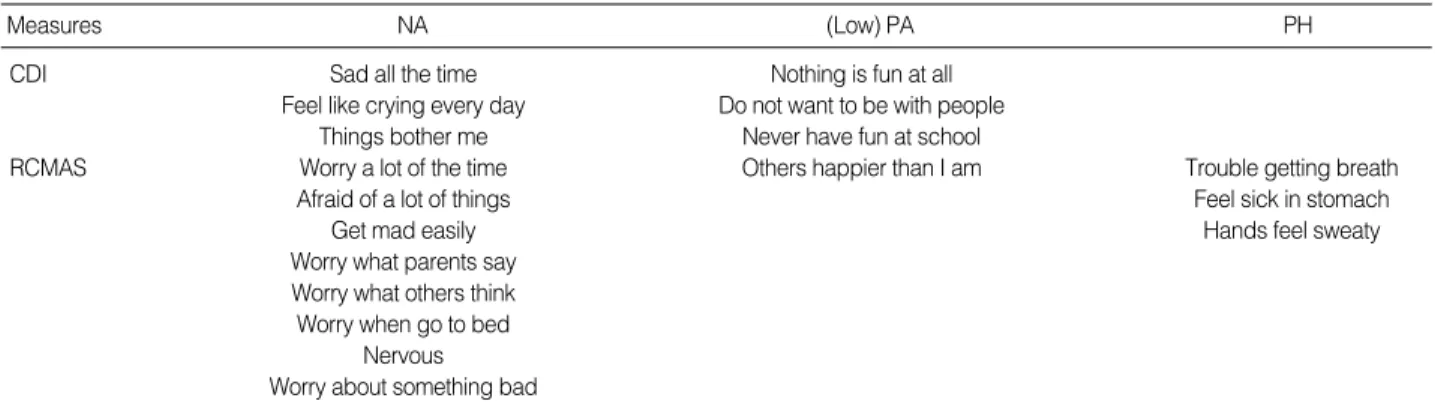
All participants completed children’s depression scale (18, 19) and revised children’s manifest anxiety scale (20, 21) which are most widely used self reports to measure depressive and anxiety symptoms. NA, PA and PH items were selected and analyzed for validation of tripartite model as were initially selected by Joiner et al. (10), in tests of the tripartite model conducted in previous studies. The selected NA, PA and PH constructs from CDI and RCMAS are shown in Table 2.
GAD, Generalized Anxiety Disorder; NOS, Not Otherwise Specified;
OCD, Obsessive-Compulsive Disorder.
Diagnosis Number
Depressive Disorders 113
Major depressive disorder 15
Dysthymic disorder 23 (comorbid with 1 GAD) Depressive disorder, NOS 75 (comorbid with 4 Anxiety
disorder, NOS & 1 OCD)
Anxiety Disorders 35
Panic disorder 2
Social phobia 1
Obsessive-compulsive disorder 5
Posttraumatic stress disorder 1
Acute stress disorder 1
Generalized anxiety disorder 1
Anxiety disorder, NOS 24
Mixed Anxiety-Depressive Disorder 2
Total 150
Table 1.Principal diagnoses of sample
NA, Negative Affect; PA, Positive Affect; PH, Physiological Hyperarousal; CDI, Children’s Depression Inventory; RCMAS, Revised Children’s Manifest Anxiety Scale.
Measures NA (Low) PA PH
CDI Sad all the time Nothing is fun at all
Feel like crying every day Do not want to be with people
Things bother me Never have fun at school
RCMAS Worry a lot of the time Others happier than I am Trouble getting breath
Afraid of a lot of things Feel sick in stomach
Get mad easily Hands feel sweaty
Worry what parents say Worry what others think Worry when go to bed
Nervous Worry about something bad
Table 2.Selected NA, PA, and PH items from CDI and RCMAS by Joiner et al.
Statistical analysis
In order to investigate the differences in CDI, RCMAS, and three constructs of tripartite model between anxiety and depression groups, t-test was conducted. For comparison of the fit of a tripartite model, confirmatory factor analyses were employed. The goodness of fit of the models was evaluated using the Comparative Fit Index (CFI), Tucker-Lewis Index (TLI), and the Root Mean Square Error of Approximation (RMSEA). The sequential chi-square difference test was used for the comparison of models. Additionally, a discriminant analysis was conducted in order to determine whether or not three factors (NA, PA, and PH) could be used to discriminate anxiety from depressive disorders. A p value of 0.05 or less was regarded as statistically significant. T-test and discrimi- nant analysis were performed using SPSS 12.0 for Windows (SPSS, Chicago, IL, U.S.A.). Confirmatory factor analysis was computed with AMOS 4.0 (22), using maximum likelihood estimation method.
RESULTS Group comparison
In the pure anxiety and depression comparisons, comorbid participants were excluded for group comparisons. Group
differences were assessed via the comparison of means on the CDI, RCMAS and the subscales of the tripartite model. As can be seen in Table 3, the depression group scored signifi- cantly higher than the anxiety group on CDI, whereas there were no differences between the two groups on the RCMAS.
With regard to the subscales of the tripartite model, we deter- mined there to be no difference in NA, but did detect a sig- nificant difference in the PA and PH constructs. That is, the depression group scored higher than the anxiety group on low PA, while the anxiety group did higher on PH.
Confirmatory factor analysis
Confirmatory factor analyses were employed in the com- parison of the fit of a tripartite model with (a) a unitary model and (b) three two-factor models, in which each two-constructs were collapsed into one factor. The results obtained using items selected on the basis of tripartite model showed that the model fit of the three-factor model was adequate, and was, in fact, significantly better than that of the one- and two- fac- tor models: 2diff(2, N=150)=24.54, p<0.01 (three-factor vs.
one-factor), 2diff(3, N=150)=36.29, p<0.01 (three-factor vs.
two-factor; see Table 4). The correlations of three latent vari- ables in the tripartite model were higher than expectation (NA:PH r=0.64; NA:PA r=0.46; PA:PH r=0.21).
Discriminant analysis
We also conducted a discriminant analysis, in order to de- termine whether or not three factors (NA, PA, and PH) could be used to discriminate anxiety from depressive disorders.
142 patients were included in this analysis, and 8 subjects with comorbid anxiety and depression were excluded from participation. For comparison, we also conducted a discrim- inant analysis, using all items from the CDI and the RCMAS.
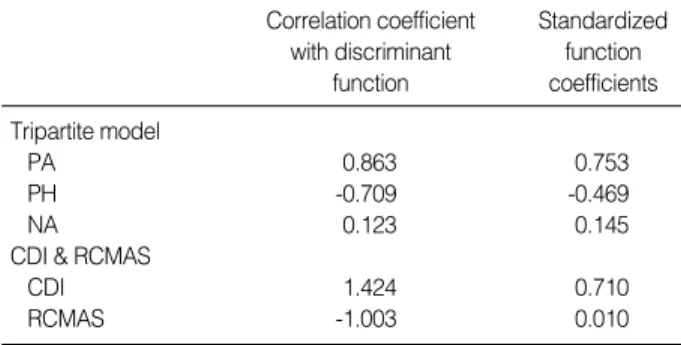
Standardized function coefficients and correlation coefficients are shown in Table 5.
Using the items selected by Joiner et al., the original clas-
CDI, Children’s Depression Inventory; RCMAS, Revised Children’s Mani- fest Anxiety Scale; NA, Negative Affect; PA, Positive Affect; PH, Physio- logical Hyperarousal.
Depressive Disorders Only
(n=107) Anxiety
Disorders Only (n=35)
t
(df=140) p
CDI 15.33 (7.30) 20.30 (7.94) -3.28 0.001
RCMAS 15.16 (5.96) 15.22 (6.33) -0.05 0.963
NA 6.41 (3.31) 5.94 (3.13) 0.74 0.462
(Low) PA 1.89 (1.28) 3.10 (1.74) -3.82 0.000
PH 1.02 (1.05) 1.49 (0.89) -2.38 0.019
Table 3.Group differences on CDI, RCMAS and subscales of tripartite models
NA, Negative Affect; PA, Positive Affect; PH, Physiological Hyperarousal;
CFI, comparative fit index; TLI, Tucker-Lewis index; RMSEA, root-mean- square error of approximation.
Model 2 df CFI TLI RMSEA
One-factor 207.81 135 0.945 0.930 0.086
Two-factor
NA-PA : PH 209.94 134 0.968 0.960 0.062
PA-PH : NA 209.00 134 0.969 0.960 0.061
NA-PH : PA 196.06 134 0.955 0.943 0.078
Three-factor 171.52 132 0.984 0.979 0.045
Table 4.Goodness-of-fit indices for confirmatory factor analyses of five alternative models of the NA, PA, and PH
NA, Negative Affect; PA, Positive Affect; PH, Physiological Hyperarousal;
CDI, Children’s Depression Inventory; RCMAS, Revised Children’s Mani- fest Anxiety Scale.
Correlation coefficient with discriminant
function
Standardized function coefficients Tripartite model
PA 0.863 0.753
PH -0.709 -0.469
NA 0.123 0.145
CDI & RCMAS
CDI 1.424 0.710
RCMAS -1.003 0.010
Table 5.Discriminant analysis for diagnosis of anxiety and dep- ressive disorder groups
sification results showed that 80.0% of the anxiety disorders had been classified correctly, whereas 67.3% of the depressive disorders had been classified correctly. In the overall sample, 70.4% of the disorders were classified correctly. However, with the whole items of the CDI and RCMAS, the correct overall classification rate was 65.4%, and the rate for anxi- ety and depressive disorders was 68.6% and 65.4% each. In general, the correct classification rate of anxiety from depres- sion was better with the NA, PA, and PH constructs than with all of the items of the CDI and RCMAS.
DISCUSSION
The result of this study, which was consistent with the find- ings of previous studies, reported that the model fit index of the three-factor structure was significantly superior to that of all of the other models. In addition, using the items logi- cally selected from the CDI and RCMAS on the basis of tri- partite model, we found there to be no significant differences between the anxiety and depression groups with regard to NA. However, the group with anxiety disorders showed more physiological hyperarousal than the group with depression.
On the contrary, the group with depression showed lower in positive affect than the group with anxiety disorders. In addi- tion, the findings of discriminant analysis indicated that the correct rate at which anxiety disorders could be differentiated from depression using the NA, PA, and PH constructs was higher than when using the whole scales, CDI and RCMAS.
These findings provide further evidence supporting the valida- tion of the tripartite model of emotion in a clinical sample of patients suffering from anxiety and depressive disorders.
To date, the validity of the tripartite model in children and adolescents has been verified by the results of prior empirical studies for a decade (8). However, almost all studies on this subject have been done in America, primarily with Caucasian youths. The results of this study, however, serve to broaden the application of the tripartite model to diverse ethnic and cultural groups.
Although the overall results of this study tend to support the tripartite model, three factors in this sample were highly correlated with one another, in contrast with Clark and Wat- son’s hypothetical explanation (5) that the tripartite factors are orthogonal dimensions.
Several explanations are possible for these unexpected results.
The first explanation involves the sample used in this study.
The subject group in this study was comprised of children and adolescents, all of whom had anxiety and depressive dis- orders which were sufficiently severe enough to warrant a visit to the department of psychiatry in a general hospital. Comor- bidity with anxiety and depression is a very common phe- nomenon. Thus, it is not surprising that patients with either anxiety or depression also have increased tendencies toward the other symptoms, although these tendencies are not nor-
mally sufficiently severe to constitute additional diagnoses.
A second explanation concerns the scales used in this study, CDI and RCMAS. It has been repeatedly proposed that both the CDI and the RCMAS possess low discriminant validity, and are only used as measurements of general distress and NA, due to the fact that they were developed in the absence of a theoretical background (23, 24). The NA, PA, and PH items used in this study were selected from these scales, and thus there might be a high degree of overlap among the tri- partite constructs, even though the items had been theoreti- cally selected. By way of contrast, other investigations em- ploying PANAS-C and AFARS, which were specifically de- signed to assess the tripartite model, indicated only a few correlations among factors, which is consistent with Clark and Watson’s hypothesis (5).
The third explanation is related to cultural differences. It is suggested that patients in non-Western cultures report somatic symptoms and deny psychological symptoms more frequently than patients in Western countries (25). In Korea, based on the traditional Confucian background of the culture, the direct expression of emotions is fairly restricted. In other words, the inhibition of emotional expression is a Korean cul- tural characteristic. Therefore, Koreans exhibit a tendency to express their negative feelings as somatic complaints. Con- sidering Korean culture, it might be inferred that somatic symptoms tend to be more strongly associated with negative emotions, including anxiety and depressive symptoms, than in any other cultures, particularly Western cultures. The Korean cultural context may explain why the correlations of three constructs are higher than was found in the prior studies, which were conducted primarily in America, and in Clark and Watson’s hypothesis; thus, cultural background should be considered to some degree when applying the tripartite model to other cultures. In order to resolve issues regarding the relationships between the three constructs in the tripar- tite model, three possibilities might be considered. Addition- al research with multiple scales, and in other countries, will be required for a solid solution.
To the best of our knowledge, this study is the first to inves- tigate the tripartite model of anxiety and depression in Asia.
The findings from this study serve to expand the applicabil- ity of the tripartite model. However, it should be noted that this study suffers from several inherent methodological limita- tions. Structured interviews for diagnosis were not conducted in this study, although semi-structured clinical interviews were conducted by a psychiatrist. Besides, due to the fact that we used only children and adolescents’ self-reports as an infor- mant, we abrogated the benefits which would have been gen- erated from the use of multiple informants. In addition, it should be noted that it was one of the limitations that the subject number of anxiety disorders was relatively small in this study. Considering the limitations of this study, though, more research with diverse cultures will be required in order to facilitate the application of the tripartite model in the future.
REFERENCES
1. Angold A, Costello EJ. Depressive comorbidity in children and ado- lescents: Empirical, theoretical, and methodological issues. J Am Psychiatr 1993; 150: 1779-91.
2. Kessler RC, Avenevoli S, Merikangas KR. Mood disorders in chil- dren and adolescents: An epidemiological perspective. Biol Psychi- atr 2001; 49: 1002-14.
3. Stavrakaki C, Vargo B. The relationship of anxiety and depression:
A review of the literature. Br J Psychiatr 1986; 149: 7-16.
4. Mineka S, Watson D, Clark LA. Comorbidity of anxiety and unipo- lar mood disorders. Annu Rev Psychol 1998; 49: 377-412.
5. Clark LA, Watson D. Tripartite model of anxiety and depression:
Psychometric evidence and taxonomic implications. J Abnorm Psy- chol 1991; 100: 316-36.
6. Joiner TE. A confirmatory factor-analytic investigation of the tripar- tite model of depression and anxiety in college students. Cognit Ther Res 1996; 20: 521-39.
7. Watson D, Weber K, Assenheimer JS, Clark LA, Strauss ME, Mc- Cormick RA. Testing a tripartite model: I. Evaluating the conver- gent and discriminant validity of anxiety and depression symptom scales. J Abnorm Psychol 1995; 104: 3-14.
8. Laurent J, Ettelson R. An examination of the tripartite model of anxi- ety and depression and its application to youth. Clin Child Fam Psy- chol Rev 2001; 4: 209-30.
9. Lonigan CJ, Carey MP, Finch AJ Jr. Anxiety and depression in chil- dren and adolescents: Negative affectivity and the utility of self-reports.
J Consult Clin Psychol 1994; 62: 1000-8.
10. Joiner TE Jr, Cantazaro SJ, Laurent J. Tripartite structure of positive and negative affect, depression, and anxiety in child and adolescent psychiatric inpatients. J Abnorm Psychol 1996;105: 401-9.
11. Chorpita BF, Plummer CM, Moffitt CE. Relations of tripartite dimen- sions of emotion childhood anxiety and mood disorders. J Abnorm Psychol 2002; 28: 299-310.
12. Laurent J, Catanzaro SJ, Joiner TE, Rudolph KD, Potter KI, Lambert S, Osborne L, Gathright T. A measure of positive and negative affect for children: Scale development and initial validation. Psychol Assess
1999; 11: 326-38.
13. Chorpita BF, Yim L, Moffitt C, Umemoto LA, Francis SE. Assess- ment of symptoms of DSM-IV anxiety and depression in children: A revised child anxiety and depression scale. Behav Res Ther 2002;
38: 835-55.
14. Boyd CP, Gullone E. An investigation of negative affectivity in Aus- tralian adolescents. J Clin Child Psychol 1997; 26: 190-7.
15. Austin AA, Chorpita BF. Temperament, anxiety, and depression:
Comparisons across five ethnic groups of children. J Clin Child and Adolescent Psychol 2004; 33: 216-26.
16. Lawson WB. Racial and ethnic factors in psychiatric research. Hosp Community Psychiatry 1986; 37: 50-4.
17. American Psychiatric Association. Diagnostic and statistical manual of mental disorders. 4th ed. Washington: APA, 1994.
18. Kovacs M. Rating scales to assess depression in school-aged chil- dren. Acta Paedopsychiatr 1981; 46: 305-15.
19. Cho SC, Lee YS. Development of the Korean form of the Kovacs’
children’s depression inventory. J Korean Neuropsychiatr Assoc 1990; 29: 945-56.
20. Reynolds CR, Richmond BO. What I think and feel: A revised mea- sure of children’s manifest anxiety. J Abnorm Child Psychol 1978;
6: 271-80.
21. Choi JS, Cho SC. Assessment of anxiety in children: Reliability and validity of revised children’s manifest anxiety scale. J Korean Neu- ropsychiatr Assoc 1990; 29: 691-702.
22. Arbuckle J, Wothke W. Amos 4.0 User’s guide. Chicago: Small waters, 1999.
23. Chorpita BF, Albano AM, Barlow DH. The structure of negative emotions in a clinical sample of children and adolescents. J Abnorm Psychol 1998; 107: 74-85.
24. Myers K, Winters NC. Ten-year review of rating scales. II: Scales for internalizing disorders. J Am Acad Child Adolesc Psychiatr 2002; 41: 634-59.
25. Simon GE, VonKorff M, Piccinelli M, Fullerton C, Ormel J. An in- ternational study of the relation between somatic symptoms and de- pression. N Engl J Med 1999; 341: 1329-35.