Development and Psychometric Evaluation of Nursing Low Back Pain Predictor Questionnaire
Focusing on Nurses Suffering from Chronic Low Back Pain in Iran
Leila Ghadyani
1, Sedigheh Sadat Tavafian
1, Anoshirvan Kazemnejad
2, Joan Wagner
31Department of Health Education, Faculty of Medical Sciences, Tarbiat Modares University, Tehran, Iran
2Department of Statistics, Faculty of Medical Sciences, Tarbiat Modares University, Tehran, Iran
3Rehabilitation Science, University of Alberta, Edmonton, Alberta, Canada
Study Design: Development and psychometric evaluation.
Purpose: Design and psychometric assessment of the Nursing Low Back Pain Predictor Questionnaire addressing nurses suffering from chronic low back pain in Iran.
Overview of Literature: Low back pain is the most prevalent behavior-related health problem among nurses, and it needs to be assessed through a validated multi-factorial questionnaire, using the premises of the social cognitive theory.
Methods: This was a cross-sectional study carried out in Tehran, Iran from April 17, 2014 to July 16, 2014. A 50-item questionnaire based on the social cognitive theory was generated. The questionnaire was distributed among 500 nurses working in hospitals located in different geographically areas in Tehran. Exploratory factor analysis was used to determine the factors and their related items.
Cronbach’s alpha was calculated to assess reliability.
Results: The exploratory factor analysis loaded six factors, named observational learning, outcome expectations, self-efficacy, self-regulation, and self-efficacy in overcoming impediments in the working environment and emotional coping. All factors were jointly accounted for 67.12% of behavior change variance. The Cronbach’s alpha coefficient showed excellent internal consistency (alpha=0.91). Test and retest analysis with 2-week intervals indicated an appropriate stability for the questionnaire (intraclass correlation coefficient=0.94).
Conclusions: According the results, the developed questionnaire is a reliable and validated theory-based instrument, which can be used to predict the work, related factors for low back pain among nurses.
Keywords: Chronic low back pain; Psychometric evaluation; Social cognitive theory
Copyright Ⓒ 2016 by Korean Society of Spine Surgery
This is an Open Access article distributed under the terms of the Creative Commons Attribution Non-Commercial License (http://creativecommons.org/licenses/by-nc/3.0/) which permits unrestricted non-commercial use, distribution, and reproduction in any medium, provided the original work is properly cited.
Asian Spine Journal • pISSN 1976-1902 eISSN 1976-7846 • www.asianspinejournal.org
Received Dec 1, 2015; Revised Dec 22, 2015; Accepted Jan 10, 2016 Corresponding author: Sedigheh Sadat Tavafian
Department of Health Education, Faculty of Medical Sciences, Tarbiat Modares University, Tehran 14115-331, Iran Tel: +98-21-82884547, Fax: +98-21-82884555, E-mail: [email protected]
ASJ A SJ
Introduction
Musculoskeletal disorders among healthcare providers
are being studied in many countries. In Italy, numerous complaints about these disorders have been reported by workers in various healthcare professions. These disorders
are also considered serious health problems among phys- iotherapists and radiologists [1]. Among the healthcare professionals, nurses are the largest group with musculo- skeletal disorders.
A study in England showed that the frequency of low back pain among nurses was equal to that of industrial workers. Accordingly, 85.7% of the subjects in the study suffered from low back pain one year after entering the nursing profession [2]. Overall, 90.3% of nurses working in South Korean hospitals had back pain at least once a month [3]. Furthermore, the prevalence of low back pain is about 62% among Italian nurses [4], and 80.9% among nurses in Hong Kong[5]. Among Iranian nurses, more than half suffer from low back pain [4-6].
Previous studies have shown that the risk of low back pain increases rapidly with greater amount of physical work and psychological stress [3,7,8]. The pain frequently experienced by nurses undermines psychological health and reduces professional performance. Evidence has shown that low back pain is the most important reason for the nurses to change jobs [9].
Nurses, because of the nature of their profession, face adverse job related factors such as worksite stress and un- healthy physical and social behaviors leading to musculo- skeletal disorders. Therefore, enhancing healthy behaviors among nurses based on a biopsychological social factors is essential [10]. Improvement in personnel skills, creation of a supportive environment and more effective macro policy-making could lead to many positive changes that might enhance the well-being and quality of the work- place for many health professionals worldwide [10,11].
Social cognition is one of the important cognitive con- cepts studied in recent decades, and is closely related to the subject of human issues, understanding people and their behavior. This kind of cognition is reflexive and participatory and involves conciliatory actions [12,13].
Social cognition emphasizes that behavior is affected by learning, which is in turn influenced by societal models.
Consequently, modifying environmental conditions with ensuring efficient self-care and improving inter-personnel relationships are among the most important methods to enhance health [10].
The social cognitive theory (SCT) of Bandura, for- merly known as the social learning theory, has attracted the attention of health educators because it deals with the explanation and prediction of behaviors through the interactions between the individual, the behavior and
the environment. Therefore, because of the nature of the nursing profession and behavior related to low back pain, the work environmental factors and individual psy- chological determinants are the obvious influences. The researchers are unaware of any measuring instruments based on SCT that are available for Iranian nurses. The aim of this study was to develop a theory-based instru- ment for measuring the relevant factors associated with low back pain; as such, the application of this instrument may help in addressing the prevalence of low back pain for the nurses.
Materials and Methods
This was a cross sectional study that employed mixed methodology. Interviews with key experts were conducted to review the existing measurement instruments, to con- sider factors thought to be important in reducing pain, to gauge the ability of nurses, and to address factors lead- ing to risky behaviors which may contribute to low back pain. These components were compared with concepts of SCT to design the questionnaire items. The research team experts also guided further refinement of the question- naire. Similar statements were either removed from the questionnaire or merged; the questionnaire items were made simple and clear so that each one measured only one variable.
In order to determine the formal validity, this instru- ment was distributed among 10 nurses and the impact score was calculated at 3.3. To determine the content va- lidity, we used both qualitative and quantitative methods.
An expert panel consisting of 15 specialists composed of neurosurgeons, rheumatologists, epidemiologists, nurs- ing instructors, health educators and experts in qualita- tive methods evaluated the questionnaire for ‘grammar’,
‘wording’, ‘item allocation’, and ‘scaling’ indices [14,15].
The expert panel checked all items and provided their modifications for the questionnaire.
The content validity ratio (CVR) and the content valid- ity index (CVI) were used to calculate quantitative content validity. Items were assessed using a 3-point rating scale:
(1) essential, (2) useful, but not essential, and (3) unes- sential [16,17]. Based on Lawshe’s table, items with CVR value of 0.4 or above were considered acceptable [18]. For CVI, according to Waltz & Bausell’s recommendation, the same experts were asked to evaluate the items based on a 4-point Likert scale on (1) simplicity, (2) relevancy, and (3)
clarity [19,20]. The CVI value of 0.79 or above was con- sidered satisfactory for each statement [21].
The construct validity of the instrument concepts was determined by a sampling of 500 nurses. This sample con- sisted of nurses who had the entry and exit characteristics of the study. Ten nurses were selected from a different ward for individual questionnaire items. The two-section questionnaire, consisting of 17 demographic questions and 50 questions based on SCT was completed by the nurses. The demographic questions dealt with socio- economic characteristics, employment/working status, low back pain characteristics, and healthy preventive be- haviors due to back pain.
1. Statistical analysis
Several statistical analyses were performed to assess the psychometric properties of the questionnaire. The con- struct validity of the questionnaire was examined using exploratory factor analysis (EFA) [18,19]. The Kaiser- Meyer-Olkin and Bartlett’s Test of Sphericity were used to assess the appropriateness of the sample for the factor analysis [22,23]. A principal component analysis with varimax rotation was performed to extract the underly- ing factors. Factor loadings equal or greater than 0.3 were considered appropriate and eigenvalues above 1 and scree plots were used for determining the number of statements [23,24].
Internal consistency of the instrument was evaluated by the Cronbach’s alpha coefficient, once for the entire ques- tionnaire, once for each construct, and once for each fac- tor. The Cronbach’s alpha coefficient of 0.7 or above was thought satisfactory [17,18]. In addition, we examined the instrument’s stability by calculating intraclass correlation coefficient (ICC) with a sub-sample of nurses (n=20) who completed the questionnaire twice with a 2-week interval between the test and the retest [24]. The acceptable value for ICC was considered 0.4 or above. All the statistical analyses were performed using the SPSS ver. 16.0 (SPSS Inc., Chicago, IL, USA).
2. Ethics
The Ethics Committee of Tarbiat Modares University approved the study. All participants signed a written in- formed consent for the study.
Results
A total of 500 nursing staff including 332 females (66.4%) participated in the study. The mean age of participants was 37.71 (standard deviation [SD]=6.75) years, and the mean work experience was 10.77 years (SD=9.45). A total of 20 nurses including 14 females (70%) with mean age of 36.75 (SD=7.96) years took part in the test-retest sample.
The mean work experience of this sample was 9.45 years (SD=5.82). The demographic characteristics of the partici- pants are shown in the Table 1.
1. Exploratory factor analysis
The Kaisar-Meyer-Olkin was 0.87, and falls in the “very good” category. The Bartlett’s test of Sphericity was signifi- cant (chi-square=4.098, p<0.001 indicating the adequacy of samples for explorative factor analysis. The initial anal- ysis indicated a 6-factor structure for the questionnaire.
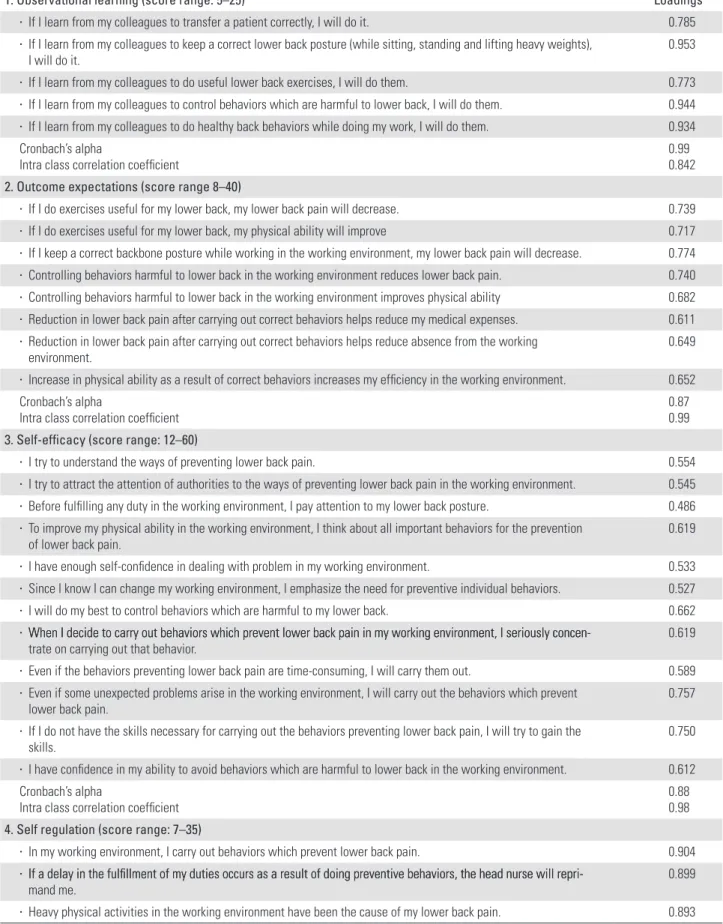
However, 4 items did not load on any factors and thus they were excluded. A final 46-item questionnaire loaded in six distinct factors. Table 2 shows the six factors derived from principal factor analysis with varimax rotation for the questionnaire. All factors jointly accounted for 67.12%
of variance (Table 2).
2. Reliability
The internal consistency of the questionnaire, as assessed by the Cronbach’s α coefficient, showed satisfactory re- sults with alpha ranging from 0.86 to 0.99. The ICC of the questionnaire also was found satisfactory, indicating that the questionnaire had a good stability. The five-part Likert scale (from score of 1 meaning “totally agree to,” and score of 5 meaning “totally disagree”) was used for all items. In total, 4 items were omitted. The 46-item questionnaire was approved by the study panel. The results of reliability as well as each concept score range follow.
Discussion
This study reports the development and psychometric evaluation of nursing low back pain predictor question- naire for Iranian nurses. The findings revealed satisfactory psychometric properties for the instrument with 6 fac- tors and 46 items. Since chronic low back pain in Iran is a prevalent health problem among nurses, the development
of a multi-dimensional questionnaire, which deals with low back pain from sociological, physical and psychologi- cal aspects has been given special attention.
The statements for this instrument were prepared through literature review based on SCT and biopsychoso- cial characteristics for low back pain among the nursing professionals. It has been revealed that individuals, who experienced a problem, are the best ones to provide input on factors, which might be effective [14]. In our study, we asked the nurses about the related factors, which might influence their low back pain in the framework of SCT.
In the present study, explanatory factor analysis showed that the factor of observational learning had satisfactory loading. This result indicated that Iranian nurses believed that they could learn healthy behaviors related to back pain through observation. Previous study indicated that observational learning may contribute to development and maintenance of pain-related beliefs that consequently resulted in healthy behaviors [25].
The other factor that was verified in this study was out- come expectation. This factor refers to anticipation of the probable outcomes that ensue as a result of engaging in a specific behavior [26]. Previous evidence identified three
types of outcomes including physical outcomes, which in- clude positive and negative consequences of the behavior, the outcome of social approval or disapproval of engaging or disengaging in a given behavior, and positive and nega- tive self-evaluation that encourages individuals to partici- pate in a specific behavior [26]. In the present study, we discussed these outcomes with the participants and asked if they would engage in preventive low back pain behav- iors at the working site.
In SCT, there were two separate concepts of outcome expectation and outcome expectancies that refer to beliefs regarding the likelihood of various outcomes resulting from the behaviors, and the value of the outcomes, re- spectively [26,27]. In present study, both concepts were grouped into one category and named “outcome expecta- tion.” McAlister et al. [27] believed that an individual’s value and an individual’s expectation are subjective items and can be categorized into the same category as a key concept named psychological determinants of behavior.
In the present study, EFA grouped the questions regard- ing self-efficacy, referring to beliefs about nurses’ ability to perform a desired behavior in their working environment [27] and the questions regarding situational perception, Table 1. The characteristics of the sample
Demographic variable EFA sample (n=500) Test-retest sample (n=20)
Work experience (yr), mean±SD 10.77 (6.05) 9.45 (5.82)
Employment status
Official 263 (52.6) 6 (30)
Official demo 48 (9.6) 3 (15)
Contractual 189 (37.80) 11 (55)
Marital status
Single 96 (19.2) 4 (20)
Married 404 (80.8) 16 (80)
Divorced/widow - -
Degree in nursing
Master’ degree - -
Bachelor’ degree 274 (54.8) 8 (40)
Associate’s degree 97 (19.4) 4 (20)
Diploma degree 129 (25.8) 8 (40)
Time of low back pain
5–10 yr 370 (74) 14 (70)
10–15 yr 107 (21.4) 6 (30)
15–20 yr 23 (4.6) -
EFA, exploratory factor analyses; SD, standard deviation .
Table 2. Six concepts derived from principle factor analysis with varimax rotation
1. Observational learning (score range: 5–25) Loadings
● If I learn from my colleagues to transfer a patient correctly, I will do it. 0.785
● If I learn from my colleagues to keep a correct lower back posture (while sitting, standing and lifting heavy weights),
I will do it. 0.953
● If I learn from my colleagues to do useful lower back exercises, I will do them. 0.773 ● If I learn from my colleagues to control behaviors which are harmful to lower back, I will do them. 0.944 ● If I learn from my colleagues to do healthy back behaviors while doing my work, I will do them. 0.934 Cronbach’s alpha
Intra class correlation coefficient
0.99 0.842 2. Outcome expectations (score range 8–40)
● If I do exercises useful for my lower back, my lower back pain will decrease. 0.739
● If I do exercises useful for my lower back, my physical ability will improve 0.717
● If I keep a correct backbone posture while working in the working environment, my lower back pain will decrease. 0.774 ● Controlling behaviors harmful to lower back in the working environment reduces lower back pain. 0.740 ● Controlling behaviors harmful to lower back in the working environment improves physical ability 0.682 ● Reduction in lower back pain after carrying out correct behaviors helps reduce my medical expenses. 0.611 ● Reduction in lower back pain after carrying out correct behaviors helps reduce absence from the working
environment.
0.649
● Increase in physical ability as a result of correct behaviors increases my efficiency in the working environment. 0.652 Cronbach’s alpha
Intra class correlation coefficient 0.87
0.99 3. Self-efficacy (score range: 12–60)
● I try to understand the ways of preventing lower back pain. 0.554
● I try to attract the attention of authorities to the ways of preventing lower back pain in the working environment. 0.545 ● Before fulfilling any duty in the working environment, I pay attention to my lower back posture. 0.486 ● To improve my physical ability in the working environment, I think about all important behaviors for the prevention
of lower back pain. 0.619
● I have enough self-confidence in dealing with problem in my working environment. 0.533 ● Since I know I can change my working environment, I emphasize the need for preventive individual behaviors. 0.527
● I will do my best to control behaviors which are harmful to my lower back. 0.662
● When I decide to carry out behaviors which prevent lower back pain in my working environment, I seriously concen-When I decide to carry out behaviors which prevent lower back pain in my working environment, I seriously concen-
trate on carrying out that behavior. 0.619
● Even if the behaviors preventing lower back pain are time-consuming, I will carry them out. 0.589 ● Even if some unexpected problems arise in the working environment, I will carry out the behaviors which prevent
lower back pain. 0.757
● If I do not have the skills necessary for carrying out the behaviors preventing lower back pain, I will try to gain the skills.
0.750
● I have confidence in my ability to avoid behaviors which are harmful to lower back in the working environment. 0.612 Cronbach’s alpha
Intra class correlation coefficient 0.88
0.98 4. Self regulation (score range: 7–35)
● In my working environment, I carry out behaviors which prevent lower back pain. 0.904 ● If a delay in the fulfi llment of my duties occurs as a result of doing preventive behaviors, the head nurse will repri-If a delay in the fulfillment of my duties occurs as a result of doing preventive behaviors, the head nurse will repri-
mand me. 0.899
● Heavy physical activities in the working environment have been the cause of my lower back pain. 0.893 (Continued to the next page)
referring to how nurses perceive and interpret the envi- ronment around them [26], into the same category named
“self efficacy.” The relationship between social environ- mental factors such as social support and self-efficacy has been confirmed [28].
A factor that gained satisfactory loading was self- efficacy in overcoming impediments. This factor describes the confidences that a person has in overcoming barri- ers while performing a given behavior. Sharma believed that using persuasion and reinforcement in overcoming work barriers in work centers promotes self-efficacy [27].
Another factor derived from explanatory factor analysis is self-regulation or goal setting and developing plans to accomplish a chosen behavior. This study grouped the questions related to two concepts of self-regulation and
environment grouped into one category named “self-reg- ulation.” Self-regulation is a key concept of SCT that refers to skills individuals use to manage their behaviors. This finding is similar to that of McAlister et al., who stated that individuals control their behaviors through rewards and planning and organization of environmental changes.
Self-regulation is one of the key constructs of SCT [28]
and it was explored in the present study. Emotional coping concept, which is a group of techniques employed by the person to control the emotional and physiological states associated with acquisition of a new behavior, is another factor that obtained satisfactory loading in this study.
In this study the nine concepts of SCT were grouped to six factors. McAlister and co-workers verified that the nine concepts of SCT could also be grouped into the five ● I use the special exercise time for doing lower back exercise in my working environment. 0.903 ● I often have plans for behaviors which prevent lower back pain in the working environment. 0.810 ● Before doing any activity in the working environment, I think about doing it with the correct posture. 0.814 ● While carrying out my duties in the working environment, I control the behaviors harmful to lower back. 0.808 ● In the working environment I try to pay attention to programs which prevent lower back pain. 0.812
● I think there are many limitations on doing lower back exercises. 0.459
Cronbach’s alpha
Intra class correlation coefficient 0.93
0.99 5. Self-efficacy in overcoming impediments in the working environment . Score range (9-45)
● I have enough courage to carry out the behaviors which prevent lower back pain in the working environment. 0.981 ● While transferring patients, I try not to cause any injuries to the patient even if I cause an injury to myself. 0.974 ● When the head nurse asks me to do something, I will do it instantly without caring about a proper lower back
posture. 0.990
● The fear of being reproached by colleagues or head nurse makes me carry out my duties without caring about the
proper behaviors which prevent lower back pain. 0.982
● I can do all my work in the due time, while I carry out behaviors which prevent lower back pain. 0.981 ● When I am required to carry out tasks above expectations even if I hurt my lower back. I feel pleased. 0.976 ● I have the power to challenge colleagues and head nurses to remove the obstacles in the path of carrying out
behaviors which prevent lower back pain. 0.983
Cronbach’s alpha
Intra class correlation coefficient
0.96 0.97 6. Emotional coping (score range: 5–25)
● I think the authorities pay a lot of attention to carrying out behaviors which prevent lower back pain. 0.972
● I feel pleased after doing special lower back exercises. 0.964
● I feel satisfied that I control behaviors which are harmful to the lower back in the working environment. 0.974 ● It is easy for me to ask others for help with carrying out behaviors which prevent lower back pain. 0.969
● Carrying out special lower back exercises makes me feel refreshed. 0.961
Cronbach’s alpha
Intra class correlation coefficient 0.99
0.84 Table 2. Continued
categories of psychological determinants, observational learning, environmental factors, self-regulation, and mor- al disengagement [28].
Although this study had several strengths, there were some limitations. The most important limitation was that the nurses answered the questions while they were at their worksite, so their stress and anxiety at their working set- ting could have affected their answers. The other limita- tion might be that only 20 individuals undertook the test- retest analysis, which is quite small. Although this number was selected based on existing evidence [24], a larger sample could have had more reliability. Despite these limitations, this instrument had the optimal statistical properties regarding predictors for low back pain among the Iranian nursing staff.
Conclusions
The developed Questionnaire is a reliable and validated theory-based instrument, which can be used to predict the factors of work related to low back pain among nurses.
However, with the existing tools, more research should be done to demonstrate the eligibility and consistency of this instrument within the different target groups.
Conflict of Interest
No potential conflict of interest relevant to this article was reported.
Acknowledgments
The authors would like to thank the Research Deputy of Tarbiat Modares University, Tehran, Iran for financial sup- port of this study. Many thanks to the nursing staffs who participated in this study.
References
1. Retsas A, Pinikahana J. Manual handling activities and injuries among nurses: an Australian hospital study. J Adv Nurs 2000;31:875-83.
2. Karahan A, Bayraktar N. Determination of the usage of body mechanics in clinical settings and the oc- currence of low back pain in nurses. Int J Nurs Stud 2004;41:67-75.
3. June KJ, Cho SH. Low back pain and work-related
factors among nurses in intensive care units. J Clin Nurs 2011;20:479-87.
4. Mohseni-Bandpei MA, Fakhri M, Bagheri-Nesami M, Ahmad-Shirvani M, Khalilian AR, Shayesteh-Azar M.
Occupational back pain in Iranian nurses: an epide- miological study. Br J Nurs 2006;15:914-7.
5. French P, Flora LF, Ping LS, Bo LK, Rita WH. The prevalence and cause of occupational back pain in Hong Kong registered nurses. J Adv Nurs 1997;26:
380-8.
6. Choobineh A, Rajaeefard A, Neghab M. Association between perceived demands and musculoskeletal disorders among hospital nurses of Shiraz University of Medical Sciences: a questionnaire survey. Int J Oc- cup Saf Ergon 2006;12:409-16.
7. Punnett L, Wegman DH. Work-related musculosk- eletal disorders: the epidemiologic evidence and the debate. J Electromyogr Kinesiol 2004;14:13-23.
8. Bagwell MM, Bush HA. Improving health promotion for blue-collar workers. J Nurs Care Qual 2000;14:65- 71.
9. Bass PF, Stetson BA, Rising W, Wesley GC, Ritchie CS. Development and evaluation of a nutrition and physical activity counseling module for first-year medical students. Med Educ Online 2004;9:23.
10. McElligott D, Siemers S, Thomas L, Kohn N. Health promotion in nurses: is there a healthy nurse in the house? Appl Nurs Res 2009;22:211-5.
11. Cleary M, Walter G. Towards a healthier lifestyle for staff of a psychiatric hospital: description of a pilot programme. Int J Ment Health Nurs 2005;14:32-6.
12. Szeto GP, Law KY, Lee E, Lau T, Chan SY, Law SW.
Multifaceted ergonomic intervention programme for community nurses: pilot study. J Adv Nurs 2010;66:
1022-34.
13. Pulvermuller F. Brain mechanisms linking language and action. Nat Rev Neurosci 2005;6:576-82.
14. Hsieh HF, Shannon SE. Three approaches to qualita- tive content analysis. Qual Health Res 2005;15:1277- 88.
15. Shahhosseini Z, Simbar M, Ramezankhani A, Majd HA. An inventory for assessment of the health needs of Iranian female adolescents. East Mediterr Health J 2012;18:850-6.
16. Hajizadeh E, Asghari M. Statistical methods and analyses in health and biosciences: a methodological approach. Tehran: ACECR Press; 2011.
17. Hyrkas K, Appelqvist-Schmidlechner K, Oksa L.
Validating an instrument for clinical supervision us- ing an expert panel. Int J Nurs Stud 2003;40:619-25.
18. Polit DF, Beck CT, Owen SV. Is the CVI an acceptable indicator of content validity? Appraisal and recom- mendations. Res Nurs Health 2007;30:459-67.
19. Lawshe CH. A quantitative approach to content va- lidity. Pers Psychol 1975;28:563-75.
20. Wynd CA, Schmidt B, Schaefer MA. Two quantita- tive approaches for estimating content validity. West J Nurs Res 2003;25:508-18.
21. Polit DF, Beck CT. The content validity index: are you sure you know what’s being reported? Critique and recommendations. Res Nurs Health 2006;29:489-97.
22. Auquier P, Pernoud N, Bruder N, et al. Development and validation of a perioperative satisfaction ques- tionnaire. Anesthesiology 2005;102:1116-23.
23. Harrington D. Confirmatory factor analysis. Oxford:
Oxford University Press; 2009.
24. Munro BH. Statistical methods for health care re- search. Philadelphia: Lippincott Williams & Wilkins;
2005.
25. Trost Z, France CR, Vervoort T, Lange JM, Goubert L.
Learning about pain through observation: the role of pain-related fear. J Behav Med 2014;37:257-65.
26. Sharma M, Romas JA. Theoretical foundations of health education and health promotion. Sudbury:
Jones & Bartlett Learning; 2012.
27. McAlister AL, Perry CL, Parcel GS. How individuals, environment and Health behaviors interact: social cognitive theory. In: Glanz K, Rimer BK, Viswanath K, editors. Health behavior and health education:
theory, re search and practice. San Francisco: Jossey- Bass; 2008. p.169-88.
28. Lee YM. Process of change, decisional balance and self efficacy corresponding to stages of change in exercise behaviors in middle aged women. Taehan Kanho Hakhoe Chi 2004;34:362-71.