Introduction
Silymarin from the Silybum marianum (milk thistle) has received a tremendous attention over the last decade (Abenavoli et al., 2010). It has been reported that silymarin has antioxidant activity (Draz et al., 2015), anti-diabetes (Kazazis et al., 2014), anti-obesity (Gu et al., 2016), anti- inflammatory activity (Guo et al., 2016) and hepatoprotective effect (Mereish et al., 1991). In previous study, we reported that silymarin suppressed the growth of human colorectal cancer cells through cyclin D1 proteasomal degradation (Eo et al., 2015) and induced apoptosis via activating ATF3 (Eo et al., 2016). In addition, the effect of silymarin on cell cycle arrest and apoptosis has been reported in ovarian cancer (Fan et al., 2014) and lung cancer (Wu et al., 2016). These studies for anti-proliferative effect of silymarin have been focused on cyclin D1 associated with the cell cycle regulation. However,
cancer cell growth has been controlled by a number of the cell cycle regulators.
Among the cell cycle regulators, c-Myc is overexpressed in various human cancers, including lung carcinoma (Little et al., 1983), breast carcinoma (Mariani-Costantini et al., 1988) and colon carcinoma (Augenlicht et al., 1997). c-Myc regulates the expression of various genes involved in controlling cell proliferation and apoptosis (Bretones et al., 2015). Thus, it has been accepted that c-Myc may be the potential target for cancer chemoprevention and therapy.
In this study, we elucidated the molecular mechanism of silymarin by which silymarin may inhibits cell proliferation in human colorectal cancer cells in order to search the new potential anti-cancer target associated with the cell growth arrest.
Materials and Methods
Reagents
Cell culture media, Dulbecco's Modified Eagle medium
Silymarin-Mediated Degradation of c-Myc Contributes to the Inhibition of Cell Proliferation in Human Colorectal Cancer Cells
Hyun Ji Eo
1†, Jin Boo Jeong
1,2†, Jin Suk Koo
1,2and Hyung Jin Jeong
1,2*
1
Department of Medicinal Plant Resources, Andong National University, Andong 36729, Korea
2
Agricultural Science and Technology Research Institute, Andong 36729, Korea
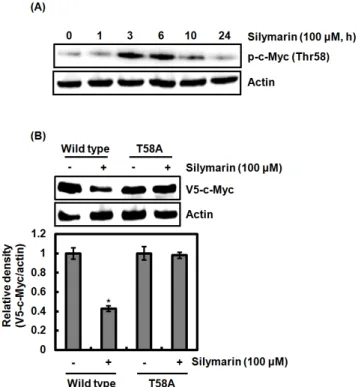
Abstract - In this study, we elucidated the molecular mechanism of silymarin by which silymarin may inhibits cell proliferation in human colorectal cancer cells in order to search the new potential anti-cancer target associated with the cell growth arrest. Silymarin reduced the level of c-Myc protein but not mRNA level indicating that silymarin-mediated downregulation of c-Myc may result from the proteasomal degradation. In the confirmation of silymarin-mediated c-Myc degradation, MG132 as a proteasome inhibitor attenuated c-Myc degradation by silymarin. In addition, silymarin phosphorylated the threonine-58 (Thr58) of c-Myc and the point mutation of Thr58 to alanine blocked its degradation by silymarin, which indicates that Thr58 phosphorylation may be an important modification for silymarin-mediated c-Myc degradation. We observed that the inhibition of ERK1/2, p38 and GSK3β blocked the Thr58 phosphorylation and subsequent c-Myc degradation by silymarin. Finally, the point mutation of Thr58 to alanine attenuated silymarin-mediated inhibition of the cell growth. The results suggest that silymarin induces the cell growth arrest through c-Myc proteasomal degradation via ERK1/2, p38 and GSK3β-dependent Thr58 phosphorylation.
Key words – Cancer chemoprevention, Cell growth arrest, c-Myc, Human colorectal cancer, Silymarin
*Corresponding author. E-mail : [email protected] Tel. +82-54-820-5464
†
These authors equally contributed to this study
ⓒ 2017 by The Plant Resources Society of Korea