유방암 생존자 부부를 위한 중재 연구 문헌고찰
강희선1·염수영2·전은영3
중앙대학교 적십자 간호대학1, 서울아산병원2, 대전대학교 간호학과3
Effect of Intervention Programs for Improving Maternal Adaptation in Korea: Systematic Review
Kang, Hee Sun1 · Yeom, Soo Young2 · Jun, Eun-Young3
1Red Cross College of Nursing, Chung-Ang University, Seoul
2Asan Medical Center, Seoul
3Department of Nursing, Daejeon University, Daejeon, Korea
Purpose: The purpose of this study was to review the literature on intervention for breast cancer survivors and their partners. Methods: The literature search was performed using MEDLINE, Pubmed, and Proquest to summarize the current state of knowledge regarding intervention for breast cancer survivors and their partners. Articles published between January 2000 and December 2011 were included. Results: A total of 14 studies were identified. Couple-base d intervention was more effective than intervention for survivors alone. Intervention to partners had also effects on their wives. Most studies were conducted in USA with Caucasian women. Sample size of intervention studies was small with most being pilot studies. Conclusion: Providing couple-based intervention to breast cancer survivors could have positive impacts on physical, interpersonal, and social aspects in breast cancer survivors. Future studies with large sample and different ethnicity are needed to confirm the effects of couple-based interventions for breast cancer survivors.
Key Words: Breast neoplasms, Survivors, Intervention studies, Review literature
주요어: 유방암, 생존자, 중재연구, 문헌고찰 Corresponding author: Kang, Hee Sun
Red Cross College of Nursing, Chung-Ang University, 84 Heukseok-ro, Dongjak-gu, Seoul 156-756, Korea Tel: +82-16-569-4370, Fax: +82-2-824-7961, E-mail: [email protected]
투고일: 2013년 6월 11일 / 수정일: 2013년 8월 22일 / 게재확정일: 2013년 8월 30일
This is an open access article distributed under the terms of the Creative Commons Attribution Non-Commercial License (http://creativecommons.org/license/
서 론
1. 연구의 필요성
전 세계적으로 유방암 환자가 증가추세이며(Jemal et al., 2011), 우리나라도 여성 암 환자 중 14.4%가 유방암이다(The Korea Central Cancer Registry, 2011). 유방암 치료과정은 여성들의 삶의 질에 영향을 미친다. 유방암 생존자의 삶의 질 을 높이기 위해 가족지지, 특히 배우자지지는 매우 중요하며, 여러 연구들에서 배우자와의 친밀한 관계가 유방암 환자의 빠
른 회복 및 대처와 적응에 긍정적으로 영향을 미친다고 보고 하고 있다(Baucom et al., 2009; Belcher et al., 2011; Co- chrane, Lewis, & Griffith, 2011). 유방암 생존자의 배우자 지지에 대한 선행연구를 살펴보면, 유방절제술 환자 배우자의 지지 정도가 높을수록 정서적 적응과 삶의 질이 높으며, 치료 의 전 과정 동안 가장 유력한 지지원은 배우자이다(Baucom et al.,; Lewis et al., 2008). 따라서 배우자지지는 유방암 생 존자들의 삶의 질과 관련 있는 중요한 사회·심리적 요인이라 할 수 있다.
유방암 생존자를 대상으로 이들의 삶의 질을 높이기 위한
중재 프로그램들이 개발되고 제공되어왔다. 그러나 유방암 생 존자의 배우자들도 유방암 치료 및 회복 과정에서 사회·심리 적 변화, 스트레스 등과 같은 부정적인 영향을 받게 되므로 삶 의 질 향상을 위해 유방암 생존자만을 대상으로 한 중재보다 배우자를 포함한 중재가 필요하다고 주장되고 있다(Belcher et al., 2011; Bigatti, Brown, Steiner, & Miller, 2011; Gar- land, Carlson, Marr, & Simon, 2009; Shields & Rousseau, 2004).
유방암 생존자를 대상으로 국내에서 수행된 중재 연구들을 살펴보면, 문헌고찰 연구로 항암화학요법 유방암 환자의 인지 기능 증진 중재에 대한 논문분석(Choi, Chung, Kim, Kim, &
Byun, 2011), 유방암 환자에게 적용한 간호중재 효과에 대한 메타분석(Rim, 2007), 국내 유방암 환자 대상 간호중재 연구 분석(Choi et al., 2011) 등 대부분 유방암 생존자를 대상으로 한 중재 연구가 다수였으며, 실시되고 있는 프로그램의 내용 도 유방암 생존자 개인을 위한 프로그램이 주를 이루고 있다 (Rim). 이에 비해 유방암 생존자의 배우자를 포함한 중재 연 구는 유방절제술을 받은 여성과 배우자에 대한 지지교육이 삶 의 질에 미치는 효과에 관한 연구(Kim, Park, & Koh, 2003) 가 있을 뿐이다. 국외 연구문헌의 경우에도 유방암 생존자 부 부를 위한 중재 프로그램에 관한 문헌고찰 연구가 한 편 수행 되었으나 2000년도 이전까지 수행된 4편의 연구에 대한 고찰 로 국한되어 있고(Cochrane & Lewis, 2005), 그 이후에 수행 된 중재 연구에 대한 분석 또한 이루어지지 않았다. 유방암 생 존자들이 겪는 문제는 생존자뿐만 아니라 생존자와 밀접하게 상호작용하는 배우자와의 공통된 경험임을 고려할 때(Bau- com et al., 2009; Budin et al., 2008; Lewis et al., 2008) 유 방암 생존자의 배우자를 포함한 중재 프로그램들을 살펴보는 것은 유방암 생존자 부부에게 필요한 효과적인 중재 프로그램 을 개발하거나 활용하는 데에 유용한 정보를 제공할 것이다.
2. 연구목적
본 연구의 목적은 유방암 생존자의 배우자를 포함한 중재에 관한 국외 논문을 분석하는 것이며, 구체적인 목적은 다음과 같다.
y 분석 대상 논문의 일반적 특성 파악 y 중재 논문의 특성 파악
y 중재 프로그램 특성 파악 y 중재 프로그램의 결과를 파악
연 구 방 법 1. 연구설계
본 연구는 유방암 생존자의 배우자를 포함하여 중재 프로그 램을 제공한 중재 관련 논문을 대상으로 중재내용 및 결과를 분석한 서술적 조사연구이다.
2. 연구대상 및 자료수집
본 연구는 2000년 1월부터 2011년 12월까지의 국외 의료 분야의 학술지 중, ‘유방암’ ‘남편/배우자(spouse, husband, partner, couple, significant other)’ ‘중재(intervention)’
라는 주제어로 검색된 자료를 수집하였다. 이들 논문은 국외 의료분야의 연구, 논문, 학술정보 등의 데이터베이스를 대표 적으로 검색할 수 있는 Pubmed (http://www.ncbi.nlm.nih.
gov), Proquest (http://proquest.umi.com), Medline (http://
www.ebscohost.com)을 통하여 실시되었고, 유방암 생존 자의 부부를 위한 중재 프로그램의 효과를 논의한 중재연구만 을 선별하였다. 본 연구에 포함된 논문(inclusion criteria)은 1) 연구대상자에 유방암생존자의 배우자(남편)나 파트너가 포함된 논문, 2) 배우자(남편)나 파트너에게 중재가 수행된 논 문, 3) 영어로 기록된 논문이었다. 그리고 본 연구에서 유방암 이외의 암 대상자가 포함된 논문은 포함하였고, 제외된 논문 (exclusion criteria)은 문헌고찰 연구 논문이었다.
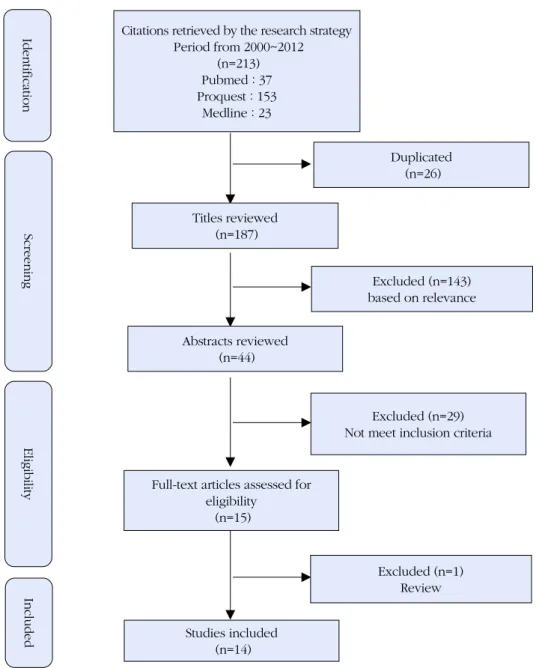
최종 14편 선별과정은 Figure 1과 같다. 먼저 자료검색을 통하여 총 213편의 연구논문이 검색되었고, 검색된 자료 중 중복된 26편을 제외한 총 187편을 대상으로 자료선정 및 제외 기준에 따라 제목과 초록을 중심으로 검토하였다. 제목 고찰 결과 중재연구가 아니거나 관련성이 없는 연구 143편이 제외 되었고, 나머지 총 44편의 초록을 검토한 결과 중재에 배우자 가 포함되지 않은 연구 총 29편이 배제되었다. 15편의 원문을 검토한 결과 종설인 논문 1편을 제외하였고, 각 연구논문의 문 헌고찰에 포함된 목록을 수기로 검토하였다. 이미 포함된 연 구 외에 본 연구의 기준에 적합한 중재연구가 없는 것을 확인 하여 최종적으로 14편을 선정하였다.
3. 분석 기준 및 방법
선정된 14편의 연구 논문의 내용 분석기준은 PICO (P:
patient, I: Intervention, C: Comparison, O: Outcome) 분
Citations retrieved by the research strategy Period from 2000~2012
(n=213) Pubmed : 37 Proquest : 153
Medline : 23
Titles reviewed (n=187)
Excluded (n=143) based on relevance
Identification
Abstracts reviewed (n=44)
Screening
Excluded (n=29) Not meet inclusion criteria
Full-text articles assessed for eligibility
(n=15)
Studies included (n=14)
Excluded (n=1) Review
EligibilityIncluded
Duplicated (n=26)
Figure 1. Process of data selection.
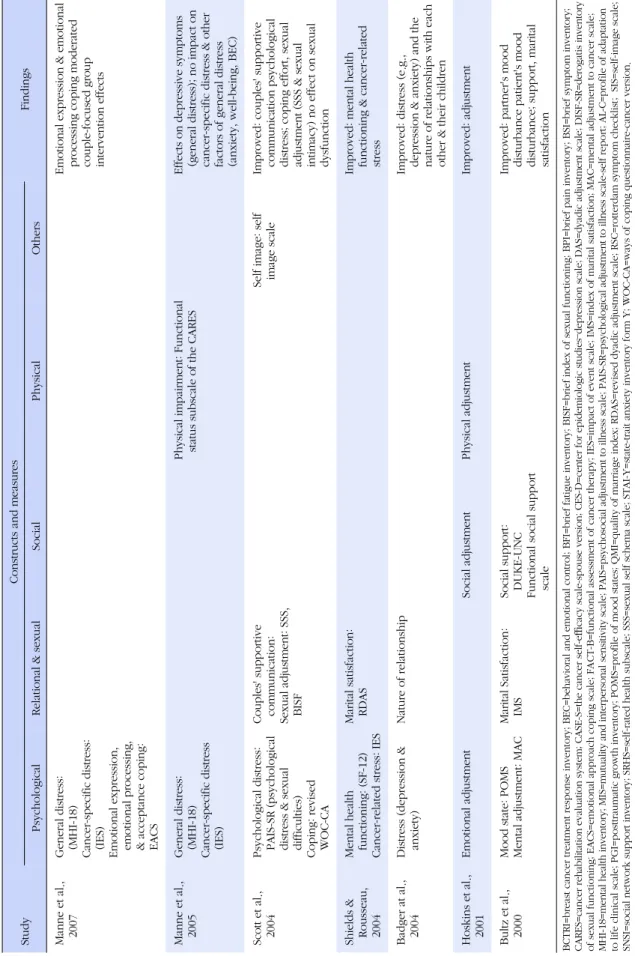
석틀을 기본으로 하여 대상자 및 대상자 수, 연구방법(연구설 계 등), 중재 내용(중재기간, 중재기법), 비교군, 결과 확인 지 표와 중재결과에 대해 분석하였다. 유방암 생존자 부부를 위 한 중재 프로그램의 효과는 중재결과 변수를 사회심리적, 관 계적, 신체적 요인 등으로 구분하여 분석하였다.
4. 연구의 신뢰도와 타당도
본 연구의 신뢰도를 높이기 위해서는 동일 주제어를 사용해 한명의 연구자가 일관되게 문헌을 탐색하여 유방암 환자의 중
재연구를 추출하였으며, 타당도를 높이기 위하여 공동연구자 2인이 추출된 자료가 타당한지에 대해 확인하였다.
연 구 결 과 1. 분석 대상 논문의 일반적 특성
본 연구에서 분석한 중재연구 14편의 일반적 특성은 다음 과 같다. 연구발표 연도별 분포는 2000년부터 2005년 6편 (42.9%), 2006년부터 2010년 6편(42.9%), 20011년 2편(14.2
%)이었다. 본 연구에 포함된 논문에 대상자 수는 18명에서 498명으로 다양했으며 평균 대상자는 약 134명이었고, 평균 대상자 연령은 54.04세이었다. 평균 중재 기간은 6.8주이었 고, 중재기간의 범위는 최소 일주일에서 최대 12주이었다. 중 재 프로그램 유형은 교육(강의, 비디오시청)을 통한 정보제공, 인지행동요법, 상담(대면, 전화), 인터넷기반 파트너지지에 대한 전자 일기 작성 등이었다.
2. 중재논문의 특성
본 연구대상 논문 총 14편 중 질적 연구는 1편이었고, 그 외 는 모두 양적 연구이었다. 연구대상자들의 유방암 병기(stage) 는 상피내암(Carcinoma In Site, CIS)부터 Stage 1-IIIa, 전이 암까지 다양하였다. 본 연구에 포함된 중재연구 중 무작위 대 조군 실험연구 8편(57.1%), 단일 실험군 연구가 2편(14.3%) (Cochrane et al., 2011; Lewis et al., 2008)이었고, 기타 4편 (28.6%)이었다. 이 중 파일럿(pilot) 연구는 총 7편(50%)이었 다. 중재 프로그램의 대상자들은 주로 백인(Baucome et al., 2009; Belcher et al., 2011; Cochrane et al.,; Lewis et al.,;
Manne, Ostroff, & Winkel, 2007)이었고, 중재 프로그램 중 11편(78.6%)이 미국에서 수행되었고, 그 외 캐나다(Bultz, Speca, Brasher, Geggie, & Page, 2000; Garland et al., 2009), 호주(Scott, Halford, & Ward, 2004)에서 수행되었다.
중재 프로그램 대상자들은 대부분 유방암 초기이며(71.4%), 대상자 모집 기준은 유방암 진단이나 수술을 받은 지 6개월 이 내(Cochrane et al.; Lewis et al.; Manne et al.) 여성들을 대상으로 하고 있었고(64.3%), 5편의 연구는(35.7%) 유방암 치료시기에 따른 모집 기준이 명시되지 않았다. 그중 1편의 연구(Garland et al.)는 암이 전이가 된 생존자들을 대상으 로 하였다.
3. 중재 프로그램의 특성
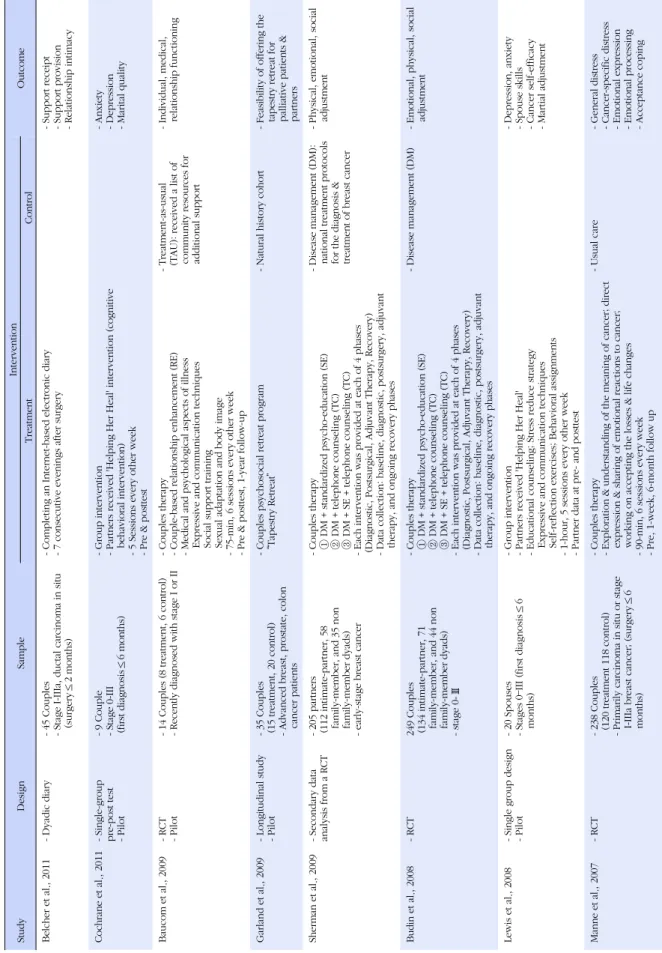
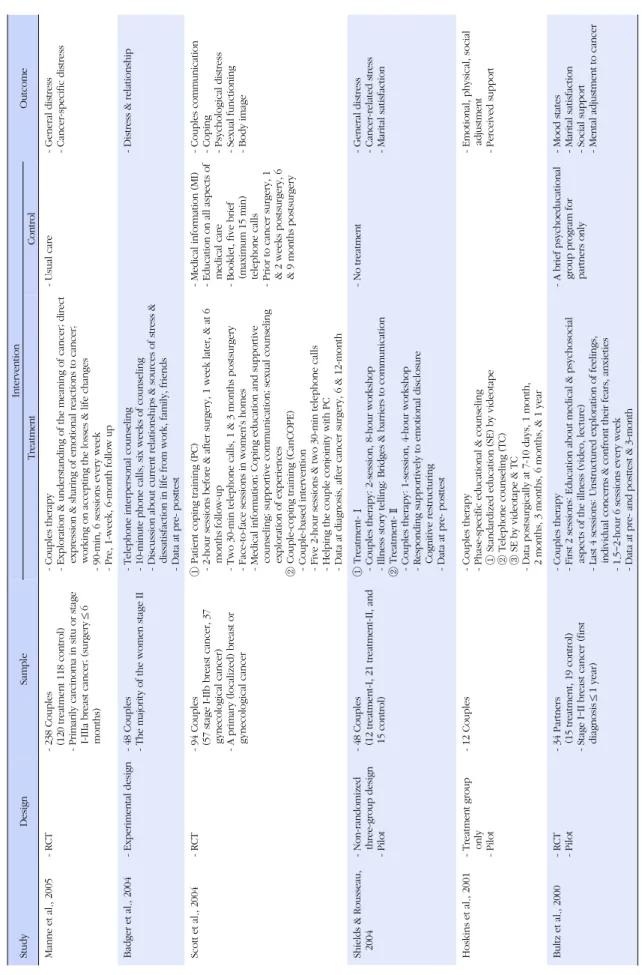
본 연구에 포함된 중재 프로그램의 분석결과는 다음과 같다 (Table 1). 중재 대상은 유방암 생존자와 배우자가 같이(Bel- cher et al., 2011; Baucom et al., 2009; Budin et al., 2008;
Garland et al., 2009; Manne et al., 2005; Manne et al., 2007; Scott et al., 2004; Shields & Rousseau, 2004), 유방 암 생존자의 배우자만(Cochrane et al., 2011; Lewis et al., 2008), 유방암 생존자의 배우자와 가족 및 비 가족을 포함한 연구(Sherman et al., 2009)로 분류되었다. 중재 프로그램 중
유방암 이외에 다른 암 환자를 포함한 중재연구는 2편이 있었 다. 구체적으로 살펴보면, 유방암과 부인암(Scott et al.), 유방 암과 대장암 등(Gerland et al.)의 환자를 포함하고 있었다.
중재 프로그램은 개별(Baucome et al., 2009; Hoskin et al., 2001; Scott et al., 2004) 또는 그룹별(Budin et al., 2008;
Bultz et al., 2000; Manne et al., 2007; Sherman et al., 2009; Shields & Rousseau, 2004)로 진행되었고, 대부분의 중재 프로그램은 임상에서 이루어졌으나 대상자의 집(Hoskin et al.; Scott et al.)에서 개별적으로 이루어진 경우도 있었다.
중재 프로그램의 진행은 최소 2회 이상에 걸쳐서, 매주(Man- ne et al., 2005; Manne et al.) 또는 격주(Baucome et al.;
Cochrane et al., 2011; Lewis et al., 2008)로 진행되었다.
본 연구에 포함된 연구 중 1개 연구는 매일 일기 작성법을 활용하였다. 부부를 대상으로 수술 후 7일 동안 매일 배우자 지지와 관계적 친밀감 등에 대해 지정된 인터넷 사이트에 접 속하여 일기를 작성하게 한 후 부부의 일기 내용을 바탕으로 지지제공, 지지수혜, 관계적 친밀감을 분석하였다. 그 결과 배 우자의 지지제공이 관계적 친밀감 증가와 관련이 있었고 지지 수혜와 지지제공은 일상의 친밀감에 도움이 된 것으로 보고되 었다(Belcher et al., 2011).
중재 프로그램 중에는 배우자만을 대상으로 단일군에게 인 지행동 중재인 ‘Helping her heal' 프로그램을 적용한 연구가 있었다(Cochrane et al., 2011). 연구결과 중재 전에 비해 중 재를 제공한 후에 불안과 우울이 감소하였고, 결혼만족도가 향상된 것으로 보고되었다. 그러나 대조군을 두지 않은 단일 그룹이라는 제한점을 보완하기 위해 유방암 생존자와 배우자 를 대상으로 출구 인터뷰를 수행하였고 그 결과 배우자와의 의사소통과 배우자와의 결혼관계의 질이 향상되었고 특히 여 성들은 파트너의 의사소통 기술이 향상되었다고 긍정적인 반 응을 보여 배우자만을 대상으로 한 중재 프로그램이 유방암 생존자 여성들에게도 파급효과가 있음을 제시하였다(Coch- rane et al.,; Lewis et al., 2008).
또한 중재 프로그램 중에는 대상자의 질병과정을 고려하여 중재를 진단 시, 수술 후, 항암이나 방사선 요법 받을 때, 회복기 에 각 각 중재를 제공한 연구(Budin et al., 2008; Hoskin et al., 2001; Sherman et al., 2009)도 있었다. 질병과정을 고려 하여 진행된 중재 프로그램(Budin et al.,)의 경우 4개의 그룹 으로 나누어 대조군에게는 질병관리에 대하여, 그리고 세 개 의 중재 군에는 질병관리에 추가하여 1) 비디오를 이용한 표 준화된 교육, 2) 개인맞춤 전화상담, 3) 비디오를 이용한 표준 화된 교육과 개인맞춤 전화상담 중재를 제공하였다. 그 결과
Table 1. Summary of Defining Characteristics of Intervention Studies with Partners of Women With Breast Cancer StudyDesignSampleIntervention Outcome TreatmentControl Belcher et al., 2011- Dyadic diary - 45 Couples - Stage I-IIIa, ductal carcinoma in situ (surgery≤2 months)
- Completing an Internet-based electronic diary - 7 consecutive evenings after surgery- Support receipt - Support provision - Relationship intimacy Cochrane et al., 2011- Single-group pre-post test - Pilot
- 9 Couple - Stage 0-III (first diagnosis≤6 months) - Group intervention - Partners received 'Helping Her Heal' intervention(cognitive behavioral intervention) - 5 Sessions every other week - Pre & posttest
- Anxiety - Depression - Marital quality Baucom et al., 2009- RCT - Pilot - 14 Couples(8 treatment, 6 control) - Recently diagnosed with stage I or II - Couples therapy - Couple-based relationship enhancement(RE) - Medical and psychological aspects of illness Expressive and communication techniques Social support training Sexual adaptation and body image - 75-min, 6 sessions every other week - Pre & posttest, 1-year follow-up
- Treatment-as-usual (TAU): received a list of community resources for additional support
- Individual, medical, relationship functioning Garland et al., 2009- Longitudinal study - Pilot- 35 Couples (15 treatment, 20 control) - Advanced breast, prostate, colon cancer patients
- Couples psychosocial retreat program “Tapestry Retreat” - Natural history cohort- Feasibility of offering the tapestry retreat for palliative patients & partners Sherman et al., 2009- Secondary data analysis from a RCT- 205 partners (112 intimate-partner, 58 family-member, and 35 non family-member dyads) - early-stage breast cancer - Couples therapy ① DM + standardized psycho-education(SE) ② DM + telephone counseling(TC) ③ DM + SE + telephone counseling(TC) - Each intervention was provided at each of 4 phases (Diagnostic, Postsurgical, Adjuvant Therapy, Recovery) - Data collection: baseline, diagnostic, postsurgery, adjuvant therapy, and ongoing recovery phases - Disease management(DM): national treatment protocols for the diagnosis & treatment of breast cancer
- Physical, emotional, social adjustment Budin et al., 2008- RCT249 Couples (134 intimate-partner, 71 family-member, and 44 non family-member dyads) - stage 0-Ⅲ
- Couples therapy ① DM + standardized psycho-education(SE) ② DM + telephone counseling(TC) ③ DM + SE + telephone counseling(TC) - Each intervention was provided at each of 4 phases (Diagnostic, Postsurgical, Adjuvant Therapy, Recovery) - Data collection: baseline, diagnostic, postsurgery, adjuvant therapy, and ongoing recovery phases - Disease management(DM)- Emotional, physical, social adjustment Lewis et al., 2008- Single group design - Pilot- 20 Spouses - Stages 0–III (first diagnosis≤6 months)
- Group intervention - Partners received 'Helping Her Heal' - Educational counseling; Stress reduce strategy Expressive and communication techniques Self-reflection exercises; Behavioral assignments - 1-hour, 5 sessions every other week - Partner data at pre- and posttest
- Depression, anxiety - Spouse skills - Cancer self-efficacy - Martial adjustment Manne et al., 2007- RCT- 238 Couples (120 treatment 118 control) - Primarily carcinoma in situ or stage I-IIIa breast cancer;(surgery≤6 months)
- Couples therapy - Exploration & understanding of the meaning of cancer; direct expression & sharing of emotional reactions to cancer; working on accepting the losses & life changes - 90-min, 6 sessions every week - Pre, 1-week, 6-month follow up - Usual care - General distress - Cancer-specific distress - Emotional expression - Emotional processing - Acceptance coping
Table 1. Summary of Defining Characteristics of Intervention Studies with Partners of Women With Breast Cancer(Continued) StudyDesignSampleIntervention Outcome TreatmentControl Manne et al., 2005- RCT- 238 Couples (120 treatment 118 control) - Primarily carcinoma in situ or stage I-IIIa breast cancer;(surgery≤6 months) - Couples therapy - Exploration & understanding of the meaning of cancer; direct expression & sharing of emotional reactions to cancer; working on accepting the losses & life changes - 90-min, 6 sessions every week - Pre, 1-week, 6-month follow up
- Usual care- General distress - Cancer-specific distress Badger et al., 2004- Experimental design- 48 Couples - The majority of the women stage II - Telephone interpersonal counseling - 10-minute phone calls, six weeks of counseling - Discussion about current relationships & sources of stress & dissatisfaction in life from work, family, friends - Data at pre- posttest
- Distress & relationship Scott et al., 2004- RCT- 94 Couples (57 stage I-IIb breast cancer, 37 gynecological cancer) - A primary(localized) breast or gynecological cancer
① Patient coping training(PC) - 2-hour sessions before & after surgery, 1 week later, & at 6 months follow-up - Two 30-min telephone calls, 1 & 3 months postsurgery - Face-to-face sessions in women's homes - Medical information; Coping education and supportive counseling; supportive communication; sexual counseling exploration of experiences ② Couple-coping training(CanCOPE) - Couple-based intervention - Five 2-hour sessions & two 30-min telephone calls - Helping the couple conjoinity with PC - Data at diagnosis, after cancer surgery, 6 & 12-month - Medical information(MI) - Education on all aspects of medical care - Booklet, five brief (maximum 15 min) telephone calls - Prior to cancer surgery, 1 & 2 weeks postsurgery, 6 & 9 months postsurgery
- Couples communication - Coping - Psychological distress - Sexual functioning - Body image Shields & Rousseau, 2004- Non-randomized three-group design - Pilot
- 48 Couples (12 treatment-I, 21 treatment-II, and 15 control)
① Treatment-Ⅰ - Couples therapy: 2-session, 8-hour workshop - Illness story telling; Bridges & barriers to communication ② Treatment-Ⅱ - Couples therapy: 1-session, 4-hour workshop - Responding supportively to emotional disclosure Cognitive restructuring - Data at pre- posttest - No treatment - General distress - Cancer-related stress - Marital satisfaction Hoskins et al., 2001- Treatment group only - Pilot
- 12 Couples- Couples therapy - Phase-specific educational & counseling ① Standardized education(SE) by videotape ② Telephone counseling(TC) ③ SE by videotape & TC - Data postsurgically at 7-10 days, 1 month, 2 months, 3 months, 6 months, & 1 year
- Emotional, physical, social adjustment - Perceived support Bultz et al., 2000- RCT - Pilot- 34 Partners (15 treatment, 19 control) - Stage I–II breast cancer (first diagnosis≤1 year)
- Couples therapy - First 2 sessions: Education about medical & psychosocial aspects of the illness(video, lecture) - Last 4 sessions: Unstructured exploration of feelings, individual concerns & confront their fears, anxieties - 1.5~2-hour 6 sessions every week - Data at pre- and posttest & 3-month - A brief psychoeducational group program for partners only - Mood states - Marital satisfaction - Social support - Mental adjustment to cancer