Research Article KME Review
Korean Medical Education Review 2020; 22(2): 115-121 pISSN 2092-5603 eISSN 2093-6370 https://doi.org/10.17496/kmer.2020.22.2.115
The Effects of Clinical Practice Stress and Resilience on Nursing Students’
Academic Burnout
Sujin Shin
1, Eunhee Hwang
21College of Nursing, Ewha Womans University, Seoul; 2Department of Nursing, Wonkwang University, Iksan, Korea
The high degree of academic burnout experienced during academic life indicates that job skill levels during the first year following graduation are low, and the correlation with turnover intention is high. We investigated the effects of clinical practice stress and resilience on nursing students’ burnout, and searched for factors that can prevent or control burnout. We recruited a convenience sample of 202 nursing students. Academic burnout, general characteristics, clinical practice stress, and resilience were assessed via self-reported questionnaires. The mean total score of academic burnout was 44.0 points; exhaustion was the highest at 18.5 points, inefficacy was 15.9 points, and cynicism was 9.6 points. High levels of clinical practice stress affected academic burnout (β=0.194, p=0.003), while high resilience was a factor that lowered the degree of academic burnout (β=-0.449, p<0.001). Based on our results, factors affecting students’
experiences of academic burnout were clinical practice stress and resilience. We therefore propose the implementation of a new curriculum aimed at increasing satisfaction with the major, reducing clinical practice stress, and increasing resilience, including an efficient peer mentoring program for clinical practice.
Keywords: Burnout, Exhaustion, Nursing education
Corresponding author Eunhee Hwang
Department of Nursing, Wonkwang University, 460 Iksan-daero, Iksan 54538, Korea
Tel: +82-63-850-6071 Fax: +82-63-850-6060 E-mail: [email protected] https://orcid.org/0000-0002-6229-5946 Received: December 24, 2019 1st revised: February 26, 2020 2nd revised: March 16, 2020 Accepted: March 17, 2020
INTRODUCTION
Nursing and medical schools require emerging healthcare professionals to practice in the clinical field. Reportedly, 80%
of the causes of stress experienced by medical students are academic in nature due to the competitive atmosphere [1], and academic burnout of junior students is highest among nursing students [2]. If this stress persists, it can lead to depression, anxiety, anger, and exhaustion [1]. As is the case with medical students, nursing students who have to complete both theoretical education and clinical practice are also likely to experience a high degree of academic burnout [3].
Academic burnout is defined as emotional exhaustion, cynicism, and inefficacy due to excessive and persistent academic stress [4]. The academic burnout experienced by nursing students often leads to a loss of confidence in nursing and acts as a negative factor leading to frustration with studying within their nursing major [5]. In addition, the high degree of exhaustion experienced during academic life indicates that job skill levels during the first year following graduation are low, and the correlation with turnover intention is high [6]. Therefore, it is necessary to find a support plan that can reduce exhaustion to help nursing students
adapt successfully to university life and transfer this adaptation to their roles as nurses.
Nursing students experience a lot of stress due to the unique characteristics of the nursing department, in addition to the general stress experienced by most university students as they adapt to college life [7]. Due to difficulties with studying vast amounts of information pertaining to their academic major at the time of enrollment, having a less flexible curriculum and a more competitive atmosphere, and undertaking the necessary preparations for the national nursing licensing qualifications [8], high levels of stress lead to academic burnout. Among the various stressors experienced by nursing students, clinical practice stress is a major factor that causes exhaustion in clinical practice [9].
Nursing students must devote more time to their clinical studies
because they are required to spend 3 hours per credit to complete
one clinical practice course related to their major, as opposed
to students of other majors who are required to spend only 1
hour to complete each clinical practice course [10]. In other
words, they spend more time studying than students of other
majors. Within 2 years, they will undergo 1,000 hours of clinical
training and complete shift work in the practice field as early
as dawn. This can be a major stress factor. In addition, clinical
practice education exposes students to unfamiliar environments and this often leads to serious anxiety and tension [11]. Most nursing colleges operate a block system in order to meet practice hours. Therefore, nursing students have a relatively narrow curriculum from which to choose compared to students of other majors. The stress related to clinical practice can be a factor in exacerbating the exhaustion of nursing students, so it is necessary to ascertain the current situation of exhaustion and preemptive effort.
Among the variables that can alleviate negative influences such as stress, resilience is considered to help nursing students prepare to face challenges and adversity, and not only survive but also thrive in the face of additional life events and challenges with hope and optimism for future successful outcomes, improved well-being, and career longevity [7,12]. The self-resilient person is one who has the necessary patience and ability to appropriately adjust to the stress level and react flexibly in unfamiliar situations, thus enabling successful adaptation [13]. Ego resilience can reduce the negative impact of psychological exhaustion, and high resilience scores have been reported to have negative correlations with the three dimensions of burnout [14,15]. Resilience is accepted as an important concept in nursing education. Ego resilience promotion leads to positive effects such as a successful university life, the ability to cope with crises and challenges, and the improvement of nursing college students’ and faculty’s satisfaction [12]. Ego resilience can be considered as a measure to reduce the burnout of nursing students.
The results of a study of nursing students who experienced clinical practice showed that a large portion (49.2%) wanted to change their major, suggesting that there are problems with current nursing education such as excessive academic demands and major maladjustment [16]. Academic burnout affects life satisfaction beyond the negative effects of school life [17]. In order to increase the retention of nursing students, it is needed to reduce academic burnout and increase adaptability to the clinical field. Therefore, it is important to make efforts to minimize academic burnout and to identify the factors that affect it. This proactive approach will help nursing students grow academically, teach nursing students how to increase their own resilience, and ultimately increase nursing student retention.
The purpose of this study was to investigate the effects of clinical practice stress and ego resilience on nursing students’
burnout, and to search for factors that can prevent or control
academic burnout. The specific objectives were as follows: (1) understand the subjects’ clinical practice stress, resilience, and academic burnout; (2) identify differences in academic burnout according to general characteristics; and (3) analyze the effects of clinical practice stress and resilience on nursing students’
academic burnout.
METHODS
1. Study design
This was a descriptive research study conducted to investigate the effects of clinical practice stress and ego resilience on academic burnout among nursing students.
2. Study sample
The study sample consisted of 202 nursing students from two universities in different cities. The inclusion criteria were: (1) being third- or fourth-year students and (2) having more than 6 months of clinical practice experience. The exclusion criteria were: (1) having a psychiatric history and (2) having a native language other than Korean.
For the multiple regression analysis, the significance level was 0.05, the power was 0.95, the effect size was 0.15, the number of predictors was 10, and the required number of samples was 172. Considering an inadequate response rate of about 20%, 206 nursing students were chosen based on convenience sampling, and the data from 202 of the students were included in the final analysis.
3. Measures
The questionnaire collected data on general characteristics such as age, sex, academic year, mentor status (have/don’t have), major satisfaction, intention to transfer, clinical practice stress, ego resilience, and academic burnout.
1) Academic burnout
To measure academic burnout, we used the Maslach Burnout
Inventory-Student Survey instrument, which was developed by
Schaufeli et al. [4] and validated for Korean students by Shin
et al. [18]. This tool consists of 15 items within three sub-factors
(i.e., exhaustion, cynicism, and inefficacy). The score is rated
on a 5-point Likert scale, with 1 meaning “not at all,” and 5
meaning “strongly agree.” The inefficacy score is decoded after
measuring competence, and the total score is between 15 and 75 points. The higher the score, the higher the tendency of academic burnout. A study by Schaufeli et al. [4] reported the reliability of Cronbach’s α to be 0.62–0.68, and a study by Shin et al. [18] reported Cronbach’s α to be 0.82–0.86. The reliability of this study was indicated by a Cronbach’s α of 0.80–0.84.
2) Clinical practice stress
Clinical practice stress was measured by Beck and Srivastava [19], and was modified by Lee and Kim [20]. This tool is comprised of 24 questions in total. The questionnaire consists of 5 items on the practical training environment, 6 items on undesirable role models, 4 items on the burden of practical work, 4 items on interpersonal conflict, and 5 items on conflict with patients. For each item, the 5-point Likert scale responses ranged from 1 (“not at all”) to 5 (“very much agree”); the higher the score, the higher the clinical practice stress level. A study by Lee and Kim [20] reported Cronbach’s α to be 0.91. The reliability of this study was indicated by a Cronbach’s α of 0.85.
3) Resilience
To measure the degree of ego resilience, we used Yu and Chae’s [21] modification of the scale developed by Block and Kremen [22]. This tool measures responses on a 4-point Likert scale, with a total of 14 possible points, from 1 (“not at all”) to 4 (“very much agree”); the higher the average score of all items, the higher the ego resilience level. A study by Block and Kremen [22] reported the reliability of Cronbach’s α to be 0.76, and a study by Yu and Chae [21] reported Cronbach’s α to be 0.67.
The reliability of this study was indicated by a Cronbach’s α of 0.80.
4. Data collection
This study was conducted by a research assistant trained for ethical consideration of subjects in the classroom who explained to participants the purpose of the study, their guaranteed anonymity and confidentiality before data collection, and the fact that the questionnaire did not affect their grade point averages (GPAs). The questionnaire was distributed to only those students who agreed. A questionnaire collection box was placed at the exit of the classroom and the questionnaires of participants who completed them were voluntarily placed in the collection box.
Data collection was conducted from June to August 2018. The
questionnaire completion response time was about 10–15 minutes.
5. Data analysis
The collected data were analyzed using the IBM SPSS for Windows ver. 24.0 (IBM Corp., Armonk, NY, USA) program.
The differences in the degree of academic burnout according to general characteristics were analyzed using t-tests and analysis of variance, followed by an least significant difference test for post-hoc comparison. Hierarchical multiple regression analysis was used to analyze the factors affecting academic burnout.
6. Ethical considerations
This study was conducted in compliance with the Helsinki Declaration and the Good Clinical Practice Guidelines. The study subjects were informed that there were no potential disadvantages if they refused to participate in the research. The purpose of the study, the participation process, and the potential risks and benefits of participating in the research were all explained. After the explanations were complete, written consent was voluntarily submitted to the researchers. In addition, research assistants with no connection to either the professor or the participants completed the data collection process. The respondents were given a small gift as compensation for their time.
RESULTS
1. General characteristics of the subjects
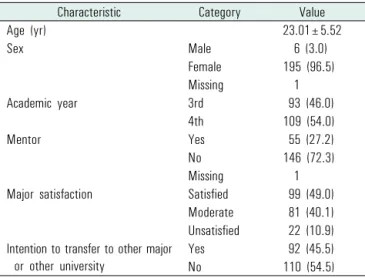
Ninety-six percent of the subjects were female; 46.0% were in their third year, and 54.0% were in their fourth. A majority, 72.3%, of the respondents said that they did not have mentors, and 49.0% of them were satisfied with their majors, while 10.9%
of them were unsatisfied. About half, 45.5%, of the respondents had intentions to transfer (Table 1).
2. Mean scores for academic burnout, clinical practice stress, and resilience
The mean total score of academic burnout was 44.0 points
(possible range, 15–75 points); exhaustion was the highest at
18.5 points (possible range, 5–25 points), inefficacy was 15.9
points (possible range, 5–25 points), and cynicism was 9.6 points
(possible range, 5–25 points). Clinical practice stress was 71.8
points (possible range, 24–100 points), and resilience was 38.0
points (possible range, 14–64 points) (Table 2).
Variable Mean±standard deviation Minimum Maximum
Total academic burnout 44.0±7.86 24.0 67.0
Exhaustion 18.5±3.60 8.0 25.0
Cynicism 9.6±3.16 4.0 20.0
Inefficacy 15.9±3.59 7.0 26.0
Stress of clinical practice 71.8±10.4 42.0 97.0
Resilience 38.0±5.68 25.0 56.0
Table 2. Descriptive statistics of academic burnout, stress of clinical practicum, and resilience (N=202)
Characteristic Category Value
Age (yr) 23.01±5.52
Sex Male 6 (3.0)
Female 195 (96.5)
Missing 1
Academic year 3rd 93 (46.0)
4th 109 (54.0)
Mentor Yes 55 (27.2)
No 146 (72.3)
Missing 1
Major satisfaction Satisfied 99 (49.0) Moderate 81 (40.1) Unsatisfied 22 (10.9) Intention to transfer to other major
or other university
Yes 92 (45.5)
No 110 (54.5)
Values are presented as mean±standard deviation or number (%).
Table 1. General characteristics of participants (N=202)
Variable Category Total academic burnout Exhaustion Cynicism Inefficacy
Mean±SD t or F p-value LSD Mean±SD t or F p-value LSD Mean±SD t or F p-value LSD Mean±SD t or F p-value LSD
Academic year 3rd 45.6±7.82 2.56 18.8±3.60 1.08 10.0±3.42 1.92 16.7±3.50 2.89
4th 42.7±7.68 0.011 18.2±3.59 0.281 9.2±2.88 0.056 15.3±3.55 0.004
Mentor Yes 40.8±8.85 -3.54 17.5±4.03 -2.44 8.7±3.31 -2.38 0.018 14.6±3.81 -3.27
No 45.2±7.17 <0.001 18.9±3.37 0.016 9.9±3.04 16.5±3.37 0.001
Major satisfaction Satisfied 40.1±6.81 40.32 <0.001 a<b<c 17.4±3.60 10.31 <0.001 a<b<c 8.0±2.36 43.63 <0.001 a<b<c 14.6±3.40 18.79 <0.001 a<b<c
Moderate 46.7±5.72 19.4±2.66 10.5±2.83 16.8±3.04
Unsatisfied 51.1±8.76 20.0±4.96 13.3±3.13 18.8±3.84
Intention to transfer to other major or other university
Yes 46.3±7.78 3.85 <0.001 19.3±3.56 3.05 0.003 10.6±3.26 4.25 <0.001 16.4±3.51 1.70 0.090
No 42.2±7.33 17.8±3.49 8.7±2.83 15.6±3.63
SD, standard deviation; LSD, least significant difference.
Table 3. Differences of burnout according to general characteristics (N=202)
3. Differences in academic burnout by general characteristics
There was a statistically significant difference in the degree of burnout among general characteristics according to GPA, mentor presence, major satisfaction, and intention to transfer.
Specifically, the degree of academic burnout of the third-year students was higher than that of the fourth-year students (t=2.56, p=0.011), and the degree of academic burnout with a mentor was lower (t=-3.54, p<0.001). Nursing students who were
dissatisfied with their majors had a high degree of academic burnout (F=40.32, p<0.001). Moreover, if subjects expressed a desire to transfer, their degree of academic burnout was high (t=3.85, p<0.001). For the subscales, the third-year students showed higher disability scores than did the fourth-year students (t=2.89, p=0.004). Additionally, the scores for exhaustion, cynicism, and inefficacy were low with the presence of a mentor and high satisfaction with the major. Students with previous experiences of attempting to transfer or transferring had higher scores on exhaustion and cynicism (t=3.05, p=0.003; t=4.25, p=0.001) (Table 3).
4. Effect of clinical practice stress and resilience on academic burnout
In order to identify the effects of dependent variables on academic burnout, clinical practice stress, and ego resilience were used as independent variables and regression factors (Table 4).
As a result of the regression analysis assumption for the
independent variables, the variance inflation factor of the variables
included in all models was less than 10, and there was no problem
of multi-collinearity. The F statistic value of the regression model
was 31.458 (p<0.001), and the coefficient of determination R
2was 0.235, accounting for 23.5% of the academic burnout on
Variable β t-value p-value Variance inflation factor
(Constant) 12.048 <0.001
Stress of clinical practicum 0.194 3.128 0.002 1.000
Resilience -0.449 -7.230 <0.001 1.000
Adjusted R
2=0.235, F=31.458, p<0.001, Durbin-Watson=1.787.
Table 4. Effect of clinical practice stress and resilience on academic burnout (N=202)