Print ISSN: 2288-4637 / Online ISSN 2288-4645 doi:10.13106/jafeb.2021.vol8.no1.169
The Role of Corporate Social Responsibility in the Investment Efficiency:
Is It Important?*
Ni Made Adi ERAWATI 1 , Sutrisno T 2 , Bambang HARIADI 3 , Erwin SARASWATI 4
Received: September 30, 2020 Revised: November 22, 2020 Accepted: December 05, 2020
Abstract
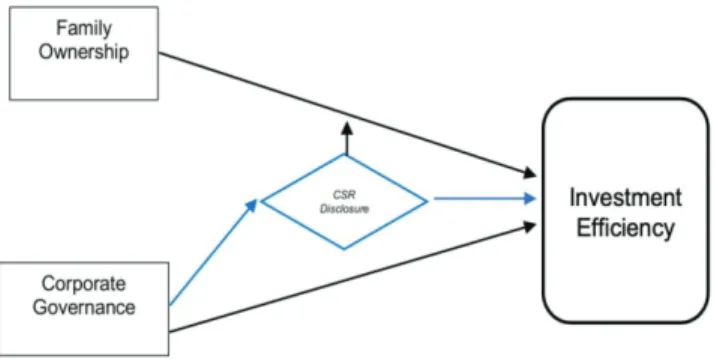
This research aims to test, firstly, how the disclosure of corporate social responsibility (CSR) helps to moderate the effect of family ownership on investment efficiency; secondly, how CSR disclosures mediate the effect of corporate governance on investment efficiency.
STATA was used to analyze archival data collected from a total sample of 210 manufacturing companies listed on the Indonesian Stock Exchange (IDX), which were in the family businesses category for the period of 2016-2018. The first finding is that CSR moderates the effect of family ownership on investment efficiency. This implies that family businesses are very careful about investing. They will avoid risky decisions that may increase the economic wealth, but reduce the socio-emotional wealth. To maintain socio-emotional wealth, they tend to choose an underinvestment strategy and are more concerned with the prestige and good reputation of their families and dynasties than with economic wealth. Thus, CSR disclosures can reduce the underinvestment strategy of family businesses listed on the IDX. The second finding is that CSR disclosures are able to mediate the effect of corporate governance on investment efficiency. CSR activities play a major role in decision-making, and through CSR disclosures, corporate governance has a greater effect on investment efficiency.
Keywords: Investment Efficiency, Corporate Governance, Corporate Social Responsibility, Family Firm JEL Classification Code: G11, G32, G34, M14
the poor category when compared to the average investment efficiency in the other ASEAN countries. Based on National Development Planning Agency, in 2019, the incremental capital output ratio (ICOR) in Indonesia was still above 6%, while other ASEAN countries ranged from 3% to 4%.
The higher the ICOR, the lower the level of investment efficiency. Solving the problem of investment efficiency is very important, considering the efficiency of corporate investments make a major contribution to a country’s economic growth (Jin & Yu, 2018).
One of the driving forces for companies to invest is the existence of investment opportunities with positive net present value (NPV) and they will continue to invest to a marginal limit (Chen, Hope, Li, and Wang, 2011). In practice however, firms may face some financial constraints that limit the ability of managers to conduct all the projects with a positive NPV. This causes a deviation from the company’s optimal investment, which will result in overinvestment or underinvestment.
According to the Indonesian Institute for Corporate and Directorship (IICD), most companies in Indonesia are family business enterprises, which are companies that are controlled by families, and they play an important role in the economy (Hanazaki & Liu, 2007). In the family system, there are value factors and family culture that are a source
*Acknowledgements:
1
I thank BPPDN from Higher Education Indonesia for providing scholarships and helping to fund this research. Thank you to all the parties from University Brawijaya who have helped a lot and shared knowledge, expertise, experience, and insights to support this research.
1
First Author and Corresponding Author. Lecturer, Department of Accounting, Faculty of Economics and Business, Universitas Udayana, Indonesia [Postal address: Jalan PB Sudirman, Denpasar, Bali, 80232, Indonesia] Email: [email protected]
2
Lecturer, Department of Accounting, Faculty of Economics and Business, Universitas Brawijaya, Indonesia.
Email: [email protected]
3
Lecturer, Department of Accounting, Faculty of Economics and Business, Universitas Brawijaya, Indonesia.
Email: [email protected]
4