• 검색 결과가 없습니다.

Development Treatment Planning System Based on Monte-Carlo Simulation for Boron Neutron Capture Therapy

N/A
N/A
Protected

Academic year: 2021

Share "Development Treatment Planning System Based on Monte-Carlo Simulation for Boron Neutron Capture Therapy"

Copied!
4
0
0

로드 중.... (전체 텍스트 보기)

전체 글

(1)

Original Article PROGRESS in MEDICAL PHYSICS 27(4), Dec. 2016 https://doi.org/10.14316/pmp.2016.27.4.232 pISSN 2508-4445, eISSN 2508-4453

- 232 -

This work was supported by the Basic Science Research Program (No. 2016R1C1B2009258) and the Joint Research Program funded by The Catholic University of Korea-Sogang University (2016).

Received 10 November 2016, Revised 22 December 2016, Accepted 23 December 2016

Correspondence: Tae Suk Suh ([email protected]) Tel: 82-2-2258-7232, Fax: 82-2-2258-7506

cc This is an Open-Access article distributed under the terms of the Creative Commons Attribution Non-Commercial License (http://creativecommons.org/licenses/by-nc/4.0) which permits unrestricted non-commercial use, distribution, and reproduction in any medium, provided the original work is properly cited.

Development Treatment Planning System Based

on Monte-Carlo Simulation for Boron Neutron Capture Therapy

Moo-Sub Kim*, Kazuki Kubo

, Hajime Monzen

, Do-Kun Yoon*, Han-Back Shin*, Sunmi Kim*, Tae Suk Suh*

*Department of Biomedical Engineering and Research Institute of Biomedical Engineering, College of Medicine, The Catholic University of Korea, Seoul, Korea,

Department of Radiation Oncology, Graduate School of Medical Science, Kinki University, Osaka, Japan

The purpose of this study is to develop the treatment planning system (TPS) based on Monte-Carlo simulation for BNCT. In this paper, we will propose a method for dose estimation by Monte-Carlo simulation using the CT image, and will evaluate the accuracy of dose estimation of this TPS. The complicated geometry like a human body allows defining using the lattice function in MCNPX. The results of simulation such as flux or energy deposition averaged over a cell, can be obtained using the features of the tally provided by MCNPX. To assess the dose distribution and therapeutic effect, dose distribution was displayed on the CT image, and dose volume histogram (DVH) was employed in our developed system. The therapeutic effect can be efficiently evaluated by these evaluation tool. Our developed TPS could be effectively performed creating the voxel model from CT image, the estimation of each dose component, and evaluation of the BNCT plan.

󰠏󰠏󰠏󰠏󰠏󰠏󰠏󰠏󰠏󰠏󰠏󰠏󰠏󰠏󰠏󰠏󰠏󰠏󰠏󰠏

Key Words: BNCT, Monte Carlo, MCNPX, Treatment planning system

Introduction

The general concept of Neutron Capture Therapy (NCT) was first proposed by Locher in 1936, and NCT which is used boron as the neutron capture element is called Boron Neutron Capture Therapy (BNCT).

1,2)

The principle of BNCT is based on the neutron capture reaction, i.e.

10

B(n, α)

7

Li, which is oc- curred between the neutron and boron incorporated into cancer cells. The alpha particles and recoiling lithium-7 ions are clas- sified in high Linear Energy Transfer (high-LET). The path lengths of these are approximately 10 μm, which is almost equivalent to the mean cell diameter. They can be selectively damage to cancer cells while sparing adjacent normal cells.

3,4)

The dose estimation in BNCT is much more complicated than that in photon and electron radiation therapy, because neutrons produce many different nuclear reactions, each with a different physical and biological dose. Although biological dose in BNCT is necessary to consider strictly divided into each component on the basis of the origin of neutron re- actions, the dosimetry could not be applied to it. Therefore, Monte-Carlo simulation that allows to take into account by separating each component is used as a solution of this problem. In order to perform the Monte-Carlo simulation, in- formation of the geometry and structure materials is required.

Patient’s computed tomography (CT) image is suitable to de-

fine them, and is required to accurately predict the dose to the

individual patient. The purpose of this study is to develop the

treatment planning system (TPS) based on Monte-Carlo simu-

lation for BNCT. In this paper, we will propose a method for

dose estimation by Monte-Carlo simulation using the CT image,

and will evaluate the accuracy of dose estimation of this TPS.

(2)

PROGRESS in MEDICAL PHYSICS Vol. 27, No. 4, December, 2016

- 233 -

Fig. 1. Schematic of Monte-Carlo simulation.

Materials and Methods

1. Monte-Carlo simulation code MCNPX

This study was performed using only mcnpx simulation without any specific dose calculation algorithm. The conven- tional TPS regarding the neutron beam is based on neutron dose calculation algorithm. However, we used the result of mcnpx simulation for calculating dose distribution originally, the mcnpx simulation tool is optimized to caluculated reaction between the neutron and the material (particle). For our devel- oped TPS for BNCT, Monte Carlo n-particle extended (MCNPX

TM

: Los Alamos National Laboratory, New Mexico, USA)

5)

version 2.6.0 was used as a dose calculation engine.

MCNPX is a general purpose Monte Carlo radiation transport code that tracks nearly all particles at nearly all energies. Most of the TPS which has been developed for BNCT were also used it for dose calculation: the NCTPlan

6)

is developed at MIT (Massachussets Institute of Technology), the JAERI com- putational dosimetry system (JCDS)

7)

is developed at JAEA (Japan Atomic Energy Agency), and the THORplan

8)

is devel- oped at Tsing Hua University. However, MCNPX has many li- brary regarding particle physics characteristic and mechanism between particles. Therefore, we use the MCNPX for this simulation. MCNPX has the following features:

- Simplify setting up geometries that involve repeating struc- tures;

- Easily getting the results of simulation that user specified.

The complicated geometry like a human body allows defin- ing using the lattice function in MCNPX. In this study, the process for reconstructing the voxel models from patient’s CT images is described in the following section. The results of simulation such as flux or energy deposition averaged over a cell, can be obtained using the features of the tally provided by MCNPX. The MCNPX uses pointwise continuous-energy neutron and photon cross sections based on the ENDF/B-VII data library.

2. Dose calculation

In this study, we assumed the treatment for malignant brain tumors. The process for reconstructing the voxel models from patient’s CT images consists mainly three parts. Firstly, pa-

tient’s head CT images with 512×512 pixels is converted into these of 150×150 pixels in this study, because if the miniatur- ization of the voxel cell size uses for Monte-Carlo simulation, calculation time is increased extremely. The focus of this study is to evaluate the accuracy of calculated doses in our devel- oped TPS, the CT image size is not necessary to maintain the original image size. Secondary, CT images were divided using lattice function in MCNPX into 1×1×1 mm

3

voxel cells.

Finally, to define the tissue material compositions (i.e., bone, normal tissue, and air) in each voxel, each voxel is classified according to the Hounsfield unit (HU) of them which depends on the primary tissue types. These compositions were defined according to the ICRU report 46

9)

values for the adult patient.

These processes are performed automatically. In addition, the tumor region is assumed the sphere with a diameter of 2 cm, which is located from the head surface to a depth of 3 cm in the cerebellum. The

10

B concentrations of 25 ppm in brain and 87.5 ppm in tumor were used, so as tumor-normal ratio is 3.5:1. The relative biological effect (RBE)

10)

for neutrons and photons were determined 3.0 and 1.0, respectively. The com- pound biological effectiveness (CBE) for tumor is 3.8, and for normal tissue is 1.35.

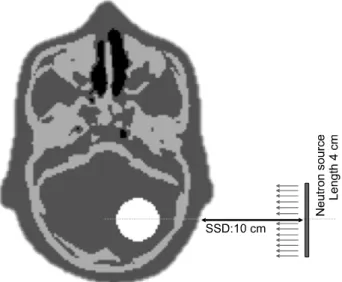
Monodirectional neutron source of 40 mm length with mon-

oenergetic epithermal neutron 5 keV was located on the right

side of the head, and source-to-surface distance is 10 cm with

its central axis intercepting the tumor, as shown in Fig. 1. The

(3)

Moo-Sub Kim, et al:Development Treatment Planning System Based on Monte-Carlo Simulation for Boron Neutron Capture Therapy

- 234 - Fig. 3. Depth dose for each dose component along the beam

centerline. Fig. 4. Dose distribution on the patients’ CT image.

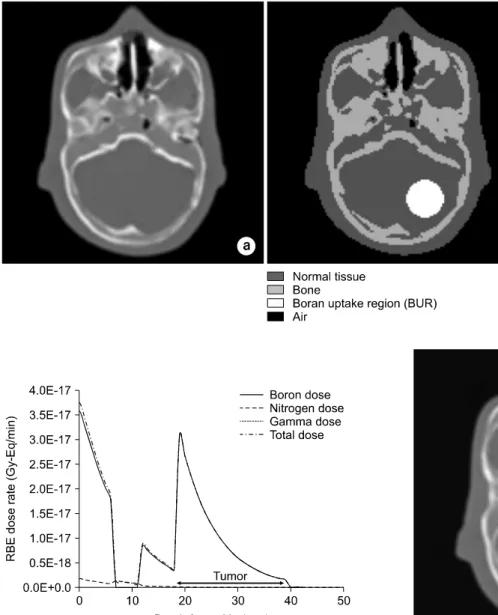
Fig. 2. Creating the voxel model from the patients’ CT image for dose calculation. (a) original pa- tients’ CT image and (b) the reconstructed voxel model.

simulation comprised 800 million independent histories. The nitrogen dose and boron dose were calculated using the track length estimate tally F4 and the kerma factor for each dose components. The photon dose was calculated using the track length estimate of energy deposition tally F6 in unit MeV g

−1

. Moreover, biological dose is also calculated using the pre- viously mentioned RBE and CBE values.

Results and Discussion

The voxel model was created from the patients’ CT image for

dose calculation. Fig. 2 shows (a) original patients’ CT image and (b) the reconstructed voxel model. In order to perform the Monte-Carlo simulation in MCNPX, the reconstructed voxel model is automatically converted into text file (i.e., input file).

Fig. 3 shows the depth dose profiles for each dose compo-

nent along the beam centerline. The neutron capture reaction is

occurred between the neutron and boron incorporated into can-

cer cells. In addition, Alpha particles have high-LET and short

path length, which can selectively damage cancer cells. The

BNCT treatment is mainly affect by the boron dose. Since the

composition of each structure is different, the absorbed dose

(4)

PROGRESS in MEDICAL PHYSICS Vol. 27, No. 4, December, 2016

- 235 - Fig. 5. Dose volume histogram (DVH) for BNCT.

delivered to these greatly differs in BNCT treatment. We found that they could be considered using the MCNPX and patients’ CT image.

To assess the dose distribution and therapeutic effect, dose distribution was displayed on the CT image (Fig. 4), and dose volume histogram (DVH) was employed in our developed sys- tem (Fig. 5). The therapeutic effect can be efficiently evaluated by these evaluation tool.

The absorbed dose can be estimated by our developed TPS in BNCT treatment. However, we assumed that

10

B concen- trations are uniformly distributed in the tumor and brain, al- though they are non-uniformity distributed in practice. Cerullo et al. introduced the data on the in vivo boron distribution, ac- quired by a positron emission tomography (PET) scan after la- beling the BPA (borono-phenylalanine) with the positron emit- ter

18

F.

11)

To incorporate the data of PET in our TPS would be needed to perform more accurate dose calculation in the near future. Although this study showed the possibility about BNCT treatment dose calculation using MCNPX, the CT pixel size is too high to apply clinical environment. Then, to apply clinical environment, it is essential to simulate dose distribution and dose calculation using clinical CT image.

Conclusion

We developed the TPS using the MCNPX and patients’ CT image for BNCT treatment. Our developed TPS could be ef- fectively performed creating the voxel model from CT image, the estimation of each dose component, and evaluation of the BNCT plan.

References

1. W. H. Sweet, M. Javid: The possible use of neutron capture isotopes such as boron-10 in the treatment of neoplasms I.

Intracranial tumors. J Neurosurg 9:200-209 (1952)

2. L. Farr, W. Sweet, J. Robertson, et al: Neutron capture therapy
with boron in the treatment of glioblastoma multiforme.

Am J
Roentgenol 71:279-291 (1954)

3. M. R. Raju, Y. Eisen, S. Carpenter, et al: Radiobiology of a particles III. Cell inactivation by α-particle traversals of the cell nucleus. Radiat Res 128:204-209 (1991)

4. H. Zhou, M. Suzuki, G. Randers-Pehrson, et al: Radia- tion risk to low fluences of particles may be greater than we thought. Proc Natl Acad Sci 98:14410-14415 (2001)

5. D.B. Pelowitz, Ed., MCNPX User’s Manual Version 2.5.0, LA-CP-05-0369, Los Alamos National Laboratory, 2005.


6. R. Zamenhof, E. 2nd Redmond, G. Solares et al: Monte Carlo-based treatment planning for boron neutron capture ther- apy using custom designed models automatically generated from CT data. Int. Radiat. Oncol. Biol. Phys. 35: 383-397 (1996) 7. H. Kumada, K. Yamamoto, A. Matsumura, et al: Verifi- cation of the computational dosimetry system in JAERI (JCDS) for boron neutron capture therapy. Phys. Med. Biol. 49:3353- 3365 (2004)

8. T. Y. Lin, Y. W. Liu: Development and verification of THORplan—a BNCT treatment planning system for THOR. Appl.

Radiat. Isot. 69:1878-1881 (2011)

9. ICRU: Photon, electron, proton, and neutron interaction data for body tissues, ICRU Report 46. Bethesda, MD: International Commission on Radiation Units and Measurements; 1992.

10. J.A. Coderre and G.M. Morris: The radiation biology of boron neutron capture therapy. Radiation Research, 151:1-18 (1999)


11. N. Cerullo, G. G. Daquino, L. Muzi, and J. Esposito:

Development of a treatment planning system for BNCT based on positron emission tomography data: preliminary results. Nucl.

Inst. Meth. Phys. Res. Sect. B: Beam Interact. Mater. Atoms,

213:637-640 (2004)

수치

Fig.  1.  Schematic  of  Monte-Carlo  simulation.
Fig.  2.  Creating  the  voxel  model  from  the  patients’  CT  image  for  dose  calculation

참조

관련 문서

n Dynamic simulation-based power estimation with coarse-grained net model from power macro model database and testbench.. i is

1 John Owen, Justification by Faith Alone, in The Works of John Owen, ed. John Bolt, trans. Scott Clark, "Do This and Live: Christ's Active Obedience as the

Based on the parametric study on the characteristic of solid NaBH 4 hydrolysis using the NaHCO 3 agent, a prototype of the hydrogen generation system was developed

Transformed –log 10 p of SNPs from the logistic regression model of association with dementia based on the additive model in male subjects.. P-value on the left Y-axis is

Among the o-carboranyl triazine derivatives tested, compound 5a appeared to be a good candidate agent based on the three essential requirements for BNCT,

Figure 6-15 shows a distribution for the typical cost components of OPEX for a deepwater development. The percentage of each cost component of the total OPEX varies from

Based on the result of such assessment, this study attempted to establish a basis for establishment of physical epidemiology research evaluation system

According to the analysis results, the characteristics obtainable by the human model based motion capture system are the Euler angle, 3 dimensional location