116 Song Hun Han, Maeng Jin Kim and Choon Bok Song
INTRODUCTION
The velvetfishes (family Aploactinidae), comprising 17 genera with about 38 species, are widely distributed in tropical and temperate seas of the world (Nelson, 2006).
This family is characterized by having body covered with prickly scales (some species lack prickles and have smooth skin), all fin rays unbranched, anal fin spines usually indistinct (rarely pungent), anterior three to five dorsal fin spines usually divergent, either elevated or largely devoid of connecting membrane (Poss, 1999; Nel- son, 2006). In Korea, one species, Erisphex pottii (Stein- dachner, 1896) in the family has been reported so far (Kim et al., 2005).
The genus Cocotropus Kaup, 1858, comprises 16 valid species worldwide (Froese and Pauly, 2016) and five species from Japan (Nakabo and Kai, 2013). Recently, a single specimen of Cocotropus masudai Matsubara, 1943
was collected by a commercial fish trap in the coastal waters of Jejudo Island on July 8, 2011. Although this species named as “Dot-chi” in Korean, which was pro- posed by Myoung et al. (2002) based on the photograph of the species collected from the northern sea of Jejudo Island, Korea. The morphological features of this species have not been reported in Korea until now. Therefore, the morphological characters of C. masudai were described based on the collected specimen and it was added to the list of Korean fish fauna. Identification procedure of this specimen was followed by the method of Hubbs and Laglar (2004). The examined specimen is deposited at the Fish Genetics and Breeding Laboratory of Jeju National Univerisy (JNU), Korea.
Cocotropus Kaup, 1858 (New Korean genus name: Dot-chi-sok)
Coccotropus Kaup, 1858: 333 (type species: Corythobatus echinatus Cantor, 1849).
Gill membranes free from isthmus; anus slightly anteri- or to anal fin origin; dorsal fin rays continuous and com-
* Corresponding author: Choon Bok Song Tel: 82-64-754-3471, Fax: 82-64-756-3493, E-mail: [email protected]
Korean Journal of ICHtHyology, Vol. 28, no. 2, 116-120, June 2016 ISSn: 1225-8598(Print), 2288-3371(online)
received: March 28, 2016 revised: May 23, 2016 accepted: June 25, 2016
First Record of a Velvetfish, Cocotropus masudai (Scorpaeniformes:
Aploactinidae) from Korea
By Song Hun Han, Maeng Jin Kim
1and Choon Bok Song
2,*
Jeju Fisheries Research Institute, National Institute of Fisheries Science(NIFS), Jeju 63068, Korea
1Fisheries Resources and Environment Division, West Fisheries Institute, NIFS, Incheon 22383, Korea
2College of Ocean Sciences, Jeju National University, Jeju 63243, Korea
ABSTRACT
A specimen of Cocotropus masudai (41.2 mm in standard length), belonging to the family Aploactinidae, was firstly collected from the eastern coastal waters of Jejudo Island, Korea by using a fish trap in July 2011. This species is characterized by having the following morphological traits: XII, 9 dorsal fin rays; I, 8 anal fin rays; 12 pectoral fin rays; I, 3 pelvic fin rays; five preopecular spines; five sensory pores present on lower jaw and isthmus tip beyond fifth sensory pore. This species is similar to C. izuensis except for the number of preopercular spines (five in C. izuensis vs.
four in C. masudai) and the anterior position of the isthmus (well beyond the fifth lower jaw sensory pore vs. the tip mostly reaching to the pore). In Korea, C. masudai can be easily distinguished from the Erisphex pottii in having the dorsal fin with nine soft rays (vs. 10~14 for Erisphex pottii), anal fin with seven soft rays (vs. 10~13) and pelvic fin with three soft rays (vs. two). We propose new Korean names, “Dot-chi-sok” and “Dot-chi” for the genus and species, respectively.
Key words: First record, Cocotropus masudai, Aploactinidae, Jejudo Island
—116 — http://www.fishkorea.or.kr
prising a single fin; I, 3 pelvic fin rays; interorbital ridges on the both sides running in parallel (Matsubara, 1943;
Poss, 1999).
Cocotropus masudai Matsubara, 1943 (Korean name: Dot-chi)
(Fig. 1; Table 1)
Cocotropus masudai Matsubara, 1943: 470 (type locality:
Izu Islands, south of Tokyo, Japan); Nakabo in Masuda et al., 1984: 319 (Japan); Poss in Carpenter and Niem, 1999: 2356 (western central Pacific); Nakabo in Nako- bo, 2002: 601 (Japan); Myoung et al., 2002: 78 (Korea).
Material examined. JNU-0387, 41.2 mm standard length (SL), fish trap, Hangyeong-myeon, Jeju-do, Ko- rea. June 8, 2011.
Description. Measurements of morphological traits for the present specimen are shown in Table 1. Measurements are revealed as a percentage against SL: Body depth, 35.7;
body width, 18.4; head length, 36.7; upper jaw, 15.3;
snout length, 11.2; eye dimeter, 9.0; interorbital width, 8.3; predorsal fin length, 11.4; prepectoral fin length, 29.4;
preanal fin length, 67.7; length of longest fifth dorsal fin ray, 23.6; length of longest third pectoral fin ray, 21.8;
length of longest third anal fin ray, 16.3; caudal peduncle length, 20.6; length of dorsal fin base, 83.3; length of pectoral fin base, 12.4; length of anal fin base, 23.5.
Body moderately compressed; body covered with small pointed papillae, each underlain by tiny buried scales;
dorsal profile of head sloping suddenly; head small, com-
pressed, with many ridges, ridges smooth and covered with thin skin; profile very steep from first dorsal spine to snout; mouth very oblique; posterior end of upper jaw extending behind middle of eyes; villiform teeth on jaws; vomer and palatines toothless; five sensory pores present on lower jaw, first pores fused on both sides; gill membranes free from isthmus; isthmus tip slightly be- yond fifth sensory pores of lower jaw; snout about two times longer than orbital diameter; eye moderate and al- most round; interorbital space with somewhat narrower
Table 1. Morphological traits compared between present and previ- ous study on C. masudai
Morphological
characters Present study Masubara(1943) (Holotype)
Total length(mm) 52.0 50.0
Standard length(mm) 41.2(n=1) 40.5(n=1) In % of standard length
Head length
Body depth at ventral 36.7
36.7 35.1
In % of head length 36.5 Snout length Orbital diameter Interorbital length Upper jaw length
30.524.5 22.541.7
34.622.3 21.640.5 Counts
Dorsal fin rays Pectoral fin rays Pelvic fin rays Anal fin rays Caudal fin rays Lateral line pores Gill rakers
XII, 10 I, 312 I, 813 2+69
XII, 10 - I, 8-
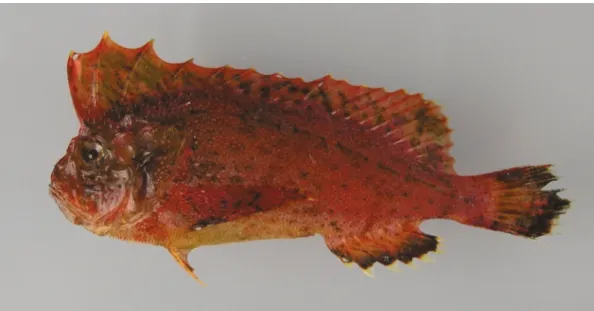
139 2+6 Fig. 1. Cocotropus masudai, JNU-0387, 41.2mm SL, fish trap, Hangyeong-myeon, Jejudo Island, Korea.
118 Song Hun Han, Maeng Jin Kim and Choon Bok Song
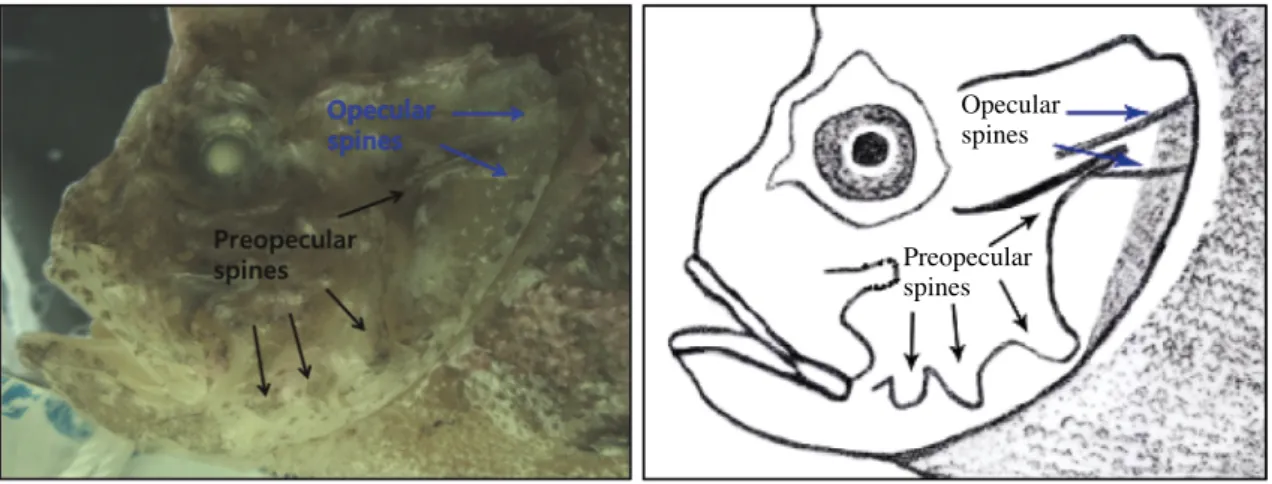
and slightly convex; supraorbital and suborbital edges somewhat raised as low ridge; five spines and two spines on preoperculum and operculum, respectively (Fig. 2);
several sensory pores present surrounding eye; lateral line well arched anteriorly, remaining part of lateral one mostly straight; sensor pores present on anterior part of lateral line; origin of dorsal fin started above anterior of eye, dorsal fin continuous, without notch between spine and sort part; the second spine and sixth soft ray the lon- gest in dorsal fin; soft dorsal fin extends base of caudal fins; pectoral fin moderate, covered with papillae except for lower and posterior margins and not reaching to ori- gin of anal fin; pelvic fin slightly small, not reaching to anus; origin of anal fin started below the second dorsal ray; caudal fin rounded and its basal portion covered with papillae; all soft fin rays unbranched.
Color when fresh. Body and head entirely brown mixed with reddish; many small dark spots on body and head; dorsal fin brown with irregular dark spots; pectoral fin brown with irregular dark marking, posterior margin of pectoral fin yellow; pelvic fin pale brown; a single dark line on ventral portion of anal fin, its posterior mar- gin yellow; caudal fin brown with irregular dark spots, its posterior margin yellow.
Color after preservation. Body entirely pale brown;
irregular brown spots or blotch on dorsal fin; pectoral fin pale brown with irregular brown marking, posterior mar- gin of pectoral fin white; pelvic fin white; a single dark line on ventral portion of anal fin, posterior margin of anal fin white; caudal fin pale brown with irregular dark spots, its posterior margin white.
Distribution. Korea (Jejudo Island, present study); Izu Islands, Japan (Matsubara, 1943).
Remarks. The present specimen belongs to the genus
Cocotropus based on the morphological characters in the dorsal fin rays which are continuous and comprising a single fin, I, 3 pelvic fin rays, and interorbital ridges on the both sides running in parallel. Also the meristic and morphometric characters of the present specimen were compared with those in the original report on C. masudai (Mastsubara, 1943; Table 1). As a result, our specimen was well matched with most of morphological characters reported before. They include XII, 9 dorsal fin rays, I, 8 anal fin rays, 12 pectoral fin rays, four preopecular spines, five sensor pores present on lower jaw and isthmus tip beyond fifth sensory pore and measurements. However, there are some differences in snout length (30.5% in HL for the present specimen vs. 34.6% for Mastsubara, 1943) and orbital diameter (24.5% vs. 22.3%). These differenc- es seem to be intraspecific or geographic variation, but it needs further studies on geographic variation of the spe- cies with more specimens.
C. masudai was firstly reported by Mastsubara (1943) based on a single specimen collected from Izu Islands, Japan. Senou (1990) and Masuda and Kobayashi (1994) subsequently reported this species from the Izu Peninsu- la located in the southern Japan, as the second and third record of the species, respectively. However, Imamura et al. (2010) recently reported that the specimens collected from the Izu Peninsula by Senou (1990) and Masuda and Kobayashi (1994) are not C. masudai, but new species, C.
izuensis. In addition, C. izuensis was very morphological similar to C. masudai except for the number of preoper- cular spines (five in C. izuensis vs. four in C. masudai) and the anterior position of the isthmus (well beyond the fifth lower jaw sensory pore vs. the tip mostly reaching to the pore) (Nakabo and Kai, 2013). Therefore, further studies of distribution and genetic variations are required
Fig. 2. The arrows indicate preopecular spines(black) and opecular spines(blue) on the head.
Opecular spines Preopecular spines
In Korea, Erisphex pottii (Steindachner, 1896), which is morphologically similar to C. masudai also inhabits the coastal waters of Jejudo Island. But, the latter can be easily distinguished from the former in having the dorsal fin with nine soft rays (vs. 10~14 for Erisphex pottii), anal fin with seven soft rays (vs. 10~13) and pelvic fin with three soft rays (vs. two) (Nakabo and Kai, 2013). We used the Korean name for C. masudai as “Dot-chi” which was previously suggested by Myoung et al. (2002).
ACKNOWLEDGMENTS
This work was supported by a grant from the National Institute of Fisheries Science (R2016032).
REFERENCES
Cantor, T.E. 1849. Catalogue of Malayan fishes. Journal of the Asi- atic Society of Bengal, 18(pt 2): i-xii+983-1443.
Froese, R. and D. Pauly(Editiors). 2016. Fishbse. World Wide Web electronic publication. www.fishbase.org. version(01/2016).
Hubbs, C.L. and K.F. Lagler. 2004. Fishes of the Great Lake region.
University of Michigan press, Ann Arbor, 332pp.
Imamura, H., M. Aizawa and G. Shinohara. 2010. Cocotropus izu- ensis, a new species of velvetfish(Teleoste: Aploactinidae) from Japan. Bull. Natl. Mus. Nat. Sci., 4: 1-7.
Kaup, J.J. 1859. Einiges über die Acanthopterygiens à joue cuirassée Cuv. Archi. Naturgeschichte, 24(pt 1): 329-343.
Illustrated book of Korean fishes. KyoHak Publishing Co Ltd Seoul., 615pp.
Masuda, H. and Y. Kobayashi. 1994. Grand Atlas of fish Life Modes.
Color Variation in Japanese Fish. Tokai Univ. Press. xliii+
465pp.(in Japanese)
Matsubara, K. 1943. Studies on the scorpaenoid fishes of Japan.
Anatomy, phylogeny and taxonomy(II). Transactions of the Sigenkagaku Kenkyusyo, (2): 171-486.
Myoung, J.G., B.I. Kim, S.M. Lee and G.B. Jeon. 2002. The sea fishes of Korea. Darakwon press, Seoul, Korea, 287pp.
Nakabo, T. 1984. Family Aploactinidae. In: Masuda, H, K Amaoka, C Araga, U Uyeno and T Yoshino(eds.), The fishes of the Japanese archipelago. Tokai Univ. Press Tokyo, p. 319.
Nakabo, T. 2002. Aploactinidae. In: Nakabo, T.(ed.), Fishes of Japan with pictorial keys to the species, English edition, Tokai University Press, Tokyo, pp. 601-602.
Nakabo, T. and Y. Kai. 2013. Aploactinidae. In: Fishes of Japan with pictorial keys to the species. Third edition, Nakabo T, ed. Tokai Univ. Press Tokyo, pp. 713-715.
Nelson, J.S. 2006. Fishes of the world. 4th ed. John Wiley & Sons, New York., i-xix+1-601.
Poss, S.G. 1999. Aploactinidae. In: Carpenter, K. E. and V. E. Niem (eds.), Species identification guide for fisheries purposes.
The living marine resources of the western central Pacific.
Bony fishes part 2(Mugilidae to Carangidae). FAO, Rome, pp. 2354-2358.
Senou, H. 1990. Cocotropus masudai. IOP Diving News, 1(Nov.): 1.
(in Japanese)
Steindachner, F. 1896. Bericht über die während der Reise Sr. Maj.
Schiff “Aurora” von Dr. C. Ritter v. Microszewski in den Jahren 1895 und 1896, gesammelten Fische. Annalen des Naturhistorischen Museums in Wien, 11: 197-230.
120 Song Hun Han, Maeng Jin Kim and Choon Bok Song
한국산 풀미역치과 어류 1미기록, Cocotropus masudai
한송헌
·
김맹진1·
송춘복2국립수산과학원 제주수산연구소, 1국립수산과학원 서해수산연구소, 2제주대학교 해양과학대학
요 약 :
풀미역치과에 속하는 Cocotropus masudai 1개체(표준체장 41.2mm)가 2011년 7월에 제주도 연안에서상업용 통발에 처음으로 채집되었다. 이 종은 등지느러미 기조수 XII, 9개를 갖는 점, 뒷지느러미 기조수 I, 8개를
갖는 점, 배지느러미 기조수 I, 3개를 갖는 점, 전새개골에 4개의 가시를 갖는 점, 아래턱에 5개의 감각공을 갖는 점
그리고 흉부의 끝이 다섯 번째 감각공을 지나는 특징을 갖는다. 이 종은 형태적으로 C. izuensis와 유사하지만 전새
개골의 가시수(C. izuensis는 5개 vs. C. masudai는 4개를 가짐)와 흉부의 끝의 위치(C. izuensis는 다섯 번째 감각 공을 훨씬 지남 vs. C. masudai 도달함)로 구분할 있다. 그리고 이 종은 우리나라에서 서식하는 풀미역치에 대해 등
지느러미 연조수가 9개(풀미역치는 10~14개), 뒷지느러미 연조수 7개(풀미역치는 10~13개) 그리고 배지느러미
연조수는 3개(풀미역치는 2개)로 구분할 수 있다. 이 미기록종의 속명과 국명은 각각 “돛치속”과 “돛치”로 제안한
다.