Kor. J. Mater. Res.
Vol. 21, No. 6 (2011)
314
†Corresponding author
E-Mail : [email protected] (B. -Y. Hur)
Fabrication, Microstructure and Compression Properties of AZ31 Mg Foams
Rui Zhao*, Yuxuan Li*, Seung-Reuag Jeong*, Xuezheng Yue* and Bo-Young Hur
†i-cube center, ERI, ReCAPT, School of Nano & Advanced Materials Science and Engineering, Gyeongsang National University, Jinju, 660-701 Korea
(Received April 28, 2011 : Received in revised form May 17, 2011 : Accepted May 19, 2011)
Abstract
Melt foaming method is one of cost-effective methods to make metal foam and it has been successfully applied to fabricate Mg foams. In this research, AZ31 Mg alloy ingot was used as a metal matrix, using AlCa granular as thickening agent and CaCO3 powder as foaming agent, AZ31 Mg alloy foams were fabricated by melt-foaming method at different foaming temperatures. The porosity was above 41.2%~73.3%, pore size was between 0.38~1.52 mm, and homogenous pore structures were obtained. Microstructure and mechanical properties of the AZ31 Mg alloy foams were investigated by optical microscopy, SEM and UTM. The results showed that pore structure and pore distribution were much better than those fabricated at lower temperatures. The compression behavior of the AZ31 Mg alloy foam behaved as typical porous materials. As the foaming temperature increased from 660oC to 750oC, the compressed strength also increased. The AZ31 Mg alloy foam with a foaming temperature of 720oC had the best energy absorption. The energy absorption value of Mg foam was 15.52 MJ/m3 at a densification strain of 52%. Furthermore, the high energy absorption efficiencies of the AZ31 Mg alloy foam kept at about 0.85 in the plastic plateau region, which indicates that composite foam possess a high energy absorption characteristic, and the Vickers hardness of AZ31 Mg alloy foam decreased as the foaming temperature increased.Key words
AZ31 Mg alloy foam, microstructure, mechanical properties.1. Introduction
Metal foams are engineered materials with a unique com- bination of physical and mechanical properties, yielding an attractive material for use in aerospace, automotive, and biomedical industries.
1,2)Al and Al alloy foams have been developed successfully and have been employed in the new generation of crash boxes.
3,4)Mg and Mg alloy foams are definitely expected to be particularly advantageous due to the good mechanical properties and lower density of their metal matrix, which is approximately two thirds that of Al.
4)Metallic foams can be produced by melt-foaming pro- cess.
1,5.6)In this fabrication technique, some viscosity increasing agents such as SiO
2and MgO particles are added into metallic melt in order to make the melt get an appropriate viscosity. Some researchers suggested that the viscosity increasing agent not only stabilized the cell wall but also affected the mechanical properties of the foams.
5-10)Generally, the mechanical properties of metallic foams depend on the foaming temperature and relative density of the foams, the macrostructure of the cell, and the micro- structure of the cell wall material.
10-13)There have been considerable researches about the effect of the cell macro- structures on the mechanical properties of the foams. How- ever, the studies on the correlation between microstructure
and compressive properties of metallic foams are scarce.
Some investigations exhibited that the secondary phase or component such as viscosity increasing agent, the brittle phase and eutectic phase in cell wall material are important factors affecting the mechanical response of the foams.
13-17)In this paper, the AZ31 Mg alloy foams with the porosity of 41.2%~73.3% were fabricated by melt-foaming method.
Besides, the microstructure, mechanical properties and energy absorption were investigated and discussed.
2. Experimental Procedure
2.1 Fabrication of AZ31 Mg alloy foam
AZ31 Mg alloy ingot was used as a metal matrix (Table 1). Granular AlCa (99.8 wt.%) was used as the thickening agent and the as-received CaCO
3powder (Table 2) (purity >
99.85 wt.%, about 4 µm) was chosen as the foaming agent.
The melt-foaming method was applied to fabricate the cellular Mg foams and the specific preparation procedure has been elaborated in Ref.
4)(Fig. 1). Briefly, a definite quantity of AZ31 Mg alloy was melted in a crucible at
Table 1. Chemical compositions of AZ31 Mg alloy ingot. (wt.%)
Element Al Zn Mn Si Cu Fe Mg
AZ31 Mg
alloy 3.49 0.82 0.41 0.07 0.08 0.06 Bal
proper temperatures, and then the addition of an amount of thickening agent (2 wt.% Ca) with stirring leads to in- creasing of viscosity and reducing of surface tension at proper temperatures. Afterward, foaming agent (2 wt.%
CaCO
3powder) was added into the Mg alloy melt with stirring more fast, and the holding time was set at 40 s before cooling it in the air. The pore structures of the final products were controlled by adjusting the foaming tem- perature in the range of 660
oC-750
oC. As a result, the cellular Mg alloy foam with relative high porosity of 73.2%
and pore size of 0.96 mm can be prepared with foaming temperature at 720
oC.
2.2 The structure of the foamed AZ31 Mg alloy AZ31 Mg foam samples were cut and they were polished by emery paper. Pore size and porosity were analyzed by using i-solution software. The cell walls were analyzed by use of metallurgical microscope and SEM. The general porosity of the product can be calculated by the following formula (1):
(1) Where ρ and ρ
1are the density of the specimen and its corresponding theoretical density, respectively, and ρ/ρ
1is called as relative density. The density of the specimen is determined by measuring its weight and dimension directly when the sample has regular shape.
2.3 Compression test
AZ31 Mg alloy foam specimens prepared at different temperatures was used in the compression test. The
specimen is a regular hexahedron. Mg alloy foam used in the compression test had the foaming temperature of 660
oC~750
oC. Its size was 30 × 30 × 30 mm
3. Compres- sion test was conducted using Universal Testing Machine (Shimadzu AG 10TG, Japan).
The energy absorption of the metal foam can be calcu- lated by integrating the lower area of the stress-strain curve according to the following formula (2).
18)(2) where W is energy absorption capacity, ε the compressive strain, and σ the compressive stress.
Energy absorption efficiency can be calculated using the following method
20):
(3)
where F is the energy absorption efficiency, and max is the maximal stress.
3. Results and discussion
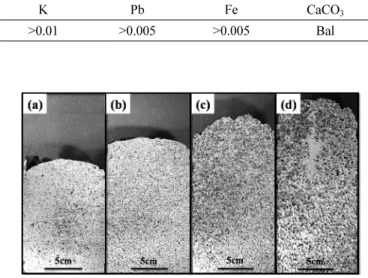
3.1 Macrostructure of AZ31 Mg alloy foam samples Fig. 2 shows the macrostructures of the AZ31 Mg alloy foams with different foaming temperatures. It is clear that the sample prepared at 660
oC is not foamed effectively (Fig. 2(a)) and the sample fabricated at 750
oC has coarse pore structure (Fig. 2(d)), while the foams prepared at 690
oC and 720
oC have relatively fine pore structures (Fig.
2(b) and (c)). The results lead us to understand the importance of the choice of different foaming temperatures.
ε 1 ρ
ρ1 ---
⎝ – ⎠
⎛ ⎞ 100 %×
=
W =
∫
0εσ ε( ) εdF
∫
0σσ ε( ) εd maxσ ε ε∫
0ε d ---=
σ ε
∫
0ε Fig. 1. Schematic diagram of apparatus for making Mg alloy foams;(a) Motor, (b) Furnace (melting, holing), (c) Impeller, (d) Thermo- couple (e) Power controller and (f) Gas mixer.
Fig. 2. The macrostructure of AZ31 Mg alloy foams with different foaming temperatures, (a) 660oC, (b) 690oC, (c) 720oC and (d) 750oC.
The effect of foaming temperature on the porosity of Mg foam (see Fig. 3) is shown in Fig. 4, indicating that the bulk porosity of AZ31 Mg alloy foam increases at first, and then decreases with the increasing of foaming tem- perature, where the porosity of the foam fabricated at 660
oC, 690
oC 720
oC and 750
oC, respectively, is 41.2%, 68.5%, 73.3% and 61.6.%, respectively. The effect of
foaming temperature on the average pore size of Mg alloy foam is shown in Fig. 4, indicating that the average pore size of the foam increases with the increasing of the foaming temperature. The average pore size of the foam at 660
oC, 690
oC 720
oC and 750
oC is 0.38, 0.71, 0.96 and 1.52 mm, respectively. The effect of the foaming tempera- ture on the pore size distribution of the corresponding Mg
Fig. 3. The macrostructure of AZ31 Mg alloy foam specimens foamed with different foaming temperatures.Fig. 4. The relationship between porosity, average pore size and foaming temperature of AZ31 Mg alloy foams; (a) average pore size and (b) porosity.
Fig. 5. The pore size distribution of the AZ31 Mg alloy foam with different foaming temperatures; (a) 660oC, (b) 690oC, (c) 720oC and (d) 750oC.
alloy foam is shown in Fig. 5, indicating that the pore number has the tendency of decreasing with increasing of the foaming temperature. Because when the other condi- tions were fixed, foaming temperature affected the viscosity of the melt and gas quantity produced during the foaming agent decomposition. When the temperature was low, the foaming agent decomposition speed was slow, bubble quantity was few and growing up resistance was large, causing the porosity and average pore size to become small. When the temperature was high, decomposition speed was quicker, the amount of bubbles were sharply increased, the viscosity of melt was low, and the bubbles contacted and merged with each other. Parts of the bubbles overflowed the melt, causing the porosity and average pore size to decline.
4,9)As the result, the cellular Mg alloy foams with relatively high porosities of 73% and pore size of 0.96 mm can be prepared with foaming temperature at 720
oC. in this study, in order to obtain Mg alloy foam with fine pore structures, the foaming temperature should be selected in the range of 690~720
oC.
3.2 Cell wall microstructure
Fig. 6 shows the microstructure of the cell wall of AZ31 Mg alloy foams with different foaming temperatures. It is found that eutectic and intermetallic compounds phase are
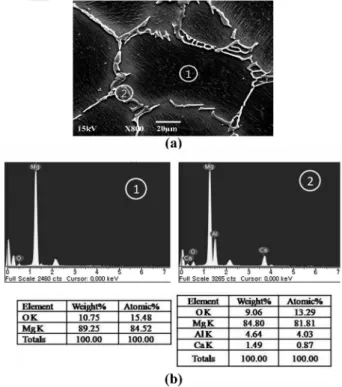
segregated in grain boundaries. SEM inspection of the cell wall of AZ31 Mg alloy foams revealed the presence in the skin microstructure (Fig. 7). The phases of CaO, MgO and Al
2O
3, which located on the cell wall as the gas gripping agent, and detected by EDS, make the viscosity high in the molten metal. The most important effect of the formability is the viscosity which is affected by the amount of the aluminum oxide formed. The process of pore growth is same with the foaming process of Al.
19)3.3 Compression behavior and hardness
Compressive stress-strain curves of Mg alloy foams have three stages of different transformation. The first stage is called elastic deformation stage. In this stage elastic deformation of the cell walls takes place, which reflects strength property of pore structure. The second stage is
Fig. 7. SEM micrograph of AZ31 Mg alloy foam at foamingtemperature of 720oC.
Fig. 8. The results of SEM-EDS analysis of cell microstructure of AZ31 Mg alloy foam of foaming temperature of 720oC, (a) SEM micrographs of the AZ31 Mg alloy foam and (b) EDS of the AZ31 Mg alloy foam.
called long plastic deformation stage. As strain increasing, load rises slowly. This process mainly reflects the pore structural yielding of collapse under pressure. The third stage is called compressive densification of the sharp increase of pressure stage. All the pores collapsed under pressure, which leads to rapid increasing of the stress. As the increasing of the strain, load rises rapidly. This stage
mainly reflects the transformation process after compaction of Mg alloy foams.
Fig. 9 shows the yield strength of AZ31 Mg foams at different foaming temperatures. It is obvious that the yield strength of foam at foaming temperature of 660
oC is the lowest among the four samples, and foams at 720 and 750
oC are higher. Especially, the yield point strength of the foam at 720
oC with pore size of 0.96 mm is the highest.
Mg alloy foam has the highest energy absorption value of 15.5 MJ/m
3at the foaming temperature of 720
oC. Fur- thermore, as the foaming temperature increased, the energy absorption also increased (Fig. 10). The energy absorption of the foam fabricated at 660
oC, 690
oC, 720
oC, and 750
oC, is 4.43, 7.95, 15.35 and 8.02 MJ/m
3, respectively, resulting in improvement of energy absorption (Table 3). However, when the temperature reached 750
oC, the energy absorption dropped, suggesting that it could be affected inversely by over-temperature. Then the to high temperature, the bubbles merged together, cell walls collapsed after dissolved and fissure appeared (Fig. 6(d)), affecting the compression characteristics of the AZ31 Mg alloy foam, leading to the decline of the yield strength and absorbed energy capacity.
Energy absorption efficiencies of AZ31 Mg alloy foams are shown in Fig. 11. It can be seen that the energy absorp- tion efficiency exhibits an irrelevant tendency to foaming temperature and the volume fractions of the reinforcement.
Fig. 9. Compressive stress-strain curves of AZ31 Mg alloy foam specimens with different foaming temperatures; (a) 660oC, (b) 690oC, (c) 720oC and (d) 750oC.
Fig. 10. Energy absorption for the AZ31 Mg alloy foam with different foaming temperatures; (a) 660oC, (b) 690oC, (c) 720oC and (d) 750oC.
Fig. 11. Variation of energy absorption efficiency and strain of AZ31 Mg alloy foam with different foaming temperatures; (a) 660oC, (b) 690oC, (c) 720oC and (d) 750oC.
Table 3. Compressive parameters of AZ31 Mg alloy foams with different foaming temperatures.
Foaming temperature (oC) Initial peak stress (MPa) Plateau stress (MPa) Densification (%) Energy absorption (MJ/m3)
660 4.82 4.81 76 4.43
690 7.61 7.41 57 7.95
720 15.13 15.83 52 15.35
750 9.87 8.69 64 8.02
Also, the high energy absorption efficiencies of the foams keeping about 0.85 during the plastic plateau region indicates that the composite foams possess high energy absorption characteristic.
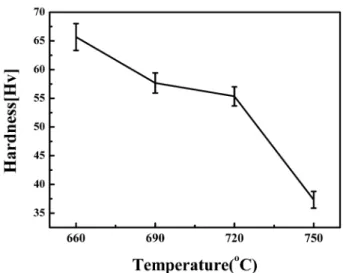
21)The effect of the foaming temperature on the Vickers hardness of corresponding AZ31 Mg alloy foams is shown in Fig. 12, indicating that the Vickers hardness of the foam decreases with the increasing of the foaming temperature.
The hardness of the foam fabricated at 660
oC, 690
oC, 720
oC and 750
oC, were 66.2, 58.7, 56.3 and 37.2 Hv, respectively.
4. Conclusion
1) In order to obtain Mg alloy foam with fine pore structures and high porosity (68%~73%), the foaming temperature should be selected in the range of 690
oC
~720
oC.
2) Compression behavior of AZ31 Mg alloy foam shows typical porous materials. As the foaming temperature in- creased from 660
oC to 750
oC, the compressed strength also increased. However, AZ31 Mg alloy foam with the foaming temperature of 720
oC had the best energy absorption. The energy absorption value of the Mg foam was 15.35 MJ/m
36. V. Gergely and B. Clyne, Adv. Eng. Mater., 2, 175 (2000).
7. A. R. Kennedy and S. Asavavisitchai, Scripta Mater., 50, 115 (2004).
8. S. W. Ip, Y. Wang and J. M. Toguri, Can. Metall. Q., 38, 81 (1999).
9. S. -H. Park, Y. -S. Um, C. -H. Kum and B. -Y. Hur, Colloid. Surface. Physicochem. Eng. Aspect., 263, 280 (2005).
10. O. Prakash, H. Sang and J. D. Embury, Mater. Sci. Eng., 199, 195 (1995).
11. A. E. Simone and L. J. Gibson, Acta Mater., 46, 3109 (1998).
12. J. Liu, S. Yu, X. Zhu, M. Wei, Y. Luo and Y. Liu, J.
Alloy. Comp., 476, 220 (2009).
13. I. Jeon and T. Asahina, Acta Mater., 53, 3415 (2005).
14. S. Esmaeelzadeh, A. Simchi and D. Lehmhus, Mater. Sci.
Eng., 424, 290 (2006).
15. M. Guden and S. Yuksel, J. Mater. Sci., 41, 4075 (2006).
16. A. E. Markaki and T. W. Clyne, Acta Mater., 49, 1677 (2001).
17. F. Campana and D. Pilone, Mater. Sci. Eng., 479, 58 (2008).
18. A. Paul and U. Ramamurty, Mater. Sci. Eng., 281, 1 (2000).
19. C. H. Seo, M. J. Jeong, I. Y. Jung and B. -Y. Hur, Mater.
Sci. Forum, 569, 273 (2008).
20. D. Lehmhus and J. Banhart, Mater. Sci. Eng., 349, 98 (2003).
21. J. A. Liu, S. R. Yu, Z. Q. Hu, Y. H. Liu and X. Y. Zhu, J. Alloy. Comp., 506, 620 (2010).
Fig. 12. Comparison of Vickers hardness of AZ31 Mg alloy foams with different foaming temperatures.