Korean Journal of Microbiology (2020) Vol. 56, No. 1, pp. 77-79 pISSN 0440-2413
DOI https://doi.org/10.7845/kjm.2020.9128 eISSN 2383-9902
Copyright ⓒ 2020, The Microbiological Society of Korea
Complete genome sequence of Mucilaginibacter ginsenosidivorans Gsoil 3017 T , a ginsenoside-converting bacterium, isolated from soil of a ginseng field
Young Woo Lee
1, Byoung Hee Lee
2, Ki-Eun Lee
2, Soon Youl Lee
1, and Wan-Taek Im
1,3*
1
Department of Biotechnology, Hankyong National University, Anseong 17579, Republic of Korea
2
Microorganism Resources Division, National Institute of Biological Resources, Incheon 22689, Republic of Korea
3
AceEMzyme Co., Ltd., Academic Industry Cooperation, Anseong 17579, Republic of Korea
인삼 재배 토양에서 분리한 진세노사이드 전환 능력이 있는
Mucilaginibacter ginsenosidivorans Gsoil 3017 T 의 유전체 서열
이영우
1・ 이병희
2・ 이기은
2・ 이순열
1・ 임완택
1,3*
1
국립한경대학교 농업생명과학대학 생명공학과,
2국립생물자원관,
3(주)에이스엠자임
(Received October 28, 2019; Revised February 14, 2020; Accepted February 14, 2020)
*For correspondence. E-mail: [email protected];
Tel.: +82-31-670-5335; Fax: +82-31-670-5339
A Gram-stain-negative, aerobic, non-motile, non-spore-forming, and rod-shaped bacterium, designated Mucilaginibacter gin- senosidivorans Gsoil 3017
T, was isolated from soil of a ginseng field. Strain Gsoil 3017
Tpossessed β-glucosidase activity, responsible for transforming ginsenosides Rb1, Rc, and Rd to F2 and C-K. Whole genome sequencing of Mucilaginibacter ginsenosidivorans Gsoil 3017
Trevealed one circular chromo- some comprising 5,352,833 bp, with DNA G + C content of 45.5%. We found several glycoside hydrolase genes that might be responsible for transforming major ginsenosides into minor ginsenosides, favoring their pharmacological effects. Plant cell wall degradation and oxidative stress-response genes were also detected.
Keywords: Mucilaginibacter ginsenosidivorans, complete genome, ginseng field, glycoside hydrolase, PacBio RS II
The genus Mucilaginibacter, a member of the family Sphingobacteriaceae within the phylum Bacteroidetes, was
first proposed by Pankratov et al. (2007). Members of this genus are Gram-stain-negative, strictly aerobic or facultatively anaerobic, non-spore-forming, non-motile and rod-shaped.
Currently, this genus comprises more than 51 species [https://
www.bacterio.net], including M. frigoritolerans (Männistö et al., 2010) and M. gotjawali (Lee et al., 2015). Members of the genus Mucilaginibacter have been isolated from diverse environments including peat bogs, wetlands, marine sands, river water, soils, plants, fresh water, tidal flat sediments, volcanic forests, and wastewater treatment facilities (Chen et al., 2018). The genomic DNA G + C content ranges between 39.1 and 49.8%.
To investigate ginsenoside-transforming bacterial strains, a
Gram-stain-negative, rod-shaped, yellow pigmented bacterium
Mucilaginibacter ginsenosidivorans Gsoil 3017
Twas isolated
from soil samples of a ginseng field in Pocheon province,
Republic of Korea. This strain demonstrates an ability to
transform major ginsenosides into minor ginsenosides. The
ginsenoside transforming ability test of M. ginsenosidivorans
Gsoil 3017
Twas settled using the method of Kim et al. (2017).
78 ∙ Lee et al.
미생물학회지 제56권 제1호
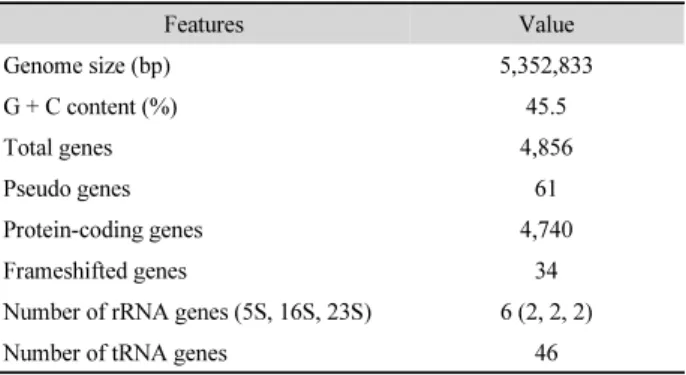
Table 1. General features of M. ginsenosidivorans Gsoil 3017
TFeatures Value
Genome size (bp) 5,352,833
G + C content (%) 45.5
Total genes 4,856
Pseudo genes 61
Protein-coding genes 4,740
Frameshifted genes 34
Number of rRNA genes (5S, 16S, 23S) 6 (2, 2, 2)
Number of tRNA genes 46
Subsequently, whole genome sequencing of strain Gsoil 3017
Twas carried out to study the genomic basis of such functions.
This strain is accessible from the host institute and from two culture collections (= KACC 14954
T= JCM 17081
T).
Genomic DNA of M. ginsenosidivorans Gsoil 3017
Twas extracted using a MagAttract HMW DNA kit (Qiagen). And Genomic DNA of the strain was purified using the chloroform wash method (shared protocol; Pacific Biosciences). Genome sequencing was carried out using a Pacific Biosciences RSII sequencing platform with a 20 kb SMRTbell
TMtemplate library, at DNA Link, Inc. Sequences were assembled using the HGAP3 protocol (Pacific Biosciences) and the sequencing depth was 132.44. The genome sequence was annotated using the NCBI Prokaryotic Genome Automatic Annotation Pipeline (http://www.ncbi.nlm.nih.gov/books/NBK174280/). rRNAs and tRNAs were predicted using rRNAmmer and tRNAscan-SE, respectively.
The whole genome of M. ginsenosidivorans Gsoil 3017
Tis made up of one circular chromosome of 5,352,833 bp, with 45.5% G + C content. Of the 4,801 predicted genes within the genome, 4,740 protein-coding genes, 6 rRNA genes (5S, 16S, and 23S), 46 tRNA genes, and 61 pseudogenes were also identified. The majority of the protein-coding genes (98.73%) were assigned a putative function, while the remaining predicted genes were annotated as hypothetical or conserved hypothetical proteins. The genome statistics are described in Table 1.
Analysis of the complete genome of M. ginsenosidivorans Gsoil 3017
Tshowed that many glycosides and hydrolases are encoded, including 14 β-glucosidases, 9 α-glucosidases, 3 α-L- arabinofuranosidases, 2 α-L-rhamnosidases, and 7 β-xylosidases, which may be responsible for the strain’s ability to convert ginseng saponins (Kim et al., 2017). Additionally, genome
annotation revealed other useful genes such as those encoding α and β galactosidases, α-amylases, nitrite reductase large and small subunits (NirD), cellulose biosynthesis protein BcsB, alcohol dehydrogenases (ADH), and endo-1,4-β-xylanase, which is related to plant cell wall degradation. The genome also contained the oxidative stress-response gene encoding thioredoxin reductase. Some stress-related genes were also identified, including genes encoding general stress protein Ctc, ATP- dependent protease ClpP, peptide methionine sulfoxide reductase MsrA/ MsrB, and thioredoxin TrxA1.
Nucleotide sequence accession number
The complete genome sequence of Mucilaginibacter ginseno- sidivorans Gsoil 3017
Thas been deposited in DDBJ/EMBL/
NCBI GenBank under accession number CP042436.
적 요
인삼밭 토양으로부터 분리한 Mucilaginibacter ginsenosi- divorans Gsoil 3017
T균주의 유전체 서열을 분석하였다. 균주 Gsoil 3017
T는 진세노사이드 Rb1, Rc 그리고 Rd를 F2와 C-K 로 변환하는 역할을 하는 베타-글루코시데이즈 활성을 가지 고 있었다. 균주 Gsoil 3017
T의 전체 유전체를 분석한 결과 단 일 원형 염색체로 구성되어 있으며 그 크기는 5,352,833 bp였 고 G + C 비율이 45.5%이었다. 균주 Gsoil 3017
T는 메이져 진 세노사이드를 마이너 진세노사이드로 전환하는 즉, 인삼 사포 닌의 당 분해에 관여하는 여러 타입의 글라이코사이드 분해 유전자를 가지고 있었다. 이러한 지놈 분석은 주요 진세노사 이드가 우수한 약리학적 활성의 미량 진세노사이드로 전환하 는데 관여하는 유전자 특징을 이해하는데 큰 기여가 되었다.
Acknowledgments
This work was supported by grants from the National Institute of Biological Resources, funded by the Ministry of Environment (No.NIBR201801106).
References