The genome of Flavivirga eckloniae ECD14
Tisolated from a seaweed Ecklonia cava was sequenced. The genome comprises a single circular 5,665,358 bp chromosome with a G + C content of 33.9%, 4,647 total genes, 4,595 protein-coding genes, 44 pseudo genes, and 52 RNA genes. CRISPER genes and sequences were not found and there were some phage remnants and transposons. This strain contains alginate lyase and β-glucosidase genes responsible for the degradation of seaweed polysaccharides.
Keywords: Flavivirga eckloniae, alginate lyase, genome sequence, seaweed
The genus Flavivirga was first proposed by Yi et al. (2012), as a member of the family Flavobacteriaceae, class Flavobacteria, phylum Bacteroidetes, and encompasses four species with validly published names (LPSN, http://www.bacterio.net/). The members of the genus Flavivirga were isolated from marine environments such as seawater and seaweed (Lee et al., 2017).
Members of the genus Flavivirga are Gram-strain-negative, aerobic, non-spore-forming, and rod-shaped with DNA G + C
contents of 27~33 mol% and require sea salts for growth.
Alginate and cellulose are widely distributed in the cell wall of marine algae such as Ecklonia cava (Kim et al., 2016; Yagi et al., 2018). Many kinds of marine bacteria including Vibrio, Shewanella, Paenibacillus, and Bacillus were known to excrete alginate lyase and cellulase (Kim et al., 2016; Wang et al., 2017; Yagi et al., 2018; Zhu et al., 2018). These enzymes were known to decompose the dead algae in the marine environ- ments and also concerned to produce bioactive oligosaccharides in industry (Kim et al., 2016; Wang et al., 2017).
Flavivirga eckloniae ECD14
Twas isolated from a seaweed Ecklonia cava collected from the South Sea, Republic of Korea and showed the degradation activity of seaweed polysaccharides alginate and cellulose (Lee et al., 2017). Thus, we determined the complete genome sequence of Flavivirga eckloniae ECD14
T(= KCTC 52352
T) and identified the presence of genes responsible for the degradation of seaweed polysaccharides.
There were no whole genome sequence data on bacteria belonging to the genus Flavivirga.
The genomic DNA was extracted from the stationary phased cells using a Wizard genomic DNA isolation kit (Promega).
Korean Journal of Microbiology (2018) Vol. 54, No. 2, pp. 161-163 pISSN 0440-2413
DOI https://doi.org/10.7845/kjm.2018.8016 eISSN 2383-9902
Copyright ⓒ 2018, The Microbiological Society of Korea
Complete genome sequence of Flavivirga eckloniae ECD14 T isolated from a seaweed Ecklonia cava
Ji Hee Lee
1, Joo Won Kang
1, Eun Mi Kim
2, and Chi Nam Seong
1*
1
Department of Biology, College of Life Science and Natural Resources, Sunchon National University, Suncheon 57922, Republic of Korea
2
Department of Dental Hygiene, Gwangju Health University, Gwangju 62287, Republic of Korea
감태(Ecklonia cava)에서 분리한 Flavivirga eckloniae ECD14 T 의 유전체 서열 분석
이지희
1・ 강주원
1・ 김은미
2・ 성치남
1*
1
순천대학교 생명산업과학대학 생물학과,
2광주보건대학교 치위생과
(Received March 30, 2018; Revised May 2, 2018; Accepted May 3, 2018)
*For correspondence.
E-mail: [email protected];Tel.: +82-61-750-3613; Fax: +82-61-750-3208
162
∙ Lee et al.미생물학회지 제54권 제2호
The whole genome of ECD14
Twas determined using Pacific Biosciences (PacBio) RSII platform (Pacific Biosciences).
Sequencing data were assembled with PacBio SMRT analysis using the HGAP2 protocol (Pacific Biosciences; Chin et al., 2013). The annotation of each CDS was made through National Center for Biotechnology Information prokaryotic genome Annotation Pipeline (Tatusova et al., 2016). Identification of clustered regularly interspaced short palindromic repeat (CRISPR) sequences was predicted by application CRISPRFinder program online (http://crispr.i2bc.paris-saclay.fr/Server/; Grissa et al.,
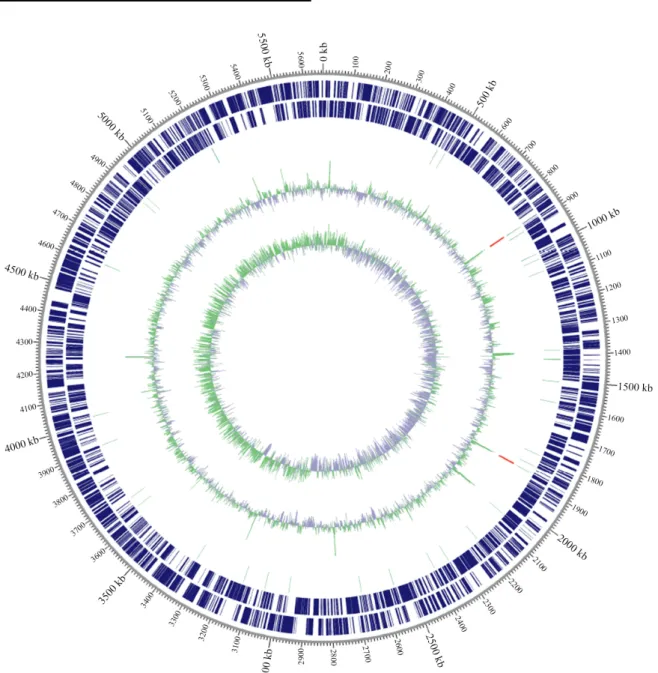
Fig. 1. Graphical circular map of F. eckloniae ECD14T. Marked characteristics are shown from outside to the center; CDS on forward strand, CDS on reverse strand, tRNA, rRNA, GC content, and GC skew.
Table 1. Genome statistics of F. eckloniae ECD14T
Attribute Values
Genome size (bp) 5,665,358
G + C content (%) 33.9
No. of contigs 1
No. of total genes 4,647
No. of coding sequences (CDS) 4,595
No. of pseudogenes 44
No. of rRNAs (5S, 16S, 23S) 6 (2, 2, 2)
No. of tRNAs 42
No. of ncRNAs 4
Genome sequence of Flavivirga eckloniae∙
163
Korean Journal of Microbiology, Vol. 54, No. 2 2007).
The genome statistics are described in Table 1. The complete genome of strain ECD14
Twas composed of a single circular chromosome and did not contain any plasmid DNA. The 5,665,358 bp genome with a G + C content of 33.93% contained 4,595 coding regions (CDS), 44 pseudogenes, and 52 RNA genes (6 rRNA genes, 42 tRNA genes, and 4 non-coding RNA genes) based on NCBI’s Prokaryotic Genome Annotation Pipeline (PGAP) (Fig. 1). The pseudogenes make stop codon in the middle of nucleotides sequences that encode proteins. There were no contigs that had CRISPR which originates from, matched the corresponding parts of viral DNA and provided the cleaving site of Cas-proteins (Makarova et al., 2011). Five phage-related genes and transposable element genes could be annotated. The genome revealed the presence of two alginate lyases and five β-glucosidases, which involved in the degradation of alginate and cellulose, respectively. Also a monooxygenase gene associated with antibiotic biosynthesis and a gene related to the degradation of microcystin were found.
The strain Flavivirga eckloniae ECD14
Tis available at KCTC 52352
Tand JCM 31797
T.
Nucleotide sequence accession number
The genome sequence of Flavivirga eckloniae ECD14
Thas been deposited in NCBI GenBank under accession number CP025791.
Acknowledgements
This work was supported by Sunchon National University Research Fund in 2017.
적 요
대한민국 남해에서 채집한 해조류 감태(Ecklonia cava)로 부터 분리한 Flavivirga eckloniae ECD14
T균주의 유전체서열 을 분석하였다. 균주 ECD14
T의 유전체는 G + C 비율이 33.9%
이며, 4,647개의 유전자와 4,595개의 단백질 코딩 유전자, 44
개의 위유전자, 52개의 RNA 유전자를 포함한 단일 원형 염색 체로 구성되었으며 그 크기는 2,371,912 bp였다. 파아지와 트 랜스포존 유전자가 존재하며, CISPR array 관련 유전자 및 서 열은 발견되지 않았다. 균주 ECD14
T는 해조 다당의 분해에 관 여하는 alginate lyase와 β-glucosidase 유전자를 가지고 있었다.
References
Chin, C.S., Alexander, D.H., Marks, P., Klammer, A.A., Drake, J., Heiner, C., Clum, A., Copeland, A., Huddleston, J., Eichler E., et al. 2013. Nonhybrid, finished microbial genome assemblies from long-read SMRT sequencing data. Nat. Methods 10, 563– 569.
Grissa, I., Vergnaud, G., and Pourcel, C. 2007. CRISPRFinder: a web tool to identify clustered regularly interspaced short palindromic repeats. Nucleic Acids Res. 35, W52–W57.
Kim, B.M., Park, J.H., Kim, D.S., Kim, Y.M., Jun, J.Y., Jeong, I.H., and Chi, Y.M. 2016. Effects of the polysaccharide from the sporophyll of brown alga Undaria pinnatifida on serum lipid profile and fat tissue accumulation in rats fed a high-fat diet. J.
Food Sci. 81, H1840–H1845.
Lee, J.H., Kang, J.W., Choe, H.N., and Seong, C.N. 2017. Flavivirga eckloniae sp. nov. and Flavivirga aquimarina sp. nov., isolated from seaweed Ecklonia cava. Int. J. Syst. Evol. Microbiol. 67, 3089–3094.
Makarova, K.S., Haft, D.H., Barrangou, R., Brouns, S.J.J., Charpentier, E., Horvath, P., Moineau, S., Mojica, F.J.M., Wolf, Y.I., Yakunin, A.F., et al. 2011. Evolution and classification of the CRISPR- Cas systems. Nat. Rev. Microbiol. 9, 467–77.
Tatusova, T., DiCuccio, M., Badretdin, A., Chetvernin, V., Nawrocki, E.P., Zaslavsky, L., Lomsadze, A., Pruitt, K.D., Borodovsky, M., and Ostell, J. 2016. NCBI prokaryotic genome annotation pipeline. Nucleic Acids Res. 44, 6614–6624.
Wang, M., Chen, L., Zhang, Z., Wang, X., Qin, S., and Yan, P. 2017.
Screening of alginate lyase-excreting microorganisms from the surface of brown algae. AMB Express 7, 74.
Yagi, H., Fujise, A., Itabashi, N., and Ohshiro, T. 2018. Characteri- zation of a novel endo-type alginate lyase derived from Shewanella sp. YH1. J. Biochem. 163, 341–350.
Yi, H., Cho, J.C., and Chun, J. 2012. Flavivirga jejuensis gen. nov., sp.
nov., and Flavivirga amylovorans sp. nov., new members of the family Flavobacteriaceae isolated from seawater, and emended descriptions of the genera Psychroserpens and Lacinutrix. Int. J.
Syst. Evol. Microbiol. 62, 1061–1068.
Zhu, X., Li, X., Shi, H., Zhou, J., Tan, Z., Yuan, M., Yao, P., and Liu, X. 2018. Characterization of a novel endo-type alginate lyase derived from Shewanella sp. YH1. J. Biochem. 163, 341–350.