서 론
채소 작물의 접목은 작물 생산에 있어서 집약 재배와 연작으 로 인해 발생하는 토양오염 및 병해충 발생과 같은 문제점를 해결하기 위해 동아시아에서 수십 년간 실행해온 기술이다 (Kubota 등, 2008). 채소 작물에 있어서 접목은 F.oxysporum 에 의해 발생하는 토양 전염병을 피하거나 줄이기 위함으로 접목묘 사용률이 크게 증가하였다(Lee, 1994). 접목묘가 병에 대해 내성을 가지는 이유는 대목의 뿌리가 그 병에 대해 내성 을 가지고 있기 때문이다(Lee 등, 2010). 토마토 대목의 사용 은 접수의 생육을 좋게 하여 수확량에 영향을 준다(Lee와 ODA, 2003). 토마토 대목의 뿌리는 활력이 좋아 물과 양분을
효율적으로 흡수할 수 있다(Lee 등, 2010). 대목과 접목한 토 마토는 접목하지 않은 실생 토마토보다 건강하고 높은 수확량 을 보였다(Lee와 ODA, 2003; White, 1963). 적합한 대목을 사용한 토마토는 수확량을 증가시켰으며 대목을 사용하지 않 은 토마토와 비교하여 대목을 사용한 접목 조합에서 주 당 총 수확량이 증가하였다(Turhan 등, 2011).
수경재배는 작물의 생육에 필요한 물, 양분 및 온도 제어가 가능하여 수확량을 극대화시킬 수 있다(McManus, 2020). 토 마토 토경재배는 5단에서 7단으로 단기재배를 하지만 수경재 배에서는 장기재배가 일반적이다. 토마토 장기재배 작형은 대부분 전년 8월에 정식하여 익년 6월까지 재배하는데 이 경 우 30단 이상 수확할 수 있어(RDA, 2019) 생산량의 증가로 높은 소득을 얻는다. 네덜란드와 우리나라의 전체 토마토 재 배면적 대비 접목 토마토 재배면적 비율은 각각 75%와 25%
로(Singh 등, 2017) 우리나라의 토마토 접목묘 사용률은 네덜
대목사용에 따른 토마토의 생육 및 수량 변화
이혜원1,4ㆍ홍규현2ㆍ권덕호2ㆍ조명철3ㆍ이준구5ㆍ황인덕6ㆍ안율균2*
1
국립한국농수산대학 채소학과 연구원,
2국립한국농수산대학 채소학과 교수,
3국립원예특작과학원 채소과 연구관,
4
전북대학교 농업생명과학대학 원예학과 대학원생,
5전북대학교 농업생명과학대학 원예학과 교수,
6
부농종묘 육종연구소 소장
Changes of Growth and Yield by using Rootstocks in Tomato
Hyewon Lee1,4, Kue Hyon Hong2, Deok Ho Kwon2, Myeong Cheoul Cho3, Jun Gu Lee5, Indeok Hwang6, and Yul Kyun Ahn2*
1
Researcher, Department of Vegetable crops, Korea National College of Agriculture and Fisheries, Jeonju, 54874, Korea,
2
Professor, Department of Vegetable crops, Korea National College of Agriculture and Fisheries, Jeonju, 54874, Korea,
3
Senior Researcher, Vegetable Research Division, National Institute of Horticultural & Herbal Science, Wanju 55365, Korea,
4
Graduate Student, Department of Horticulture, College of Agriculture & Life Sciences, Jeonbuk National University, Jeonju 54896, Korea,
5
Professor, Department of Horticulture, College of Agriculture & Life Sciences, Jeonbuk National University, Jeonju 54896, Korea
6
R&D Director, R&D Center, Bunongseed Co., Ltd., Gimje 54324, Korea
Abstract. This research was conducted to examine the changes in yield and difference in growth, using rootstocks in tomatoes as the growth indicators. Seedlings of tomato ‘Gama’, were used as scion and non-grafted control, while 4 different grafted tomatoes ‘Powerguard’, ‘T1’, ‘L1’, and ‘B.blocking’ were used as rootstocks. The non-grafted and grafted plants were grown in hydroponics for long-duration cultivation under plastic greenhouse conditions. The total yield of grafted tomato ‘Powerguard’ and non-grafted tomato ‘Gama’ were 8,428 g and 7,645 g, respectively. The flowering position of grafted plants ‘B.blocking’ and non-grafted plants at the latter period were 17.58 cm and 14.92 cm, respectively. The results showed that the yield and the balance of the plant were improved until the end of the harvest by grafting. The difference in yield between non-grafted and grafted tomatoes was evident in the 19th cluster, 236 days after planting. Therefore using rootstocks could be advantageous for long-duration cultivation in tomatoes.
Additional key words : flowering position, grafting, growth strength, long-duration cultivation
*Corresponding author: [email protected]
Received August 28, 2020; Revised October 16, 2020;
Accepted October 17, 2020
란드에 비해 낮은 비율을 보인다. 수경 재배시설을 이용하여 토마토 장기재배를 하고 접목묘를 사용하여 병 저항성 뿐 아 니라 수확량 증대를 기대할 수 있지만 우리나라의 토마토 접 목묘 사용률은 아직까지 낮은 편이다. 접목함으로써 토마토 수확량, 과경, 과폭, 과실 수 및 과중이 향상되었다는 결과를 보여주는 연구(Turhan 등, 2011) 등이 수행되었으나 대목을 사용한 토마토와 대목을 사용하지 않은 토마토의 생육 및 수 확량 변화에 대한 연구가 부족한 실정이다.
따라서 본 연구는 토마토에 있어서 수경재배 시설 내에서 대 목을 사용한 접목묘와 대목을 사용하지 않은 실생묘의 수확 시기별 수확량 변화와 생육지표를 활용한 생육차이를 살펴보 고자 수행하였다.
재료 및 방법
1. 실험재료
토마토 대목 품종인 ‘파워가드’(National Institute of Horticultural and Herbal Science, Korea), ‘T1’(Bunongseed, Korea), ‘L1’(Bunongseed, Korea), ‘B.blocking’(Takii, Japan)과 토마토 접수 품종 ‘감마’(Semillas Fitó, Spain)를 사 용하였다. 토마토 육묘는 2019년 7월 4일 토마토 대목 종자는 모판에 파종하여 10일 후 40구 트레이에 가식하였고 접수 종 자는 128구 트레이에 파종하였다. 2019년 7월 25일에 대목 품 종 4가지와 접수를 합접법으로 접목하였다. 접목 후에는 온도 24℃, 습도 80% 이상으로 유지되는 접목 활착실에 6일간 두 었다. 접목하지 않은 토마토 품종 ‘감마’ 실생묘도 실험에 사 용하였다. 접목묘와 같은 크기로 정식하기 위해 실생묘는 2019년 7월 11일에 파종하였다.
2. 식물재배 및 재배환경
본 실험은 전라북도 정읍에 위치한 연동형 비닐하우스(폭 9.6m, 길이 115m, 측고 5.5m, 동고 7m)에서 수행하였다. 실 험 기간은 2019년 8월 24일부터 2020년 5월 29일까지 실시하 였다. 접목한 4개의 처리 구와 접목하지 않은 1개의 처리 구를 15주씩 3반복 난괴법으로 배치하였다. 정식 시 배지는 코코피 트 배지(Duck Yang Coco, Korea, 가로 20cm, 세로 100cm, 높이 10cm)를 사용하여 재식거리는 160cm x 25cm로 하였 다. 실험에 사용한 배양액은 Yamazaki 토마토 배양액을 pH 6.0, EC 2.0dS·m-1 수준으로 조정하였으며, 온실 내부 평균온 도가 15℃인 1월 부근에는 EC는 2.6에서 2.7dS·m-1을 유지 하였다. 겨울철 급액은 오전 9시 30분에 시작하여 일몰 4시간 전까지 5회(80cc/주)에 걸쳐 급액하였고, 여름철 급액은 오전 8시에 시작하여 일몰 2시간 전까지 17회(100cc/주)에 걸쳐 급
액하였다. 배양액 공급은 자동공급장치(MAGMA 1000 V2.0, Green Control System Ltd, Korea)를 이용하였으며, 온도와 일사 센서는 복합 환경 제어 시스템(MAGMA multivariable controller Ver 2.4, Green Control System Ltd, Korea)를 이 용하여 수집하였다. 토마토 식물체 관리는 정식 후 발생되는 측지와 노엽을 지속적으로 제거하고 동일한 개수로 적과하 였다.
3. 수확량 및 과실특성 조사항목 및 조사방법
토마토 수확량 조사는 반복당 5개체를 골라 2019년 12월 6 일부터 2020년 5월 29일까지 총 26주간 1에서 2주마다 조사 하였다. 수확한 토마토는 실험실에서 과중, 개수, 당도, 과경 및 과폭을 측정하였다. 과중은 전자저울(KS-308, DRETEC, Japan)을 이용하여 조사하였고 동시에 개수를 조사하였다. 당 도는 당도계(PR-32a, ATAGO, Japan)를 이용하여 수확된 과 실을 5반복 측정하였다. 과경(Fruit length)과 과폭(Fruit diameter)은 디지털 버니어 캘리퍼스 300mm(IP67, FUTURO, Switzerland)를 이용하여 수확된 과실을 5반복 측정하였다.
4. 생육조사 항목 및 측정방법
식물 생육조사는 초기와 후기 생육조사로 나누어 생장강도, 개화위치, 개화속도, 엽장 및 엽폭을 조사하였다. 초기 생육조 사는 정식 후 42일에 시작하여 7일 간격으로 3주간 조사하였 고, 후기 생육조사는 정식 후 266일에 시작하여 7일 간격으로 3주간 조사하였다. 처리 당 5주씩 3반복으로 조사하였다. 생 장강도는 7일 전 유인선에 표시한 생장점이 있던 위치의 줄기 직경(경경)을 측정하였으며 측정할 부위가 마디인 경우 바로 아래부분을 측정하였다(Kim 등, 2010). 개화위치는 생장점 과 개화하는 화방 사이의 길이를 측정하였다. 개화속도는 7일 간격으로 같은 시간에 완전히 개화된 꽃 수를 측정하여 금주 의 개화 수에서 전주의 개화 수를 뺀 값으로 계산하였다(Kim 등, 2014). 엽장과 엽폭은 개화한 최상위 화방의 하부엽의 정 단엽의 세로와 가로 길이를 측정하였다.
5. 통계분석
통계분석은 R 프로그램을 이용하여 ANOVA(analysis of variance)를 통해 실시하였다. 통계적 유의성 검정을 위해 최 소 유의차 검정(Least Significant Difference Test, LSD)을 통해 5% 유의수준에서 실시하였다. 평균 간 비교는 95% 신뢰 수준에서 Duncan’s Multiple Range Test(DMRT) 검정을 이 용하여 차이를 확인하였다.
결과 및 고찰
1. 토마토 수확량 변화
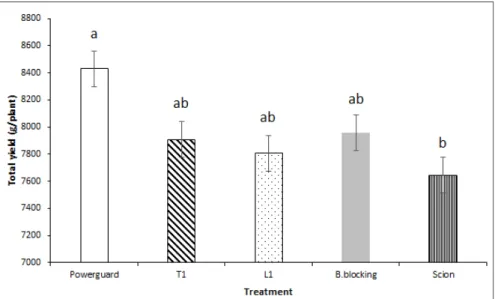
토마토의 주 당 평균 총 수확량을 조사한 결과 대목을 사용하 여 접목한 토마토 ‘파워가드’의 수확량이 8,428.4g으로 가장 높고 그 다음으로 ‘B.blocking’, ‘T1’, ‘L1’이 각각 7,955.9g, 7,908.1g, 7,806g 순으로 수확량이 높으며, 접목하지 않은 토
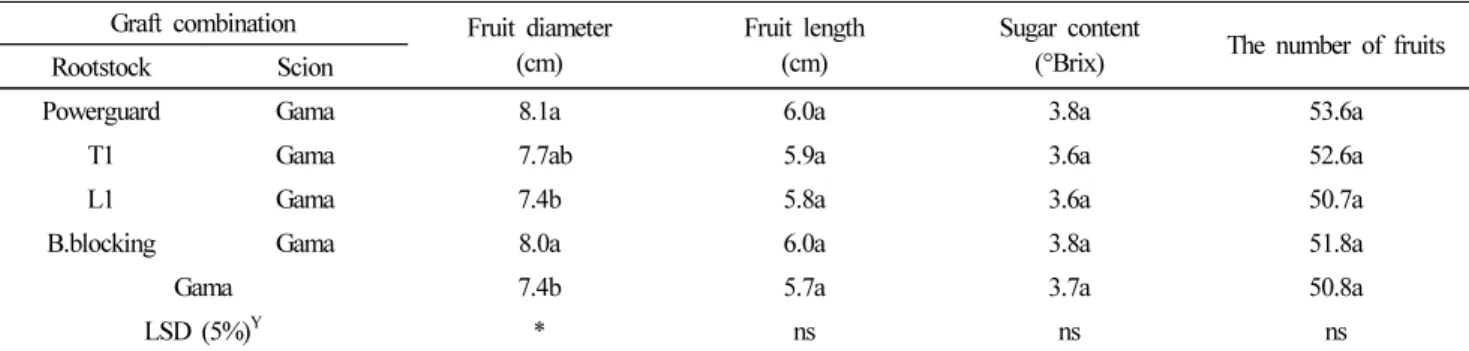
마토는 7,645.5g으로 수확량이 가장 낮았다(Fig. 1). 월별 평 균 과중을 조사한 결과는 수확을 시작한 12월을 제외하고 전 체 재배기간 동안 접목하지 않은 처리 구의 평균 과중이 접목 한 처리 구에 비해 3 내지 26g 낮았다(Fig. 2). 정식 후 251일에 수확한 과실의 과경과 과폭은 접목한 처리 구에 비해서 접목 하지 않은 처리 구가 낮았다(Table 1). 이러한 결과는 접목하 지 않은 토마토의 수확량과 과실 크기 및 과중이 접목한 토마
Fig. 1. Total fruit yield of non-grafted and grafted tomato plants. ‘Scion’ was used as non-grafted control, while 4 grafted tomato plants ‘Powerguard’,
‘T1’, ‘L1’, and ‘B.blocking’ were used as rootstocks under plastic greenhouse.
Fig. 2. Monthly average fruit weight of non-grafted and grafted tomatoes. ‘Scion’ was used as non-grafted control, while 4 grafted tomato plants
‘Powerguard’, ‘T1’, ‘L1’, and ‘B.blocking’ were used as rootstocks under plastic greenhouse.
토보다 낮았다는 결과(Turhan 등, 2011)와 접목하지 않은 토 마토보다 접목한 토마토의 과중이 높게 나타났다는 결과 (Khah 등, 2006)와 일치하였다.
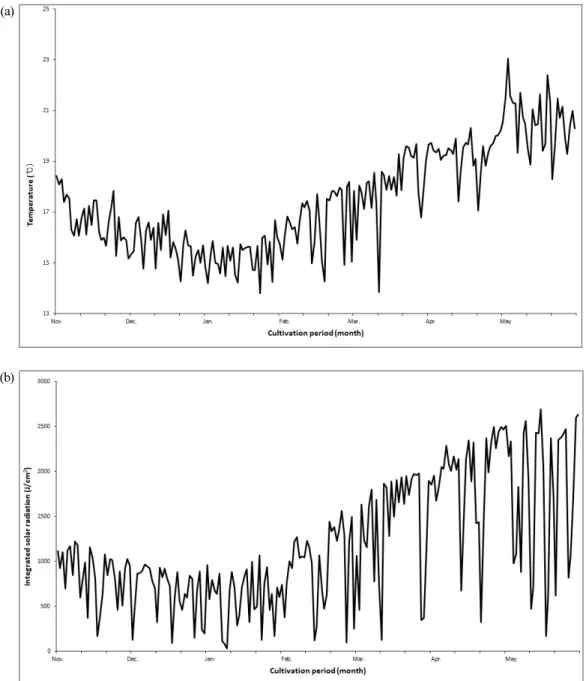
생육 초기인 12월에는 실생 토마토가 접목 토마토보다 수확 량이 많았는데 이는 대목을 사용한 처리 구의 첫 개화일이 늦 어서 나타나는 현상이라고 판단된다(Fig. 3). 이 같은 결과는 토마토에서 접목을 하는 경우 작물에 스트레스를 주고 화기 형성을 늦추기 때문이라고 보고되고 있다(Khah 등, 2006). 수 확을 시작한 12월에는 주 당 2,000g에서 2,500g의 수확량을 보이다가 2월에는 500g에서 1,000g으로 수확량이 감소하였 는데(Fig. 3) 이는 1월과 2월의 온실 평균 내부온도가 15.3℃
와 16.7℃로 토마토 생육적온인 17 내지 27℃보다 낮은 온도 로(Fig. 4) 낮은 온도는 토마토의 절대 성장률을 감소시키고 절
대 성장률이 최대가 되는 시기를 늦춘다는 연구결과(Adams 등, 2001)에 따라 수확량이 감소된 것으로 판단된다. 4월부터 수확량이 1,000g에서 1,500g으로 증가하였는데(Fig. 3) 이는 3월 온실 평균 내부온도가 18.2℃로 올라가고 일일 누적 일사 량이 높아졌기 때문이다(Fig. 4). 4월의 수확량이 증가함과 동 시에 처리 간의 차이가 벌어졌는데 4월 한 달 동안의 주 당 평 균 수확량을 보면, ‘파워가드’는 1,505.3g으로 가장 높은 수확 량을 보였고 ‘B.blocking’, ‘L1’, ‘T1’ 순으로 각각 1,385.1g, 1,371g, 1,324.1g의 수확량을 보였으며 실생묘는 1,222.8g으 로 가장 낮은 수확량을 보였다(Fig. 3). 적합한 대목 사용은 수 확량을 증가시킨다는 연구결과(Marsic과 Osvald, 2004)를 보아 대목인 ‘파워가드’가 다른 대목보다 접수인 ‘감마’와 적 합하다고 판단된다. 대목을 사용한 처리 구와 대목을 사용하
Table 1. Fruit diameter, fruit length, sugar content, the total number of fruits of non-grafted and grafted tomatoes.
ZGraft combination Fruit diameter
(cm) Fruit length
(cm) Sugar content
(°Brix) The number of fruits
Rootstock Scion
Powerguard Gama 8.1a 6.0a 3.8a 53.6a
T1Gama 7.7ab 5.9a 3.6a 52.6a
L1Gama 7.4b 5.8a 3.6a 50.7a
B.blocking Gama 8.0a 6.0a 3.8a 51.8a
Gama 7.4b 5.7a 3.7a 50.8a
LSD (5%)
Y* ns ns ns
Z
251 days after planting.
Y
Mean separation within columns by Duncan’s multiple range test at P = 0.05. ns, * ; Nonsignificant or significant at P ≤ 0.05.
Fig. 3. Monthly fruit yield of non-grafted and grafted tomato plants. ‘Scion’ was used as non-grafted control, while 4 grafted tomato plants
‘Powerguard’, ‘T1’, ‘L1’, and ‘B.blocking’ were used as rootstocks under plastic greenhouse.
지 않은 처리 구간의 수확량 차이가 벌어지기 시작한 시점의 화방 수는 19 화방째이고 정식한 날을 기준(2019년 8월 24일) 으로 236일 째(2020년 4월 15일)였다(Fig. 3). 정식 280일까 지인 총 25화방을 수확한 토마토 재배기간 동안 정식 236일 째인 19 화방을 기점으로 후반기에 갈수록 수확량 차이가 크 게 벌어지는 것을 알 수 있다. 이것은 대목과 접목한 토마토는 접목하지 않은 실생 토마토보다 건강하고 높은 수확량을 생산 하였다(Lee와 ODA, 2003; White, 1963)는 보고와 유사하였 다. 토마토 대목의 뿌리는 더 크고 건강하여 물과 양분을 효율 적으로 흡수할 수 있어(Lee 등, 2010) 접목 토마토가 실생 토
마토보다 수확 후기까지 수확량이 높은 것으로 판단된다.
주 당 총 수확량에서 접목 토마토 ‘파워가드’는 8,428.4g이 고 실생 토마토는 7,645.5g이다(Fig. 1). 10a당 2,500주가 재 배될 때 ‘파워가드’는 21,071kg의 토마토를 생산할 수 있고 실생묘는 19,114kg을 생산할 수 있다. ‘파워가드’를 대목으로 사용한 토마토가 10a당 1,957kg을 더 수확할 수 있어서 농가 소득 증가에 도움이 될 것으로 기대된다.
따라서 토마토 장기재배에 있어서 대목을 사용하는 것이 높 은 수량과 소득을 얻을 수 있는 것으로 판단된다.
(a)
(b)
Fig. 4. Changes of temperature(a) and integrated solar radiation(b) during the experimental period in plastic greenhouse.
2. 토마토의 생육변화
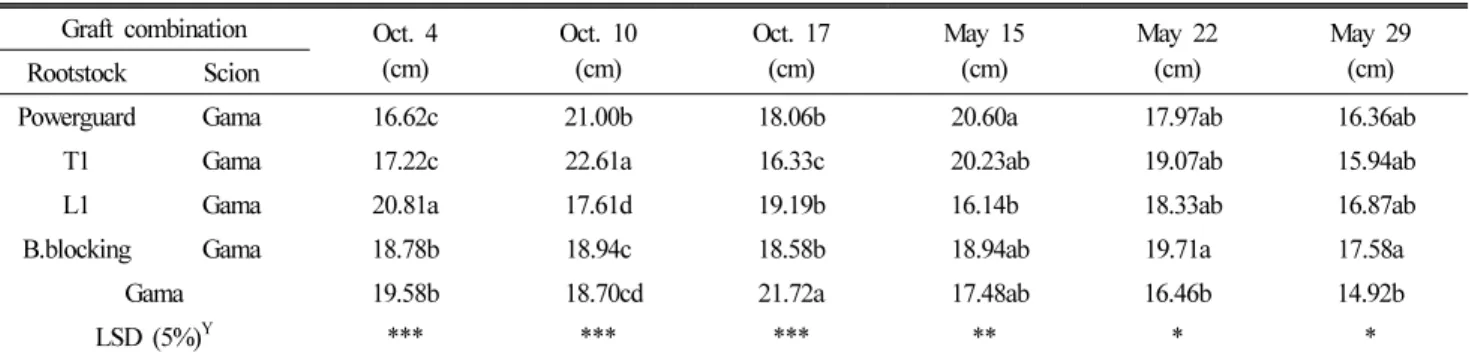
줄기 직경(경경)을 측정하여 작물의 힘이 강한지 약한지 판 단하고, 개화위치를 측정하여 영양생장인지 생식생장인지의 작물 생장의 균형을 판단할 수 있다(Stradiot과 Battistel, 2003). 정식 266일 후 실생 토마토의 생장강도는 10.38mm이 고 접목한 처리 구인 ‘파워가드’, ‘T1’, ‘L1’, ‘B.blocking’은 각각 11.7mm, 11.83mm, 12.56mm, 12.23mm의 생장강도를 보였다(Table 2). 생장강도는 11mm 내지 12mm를 기준으로 줄기 직경이 기준보다 굵으면 생장강도가 강한 것이고 기준보 다 가늘면 생장강도가 약한 것이라고 판단할 수 있다(Stradiot 과 Battistel, 2003). 실생 토마토의 줄기 직경이 접목한 토마 토의 줄기 직경보다 1 내지 2mm 가늘었지만 처리 간 통계적 유의차가 없었다. 정식 280일 후 생육 후기의 개화위치는 접목 한 처리 구 ‘파워가드’, ‘T1’, ‘L1’, ‘B.blocking’은 각각 16.36cm, 15.94cm, 16.87cm, 17.58cm를 보였고 실생묘의 개 화위치는 14.92cm로 유의적으로 낮은 값을 보였다(Table 3).
개화위치는 15 내지 20cm를 기준으로 개화위치가 기준보다
짧으면 생식생장으로의 진행, 기준보다 길면 영양생장으로의 진행이라고 판단할 수 있다(Stradiot과 Battistel, 2003). 접목 한 토마토는 후반기까지 생육의 균형을 맞추고 있음을 볼 수 있었으며, 생육 후기로 갈수록 실생묘는 생식생장으로의 진 행이 되는 것을 볼 수 있었다. 수확 후기에 접목하지 않은 토마 토의 수확량이 접목한 토마토의 수확량보다 낮은 이유는 식물 체가 생장상의 균형을 보이지 않고 생식생장으로 치우쳤기 때 문이라고 판단된다.
정식 48일 후 생육 초기의 개화속도는 0.5/주에서 0.6/주의 값을 보이다가 정식 55일 후 0.6/주에서 0.8/주로 개화속도가 빨라졌으며 정식 266일 후 생육 후기의 개화속도는 모든 처리 구가 0.7/주 대의 값을 보이다가 0.6/주 대로 개화속도가 느려 졌다(Table 4). 토마토의 경우 개화속도는 일주일에 0.7/주 정 도인 것이 생육균형에 적당한 것으로 알려져 있는데(Kim 등, 2013; Saito 등, 2011), 정식 266일 후 생육균형에 적당한 개 화속도를 보이다가 모든 처리 구가 느려지는 양상을 보였으나 처리 간 통계적 유의차가 없었다(Table 4). 엽장과 엽폭은 초
Table 2. Growth strength of non-grafted and grafted tomato plants.
ZGraft combination Oct. 10
(mm) Oct. 17
(mm) May 22
(mm) May 29
Rootstock Scion (mm)
Powerguard Gama 8.43a 10.43a 11.7a 11.35a
T1 Gama 8.80a 10.56a 11.83a 11.29a
L1 Gama 9.19a 10.70a 12.56a 11.13a
B.blocking Gama 9.30a 10.49a 12.23a 11.83a
Gama 9.07a 10.47a 10.38a 10.85a
LSD (5%)
Yns ns ns ns
Z
42 days after planting, 266 days after planting. Growth strength was expressed as the average diameter of the stem. Method to measure the stem diameter at the place where the growing tip was 7 days ago.
Y
Mean separation within columns by Duncan’s multiple range test at P = 0.05. ns ; Nonsignificant.
Table 3. Flowering position of non-grafted and grafted tomato plants.
ZGraft combination Oct. 4
(cm) Oct. 10
(cm) Oct. 17
(cm) May 15
(cm) May 22
(cm) May 29
Rootstock Scion (cm)
Powerguard Gama 16.62c 21.00b 18.06b 20.60a 17.97ab 16.36ab
T1 Gama 17.22c 22.61a 16.33c 20.23ab 19.07ab 15.94ab
L1 Gama 20.81a 17.61d 19.19b 16.14b 18.33ab 16.87ab
B.blocking Gama 18.78b 18.94c 18.58b 18.94ab 19.71a 17.58a
Gama 19.58b 18.70cd 21.72a 17.48ab 16.46b 14.92b
LSD (5%)
Y*** *** *** ** * *
Z
42 days after planting, 266 days after planting. The flowering position was expressed as the distance between the flowering truss and the head of the plant.
Y
Mean separation within columns by Duncan’s multiple range test at P = 0.05. *, **, *** ; Significant at P ≤0.05, 0.01 or 0.001.
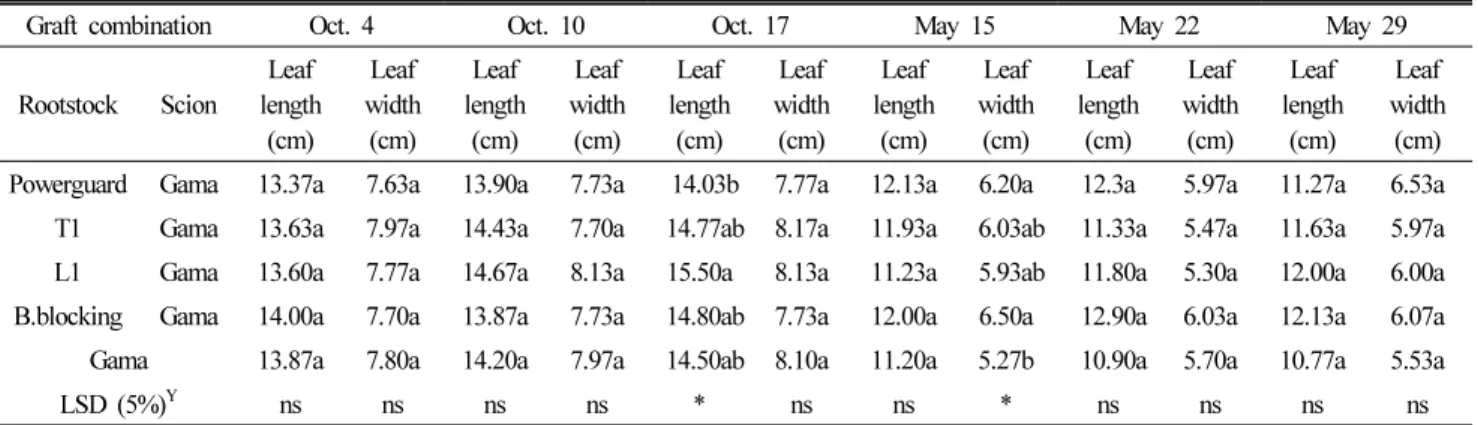
기 생육에 비해 후기 생육에 전체적으로 크기가 작아졌다. 정 식 266일 후의 엽폭은 ‘B.blocking’과 ‘파워가드’가 6.5cm와 6.2cm로 유의있게 컸으며 실생묘가 5.27cm로 유의있게 작았 다(Table 5).
적 요
수경재배 시설 내에서 토마토를 재배할 때 대목사용에 따른 수확 시기별 수확량 변화와 생육지표를 활용한 생육차이를 살 펴보고자 본 실험을 수행하였다. ‘감마’를 접수로 ‘파워가드’,
‘T1’, ‘L1’, ‘B.blocking’을 대목으로 접목한 토마토 접목묘 4 종류와 접목하지 않은 ‘감마’를 실생묘로 실험에 사용하였다.
재배는 장기재배를 하는 토마토 수경재배 비닐하우스에서 재 배되었다. 토마토의 총 수확량을 조사한 결과 대목을 사용하 여 접목한 토마토 ‘파워가드’의 수확량과 접목하지 않은 토마 토의 수확량은 각각 8,428g과 7,645g으로 나타났다. 생육 후
기 접목한 토마토 ‘B.blocking’과 실생 토마토의 개화위치는 각각 17.58cm와 14.92cm였다. 이같은 결과는 토마토에 있어 서 대목을 사용하는 것이 수확량이 높고 수확 후기까지 식물 체가 균형있는 생장을 하는 것으로 볼 수 있다. 접목묘와 실생 묘의 수확량 차이는 정식 236일 째인 19화방부터 크게 나타나 기 시작하였다. 토마토 장기재배를 할 경우에는 대목을 사용 하는 것이 높은 수량을 얻을 수 있는 것으로 판단된다.
추가 주제어 : 개화위치, 생장강도, 장기재배, 접목
사 사
본 연구는 농촌진흥청 공동연구사업(과제번호 PJ0135610 32020)에 의해 수행되었음.
Table 4. Flowering rates of non-grafted and grafted tomato plants.
ZGraft combination
Oct. 10 Oct. 17 May 22 May 29
Rootstock Scion
Powerguard Gama 0.54a 0.89a 0.75a 0.66a
T1Gama 0.44a 0.85a 0.75a 0.63a
L1Gama 0.60a 0.82a 0.78a 0.63a
B.blocking Gama 0.58a 0.68a 0.79a 0.66a
Gama 0.51a 0.72a 0.70a 0.65a
LSD (5%)
Yns ns ns ns
Z
42 days after planting, 266 days after planting. Flowering rates were expressed as subtracting ‘the number of fully-bloomed flowers last week’
from ‘the number of fully-bloomed flowers this week’. Each truss has 4 flowers, each flower was counted as 0.25. When all the flowers on that truss fully bloomed, it is ‘1’.
Y
Mean separation within columns by Duncan’s multiple range test at P = 0.05. ns ; Nonsignificant.
Table 5. Leaf length and width of non-grafted and grafted tomato plants.
ZGraft combination Oct. 4 Oct. 10 Oct. 17 May 15 May 22 May 29
Rootstock Scion Leaf length
(cm)
Leaf width
(cm)
Leaf length
(cm)
Leaf width
(cm)
Leaf length
(cm)
Leaf width
(cm)
Leaf length
(cm)
Leaf width
(cm)
Leaf length
(cm)
Leaf width
(cm)
Leaf length
(cm)
Leaf width
(cm) Powerguard Gama 13.37a 7.63a 13.90a 7.73a 14.03b 7.77a 12.13a 6.20a 12.3a 5.97a 11.27a 6.53a T1 Gama 13.63a 7.97a 14.43a 7.70a 14.77ab 8.17a 11.93a 6.03ab 11.33a 5.47a 11.63a 5.97a L1 Gama 13.60a 7.77a 14.67a 8.13a 15.50a 8.13a 11.23a 5.93ab 11.80a 5.30a 12.00a 6.00a B.blocking Gama 14.00a 7.70a 13.87a 7.73a 14.80ab 7.73a 12.00a 6.50a 12.90a 6.03a 12.13a 6.07a Gama 13.87a 7.80a 14.20a 7.97a 14.50ab 8.10a 11.20a 5.27b 10.90a 5.70a 10.77a 5.53a
LSD (5%)
Yns ns ns ns * ns ns * ns ns ns ns
Z
42 days after planting, 266 days after planting.
Y