서 론
최근 기후 변화 및 이상 기상 등으로 인해서 접수 및 대목의 안정적인 생산이 어려워지고 있다. 식물공장형육묘시스템은 폐쇄된 환경에서 인공광을 이용하여 작물 재배에 적합한 환경 제어가 가능하여 고품질 규격묘의 안정적인 생산을 위해 필요 한 기술로 대두되고 있다(Jang 등, 2014b). 식물공장형육묘시
스템은 광량, 광질, 명/암기 등을 포함한 광, 기온, 습도, 이산화 탄소 농도 등 식물 생육에 영향을 미치는 환경 요인들의 정밀 제어가 가능하고, 이를 통해서 외부 기상 환경에 영향을 받지 않고 연중 안정적으로 단기간 대량의 규격묘 생산이 가능하 다. 식물공장형육묘시스템의 개념은 일본에서 처음으로 도입 되어 원예작물 등의 고부가가치 묘 안전 생산을 목적으로 개 발되어 보급되었다(Kim et al., 2005).
또한, 농촌의 인력 부족과 인건비 상승으로 접목 인력 확충 의 어려움과 접목묘 생산비가 증가하고 있는 실정으로 접목 작업의 자동화를 위해 접목 로봇의 적용이 검토되고 있다. 접
식물공장형육묘시스템 내 광량에 따른
오이와 토마토 접수 및 대목의 증발산량 및 생육 변화
박선우1†ㆍ안세웅2†ㆍ곽유리나3*
1
㈜플랜티팜 책임연구원,
2국립원예특작과학원 채소과 연구사,
3연암대 스마트원예계열 교수
Changes in Transpiration Rates and Growth of Cucumber and Tomato Scions and Rootstocks Grown Under Different Light Intensity Conditions
in a Closed Transplant Production System
Seon Woo Park1†, Sewoong An2†, and Yurina Kwack3*
1
Senior Researcher, Plan T Farm Co. Ltd., Pyeongtaek 17706, Korea
2
Research Scientist, Department of Horticultural Crop Research, National Institute of Horticultural and Herbal Science, Wanju 55365, Korea
3
Professor, Division of Smart Horticulture, Yonam College, Cheonan 31005, Korea
Abstract. Recently, it is difficult to produce uniform scions and rootstocks with high quality in a greenhouse due to weather extremes. The closed transplant production system is useful for producing scions and rootstocks with desirable morphological characteristics by environment control regardless of weather outside. In this study, we investigated transpiration rates and growth of cucumber and tomato scions and rootstocks grown under different light intensity conditions for precise irrigation control in a closed transplant production system. Hanging system to measure continuously the weight of plug tray consisting of seedlings and substrate with load-cell was installed in each growing bed. Using this system, we confirmed initial wilting point of cucumber and tomato seedlings, and conducted sub- irrigation when moisture content of substrate was not below 50%. The irrigation time of cucumber scions and rootstocks were 7 and 6 days after sowing, respectively. In tomato scions and rootstocks grown under PPF (photosynthetic photon flux) 300 μmol·m
-2·s
-1, the irrigation time were 5, 8, 11, and 13 days after sowing. Increasing light intensity increased transpiration rates and differences of transpiration rates by light intensity was higher in tomato seedlings. The growth of cucumber and tomato seedlings was promoted by increasing light intensity, especially, hypocotyl elongation and stem thickening was affected by light intensity. Cumulative transpiration rate of plug tray in cucumber and tomato seedlings was increased by increasing light intensity, and daily transpiration rate per seedling was regressed by 1st-order linear equation with high correlation coefficient. Estimation of transpiration rates by weighing continuously plug tray of vegetable seedlings can be useful to control more accurately irrigation schedule in a closed transplant production system.
Additional key words : load-cell, plug tray, seedling, substrate moisture content, sub-irrigation
†These authors contributed equally to this work
*Corresponding author: [email protected]
Received August 24, 2020; Revised September 24, 2020;
Accepted September 25, 2020
목 자동화를 위한 다양한 접목 로봇이 개발되어 보급되고 있 으나, 접목 로봇의 접목 속도는 사람보다 빠르나 접목 실패율 이 높다는 단점이 있다. 이는 접목 로봇의 기계상 오류 뿐만 아 니라 공급되는 접수 및 대목의 초장, 경경 등 불균일한 묘소질 이 주요한 요인 중 하나로 여겨진다(Kim and Hwang, 2015).
따라서, 불량한 외부 기상 환경과 인력 문제에 적극적으로 대처하기 위해서는 관행 재배보다 재배 환경의 정밀 제어가 가능한 식물공장형육묘시스템을 이용하여 균일한 묘소질의 접수 및 대목을 생산함으로써 접목 로봇의 작업성 향상을 연 계시키는 규격묘 생산 자동화시스템 구축이 필요하다.
식물공장형육묘시스템 내 환경 조절이 접수와 대목의 품질 에 크게 영향을 미친다는 사실은 잘알려져 있다. Jang 등(2014b) 은 식물공장형육묘시스템 내 광량 및 플러그 트레이 규격이 오 이 접수 및 대목의 묘소질에 영향을 미치는 것을 확인하였고, Kwack 등(2014)은 식물공장형육묘시스템 내 오이 접수 및 대 목 재배 시, 광량과 재배 기간이 접목묘의 소질 및 정식 후 생육 에 영향을 미치는 것을 확인하였다. 접목 전 접수 및 대목의 양 수분 관리가 접수 및 대목의 묘소질과 접목 후 활착에 영향을 미친다는 것은 Jang 등(2014a)에 의해서 보고되었다.
하지만 묘소질 향상을 위한 식물공장형육묘시스템 내 환경 조절에 대한 연구는 다수 수행되었으나 주로 지상부 환경(광 량, 광질, 명/암기, 기온 등)에 치중되어 있고 지하부 환경에 관 한 연구는 극소수이다. 공정육묘 시, 플러그 트레이 내 작물 당 근권 부피가 매우 작으므로 정밀한 근권 관리가 필요하며, 적 정 관수 시기, 관수량 등을 파악하기 위해서는 작물의 증발산 을 정확하게 추정하는 것이 필수적이다. 일반적으로 식물이 흡수한 수분의 대부분은 증발산을 통해 공기 중으로 이동하 고, 약 1% 정도만 대사 작용에 이용된다(Tai 등, 2010). 따라 서, 작물의 정확한 증발산량 추정을 통해서 적절한 관수 계획 을 수립할 수 있으나, 현재까지 접수 및 대목의 증발산량에 대 한 기초 연구는 수행된 바 없다.
본 연구에서는 식물공장형육묘시스템에서 저면 관수 시 오 이와 토마토 접수 및 대목의 관수 시기 및 관수량 등 관수 계획 수립을 위해 광량에 따른 증발산량과 묘소질을 조사하였다.
재료 및 방법
오이 접수와 대목 품종은 조은백다다기(Farm Hannong Co.
Ltd., Seoul, Korea)와 흑종(Sakata Korea Co. Ltd., Seoul, Korea)을 사용하였고, 토마토 접수와 대목은 도태랑다이아 (Takii Korea Co & Ltd., Seoul, Korea)와 B-블로킹(Takii Korea Co. Ltd., Seoul, Korea)를 사용하였다. 원예용 상토 (Bio Plug, Farm Hannong Co. Ltd., Seoul, Korea)를 128공
트레이에 충진한 후, 종자를 파종하였다. 파종한 트레이는 충 분히 저면 관수시킨 후, 기온 27oC 암조건으로 설정된 발아실 에서 48시간 동안 발아시켰다. 이 후, 연암대학교 내 식물공장 형육묘시스템에서 오이는 7일(파종 후 9일), 토마토는 13일 (파종 후 15일)간 재배하였다. 광원은 화이트 LED를 사용하 였고, 명/암기는 14/10h으로 설정하였다. 기온 및 상대습도는 각각 25/20oC 및 60/90%로 설정하였다.
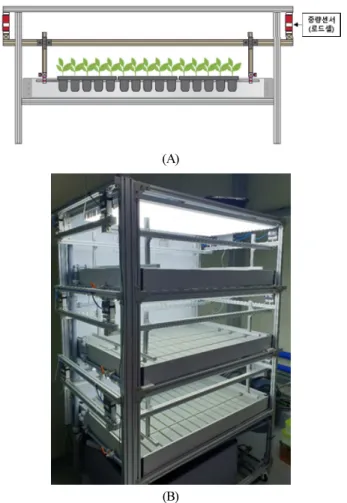
재배기간 중 관수는 한국원시 1배액으로 저면 관수 해주었 다. 광량에 따른 증발산량을 확인하기 위하여, 오이는 PPF (photosynthetic photon flux) 50, 100, 150 μmol·m-2·s-1, 토 마토는 PPF 100, 200, 300 μmol·m-2·s-1의 서로 다른 3개의 광 량 처리구에서 재배하였다. 육묘시스템 내 베드에 행잉형 로 드셀(Fig. 1)을 제작하여 10분마다 각 트레이의 무게를 측정 하였다. 관수 직후, 충분히 포습된 트레이의 무게를 100%로 환산하여 배지수분함량을 계산하였다.
재배기간 중 관수 개시 시점을 확인하기 위하여 발아 후 트 레이를 식물공장형육묘시스템으로 이동시켜서 초기 위조가
(A)
(B)
Fig. 1. Schematic diagram (A) and figure (B) of hanging system for
measuring the weight of plug tray used in this study.
나타나는 배지수분함량을 조사하였다. 오이와 토마토 모두 배지수분함량이 40% 되는 시점에서 초기 위조가 시작되는 것 이 육안으로 확인되어 건조 스트레스에 의한 생육 장해를 방 지하기 위해 배지수분함량이 50% 이상으로 유지되도록 저면 관수하였다. 파종 후 9일 및 15일 후, 각각 오이와 토마토의 생 육을 조사하였다. 오이 접수와 대목은 엽수, 하배축장, 경경, 잎, 줄기 및 뿌리의 생체중을 측정하였고, 토마토 접수와 대목 은 엽수, 초장, 하배축장, 경경, 잎, 줄기 및 뿌리의 생체중을 측 정하였다. 통계 분석은 SAS System 9.4(SAS Institute Inc., Cary, N.C., USA)을 이용하여 Duncan의 다중 검정을 실시하 였다.
결과 및 고찰
1. 생육 분석
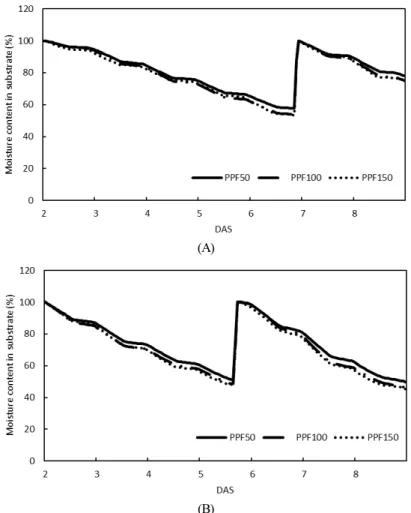
오이 접수 및 대목의 관수 개시 시점을 배지수분함량 약 50% 이상으로 설정하였을 때, 육묘 기간 중 관수 시기는 각각
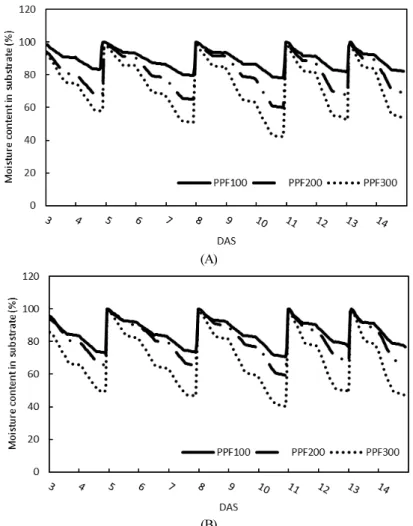
파종 후 7일 및 6일이었다(Fig. 2). 오이 접수 및 대목 모두 광 량이 높을수록 증발산 속도가 빠르게 나타났다. 반면, 토마토 접수 및 대목의 관수 개시 시점을 배지수분함량 약 50% 이상 으로 설정하였을 때, 육묘 기간 중 관수 시기는 가장 높은 광량 처리구(300 μmol·m-2·s-1) 기준으로, 파종 후 5, 8, 11, 13일이 었다(Fig. 3). 토마토 접수 및 대목 모두 광량이 높을수록 증발 산 속도가 빠르게 나타났는데, 처리구별 차이가 오이보다 크 게 나타났다. 이는 토마토의 광량 처리구별 차이(100 μ mol·m-2·s-1)가 오이 (50 μmol·m-2·s-1)보다 컸으며, 토마토와 오이 묘의 형태적 차이 역시 영향을 미쳤을 것으로 생각된다.
토마토 묘는 여러 장의 소엽으로 구성되어 있고 잎의 결각이 많으나, 오이 묘는 잎의 면적이 클 뿐 만 아니라 잎의 발생 각도 가 크고 잎의 결각이 적다. 따라서 오이 묘는 토마토 묘에 비해 수광 태세가 좋지 않고 배지가 광에 노출되는 면적 또한 적어 서 광량에 따른 증발산량의 변화가 적었을 것으로 생각된다.
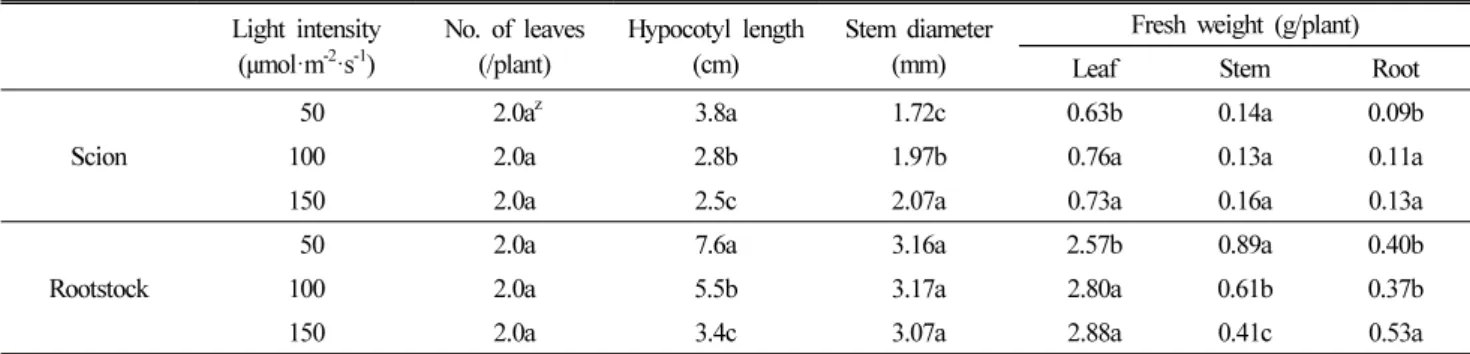
오이 접수와 대목 모두 광량이 증가할수록 하배축장이 감소 하였는데, 대목에서 광량 증가에 따른 하배축장의 감소 현상
(A)
(B)
Fig. 2. Changes in moisture content of substrate in cucumber scions (A) and rootstocks (B) grown under different light intensity conditions.
이 현저하게 나타났다(Table 1). 오이 접수의 경경은 광량이 증가할수록 증가하였으나, 대목의 경경은 광량에 따른 차이 가 없었다. 오이 접수의 잎과 뿌리 생체중은 50 μmol·m-2·s-1 처리구에서 가장 낮았고, 줄기 생체중은 처리구별 차이가 없 었다. 오이 대목의 잎과 뿌리 생체중은 광량이 증가할수록 증 가하는 경향을 보였으나, 줄기 생체중은 광량이 증가할수록 감소하였다. 토마토 접수의 엽수 및 초장은 광량에 따른 차이 가 없었으나, 하배축장은 광량이 증가할수록 감소하였다 (Table 2). 토마토 대목의 엽수와 초장은 광량이 증가할수록 증가하였고, 하배축장은 광량이 증가할수록 감소하는 경향을 보였다. 토마토 접수와 대목의 경경과 잎, 줄기, 뿌리의 생체중 은 광량이 증가함에 따라 증가하였다.
식물공장형육묘시스템에서 광량이 증가할수록 묘의 광합 성, 엽수, 건물중 등이 증가한다고 보고되었으며(Kim과 Park, 2002; Jang 등, 2014b), 본 연구에서도 광량 증가에 따라 묘의 생육이 촉진되었다. 오이와 토마토의 접수 및 대목 모두 광량 이 감소할수록 하배축이 신장하는 경향을 보였고, 많은 연구
에서 짧은 육묘 과정 중에도 광량이 줄기 또는 배축의 신장에 영향을 준다고 보고되어 왔다(Kang 등, 2010; Jang 등, 2014b).
광량의 감소에 의한 하배축 신장은 오이 접수보다 오이 대목 에서 현저하게 나타났는데, 약광 처리구(50 μmol·m-2·s-1)의 하배축장이 강광 처리구(150 μmol·m-2·s-1)보다 약 2배 정도 증가하였다. 반대로 토마토에서는 광량에 따른 하배축장의 차이가 대목보다 접수에서 더 뚜렷하게 나타났고, 초장은 대 목에서만 광량에 따른 차이가 나타났다.
접목 작업자의 작업 편의성 및 접목 로봇의 접목 성공률 향 상을 위하여 접수 및 대목의 하배축 신장 및 경경의 조절이 필 요하다(Kim과 Hwang, 2015). 이를 위해서 온실에서 관행 육 묘 시에는 접수 및 대목의 파종 시기를 달리하기도 한다. 본 연 구에서는 광량 조절을 통해서 하배축장 및 경경의 조절이 가 능하였고, 접수 및 대목의 광량을 달리함으로써 하배축장, 경 경 등 묘소질을 향상시킬 수 있음을 확인하였다.
(A)
(B)
Fig. 3. Changes in moisture content of substrate in tomato scions (A) and rootstocks (B) grown under different light intensity conditions.
2. 증발산량 분석
공정육묘 시, 플러그 트레이의 셀 당 부피가 작아서 배지량 이 작고 배지가 보유할 수 있는 수분 함량도 적다. 이는 관수 또 는 증발산에 의한 배지의 수분 함량의 변동이 커지게 되므로 묘의 광합성 및 생육에 큰 영향을 미치게 된다. 일정 면적의 플 러그 트레이를 이용하여 밀식 재배하는 공정육묘의 특성 상, 묘 개체당 증발산량을 측정하는 것에는 어려움이 있으므로 Shibuya 등(1997a)은 트레이 내 묘와 배지를 포함한 “묘개체 군”의 개념을 도입하여 묘개체군의 중량을 측정하여 비교적 정확하게 묘개체군의 증발산량을 구하였다. 묘개체군의 중량 을 연속 측정하여 계산한 증발산량을 관수 시기 및 관수량을 결정하는 지표로서 기후에 관계없이 육묘 시 정밀 관수 제어 에 활용할 수 있음을 보고하였다.
본 연구에서 행잉형 로드셀을 이용하여 측정한 오이 접수 묘 개체군의 재배기간(7일)동안 누적 증발산량은 광량 50, 100 및 150 μmol·m-2·s 처리구에서 각각 1.50, 1.63 및 1.69 kg/tray였고, 오이 대목 묘개체군은 각각 2.31, 2.55 및 2.59 kg/tray이었다. 토마토 접수 묘개체군의 재배기간(13일)동안 누적 증발산량은 광량 100, 200 및 300 μmol·m-2·s 처리구에 서 각각 2.28, 3.83 및 5.18 kg/tray였고, 토마토 대목 묘개체군 은 각각 3.05, 3.83 및 5.97 kg/tray이었다. 오이와 토마토 접수
및 대목 개체당 일(24h) 증발산량(g/plant)을 계산하여 광량 과의 상관관계를 조사하였고, 개체당 일(24h) 증발산량과 광 량은 정의 상관관계를 보였다(Table 3).
일반적으로 1일 기준 평균(또는 누적) 광량과 증발산량은 1 차 선형식으로 비례한다고 알려져 있으며(Jolliet과 Bailey, 1992), 외부 일사 환경과 다르게 식물공장형육묘시스템에서 는 일정한 시간의 명기와 일정한 광량으로 광 환경을 제어하 므로 광량과 증발산량이 높은 정의 상관을 보인 것으로 생각 된다. 작물의 증발산량은 광량, 기온, 상대 습도 등 재배 환경 뿐만 아니라 생육 단계의 영향을 받는다. 육묘 기간이 짧은 오 이는 생육 단계에 따른 증발산량의 차이가 없었으나, 육묘 기 간이 길었던 토마토는 육묘 초기(~8DAS) 및 후기(9~15DAS) 의 개체당 일(24h) 증발산량(g/plant)의 차이를 보였다. 광량 300 μmol·m-2·s 처리구 기준으로 육묘 초기 토마토 접수와 대 목의 개체당 일(24h) 증발산량(g/plant)은 각각 2.56 및 2.92 g/plant였고 후기는 3.52 및 3.91 g/plant였으며, 후기 개체당 일(24h) 증발산량(g/plant)은 초기 대비 약 34.0-37.5% 증가 하였다. 묘의 생장과 더불어 엽면적 지수가 증가하고 증발산 면적이 늘어나면서 개체당 증발산량이 증가하였고, 따라서 토마토의 관수 개시 시점의 간격이 5일, 3일, 2일로 감소하였 다. Shibuya 등(1997b)도 광량 증가 및 생육 단계 진행에 따라
Table 1. Growth of cucumber scions and rootstocks grown under different light intensity conditions.
Light intensity
(μmol·m
-2·s
-1) No. of leaves
(/plant) Hypocotyl length
(cm) Stem diameter (mm)
Fresh weight (g/plant)
Leaf Stem Root
Scion
50 2.0a
z3.8a 1.72c 0.63b 0.14a 0.09b
100 2.0a 2.8b 1.97b 0.76a 0.13a 0.11a
150 2.0a 2.5c 2.07a 0.73a 0.16a 0.13a
Rootstock
50 2.0a 7.6a 3.16a 2.57b 0.89a 0.40b
100 2.0a 5.5b 3.17a 2.80a 0.61b 0.37b
150 2.0a 3.4c 3.07a 2.88a 0.41c 0.53a
z
Means in columns followed by different letters are significantly different by Duncan’s multiple range tests at p ≤ 0.05.
Table 2. Growth of tomato scions and rootstocks grown under different light intensity conditions.
Light intensity
(μmol·m
-2·s
-1) No. of leaves
(/plant) Plant height
(cm) Hypocotyl length
(cm) Stem diameter (mm)
Fresh weight (g/plant)
Leaf Stem Root
Scion
100 2.0a
z7.0a 5.1a 1.87b 0.27c 0.25b 0.04c
200 2.2a 7.6a 4.7ab 2.32a 0.48b 0.34a 0.06b
300 2.3a 7.0a 4.3b 2.42a 0.62a 0.36a 0.10a
Rootstock
100 2.0c 6.1c 3.8a 1.83c 0.20c 0.18c 0.03c
200 2.6b 7.2b 3.8a 2.26b 0.40b 0.31b 0.07b
300 3.0a 7.7a 3.3b 2.64a 0.57a 0.41a 0.12a
z
Means in columns followed by different letters are significantly different by Duncan’s multiple range tests at p ≤ 0.05.
서 묘개체군의 증발산량이 증가한다고 보고하였다.
본 연구에서는 식물공장형육묘시스템에서 저면 관수 시 묘 개체군의 연속 중량 측정을 통해서 광량별 오이와 토마토 접 수 및 대목의 증발산량을 확인하였고, 이는 정밀 관수 제어를 위한 관수 시기 및 관수량 결정을 위한 지표로 사용할 수 있었 다. 또한, 광량 조절을 통해서 하배축장, 경경 등 접목 효율에 영향을 미치는 묘소질의 향상이 가능하였다. 본 연구 결과는 이후 식물공장형육묘시스템의 정밀 자동 관수 제어 및 접목 로봇 연계 공정육묘 자동화 시스템 구축을 위한 기초 자료로 활용될 수 있을 것이다.
적 요
최근 이상 기후 및 노동력 문제를 해결하기 위하여 재배 환 경의 정밀 제어가 가능한 식물공장형육묘시스템을 이용한 균 일한 묘소질의 접수 및 대목 생산과 접목 로봇의 작업성 향상 을 연계시키는 규격묘 생산 자동화시스템 구축의 필요성이 증 가하고 있다. 본 연구에서는 식물공장형육묘시스템에서 저면 관수 시 오이와 토마토 접수 및 대목의 관수 시기 및 관수량 등 관수 계획 수립을 위해 광량에 따른 증발산량과 묘소질을 조 사하였다. 저면 관수 시 연속 중량 측정이 가능하도록 행잉형 로드셀을 설치하고 육안으로 초기 위조가 시작되는 시점을 확 인하여 관수 개시 시점을 배지수분함량 50% 이상으로 설정하 였다. 오이 접수 및 대목의 관수 시기는 파종 후 7일 및 6일이었 고, 토마토 접수 및 대목의 관수 시기는 강광(300 μmol·m-2·s-1) 처리구 기준으로, 파종 후 5, 8, 11, 13일이었다. 오이와 토마 토 모두 광량 증가에 따라서 증발산 속도가 증가하였으며, 토 마토에서 광량에 따른 증발산 속도 차이가 크게 나타났다. 오 이와 토마토 묘의 생육은 광량이 증가할수록 촉진되었는데, 광량 증가는 하배축장의 신장을 억제시키고 경경을 증가시켰 다. 오이 및 토마토 묘개체군의 누적 증발산량은 광량이 증가 할수록 증가하였고, 개체당 일(24h) 증발산량과 광량은 1차 선형 형태로 높은 정의 상관관계를 보였다. 묘개체군의 연속 중량 측정을 통한 오이와 토마토 접수 및 대목의 증발산량 추 정은 식물공장형육묘시스템의 정밀 관수 제어를 위한 관수 시
기 및 관수량 결정을 위한 지표로 사용할 수 있을 것이다.
추가 주제어 :로드셀, 묘, 배지수분함량, 저면관수, 플러그 트 레이
사 사
본 성과물은 농촌진흥청 연구사업(세부과제번호: PJ01384 003)의 지원에 의해 이루어진 것임.