DOI http://dx.doi.org/10.12791/KSBEC.2014.23.3.199 eISSN 2288-100X
Effect of Water Content in the Substrate of the Scion and Rootstock during Pre- and Post-Grafting Period on the Survival Rate and
Quality of Tomato Plug Seedlings
Ngoc-Thang Vu
1, Ki Young Choi
2, and Il-Seop Kim
1*
1Department of Horticulture, Kangwon National University, Chuncheon 200-701. Korea
2College of Agriculture and Life Science, Kangwon National University, Chuncheon 200-701. Korea
Abstract. This study evaluated the effect of water content in the substrate during pre- and post-grafting period on the survival rate and quality of tomato plug seedlings. Nine combinations of three water levels (high, medium, and low) were set up in the substrate of both scion and rootstock. The water content in the substrate of the scion did not affect the survival rate of grafted tomato seedlings, while the survival rate was statically different among the various water contents in the substrate of the rootstock. The maximum survival rates (100%) were observed in seedlings treated with high water levels in the substrate of the rootstock, and the survival rates declined with decreasing water content in the rootstock substrate. The growth characteristics were not significantly affected by different water content in the scion substrate, while they were statically different among the seedlings treated with various water contents in the rootstock substrate. The growth characteristics decreased with decreasing water con- tent in the rootstock substrate. The highest value of compactness was observed in grafted seedlings, which com- bined medium water level in the scion and high water level in the rootstock substrate treatment. The root morphology of tomato seedlings was also affected by water content in the rootstock substrate. The total root sur- face area, total root length, and number of root tips decreased with deceasing water content in the rootstock sub- strate.
Additional key words: growth parameters, root morphology, root stock, scion, water stress,
Introduction
In recent years, the production area of tomato using grafted seedlings has increased in many countries in order to improve resistance to biotic and abiotic stresses (Lee and Oda, 2003; Rivero et al., 2003). The successful production of grafted transplants requires highly technical grafting skill and environmental control pre- and post-grafting, especially during healing and acclimatization periods (Vu et al., 2013, 2014). In conventional cultures, the grafting is done in tunnels made from plastic film and shaded by cloth to avoid heat buildup and maintain high relative humidity and low light intensity until the union is formed (Davis et al., 2008; Oda, 1999). Therefore, it is difficult to control the optimal environment for healing and acclimatization of grafted seedlings under natural conditions by changing environmental conditions such as day, night, and seasons.
To achieve optimal environment for healing, several types
of acclimatization chambers have been developed and are widely used by commercial plug seedling growers in Korea and Japan. Higher survival ratios, faster growth, and higher quality of grafted plants were reported in the healing cham- bers under highly controlled conditions (Kim et al., 2001;
Nobuoka et al., 2005; Vu et al., 2013).
The key environmental factors that influence the healing and acclimatization of grafted seedlings are temperature, humidity, and light. In the healing chambers, they can be easily controlled to achieve optimal environment. The moisture in the substrate of grafted seedlings is also thought to be an important factor that affects the survival rate and seedling quality, but information about this effect is limited. Oda, (1999) suggested that in order to improve survival rate of grafted plants, the seedlings should be exposed to sunshine and the water should be withheld from the plants to avoid spindly growth before grafting. Further, Lee et al. (2010) suggested that maintenance of proper moisture content before and after grafting is critical for the production of uniform grafted seedlings. Although mois- ture in the substrate of grafted seedlings is an important
*Corresponding author: [email protected]
*Received July 25, 2014; Revised August 13, 2014;
*Accepted August 21, 2014
factor, it is difficult to control during the healing and accli- matization process. Therefore, this study was conducted in order to elucidate the effect of the water contents in the substrate on the survival rate and tomato seedling quality during pre- and post-grafting period.
Materials and Methods
1. Plant material and growing of scions and rootstocks Tomato seeds were sown in the 128-cell plug trays (Bumnong. Co., Ltd., Jeongeup, Korea) containing com- mercial nursing substrate (BM2, Berger Group Ltd., Que- bec, Canada). ‘Unicorn’ cultivar was used as scion and rootstock and was ‘self-grafted’ for this study. While in the plastic house, the seedlings were watered daily or as required. One week after sowing, the seedlings were fertil- ized by overhead irrigation twice a week with a commercial fertilizer (Wonder Grow Fertilizers, Chobi Co., Ltd., Seoul, Korea). Twenty-two days after sowing, when two true leaves had unfolded, the seedlings were used for grafting.
2. Grafting method and healing and acclimatization process
Grafting was done by splice grafting method. After placing the scion on the rootstock, ordinary grafting clips were used to fix the grafted position tightly together (Lee and Oda, 2003). After grafting, the plants were placed in healing chambers for 10 days. Healing chambers were also equipped with an auto-control air conditioning sys- tem for healing the grafts. Light intensity was approxi- mately 30µmol·m−2·s−1 provided by fluorescent lamps.
Relative humidity was maintained 85-90%, temperature was set above 23oC.
3. Water content in substrate treatments
The effect of water content in the substrate during pre- and post-grafting period was studied by treating tomato seedlings with three levels of water content (high, medium, and low) in the substrate of both the scion and rootstock for 6 days (3 days before and 3 days after graft- ing). Three levels of water content (high, medium, and low) were applied overhead irrigation 3 times, twice, and once a day about 30, 15, 10mL of water/cell/day, respec- tively. Treatments with medium water were applied twice a day with sufficient water (similar irrigation schedule of Seedling Company). After grafting, grafted seedlings
were placed in the healing room for 10 days. After 10 days in the healing room, the seedlings were transferred to plastic house under natural conditions for 5 days. The grafting clips were removed 2 days after seedlings were out of the healing room.
4. Data collection and analysis
All grafted seedlings were evaluated for signs of graft- ing failure on the 10th day after grafting. Grafted seed- lings on the 15th day after grafting were harvested for analysis of growth characteristics. Plant height (cm), number of leaves, fresh and dry weights of the shoot and root of the seedlings were measured. Leaf area was mea- sured with a leaf area meter (Delta-T Device Ltd., Bur- well, Cambridge, UK); leaf chlorophyll value was measured using a chlorophyll meter (SPAD-502 Plus, Konica Minolta Sensing Inc., Osaka, Japan). The fresh shoot and root were dried in an oven (MOV-212F, Sanyo Electric Co., Ltd., Osaka, Japan) at 80oC for 72 hrs before measuring the dry mater. T/R ratio (shoot dry weight/root dry weight ratio) and compactness (shoot dry weight/plant height) were calculated according to Kim et al. (2008).
For the root system morphology, the WinRHIZO Pro 2009c (Regent Instruments, Inc, Quebec, Canada) images analysis system was used, coupled with professional scan- ner Epson 10000XL (Seiko Epson Corporation, Nagano, Japan) according to Arsenault et al. (1995). The roots were detached from their shoots, placed in a tray (15× 30 × 2cm) with water and positioned on the scan- ner. Scanned images were analyzed by the WinRHIZO program for total root surface area, total root length, and number of root tips.
The experimental design was a split-plot. Water con- tents in the substrate of rootstock were the main plot and water contents in the substrate of scion were the sub plot in this study. Nine treatments were designed by combina- tion of three levels (high, medium, and low) of water con- tent in the substrate of rootstock and three levels (high, medium, and low) of water content in the substrate of scion. In each replication, one 128-cell plug tray with 64 plants was measured. For the statistical analysis, ten seed- lings per treatment from each replicate were randomly selected. Data were analyzed using the analysis of vari- ance of the Statistical Analysis System (SAS Institute Inc., Cary, NC, USA). Mean separations were calculated using Duncan’s multiple range test.
Results and Discussion
1. The effect of water content in the substrate during pre- and post-grafting period on survival rate of tomato seedlings
The effect of water content in the substrate on survival rate during pre- and post-grafting period is summarized in Table 1. The water content in the rootstock substrate had a statistically significant effect on the seedling’s survival rate, while the water content in the scion substrate did not affect the survival rate significantly. The maximum graft-take ratios (100%) were observed in all treatments with high water content in the rootstock substrate and the survival rate decreased with decreasing water content in the root- stock substrate. The lowest survival rate (75.0%) was observed in the combination of scion low and rootstock high water content in the substrate treatment.
This result agrees with suggestion of Lee et al. (2010) that maintenance of proper moisture content before and after grafting is critical for the production of uniform grafted seedlings. Based on previously reported histologi- cal analysis, the transport activities of the vasculature in the grafts were recovered after 3 days and auxin modulated the vascular reconnection 2 days after grafting (Yin et al.,
2012). Thus, high water content in the rootstock substrate for 6 days (3 days before and 3 days after grafting) is a very important factor for the contact formation between the scion and the rootstock. Therefore, the maintenance of proper moisture content in the rootstock is critical for improved survival rate of grafted tomato seedlings.
2. The effect of water content in the substrate during pre- and post-grafting period on growth characteristics of tomato seedlings
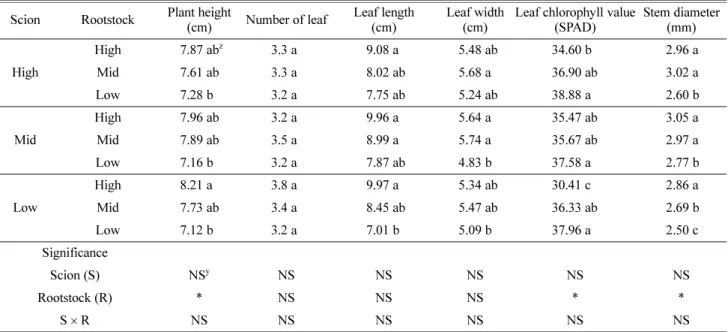
The different water content in the rootstock substrate had a statistically significant effect on plant height, leaf chlorophyll value, and stem diameter, while the water content in the scion substrate had no significant effect on any growth characteristic. Plant height and stem diameter decreased with deceasing water content in the rootstock substrate; however, no significant difference was detected between high and medium water levels. The highest plant height was obtained in the treatment with scion low and rootstock high water content in the substrate. The water content in the rootstock substrate also significantly affected the leaf chlorophyll value, which increased with decreasing water content in the substrate. Stem diameter decreased with decreasing water contents in the rootstock substrate (Table 2).
Leaf area, dry weight of shoot and root, T/R, and com- pactness were significantly different between the various water contents of the rootstock substrate, but not the sub- strate of the scion. The leaf area and dry weight of shoot and root decreased with decreasing water content in the rootstock substrate; however, no significant difference was detected between high and medium water levels. The T/R increased while the compactness of the grafted seedlings decreased with decreasing water content in the rootstock substrate. The highest value of compactness was observed in seedlings with scion medium and rootstock high water levels (Table 3). These results are in accordance with those of Mahmoud et al. (2011) who found that all growth traits of tomato plants were greatly reduced by successive decreases in irrigation.
3. The effect of water content in the substrate during pre- and post-grafting period on root morphology of tomato seedlings
Many earlier studies show that water deficit inhibits root growth (Sharp and Davies, 1979, 1985; Kuzmanoff and Table 1. Effect of water content in the substrate during pre- and
post-grafting period on survival rate of tomato seedlings.
Water content in the substrate of
scion
Water content in the substrate of
rootstock
Survival rate (%)
High
High 100 az
Mid 96.8 ab
Low 78.1 c
Mid
High 100 a
Mid 96.9 ab
Low 81.3 c
Low
High 100 a
Mid 93.8 b
Low 75.0 c
Significance
Scion (S) NSy
Rootstock (R) **
S× R NS
zMean separation within columns by Duncan’s multiple range test at P = 0.05.
yNS, **, indicates Non-significant; significant at P£ 0.05, respectively.
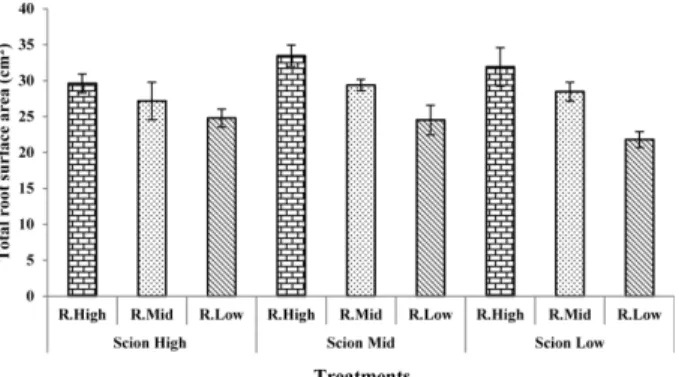
Evans, 1981). Accordingly, the total root surface area, total root length, and number of root tips decreased with deceas- ing water content in the rootstock substrate in this study.
The highest values of total root surface area, total root length, and number of root tips were observed in seedlings
grafted with rootstock high and scion medium water con- tent in the substrate. The lowest values of total root surface area, total root length, and number of root tips was observed in rootstock low and scion low water content in the substrate (Fig. 1, 2, 3).
Table 2. Effect of water content in the substrate during pre- and post-grafting period on growth characteristics of tomato seedlings.
Scion Rootstock Plant height
(cm) Number of leaf Leaf length (cm)
Leaf width (cm)
Leaf chlorophyll value (SPAD)
Stem diameter (mm)
High
High 7.87 abz 3.3 a 9.08 a 5.48 ab 34.60 b 2.96 a
Mid 7.61 ab 3.3 a 8.02 ab 5.68 a 36.90 ab 3.02 a
Low 7.28 b 3.2 a 7.75 ab 5.24 ab 38.88 a 2.60 b
Mid
High 7.96 ab 3.2 a 9.96 a 5.64 a 35.47 ab 3.05 a
Mid 7.89 ab 3.5 a 8.99 a 5.74 a 35.67 ab 2.97 a
Low 7.16 b 3.2 a 7.87 ab 4.83 b 37.58 a 2.77 b
Low
High 8.21 a 3.8 a 9.97 a 5.34 ab 30.41 c 2.86 a
Mid 7.73 ab 3.4 a 8.45 ab 5.47 ab 36.33 ab 2.69 b
Low 7.12 b 3.2 a 7.01 b 5.09 b 37.96 a 2.50 c
Significance
Scion (S) NSy NS NS NS NS NS
Rootstock (R) * NS NS NS * *
S× R NS NS NS NS NS NS
zMean separation within columns by Duncan’s multiple range test at P = 0.05.
yNS, *, indicates Non-significant; significant at P£ 0.05, respectively.
Table 3. Effect of water content in the substrate during pre- and post-grafting period on leaf area, dry weight of shoot and root, T/R ratio, and compactness of tomato seedlings.
Scion Rootstock Leaf area
(cm2)
Dry weight (g) T/Rz
ratio
Compactnessy (mg.cm-1)
Shoot Root
High
High 12.8 ax 0.114 a 0.025 a 4.251 b 13.42 ab
Mid 11.7 ab 0.109 ab 0.023 ab 4.915 a 13.39 ab
Low 11.0 b 0.094 b 0.022 b 5.004 a 12.02 b
Mid
High 13.8 a 0.129 a 0.026 a 4.236 b 15.04 a
Mid 12.2 ab 0.108 ab 0.025 a 4.387 b 13.51 ab
Low 10.7 b 0.098 b 0.020 b 4.894 a 12.69 b
Low
High 13.7 a 0.119 a 0.026 a 4.080 b 14.98 a
Mid 12.3 a 0.106 ab 0.024 a 4.922 a 12.50 b
Low 10.0 b 0.090 b 0.018 c 5.525 a 11.04 c
Significance
Scion (S) NSw NS NS NS NS
Rootstock (R) * * * * *
S× R NS NS NS NS NS
zT/R ratio is shoot dry weight/root dry weight ratio.
yCompactness is the values of the dry weight divided by the plug height.
xMean separation within columns by Duncan’s multiple range test at P = 0.05.
wNS, *, indicates Non-significant; significant at P£ 0.05, respectively.
Conclusion
The maintenance of proper moisture content in the root- stock during pre- and post-grafting period is critical for improved survival rate and quality of grafted tomato seed- lings. Based on the results of this study, it is not advisable to withhold water from the grafts; in contrast, the best results were achieved at the highest levels of water content
in the substrate of the rootstock. The maximum survival rate (100%) and the highest value of compactness were observed in the treatment with high water content in the rootstock substrate and medium water content in the scion substrate.
Acknowledgements
This study was supported by Export Promotion Technol- ogy Development Program, Ministry of Agriculture, Food and Rural Affairs, Republic of Korea.
Literature Cited
Arsenault, J.L., S. Pouleur, C. Messier, and R. Guay. 1995.
WinRHIZO, a root-measuring system with a unique over- lap correction method. Hort.Sci. 30:906.
Davis, A.R., P. Perkins-Veazie, Y. Sakata, S. L ìopez-Galarza, J.V. Maroto, S.G. Lee, Y.C. Huh, Z.Y. Sun, A. Miguel, R.K.
Stephen, R. Cohen, and J.M. Lee. 2008. Cucurbit grafting.
Critical Rev. Plant Sci. 27:50-74.
Kim, I.S., C.H. Zhang, H.M. Kang, B. Mackay. 2008. Control of stretching of cucumber and tomato plug seedlings using supplemental light. Hort. Environ. Biotechnol. 49:287-292.
Kim, Y. H., C.S. Kim, J.W. Lee, and S.G. Lee. 2001. Effect of vapor pressure deficit on the evaportranspiration rate and graft-taking of grafted seedlings population under artificial lighting. J. Bio-Environ. Control 10: 232-236.
Kuzmanoff, K.M. and M.L. Evans. 1981. Kinetics of adapta- tion to osmotic stress in lentil (Lens culinaris Med.) roots.
Plant Physiol. 68:244-247.
Lee, J and M. Oda. 2003. Grafting of herbaceous vegetable and ornamental crops. Hort. Rev. 28:61-124.
Lee, J.M., C. Kubota, S.J. Tsao, Z. Bie, P. Hoyos Echevarria, L. Morra, and M. Oda. 2010. Current status of vegetable grafting: Diffision, grafting techniques, automation. Scien- tia Hort. 127:93-105.
Mahmoud A, W.A., A. Abdullah A, and I. Abdullah A. 2011.
Drought tolerance of several tomato genotypes under green- house conditions. World Applied Sci. J. 15:933-940.
Nobuoka, T., T. Nishimoto, and K. Toi. 2005. Wind and light promote graft-take and growth of grafted tomato seedlings.
J. Japan Soc. Hort. Sci. 74:170-175.
Oda, M. 1999. Grafting of vegetables to improve greenhouse production. Food and Fertilizer Technology Centure Exten- sion Bullentin 480:1-11.
Rivero, R.M., J.M. Ruiz, and L. Romero. 2003. Role of graft- ing in horticultural plants under stress conditions. Food Agr.
Environ. 1:70-74.
Sharp, R.E. and W.J. Davies. 1979. Solute regulation and growth by roots and shoots of water-stressed maize plants.
Fig. 1. Effect of water content in the substrate during pre- and post-grafting period on total root surface area of tomato seed- lings. Vertical bars represent ± SD of means, n=10.
Fig. 2. Effect of water content in the substrate during pre- and post-grafting period on total root length of tomato seedlings.
Vertical bars represent ± SD of means, n=10.
Fig. 3. Effect of water content in the substrate during pre- and post-grafting period on number of root tips of tomato seed- lings. Vertical bars represent ± SD of means, n=10.
Planta. 147:43-49.
Sharp, R.E. and W.J. Davies. 1985. Root growth and water uptake by maize plants in drying soil. J. Exp. Bot. 36:1441- 1456.
Vu, N.T., C.H. Zhang, Z.H. Xu, Y.S. Kim, H.M. Kang, and I.S. Kim. 2013. Enhanced Survival rateand quality of grafted tomato seedlings by controlling temperature and humidity conditions. Protected Hort. Plant Fac. 22:146-153.
Vu, N.T., Y.S. Kim, H.M. Kang, and I.S. Kim. 2014. Influ-
ence of short-term irradiation during pre- and post-grafting period on the graft-take ratio and quality of tomato seed- lings. Hort. Environ. Biotechnol. 55:27-35.
Yin, H., B. Yan, J. Sun, P.F. Jia, Z.J. Zhang, X.S. Yan, J. Chai, Z.Z. Ren, G.C. Zheng, and H. Liu. 2012. Graft-union devel- opment: a delicate process that involves cell-cell communi- cation between scion and stock for local auxin accumulation. J. Expt. Bot. 63:4219-4232.
접목 전후 대목과 접수의 상토 내 수분함량이 토마토 플러그묘의 접목 활착율과 묘소질에 미치는 영향
넉탕부
1·최기영
2·김일섭
1*
1강원대학교 원예학과, 2강원대학교 농업생명과학대학
적 요. 본 실험은 토마토 플러그묘의 접목활착율과 묘소질 향상을 위한 적정 상토 내 수분함량을 구명하기 위하여 수행되었다. 시험구는 접수와 대목의 상토내 수분함량을 각각 3처리구(고, 중 저)씩, 총 9개의 조합을 설계하여 각 처리구별로 접목활착율과 묘의 생육을 조사하였다. 접수의 상토내 수분 함량의 차이는 접목 활착 율에 통계적 유의차는 나타나지 않았으나, 대목의 수분함량은 접목활착율에 영향을 미쳐 수분함량이 낮아질수 록 활착율도 저하하는 경향을 보였다. 수분 함량에 따른 묘소질도 접목활착율과 유사한 경향을 보여 접수의 수분함량차이는 생육지표에 큰 영향을 미치지 않았으나, 대목에서는 잎(엽수, 엽장, 엽폭)을 제외한 초장, SPAD함량, 경경은 수분함량의 차이에 따라 유의적 차이를 나타냈다. 묘의 충실도는 상토내 수분 함량이 접수 는 중간, 대목은 높은 조합에서 가장 좋게 나타났다. 근권부의 생육에서도 대목의 수분함량이 주로 영향을 미 쳐, 수분함량이 저하될수록 전 뿌리 표면적, 전 근장, root tip수 모두가 감소되는 것으로 나타났다.
추가주요어 : 생육지표; 뿌리형태; 대목; 접수; 수분스트레스