염
염스 스트 트레 레스 스에 에 의 의한 한 토 토마 마토 토 생 생장 장반 반응 응과 과 식
식물 물체 체내 내 N Niittrraattee 및 및 S Suuccrroossee 변 변화 화
Growth Response and Changes of Nitrate and Sucrose Content in Tomato under Salt Stress Condition
이주영*·장병춘·이수연·박재홍·최근형·김삼권·김태완1
Ju-Young Lee,
*Byoung-Choon Jang, Su-Yeon Lee, Jae-Hong Park, Geun-Hyoung Choi, Kim Sam Cwaun, and Tae-Wan Kim
1농업과학기술원, 1한경대학교 식물생명환경과학부
NIAST, Rural Development Adminstration, Suwon 441-707, Korea
1
Department of Plant Life and Environmental Science, Hankyong National University, Ansung 456-749, Korea
This experiment was carried out to find the growth response and changes of nitrate and soluble sugar content in tomato leaves with salt stress. Tomato (Solanum lycopericum) seedlings were grown under different electrical conductivity (EC) levels adjusted with CaCl
2as 1, 2, and 6 dS m
-1. The growth response and contents of nitrate and soluble sugar in tomato plants were examined at 7 and 14 days after salt treatment. Leaf area and dry weight ratio of shoot to root of tomato plants were decreased as EC level increased. Photosynthetic rate of leaves was reduced under high EC level due to the stomatal closure and the reduction of transpiration rate. The soluble sugar and starch content were lower in the tomato leaves grown under high EC level. Total nitrogen and nitrate contents were decreased in high EC level, whereas the ammonium content was increased. High-salt stress induced the accumulation of salt crystal in mesophyll cells of tomato leaf.
Key words: Salt stress, Nitrate, Photosynthesis, Carbohydrate, Tomato
서 언
우리나라에서는 집약적 영농방법의 하나인 시설재배 를 통해 작물을 연중 재배할 수 있게 되었고 최근 시 설재배 면적이 크게 늘어나고 있다. 현재 많은 시설재 배지는 연작과 동일한 경종방법으로 인해 근권 영역 의 이화학성이 불량해지는 등 토양환경이 악화되어 작물에 여러 가지 생리장애가 빈번하게 발생하고 있 다. 토양에 염류가 심하게 집적되면 특정이온에 의한 독성 또는 토양의 수분포텐셜 감소에 따른 수분흡수 장애가 나타나 물질생산이 크게 저하된다(Lutts, 1995; Volkmar, 1998). 이와 같은 염 스트레스는 식물 에 많은 생리적 장애를 일으킨다. 대표적 증상으로 노 화현상의 가속화 (Lutts, 1995), 줄기 및 뿌리의 신장 감소, 개화기의 지연 및 개화율의 감소(Benes, 1996;
Evers, 1997; Michael, 1994; Rodriguez, 1997;
Shalhevet, 1995), 엽면적의 감소 (Lips, 1998) 및 Na+
와 K+의 불균형에 의한 광합성 능력의 저하(Michael, 1994; Volkmar, 1998) 등이 보고되어 있다. 광합성능 이 저하되면 기공이 폐쇄되고, 잎에 수용성 당이 축적 되어 광합성능 저해가 심화된다(Kaiser, 1987; Parida and Das, 2004; Stitt, 1987). Balibrea (2000)은 염류저 항성의 차이는 탄소분배 조절능력과 sucrose 대사와 큰 관련이 있다고 하였다. 또한 염 스트레스가 질소대 사에 영향을 미친다는 연구도 보고되어 있다 (Abd- ElBaki, 2000; Flares, 2000; Carillo, 2005). Debouba 등 (2007)은 토마토 유묘기에 염 스트레스를 받으면 잎 과 뿌리에서 Na+와 Cl- 농도가 빠르게 증가하나 반대 로 NO3 농도는 먼저 뿌리에서 낮아지고 후에는 잎에 서도 낮아지며, NH4+ 농도는 잎에서 높아지고, NO3 환원과 NH4+ 생합성 관련 효소활성은 염 스트레스에 의해 잎보다 뿌리에서 낮아진다고 보고하였다. 본 연 구는 염류 집적 시설재배지에서 작물의 과잉 염 장애 현상을 구명하고자 몇 가지 염농도에서 토마토 유묘 의 생육, 광합성, 탄수화물 및 질소대사에 미치는 영 향을 조사하였다.
접 수 : 2008. 5. 1 수 리 : 2008. 6. 8
*연락저자 : Phone: +82312900320, E-mail: [email protected]
재료 및 방법
공시품종 및 처리내용 본 실험은 유리온실에서 토마토 종자(품종 : 선명, 농우바이오)를 펄라이트에 파종하여 발아시킨 후 어린 토마토 묘를 양액재배상 에 이식하여 Yamazaki(1981) 표준양액 1/2 농도로 15 일간 재배하였다. 양액에 CaCl2를 첨가하여 EC 농도 를 1, 2, 6 dS m-1으로 조절한 후, 14일간 재배하였다.
시료채취는 처리 후 7일과 14일에 유묘의 상위 완전 전개 엽을 채취하여 현미경 검경과 nitrate 및 sucrose 분석시료로 사용하였다. 염 처리에 의한 유묘의 생장 반응을 알아보기 위하여 엽면적과 지상부와 지하부의 건물중 비를 조사하였다.
광합성 및 탄수화물 분석 염 처리 후 7일과 14일 째 되는 날 오전 10시부터 오후 1시까지 처리당 3주 씩 3반복으로 상위 완전전개 엽을 잎당 5회 광합성량 (GBP4, LC pro+)을 측정하였다. 엽중 수용성 당과 전분함량 분석은 Rose(1955)방법을 이용하여, 수용성 당은 건조시료 0.2 g에 80% ethanol 10 mL 넣고 원 심분리(15,000 rpm, 15분, 4℃)한 후 상등액을 취하였 고, 전분은 수용성 당을 추출한 후 남아있는 시료를 9.3 N HClO4를 첨가한 후 원심분리하여 상등액을 사 용하였다. 수용성 당과 전분함량을 측정하기 위하여 0.2% anthrone(conc. H2SO4)과 반응시킨 후, 분광광도 계를 이용하여 630 nm에서 측정하였으며 표준물질로 glucose를 이용하였다.
질소함량 및 효소활성 엽 중 총 질소함량은 농촌 진흥청의 토양 및 식물체 분석법(농촌진흥청, 2000)에 따라 분석하였다. 질소형태별(NO2-
-N, NO3-
-N와 NH4+-N)분석은 Cataldo(1975) 방법에 따라 생체시료 0.5g에 증류수 5 mL를 넣고 추출하였다. NO2--N 함 량은 2% sulfanilamine(3 N HCl)와 0.1% N- naphthyl-ethylene-diamine-dichloride(NEDC) 혼합용 액에서 발색 시킨 후 540 nm에서 측정하였다. NO3-- N와 NH4+-N 함량은 여과액을 자동분석기(CFA Auto Analyzer 3, BRaN+ LUEBBE)를 사용하여 측 정하였고, 표준물질로 KNO3(NO3)와 (NH4)2SO4(NH4) 을 이용하였다.
Nitrate reductase(NR), nitrite reductase(NiR) 활성 측정은 Robin(1979) 방법으로 생체 0.1 g을 추출용액 (100 mM sodium phosphate buffer(pH 7.5), 6 mM L-Cysteine, 5 mM EDTA) 1 mL와 혼합한 후 원심 분리(10,000 rpm, 20분, 4℃) 후 상등액을 이용하였다.
NR 효 소 활 성 은 시 료 추 출 액 (50 mM sodium phosphate buffer(pH 7.5), 10 mM KNO3, 250 μM
NADH) 을 첨가하여 2 mL에 맞추었으며, 30℃에서 15분 동안 반응 시킨 후 1 M zinc acetate 200 L를 첨가하고 원심분리(10,000 rpm, 15분, 4℃)하였으며 상등액 1 mL를 채취하여 0.15 mM phenazine methosulfate 100 μL를 첨가하고 실온에서 20분 동안 방치하였다. 실험관에 여액 200 μL에 발색시약(2%
Sulfanilamine을 3 N HCl에 녹이고, 0.1% NEDC와 함 께 1:1로 혼합 2 mL를 넣고 실온에서 10분정도 방치 후 비색계를 사용하여 540 nm에서 측정하였다. NiR 활성은 추출액을 반응액(200 mM Tris-HCl buffer(pH 7.5), 5 mM KNO2, 200 mM sodium hydrosulfite)과 혼합 한 후 30℃에서 15분 동안 반응시켰다. 반응 후 발색시약(2% Sulfanilamine을 3 N HCl에 녹이고 0.1%
NEDC와 1:1로 혼합 2 mL를 넣고 실온에서 10분정도 방치 후 비색계를 사용하여 540 nm에서 측정하였다.
Glutamine synthetase(GS) 활성은 Chikara (2002) 방 법으로 생체시료 0.1 g과 추출용액(100 mM Tris-HCl (pH 7.5), 5 mM 2-mercaptoethanol, 2 mM EDTA) 1 mL를 넣고 원심분리(15,000 rpm, 10분, 4℃)하여 상등 액을 채취하였다. 반응용액(100 mM imidazole-HCl(pH 7.2), 20 mM MgCl2, 25 mM 2-mercaptoethanol, 50 mM sodium L-glutamate(pH 7.2), 125 mM hydroxylamine(pH 7.2), 10 mM ATP) 2 mL와 시료 를 혼합한 후 30℃에서 15분 동안 반응시킨 후 0.75 mL ferric acid reagent(370 mM FeCl3, 200 mM TCA, 670 mM HCl)를 첨가하고, 원심분리 후 상등액 을 채취하여 비색계를 이용하여 535 nm에서 측정하 였다.
잎 기공 및 엽육세포 크리스탈 관찰 잎 기공 관 찰은 상위 완전전개 잎의 중앙부위 잎맥 사이의 엽육 조직을 채취하여 현미경으로 관찰하였으며, 축적 염 의 크리스탈을 관찰하기 위하여 잎 기공 관찰을 위해 채취한 동일한 부위의 잎을 채취하여 Spurr(1969) 방 법으로 Karnovsky's 고정액에 넣고 4℃에서 24시간 고정한 후 0.05 M cacodylate 용액으로 세척하고 1%
osmic acid에 4℃에서 2시간 처리하고 0.05 M cacodylate 용액을 사용하여 다시 세척하였다. 에탄올 과 amyloacetate로 시료를 탈수시킨 후 금으로 코팅 하여 주사전자현미경(SEM Scanning Electron Microscope, Hitachi, S-2460n, Japan)으로 관찰하였다.
통계분석 각 항목에 따른 실험결과는 엑셀 프로 그램을 이용하여 평균치와 표준편차를 산출하였고, SAS(ver. 9.0) 프로그램을 사용하여 ANOVA test 후, 평균치간의 유의성은 최소유의차검정법(LSD)으로 검 증하였다.
결과 및 고찰
생장반응과 광합성능 양액재배상에 이식하여 15 일간 생육시킨 토마토 유묘에 CaCl2를 처리하여 염 스트레스를 유발하고 염처리 후 7일과 14일에 조사한 토마토 생장반응을 보면(표 1), 지상부 식물체 생체중 및 건물중은 CaCl2 처리농도가 높을수록 크게 낮았으 며, 지상부와 지하부의 건물중 비는 염 처리 14일 후 EC 6 dS m-1에서 현저하게 낮았다. 엽면적은 EC 2 dS m-1에서도 크게 작아지는 경향을 보였다. 이러한 생장반응은 Cuartero와 Rafael(1999)이 토마토가 염 스트레스를 받으면 뿌리보다는 지상부의 생육이 더 억제된다고 보고 한 것과 일치하였다.
잎에 있는 기공은 증산작용이 일어나는 기관이며 광합성에 필요한 이산화탄소의 유입구로써 기공 개폐 여부는 증산작용과 함께 광합성능에 영향을 미친다.
염 스트레스(EC 6 dS m-1)를 받은 토마토 잎의 기공 은 닫혀 있는 것을 볼 수 있다(Fig. 1). 이것은 작물 이 염해를 받으면 기공을 닫아 증산작용을 억제하여 체내 수분을 유지하는 것으로 판단된다.
광합성능은 염 처리 후 7일에 EC 2 dS m-1와 6 dS m-1에서 지속적으로 감소하는 경향을 보였고 특히 염 처리 후 14일에는 EC 6 dS m-1에서 광합성량이 약 50% 수준까지 낮아졌다. Lips(1998)와 Kaiser(1987)의 연구에서도 염 스트레스는 식물의 엽면적을 감소시키
고 기공을 폐쇄하여 증산작용 및 광합성능을 억제한 다고 보고한 바 있다.
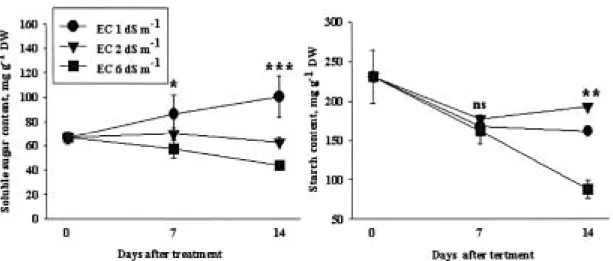
Sucrose 변화 본 연구에서 soluble sugar 함량이 낮 아진 것은 처리 염 농도가 EC 2 - 6 dS m-1 정도로 낮은 농도에서는 오히려 sugar의 분해대사에 촉진효 과를 주는 것으로 추정된다. 낮은 농도에서의 starch 함량은 오히려 무처리보다 높은 농도를 보였다(Fig.
3). 그러나 작물은 염해를 받으면 식물체 sugar 함량
Fig. 1. Comparison of stomatal closure of tomato leaves grown under different EC levels with 1 dS m-1(A) and 6 dS m-1(B). (SEM, 20kv, ×× 500, ×× 2000).
Treatment
EC 1 dS m-1 EC 2 dS m-1 EC 6 dS m-1
16.73a 11.97b 9.38b
1.77a 1.49ab 1.22b
1.79a 1.13b 1.11b
0.17a 0.10b 0.16a
12.63a 11.27a 16.62b
328.4a 218.6b 126.7c Leaf area A/B
Root(B) Shoot(A)
Shoot
Fresh weight
--- g plant-1---
Significantly different at P<0.05 based on LSD test.
--- g plant-1--- cm plant-1 Dry weight
Table 1. Fresh weight, dry weight, and leaf area of tomato plant grown for 14 days under different EC levels.
Fig. 2. Changes of photosynthetic rate of tomato leaves grown under different EC levels. In this figure, ns means no significant difference and *, **, and *** mean significant difference at p<0.05, p<0.01, and p<0.001, respectively.
이 증가하고 starch 함량은 줄어든다고 보고(Kheil 등, 2007; Parida and Das, 2005; Stitt, 1987)한 연구자가 많은데 이것은 NaCl 100 - 200 mM의 매우 높은 농 도로 처리한 경우로 거의 대사가 이루어지지 못하는 조건이기 때문으로 생각된다.
Nitrate 변화 토마토 유묘에 CaCl2로 염 스트레스를 유도하면 식물체 중 질소 농도는 무 처리와 큰 차이 가 없으나 NO3- 농도는 크게 줄고 NH4+ 농도가 크게 증가하는 특성을 보이고 있다(Table 2). 이것은 염 스 트레스가 NO3- 환원을 조장하고 NH4+ 생성을 촉진하 여 아미노산이나 단백질 생합성을 조장하는 것으로 보인다. 일반적으로 식물은 스트레스를 받으면 자기 방어를 위하여 신속하게 저장물질로 변화하여 외부 변화에 대한 적응력을 높이는 특성을 갖고 있다고 볼 수 있다. 그러나 nitrate reductase와 nitrite reductase 의 활성이 염 처리에서 낮은 것은 염 스트레스에 의 한 뿌리로부터 흡수되는 NO3의 함량이 적어 활성이 떨어지는 것으로 추정된다. glutamine synthetase의 활
성을 보면 오히려 염 처리에 의해 높아진 것을 볼 수 있다. 이것은 아미노산 생합성을 위한 전단계로 축적 Fig. 3. Changes of soluble sugar and starch contents in tomato leaves under different EC levels. In this figure, ns means no significant difference and *, **, and *** mean significant difference, at p<0.05, p<0.01, and p<0.001, respectively.
Days
0 day
7 day
14 day
Significantly different at P<0.05 based on LSD test. (NR: nitrate reductase, NiR: nitrite reductase, GS: glutamine synthetase)
GS --- mol hr-1g-1FW --- --- mol g-1FW ---
%
NiR NH4+ NR
-N NO2-
-N NO3-
T-N -N Treatment
EC 1 dS m-1 EC 1 dS m-1 EC 2 dS m-1 EC 6 dS m-1 EC 1 dS m-1 EC 2 dS m-1 EC 6 dS m-1
5.07 4.86a 4.75a 4.77b 4.81a 4.82a 4.64a
12.2a 15.5a 8.6a 3.0b 10.1a 5.1b 1.5b
0.4a 0.5a 0.2b 0.1b 0.7a 0.2b 0.1b
12.2a 19.5c 26.2b 34.6a 19.6b 21.5b 28.6a
48.4a 48.4a 16.1b 9.7b 67.8a 9.7b 6.5b
12.9a 19.1a 18.0a 12.1b 17.6a 15.9a 6.3b
24.5a 27.4a 30.4b 33.4c 36.4a 39.4b 42.4c Table 2. Changes of nitrogen fraction substances content and enzyme activities related with nitrogen metabolism in leaves of tomato seedlings with CaCl2stress.
Fig. 4. Changes of NH4+
/NO3-
ratio in tomato leaves with CaCl2
stress. In this figure, ns means no significant difference and *,
**, and *** mean significant difference at p<0.05, p<0.01, and p<0.001, respectively.
된 NH4+이 amine으로 빠르게 변한다고 볼 수 있다.
염 스트레스를 받으면 토마토 유묘의 NH4+/NO3- 함 량 비가 높아져 NO3- 환원과 NH4+ 축적이 큰 것으로 보인다(Fig. 4). 이것은 질소화합물질의 생합성이 촉 진된다고 볼 수 있다.
염 처리 후, 토마토 유묘의 잎과 뿌리 세포 중 크리 스탈 집적양상을 관찰한 결과는 Fig. 5에서 보는 바와 같다. 형태를 보면 세포조직 사이에 염 크리스탈의 축 적이 많은 것을 볼 수 있다
적 요
토양에 과잉으로 집적된 염류에 대한 작물의 양분 과잉 흡수 피해 기작을 밝히고 그 피해를 경감할 수 있는 기술을 개발하고자 토마토 유묘에 염 스트레스 를 유발하고 이때 식물체 생장반응 비교와 잎 중 질 소와 당의 변화를 구명하고자 본 시험을 수행한 결과 는 다음과 같다.
가. 염 스트레스에 의한 식물체의 생장특성은 생체 중과 건물중의 감소와 엽면적이 작고, 지상부와 지하 부의 건물중 비가 낮아져 지상부의 생장 저해가 뿌리 보다 큰 것으로 보인다.
나. 염 스트레스를 받은 토마토 잎은 잎의 기공이
닫혀 있어 광합성능이 감소하였다.
다. EC 6 dS m-1 정도의 염 농도에서는 어린 토마토 잎 중 수용성당과 전분함량이 현저하게 감소하였다.
라. 염 스트레스를 받으면 토마토 잎 중 총 질소함 량이 크게 낮아졌으며, NO3- 농도는 낮아지는 반면 NH4+ 농도는 높아졌다.
인 용 문 헌
Abd-EIBaki, G.K., F. Siefritz, H.M. Man, H. Weiner, R. Haldenhoff and W.M. Kaiser. 2000. Nitrate reductase in Zea mays L. under salinity. Plant. Cell and Environment 23 : 515-521.
Balibrea, M.E., I. Dell' Alnico, M.C. Bolarin, and F. Perez-Alfocea.
2000. Carbon partitioning and sucrose metabolism in tomato plants growing under salinity, Physiol. Plant 110 : 503-511.
Benes, S.E., R. Aragus, S.R. Grattan and R.B. Austin. 1996. Foliar and root absorption of Na+and CI-in maize and barley : Implications for salt tolerance screening and the use of saline sprinkler irrigation. Plant and Soil. 180 : 75-86.
Carillo, P,G. Mastrolonardo, F. Nacca and A. Fuggi. 2005. Nitrate reductase in durum wheat seedlings as affected by nitrate nutrition and salinity. Functional Plant Biology 32 : 209-219.
Cataldo, D., A.M. Haroon., L.E. Schrader and V.L. Young. 1975.
Rapid colorimetric determination of nitrate in plant tissue by nitration of salicylic acid. Comm. Soil Sci. Plant Anal. 6 : 71-80.
Fig. 5. Salt crystal accumulation in leaf and root cells of tomato with CaCl2stress. (A) Leaf, EC 1 dS m-1, (B) Leaf, EC 6 dS m-1, (C) Root, EC 1 dS m-1, (D) Root, EC 6 dS m-1(SEM, 20kv, ×× 500).
′
Cuartero, J. and F.M. rafael. 1999. Tomato and salinity. Sci. Hort.
78 : 83-125.
Hirayama, Chikara and Masatoshi Nakamura. 2002. Regulation of glutamine metabolism during the development of Bombyx mori larvae. Biochimica et Biophysica Acta. 1571 : 131-137.
Debouba, Mohamed, Houda Maaroufi-Dghimi, Akira Suzuki, Mohamed Habib Ghorbel and Houda Gouia. 2007. Changes in growth and activity of enzymes involved in nitrate reduction and ammonium assimilation in tomato seedlings in response to NaCI Stress. Annals of Botany 99 : 1143-1151.
Evers, D., C. Schmit, Y. Mailliet and F. Hausman. 1997. Growth characteristics and biochemical changes of poplar shoot in vitro under sodium chloride stress. J. Plant Physiol. 151 : 748-753.
Flares, P, M.A. Batella, V. Martinez and A. Cerdá. 2000. Ionic and osmotic effects of nitrate reductase activity in tomato seedlings.
Journal of Plant Physiology 156 : 552-557.
Kaiser, W.M. 1987. Effect of water deficit in photosynthetic capacity, Physiol. Planta. 71 : 142-149.
Khelil, Aminata, Thierry Menu and Berenice Ricard. 2007.
Adaptive response to salt involving carbohydrate metabolism in leaves of a salt-sensitive tomato cultivar. Plant Physiology and Biochemistry 45 : 551-559.
Lips, S.H. 1998. Nitrogen stress and plant growth regulation, in:
H.S. Srivastava, R.P. Singh (Eds.), Nitrogen Nutrition and Plant Growth, IBH Publishing, Oxford and New Delhi, India, pp. 283- 304.
Lutts, s., J.M. Kinet and J. Bouharmont. 1995. Changes in plant response to during development of rice(Oryza sativa L.) varieties differing in salinity resistance. J. Exper. Bot. 46(293) : 1843-1852 Michael, C.S., M.G. Catherine and E.F. Leland. 1994. Whole plant
response to salinity. In R. E. Wilkison(ed), Plant-environment
interaction. Marcel Dekker, Inc. New York. 199-244.
Parida, A.K., A.B. Das. 2004. Effects of NaCl stress on nitrogen and phosphorus metabolism in a true mangrove Bruguiera parviflora grown under hydroponic culture. Journal of Plant Physiology 161 : 921-928.
Robin, P. 1979. Etude de quelques conditions d' extraction de la nitrate reductase des racines et des feuilles de plantules mais.
Physiol Veg. 7 : 45-54.
Rodriguez, P., J, DeB' Amico, D. Morales, M.J. Sanchez branco and 1.J. Alarcon. 1997. Effects of salinity on growth, shoot water relations and root hydraulic conductivity in tomato plants. J. Agri.
Sci. 128 : 430-444.
Rose, J.H. 1955. The determination of sugar in blood and spinal fluid with anthrone reagent. J. Biol. Chem. 212 : 335-343.
Shalhevet, 1., M.G. Huck, and B.P. Schroeder. 1995. Root and shoot growth responses to salinity in maize and soybean. Agron. J. 87 : 12-516.
Spurr, A.R. 1969. A low viscosity epoxy resin embedding medium for electron microscopy. Journal of Ultrastructural Research. 26 : 31-43.
Stitt, M. 1987. Rising CO2levels and their potential significance to carbon flow in photosynthetic cells. Plant Cell Environ. 14 : 7104- 7108.
Volkmar, K.M., Y. Hu and H. Steppuhn. 1998. Physiological responses of plants to salinity : A review. Can. J. Plant Sci. 78 : 19- 27.
Yamazaki, K. 1981. The management of nutrient solution on soilless culture, Agriculture and Horticulture. 56 : 563-568(In Japanese)
농촌진흥청 농업과학기술원. 2000. 토양 및 식물체 분석법.
散埼矜杯. 1978. 양액재배 전편. pp 34-49.
′
′′
ˇ