• 검색 결과가 없습니다.

Analysis of Narrative for Mobile e-book Applications with Haeinsa Buddhist Tales

N/A
N/A
Protected

Academic year: 2021

Share "Analysis of Narrative for Mobile e-book Applications with Haeinsa Buddhist Tales"

Copied!
8
0
0

로드 중.... (전체 텍스트 보기)

전체 글

(1)

Analysis of Narrative for Mobile e-book Applications with Haeinsa Buddhist Tales

Young-Suk Lee

, Sang-Nam Kim

††

, Jong Dae Lee

†††

ABSTRACT

This study describes the humanistic perspective inherent in Korean Buddhism. It is based on a narrative of the establishment of Haeinsa Temple, which is one of the three major Korean traditional temples, and represents the heritage of Korean Buddhism. With this narrative, we developed and implemented mobile content for Android devices titled “Treasures from the Palace of the Dragon King.” Its scenario, which is a folktale of the establishment of the Haeinsa Temple, was created using A.J. Greimas’ Actantial model as the research method. As a result, the content developed by the reconstruction of the scenario consists of mini-games and animations offering an intuitive user experience (UX), which is implemented in a compound E-BOOK for mobile devices. We aim to promote Korea’s traditional culture throughout the world, using this content as a starting point for the future.

Key words: Narrative; Haeinsa Buddhist Tales; E-Book

※ Corresponding Author : Jong-Dae Lee, Address: (100- 715) Dongguk University, Pildong-ro 1-30, Jung-gu, Seoul, Korea, TEL : +82-2-2260-3144, FAX : +82-2- 2264-0159 , E-mail : [email protected]

Receipt date : Jan. 19, 2015, Revision date : Feb. 23, 2015 Approval date : Mar. 4, 2015

Institute of Image and Cultural Contents, Dongguk University, Korea (E-mail : [email protected])

†††

Graduate School of Digital and Image, Dongguk University, Korea (E-mail : [email protected])

†††
Graduate School of Digital and Image, Dongguk University, Korea

※ This research was supported by Basic Science Re- search Program through the National Research Founda- tion of Korea (NRF) funded by the Ministry of Education, Science and Technology (2014R1A1A1005863)

1. INTRODUCTION

Korea’s Buddhist culture has recently become known to the world, after a Temple Stay program was started in 2002[6]. Temple Stay is a healing retreat program based on religious experiences and temple culture [7].

In addition to Temple Stay, Korean Buddhist culture has been digitalized with online missionary activities and cultural content using cable tele- vision (TV), websites, and cyber-museums con- taining religious thought as well as healing pro- grams. A cultural approach to Korean Buddhist culture is valid, because it has value in terms of physical and mental self-discipline, educational applications, and promoting the understanding of

Korean culture for not only Buddhists, but also the public [8].

Buddhism was part of a national project in the period of Unified Silla, as a patriotic religious belief that was used to consolidate national defense [5].

Consequently, it left a rich heritage, suitable for

the development of a Once Source Multi-Use

(OSMU) cultural content strategy. In addition, it

has the potential to become Korea’s next-gen-

eration cultural product. Disney has always suc-

ceeded in creating most impressive animation con-

tents over the last century and as making good use

of their solid foundation built upon all these suc-

cesses, they are currently producing e-books

which are giving them another grateful chance to

enjoy a wide range of readership around the world.

(2)

In addition, everyone is now eagerly investigat- ing anything about Disney animations from shapes and characteristics of Disney characters to their stories and others[14,15].

Lately in South Korea, a few researches on character story-telling and commercialization of jangsenung, goblins[16], the Four Devas[17] and others are being conducted and yet, they seem less interested or motivated to look into how to develop contents or how to do with story-telling especially using traditional Korean cultural characters or Korean folk tales. In the light of that, this study argues how necessary it is for any relevant fields to figure out how to use Korean traditions and cul- tures to create contents as how Disney has been doing with their Disney digital books.

This study attempts to analyze Korean Bud- dhism from a cultural perspective, and create a compatible smart content scenario.

Recently, with the fast-growing mobile market, the expansion of digital platforms for Buddhist cul- ture has become a big issue. In order to become a “Buddhist culture in the palm,” accessible any- time and anywhere, it should be ubiquitous content (U-Contents) [3]. The meaning of [Ubiquitous] in Latin is “existing everywhere at the same time,”

and in this context it means an environment in which users can have free access to a network, re- gardless of place, without being aware of the com- puter or the network.

This is also important in terms of the “harmony of U-Concept and Buddhist philosophy,” as well as the “fusion of U-Technology and Buddhist culture.”

Practicing Buddhism is built on the premise that

“everyone is equal and everyone is together,” and thus, it is like the ubiquitous concept, “invisible communication.” In particular, Buddhism in Korea has developed as patriot-oriented Buddhism, blend- ed with indigenous Korean culture[4].

This study adapted a narrative of the establish- ment of the Haeinsa Temple (a folktale of ancient architecture) based on Buddhist tales, which are

the archetypes of Buddhist culture, and developed it into smart content.

The reason the folktale of Haeinsa Temple was selected as subject matter for content development is as follows.

First, the Temple of Haeinsa (established in A.D.

802), which is home to the documentary heritage

“Tripitaka Koreana” (national treasure No.32), was added to the UNESCO World Heritage List (desig- nated in 1995), and has been an emotional founda- tion for the Korean people as one of the Three Jewel Temples of Korea (Haeinsa is the temple housing the Dharma or Buddhist scriptures, Tong- dosa is the temple representing the Buddha, and Songgwangsa is the temple representing the Sangha or Buddhist community).

Second, Haeinsa Temple has the most accultu- rated folktale of these three temples, and the Buddhist view is well represented in this temple.

Lastly, the original text of the narrative is clearly revealed[1,2]. Therefore, this study created a nar- rative of the establishment of the Haeinsa Temple for a mobile application, for purposes of the “pres- ervation, application, and diffusion of Buddhist culture.” The narrative provides details on the planning, production, directivity, and expected ef- fects of the Buddhist cultural contents. The study then created the cultural content of Korean Buddhism with an intuitive UX. The objective of this study is to facilitate the development of such content by blending a prototype of the traditional culture as content material with technology. For the future, it also seeks the potential for updating Buddhist cultural contents with with the times, and ultimately, attempting to achieve globalization of Korean Buddhist culture.

This study is comprised of the following sec-

tions. In section 2, research methods will be ex-

plored, and in section 3 the scenario analysis and

design process will be presented. The actual con-

tents created are illustrated in section 4, and the

conclusion and future studies are discussed in sec-

(3)

tion 5.

2. RELATED WORK

An The Temple of Haeinsa was first built in the third year (October) of King Aejang’s rule (A.D.

802), during the Unified Silla, by two Korean monks, Sun-eung and Li-jong[1]. The Heainsa Temple was restored several times during the Joseon Dynasty, and is currently one of three prin- cipal temples in Korea serving as depositories for the Buddhist scriptures, one of the Three Jewels of Buddhism. This study reinterpreted the narra- tive of the temple’s establishment, using the Heainsa Temple as content material, and created cultural content of Korean Buddhism.

The establishment narrative is discussed from three perspectives as follows:

• An overview of the characteristics of the Haeinsa Temple establishment narrative .

• An analysis of the scenario planning process for the Heainsa Temple establishment narrative.

• The development and implementation of smart content using the Heainsa Temple establish- ment narrative.

First, the study considered how the Korean Buddhist culture could be made accessible. One of the characteristics of Korean Buddhist culture is that its role in the traditional culture extends be- yond mere religious significance. It deeply per- meates a national culture and history, and is part of a cultural pattern and consciousness, not merely a religious tenet. A clear example illustrating how Korean Buddhism served as part of the larger na- tional culture is the group of warrior monks who fought in the Imjin War, the Japanese Invasion of Korea [5]. Korean Buddhism went beyond the Buddhist tenet of no killing, and served as part of the culture, sharing in the country’s upheavals with the people. In other words, the development of Buddhist culture is in line with the diffusion of

Korea’s traditional culture. In this regard, Korean Buddhism should be approached from a cultural perspective, rather than a religious one, and based on this understanding, a variety of cultural con- tents should be developed. In short, Buddhist con- tent, which respects Buddhist values, is developed as cultural content, as Korean culture based on its Buddhist cultural heritage and the Buddhist way of life[9]. The Walt Disney culture is instilled in users experientially, in the form of popular prod- ucts. Children learn and acquire culture through Disney’s movies, videos, and even a water bottle, rather than through a formal school education. In this way, they come to embrace the culture, and even its spirit, without repulsion, by using the most popular forms of Disney’s cultural products[10]. So it is necessary to approach the Buddhist culture in a more accessible and interesting form.

Second, this study analyzed the relevant charac- ters, events, and environments by focusing on the composition of a narrative in the scenario planning process for the Korean Buddhist culture folktale.

The first step in the narrative technique is to sketch a plot flow chart. Research methods for the narrative structure are based on storytelling and discourse analysis [11]. A narrative was seg- mented into storytelling and discourse, and then a plot was drafted by focusing on the events and lo- cation of the story, taking a special form of Haeinsa Temple folktale into consideration. The analysis in this study was based on A.J. Greimas’ “actantial”

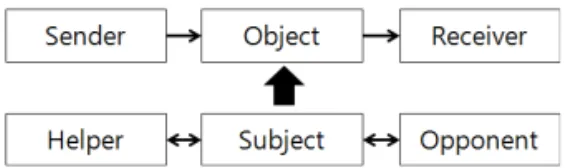
model, and the plot structure was reviewed in de- tail, by analyzing the relationships between char- acters and the changes in their personalities, ac- cording to the events they (the main characters) have experienced. The actantial model developed by A.J. Greimas is based on a discourse analysis of V. Propp’s work[12]. With the subject and value objects as a pivots, the actants created are a

“sender,” who initiates a quest for a physical object

or cognitive subject, a “receiver,” who accepts the

quest, a “helper,” who helps the subject achieve the

(4)

Fig. 1. A.J. Greimasa Actantial model.

Table. 1 Story flow chart (A story flow chart with an analysis of event formation)

Obtain the law (book / Haein)

↓ Help others

Build the Temple of Haeinsa goal of the quest, and an “opponent,” who inter-

rupts the subject’s attempt to achieve the goal[13].

Lastly, cultural content of Korean Buddhism is developed in the form of animations and games, before being implemented on the Android platform.

3. SCENARIO ANALYSIS AND THE DESIGN PROCESS

The original text of the Korean Haeinsa folktale can be divided into two parts.

1. Sun-eung and Li-jong set off to meet with an ascetic Bochi, but found out that he had passed away before they arrived, leaving a book and a message for them to build a temple on Mount Kaya, as he knew ahead of time that they would come to see him. When Sum-eung and Li-jong re- turned to Mount Kaya in Silla, the auspicious en- ergy released from Mount Kaya was released, and with this energy the two monks were able to heal their Queen—who had reached the mountain by following the energy—of her illness. Thereupon, they built the Temple of Haeinsa [1].

2. A government official named Lee helped a dragon ascend to heaven (for saving people’s lives, and granting them salvation) by returning with Great King Yeomna’s seal (Yama, a mythological figure equivalent to the ancient Greek god Hades), or a seal of the Dragon King of the Sea, Haein, from the netherworld. Thereupon, he built the Temple of Haeinsa [2].

The first story contained in the Silla Kayasan Haeinsa Sunanjuwonbyukki, written by Choi Chi Won in 900, provides a recorded historical fact.

In the second story, a folktale passed down or- ally from one generation to another was recorded and transformed into various forms such as “a

puppy from the palace of the Dragon King,” and the “Haein story.”

Fundamentally, unlike the other establishment narratives that focus on space or place, the Haeinsa Temple narrative develops mainly with main char- acter’s events, and has the simple plot that “a main character made someone’s dearest wish come true and so he/she built the Temple of Haeinsa.” A nar- rative of the Haeinsa Temple achieved the signi- fication of Buddhist salvation through books and the truth-dharma. Our analysis, which was con- ducted by modularizing the structure of these two stories, shows that they have an identical structure.

This structure appears in the transformed version of the relevant narrative. A story flow chart of the two Buddhist folktales is as follows (Table 1).

The second story of the Haeinsa Temple estab- lishment narrative reveals the fantasy and epic characteristics of the netherworld (the divine world) and this world (the human world). The name of “Haein” came from “Haein Samme,”

meaning that it seeks truth with a sincere heart, like a mirror.

The meaning and symbolism of this world is well displayed in the second story, so this content was reconstructed in the second story as a scenario suitable for digital media, taking the identity of the Haeinsa Temple and interesting storytelling ele- ments into account (Table 2).

This content is developed in E-Book form, and

its target audience is children younger than ten

years of age. The characters in the e-book were

recreated for children younger than ten years of

age, and the turtle “Haein” was selected for the

leitmotif, because amphibious turtles have the dou-

(5)

Table. 2 Content development planning

Elements Original text Reconstruction

Format Folktale Digital E-Book content

Implementation - Android

Target audience - Children

Background Mount Kaya, the palace of the

Dragon King Mount Kaya, the palace of Dragon King

Leading characters Officer Lee Dong-yi, Song-yi

Medium Haein Turtle (Haein)

Traditional elements Great King Yeomna, dragon Goblin, the palace of the Dragon King, the Dragon King, monster serpent

Theme Mercy Mercy, courage

Table. 3 Content story outline

Descriptions

Act 1 Dong-yi and Song-yi rescued a turtle (Haein) from a goblin, and went to the palace of the Dragon King together

Act 2 Dong-yi and Song-yi left the palace of the Dragon King, and were taken to a monster serpent by goblins, but they managed to escape using Dong-yi’s wits in rescuing a turtle.

Act 3 In order to save Dong-yi and Song-yi, who were caught by the monster serpent chasing after them, the Haein gave off its own light, and the monk Li-jong followed the light and finally saved them.

Fig. 2. Event-oriented space node flow chart.

ble meaning of land and water in many folktales.

It expresses the theme of the content by serving as a medium that connects the human world with the divine world, and the land with the palace of the Dragon King.

In addition, the appearance of traditional and fantasy elements including goblins, monster ser- pents, the palace of the Dragon King, and the Dragon King added fun to the story.

The reconstructed story is as follows (Table 3).

The outline of the story is that in their adventure, Dong-yi and Song-yi rescue and protect Haein with sincere hearts and courage, and Haein even- tually saves their lives.

This story is again divided into three smaller narratives. Each part has a theme of compassion, courage, and sacrifice. An abstract concept, the truth, was visualized as a “turtle.” In this way, the theme of the Haeinsa Temple establishment narra- tive—that overcoming agony and seeking truth

with courage will illuminate the world—is repre- sented.

The narrative that was analyzed by focusing on events is reconstructed by focusing on space (Fig.

2). Space is organized on the basis of meanings, and each space has its own meaning. Events are closely related to each other through space nodes.

This context will be used as a background for

mini-games that enable children to review a story

as the space changes. In this way, children can

learn the symbolic themes of a story, and analyze

the cultural meanings in each space.

(6)

Fig. 3. Screen of Treasure from the Palace of the Dragon King MAIN UI.

Fig. 4. Screen of the Treasures from the Palace of the Dragon King SUB_UI.

Fig. 5. Functional games inducing users to participate.

4. SMART CONTENT IMPLEMENTATION OF THE HAEINSA TEMPLE ESTABLISHMENT NARRATIVE WITH AN INTUITIVE UX

This study developed an e-book about Korean Buddhist culture. The content is separated into ei- ther animations or games. In the animations, a voice actor/actress read a narrative of the estab- lishment of the Haeinsa Temple, and the dialogue between the characters was inserted. The gaming elements were added to stimulate the participation and interest of the target audience. A mini-game designed to induce user participation was inserted to add fun elements to the story. This is designed in a different format (for example: quest games), so that the audience can easily understand each scene displayed in the animation. To begin, details on the main screen are illustrated as follows.

Button 1 is for the animation described above.

Button 2 is for the game. Button 3 is activated as an end credit. Button 4 signals the end of the con- tent (Fig. 3).

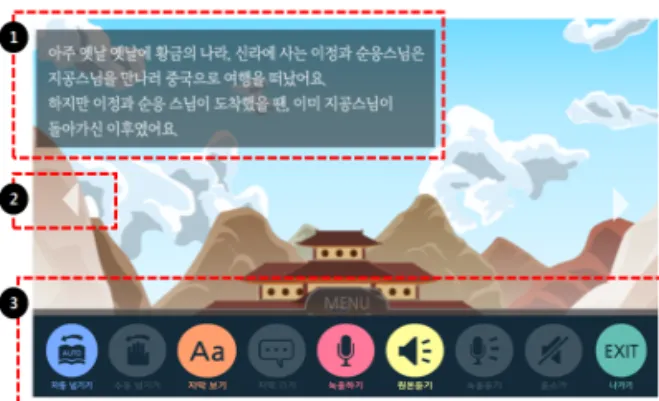
Details on the main screen of animated content are as follows. Area 1 shows subtitles. It changes according to the text (explanation) on the screen.

Area 2 can be selected by users, and displays the Previous and Next buttons symmetrically on the screen. In Area 3, the Next Page, Subtitles, and Record buttons are visualized and developed to be grasped intuitively (Fig. 4).

The following is a typical example that stim- ulates and induces user participation (Fig. 5). In

the picture on the left, to move to the next screen, users have to complete a quest by touching a turtle stuck in the rocks, to release it.

The image on the right is a drag-and-drop type of mini-game in which a user drags an image and drops it into a matching silhouette of the character or the object.

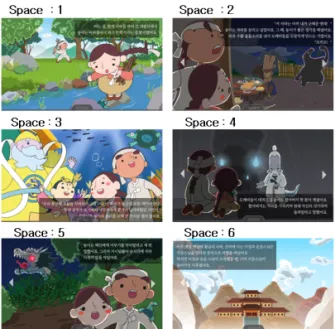
The structure of the story using the movement of space analyzed in the previous chapter is illus- trated as follows (Fig. 6). The story flow moves through space. The changes (traveling) through space unfold before the brother and sister, Dong-yi and song-yi. Six phases of space “Stream ->

Goblin’s house -> The palace of the Dragon King -> Cave -> Mountain -> Haeinsa Temple,” are closely linked by nodes through nodalization.

The users will review the story in a mini- game later, while moving through space. Each space includes cultural elements, as the story plays out.

5. CONCLUSION AND FUTURE WORK

This study analyzed Korean Buddhism from a

(7)

Fig. 6. Image layout according to the changes of space.

cultural perspective, and suggested its potential for smart content through a scenario development us- ing Buddhist culture prototypes as materials. As a result, the cultural content of Korean Buddhism, especially the Haeinsa Temple establishment nar- rative, titled “Treasures from the Palace of the Dragon King” was developed in the form of anima- tions and games.

This achievement is significant because the Heainsa Temple, one of the Three Jewel Temples of Korea and a typical representation of the cultural heritage of Korean Buddhism over a millennium of history, was reborn as smart cultural content in the smart environment. The study also suggests that any follow-up researches should discuss ways to apply features of Korean traditions and cultures when the fields try to develop the characters.

We aim to promote Korea’s traditional culture throughout the world, with this content as the starting point for the future. This study also sup- ports the globalization of Korean Buddhist culture edutainment, by allowing the audience to under- stand Korean Buddhism more easily. Furthermore, we hope that Korean Buddhism will be introduced to the world through mobile devices and services, leading to a sustainable diffusion of Korean cul-

tures and traditions.

REFERENCE

[ 1 ] C.W Choi, Silla Kayasan Haeinsa Sunanju- wonbyukki, Samguksagi, 900.

[ 2 ] Anonymous author, Mount Kaya Haeinsa Gojuk, 1662.

[ 3 ] Y. Lee and M. Sung, “A New Direction on Buddhist Culture Content Studies in the Digital Ubiquitous Culture: An Understand- ing of Religious Character Classifications,”

J ournal of Korea Design Forum, Vol. 29, pp.

421-430, 2010.

[ 4 ] Y.T. Kim, "Buddhism's Guarding the Country in the History of Korean Buddhism, and the Korean People's Perception of such 'Buddhist Role in Protecting and Saving the Country,”

Maha Bodhl Thought, Vol. 17, pp. 43-73, 2012.

[ 5 ] B. Kim, “A Study of the Present Condition and Assignment about Buddhism of Middle and Late Silla Dynasty,” The Journal of the Center of Research for Silla Culture, the Center of Research for Silla Culture Dongguk University, Vol. 26 No.1, pp.283-301, 2005.

[ 6 ] OECD. The Impact of Culture on Tourism.

OECD, Paris, pp. 129-140. 2009.

[ 7 ] W. Shim and J. Kim, “A Comparative Study on Participation Motivation and Experience Satisfaction on Temple-stay among Koreans and Foreigners,” J ournal of Tourism Sciences, Vol. 7, No. 35, pp. 343-366. 2011 [ 8 ] M. Peleggi, “National Heritage and global

tourism in Thailand. Annals of Tourism Research,” Annals of Tourism Research, Vol.

23, No. 2, pp. 432-448, 1996.

[ 9 ] J. Lee, “A Study on the Research Directions and Educational Methods of Buddhist Cultural Contents Studies,” Religious and Cultural Studies, Vol. 20 No. 20, pp. 243-277, 2013.

[10] H.A. Griroux, “Animating Youth The Disney-

(8)

fication of Children's Culture,” SOCIALIST REVIEW-SAN FRANCISCO-, lafayetteschools.

org. pp. 65-76, 1995.

[11] S. Chatman, “Story and Discourse: Narrative Structure in Fiction and Film,” Ithaca: Cornell UP, pp. 19-20, 1978.

[12] M.L. Franz, “The Interpretation of Fairy Tales,” Shambhala Publication, Inc, Boston U.S.A, 1996.

[13] Greimas, Algirdas Julien. Structural Seman- tics, Lincoln: University of Nebraska Press, 1966.

[14] Y. Lee, J. Kim, “A Study on The Step of Anthropomorphic Animal Charaters in Animation”, Journal of Korea Multimedia Society, Vol. 12, No. 11, pp.1661-1670, 2009.

[15] Y. Lee, Classification and Searching for Anthropomorphic Animal Charaters in Animation, Doctor’s Thesis of Pusan National University, 2010.

[16] C. Lee, Y. Lee, “The study of the Korean Traditional Hybrid Character Shape- for Jangseung and Dokkaebi,” The Korean Society of Cartoon & Animation Studies, Vol.

31, No.1, pp.1-27, 2013.

[17] Y. Lee, Y. Ahn, “Planning and Development of the Four Devas (四天王) Characters Items with Storytelling Applied,” J ournal of Korea Design Forum, Vol. 39, No.1, pp. 93-104, 2013.

Youngsuk Lee

is an Assistant Professor at Research Institute for Image &

Cultural Content, Dongguk Uni- versity. She received B.Des. de- gree from Tongmyong Univer- sity in 2002 and Her M.E. &

Ph.D degrees from Busan Na- tional University in 2004 and 2010. Her research in- terests include the game of graphic design, animation and character.

Sangnam Kim

is a doctoral student in Culture Contents from Dongguk Univer- sity. Her research interests in- clude digital storytelling and culture prototype. She received B.A. degree in Literary Creation and B.E. degree in Computer Science from Dongguk University in 2010, and her M.A degree in Culture Contents from Dongguk University in 2014.

Jongdae Lee

is currently a professor at De-

partment of Cultural Contents,

of Graduate School of Digital

Image and Contents, Dongguk

University, Seoul, Korea. He is

also Headmaster of Graduate

School of Digital Image and

Contents and Institute for Image & Cultural Contents,

Dongguk University, Seoul, Korea. He received a Ph.D

of Liberal Arts from Dongguk University, Seoul, Korea

in 1994. His research interests are Cultural contents

and Trans-media from Traditional source to Digital

contents.

수치

Fig. 1. A.J. Greimasa Actantial model.
Fig. 2. Event-oriented space node flow chart.
Fig. 3. Screen of Treasure from the Palace of the Dragon  King MAIN UI.
Fig. 6. Image layout according to the changes of space.

참조

관련 문서

The Cainozoic Era drawing mainly expressed north the first half of the 1990s with the political society's one individual political fable narrative as well as

The free semester system, which was implemented with the introduction of the Irish transition school system, is a system that provides diverse

We have already looked at this problem from one standpoint for which we found the value of the potential was doubled at the surface and the expression for the

In this paper, we developed a data management system for shipboard machinery equipment and the monitoring application for the verification of the utility, and we

jQuery Mobile solves this problem, as it only uses HTML, CSS and JavaScript, which is standard for all mobile web browsers..

Keywords : Developmental disability, Right to self-determination, Guardianship for adults, Crimes related to mobile phones, Convention on the Rights of Persons

1 John Owen, Justification by Faith Alone, in The Works of John Owen, ed. John Bolt, trans. Scott Clark, "Do This and Live: Christ's Active Obedience as the

Since then, many research applications of 10 Be for both terrestrial and extraterrestrial applications have been developed, which parallel the wide range