• 검색 결과가 없습니다.

Roles of TLR-4 and NF-κB in Interleukin-6 Expression Induced by Heat Shock Protein 90 in Vascular Smooth Muscle Cells

N/A
N/A
Protected

Academic year: 2021

Share "Roles of TLR-4 and NF-κB in Interleukin-6 Expression Induced by Heat Shock Protein 90 in Vascular Smooth Muscle Cells"

Copied!
7
0
0

로드 중.... (전체 텍스트 보기)

전체 글

(1)

Roles of TLR-4 and NF-κB in Interleukin-6 Expression Induced by Heat Shock Protein 90 in Vascular Smooth Muscle Cells

Byung-Yong Rhim, Kang-Seong Kim and Koanhoi Kim*

Department of Pharmacology, School of Medicine - Pusan National University, Busan, Korea Received September 5, 2008 /Accepted December 11, 2008

This study has investigated whether extracellular HSP90 predisposes vascular smooth muscle cells (VSMCs) to pro-inflammatory phenotype. Exposure of rat aortic smooth muscle cells to HSP90 not on- ly enhanced IL-6 release but also profoundly induced IL-6 transcript via promoter activation.

HSP90-induced IL-6 promoter activation was suppressed by dominant-negative forms of Toll-like re- ceptor (TLR)-4 and myeloid differentiation factor 88 (MyD88), but not by dominant-negative-forms of TLR-3 and TIR-domain-containing adapter-inducing interferon-β (TRIF). Curcumin, which inhibits di- merization of TLR-4, also attenuated the IL-6 induction by HSP90. Mutation at the NF-κB- or C/EBP-binding site in the IL-6 promoter region suppressed the promoter activation in response to HSP90. The gene delivery of IκB using recombinant adenoviruses and treatment with resveratrol, which inhibit NF-κB activity, attenuated the HSP90-induced IL-6 release from VSMCs. The present study proposes that extracellular HSP90 would contribute to inflammatory reaction in the stressed vasculature by inducing IL-6 in VSMCs, and that TLR-4 and NF-κB would play active roles in the process.

Key words : Interleukin 8, heat shock protein 90, toll-like receptor, vascular smooth muscle cell

*Corresponding author

*Tel:+82-51-240-7963, Fax:+82-51-244-1036

*E-mail : [email protected]

Introduction

Heat shock proteins (HSPs), the highly conserved mole- cules which participate in protein folding and assembly, are crucial for correct transportation of proteins through the cell [21]. Among the families of HSPs grouped according to their molecular weight, HSP60 and HSP70 have been the subject of extensive studies with regard to immunogenic and in- flammatory properties in association with atherosclerosis [16,19]. HSP60 localizes selectively in atherosclerotic lesions as opposed to non-atherosclerotic regions of the arterial wall.

In advanced atherosclerotic lesions, HSP70 is over-expressed in several cell types, including monocytes, macrophages, dendritic cells and smooth muscle cells [7,29]. HSPs are nor- mally intracellular whereas HSP90 is secreted from vascular smooth muscle cells (VSMCs) during oxidative stress and from necrotic, not apoptotic, macrophages [2,11]. However, it is not reported whether the secreted HSP90 affects VSMCs in terms of inflammatory property.

VSMCs reside mostly in the media of healthy arteries and regulate vascular tone. In atherosclerosis, VSMCs undergo phenotypic and cellular changes thought to be crucial in the

development of atherosclerotic plaque, and thus producing cytokines and excessive extracellular matrix proteins [12,13].

It is evident that interleukin-6 (IL-6) plays an active role in this process. IL-6 induces an acute phase response and stim- ulates lymphocyte proliferation as well as differentiation of B cells and their antibody production [9]. The effects of this cytokine also include growth- and differentiation-inducing activities of nonlymphoid cells, particularly of VSMCs and vascular endothelial cells [6,17]. Findings from previous clin- ical studies have shown that IL-6 can be a risk factor for the development of atherosclerosis and restenosis. Plasma levels of IL-6 are enhanced in patients with unstable angina and with restenosis independent of other risk factors [10,27].

Thus, understanding IL-6 regulation is important in vascular biology due to close association of this cytokine with vas- cular diseases.

VSMCs produce IL-6 and the production is enhanced in

response to platelet-derived growth factor-BB, thrombin, an-

giotensin II [14], and mechanical stress [28]. The presence

of IL-6 protein and mRNA has been observed in human nor-

mal and atherosclerotic arterial walls. When the cytokine has

been detected by immunohistochemical staining, the normal

intima presents only cellular deposits. In contrast, intimal

thickening and fibrous plaque show extended intracellular

and extracellular deposits of IL-6 [18,20]. These findings sug-

gest that some local factors induce synthesis of this cytokine

(2)

in the cells of the atherosclerotic arterial wall.

To explore the potential role of secreted HSP90 in vascular inflammation, we investigated whether extracellular HSP90 induces IL-6 in VSMCs, and found that aortic smooth muscle cells (AoSMCs) exhibited IL-6 up-regulation via transcrip- tional activation in response to HSP90. Furthermore, the in- volvement of Toll-like receptors (TLRs) and transcription el- ements in HSP90-induced IL-6 up-regulation in VSMCs was investigated.

Materials and Methods Cell culture and reagents

A7r5 rat AoSMCs (American Type Culture Collection, Manassas, VA) were cultured in Dulbecco's modified Eagle's medium-high glucose (DMEM) supplemented with 10% fetal bovine serum (FBS), 50 units/ml penicillin and 50 μg/ml streptomycin in a humidified atmosphere of 5% CO

2

. Recombinant HSP90 was purchased from ProSpec-Tany Technogene Ltd (Rehovot, Israel). Resveratrol (3,4’,5-trihy- droxy-trans-stilbene) and curcumin were purchased from Sigma-Aldrich (St. Louis, MO). The reporter plasmid con- taining a 651-bp fragment of the IL-6 gene promoter region (pIL-6-Luc) located directly upstream of the transcriptional start site, as well as its mutant constructs were kindly pro- vided by Dr. Oliver Eickelberg [4]. Plasmids encoding domi- nant-negative forms of TLR pathway were purchased from Invivogen (San Diego, CA).

Enzyme linked immunosorbent assay (ELISA) of IL-6 The cytokine content of culture supernatant was de- termined through the use of commercially available micro- titer plate ELISA kit according to the manufacturer’s in- structions (Biotrak ELISA, Amersham, Buckinghamshire, UK). Cells were serum starved for 6 hr and exposed to HSP90 prior to isolation of culture medium. The isolated cul- ture medium and IL-6 standards were added to the micro- titer plate pre-coated with a monoclonal antibody against IL-6. After incubation for 1 hr, the plate was washed. Next, the plate was incubated with an enzyme-linked polyclonal antibody specific for IL-6. The substrate solution was added after several washes, and the color intensity was read.

Reverse transcription (RT) - polymerase chain reaction (PCR)

Total RNAs were reverse-transcribed for an hour at 42

o

C

with Moloney Murine Leukemia Virus reverse transcriptase, followed by PCR analysis. For PCR analysis, primers for IL-6 were 5’- AGTTGCCTTCTTGGGACTGA-3’ (forward) and 5’- CAGAATTGCCATTGCACAAC-3’ (reverse). Products were size-separated by electrophoresis on 2% agarose gels and vi- sualized by ethidium bromide staining. To ensure that cor- rect sequences had been amplified, amplification products were sequenced.

Transient transfection and luciferase assay

Rat AoSMCs were seeded in 100-mm culture dishes 24 hr before transfection. Cells were transfected with 10 μg IL-6 reporter plasmid and 3 μg β-galactosidase plasmid using Lipofectamine. Cells were then re-fed DMEM containing 10% FBS 6 hr post-transfection and incubated overnight.

Transfected cells were exposed to 500 ng/ml HSP90 for the indicated time periods. Luciferase activity was measured us- ing a luciferase assay kit (Promega, Madison, WI) with signal detection in a luminometer and normalized to β-galactosi- dase activity.

Statistics

Statistical analyses were performed by ANOVA, and p<0.05 was considered statistically significant.

Results

The effects of HSP90 on IL-6 transcript and protein in VSMC

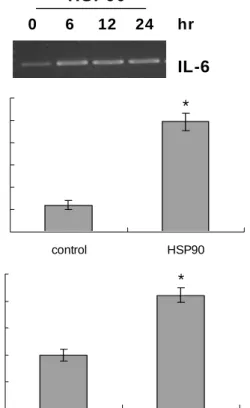
To investigate the effects of HSP90 on IL-6 expression in VSMCs, the level of IL-6 transcript was examined by RT-PCR after exposure of rat AoSMCs to recombinant HSP90. Figure 1A shows that IL-6 transcript was elevated in the presence HSP90. The elevation was observed as early as 6 hr post-treatment and persisted up to 24 hr after treatment. We also examined by ELISA whether VSMCs re- leased IL-6 protein, and found that secreted IL-6 increased profoundly in response to HSP90 (Fig. 1B). The amount of IL-6 in the medium increased from 90 pg/ml to 370 pg/ml in the presence of HSP90. Reporter gene assays were carried out to investigate whether HSP90 increased IL-6 transcript via promoter activation. Rat AoSMCs were transfected with the IL-6 reporter plasmid, and luciferase activity was as- sessed in the presence or absence of HSP90 (Fig. 1C).

Compared with control exposed to BSA, luciferase activity

increased by 2.1-fold in the presence of HSP90, indicating

(3)

0 6 12 24 hr IL-6 HSP90

(A)

0 75 150 225 300 375 450

control HSP90

IL -6 ( p g/ m l)

(B) *

0 50 100 150 200 250

control HSP90

% of contro l

*

0 50 100 150 200 250

control HSP90

% of contro l

(C) *

Fig. 1. The effects of HSP90 on IL-6 expression. (A) Up-regu- lation of IL-6 mRNA by HSP90. Rat AoSMCs were treat- ed for the indicated time periods with 500 ng/ml of HSP90, and IL-6 transcripts were amplified using RT-PCR. (B) Enhancement of IL-6 release by HSP90. Rat AoSMCs (1x10

6

cells) cultured in growth media were in- cubated in the presence of BSA (control) or HSP90 (500 ng/ml, for 12 hr). IL-6 secreted into the culture medium was measured using ELISA. Data are expressed as means±SDs (n=3 replicates/group). * P<0.01 vs. control.

(C) Promoter activation of IL-6 gene by HSP90. Rat AoSMCs were transfected with the pIL-6-Luc construct and incubated in the presence of BSA (control) or HSP90 (500 ng/ml, for 6 hr). Luciferase activity was determined and normalized to β-galactosidase activity. Induction was calculated relative to the activity of control cells.

Data are expressed as means±SDs (n=3 replicates/

group). * P<0.01 vs. control.

that HSP90 promoted IL-6 transcriptional activity.

Involvement of TLR-4 pathways in IL-6 promoter activation

To investigate roles of TLRs in HSP90-induced promoter activation of IL-6 gene, a reporter gene assay was carried out after transfection of rat AoSMCs with the IL-6 reporter plasmid in combination with dominant-negative forms in TLR pathways. HSP90-induced luciferase activity driven by

IL-6 promoter was affected by co-transfection with domi- nant-negative forms of TLR-4 (Fig. 2A) and myeloid differ- entiation factor 88 (MyD88) (Fig. 2B). Of the two, domi- nant-negative MyD88 profoundly inhibited promoter acti- vation of IL-6 gene. Co-transfection with dominant negative forms of TLR-3 and TIR-domain-containing adapter-induc- ing interferon-β (TRIF), however, did not inhibit HSP90-in- duced IL-6 gene activation. The effects of phytochemicals known to modify TLR-4 signaling on HSP90-induced IL-6 up-regulation were investigated by reporter gene assays (Fig. 3A). Curcumin and resveratrol significantly sup- pressed the HSP90-induced IL-6 promoter activity. The sup- pression was more significant in the presence of curcumin.

Pre-treatment with curcumin suppressed the HSP90-in- duced IL-6 promoter activity approximately to that of control. When the effects of the two phytochemicals on IL-6

0 50 100 150 200 250 300

control pCM V dn-TLR4 dn-TLR3

% of control

*

**

- HSP90 + HSP90

(A)

0 50 100 150 200 250 300

control pCMV dn-MyD88 dn-TRIF

% of control

*

**

- HSP90 + HSP90

(B)

Fig. 2. Involvement of TLR-4 in the activation of IL-6 gene by HSP90 in VSMCs. The IL-6-Luc plasmid was co-trans- fected into rat AoSMCs with the indicated dominant- negative forms of TLRs (A) or with dominant negative forms of TLR-4 adaptor molecules (B). After stimulation with HSP90 (500 ng/ml, for 6 hr), luciferase activity was determined and normalized to β-galactosidase activity.

Induction was calculated relative to the activity of con-

trol cells. Data are expressed as means±SDs (n=3 repli-

cates/group). * P<0.01 vs. control. **P<0.01 vs. pCMV.

(4)

0 50 100 150 200 250

control DMSO Cur Res

% of control

*

** **

- H S P 90 + H S P 90

(A)

0 50 100 150 200 250 300 350 400

control DMSO Cur Res

IL -6 ( pg /m l)

*

** **

- HSP90 + H S P90

(B)

Fig. 3. Attenuation of IL-6 up-regulation induced by resveratrol and curcumin. (A) The effects of curcumin and resveratrol on the promoter activation of IL-6 gene. The IL-6-Luc plasmid was transfected into rat AoSMCs and incubated for 2 hr with 10 μM curcumin (Cur) or 25 μM resveratrol (Res). The transfected cells were processed for luciferase and β-galactosidase assays after stimulation with HSP90 (500 ng/ml, for 6 hr). Induction was calculated relative to the activity of the control cells that were incubated without HSP90. Data are expressed as means±SDs (n=3 replicates/ group). *P<0.01 vs. control.

**P<0.05 vs. DMSO. (B) The effects of curcumin and resveratrol on IL-6 release. Rat AoSMCs were stimulated with HSP90 (500 ng/ml, for 12 hr) in the absence or presence of the indicated phytochemicals. IL-6 in the culture medium was measured using ELISA. Data are expressed as means±SDs (n = 3 replicates/group). *P<0.01 vs. control. **P<0.01 vs. DMSO.

0 50 100 150 200 250

pCMV pIL-6-Luc mt C/EBP mt NF-kB

% of control

*

** **

- HSP90 + HSP90

(A)

0 30 60 90 120 150 180 210

LacZ LacZ IkB

IL-6 (pg/ml)
- HSP90 + HSP90

*

**

(B)

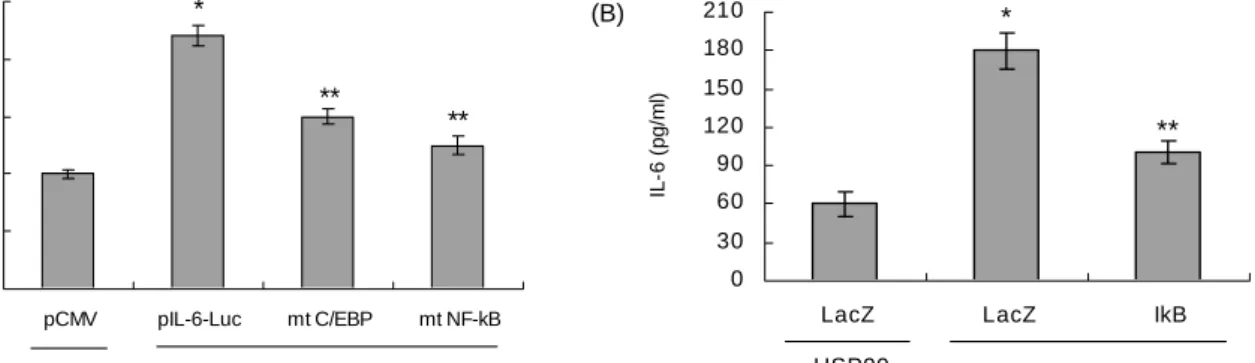
Fig. 4. Suppression of IL-6 induction through inhibition of NF-κB. (A) The effects of the mutation on the NF-κB binding consensus sequence on promoter activation of IL-6 gene. Rat AoSMCs transfected with the wild-type pIL-6-Luc construct or the indicated mutant construct were stimulated with HSP90 (500 ng/ml, for 6 hr) and processed for luciferase and β-galactosidase assays.

Induction was calculated relative to the activity of control cells transfected with wild-type IL-6 promoter. Data are expressed as means±SDs (n = 3 replicates/group). *P<0.01 vs. pCMV. **P<0.01 vs. pIL-6-Luc. (B) The effects of κB on IL-6 release.

Rat AoSMCs were infected with indicated recombinant adenoviruses (MOI: 100) and stimulated with HSP90 (500 ng/ml, for 12 hr). The amount of secreted IL-6 was measured using ELISA. Data are expressed as means±SDs (n = 3 replicates/group).

*P<0.01 vs. LacZ -HSP90. **P<0.01 vs. LacZ +HSP90.

protein were examined, resvaratrol and curcumin sig- nificantly attenuated IL-6 release from VSMCs (Fig. 3B).

Roles of NF-κB and C/EBP in HSP90-induced IL-6 promoter activation in VSMCs

To investigate roles of the transcription elements in HSP90-induced IL-6 promoter activation, reporter gene as- says were carried out after transfection of rat AoSMCs with an IL-6 reporter plasmid mutated at the NF-κB- or C/EBP-binding site (Fig. 4A). HSP90 significantly increased

the luciferase activity. Mutation at the NF-κB- or C/EBP- binding site profoundly inhibited the luciferase activity in- duced by HSP90 which indicates that the NF-κB- and C/EBP-binding sites are necessary for activation of IL-6 by HSP90 in VSMCs. To obtain further evidence for the role of NF-κB in HSP90-induced IL-6 up-regulation in VSMCs, the amount of secreted IL-6 in response to HSP90 was de- termined by ELISA after infection with recombinant ad- enoviruses expressing IκB and β-galactosidase (Fig. 4B).

HSP90 elevated IL-6 release from VSMCs. However, the

(5)

HSP90-induced IL-6 release was significantly attenuated by gene delivery of IκB, an endogenous inhibitor of NF-κB.

Discussion

The present study focused on the expression of IL-6 and regulation of IL-6 gene in AoSMCs in response to ex- tracellular HSP90. When VSMCs were exposed to HSP90, IL-6 transcripts were significantly increased, and the lucifer- ase activity driven by the IL-6 gene promoter was elevated, which indicates that extracellular HSP90 transactivates IL-6 gene. Moreover, HSP90 enhanced release of IL-6 protein from VSMCs. Taken together, these data indicate that HSP90 upregulates IL-6 at transcriptional and post-translational levels.

The association of TLRs with vascular diseases has been demonstrated. Compared with normal arteries, expression of TLRs, such TLR-1, -2, and -4, are markedly enhanced, and a considerable proportion of TLR-expressing cells are acti- vated in the human atherosclerotic lesion [3]. Among the subtypes of TLRs, TLR-4 seems to be closely associated with atherosclerosis, as knockout of TLR-4 or its adaptor mole- cule, MyD88, has been reported to block inflammatory re- sponse and proliferation of VSMCs in the atherosclerotic le- sion [5,15]. HSPs can act as an endogenous ligand for the TLRs [1]. Among the subtypes of TLRs, expression of TLR-3, and -4 has been detected in human VSMCs [23,24]. TLR-4, which is the most abundant TLR in human VSMCs, trans- mits signals through MyD88-dependent and -independent (e.g., via TRIF) pathways after recognition of LPS, an exoge- nous ligand [1,8]. When the roles of the TLRs in HSP90-mediated activation of IL-6 gene were examined us- ing dominant-negative constructs, IL-6 promoter activity was attenuated by dominant-negative TLR-4 and MyD88, but not by dominant-negative TLR-3, TRIF, indicating major roles of TLR-4 and MyD88 in activation of IL-6 gene by HSP90. We also investigated the effects of phytochemicals, which modulate TRL-4 signaling, on IL-6 up-regulation.

Curcumin inhibits ligand-induced and ligand-independent dimerization of TLR-4, and thus inhibited both MyD88- and TRIF-dependent pathways in LPS-induced TLR-4 signaling [26]. We found that curcumin inhibited promoter activation of IL-6 gene and release of IL-6 protein by HSP90. Taken together, these findings indicate HSP90 is likely to induce IL-6 expression in VSMCs via MyD88-dependent TLR-4 pathway.

The IL-6 promoter region contains motifs for transcription element of NF-κB, C/EBP, and AP-1 [22]. Thus, it was de- termined which transcription elements were responsible for promoter activation in response to HSP90 using mutant IL-6 reporter plasmids. The mutation at NF-κB- or C/EBP-bind- ing site significantly attenuated promoter activity, indicating active role of NF-κB- and C/EBP in IL-6 induction. This find- ing agrees to the fact that the signal from TLR-4 activates NF-κB [1,8] and to the result of this study that IL-6 induction by HSP90 was significantly attenuated by resveratrol, which inhibits NF-κB activation [25]. Whether the inhibition of tran- scription factor NF-κB played a role in IL-6 release was fur- ther investigated using recombinant adenoviruses. Over-ex- pression of IκB attenuated the IL-6 release. Taken together, these data indicate that NF-κB is necessary for the HSP90-mediated IL-6 up-regulation in VSMCs.

In the present study, we demonstrated that extracellular HSP90 induces IL-6 expression in VSMCs via TLR-4 signal- ing pathway. This finding suggest that HSP90, which is se- creted by oxidative stress and during necrotic cell death, would upregulate IL-6 in VSMCs via TLR-4 pathway, and thereby would contribute to the inflammatory reaction in the damaged vasculature.

Acknowledgement

This work was supported for two years by Pusan National University Research Grant to B-Y. Rhim.

References

1. Akira, S. and K. Takeda. 2004. Toll-like receptor signalling.

Nat. Rev. Immunol. 4, 499-511.

2. Basu, S., R. J. Binder, R. Suto, K. M. Anderson and P. K.

Srivastava. 2000. Necrotic but not apoptotic cell death re- leases heat shock proteins, which deliver a partial matura- tion signal to dendritic cells and activate the NF-kappa B pathway. Int. Immunol. 12, 1539-1546.

3. Edfeldt, K., J. Swedenborg, G. K. Hansson and Z. Q. Yan.

2002. Expression of toll-like receptors in human athero- sclerotic lesions: a possible pathway for plaque activation.

Circulation 105, 1158-1161.

4. Eickelberg, O., M. Roth, R. Mussmann, J. J. Rudiger, M.

Tamm, A. P. Perruchoud and L. H. Block. 1999. Calcium channel blockers activate the interleukin-6 gene via the tran- scription factors NF-IL6 and NF-kappaB in primary human vascular smooth muscle cells. Circulation 99, 2276-2282.

5. Hollestelle, S. C., M. R. De Vries, J. K. Van Keulen, A. H.

Schoneveld, A. Vink, C. F. Strijder, B. J. Van Middelaar, G.

(6)

Pasterkamp, P. H. Quax and D. P. De Kleijn. 2004. Toll-like receptor 4 is involved in outward arterial remodeling.

Circulation 109, 393-398.

6. Ikeda, U., M. Ikeda, T. Oohara, A. Oguchi, T. Kamitani, Y.

Tsuruya and S. Kano. 1991. Interleukin 6 stimulates growth of vascular smooth muscle cells in a PDGF-dependent manner. Am. J. Physiol. 260, H1713-1717.

7. Kanwar, R. K., J. R. Kanwar, D. Wang, D. J. Ormrod. and G. W. Krissansen. 2001. Temporal expression of heat shock proteins 60 and 70 at lesion-prone sites during athero- genesis in ApoE-deficient mice. Arterioscler. Thromb. Vasc.

Biol. 21, 1991-1997.

8. Kawai, T. and S. Akira. 2005. Toll-like receptor downstream signaling. Arthritis Res. Ther. 7, 12-19.

9. Kishimoto, T. and T. Hirano. 1988. Molecular regulation of B lymphocyte response. Annu Rev. Immunol. 6, 485-512.

10. Lee, W. Y., M. A. Allison, D. J. Kim, C. H. Song and E.

Barrett-Connor. 2007. Association of interleukin-6 and C-re- active protein with subclinical carotid atherosclerosis (the Rancho Bernardo Study). Am. J. Cardiol. 99, 99-102.

11. Liao, D. F., Z. G. Jin, A. S. Baas, G. Daum, S. P. Gygi, R.

Aebersold and B. C. Berk. 2000. Purification and identi- fication of secreted oxidative stress-induced factors from vascular smooth muscle cells. J. Biol. Chem. 275, 189-196.

12. Libby, P. 2002. Inflammation in atherosclerosis. Nature 420, 868-874.

13. Libby, P., P. M. Ridker and A. Maseri. 2002. Inflammation and atherosclerosis. Circulation 105, 1135-1143.

14. Liu, Z., N. Dronadula and G. N. Rao. 2004. A novel role for nuclear factor of activated T cells in receptor tyrosine kinase and G protein-coupled receptor agonist-induced vas- cular smooth muscle cell motility. J. Biol. Chem. 279, 41218-41226.

15. Michelsen, K. S., M. H. Wong, P. K. Shah, W. Zhang, J.

Yano, T. M. Doherty, S. Akira, T. B. Rajavashisth and M.

Arditi. 2004. Lack of Toll-like receptor 4 or myeloid differ- entiation factor 88 reduces atherosclerosis and alters plaque phenotype in mice deficient in apolipoprotein E. Proc. Natl.

Acad. Sci. U. S. A. 101, 10679-10684.

16. Pockley, A. G. 2003. Heat shock proteins as regulators of the immune response. Lancet 362, 469-476.

17. Roth, M., M. Nauck, M. Tamm, A. P. Perruchoud, R.

Ziesche and L. H. Block. 1995. Intracellular interleukin 6 mediates platelet-derived growth factor-induced pro- liferation of nontransformed cells. Proc. Natl. Acad. Sci. U.

S. A. 92, 1312-1316.

18. Rus, H. G., R. Vlaicu and F. Niculescu. 1996. Interleukin-6

and interleukin-8 protein and gene expression in human ar- terial atherosclerotic wall. Atherosclerosis 127, 263-271.

19. Srivastava, P. 2002. Roles of heat-shock proteins in innate and adaptive immunity. Nat. Rev. Immunol. 2, 185-194.

20. Tedgui, A. and Z. Mallat. 2006. Cytokines in atherosclerosis:

pathogenic and regulatory pathways. Physiol. Rev. 86, 515-581.

21. Whitley, D., S. P. Goldberg and W. D. Jordan. 1999. Heat shock proteins: a review of the molecular chaperones. J.

Vasc. Surg. 29, 748-751.

22. Wu, Y. M., D. R. Robinson and H. J. Kung. 2004. Signal pathways in up-regulation of chemokines by tyrosine kin- ase MER/NYK in prostate cancer cells. Cancer Res. 64, 7311-7320.

23. Yang, X., D. Coriolan, V. Murthy, K. Schultz, D. T.

Golenbock and D. Beasley. 2005. Pro-inflammatory pheno- type of vascular smooth muscle cells: role of efficient Toll-like receptor 4 signaling. Am. J. Physiol. Heart Circ.

Physiol. 289, H1069-1076.

24. Yang, X., V. Murthy, K. Schultz, J. B. Tatro, K. A. Fitzgerald and D. Beasley. 2006. Toll-like receptor 3 signaling evokes a pro-inflammatory and proliferative phenotype in human vascular smooth muscle cells. Am. J. Physiol. Heart Circ.

Physiol. 291, H2334-2343.

25. Youn, H. S., J. Y. Lee, K. A. Fitzgerald, H. A. Young, S.

Akira and D. H. Hwang. 2005. Specific inhibition of MyD88-independent signaling pathways of TLR-3 and TLR-4 by resveratrol: molecular targets are TBK1 and RIP1 in TRIF complex. J. Immunol. 175, 3339-3346.

26. Youn, H. S., S. I. Saitoh, K. Miyake and D. H. Hwang. 2006.

Inhibition of homodimerization of Toll-like receptor 4 by curcumin. Biochem. Pharmacol. 72, 62-69.

27. Yudkin, J. S., M. Kumari, S. E. Humphries and V.

Mohamed-Ali. 2000. Inflammation, obesity, stress and coro- nary heart disease: is interleukin-6 the link? Atherosclerosis 148, 209-214.

28. Zampetaki, A., Z. Zhang, Y. Hu and Q. Xu. 2005.

Biomechanical stress induces IL-6 expression in smooth muscle cells via Ras/Rac1-p38 MAPK-NF-kappaB signaling pathways. Am. J. Physiol. Heart Circ. Physiol. 288, H2946-2954.

29. Zhou, J., G. H. Werstuck, S. Lhotak, A. B. de Koning, S.

K. Sood, G. S. Hossain, J. Moller, M. Ritskes-Hoitinga, E.

Falk and S. Dayal. 2004. Association of multiple cellular stress pathways with accelerated atherosclerosis in hyper- homocysteinemic apolipoprotein E-deficient mice.

Circulation 110, 207-213.

(7)

초록:혈관평활근세포에서 HSP90에 의한 IL-6 발현에 TLR-4와 NF-κB의 작용 임병용․김강성․김관회*

(부산대학교 의학전문대학원 약리학교실)

HSP90에 노출된 혈관평활근세포에서 IL-6 transcript가 증가하고, IL-6 단백질의 분비가 증가하며, 또한 IL-6 유전자의 promote가 활성화되었다. HSP90에 의한 IL-6 유전자의 promoter 활성화는 dominant negative 형태의 TLR-4와 MyD88에 의하여 크게 감소되었지만, dominant negative 형태의 TLR-3와 TRIF의 영향을 받지 않았다.

그리고 TLR-4의 이합체화(dimerization)를 저해하는 curcumin은 HSP90에 의한 IL-6의 분비 및 IL-6 유전자 pro-

moter 활성화를 억제하였다. 그리고 IL-6 유전자의 promoter의 NF-κB- 또는 C/EBP-binding sequence에 변이는

HSP90에 의한 IL-6 유전자의 promoter 활성화 억제하였다. 이러한 결과는 혈관평활근세포에서 HSP90에 의한

IL-6 유전자 활성화에 TLR-4와 NF-κB가 관여함을 의미한다.

수치

Fig.  1.  The  effects  of  HSP90  on  IL-6  expression.  (A)  Up-regu- Up-regu-lation  of  IL-6  mRNA  by  HSP90
Fig.  4.  Suppression  of  IL-6  induction  through  inhibition  of  NF-κB.  (A)  The  effects  of  the  mutation  on  the  NF-κB  binding  consensus  sequence  on  promoter  activation  of  IL-6  gene

참조

관련 문서

In other words, pomegranate extract has an effect of inhibiting the progression of alveolar bone loss due to periodontal inflammation by reducing the expression of COX-1 and

Since it was reported that COX2 expression is regulated by NF-κB, whose binding ability is enhanced by APE in response to oxidative stresses, we examined

We found that FoxO1 is constantly increased in MCF-7/ADR, adriamycin-resistant breast cancer cells, and FoxO1 has a critical role in the MDR1 gene expression (16).. There is

In this study, we found that Pin1 plays a pivotal role in insulin- induced AP-1 activation through its interaction with p70S6K and prolongs activity of

In the current study, I investigated the association between vascular risk factors as chronic ischemia of the prostate and BPH by conducting experiments to elucidate

The combination treatment of PBA and 6-gingerol induced the cleavage of caspase-3, caspase-4, PARP, GRP78, p-eIF2α, and CHOP in DU145 cells and Western blot analysis for

• Theory can extent to molten polymers and concentrated solutions.. The single-molecule bead spring models.. a)

포에서 We s t e r nbl ot 을 통해 HJ ME가 i NOS의 단백질 발현을 농도의존적으로 저해 하는 것을 확인하였다( Fi g.6) .그러므로 환삼덩굴은 i NOS의 발현을