발사 후 개월간의 궤도 내 시험을 통한3 통신해양기상위성 관제시스템의 운용검증
이병선*, 김인준*, 이수전*, 황유라*, 정원찬*, 김재훈*, 김해연**, 이훈희**, 이상철**, 조영민**, 김방엽** 정회원
Operational Validation of the COMS Satellite Ground Control System during the First Three Months of In-Orbit Test Operations
Byoung-Sun Lee*, In Jun Kim*, Soojeon Lee*, Yoola Hwang*, Won Chan Jung*, Jaehoon Kim*, Hae-Yeon Kim**, Hoon-Hee Lee**, Sang-Cherl Lee**, Young-Min Cho**,
Bang-Yeop Kim** Regular Members
요 약
년 월 일에 발사된 통신해양기상위성 천리안 은 대역 위성통신 정지궤도 해양관측 그리고 기상관측을 위한 탑재체
2010 6 26 ( ) Ka- , ,
를 가지고 있다 정지궤도상의 위성을 효과적으로 운용하기 위해서 위성 임무운영 개념을 정립하여 이를 위성관제시스템의 개발 초. 기 단계부터 적용하였다 천리안 위성의 임무운영은 일별 주별 월별 그리고 계절별 운영으로 구분된다 위성의 일별운영은 임무계. , , . 획 명령계획 및 전송 원격측정 데이터 처리 및 분석 위성 거리측정 및 궤도결정 위성의 궤도 및 이벤트 예측 그리고 휠 오프로, , , , , 딩 파라미터 계산으로 구분된다 위성의 주별 운영으로는 화요일에 남북방향 위치유지조정 목요일에 동서방향 위치유지조정으로 구. , 분된다 월별운영으로는 위성의 온보드 오실레이터를 갱신하기 위한 비행역학 파라미터 계산과 위성으로의 전송이 수행되며 계절별. 운영으로 봄과 가을에는 지구가 태양을 가리는 식에 관련된 위성운영을 수행한다 이 논문에서는 통신해양기상위성이 발사된 후 약. 개월에 걸친 궤도 내 시험 기간 중에 이루어진 위성관제시스템의 주요 기능들에 대한 운영검증을 기술한다 이 기간 중에 위성관
3 .
제시스템의 대부분 기능이 성공적으로 검증되었으며 천리안 위성관제시스템은 위성의 설계 수명기간인7년 또는 위성이 수명을 다 하는 그 이후까지 계속 사용될 예정이다.
Key Words : COMS, Satellite Control, Realtime Operations, Mission Planning, Flight Dynamics
COMS(Chollian) satellite which was launched on June 26, 2010 has three payloads for Ka-band communications, geostationary ocean color imaging and meteorological imaging. In order to make efficient use of the geostationary satellite, a concept of mission operations has been considered from the beginning of the satellite ground control system development. COMS satellite mission operations are classified by daily, weekly, monthly, and seasonal operations. Daily satellite operations include mission planning, command planning and transmission, telemetry processing and analysis, ranging and orbit determination, ephemeris and event prediction, and wheel off-loading set point parameter calculation. As a weekly operation, North-South station keeping maneuver and East-West station keeping maneuver should be performed on Tuesday and Thursday, respectively. Spacecraft oscillator updating parameter should be calculated and uploaded once a month. Eclipse operations should be performed during a vernal equinox and autumnal equinox season. In this paper, operational validations of the major functions in COMS SGCS are presented for the first three month of in-orbit test operations. All of the major functions have been successfully verified and the COMS SGCS will be used for the mission operations of the COMS satellite for 7 years of mission life time and even more.
한국전자통신연구원 위성시스템연구팀 한국항공우주연구원 정지위성관제팀
* ([email protected]), ** ([email protected])
본 논문의 일부 내용은 에 발표되었습니다
* JC-SAT 2010 .
접수일자: 2011년 월3 14 ,일 수정완료일자: 2011년 월 일 최종게재확정일자5 3 , : 2011년 월5 31일
I. Introduction
The first Korean multi-mission geostationary satellite, Communication, Ocean, and Meteorological Satellite(COMS) was successfully put into geostionary transfer orbit by Ariane 5 launcher on June 26, 2010. The satellite was positioned at 128.2 degrees East longitude on July 5, 2010 after three apogee engine firing operations and a couple of station acquisition maneuvers. The Multi-Mission Satellite Control(MMSC) at EADS Astrium handed the satellite over Korea on July 10, 2010. After that, the COMS satellite is being controlled by Korea Aerospace Research Institute(KARI) using COMS Satellite Ground Control System(SGCS)[1] which was developed by Electronics and Telecommunications Research Institute (ETRI).
COMS SGCS is the only ground system to control and monitor the satellite in orbit. There are primary SGCS at KARI in Daejeon and backup SGCS at National Meteorological Satellite Center (NMSC) in Jincheon. Two stations are apart from about 80 km.
COMS SGCS has been developed using the heritages of the Mission Control Element(MCE)[2] for LEO satellite KOMPSAT-1 and KOMPSAT-2 which were launched in 1999 and 2006, respectively. Because the COMS SGCS was the first control system for GEO satellite, there were a series of the qualification tests to verify the technical and operational aspects of the system using Dynamic Satellite Simulator System (DSSS) from the satellite manufacturer, Astrium. In addition to the tests before the launch of the satellite, COMS SGCS has been actively participated in the Launch and Early Orbit Phase(LEOP) operations for ranging data collection, realtime telemetry reception and processing. The telecommand planning and transmission operations at Astrium MMSC were also monitored via isolated network. As of the end of October, 2010, the COMS satellite is being operated as In-Orbit Test(IOT) for six months.
The satellite mission operations are classified by daily, weekly, monthly, and seasonal activities. Daily satellite operations include mission planning, command planning and transmission, telemetry processing and analysis, ranging and orbit determination, ephemeris and event prediction, and wheel off-loading set point calculation. As a weekly operation, North-South station keeping maneuver and
East-West station keeping maneuver should be performed on Tuesday and Thursday, respectively.
Spacecraft oscillator updating parameter should be calculated and uploaded once a month. Eclipse operations should be performed during a vernal equinox and autumnal equinox season.
In this paper, operational validations of the major functions in COMS SGCS are presented for the first three month of IOT operations. All of the major functions are verified successfully and the COMS SGCS will be used for the mission operations of the COMS satellite for 7 years of mission life time and even more.
. COMS Satellite Ground Control System (SGCS)
Ⅱ
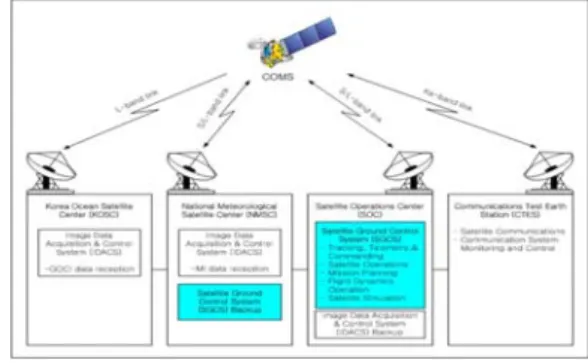
In order to carry out three missions, COMS system consists of three payloads, a spacecraft bus and ground segment as shown in Figure 1. From a functional point of view, COMS ground segment comprises SGCS for satellite operation, Image Data Acquisition and Control System (IDACS) for Meteorological Imager (MI) and Geostationary Ocean Color Imager (GOCI) data processing, and Communications Test Earth Station (CTES) for Ka-band communications. SGCS and IDACS are installed in Satellite Operations Center (SOC) and National Meteorological Satellite Center (NMSC) as cross backup for the redundancy of the satellite control and image data reception.
Figure 1. COMS Ground Segment Architecture
COMS SGCS is the only system for monitor and control of the satellite in orbit. In order to fulfill the mission operations of the three payloads and spacecraft bus, COMS SGCS performs telemetry reception and processing, satellite tracking and ranging, command generation and transmission, satellite mission planning, flight dynamics operations, and satellite simulation. By the proper functional
allocations, COMS SGCS was designed and implemented on five subsystems such as Telemetry, Tracking, and Command subsystem (TTC) [3], Real-time Operations Subsystem (ROS) [4], Mission Planning Subsystem (MPS) [5], Flight Dynamics Subsystem (FDS) [6], and COMS Simulator Subsystem (CSS) [7] as shown in Figure 2. Dynamic satellite simulator system (DSSS) was developed by EADS Astrium and used for technical qualification and operations qualification of the COMS SGCS.
S-band link
Satellite Ground Control System (SGCS) COMS
Mission Planning Subsystem
(MPS)
Real-time Operations Subsystem (ROS) Telemetry, Tracking,
and Command (TTC) - Telemetry Reception - Command Transmission - Tracking and Ranging - Control and Monitoring
- Mission Request Gathering - Mission Scheduling - Mission Schedule Reporting
Mission Plannig Subsystem (MPS)
- Telemetry Processing - Telemetry Analysis - Command Planning - Telecommand Processing
COMS Simulator Subsystem(CSS) - Satellite Dynamic/Static Simulation - Command Verification - Anomaly Simulation
- Orbit Determination and Prediction - Station-Keeping and Re-location Planning - Satellite Event Prediction - Satellite Fuel Accounting Flight Dynamics Subsystem (FDS)
Dynamic Satellite Simulator System (DSSS) by ASTRIUM - SGCS Operational Acceptance Test
Figure 2. COMS SGCS functional architecture
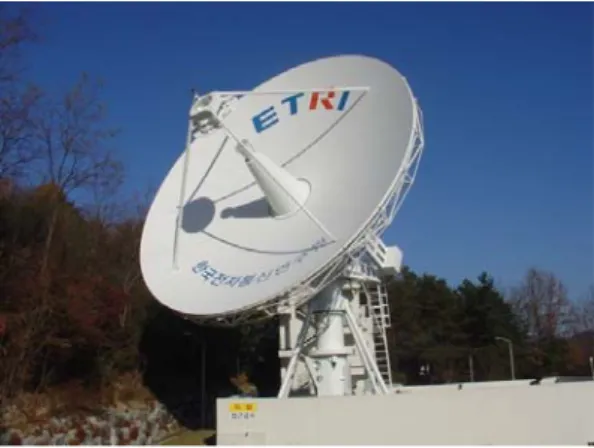
A 13-m mono-pulse Cassegrain type antenna with polarization diversity was established at (KARI) for S-band tracking, telemetry, and command functions and L-band image data reception, and processed data transmission as shown in Figure 3.
Figure 3. 13 meter TTC antenna
Figure 4 shows the COMS satellite control room at KARI. All of the SGCS computer hardware is based on the Intel microprocessor and the operating system is Microsoft Windows XP or Server 2002.
The SGCS computer software is implemented on .NET framework with C# programming language.
COMS SGCS has a dedicated network linked with Ka-band CTES at ETRI, NMSC in Jincheon and Korean Ocean Satellite Center (KOSC) in Ansan.
Figure 4. COMS satellite control center
. Satellite Mission Operations
Ⅲ
1. Daily Operations
The COMS satellite is linked with the SGCS in 24 hours a day. Satellite operators continuously monitor a state of the satellite payload and bus via telemetry link. Satellite command can be generated and transmitted in a regular manner. Daily satellite operations include the following activities.
z Telemetry monitoring and analysis z Telecommand generation and transmission z Daily mission request and scheduling
z Twice-a-day wheel off-loading maneuver and related fuel accounting
z Satellite ranging and orbit determination
z Orbital event prediction and ephemeris distribution
z Urgent payload request reception and command overriding (if any)
Daily payload operational requests from NMSC, KOSC, and CTES should be delivered to MPS via dedicated network by 11 a.m. KST for next day mission. Mission scheduling is performed with payload requests and flight dynamics events until 1 p.m. KST. After the confirmation of the schedule with payload users, final mission planning is delivered to ROS at 2 p.m. KST for command planning. Daily event file for payload users should be delivered until 17:00 KST for the next day data reception.
Twice-a-day Wheel Off-Loading (WOL) maneuvers are operated to prevent the excessive speed
increments of the momentum wheel in the satellite.
Daily WOL set-point parameters are calculated by FDS and transmitted to the MPS for mission scheduling. Daily orbit determination should include the WOL maneuvers effect because the orbit is perturbed by the maneuvers.
The immediate commands can override the nominal command schedule when there are urgent payload and bus command requests.
2. Weekly Operations
The most important weekly operations are station-keeping maneuvers. A North-South station- keeping maneuver is planned and commanded on Monday and the maneuver is executed on Tuesday.
Two days later, East-West station-keeping maneuver should be performed in consideration of the plume impingement effect during the NSSK maneuver.
Flight dynamics predicts weekly orbital events such as on-board sensor blinding, MI and GOCI blinding due to the Sun and Moon.
3. Monthly Operations
The monthly operation of the COMS is the oscillator parameters updating. The ground updates the sidereal oscillator and the tropical Sun oscillator.
This operation allows the Attitude and Orbit Control Subsystem (AOCS) to manage automatically Infra Red Earth Sensor (IRES) Sun blinding during Equinox seasons. These operations can be programmed in advance with the Master Schedule. The FDS has a function to calculate the oscillator parameters. IRES Moon blinding events are also predicted and the related commands should be uploaded on the satellite.
4. Seasonal Operations
Solar array and batteries in the satellite electrical power subsystem are managed before and after the eclipse seasons. RF interference time due to the Sun transit should be calculated by FDS and prepare for the loss of satellite telemetry.
. Operational Validations
Ⅳ
1. Mission Scheduling, Command Planning and Transmission
In order to operate three payloads of the COMS, mission planning includes three functions: mission
request gathering, mission scheduling, and mission schedule reporting. Through mission request gathering, mission requests are delivered from KOSC and MSC in web-driven format for operational activities. The mission requests of the payloads are gathered in predefined time with standard format data file. The FDS predicts various satellite events related to satellite orbit maneuver and also sends them to the MPS.
Figure 5 presents major mission schedule for three days. There are NSSK maneuver on Tuesday and EWSK maneuver on Thursday. Twice a day wheel off-loading operations are also planned. MI is operated in 24 hours and GOCI is used in the morning time. Space look side operations are planned based on the position of the Sun.
Figure 5. Major satellite missions for three days
Figure 6. Gantt chart for mission scheduling
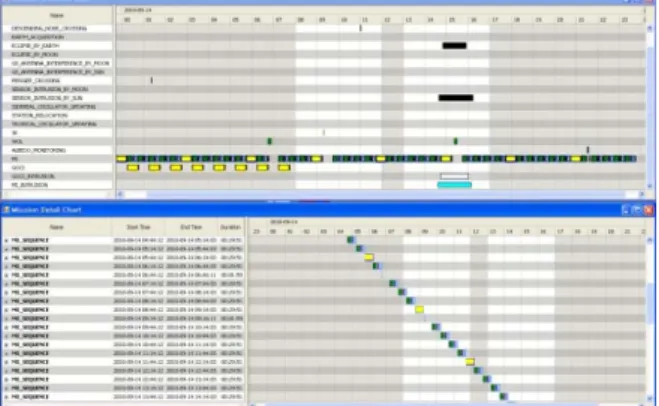
Figure 6 shows two Gantt charts for mission scheduling. The upper chart presents flight dynamics events and payload operations. There are orbital events such as eclipse due to the Earth and IRES, MI, and GOCI intrusion by the Sun. A NSSK maneuver operation is planned. The lower chart presents MI and GOCI payload schedule. There are
MI missions for Full Disk (FD), Extended Northern Hemisphere (ENH), Local Area (LA), Asia-Pacific Northern Hemisphere (APNH), and Limited Southern Hemisphere (LSH). After the completion of the scheduling, the mission timeline is translated to ROS for command planning and transmission.
Figure 7 shows a command transmission window.
The Flight Operation Procedure (FOP) for MI mission is loaded in the window. The FOP procedures are transmitted to the spacecraft in a step by step manner. The COMS FOP has a capability to check the telemetry data validity before transmission. All telecommands sent to the satellite are electronically recorded in a log, which is part of the permanent records of the SGCS. Telecommands sent to the satellite are packaged automatically by the TTC software to include any formatting necessary for the sequences to be recognized by the spacecraft as valid command information.
Figure 7. Command Transmission
2. Telemetry Reception, Processing, and Trend Analysis
The ROS is configured to receive, display, and record telemetry data in realtime. The ROS extracts the proper telemetry values from the telemetry frame to check the validity of the frame before it processes the telemetry frame.
Figure 8 presents the MI master schedule in flight computer of COMS. When the MI plan is transmitted to the spacecraft, the master schedule is downlinked to ground via telemetry link. The satellite operator can check the spacecraft mission.
Figure 9 presents MIMIC diagram for GOCI payload. Real time MIMIC diagram shows that the 16th slot of the GOCI is currently operated. Popup
information box gives telemetry descriptions. The GOCI shutter and filter information are also shown in the Figure 9.
Figure 8. Master schedule for MI
Figure 9. GOCI MIMIC diagram
Figure 10 presents trend analysis during the NSSK maneuver operations. Attitude errors and thruster operations are shown in the windows. During the NSSK maneuver, thruster 1, 2, and 3 are the major contributors.
Figure 10. Realtime trend analysis
3. Satellite Ranging and Orbit Determination
Ground based antenna angle tracking and ranging data are used for daily orbit determination.
Automatic mono-pulse antenna tracking is required for ranging operation because angle data such as azimuth and elevation are required for orbit determination using single station ranging [8]. The ranging operations are carried out in a regular interval, i.e. more than 8 times a day.
Figure 11 presents daily orbit determination window in FDS. Osculating orbital elements are estimated using batch weighted least square method.
Residual values of range, azimuth, and elevation are shown to check the validity of the orbit determination. Bias estimation capability of the measurement data is implemented for estimating of the azimuth angle bias in a singular geometry between the ground station and the satellite.
Figure 11. Orbit determination window
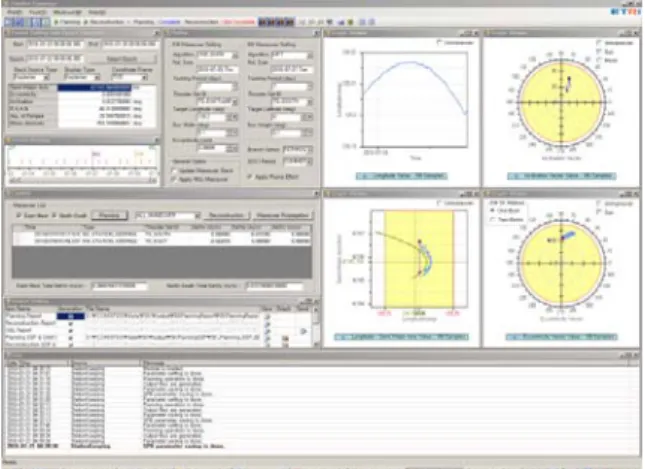
4. Station-Keeping Maneuver and Fuel Accounting In order to keep the COMS satellite in 128.2°±0.05° longitude and latitude box, the satellite should perform station-keeping maneuvers using on-board thrusters in East-West and North-South direction [9]. Figure 12 presents station-keeping maneuver planning window for NSSK and EWSK.
Required velocity changes for the maneuvers are calculated and the related orbit changes are shown.
Satellite telemetry is collected during the thruster operations for station-keeping maneuvers and WOL maneuvers. Thruster data is used for estimating the fuel and oxidizer usage. Figure 13 presents fuel accounting window for WOL maneuver on Oct. 5, 2010. The amount of fuel and oxidizer usage for each thruster is shown in the upper right box. Time
history of the fuel mass is depicted in the lower right box.
Figure 12. Station-keeping maneuver window
Figure 13. Fuel accounting window
. Conclusions
Ⅴ
COMS Satellite Ground Control System(SGCS) has been validated by mission operations during the first three months of In-Orbit Test(IOT) period. Daily, weekly, monthly, and seasonal satellite mission operations were included in the three month of validation activities. All of the major functions of the COMS satellite have been tested so far. The COMS imaging chain including the payload imaging system of Meteorological Imager (MI) and Geostationary Ocean Color Imager(GOCI) and ground processing system of Image Data Acquisition and Control System (IDACS) will be further tested and tuned during the next three month of IOT period.
References
[1] B. S. Lee, W. C. Jung, S. Lee, J.-H. Lee, and– J. Kim, “Design of the COMS Satellite Ground
Control System,” IEIC Technical Report, vol.
106, pp. 35-42, 2006.
[2] W. C. Jung, H.-S. Mo, M.-J. Kim, I.-J. Kim, J.-H. Kim, “Development of the Satellite Operations Subsystem for the KOMPSAT-2 Mission Control Element,” IEIC Technical Report, vol. 104, pp. 103-108, 2004.
[3] T.-H. Kim, J.-H. Lee, W.-C. Jung, J.-H. Kim,
“The Design of TTC Monitoring and Control System in COMS SGCS,“ 25th AIAA International Communications Satellite Systems Conference (ICSSC-2007), 2007.
[4] M. Kim, I. J. Kim, W. C. Jung, J.-H. Kim,
“Design of Real-time Operations Subsystem in COMS SGCS,” 25th AIAA International Communications Satellite Systems Conference (ICSSC-2007), 2007.
[5] S. Lee, W. C. Jung, and J. Kim, “Task Scheduling Algorithm for the Communication, Ocean, and Meteorological Satellite,”, ETRI Journal, vol. 30, pp. 1-12, 2008.
[6] B.-S. Lee, Y. Hwang, H.-Y. Kim, and J. Kim,
“Design of the Flight Dynamics Subsystem for the COMS Satellite Ground Control System”, Proceedings of 3rd Recent Advances in Space Technologies, Istanbul, Turkey, pp. 595-601, June, 2007.
[7] S. Jeong, S. Lee, J. Bang, J. Kim, and T. No,
“Generalized Satellite Multi-Body Attitude Dynamics Modeling using Component-based Design Methodology,” 25th AIAA International Communications Satellite Systems Conference (ICSSC-2007), AIAA 2007-3224, 2007.
[8] Y. Hwang, B.-S. Lee, H.-Y. Kim, H. Kim, and J. Kim, “Orbit Determination Accuracy Improvement for Geostationary Satellite with Single Station Antenna Tracking Data,” ETRI J.
vol. 30, pp. 774 – 782, 2008.
[9] H.-Y. Kim, B.-S. Lee, Y. Hwang, D. Shin, and J. Kim,“Station Keeping Maneuver Planning Using COMS Flight Dynamics Software,“ IEICE Technical Report, vol. 107, pp. 113 – 118, 2007.
저 자
이 병 선 (Byoung-Sun Lee) 정회원
년 월 연세대학교 천문우주학 2001 2 :
박사
년 월 현재 책임연구원
1989 10 ∼ :ETRI
관심분야 위성시스템 위성관제
< > , ,
우주비행역학
김 인 준 (In Jun Kim) 정회원
년 월 건국대학교 전자공학 1999 2 :
석사
년 월 현재 선임연구원
1999 4 ∼ :ETRI
관심분야 위성관제 항법측위시스템
< > ,
이 수 전 (Soojeon Lee) 정회원
년 월 전 컴퓨터
2005 2 :KAIST( ICU) 공학 석사
년 월 현재 선임연구원
2005 2 ∼ :ETRI
관심분야 위성관제 임무 스케줄링
< > ,
황 유 라 (Yoola Hwang) 정회원
년 월 미 콜로라도대 항공
2003 12 :
우주공학 박사
년 월 현재 선임연구원
2004 6 ∼ :ETRI
관심분야 위성관제 항법 정밀측위
< > , ,
정 원 찬 (Won Chan Jung) 정회원
년 월 미 루이지애나 주립대 1992 5 :
컴퓨터과학 박사
년 월 현재 책임연구원
1992 6 ∼ :ETRI
관심분야 위성통신시스템 위성관제
< > ,
김 재 훈 (Jaehoon Kim) 정회원 년 월 충북대학교 컴퓨터공학 2001 9 :
박사
년 월 현재 위성시스템
1983 3 ∼ :ETRI 연구팀장
관심분야 위성관제 위성방송통신
< > ,
김 해 연 (Hae-Yeon Kim) 정회원
년 월 연세대학교 천문우주학 2005 2 :
석사
년 월 년 월 연
2005 3 ∼2009 3 :ETRI 구원
년 월 현재 연구원
2009 12 ∼ :KARI
관심분야 위성관제 우주비행역학
< > ,
이 훈 희 (Hoon-Hee Lee) 정회원
년 월 인하대학교 항공우주 2005 8 :
공학 석사
년 월 현재 연구원
2005 8 ∼ :KARI
관심분야 우주공학 시뮬레이션
< > , &
모델링
이 상 철 (Sang-cherl Lee) 정회원
년 월 전북대학교 항공우주 1999 2 :
공학 석사
년 월 현재 선임연구원
1999 3 ∼ :KARI
관심분야 위성통신 우주공학
< > ,
조 영 민 (Young-Min Cho) 정회원
년 월 물리학
1994 2 :KAIST 박사
년 월 현재 책임연구원
1995 3 ∼ :KARI
관심분야 위성탑재체 위성관제
< > ,
김 방 엽 (Bang-Yeop Kim) 정회원
년 월 연세대학교 천문우주학 2002 8 :
박사
년 월 현재 정지궤도
1995 3 ∼ :KARI
위성 관제팀장
관심분야 위성운용 정지위성 임무
< > ,
해석