• 검색 결과가 없습니다.

Convergent Influence Effect on the High - Quality CPR of 119 Paramedics by Wearing Personal Protective Equipment by Level

N/A
N/A
Protected

Academic year: 2021

Share "Convergent Influence Effect on the High - Quality CPR of 119 Paramedics by Wearing Personal Protective Equipment by Level"

Copied!
8
0
0

로드 중.... (전체 텍스트 보기)

전체 글

(1)

Convergent Influence Effect on the High - Quality CPR of 119 Paramedics by Wearing Personal Protective Equipment by Level

Dong-Min Shin 1 , Byung-Jun Cho 2 , Hyun-Mo Yang 1 , Seong-Man Jeon 3 , Yong-Taek Han 4*

1

Professor, Department of Paramedic Science, Korea National University of Transportation

2

Professor, Department of Paramedic Science, Kangwon National University

3

Master’s Course, Department of Paramedic Science, Korea National University of Transportation

4

Professor, Department of Safety and Environmental Prevention, Daegu Haany University

구급대원의 수준별 개인용 보호구 착용에 따른 심폐소생술 품질에 미치는 융합적인 영향

신동민 1 , 조병준 2 , 양현모 1 , 전성만 3 , 한용택 4*

1

한국교통대학교 응급구조학과 교수,

2

강원대학교 응급구조학과 교수,

3

한국교통대학교 응급구조학과 석사과정,

4

대구한의대학교 소방방재환경전공 교수

Abstract The purpose of this study is to investigate the effect of wearing clothes, Level B, and Level C PPE on normal CPR using mannequins. The paramedics who participated in this experiment were 20 paramedics with more than 5 years of experience in firefighting area C. It was found that chest compressions in the process that hand off time was 11.9 seconds in the uniform wearing group, 11.4 seconds in the level C PPE wearing group, and 13.1 seconds in the SCBA wearing group. In other words, wearing personal protective equipment prevents the movement of paramedics and uses compensatory movements, which may increase the difficulty of efficient first aid. If this situation persists, it may cause fatigue and damage to the body of paramedics. Rescue and paramedics should wear level personal protective equipment in case of emergencies and conduct rescue and CPR training.

Key Words : Helmet, Personal protective equipment, Self-contained breathing apparatus, Cardio pulmonary resuscitation, Paramedics

요 약 본 연구에서는 마네킹을 이용해서 평상시 응급처치시 입는 옷, 레벨 B, 레벨 C PPE를 착용이 고품질의 심폐소 생술에 미치는 영향을 알아보고자 한다. 본 실험에 참여한 응급구조사는 C 지역 소방 소속의 5년 이상의 경력을 가진 119 구급대원 20명을 대상으로 하였다. 심폐소생술 중 가슴압박이 중지되는 손이탈 시간 및 비율의 경우 유니폼 착용 그룹에서 11.9 초, 레벨 C PPE 착용 그룹에서 11.4 초, SCBA 착용 그룹에서 13.1 초인 것으로 밝혀졌다. 개인보호장 비 착용은 구급대원의 움직임을 방해하고 있고 보상동작을 사용하게 되어 효율적인 응급처치의 어려움이 나타날 가능 성이 많아지며, 이러한 상황이 지속될 경우 구급대원의 신체에도 피로감과 손상을 줄 수 있다. 구조 및 구급대원들은 응급상황을 대비해서 레벨별 개인보호장비를 착용하고 구조 및 심폐소생술 훈련에 임하여야 한다.

주제어 : 헬멧, 보호복, 공기호흡기, 심폐소생술, 응급구조사

*The study was conducted by a research program funded by the Korea National University of Transportation in 2018.

*Corresponding Author : Yong-taek Han([email protected]) Received January 29, 2020

Accepted April 20, 2020

Revised March 27, 2020

Published April 28, 2020

(2)

1. Introduction

Chemical, Bological, Radiological, Nuclear and Explosive(CBRNE) situations refer to disasters caused by chemical, biological, radiation, nuclear and explosives. Personal protective equipment(PPE) is essential to prevent secondary contamination when providing first aid and first aid to a patient in such a disaster. Therefore, emergency responders must select the appropriate PPE.

The Occupational Safety and Health Administration(OSHA)[1] says that emergency responders may use PPE in situations such as evolving disease, accidental industrial or commercial pollution, domestic and international terrorism, mass disasters and traffic accidents) to wear. Disasters sometimes appear in the form of CBRNE caused by explosions and trauma.

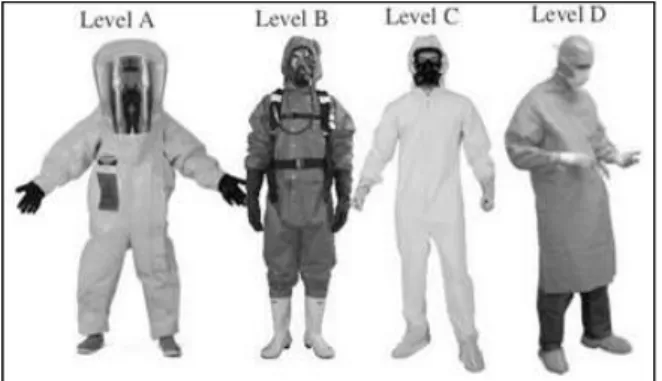
The most common protective clothing is protection levels A, B, C, and D as established by the OSHA. Paramedics need PPE to safely enter areas contaminated with HAZMAT to treat injuries. Level A is aimed at the maximum possible blocking and protection in the most severe stages of exposed hazardous substances.

Along with positive pressure ventilated scuba (SCBA) equipment, these include capsule-type suits and gloves that block the body completely from the outside and block chemicals and vapors. Level B has a similar level of respiratory protection compared to level A, but protection against skin is a step down from level A. Level C is applicable when breathing is possible after the respiratory disease is blocked by purifying contaminated air through the air purifier and not by the scuba breathing. Level D is the minimum level of protection provided that there is no exposure to dangerous substances that can be damaged by respiratory or liquid ejection.

A recent study, on the other hand, suggests that personal protective equipment reduces crew movement and increases muscle sprains.

Therefore, it has a negative effect on the

performance of the activity[2-6]. Smith's study also found that PPE increases volume and weight, constraining members' activities and increasing physical strains[7]. In Korea, detailed procedures and actions, central guidelines and roles of the Central 119 Rescue Team are specified in the CBRNE Manual through the Terrorism and Accident Response Manual. Doing. In the event of a disaster, it is stated that protective clothing, respirators, non-penetrating gloves and boots should be worn by default. Paramedics working primarily in warm zones and cold zones should wear Class B or C protective clothing[8].

Since chest compressions become shallower between 1.5 and 3 minutes after CPR starts, alternating chest compressions every two minutes can help reduce rescuer fatigue and provide high quality CPR[9]. Several previous studies have evaluated the effects of PPE on airway management[10]. There is also little research on chest compression quality using PPE level C. However, few studies have performed high quality CPR on level B. The purpose of this study was to provide basic data on how to provide high quality CPR to patients after wearing normal clothes, Level B, and Level C using mannequins.

2. Research Method

2.1 Subject

The experiment was conducted at the 2nd floor simulation center of K University Health Center, C. The paramedics participated in this experiment were 20 119 paramedics with more than 5 years' experience in firefighting in C area.

The subjects were selected as those who have practical experience in CPR and are in charge of first aid. All subjects agreed in writing after hearing the full explanation of the experiment.

Subjects who did not wish to participate in the

study were not included. Subjects selected the

(3)

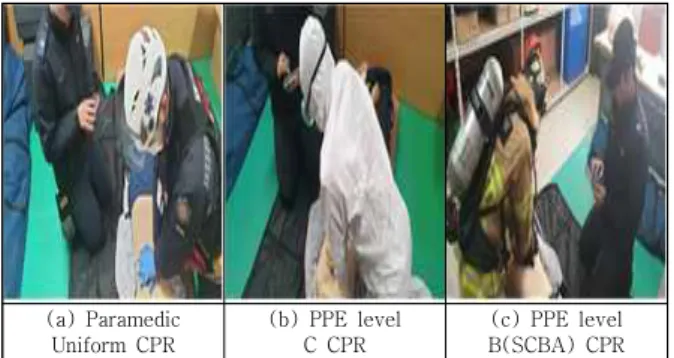
number from the box containing the number, and after 1, they wore their usual clothes, 2, PPE C, and 3, SCBA after wearing CPR. I took a break (more than 3 hours each). Afterwards, the subjects who wore normal clothes wore PPE C, and those who wore PPE C wore SCBA, and those who wore SCBA performed CPR in the order of normal clothes. In this experiment, personal protective equipment (Tychem C, gas mask # 6800, 3M) corresponding to OSHA PPE level C was worn, and PPE level B was equipped with a self-contained breathing apparatus (SCBA). The experimental photograph is shown in Fig. 1.

(a) Paramedic Uniform CPR

(b) PPE level C CPR

(c) PPE level B(SCBA) CPR

Fig. 1. (a) (b) (c) PPE(Personal protective equipment) and CPR.

2.2 CPR

The experiment will begin with the investigator's start signal and subjects will receive 30 chest compressions and 2 chest compressions on the floor of a manikin (Resusci Anne QCPR®, Laerdal, Stavanger, Norway) set up to perform CPR for a cardiac arrest patient in a disaster situation. A 30: 2 one-man CPR procedure was performed. Previous studies [11,12] performed 30: 2 CPR for 5 minutes, but this study was performed for 4 minutes considering indoor environment and personal protective equipment.

Pulse check was not performed in the middle of CPR, and artificial respiration was performed using a bag-valve mask, considering that respiratory protective equipment cannot be used to orally ventilate with the patient. Positive pressure ventilation was performed.

Mannequins performed CPR using Laerdal's Resusci Anne QCPR®, a 'QCPR Instructor' app that monitors the feedback device mounted inside the mannequin in conjunction with the instructor's tablet device and stores the result in real time. The subject's name initials were stored in the app by date and time in a digitized record that includes chest compression rate, relaxation rate, average chest compression depth, speed, and adequate ventilation (using a pocket mask).

In addition, the CPR sequence, location of chest compressions, and chest compression stop time were used by the investigator to evaluate the appropriateness or inadequacy.

2.3 Analysis of Research Data

SPSS 23.0 was used to evaluate the results of chest compressions and posture analysis of the paramedics according to the wearing of personal protective equipment during CPR. The results obtained are described as mean and standard deviation.

Since the normality of each measurement item was small in size, Shapiro-Wilk's normality test was conducted. The statistical significance level α was .05.

3. Research Results

3.1 General characteristics of the subject The participants in this study were 20 male paramedics with a career of 97.55 ± 51.81 months, an average age of 33.35 ± 4.57 years, and a weight of 63.55 ± 11.41 kg. The results is shown in Table 1.

Variables Mean±SD

Age (years) 33.35± 4.57

Career (months) 97.55±51.81

Height (Cm) 176.45±6.43

Weight (kg) 63.55±11.41

Table 1. General characteristics of the subjects (N=20)

(4)

3.2 Quality comparison of CPR 3.2.1 Quality of chest compressions

As a result, there was no difference in the relaxation depth of chest compression, and the average speed and the average depth were statistically different. However, there were statistical differences in the number of chest compression successes, hand off time, correct BVM use, and number of under ventilation.

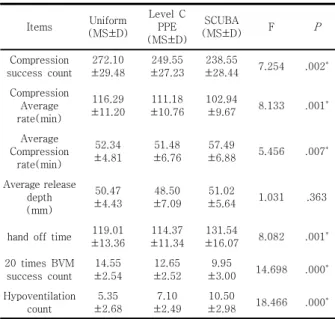
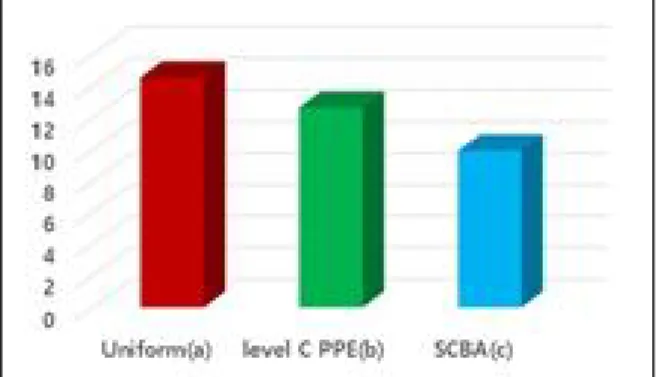
The number of successful chest compressions was 272 in uniforms, 249 in Level C PPE, and 238 in SCBA. The group wearing the uniform had more successes and had a statistically significant difference compared with the group wearing the Level C PPE and the group wearing the SCBA (p

<0.05). There was no statistical difference between the group wearing Level C PPE and the group wearing SCBA. The quality of chest compressions results is shown in Table 2 and Fig. 2.

Items Uniform (MS±D)

Level C PPE (MS±D)

SCUBA

(MS±D) F P

Compression success count

272.10

±29.48

249.55

±27.23

238.55

±28.44 7.254 .002

*

Compression

Average rate(min)

116.29

±11.20

111.18

±10.76

102.94

±9.67 8.133 .001

*

Average Compression

rate(min)

52.34

±4.81

51.48

±6.76

57.49

±6.88 5.456 .007

*

Average release depth (mm)

50.47

±4.43

48.50

±7.09

51.02

±5.64 1.031 .363

hand off time 119.01

±13.36

114.37

±11.34

131.54

±16.07 8.082 .001

*

20 times BVM

success count 14.55

±2.54

12.65

±2.52

9.95

±3.00 14.698 .000

*

Hypoventilation

count

5.35

±2.68

7.10

±2.49

10.50

±2.98 18.466 .000

*

Table 2. The quality of CPR among three groups

3.2.2 Hand off time

Hand off time was 11.9 seconds in the Uniform wearing group, 11.4 seconds in the Level C PPE wearing group, and 13.1 seconds in the SCBA wearing group. The group wearing SCBA showed longer hand off time and a statistically significant

difference than the group wearing Uniform and the Level C PPE (p <0.05). There was no statistically significant difference between the group wearing the uniform and the group wearing the Level C PPE. The hand off time result is shown in Table 2 and Fig. 3.

3.2.3 BVM Ventilation

Among the 20 BVM ventilations, the number of successes was 14.5 in the Uniform wearing group, 12.6 in the Level C PPE wearing group, and 9.9 in the SCBA wearing group.

The group wearing SCBA had fewer successful BVM ventilations than the group wearing Uniform and Level C PPE and showed a statistically significant difference (p <0.05). There was no statistically significant difference between the group wearing the uniform and the group wearing the Level C PPE. 3>. The number of low ventilation was 14.5 in the uniform wearing group, 12.6 in the Level C PPE wearing group and 9.9 in the SCBA wearing group. The group wearing the SCBA had a higher number of low ventilation and a statistically significant difference compared with the group wearing the Uniform and the Level C PPE (p <0.05). There was no statistically significant difference between the group wearing the uniform and the group wearing the Level C PPE. The BVM ventilation result is shown in Table 2 and Fig. 4.

Fig. 2. Chest compression success count among three

groups

(5)

Fig. 3. Hand off time among three groups

Fig. 4. Number of 20 successful BVM among three groups

4. Contemplation

In this study, there was no difference in the relaxation depth of chest compression, and there was a statistical difference in mean velocity and mean depth, but all three groups showed results that meet the AHA 2015 standard guidelines.

There were statistical differences in the number of chest compression successes, hand off time, correct number of BVM use, and the number of under ventilation.

In a previous study, paramedics wearing personal protective clothing had worse results in the time and rate of hand release when breast compression was stopped when breast compression was performed. The mean cardiopulmonary resuscitation time was 11.1 seconds and 12.5 seconds in the non-wearing and wearing groups, respectively, longer than the wearing group (p

<0.05), and the average difference between

individuals was 1.3 seconds. Also, this result is consistent with the study that the quality of chest compression is improved through the stability of the core muscle[11].

This suggests that patients do not receive chest compressions for about 1.3 seconds per cycle when wearing CPR and this will increase with longer CPR. It also suggests that wearing personal protective clothing, including gloves, has a negative effect on chest compressions and may delay chest compressions and switching to ventilation techniques when performing CPR[12,13]. Ben-Abraham et al. Noted that CBRN protection makes injecting intravenous more difficult[5]. Punakallio et al. Reported that PPE increased fatigue[14]. Therefore, it is judged that the standardization and manufacture of PPE equipment in accordance with the standard body of Koreans can improve the problems.

The total hand departure time for 4 minutes increased from 107.00 ± 12.12 seconds without wearing personal protective equipment to 113.36

± 14.32 seconds after wearing, and the average

hand release time per cycle also increased from

11.13 ± 2.54 seconds to 12.55 ± 2.62 seconds

The time to stop the pressure increased. These

results suggest that wearing a protective glove on

the hand did not make proper adjustment due to

sensory changes in the hand. Coronary perfusion

pressure decreases rapidly even during short

chest compressions, which adversely affects the

resuscitation of patients[15]. Therefore, it is

important to wear gloves that can freely move

hands during first aid. However, the average

chest compression depth was 50.46 ± 5.98mm

when the gloves were worn, but not statistically

significant. This satisfies the minimum standard

of 5cm, recommended by Field et al.[15] both

before and after wearing personal protective

equipment. These results suggest that paramedics

were more consciously pressured to compensate

for the slowing down of CPR caused by

unfamiliar protective equipment. Therefore, if

(6)

training and education using personal protective equipment become habitual, it is considered that chest compression can be maintained while maintaining the depth of chest compression properly.

The most common protective suit is OSHA's typical protective suit as shown in Fig. 5. The SCBA consists of turnout coats, trousers, boots, gloves, breathing apparatus and helmets, and serves to protect paramedics from dangerous liquids, physical and electrical hazards as well as flames and high temperatures. The risk of death from apnea or cardiac arrest following a CBRN accident is very high[16]. Rapid treatment immediately after a CBRN accident can minimize the delay of death and maximize the chance of survival[10]. Decontamination after a CBRN accident takes at least 12 minutes per casualty, so emergency responders wearing CBRNs must wear personal protective equipment (PPE) and perform resuscitation procedures in warm areas (between contaminated areas)[17].

Fig. 5. Personal protective equipment by level

5. Conclusion

In the case of CPR, there was no difference in the index of chest compression in the group, but the worsening time and the rate at which chest compression was stopped showed worse results in the group wearing personal protective clothing.

In the case of paramedics wearing personal

protective equipment, the positive pressure ventilation index decreased. This result shows that the bag-valve mask use is not properly made. Wearing personal protective equipment can disrupt the movement of paramedics and decrease the likelihood of efficient first aid, and if sustained, can cause fatigue and damage to the paramedic's body. Therefore, rescue and paramedics should wear personal protective equipment for each level in case of an emergency and perform rescue and CPR training.

6. Suggestions

In order to provide high quality CPR, two rescuer CPR should be performed rather than single rescuer CPR. Cooperation between rescuers is very important. Therefore, it is recommended that two or more rescuers collaborate in the basic resuscitation process with emphasis on how to provide high quality CPR.

In addition, for the protection of paramedics in a disaster situation, it should be possible to research and develop personal protective equipment suitable for reality.

REFERENCES

[1] Occupational Safety and Health Standards. (1994).

General description and discussion of the levels of protection and protective gear. U.S. DEPARTMENT OF LABOR [Online].

https://www.osha.gov/pls/oshaweb/owadisp.show_do cument?p_id=10653&p_table=STANDARDS

[2] K. G. Davis, P. A. Succop, W. A. Jetter & A.

Bhattacharya. (2006). Postural Balance Changes in on-duty Firefighters: Effect of Gear and Long Work Shifts. Jour Occup Environ Med, 48(1), 68-75.

DOI : 10.1097/01.jom.0000181756.38010.d2

[3] K. Park, K. S. Rosengren, G. P. Horn, D. L. Smith & E.

T. Hsiao-Wecksler. (2011). Assessing Gait Changes in Firefighters due to Fatigue and Protective Clothing.

Safe Scie, 49(5), 719-726.

DOI : 10.1016/j.ssci.2011.01.012

[4] A. Coca, R. Roberge, A. Shepherd, J. B. Powell, J. O.

(7)

Stull & W. J. Williams. (2007). Ergonomic Comparison of a Chem/Bio Prototype Firefighter Ensemble and a Standard Ensembles on Mobility and Performance.

Appl Ergon, 104(2), 636-641.

DOI : 10.1007/s00421-007-0644-z

[5] R. Ben-Abraham, I. Gur, Y. Vater & A. A. Weinbroum.

(2003). Intraosseous Emergency Access by Physicians Wearing Full Protective Gear. Acad Emerg Med, 10(12), 1407-1410.

DOI : 10.1197/S1069-6563(03)00546-3

[6] H. J. Park, S. Y. Kim, K. Morris, M. Moukperian, Y. J.

Moon & J. Stull. (2015). Effect of Firefighters Personal Protective Equipment on Gait. Appl Ergon, 48, 42-48.

DOI : 10.1016/j.apergo.2014.11.001

[7] D. L. Smith. (2008). Firefighter Fatalities and Injuries:

the Role of Heat Stress and PPE. Firefighter Life Safety Research Center. Illinois : University of Illinois fire service institute firefighter life safety research center.

[8] National 119 Rescue Headquarters. (2012). CBRN terrorism and incident response manual.

[9] N. Castle, J. Bowen & N. Spencer. (2010). Does wearing CBRN-PPE adversely affect the ability for clinicians to accurately, safely, and speedily draw up drugs. Journal Clinical Toxicology, 48(6), 522-529.

DOI : 10.3109/15563650.2010.491483

[10] P. C. Muskat. (2008). Mass casualty chemical exposure and implications for respiratory failure. Respir Care, 53(1), 58–63.

[11] E. J. Hong, B. J. Cho & G. Y. Kim. (2019). Effect of chest compressions on the quality of back pain prevention and chest compressions by applying body stabilization Convergence movement. Journal of the Korea Convergence Society, 10(5), 85-94.

DOI : 110.15207/JKCS.2019.10.5.085

[12] J. Chen, K. Z. Lu, B. Yi & Y. Chen. (2016). Chest Compression With Personal Protective Equipment During Cardiopulmonary Resuscitation A Randomized Crossover Simulation Study. Medicine, 95(14), 3262.

DOI : 10.1097/MD.0000000000003262

[13] N. Castle, Y. Pillay & N. Spencer. (2011). Comparison of six different intubation aids for use while wearing CBRN-PPE: a manikin study. Resuscitation, 82(12), 1548-1552.

DOI : 10.1016/j.resuscitation.2011.06.020

[14] A. Punakallio, S. Lusa & R. Luukkonen. (2003).

Protective Equipment Affects Balance Abilities Differently in Younger and Older Firefighters. Avia Spa & Envir Medi, 74(11), 1151-1156.

[15] J. M. Field et al. (2010). Part 1: Executive summary 2010 American Heart Association guidelines for cardiopulmonary resuscitation and emergency cardiovascular care.

Circulation, 122(3), S640-656.

DOI : 10.1161/CIRCULATIONAHA.110.970889 [16] Y. Tokuda et al. (2006). Prehospital management of

sarin nerve gas terrorism in urban settings: 10 years

of progress after the Tokyo subway sarin attack.

Resuscitation, 68(2), 193–202.

DOI : 10.1016/j.resuscitation.2005.05.023

[17] J. F. Laurent, F. Richter & A. Michel . (1999).

Management of victims of urban chemical attack: the French approach. Resuscitation, 42(2), 141–149.

DOI : 10.1016/S0300-9572(99)00099-4

신 동 민(Dong-Min Shin) [정회원]

․ 2000년 5월 : 미국 Aubum 대학 박 사 취득

․ 1995년 8월 ~ 현재 : 한국교통대학교 응급구조학과 교수

․ 2013년 3월 ~ 현재 : 재난관리융합연 구소 소장

․ 2016년 3월 ~ 현재 : 한국 응급구조학 회 회장

․ 2019년 4월 ~ 현재 : 한국시뮬레이션학회 부회장

․ 관심분야 : 응급구조, 응급의학, 시뮬레이션교육

․ E-Mail : [email protected]

조 병 준(Byung-Jun Cho) [종신회원]

․ 2003년 2월 : 충남대학교 대학원(이 학박사)

․ 2008년 2월 ~ 2010년 3월 : 대원대 학교 응급구조학과 교수

․ 2010년 3월 ~ 현재 : 강원대학교 응급 구조학과 교수

․ 관심분야 : 응급구조학, 스포츠의학, 보 건의료 융합

․ E-Mail : [email protected]

양 현 모(Hyun-Mo Yang) [종신회원]

․ 2017년 8월 : 충남대학교 의학과(의학 박사)

․ 2014년 3월 ~ 2019년 2월 : 동주대 학교 응급구조과 조교수

․ 2019년 3월 ~ 현재 : 한국교통대학교 응급구조학과 조교수

․ 관심분야 : 응급구조학, 응급의학

․ E-Mail : [email protected]

(8)

전 성 만(Seong-Man Jeon) [학생회원]

․ 2014년 2월 : 한국교통대학교 응급 구조학과 (보건학사)

․ 2019년 1월 현재 : 한국교통대학교 대 학원 (응급구조학 석사과정 중)

․ 2017년 1월 ~ 2018년 12월 : 충북대 학교병원 외상센터 응급구조사

․ 관심분야 : 응급구조학

․ E-Mail : [email protected]

한 용 택(Yong-Taek Han) [정회원]

․ 1999년 7월 : 한양대학교 기계공학 과(공학석사)

․ 2006년 2월 : 한양대학교 기계공학과 (공학박사)

․ 2019년 9월 ~ 현재 : 대구한의대학교 소방방재환경학과 교수

․ 관심분야 : 소방, 장비

․ E-Mail : [email protected]

수치

Fig. 1. (a) (b) (c) PPE(Personal protective equipment)  and  CPR.
Table  2.  The  quality  of  CPR  among  three  groups
Fig.  4.  Number  of  20  successful  BVM  among  three  groups
Fig.  5.  Personal  protective  equipment  by  level

참조

관련 문서

 The Dutch physicist Pieter Zeeman showed the spectral lines emitted by atoms in a magnetic field split into multiple energy levels...  With no magnetic field to align them,

Modern Physics for Scientists and Engineers International Edition,

If both these adjustments are considered, the resulting approach is called a bootstrap-BC a -method (bias- corrected-accelerated). A description of this approach

2재화 2요소 헥셔-올린 모형에서는 어느 한 경제에서 어느 한 요소의 양이 증가하면, 그 요소를 집약적으로 사용하는 산업의 생산량은 증가하고 다른

Ross: As my lawfully wedded wife, in sickness and in health, until

웹 표준을 지원하는 플랫폼에서 큰 수정없이 실행 가능함 패키징을 통해 다양한 기기를 위한 앱을 작성할 수 있음 네이티브 앱과

_____ culture appears to be attractive (도시의) to the

다양한 번역 작품과 번역에 관한 책을 읽는 것은 단순히 다른 시대와 언어, 문화의 교류를 넘어 지구촌이 서로 이해하고 하나가