Correlation between Peripheral Neuropathy and Cognitive Factors in Type 2 Diabetic Patients
Wonyul Yang1, Jong Kuk Kim2, Kyung Won Park2, Sunghwan Suh1, Hye-Jeong Lee3 and Mi-Kyoung Park1*
1Department of Internal Medicine, Dong-A University College of Medicine, Busan 49201, Korea
2Department of Neurology, Dong-A University College of Medicine, Busan 49201, Korea
3Department of Pharmacology, Dong-A University College of Medicine, Busan 49201, Korea Received November 14, 2019 /Revised December 30, 2019 /Accepted January 1, 2020
Diabetes is a well-known risk factor for dementia and cognitive impairment. Diabetic polyneuropathy (DPN) is the most prevalent microvascular complication in type 2 diabetes mellitus (T2DM) patients.
The purpose of this study was to evaluate the relation between diabetic peripheral polyneuropathy and cognitive factors in T2DM patients. Retrospective chart review of type 2 diabetic patients with results of a nerve conduction study (NCS) and a neurocognitive study. A total of 19 patients were included. DPN was defined using data from a nerve conduction study: a score of less than 24 in the Korean version of the Mini-Mental State Examination (K-MMSE) was considered as an indicator of cognitive impairment (CI). The mean age of the 19 patients was 71.6±5.0 years. The mean duration of diabetes was 8.4±9.1 years, and the mean HbA1c level was 8.1±1.8%. DPN was present in 7 of the 19 patients. Based on the K-MMSE score, CI was diagnosed in eight patients. The mean K-MMSE scores and the prevalence of CI was not different between the groups with and without DPN. There was no significant difference in DPN prevalence between the groups with and without CI. Education was significantly correlated with cognitive factors. Only the digit span-forward among the cognitive factors showed a significant negative correlation with nerve conduction velocity. In conclusion, the longer education period was associated with higher cognitive function and no significant correlation was observed between diabetic peripheral neuropathy and cognitive dysfunction in type 2 diabetic patients. Further prospective research is needed in the future.
Key words : Cognitive factors, nerve conduction study, peripheral polyneuropathy, type 2 diabetes
*Corresponding author
*Tel : +82-51-240-2815, Fax : +82-51-242-5852
*E-mail : [email protected]
This is an Open-Access article distributed under the terms of the Creative Commons Attribution Non-Commercial License (http://creativecommons.org/licenses/by-nc/3.0) which permits unrestricted non-commercial use, distribution, and reproduction in any medium, provided the original work is properly cited.
Journal of Life Science 2020 Vol. 30. No. 3. 250~259 DOI : https://doi.org/10.5352/JLS.2020.30.3.250
서 론
당뇨병의 유병률은 전세계적으로 급증하고 있으며, 우리나 라에서도 증가 추세에 있다[8]. 이러한 당뇨병 유병률 및 발생 률의 증가는 노령 인구의 증가, 소아 비만, 서구화된 생활 습관 및 식습관, 조기 검진의 보편화 등의 이유 때문인 것으로 여겨 지고 있다. 최근 우리나라도 빠르게 초고령 사회로 접어들면 서 여러 가지 사회적 문제가 유발 되고 있는데[10], 노인 질환 특히, 치매와 인지기능 장애는 당뇨병과 더불어 가장 흔히 동 반되는 질환 중의 하나로 경제적, 사회적으로 큰 부담이 되어 중요한 문제로 대두되고 있다. 알츠하이머병의 발생에는 고 령, 비만, 교육 수준, 당뇨병, 뇌졸종 및 apoprotein ε4 (APOE
ε4)와 같은 여러 위험 인자들이 주요 역할을 할 것이라는 연구 결과들이 나오면서[16], 이러한 위험 위험인자들의 역할을 규 명하고 예방하는 것에 집중을 해야 할 것으로 제시되고 있다.
제2형 당뇨병은 인지 기능 저하의 진행을 더 촉진하고, 알츠 하이머병과 혈관성 치매 발생 위험을 증가시킨다고 알려져 있다[17, 22]. 당뇨병 환자에서 당뇨병 유병기간, 저혈당, 인슐 린 사용, 경구혈당강하제, 심혈관계 합병증 등이 인지기능과 연관된다는 보고들이 있다[3, 14].
당뇨병성 신경병증은 미세혈관합병증 중 가장 흔한 만성 합병증으로 알려져 있다. 우리나라의 유병율은 15-54%로 보고 하고 있고[19], 삶의 질 저하와 함께 질병의 이환율, 사망률 증가와 같은 중대한 임상적 의미를 지닌다. 당뇨병 유병 기간 이 길어질수록 빈도도 증가하여, 고령의 당뇨병 환자에서 높 은 유병율을 보인다. 당뇨병성 말초신경병증(diabetic poly- neuropathy, DPN)은 주로 감각 신경을 침범하지만 드물게 운 동 신경을 침범할 수 있으며, 감각 신경 장애가 오래 지속되고 심하면 운동 기능 저하 및 신체 기능 저하를 동반할 수 있다고 알려져 있다[20].
중추 신경계 합병증인 치매 및 인지기능장애와 말초신경병 증은 당뇨병 환자에서 가장 흔히 동반되는 대표적인 2개의
신경계의 합병증임에도 불구하고 이들 간의 연관성에 대한 보고는 매우 드물다. 일부 당뇨병성 자율신경합병증이 인지기 능장애와 관련이 있다는 보고가 있었으며[13, 23], 몇몇 소규모 연구에서 말초신경병증의 증상[15], 또는 근전도에 기초한 당 뇨병성 말초신경병증과 인지기능 간의 연관성[21]을 보고하였 고, 신경증상과 NCS에 기초하여 DPN을 진단하고 인지기능 항목을 조사하여 DPN 군과 당뇨병이 없는 대조군과 비교한 연구가 있었다[18]. 말초신경병증의 진단법의 표준으로 인정 되고 있는 신경전도검사(nerve conduction study, NCS) 결과 와 인지 기능 항목들간의 상관성에 관한 연구는 국내 뿐만 아니라 전세계적으로 드물며, 제2형 당뇨병 환자에서 NCS에 기초한 DPN 동반군과 동반하지 않은 군 간에 인지기능항목을 비교한 연구는 거의 없다.
본 연구는 제2형 당뇨병에서 흔히 발생되는 대표적인 신경 계 합병증인 말초신경병과 인지기능 장애 간의 상호 관련성에 관하여 알아보고, 인지기능 장애에 영향을 미치는 인자들을 확인해 보고자 하였다.
재료 및 방법 연구 대상
본 연구는 2005년 1월 1일부터 2016년 10월 31일까지 동아 대학교의료원에 내원한 제2형 당뇨병 환자들을 대상으로 후 향적으로 의무기록지를 확인하여 신경전도검사와 신경인지 기능검사를 시행한 환자들의 검사 결과와 임상적 특징들을 조사하였다. 포함 기준은 제 2형 당뇨병 진단된 환자에서 신경 인지기능 검사와 말초신경전도 검사를 모두 시행한 환자이며, 제외기준은 제1형 당뇨병 및 이차성 당뇨병 환자, 신경전도검 사나 신경인지검사를 시행하지 않은 경우 제외하였다. 본 연 구는 동아대학교의료원 임상연구심사위원회(Institutional Review Board, IRB)의 승인을 받은 이후 진행되었다 (DAUHIRB-16-173).
연구 방법 신체 계측과 혈압
환자의 성별, 나이, 당뇨병 진단 시기, 고혈압 및 고지혈증 진단 여부, 우울증 동반 여부, 과거 심혈관 질환 동반 여부, 교육 기간 들을 진료기록부로 확인하였다. 조사 대상 환자 모 두 입원하여 검사를 진행하였으며, 입원 당시 가벼운 옷차림 을 한 상태에서 측정된 키, 체중을 기록하였다. 체질량지수 (body mass index, BMI)는 체중(kg)을 신장(m)의 제곱으로 나누어 계산하였다. 혈압은 최소 10분 이상 안정 상태에서 앉 은 자세로 팔을 심장 높이에 위치한 후 간호사가 측정하였다.
검사실 검사
최소 8시간이상 금식한 상태에서 혈액과 소변 검사를 시행 하였다. 혈액 내 total cholesterol, triglyceride, high density
lipoprotein cholesterol (HDL-C), BUN (blood urea nitrogen), creatinine, uric acid 농도는 자동화 생화학 분석기(Toshiba, TBA2000FR)로 검사하였고, 당화혈색소(HbA1c)와 TSH는 자 동화 생화학 분석기(Tosoh, HLC-723G11)로 검사하였다. 요 검사는 자동화 생화학분석기(Siemens CLINITEK Novus)를 이용하였다. 단회 요 검사에서 요 단백 결과로 산정하였다(0, 30 mg/dL (1+), 100 mg/dL (2+), 300 mg/dL (3+), 1,000 mg/dL (4+). 사구체여과율(glomerular filtration rate, GFR)은 Modification of Diet in Renal Disease equation (MDRD) 법 [15]으로 다음과 같이 계산하여 구하였다.
Estimate GFR (eGFR, mL/min/1.573 m2) = 1.86× serum creatinine (mg/dL) -1.154× age -0.203 (×0.742 if female)
신경전도검사
환자들은 조용한 방에서 누운 상태로 피부 온도는 32-34도 로 유지하면서 신경전도검사를 받았다. 숙련된 기술자에 의해 서 최대초과자극(supermaximal stimulation과 표면 전극을 이용하는 표준 방법[16]으로 시행하였다. 상지의 정중신경 (median nerve)과 척골신경(ulnar nerve), 하지의 비복신경 (sural nerve)과 비골신경(peroneal nerve)의 신경전도검사를 시행하였다.
신경전도속도(nerve conduction velocity, CV)와 감각신경 활동 전위(sensory nerve action potential, SNAP)의 진폭, F파 잠복기를 측정하였다. 신경전도검사 결과, 우세 다리(domi- nant leg)의 비복신경(sural nerve) 검사에서 낮은 감각신경활 동 전위(SNAP <6 μV) 또는 느린 신경전도속도(CV <34.68 mV)를 보이는 경우 당뇨병성 말초신경병증으로 정의하였다.
신경인지검사
환자들의 전반적인 인지 기능은 Korean version of the Mini Mental State Examination (K-MMSE) 검사[6, 7]로 평가 하였다. K-MMSE는 시간에 대한 지남력 5점, 장소에 대한 지 남력 5점, 기억등록 3점, 기억회상 3점, 주의집중 및 계산능력 5점, 언어능력 8점, 시각구성 1점으로 구성되어 있으며, 총점 은 이 30점으로 학력과 연령에 각각의 기준치를 제시하고 있 는데, 본 연구에서는 K-MMSE 총점 24점 미만을 인지기능 저 하에 대한 기준으로 정하였다. 보다 상세한 검사로서 Seoul Neuropsychological Screening Battery-Demential Version (SNSB-D) [1]를 시행하였다. SNSB-D는 5개의 세부항목으로 구성되어 있으며, 총점은 300점이다: 주의력 6%(17점), 언어능 력 9%(27점), 시공간능력 12%(36점), 기억력 50%(150점), 전두 엽 실행기능 23%(70점). 주의력은 digit span test-forward 와 digit span test-backward 를 이용하여 평가하였고, 전두엽 실 행기능은 Rey-Osterrieth Complex Figure Test (ROCFT)로서 평가한다. 기억력은 verbal memory와 nonverbal memory로 평가하였는데, verbal memory는 immediate recall 및 delayed
recall 능력, 그리고 Seoul Verbal Learning Test (SVLT)의 rec- ognition domain으로 확인하였다. Nonverbal memory는 im- mediate recall 및 delayed recall 능력, 그리고 ROCFT의 rec- ognition domain (ROCFT-recognition) 으로 평가하였다. 전두 엽 실행기능은 contrasting-program, go-no-go, fist-edge-palm, word fluency-animal, word fluency-phonemic, 그리고 Stroop tests 로서 평가하였다. 마지막으로, 언어관련능력은 Korean version of the Boston Naming Test (K-BNT)과 [9] calculation 및 apraxia test로 시행하였다.
통계분석 방법
통계 분석은 SPSS v 23.0을 이용하였다. 모든 자료는 평균
± 표준 편차로 기술하였다. 말초신경병증이 동반된 환자군과 동반되지 않은 환자군 간의 비교에서 연속형 자료의 비교는 Mann-Whitney test를 사용하였고, 범주형 자료는 Fisher’s ex- act test를 사용하여 검정하였다. 인지 기능 저하를 동반된 환 자군과 동반되지 않은 환자군 간의 비교에서도 연속형 자료의 비교는 Mann-Whitney test를 사용하였고, 범주형 자료는 Fisher Exact test를 사용하여 검정하였다. 인지기능 항목들과 신체계측수치, 검사실 결과 및 신경전도검사와의 상관 관계를 분석하기 위해 Spearman의 순위상관분석을 이용하였다. 모든 통계 분석의 결과는 two-tailed 분석으로 P값이 0.05 미만일 때 통계적으로 유의한 것으로 판정하였다.
결 과 연구 대상 환자의 임상적 특성
2005년 1월 1일부터 2016년 10월 31일까지 동아대학교의료 원에 내원한 제2형 당뇨병 환자에서 신경인지기능검사와 신 경전도검사를 모두 시행한 환자들은 총 49명이었다. 이 중 파 킨슨병이 동반된 환자가 24명, 급성 뇌경색 1명, Corticobasal degeneration 1명, Cervical dystonia 1명이었고, 1명은 de- mentia 진단을 받은 환자였으며, 이 질환들은 인지기능과 신 경전도검사에 영향을 미칠 수 있어 연구 대상에서 제외하였 다. 이러한 동반 질환들이 없는 제2형 당뇨병 환자는 총 19명 을 대상으로 최종 분석을 시행하였다. 평균 나이는 71.6±5.0세, 당뇨병 유병기간은 8.4±9.1년, 당화혈색소는 8.1±1.8%였다. 고 혈압을 동반한 환자는 11명(57.8%) 이었고, 21%에서 고지혈증 약물 복용력이 있었다, 심혈관질환이 동반된 환자는 3명(15.7
%)였다.
신경전도검사
우세 다리의 비복신경(sural nerve)의 신경전도검사에서 낮 은 감각신경활동 전위(SNAP < 6μV) 또는 느린 신경전도속도 (CV < 34.68 mV)를 보여 당뇨병성 말초신경병증이 동반된 것으로 확인된 환자는 전체 19명 중 7명이었다(36.8%). 전체
19명의 평균 CV 37.5±3.8 mV 였고, SNAP 는 12.0±7.3 μV였다.
당뇨병성 말초신경병증 동반한 군(DPN 동반, n=7)과 동반하 지 않은 군(DPN 동반하지 않음, n=12) 간의 신경전도검사 결 과는 다음과 같았다: 평균 CV 34.3±4.0 vs 39.0±2.5 mV (P=
0.018), 평균 SNAP 5.4±0.9 vs 15.2±6.7 μV (P=0.001, Table 3).
신경인지검사
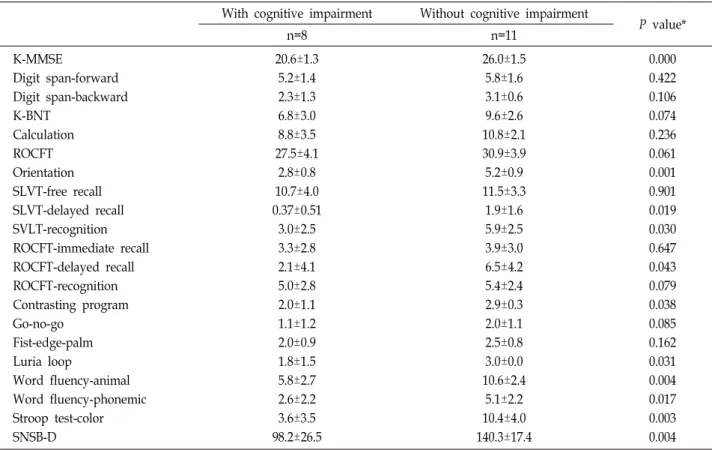
전체 19명의 평균 교육 연수는 10.0±4.6년이었다. 평균 K- MMSE 점수는 23.7±3.1이었고, K-MMSE 검사 결과 총점 24점 미만으로 인지기능저하를 동반한 환자는 19명 중 8명 42.1%) 였다. 전체 19명의 평균 SNSB-D 점수는 122.6±29.9 였고, 세부 항목의 평균 점수는 다음과 같았다: Digit span test-forward 5.5±1.5, Digit span test-backward 2.8±1.0, K-BNT 8.4±3.0, Calculation 10.1±2.8, ROCFT 29.4±4.2, Orientation 4.2±1.4, SLVT-free recall 11.2±3.5, SVLT-delayed recall 1.2±1.4, SVLT-recognition 4.6±2.9, ROCFT-immediate recall 3.6±2.8, ROCFT-delayed recall 4.6±4.5, ROCFT-recognition 4.3±3.0, Contrasting program 2.5±0.9, Go-no-go 1.6±1.1, Fist-edge- palm 2.3±0.8, Luria loop 2.5±1.1, Word fluency-animal 8.6±3.4, Word fluency-phonemic 4.1±2.5, Stoop test-color 7.4±5.0. 인지기능저하 동반한 군(K-MMSE <24)의 SNSB-D 점 수는 98.2±26.5, 동반하지 않은 군(K-MMSE ≥24)의 점수는 140.3±17.4였다(P=0.004, Table 8).
말초신경병증 동반 유무에 따른 비교 임상적 특징 비교
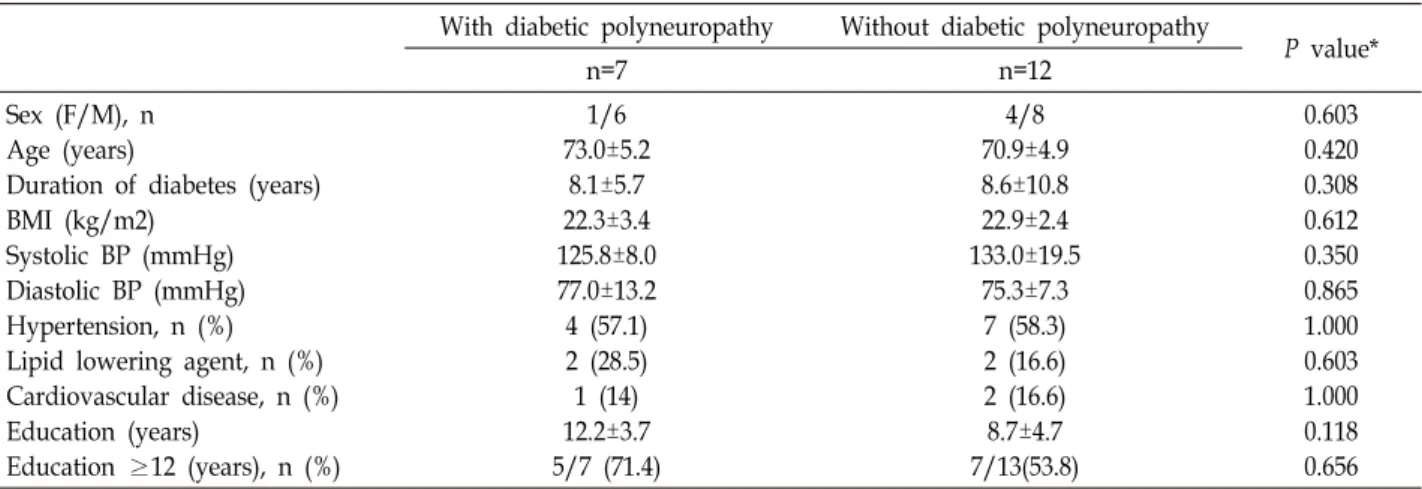
당뇨병성 말초신경병증 동반한 군(DPN 동반, N=7)에서 당 뇨병성 말초신경병증을 동반하지 않은 군(DPN 동반하지 않 음, N=12) 간에 평균 나이, 고혈압 및 심혈관질환 동반, 수축기 /이완기 혈압, 교육기간(Table 1), 그리고 HbA1c 를 포함한 검사실 검사 결과들은 두 군 간에 차이가 없었다(Table 2). 남 성 환자의 비율이 당뇨병성 말초신경병증(DPN) 동반 군(7명 중 6명, 85.7%)에서 동반하지 않은 군(12명 중 8명, 66.7%)에 비해 통계적으로 유의하지는 않았지만 수적으로 더 많았다 (P=0.603, Table 1).
인지기능항목 비교
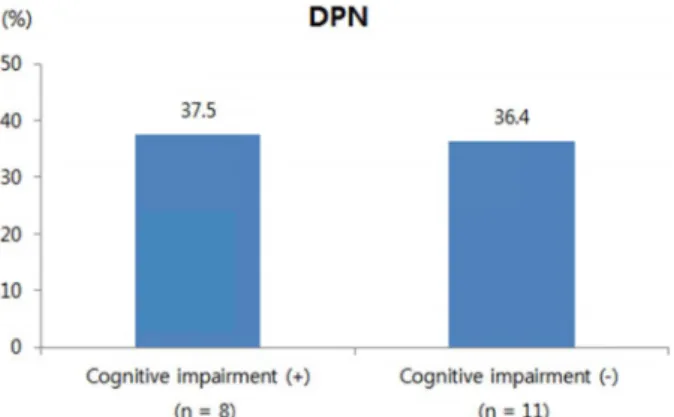
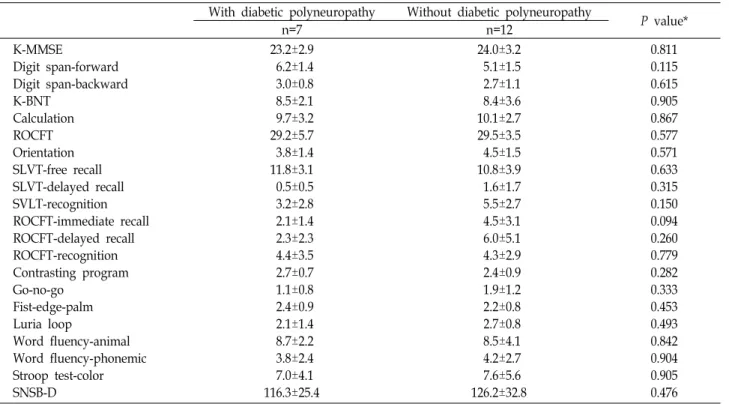
당뇨병성 말초신경병증 동반 군과 동반하지 않은 군의 K- MMSE 점수는 각각 23.2±2.9점과 24.0±3.2점으로 유의한 차이 는 없었다(P=0.811). 두 군 간에 K-MMSE <24를 보이는 환자 의 비율도 각각 7명 중 3명42.9%), 12명 중 5명(41.6%)으로 의 미있는 차이가 없었다(P=0.811, Fig. 1). 보다 정밀한 신경인지 검사인 SNSB-D의 총점과 세부항목검사 결과 DPN 동반 군과 동반하지 않은 군 간에 통계적으로 유의한 차이가 없었다. 기 억력 평가 항목 중의 하나인 ROCFT-immediate recall 점수는 DPN 동반군에서 2.1±1.4, DPN 동반하지 않은 군에서 4.5±3.1 로 통계적으로 유의하지는 않았지만 DPN 동반군에서 더 낮은
Table 1. Comparison of the clinical characteristics between groups with and without diabetic polyneuropathy With diabetic polyneuropathy Without diabetic polyneuropathy
P value*
n=7 n=12
Sex (F/M), n Age (years)
Duration of diabetes (years) BMI (kg/m2)
Systolic BP (mmHg) Diastolic BP (mmHg) Hypertension, n (%) Lipid lowering agent, n (%) Cardiovascular disease, n (%) Education (years)
Education ≥12 (years), n (%)
1/6 73.0±5.2
8.1±5.7 22.3±3.4 125.8±8.0 77.0±13.2 4 (57.1) 2 (28.5)
1 (14) 12.2±3.7 5/7 (71.4)
4/8 70.9±4.9 8.6±10.8 22.9±2.4 133.0±19.5
75.3±7.3 7 (58.3) 2 (16.6) 2 (16.6) 8.7±4.7 7/13(53.8)
0.603 0.420 0.308 0.612 0.350 0.865 1.000 0.603 1.000 0.118 0.656 Data are mean ± SD or n (%). Mann Whitney U test was used for continuous variables, and Fisher’s exact test for categorical variables.
*The level of significance was P value <0.05.
BMI, body Mass Index; BP, blood pressure.
Table 2. Comparison of the results of metabolic parameters and renal function studies between groups with and without diabetic polyneuropathy
With diabetic polyneuropathy Without diabetic polyneuropathy
P value*
n=7 n=12
HbA1c (%)
Total cholesterol (mg/dL) LDL-C (mg/dL)
HDL-C (mg/dL) Triglyceride (mg/dL) Urine protein (mg/dL) Proteinuria, n (%) BUN (mg/dL) Creatinine (mg/dL) eGFR (mL/min/1.73 m2) TSH (uIU/mL)
Uric acid (mg/dL)
8.5±2.0 169.4±32.7
83.0±29.5 49.8±25.1 154.7±58.1 57.1±113.3 2(28.5) 15.7±5.9
1.1±0.3 72.1±22.2
1.9±1.5 5.4±1.8
7.9±1.8 176.4±26.8 112.0±31.7 40.4±10.0 128.9±61.6 8.3±28.8
1(8.3) 19.4±4.6
0.9±0.2 75.5±20.1
3.4±2.9 5.1±2.0
0.525 0.617 0.107 0.750 0.487 0.231 0.455 0.161 0.666 0.933 0.224 0.650 Data are mean ± SD or n (%). Mann Whitney U test was used for continuous variables, and Fisher’s exact test for categorical variables.
*The level of significance was P value <0.05.
HbA1c, hemoglobin A1c; LDL-C, low density lipoprotein cholesterol; HDL-C, high density lipoprotein cholesterol; BUN, blood urea nitrogen; eGFR, esteimated glomerular filtration rate; TSH, thyroid-stimulation hormone.
경향을 보였다(P=0.094, Table 4).
인지기능저하 동반 유무에 따른 비교 임상적 특징 비교
인지기능저하 동반군(K-MMSE <24)과 동반하지 않은 군 (K-MMSE ≥24) 간에 평균 나이, 70세 이상 고령비율, 당뇨병 유병 기간, 고혈압 및 심혈관질환 동반, 수축기/이완기 혈압은 차이가 없었다(Table 5). 교육 기간은 인지기능저하 동반군에 서 8.3±4.5년, 동반하지 않은 군 11.3±4.4년에 비해 짧았지만 통계적으로 유의하지는 않았다(P=0.107, Table 5). 12년 이상 고등 교육을 받은 환자 비율은 인지기능저하 동반군에서 25%
로, 동반하지 않은 군의 81.8%에 비해 낮았지만 통계적 유의성
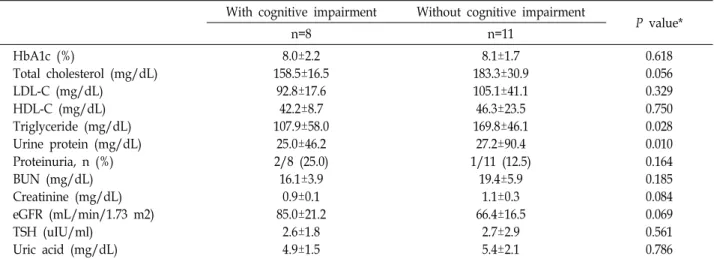
에 도달하지는 않았다(P=0.074, Table 5). 검사실 검사를 비교 한 결과 양 군간에 HbA1c, LDL-C, HDL-C 수치는 차이가 없 었고, TG 는 인지기능저하 동반군에서 107.9±58.0 mg/dL로 동반하지 않은 군 의 169.8±46.1 mg/dL에 비해 유의하게 낮았 다(P=0.028, Table 6). 신기능 검사(BUN, creatinine, eGFR)는 두 군간에 차이가 없었으나, 단회 요 단백은 인지기능저하 동 반군에서 25.0±46.2 mg/dL로, 동반하지 않은 군 27.2±90.4 mg/dL 에 비해 유의하게 낮았다(P=0.010, Table 6).
신경전도검사 비교
신경전도속도(CV)는 인지기능저하 동반군에서 36.9±3.8 mV, 동반하지 않은 군에서 37.9±4.0 mV로 두 군간에 유의한
Fig. 1. The prevalences of patients with K-MMSE <24 in both groups with or without diabetic polyneuropathy. Data are presented as percentage (%). K-MMSE; Korean version of the Mini Mental State Examination, DPN; diabetic poly- neuropathy.
Table 3. Comparison of sural electrophysiolgical findings between groups with and without diabetic polyneuropathy
With diabetic polyneuropathy
Without diabetic
polyneuropathy P value*
n=7 n=12
CV (mV) SNAP (μV)
34.3±4.0 5.4±0.9
39.0±2.5 15.2±6.7
0.018 0.001 Data are mean ± SD. Mann Whitney U test was used for con- tinuous variables.
*The level of significance was P value <0.05.
Diabetic polyneuropathy was defined by data from nerve con- duction study; CV <34.68 mV or SNAP <6 μV.
CV, Conduction velocity; SNAP, sensory nerve action potential.
Fig. 2. The prevalence of diabetic polyneuropathy in the groups with or without cognitive impairment.
차이가 없었다(P=0.620). 감각신경활동 전위(SNAP)은 인지기 능저하동반군에서 11.7±5.4 μV, 동반하지 않은 군에서 12.2±
8.7 μV로 두 군간에 유의한 차이가 없었다(P=0.836). 인지기능 저하에 따른 DPN 동반 비율은 인지기능저하 동반군에서 37.5%, 동반하지 않은 군에서 36.4%로 차이가 없었다(P=1.000, Fig. 2).
인지기능 항목과 각 변수와의 상관 관계
교육 기간과 SNAB-D 의 세부항목 중 다음 3가지 항목과 통계적으로 유의한 양의 상관관계를 보였다; digit span-for- ward (rho=0.674, P = 0.002), digit span-backward (rho=0.470, P = 0.042, Table 9), calculation (rho=0.587, P=0.008), ROCFT (rho=0.457, P=0.049). 신경전도속도(CV)는 digit span-forward 와 통계적으로 유의한 음의 상관관계를 보였다(rho=0.510, P=0.026, Table 9). 교육 기간과 신경전도속도(CV)는 K-MMSE 와는 유의한 상관관계를 보이지 않았다(각각 rho=0.370, P=0.119; rho=0.255, P=0.292, Table 9).
고 찰
본 연구는 제2형 당뇨병 환자에서 당뇨병성 말초신경병증 과 인지기능 간의 연관성을 알아보고자 후향적 차트 리뷰를 시행하였다. K-MMSE와 SNAB-D 세부 인지항목 중 유일하게 digit span-forward가 신경전도속도(CV)와 유의한 음의 상관 관계를 보였고, 다른 인지항목들과 신경전도검사 결과와는 연 관성을 보이지 않았다. 당뇨병성 말초신경병증 동반군과 동반 하지 않은 군 간에 인지기능항목 점수는 유의한 차이가 없었 다. 인지기능저하 동반군과 동반하지 않은 군 간 신경전도검 사 비교에서도 유의한 차이가 없었다. 본 연구는 제2형 당뇨병 환자에서 말초신경병의 진단법의 표준으로 인정되고 있는 NCS를 바탕으로 DPN을 진단하고, NCS 세부항목(CV와 SNAP) 결과와 다양한 인지 기능 항목들(K-MMSE와 SNAB- D) 간의 연관성을 확인한 독창적인 연구였지만, 후향적 차트 리뷰에 기초하였고 대상 연구 수가 매우 적어 당뇨병성 말초 신경병과 인지기능항목간에 연관성을 확인하지 못하였다. 제 2형 당뇨병 환자에서 당뇨병성 말초신경병증과 인지기능 간 의 연관성을 확인하기 위해 신경전도검사와 인지기능 검사를 모두 시행한 대상군을 찾기 위해 2005년부터 2016년 10월까지 약 12년간 동아대학교의료원에 내원한 전체 환자를 전수 조사 를 시행했음에도 불구하고 연구 포함 기준을 만족한 환자수가 47명으로 워낙 적었고, 더구나 이 들 중 약 3분의 2는 파킨슨 병, 급성 뇌경색 등 인지기능에 영향을 미치는 다른 질환들을 동반하고 있어 최종 대상에서 제외해야 했다. 따라서 인지기 능에 영향을 미치는 다른 동반 질환이 없는 19명을 대상으로 자료를 분석하였다.
당뇨병과 치매 및 인지기능장애 간의 밀접한 연관성은 많은 연구들이 있었다[17, 22]. 당뇨병이 치매 위험을 증가시키는 위험 인자라는 것은 널리 받아들여지고 있지만, 명확한 인과 관계에 아직 밝혀져야 한다. 심혈관계 질환과 인슐린 저항성 및 고혈당이 주요 인자로 보고되었다[3, 14]. 본 연구에서는 심혈관 질환, 고혈압, 지질저하제 복용력과 인지기능항목 간 에 유의한 연관성이 없었는데, 이는 적은 대상 수와 후향적 조사로 인해 자료 부족이 주된 원인으로 생각된다. 당화혈색
Table 4. Comparison of cognitive factors between groups with and without diabetic polyneuropathy With diabetic polyneuropathy Without diabetic polyneuropathy
P value*
n=7 n=12
K-MMSE
Digit span-forward Digit span-backward K-BNT
Calculation ROCFT Orientation SLVT-free recall SLVT-delayed recall SVLT-recognition ROCFT-immediate recall ROCFT-delayed recall ROCFT-recognition Contrasting program Go-no-go
Fist-edge-palm Luria loop
Word fluency-animal Word fluency-phonemic Stroop test-color SNSB-D
23.2±2.9 6.2±1.4 3.0±0.8 8.5±2.1 9.7±3.2 29.2±5.7 3.8±1.4 11.8±3.1 0.5±0.5 3.2±2.8 2.1±1.4 2.3±2.3 4.4±3.5 2.7±0.7 1.1±0.8 2.4±0.9 2.1±1.4 8.7±2.2 3.8±2.4 7.0±4.1 116.3±25.4
24.0±3.2 5.1±1.5 2.7±1.1 8.4±3.6 10.1±2.7 29.5±3.5 4.5±1.5 10.8±3.9 1.6±1.7 5.5±2.7 4.5±3.1 6.0±5.1 4.3±2.9 2.4±0.9 1.9±1.2 2.2±0.8 2.7±0.8 8.5±4.1 4.2±2.7 7.6±5.6 126.2±32.8
0.811 0.115 0.615 0.905 0.867 0.577 0.571 0.633 0.315 0.150 0.094 0.260 0.779 0.282 0.333 0.453 0.493 0.842 0.904 0.905 0.476 Data are mean ± SD. Mann Whitney U test was used for continuous variables.
*The level of significance was P value <0.05.
Diabetic polyneuropathy was defined by data from nerve conduction study: Conduction velocity (CV) < 34.68 mV or sensory nerve action potential (SNAP) < 6 μV).
K-MMSE, Korean version of the Mini Mental State Examination; K-BNT, Korean version of the Boston Naming Test; ROCFT, Rey-Osterrieth Complex Figure Test; SLVT, Seoul Verbal Learning Test; SNAB-D, Seoul Neuropsychological Screening Battery- Demential Version.
Table 5. Comparison of the clinical characteristics between groups with and without cognitive impairment With cognitive impairment Without cognitive impairment
P value*
(n=8) (n=11)
Sex (F/M), n Age (years)
Age ≥70 (years), n (%) Duration of diabetes (years) BMI (kg/m2)
BMI ≥ 23 kg/m2, n(%) Systolic BP (mmHg) Diastolic BP (mmHg) Hypertension, n (%) Lipid lowering agent, n (%) Cardiovascular disease, n (%) Education (years)
Education ≥ 12 ( years), n (%)
2/6 72.0±3.6 5/8(62.5) 7.1±10.1 23.6±4.2 3/8(37.5) 132.8±21.0
79.8±11.3 4/8 (50.0) 3/8 (37.5) 1/8 (12.5) 8.3±4.5 2/8 (25.0)
3/8 71.4±6.0 8/11(72.7)
9.4±8.6 22.7±2.7 6/11(54.5) 128.5±12.6 73.0±7.3 7/11 (63.6)
1/11 (9.0) 2/11 (18.1)
11.3±4.4 9/11 (81.8)
1.000 0.836 1.000 0.361 0.620 0.650 0.507 0.157 0.658 0.262 1.000 0.107 0.074 Data are mean ± SD or n (%). Mann Whitney U test was used for continuous variables, and Fisher’s exact test for categorical variables.
BMI, body mass index; BP, blood pressure.
소 역시 인지기능항목 간에 유의한 연관성이 없었는데, 이는 인지기능장애 동반 군에서 동반하지 않은 군에 비해 당뇨병 유병기간이 짧아서(7.1 vs 9.4 년), 연관성이 없다고 결론을 내
리기는 어렵다. 치매와 인지기능장애와 교육 기간은 밀접한 연관이 있다고 알려졌고[2, 4], 국내 연구에서도 제2형 당뇨병 환자에서 대학 이상의 교육을 받은 군과 초등 교육을 받은
Table 6. Comparison of the results of metabolic parameters and renal function between groups with and without cognitive impairment With cognitive impairment Without cognitive impairment
P value*
n=8 n=11
HbA1c (%)
Total cholesterol (mg/dL) LDL-C (mg/dL)
HDL-C (mg/dL) Triglyceride (mg/dL) Urine protein (mg/dL) Proteinuria, n (%) BUN (mg/dL) Creatinine (mg/dL) eGFR (mL/min/1.73 m2) TSH (uIU/ml)
Uric acid (mg/dL)
8.0±2.2 158.5±16.5
92.8±17.6 42.2±8.7 107.9±58.0
25.0±46.2 2/8 (25.0) 16.1±3.9
0.9±0.1 85.0±21.2
2.6±1.8 4.9±1.5
8.1±1.7 183.3±30.9 105.1±41.1 46.3±23.5 169.8±46.1 27.2±90.4 1/11 (12.5)
19.4±5.9 1.1±0.3 66.4±16.5
2.7±2.9 5.4±2.1
0.618 0.056 0.329 0.750 0.028 0.010 0.164 0.185 0.084 0.069 0.561 0.786 Data are mean ± SD or n (%). Mann Whitney U test was used for continuous variables, and Fisher’s exact test for categorical variables.
*The level of significance was P value <0.05.
HbA1c, hemoglobin A1c; LDL-C, low density lipoprotein cholesterol; HDL-C, high density lipoprotein cholesterol; BUN, blood urea nitrogen; eGFR, esteimated glomerular filtration rate; TSH, thyroid-stimulation hormone.
Table 7. Comparison of sural electrophysiolgical findings be- tween groups with and without cognitive impairment
With cognitive impairment
Without cognitive
impairment P value*
n=8 n=11
CV (mV) SNAP (μV) DPN, n (%)
36.9±3.8 11.7±5.4 3/8(37.5)
37.9±4.0 12.2±8.7 4/11(36.4)
0.620 0.836 1.000 Data are mean ± SD or n (%). Mann Whitney U test was used for continuous variables, and Fisher’s exact test for categorical variables.
CV, conduction velocity; SNAP, sensory neural action potential;
DPN, diabetic polyneuropathy.
군 간에 유의한 차이를 보고하였다[11].
본 연구 결과 인지기능저하 동반 군에서 동반하지 않은 군 에 비해 교육 기간이 짧았고(8.3 vs 11.3 년), 12년 이상 고등교 육을 받은 비율도 낮았다(25 vs 81%). 교육 기간과 SNAB-D 의 세부항목 중 digit span-forward, digit span-backward, cal- culation 과도 통계적으로 유의한 양의 상관관계를 보여 교육 기간이 길수록 인지기능이 좋을 가능성이 높으며, 이는 이전 연구들과 일치되는 결과이다.
당뇨병성 신경합병증과 인지기능 간의 연관성에 대해서는 보고가 많지 않다. Lerida M.A. 등은 제2형 당뇨병 환자에서 자율신경계합병증 동반이 시각적 인지 기능 저하와 연관이 있다고 보고하였고[23], Matei D. 등은 혈관성 치매를 보이는 제2형 당뇨병 환자에서 자율신경기능장애가 동반된다고 보고 하였다[13]. 본 연구에서는 자율신경계 검사를 시행한 대상이 거의 없어 분석을 하지 않았다. 최근에 당뇨병성 말초신경병 과 인지기능 간의 연관성에 대해 몇몇 소규모 연구에서 보고
하였다. Valkova M. 등은 근전도에 기초하여 당뇨병성 말초신 경병을 진단받은 47명의 환자에서 MMSE, 10 단어 검사, Benton visual retention test및 Hamilton scale 검사를 시행한 결과, 당뇨병성성 말초신경병과 인지기능장애와 연관성이 있 다고 보고하였다[21]. Rucker J.L. 등은 신경병증 증상과 NCS 를 바탕으로 진단된 DPN을 동반한 제2형 당뇨병 환자군 20명 과 20명의 비당뇨병 대조군에서 MMSE 와 Timed Up and Go 검사 결과를 비교한 결과, DPN을 동반한 제2형 당뇨병 환자에 서 동시 업무 수행 능력과 다른 집행 능력 저하를 보였다고 보고하였다[18]. Moreira R.O. 등은 제2형 당뇨병 환자 94명에 서 대조군에 비해 인지기능저하를 보였지만, 신경증상을 바탕 으로 진단한 당뇨병성 말초신경병 동반은 인지기능 저하에 영향을 미치지 않았다고 보고하였다[15]. 이상과 같이 당뇨병 성 신경합병증과 치매 및 인지장애와의 연관성에 대한 연구는 많지 않고 대부분 소규모 연구였고, 결과도 다양하게 보고되 었다. 본 연구는 제2형 당뇨병 환자에서 말초신경병의 진단법 의 표준으로 인정되고 있는 NCS를 바탕으로 DPN을 진단하 였고, NCS 세부항목(CV와 SNAP) 결과와 다양한 인지 기능 항목들(K-MMSE와 SNAB-D) 간의 연관성에 대해서 확인하였 는데 저자가 조사한 바로는 현재까지 동일한 연구는 없었다.
SNAB-C 인지항목 중 digit span-forward와 CV만이 유의한 음의 상관관계를 보였는데, CV 속도가 느릴수록 digit span- forward 점수가 상승하는 결과로 이는 말초신경기능이 저하 될수록 중추인지기능은 높을 것이라고 해석할 수 있으며, DPN 동반시 인지기능 저하와 연관이 있을 것이라는 기대와는 정반대의 결과이다. 명확한 이유를 확인하기는 어렵지만 아마 도 매우 적은 대상 수에서 인지기능에 연관될 수 있는 다른 변수들에 통제가 되지 못해 발생한 우연적 결과일 가능성이
Table 8. Comparison of cognitive factors between groups with and without cognitive impairment With cognitive impairment Without cognitive impairment
P value*
n=8 n=11
K-MMSE
Digit span-forward Digit span-backward K-BNT
Calculation ROCFT Orientation SLVT-free recall SLVT-delayed recall SVLT-recognition ROCFT-immediate recall ROCFT-delayed recall ROCFT-recognition Contrasting program Go-no-go
Fist-edge-palm Luria loop
Word fluency-animal Word fluency-phonemic Stroop test-color SNSB-D
20.6±1.3 5.2±1.4 2.3±1.3 6.8±3.0 8.8±3.5 27.5±4.1
2.8±0.8 10.7±4.0 0.37±0.51
3.0±2.5 3.3±2.8 2.1±4.1 5.0±2.8 2.0±1.1 1.1±1.2 2.0±0.9 1.8±1.5 5.8±2.7 2.6±2.2 3.6±3.5 98.2±26.5
26.0±1.5 5.8±1.6 3.1±0.6 9.6±2.6 10.8±2.1 30.9±3.9 5.2±0.9 11.5±3.3 1.9±1.6 5.9±2.5 3.9±3.0 6.5±4.2 5.4±2.4 2.9±0.3 2.0±1.1 2.5±0.8 3.0±0.0 10.6±2.4 5.1±2.2 10.4±4.0 140.3±17.4
0.000 0.422 0.106 0.074 0.236 0.061 0.001 0.901 0.019 0.030 0.647 0.043 0.079 0.038 0.085 0.162 0.031 0.004 0.017 0.003 0.004 Data are mean ± SD. Mann Whitney U test was used for continuous variables.
*The level of significance was P value <0.05.
K-MMSE, Korean version of the Mini Mental State Examination; K-BNT, Korean version of the Boston Naming Test; ROCFT, Rey-Osterrieth Complex Figure Test; SLVT, Seoul Verbal Learning Test; SNAB-D, Seoul Neuropsychological Screening Battery- Demential Version.
Table 9. Simple correlation of cognitive factors and education, conduction velocity and renal function in type 2 dia- betic patients with or without diabetic peripheral poly- neuropathy
Education CV
K-MMSE r=0.370
P=0.119
r=0.255 P=0.292 Digit span-forward r=0.674
P=0.002
-r=0.510 P=0.026 Digit span-backward r=0.470
P=0.042
-r=0.309 P=0.197
Calculation r=0.587
P=0.008
-r=0.174 P=0.475
ROCFT r=0.457
P=0.049
-r=0.217 P=0.373 Spearman’s rank correlation was used. The level of significance was P value <0.05.
r, Spearman’s rho correlation coefficient. K-MMSE, Korean ver- sion of the Mini Mental State Examination; ROCFT, Rey- Osterrieth Complex Figure Test; CV, conduction velosity.
가장 높아 보인다. 이 외에는 NVS 검사 결과와 다른 인지기능 항목 간에 유의한 연관성은 보이지 않았으며, 당뇨병성 말초 신경병증 유무와 인지기능항목 간에도 연관성은 없었다. 결론 적으로 제2형 당뇨병 환자에서 교육기간이 길수록 높은 인지 기능과 관련이 있었으며, 당뇨병성말초신경병증과 인지기능 장애 간에는 유의한 상관 관계가 관찰되지 않았다. 본 연구를 계기로 향후 대규모의 제2형 당뇨병 환자를 대상으로 인지기 능과 말초신경병증에 영향을 미치는 다른 요인들, 특히, 당뇨 병, 고혈압 및 고지혈증 약제, 저혈당, 그리고 다른 당뇨병 합 병증 동반 등에 대한 분석을 동반한 전향적 연구가 필요할 것으로 사료된다.
The Conflict of Interest Statement The authors declare that they have no conflicts of interest with the contents of this article.
References
1. Ahn, H. J., Chin, J., Park, A., Lee, B. H., Suh, M. K., Seo,
S. W. and Na, D. L. 2010. Seoul Neuropsychological Screening Battery-Dementia Version (SNSB-D): a useful tool for assessing and monitoring cognitive impairments in de- mentia patients. J. Kor. Med. Sci. 25, 1071-1076.
2. Cobb, J. L., Wolf, P. A., Au, R., White, R. and D'Agostino, R. B. 1995. The effect of education on the incidence of de- mentia and Alzheimer's disease in the Framingham Study.
Neurology 45, 1707-1712.
3. de Galan, B. E., Zoungas, S., Chalmers, J., Anderson, C., Dufouil, C., Pillai, A., Cooper, M., Grobbee, D. E., Hackett, M., Hamet, P., Heller, S. R., Lisheng, L., Macmahon, S., Mancia, G., Neal, B., Pan, C. Y., Patel, A., Poulter, N., Trav- ert, F., Woodward, M. and ADVANCE Collaborative Group.
2009. Cognitive function and risks of cardiovascular disease and hypoglycaemia in patients with type 2 diabetes: the ac- tion in diabetes and vascular disease: Preterax and diami- cron modified release controlled evaluation (ADVANCE) trial. Diabetologia 52, 2328-2336.
4. EClipSE Collaborative Members, Brayne, C., Ince, P. G., Keage, H. A., McKeith, I. G., Matthews, F. E., Polvikoski, T.
and Sulkava, R. 2010. Education, the brain and dementia:
neuroprotection or compensation? Brain 133, 2210-2216.
5. Feldman, E. L., Stevens, M. J., Thomas, P. K., Brown, M.
B., Canal, N. and Greene, D. A. 1994. A practical two-step quantitative clinical and electrophysiological assessment for the diagnosis and staging of diabetic neuropathy. Diabetes Care 17, 1281-1289.
6. Folstein, M. F., Folstein, S. E. and McHugh, P. R. 1975.
“Mini-mental state”. A practical method for grading the cognitive state of patients for the clinician. J. Psychiatr. Res.
12, 189-198.
7. Kang, Y., Na, D. L. and Hahn, S. 1997. A validity study on the Korean Mini-Mental State Examination (K-MMSE) in dementia patients. J. Kor. Neurol. Assoc. 15, 300-308.
8. Kim, D. J. 2011. The epidemiology of diabetes in Korea.
Diabetes Metab. J. 35, 303-308
9. Kim, H. and Na, D. L. 1999. Normative data on the Korean version of the Boston Naming Test. J. Clin. Exp. Neuropsychol.
21, 127-133.
10. Korea Health Industry Development Institute. Statistics for senior-friendly industry. Seoul: Korea Health Industry Development Institute; 2007.
11. Lee, Y. J., Kang, H. M., Kim, N. K., Yang, J. Y., Noh, J.
H., Ko, K. S., Rhee, B. D. and Kim, D. J. 2014. Factors asso- ciated for mild cognitive impairment in older Korean adults with type 2 diabetes mellitus. Diabetes Metab. J. 38, 150-157.
12. Levey, A. S., Bosch, J. P., Lewis, J. B., Greene, T., Rogers, N. and Roth, D. 1999. A more accurate method to estimate glomerular filtration rate from serum creatinine: A new prediction equation. Ann. Intern. Med. 130, 461-470.
13. Matei, D., Popescu, C. D., Ignat, B. and Matei, R. 2013.
Autonomic dysfunction in type 2 diabetes mellitus with and without vascular dementia. J. Neurol. Sci. 15, 325:6-9.
14. McGuire, L. C., Ford, E. S. and Ajani, U. A. 2006. The impact of cognitive functioning on mortality and the development of functional disability in older adults with diabetes: the sec- ond longitudinal study on aging. BMC Geriatr. 6, 8.
15. Moreira, R. O., Soldera, A. L., Cury, B., Meireles, C. and Kupfer, R. 2015. Is cognitive impairment associated with the presence and severity of peripheral neuropathy in patients with type 2 diabetes mellitus? Diabetol. Metab. Syndr. 7, 51.
16. Profenno, L. A., Porsteinsson, A. P. and Faraone, S. V. 2010.
Meta-analysis of Alzheimer’s disease risk with obesity, dia- betes, and related disorders. Biol. Psychiatry 67, 505-512.
17. Reaven, G. M., Thompson, L. W., Nahum, D. and Haskins, E. 1990. Relationship between hyperglycemia and cognitive function in older NIDDM patients. Diabetes Care 13, 16-21.
18. Rucker, J. L., Jernigan, S. D., McDowd, J. M. and Kluding, P. M. 2014. Adults with diabetic peripheral neuropathy ex- hibit impairments in multitasking and other executive functions. J. Neurol. Phys. Ther. 38, 104-110.
19. Ko, S. H. and Cha, B. Y. 2012. Diabetic peripheral neuro- pathy in type 2 diabetes mellitus in Korea. Diabetes Metab.
J. 36, 6-12.
20. Tesfaye, S., Boulton, A. J., Dyck, P. J., Freeman, R., Horowitz, M., Kempler, P., Lauria, G., Malik, R. A., Spallone, V., Vinik, A., Bernardi, L. and Valensi, P.; Toronto Diabetic Neuropa- thy Expert Group. 2010. Diabetic neuropathies: update on definitions, diagnostic criteria, estimation of severity, and treatments. Diabetes Care 33, 2285-2293.
21. Valkova, M., Stamenov, B., Peychinska, D. and Danovska, M. 2011. Cognitive dysfunctions in diabetic polyneuropathy.
J. IMAB. 17, 183-188.
22. Yaffe, K., Blackwell, T., Kanaya, A. M., Davidowitz, N., Barrett-Connor, E. and Krueger, K. 2004. Diabetes, impaired fasting glucose, and development of cognitive impairment in older women. Neurology 63, 658-663.
23. Zaslavsky, L. M., Gross, J. L., Chaves, M. L. and Machado, R. 1995. Memory dysfunction and autonomic neuropathy in non-insulin-dependent (type 2) diabetic patients. Diabetes Res. Clin. Pract. 30, 101-110.
초록:제2형 당뇨병환자에서 말초신경병증과 인지기능항목의 상관관계 양원열1․김종국2․박경원2․서성환1․이혜정3․박미경1*
(1동아대학교 의학과 내과학교실, 2동아대학교 의학과 신경과학교실, 3동아대학교 의학과 약리학교실)
당뇨병은 치매 및 인지기능장애의 주요 위험인자로 알려져 있다. 당뇨병성 말초신경병증은 제2형 당뇨병에서 가장 흔히 발생되는 합병증으로 본 연구는 말초신경병과 인지기능항복 간의 관련성을 확인하기 위함이었다. 2005 년부터 2016년 10월 31일까지 동아대학교의료원에 내원한 제2형 당뇨병 환자들을 대상으로 후향적으로 의무기록 지를 확인하여 신경전도검사와 신경인지기능검사를 시행한 환자 총 19명을 대상으로 하였다. 총 19명 대상환자의 평균 나이는 71.6±5.0세, 당뇨병 유병기간은 8.4±9.1년, 당화혈색소는 8.1±1.8%였다. 당뇨병성 말초신경병증이 동 반된 환자는 전체 19명 중 7명(36.8%)이었다. Korean version of the Mini Mental State Examination (K-MMSE) 검사 결과 총점 24점 미만으로 정의한 인지기능저하를 동반한 환자는 19명 중 8명(42.1%)였다. 당뇨병성 말초신경 병증 동반 군과 동반하지 않은 군 간에 K-MMSE 점수와 인지기능저하 동반율은 차이가 없었다. 인지기능저하 동반군과 동반하지 않은 군 간에 DPN 동반 비율도 각각 37.5%와 36.4%로 유의한 차이가 없었다. 인지기능항목과 유의한 상관관계를 보인 변수는 교육 기간이었으며, 교육기간이 길수록 높은 인지기능과 관련이 있었다. 인지항목 중 digit span-forward 만이 신경전도속도(CV)와 유의한 음의 상관관계를 보였다. 결론적으로 제2형 당뇨병 환자 에서 교육기간이 길수록 높은 인지기능과 관련이 있었으며, 당뇨병성말초신경병증과 인지기능장애 간에는 유의 한 상관 관계가 관찰되지 않았다. 향후 더 큰 규모의 전향적 연구가 필요하다.