Effects of Dolsan Leaf Mustard Powder on the Quality of Frying Batter
SunKyung Oh and MyeongRak Choi*
Department of Biotechnology, Chonnam National University, Yeosu 59626, Korea
Received September 20, 2019 /Revised December 16, 2019 /Accepted December 18, 2019
The anti-oxidant activity, sinigrin content, and sensory evaluation of frying batter treated with Dolsan leaf mustard powder (DLMP) were investigated. These endpoints were measured in the control sam- ple (batter without DLMP) and seven other batters with the addition of DLMP in the following quan- tities: 0.03 g (S-1), 0.02 g (S-2), 0.06 g (S-3), and 0.3 g (S-4, S-5, S-6, and S-7 with different amounts of red pepper powder). The acid value (AV) and peroxide value (POV) were low in the S-4 and S-5 batters; the total polyphenol content was 190.97 mg GAE/g in the control sample and 721.17 mg GAE/g in S-4; and the total flavonoid content of S-6 was 67.82 mg QE/g which was higher than that of the control sample. The anti-oxidant activity was measured by EDA, ABTS, and FRAP assays and was seen to rise as the amount of DLMP increased. Moreover, sinigrin content was higher in S-4, S-5, S-6, and S-7 than in the control, S-1, S-2, and S-3, and there were no significant differences among S-4 to S-7 when just 0.3 g of DLMP was added. Sensory evaluation showed that color, flavor, taste, texture, and overall acceptability values were significantly higher in S-4 and S-5, and that there was no significant difference across the samples. The addition of DLMP is therefore expected to increase the anti-oxidant activity of frying batter which would be effective in improving the storage and qual- ity of the product.
Key words : Antioxidant activities, Dolsan leaf mustard powder, frying batter, sinigrin
*Corresponding author
*Tel : +82-61-659-7303, Fax : +82-61-659-7309
*E-mail : [email protected]
This is an Open-Access article distributed under the terms of the Creative Commons Attribution Non-Commercial License (http://creativecommons.org/licenses/by-nc/3.0) which permits unrestricted non-commercial use, distribution, and reproduction in any medium, provided the original work is properly cited.
Journal of Life Science 2019 Vol. 29. No. 12. 1364~1370 DOI : https://doi.org/10.5352/JLS.2019.29.12.1364
Introduction
With increased economic development and improvements in living standards, the interest a healthy lifestyle and in food with stability and functionality has increased. Further- more, there is a continuing increase in the demand for plants products that have excellent physiological activity and no side effects. Thus, studies to investigate these natural sources have garnered considerable attention. Dolsan leaf mustard (DLM) (Brassica juncea) is one of the leaf and stem vegetables that belongs to the Cruciferae family. The seeds from this plant are used as acrid spices because of their pungent taste and unique flavor [21]. Cruciferous vegetables are partic- ularly rich in glucosinolates, phenols, flavonoids, and sulfur compounds [2]. These substances are physiologically active and have pharmacological effects in the body [16]. In addi- tion, leaf mustard is a rich source of minerals because it has an abundance of iron, phosphate, calcium, and potassium
[22]. In particular, DLM contains more vitamin A, β-car- otene, chlorophyll, and ascorbic acid compared with other leafy vegetables, and these components have antioxidant properties [5, 26]. DLM also contains large amounts of thio- sulfates and organosulfur compounds, which reportedly in- hibit chemically induced tumors [22]. The volatile sulfur component of glucosinolates, which are typical of sinigrin, are responsible for the unique pungent characteristic of DLM [4]. In other words, when the tissue is injured, myrosinase produces various sulfurous components and related sub- stances [3], which exhibit antibacterial activity against yeast, fungi, and bacteria [4]. In addition, active oxygen species produce a significant number of free radicals, which are de- stroyed by free radical defense mechanisms in the body;
however, in vivo, these defense mechanisms and the gen- eration and elimination mechanisms of reactive oxygen spe- cies are absent [17, 24]. These diseases are closely related to meat consumption a low fiber diet, and Western-influ- enced diets. Hence, food and health have become more im- portant to the general public. The use of synthetic medicines and synthetic food additives has been restricted due to safety issues. Consequently, there has been a wide range of studies to identify physiologically active substances in natural prod- ucts and foods that have no side effects [8, 23]. There is a perception that it is unhealthy, such as feeling when eating
fried products and rancidity of fats and oils during storage.
This study was conducted to investigate the physicochemical properties of Dolsan leaf mustard powder (DLMP) and the quality changes after its addition to frying batter. The sen- sory quality evaluation was used to determine the proper addition ratio of DLMP and to apply the ratio to new quality frying batter that reflects the health-oriented needs of con- sumers by suppressing the negative feelings associated with fried products and the rancidity of oils and fats.
Materials and Methods
Materials and reagents
DLM used in this experiment was purchased in January 2019 at Dolsan leaf mustard Farming Association in Yeosu, Jeonnam Province, dried with a vacuum freeze dryer (FDU- 8624, TRK, Japan) and then ground in a vacuum bag and stored at -18℃ as a sample. The frying batter was purchased at local markets and made from soft flour, cornstarch, egg white powder, garlic powder, white pepper powder, red pepper powder, DLMP, and syrup. Sinigrin, Folin-Ciocal- teu’s phenol reagent, 1,1-diphenyl-2-picrylhydrazyl (DPPH), 2,2-azino-bis(3-ethyl-benzothizoline-6-sulfonic acid) (ABTS), sodium carbonate, gallic acid, 2,4,6-Tris(2-pyridyl)-s-triazine (TPTZ), iron (III) chloride hexahydrate, Iron (II) sulfate hep- tahydrate (FeSO4・H2O), potassium persulfate, ascorbic acid, sodium chloride (NaCl), aluminum nitrate, potassium ace- tate, quercetin, methanol and ethanol were purchased from Sigma-Aldrich Co. (St. Louis, MO, USA).
Measurement of acid value (AV)
AV was determined by the method followed Kim et al.
[11]. An ethanol: ethyl ether (ratio 1:2) mixture of 100 ml was added to the 0.3 g of the sample and shaken well. Four drops of phenolphthalein solution were then added and shaken for 5 minutes. The solution was then titrated with 0.1 N ethanolic potassium hydroxide solution. The end point was determined by the solution turning reddish red for 30 seconds.
AV (acid value) = 5.611 ⨉ (T-B) ⨉ F/W
T: Optimum consumption of 0.1 N ethanolic potassium hydroxide solution for this test (ml)
B: Optimum consumption of 0.1 N ethanolic potassium hydroxide solution in the blank test (ml)
F: Titer of the 0.1 N-KOH solution used for titration W: Sample weight (g)
Measurement of peroxide value (POV)
POV was determined by the method followed by Kim et al. [11]. Addition of 30 ml of chloroform: acetic acid (ratio 2:3) mixture and 1 ml of saturated iodine potassium solution to 0.3 g of the sample. The mixture was stirred lightly for 1 minute and then incubated in the dark for 5 minutes. 30 ml of distilled water were added and titrated with 0.01 N sodium thiosulfate solution. The end-point was the loss of starch-associated coloration (colorless), a blank test was per- formed separately.
POV (meq/kg) = (A-B) ⨉ F ⨉ 10/S
A: Optimum consumption of 0.01 N sodium thiosulfate solution for this test (ml)
B: Optimum consumption of 0.01 N sodium thiosulfate solution of the blank test (ml)
F: Titer of 0.01 N sodium thiosulfate solution used for titration
S: Sample weight (g)
Measurement of total polyphenol content
The total polyphenol content in frying batter with DLMP added was measured using colorimetry and the Folin- Ciocalteu’s phenol reagent [25]. We added 200 μl of Folin- Ciocalteu’s phenol reagent and 2.6 ml of distilled water to 200 μl of the sample. The mixture was allowed to react for 6 minutes at room temperature, and then, 2 ml of 7% (w/v) Na2CO3 solution was added. The mixture reacted for 90 mi- nutes, and the absorbance was measured using a microplate reader (Infinite F50, Männedorf, Switzerland) at 750 nm. A standard curve was constructed using gallic acid as the standard, and the polyphenol content was reported in mg gallic acid equivalents (GAE)/g.
Measurement of total flavonoid content
The total flavonoid content in the frying batter with DLMP added was measured using the method followed by Moreno [18]. One milliliter of the sample, 0.1 ml of 10% alu- minum nitrate, 0.1 ml of 1 M potassium acetate and 4.3 ml of 80% (v/v) ethanol were sequentially added, and the ab- sorbance was measured at 415 nm by allowing the mixture to react in a dark room for 40 minutes. A standard curve was constructed using quercetin as the standard, and the flavonoid content was reported in mg quercetin equivalents (QE)/g.
Measurement of electron donating ability (EDA) The electron donating ability (EDA), which is the radical scavenging effect of 1,1-diphenyl-2-picrylhydrazyl (DPPH), was shown as the reducing power of the DMS and DLM extracts. We added 0.5 ml of 0.5 mM DPPH solution to a test tube containing 1 ml of the sample, 1 ml of methanol, and 0.99 ml of 100 mM sodium acetate buffer (pH 5.5), and the mixture was agitated and left to react in the dark for 5 minutes. The concentration of the remaining radicals was measured at 517 nm and was reported according to the fol- lowing equation [27]:
EDA (%) = (1 - absorbance of the solution with the sample added/absorbance of the solution without sample) ×100
2,2-azino-bis(3-ethyl-benzothizoline-6-sulfonic acid) (ABTS) radical scavenging activity
The ABTS radical scavenging activity was measured using a slight modification to the method reported by Kriengsak et al. [13]. Equal volumes of 1.8 mM ABTS solution and 0.63 mM potassium persulfate were combined and left to react in the dark for 24 hr at 37℃ to create an ABTS solution with ABTS free radicals; the solution was modified so that the absorbance at 735 nm was 1.4±0.1. Five ml of the ABTS solution with ABTS radicals was added to 0.1 ml of the sam- ple, and the mixture was allowed to react for 7 minutes;
subsequently, the absorbance was measured at 735 nm. The results were calculated according to the following equation:
ABTS radical scavenging activity (%) = (1 - absorbance of the solution with the sample added/absorbance of the solution without sample) ×100
Measurement of ferric reducing antioxidant power (FRAP)
The ferric reducing antioxidant power (FRAP) was meas- ured using a slight modification of the method reported by Benzie et al. [1]. We mixed 30 mM acetate buffer (pH 3.6), 10 mM 2,4,6-tripyridyls-triazine (TPTZ) dissolved in 40 mM HCl, and 20 mM iron (III) chloride hexahydrate in a 10:1:1 (v:v:v) ratio. We mixed 150 μl of the sample with 2,850 μl of the reaction mixture and allowed them to react for 30 minutes; then, the absorbance was measured at 593 nm. A standard curve was constructed using FeSO4·H2O, and FRAP content was quantified in mg FeSO4 equivalents/g extract.
Sinigrin standard curve and high-performance liquid chromatography (HPLC) operating conditions
The standard reagent sinigrin was manufactured at 125, 250, 500, and 1,000 ppm; the measurements were repeated three times, and the mean of the three values was used to create a standard curve, which was used to measure the lev- el of sinigrin in frying batter with added DLMP. HPLC was performed using a Shimadzu JP/LC-20Avp, fitted with a UV-VIS detector set at 228 nm. Phenomenex Luna 5 um C18 column (4.6×250 mm) was used with a flow rate of 1.0 ml/min and an injection volume of 10 μl.
Sensory evaluation
Ten trained panelists, who were graduate students at the Chonnam National University, performed the sensory evaluation. The color, flavor, taste, texture and overall ac- ceptability were evaluated using a 9-point scale (1 = very weak, 3 = little weak, 5 = moderate, 7 = little strong, 9 = very strong).
Statistical analysis
All tests and analyses were repeated at least three times.
The results are expressed as the mean± standard deviation (SD). One-way analysis of variance (ANOVA) and Duncan’s test were used for multiple comparisons using the SPSS ver- sion 21.0 (SPSS Institute, Chicago, IL, USA). Differences be- tween values were considered statistically significant in all experiments at p<0.05.
Results and Discussion
Acid value (AV) and peroxide value (POV) of frying batter
AV is a measure of the proportion of fat turning rancid;
it is obtained by measuring the free fatty acid content formed by hydrolysis of the oil present in the food. The production of free fatty acids promotes auto-oxidation, which degrades the quality of the product [21] and has a negative effect on its sensory properties. The different ratios of DLMP added to the frying batter are shown in Table 1. The AV and POV of the control group and the seven samples are shown in Table 2. The AV of the control group containing 0 g of DLMP with 0.06 g of red pepper powder was the highest value at 0.62 among all the samples, and frying batter (S-4) to which 0.3 g of DLMP and 0.06 g of red pepper powder were added had an AV of 0. This finding is consistent with the
Table 1. Frying batter ingredients and the amounts of Dolsan leaf mustard powder added
Ingredients (g) Control S-1 S-2 S-3 S-4 S-5 S-6 S-7
Soft flour Corn starch Egg white powder Garlic powder White pepper powder Red pepper powder Dolsan leaf mustard powder Syrup
20.0 4.34 0.40 0.20 0.20 0.06 0 36.0
20.0 4.34 0.40 0.20 0.20 0.03 0.03 36.0
20.0 4.34 0.40 0.20 0.20 0.02 0.04 36.0
20.0 4.34 0.40 0.20 0.20 0 0.06 36.0
20.0 4.34 0.40 0.20 0.20 0.06 0.3 36.0
20.0 4.34 0.40 0.20 0.20 0.03 0.3 36.0
20.0 4.34 0.40 0.20 0.20 0.02 0.3 36.0
20.0 4.34 0.40 0.20 0.20 0 0.3 36.0
Total 61.2 61.5
Table 2. Acid value (AV) and peroxide value (POV) of frying batter with Dolsan leaf mustard powder added Samples1) Acid value (AV)
(KOH mg/g)
Peroxide value (POV) (meq/kg) Control
S-1 S-2 S-3 S-4 S-5 S-6 S-7
0.62±0.22C*
0.31±0.11C 0.19±0.19B 0.12±0.11B 0.00±0.00A 0.06±0.11A 0.12±0.11B 0.19±0.19A
5.78±0.67D 4.71±0.19C 3.96±0.56B 3.21±0.37B 0.21±0.19A 0.11±0.00A 0.54±0.19A 0.32±0.37A
1)Refer to Table 1.
* Data represent the mean ± SD of experiments performed in triplicates. The different lower-case letters (superscript) in the same column (A-D) indicate the significant difference by Duncan’s multiple range test (p<0.05).
Table 3. Total polyphenol and total flavonoids content of frying batter with Dolsan leaf mustard powder added Samples1) Total polyphenol
(mg GAE/g)
Total flavonoids (mg QE/g) Control
S-1 S-2 S-3 S-4 S-5 S-6 S-7 0.02% Ascorbic acid
190.97±6.69b*
227.23±5.29b 223.78±2.16b 230.62±2.18b 721.17±0.39c 718.11±0.55c 713.26±0.66c 696.33±0.81c 97.51±0.31a
25.63±0.07a 26.34±0.03a 27.00±0.09a 27.56±0.10a 67.27±0.05c 66.61±0.05c 67.82±1.08c 61.79±0.07c 50.73±0.00b
1)Refer to Table 1.
* Data represent the mean ± SD of experiments performed in triplicates. The different lower-case letters (superscript) in the same row (a-c) indicate the significant difference by Duncan’s multiple range test (p<0.05).
AV of red ginseng powder or mugwort samples, which was low in proportion to their concentrations [7, 12]. POVs were 3.21-5.78 meq/kg for the control group, S-1, and S-2, and 0.11-0.54 meq/kg or S-4, S-5, S-6, and S-7 containing 0.3 g DLMP. AV and POV inhibited rancidity with increasing DLMP content, and significantly differed from the control group [6].
Total polyphenol and total flavonoid contents of fry- ing batter
Phenolic compounds are one class of widely distributed plant secondary metabolites. They have various structures and molecular weights. The phenolic hydroxyl (OH) groups of these compounds enable them to be easily combined with proteins or other giant molecules. They exhibit many physio- logical activities such as antioxidant or anticancer activities.
Flavonoids have a diphenylpropane (C6-C3-C6) skeletal structure and are widely distributed in vegetables, fruits, seeds, and nuts [9]. The total polyphenol and total flavonoid
content of frying batter with different DLMP additions are shown in Table 3. The total polyphenol and total flavonoid contents were significantly higher than those in the control group without DLMP, indicating a significant increase with increasing DLMP concentration. In particular, total poly- phenol and total flavonoid contents were about three times higher in samples, S-4, S-5, S-6, and S-7 than in S-2, S-3 and S-4 [10, 28], but there were no significant differences between the samples. Generally, active ingredients including total phenolic compounds in natural plants are known to have a larger amount of residue than that of hot air drying in vacuum freeze drying [12]. As a result, total polyphenol and total flavonoid content are expected to have a positive effect on antioxidant activities.
Antioxidant activities and sinigrin content
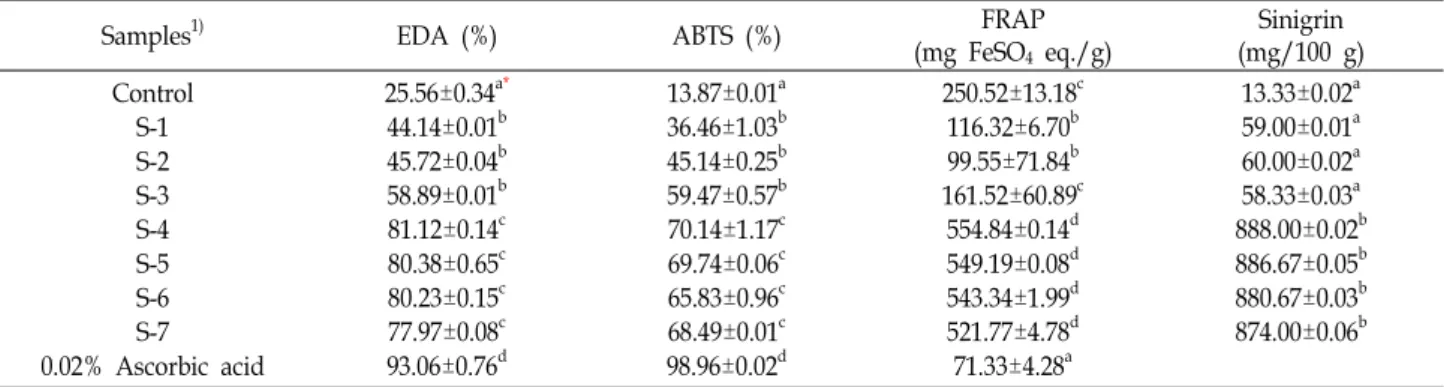
The antioxidant activity and sinigrin contents of frying batter with different DLMP additions using EDA, ABTS and
Table 4. Antioxidant activities and sinigrin content of frying batter with Dolsan leaf mustard powder added
Samples1) EDA (%) ABTS (%) FRAP
(mg FeSO4 eq./g)
Sinigrin (mg/100 g) Control
S-1 S-2 S-3 S-4 S-5 S-6 S-7 0.02% Ascorbic acid
25.56±0.34a*
44.14±0.01b 45.72±0.04b 58.89±0.01b 81.12±0.14c 80.38±0.65c 80.23±0.15c 77.97±0.08c 93.06±0.76d
13.87±0.01a 36.46±1.03b 45.14±0.25b 59.47±0.57b 70.14±1.17c 69.74±0.06c 65.83±0.96c 68.49±0.01c 98.96±0.02d
250.52±13.18c 116.32±6.70b 99.55±71.84b 161.52±60.89c
554.84±0.14d 549.19±0.08d 543.34±1.99d 521.77±4.78d 71.33±4.28a
13.33±0.02a 59.00±0.01a 60.00±0.02a 58.33±0.03a 888.00±0.02b 886.67±0.05b 880.67±0.03b 874.00±0.06b
1)Refer to Table 1.
* Data represent the mean ± SD of experiments performed in triplicates. The different lower-case letters (superscript) in the same row (a-d) indicate the significant difference by Duncan’s multiple range test (p<0.05).
Table 5. Sensory properties of frying batter with Dolsan leaf mustard powder added
Samples1) Color Flavor Taste Texture Overall acceptability
Control S-1 S-2 S-3 S-4 S-5 S-6 S-7
1.40±0.89bA*
2.20±1.10aA 3.40±0.89aB 5.00±0.00bC 7.40±0.89cD 7.00±0.00cD 6.60±0.89cD 5.80±1.10bC
1.00±0.00aA 2.20±1.10aA 3.40±0.89aB 3.80±1.79aB 7.00±1.41cD 7.00±0.00cD 5.40±0.89aC 5.80±1.10bC
1.00±0.00aA 3.00±1.41bB 3.80±1.10bB 3.40±0.89aB 6.20±1.10bD 6.20±1.10bD 5.80±1.10bC 5.40±0.89aC
3.40±1.67dA 3.00±1.41bA 3.40±0.89aA 3.40±0.89aA 5.80±1.10aB 5.80±1.10aB 5.00±0.00aB 5.00±0.00aB
2.20±1.79cA 3.00±1.41bB 3.40±0.89aB 3.40±0.89aB 7.00±1.41cD 7.00±0.00cD 5.80±1.10bC 6.60±0.89cC
1)Refer to Table 1.
* Data represent the mean ± SD of experiments performed in triplicates. The different lower-case letters (superscript) in the same row (a-d) and column (A-D) indicate the significant difference by Duncan’s multiple range test (p<0.05).
FRAP method are shown in Table 4. The EDA, ABTS radical scavenging activity and FRAP content significantly increased in S-1, 2, and 3 with increasing amounts of DLMP. The anti- oxidant activity measured by the FRAP method was gen- erally similar to the result of the antioxidant activity meas- ured by the ABTS method. The sinigrin content, a major component of DLM, was also significantly increased accord- ing to the addition. S-4, S-5, S-6, and S-7 which differed in the amount of red pepper powder added to 0.3 g of DLMP, showed high antioxidant activity and sinigrin content with no significant differences among the samples. The anti- oxidant activity and sinigrin content of the control group were also reported to be altered by the addition of garlic powder, white pepper and red pepper powder to the batter, and were similar to the results of this experiment [14].
Frying batter with high sinigrin content effectively elimi- nated radicals and had a high antioxidant capacity, while the frying batter with low sinigrin content showed relatively low radical scavenging ability. The results of this study showed that, the addition of DLMP significantly increased
antioxidant activity and sinigrin content compared with bat- ter without DLMP addition [19]. When the batter is fried and applied to processed meat products, it is considered to be effective in increasing the antioxidant activity of the prod- uct and this increase is thought to correlate with DLMP anti- oxidant capacity and sinigrin content.
Sensory evaluation
The results of sensory evaluations frying batter with dif- ferent DLMP additions are shown in Table 5. The color in- tensity increased with increasing amounts of DLMP com- pared with that in the control sample, with the highest score of 7.4 in S-4. The flavor and taste values were highest in S-4 and S-5 at 7.0 and 6.2, respectively, and significantly low- er in S-1, S-2, and S-3. Taste, texture, and overall accept- ability were also better in S-4 and S-5, but the difference was not significant. Although there was no significant differ- ence in the sensory evaluation results with added spices, such as green tea, rosemary, and parsley, it was reported that products that had green tea in them tasted good [15].
These results suggest that the addition of DLMP to frying batter may be desirable because of its high antioxidant activ- ity and preference. However, further studies are needed to improve the storage stability of the product.
Acknowledgment
This work (2018-3270) was supported by Business for Cooperative R & D between Industry, Academy, and Research Institute funded Korea Small Business Administra- tion in 2018.
References
1. Benzie, M. S. 1958. Antioxidants determination by the use of a stable free radical. Nature 181, 1199-1200.
2. Cho, Y. S., Ha, B. S., Park, S. K. and Chun, S. S. 1993.
Contents of carotenoids and chlorophylls in Dolsan leaf mustard (Brassica Juncea). Kor. J. Dietary Culture 8, 153-157.
3. David, S. S. 1995. Plant Secondary Metabolism. KLUWER ACADEMIC PUBLISHER. pp.300-310
4. Gerendas, J., Podestat, J., Stahl, T., Kubler, K., Bruckner, H., Mersch-Sundermann, V. and Muhling, K. H. 2009. Interactive effects of sulfur and nitrogen supply on the concentration of sinigrin and allyl isothiocyanate in indian mustard (Bras- sica juncea L.). J. Agric. Food Chem. 57, 3837-3844.
5. Gupta, K. and Wagle, D. S. 1988. Nutritional and antinutri- tional factors of green leafy vegetables. J. Agric. Food Chem.
36, 472-475.
6. Gwon, S. Y. and Moon, B. K. 2007. The quality character- istics and antioxidant activity of yakgwa prepared with herbs.
Kor. J. Food Cook. Sci. 23, 899-907.
7. Hyun, J. S. and Kim, M. A. 2005. The effect of addition of level of red ginseng powder on Yackwa quality and during storage. Kor. J. Food Cook. Sci. 20, 352-359.
8. Kada, T. 1981. Recent research on environment mutagens.
Nippon Nogeikagaku Kaishi. 55, 597-599.
9. Khnau, J. 1976. The flavonoids: a class of semi-essential food components: their role in human nutrition. World Rev. Nutr.
Diet. 24, 117-191.
10. Kim, H. Y., Hwang, I. G., Shin, Y. J., Kim, S. Y., Hwang, Y. and Yoo, S. M. 2012. Quality characteristics of seasoned pork meat added with sauce of pine needle extract during storage. J. East Asian Soc. Dietary Life 22, 593-603.
11. Kim, K. H., Kim, S. J., Yoon. M. H., Byun, M. W., Jang, S. A. and Yook, H. S. 2011. Changes of anti-oxidative activ- ity and quality characteristics of Maejakgwa with mugwort powder during the storage period. J. Kor. Soc. Food Sci. Nutr.
40, 335-342.
12. Kim, M. J., Kim, I. J., Nam, S. Y., Lee, C. H., Un, T. and Song, B. H. 2006. Effect of drying methods on content of active components, antioxidant activity, and color values of Saururus chinensis Bail. Kor. J. Med. Crop Sci. 14, 8-13.
13. Kriengsak, T., Unaroj, B., Kevin, C., Luis, C. Z. and David,
H. B. 2006. Comparison of ABTS, DPPH, FRAP, and ORAC assays for estimating antioxidant activity from guava fruit extracts. J. Food Comp. Anal. 19, 669-675.
14. Lee, S. H., Jeong, E. J., Jung, T. S. and Park, L. Y. 2009.
Antioxidant activities of seasoning sauces prepared with Geranium thunbergii Sieb. Et Zucc. And Crataegi fructus and the quality changes of seasoned pork during storage. Kor.
J. Food Sci. Technol. 41, 57-63.
15. Lee, S. J. and Park, G. S. 2004. The quality characteristics of beef jerky prepared with various spices. Kor. J. Food Cookery Sci. 20, 489-497.
16. Lee, S. M. and Rhee, S. H. 1997. Inhibitory effect of various cruciferous vegetables on the growth of human cancer cells.
J. Life Sci. 7, 234-240.
17. Lim, H. S., Yoo, E. J. and Choi, M. R. 2000. Changes physio- logical activity of mustard leaf during its fermentation period. J. Microbiol. Biotechnol. 10, 43-47.
18. Moreno, M. I. N., Isla, M. I., Sampietro, A. R. and Vattuone, M. A. 2000. Comparison of the free radical-scavenging activ- ity of propolis from severals regions of Argentina. J. Ethno- pharmacol. 71, 109-114.
19. Oh, S. K. 2017. The antioxidative, antihypertensive, anti- diabetic and anticancer activities of separated glucosinolates from Dolsan leaf mustard (Brassica juncea) Kimchi. Ph. D.
dissertation, Chonnam University, Korea.
20. Park, B. H., Yang, H. H. and Cho, H. S. 2012. Quality charac- teristics and antioxidative effect of Yukwa prepared with Lycii fructus powder. J. Kor. Soc. Food Sci. Nutr. 41, 745-751.
21. Park, M. J., Jeon, Y. S. and Han, J. S. 2001. Fermentation characteristics of mustard leaf kimchi added green tea and pumpkin powder. J. Kor. Soc. Food. Sci. Nutr. 30, 215-221.
22. Park, S. K., Cho, Y. S., Park, J. R., Chun, S. S. and Moon, J. S. 1993. Non-volatile organic acid, mineral, fatty acid and fiber compositions in Dolsan Leaf Mustard (Brassica juncea).
J. Kor. Soc. Food Nutr. 22, 53-57.
23. Seo, J. S., Lee, Y. W., Suh, N. J. and Chang, I. M. 1990. Assay of antimutagenic activities of vegetable plants. Kor. J. Pharm.
26, 86-88.
24. Singh, A. 1989. Chemical and biochemical aspects of acti- vated oxygen (singlet oxygen, superoxide anion and related species), In Miquel, J., A. T. Quintaniha, H. Weber(ed.), Handbook of free radicals and antioxidants in biomedicine, Vol. I, CRC Press, Boca Raton, Florida, pp. 177-185.
25. Singleton, V. L. and Rossi, J. A. Jr. 1965. Colorimetry of total phenolics with phosphomoly bdic-phosphotungstic acid reagent. Am. J. Enol. Viticult. 16, 144-158.
26. Song, E. S., Jeon, Y. S. and Cheigh, H. S. 1997. Changes in chlorophylls and carotenoids of mustard leaf Kimchi dur- ing fermentation and their antioxidative activities on the lip- id oxidation. J. Kor. Soc. Food Sci. Nutr. 26, 563-568.
27. Song, H. N. 2013. Quality analysis for recycle of the drained soybean boiling water discarded in the mass production of fermented soy foods. Kor. J. Food Cook. Sci. 29, 525-531.
28. Sung, K. H. and Chung, C. H. 2015. Functional composition and antioxidant activity of Eel teriyaki sauce with Bokbunja (Rubus corenus Miquel). J. East Asian Soc. Dietary Life 25, 287-299.
초록:돌산갓 분말 첨가가 튀김반죽의 품질에 미치는 영향 오선경․최명락*
(전남대학교 생명산업공학과)
돌산갓 분말을 첨가한 튀김반죽의 항산화 활성, sinigrin함량 및 관능검사를 측정하였다. 돌산갓 분말을 첨가하 지 않은 대조군과 돌산갓 분말을 0.03 g (S-1), 0.02 g (S-2), 0.06 g (S-3)과 돌산갓 분말0.3g에 고추 가루의 첨가량을 달리하여(S-4, 5, 6, 7) 튀김반죽을 만들었다. 튀김반죽의 산가와 과산화물가는 S-4와 S-5에서 낮은 값을 나타냈다.
총 폴리페놀함량은 대조군에서 190.97 mg GAE/g, S-4에서 721.17 mg GAE/g, 총 플라보노이드 함량은 S-6에서 67.82 mg QE/g으로 대조군보다 높은 함량을 나타냈다. 전자공여능, ABTS 라디컬 소거능과 FRAP로 측정한 항산 화 활성은 돌산갓 분말 첨가량이 증가될수록 항산화 활성도 증가함을 나타냈다. 또한 sinigrin 함량은 대조군을 제외하고 S-1, 2, 3보다 S-4, 5, 6, 7에서 높게 나타났으며, S-4, 5, 6, 7은 서로 유의적인 차이는 없었다. 관능검사는 색, 향, 맛, 촉감과 전반적인 기호도는 S-4와 S-5에서 유의적으로 높았으며, 나머지 시료들은 유의적 차이가 없었 다. 이로 보아 튀김반죽에 돌산갓 분말의 첨가는 튀김반죽의 항산화 활성을 증가시킴으로써 제품의 저장성과 품 질향상에 효과적일 것으로 예상된다.